Author: admin

  • HMRC Penalties Small Businesses Often Overlook

    HMRC Penalties Small Businesses Often Overlook

    hmrc penalties for late payment​

    Posted by:

    Admin

    Date:

    August 3, 2026

    Category:

    blogs

    Error: Contact form not found.

    HMRC Penalties Small Businesses Often Overlook

    Do you sometimes get HMRC penalties and wonder why you got them? Most of the time, small business owners only worry about their tax payments near the deadline or even a little too late. This delay and a combination of other reasons lead to HMRC penalties that small businesses often overlook.

    Errors in record keeping, tax returns and tax payments can be costly for the business in terms of loss and penalties. Recent figures show that HMRC issued over £16 million in Corporation Tax penalties to mid-sized businesses. HMRC also carried out more compliance checks than before. This shows that HMRC is monitoring businesses more closely and taking action when compliance criteria are not met.

    The problem is that some penalties result due to negligence and error. These penalties come up due to routine compliance problems, which many businesses are unaware of, leading to penalties. Knowing some common HMRC penalties for late payments can help you understand what the risks are and avoid them.

    This guide explains the hidden compliance mistakes that can lead to unexpected charges.

    Key Takeaways

    • HMRC penalties can arise from more than missed deadlines. Failure to notify HMRC, poor record-keeping and reporting errors can also lead to charges.
    • HMRC penalties for late payment can increase over time. Interest and additional charges may be added if the debt remains unpaid.
    • Good record-keeping helps reduce compliance risks. Accurate financial records make it easier to file returns and support tax calculations.
    • Early action can prevent further problems. Contacting HMRC quickly may help you manage penalties, discuss payment options or resolve issues sooner.
    • Businesses can appeal HMRC penalties in certain situations. A valid reason, such as a serious illness or technical failure, may support a successful appeal.

    What Are HMRC Penalties?

    HMRC Penalties are fines that are issued by HM Revenue and Customs if a person or company does not comply with their tax liabilities. This applies in cases where they do not file and submit their tax return on time, where they provide wrong information, do not pay taxes or even in cases where they do not inform the HMRC of tax liability.

    One instance is the HMRC penalties for late payment of tax. It applies when tax is not paid within the required deadline. The amount to be charged depends on the type and circumstances of the breach. Even with these risks, many SMEs do not realise why HMRC penalises them until they receive one. The role of HMRC is summed up in their own words.

    ‘The tax system is based on individual and business customers taking responsibility for getting their tax right.’

    HM Revenue & Customs

    Which HMRC Penalties Do Small Businesses Often Overlook?

    Many small business owners focus on filing and paying taxes on time. However, overlooked compliance mistakes such as failing to notify HMRC, poor record keeping and reporting errors can also lead to penalties, interest and unnecessary costs.

    The most common neglected HMRC penalties for late payment are:

    1. Failure to Notify Penalties

    You may face HMRC penalties for late payment if you do not notify HMRC about your firm’s tax liability. This usually occurs if the firm has become liable for a tax and does not register within the specified period.

    What You Might Be Overlooking

    You can still get a fine even if you do not owe any tax.

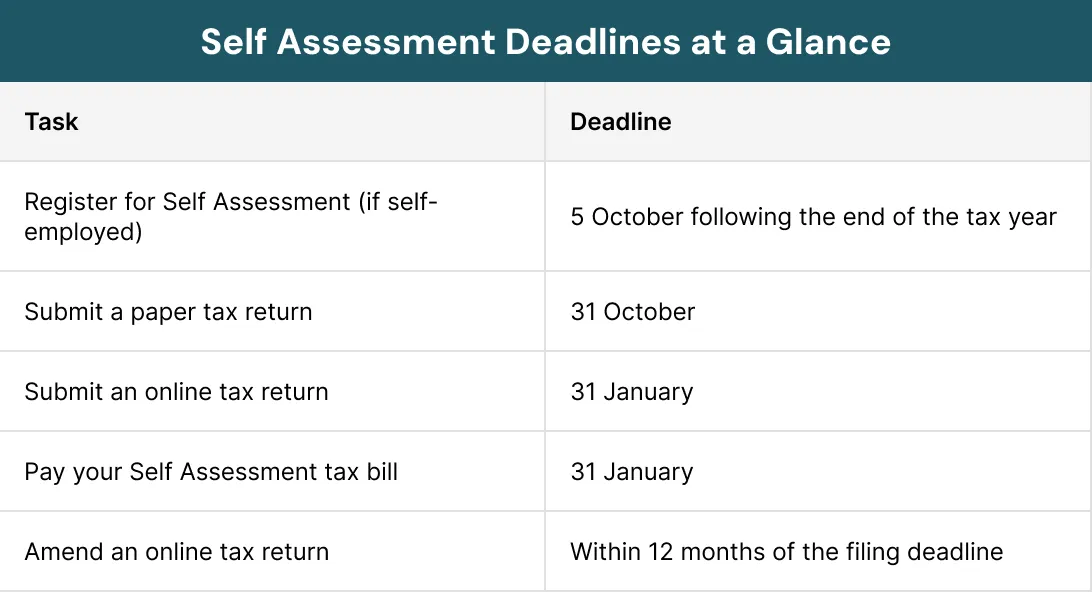
    • Self Assessment: £100 fine after 31 January
    • VAT returns: £200 fixed fine for repeat late filing
    • Corporation Tax: £100 fine after one day late

    How To Avoid It

    • Know your tax dates.
    • Mark them in your diary.
    • Send returns early where you can.
    • Use a tax app or set a clear reminder.

    2. Late Payment Penalties

    HMRC can charge interest and penalties when you pay your taxes late. This can happen even if you filed your tax return on time. HMRC penalties for late payment can also add to the total tax you owe.

    What You Might Be Overlooking

    • Interest can start from the day after the payment due date.
    • Self-assessment may lead to penalties after 30 days, 6 months and 12 months.
    • Corporation Tax interest starts from the payment due date.
    • PAYE and NIC payments must also be made on time.

    How To Avoid It

    • Set a budget for tax payments.
    • Ask your accountant to help plan future tax bills.
    • Set reminders for both filing and payment dates.

    3. Record-Keeping Penalties

    Failure to maintain proper records may result in HMRC penalties for late payment​ if records are incomplete or inaccurate. Lack of receipts, invoices or any other missing accounting records may cause errors in filing tax returns. The HMRC requires that all businesses have proper records maintained at all times.

    What You Might Be Overlooking

    HMRC does not accept rough guesses as proper records. Missing receipts or unclear spreadsheets can make it hard to prove your figures.

    • Poor records can lead to a fine.
    • Missing proof can make your tax figures hard to check.
    • Errors are more likely when records are not kept up to date..

    How To Avoid It

    • Save money for taxes all year.
    • Keep track of your tax bills.
    • Set reminders for each payment date.
    • Ask your accountant to help you plan ahead.

    Small Errors Can Lead to Big Costs
    HMRC penalties are not only linked to late tax payments. Late filing, poor records, VAT errors and missed tax updates can also lead to fines. A small mistake can become costly if it is not fixed in time.

    4. VAT Compliance Penalties

    HMRC penalties for late payment may be imposed on businesses if there are mistakes in VAT returns or VAT payment is made after the due date. Even honest mistakes can be penalised if HMRC thinks they weren’t made with due care and attention. Errors that lead to underpaid VAT can trigger fines up to 30%. Repeated mistakes can lead to increased fines.

    What You Might Be Overlooking

    Missing receipts and poor records can lead to errors in your tax return. You may also face a fine if HMRC finds that your records are not good enough.

    How To Avoid It

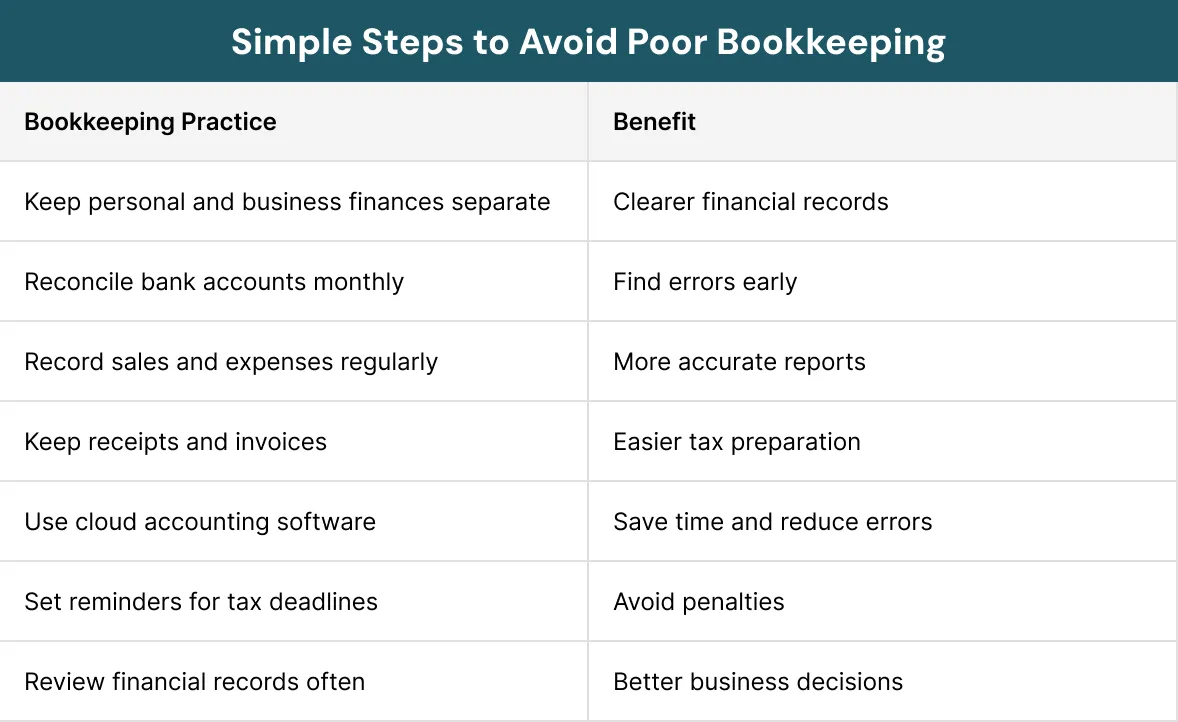
    • Use tools such as Xero or QuickBooks.
    • Keep receipts and bills in a safe place.
    • Save digital copies of key records.
    • Check your accounts on a set date each month.

    5. PAYE and Payroll Penalties

    Any errors in payroll reporting can result in HMRC penalties for late payments. Issues occur if the employee details are wrong and the PAYE liability is not met. The penalties can range from £100 to £400 depending on the number of employees.

    What You Might Be Overlooking

    Small errors in pay or staff details can lead to the wrong tax report. Late PAYE or NIC payments can also lead to fines and interest.

    How To Avoid It

    • Check employee details before each pay run.
    • Check salary, tax and NIC figures.
    • Send payroll reports on time.
    • Keep clear records of pay and employee details.
    • Set reminders for PAYE and NIC payment dates.

    Stay Ahead of HMRC Penalties
    Keep clear records, track key tax dates and check your business details often. Simple checks can help you avoid missed deadlines, late payments and costly HMRC fines.

    6. Corporation Tax Penalties

    Late submissions of the corporation tax return or the taxes owed lead to HMRC penalties for late payment. There are interest charges that may be applied, thus increasing the total amount owed.

    What You Might Be Overlooking

    Many firms only look at their yearly sales. However, VAT registration is based on your rolling 12-month turnover. A late registration may lead to a fine and a backdated VAT bill.

    How To Avoid It

    • Check your turnover each month.
    • Track your sales over a rolling 12-month period.
    • Act fast when you get close to the VAT limit.
    • Tell your accountant about major changes in sales.

    7. Failure to Register or Deregister Correctly

    Businesses must register for VAT when they reach the VAT threshold. Failing to register or deregister on time can lead to HMRC penalties for late payment​. You may also have to pay backdated VAT. So, it is vital that you check your turnover regularly and register as soon as you reach the limit. If your turnover falls below the threshold, deregister if needed.

    What You Might Be Overlooking

    Failing to tell HMRC about a change is more than a small admin task. It can lead to a fine if you do not share key tax details on time.

    How To Avoid It

    • Tell HMRC about key changes as soon as you can.
    • Check your tax records once a year.
    • Keep your firm details up to date.
    • Ask your accountant to help with key updates.
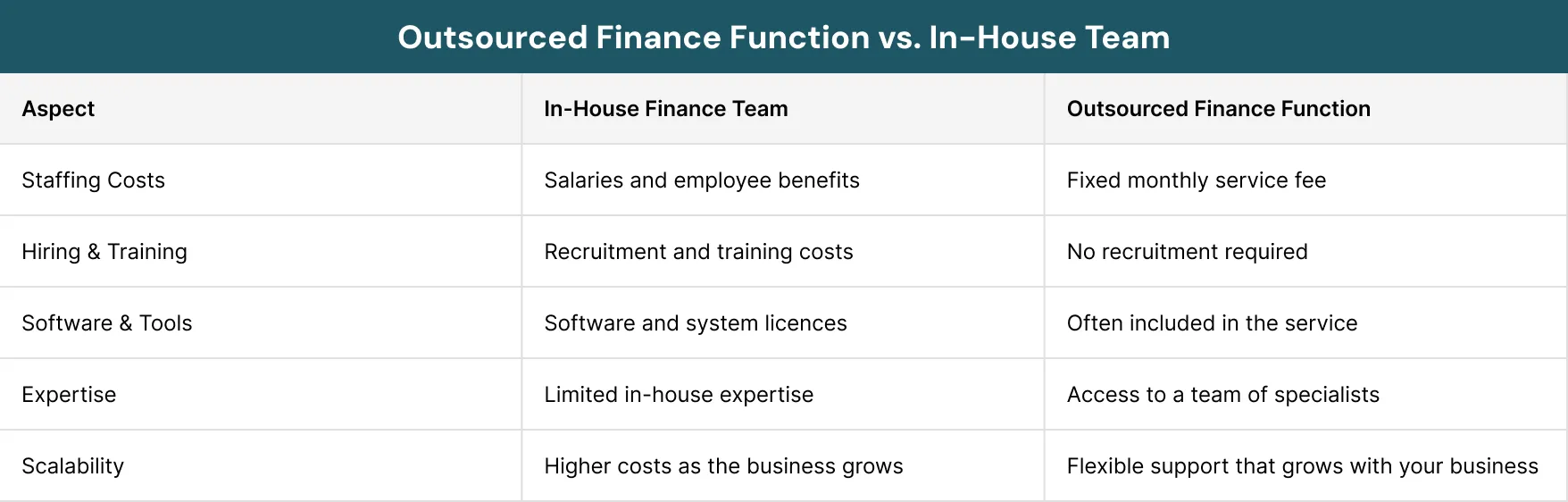
    Outsourced Finance Function vs. In-House Team

    Compounding Penalties: Case Study

    HMRC recently published the names of more than 150 individuals and businesses that deliberately failed to pay the tax they owed. Many of these were small businesses, including builders, takeaways and local shops. This shows that businesses of any size can face action if they fail to meet their tax duties.

    One example was a Liverpool-based company that failed to pay more than £470,000 in tax. The company later received penalties of over £329,000. This made the total amount owed much higher. It shows how HMRC penalties for late payment can quickly grow when tax bills are ignored.

    Late payments do not only lead to penalties. HMRC also charges daily interest on the unpaid amount. This means the longer the payment is delayed, the more the business has to pay. In many cases, HMRC penalties for late payment can put extra pressure on cash flow and make it harder for small businesses to recover.

    The best way to avoid this is to act early. If you think a penalty is wrong, appeal HMRC penalties as soon as possible. Appealing HMRC penalties may be an option if you have a reasonable excuse or believe HMRC made an error. Keep accurate records. File your tax returns on time. Pay your tax before the deadline whenever possible. If you cannot pay in full, contact HMRC straight away. You may be able to arrange a payment plan and reduce the risk of further penalties.

    Conclusion

    An HMRC penalty may soon add up if not addressed properly or understood clearly. These mostly arise due to late payments, missed deadlines or simply errors in paperwork. Keeping your records organised and proactive will help avoid such situations. In case an HMRC penalty is issued, then it should be handled immediately.

    At Sterling Cooper, we help firms in dealing with HMRC penalties for late payment. Our approach to handling such issues is always hassle-free and straightforward. Contact us now if you have any questions regarding HMRC penalties and compliance checks.

    Need help understanding or dealing with HMRC penalties?

    Our team can help you stay compliant, reduce risks and respond to tax issues with confidence. Contact us today for expert guidance tailored to your business.

    FAQs


    What are the most common HMRC penalties for small businesses?

    The most common penalties include late filing penalties, HMRC penalties for late payment, inaccurate tax returns, failure to notify HMRC of a tax liability and poor record-keeping. Many of these issues can be avoided through proper tax planning and compliance.

    HMRC penalties depend on the type of tax and the reason for the penalty. For example, a late Self Assessment tax return can lead to a £100 fine. Late tax payments may also lead to extra charges and interest. The final amount can vary based on how late the payment is and the type of tax involved.

    Yes, you can pay HMRC penalties in monthly instalments if you agree on a payment plan with HMRC. This is not automatic. HMRC will look at your situation before deciding. Contact HMRC as soon as possible if you cannot pay the full penalty at once.

    Yes, HMRC may charge interest if penalties or tax liabilities remain unpaid. Interest can build over time, increasing the total amount you owe.

    If you do not pay HMRC penalties, the amount you owe can increase. HMRC may also charge daily interest on the unpaid balance. If the debt remains unpaid, HMRC can take further action to recover the money. Paying on time or contacting HMRC early can help you avoid extra costs.

    Share This Article!

    Recent Posts

  • Why More SMEs Are Outsourcing Their Finance Function

    Why More SMEs Are Outsourcing Their Finance Function

    outsourced finance function

    Posted by:

    Admin

    Date:

    July 30, 2026

    Category:

    blogs

    Error: Contact form not found.

    Why More SMEs Are Outsourcing Their Finance Function

    Did you know that finance functions account for 31.3% of all outsourcing in the UK? This reflects the growing needs of businesses. As businesses grow, managing finance becomes more demanding.

    Many SMEs in the UK outsource their finance function to save time, reduce costs and access expert support. This helps them focus on growth while avoiding the overhead costs of hiring an in-house finance team. In this guide, you will learn why more SMEs are choosing an outsourced finance function, how finance function outsourcing works and whether it is the right choice for your business.

    If your finance tasks are taking time away from running your business, or your costs are rising as your business grows, it may be the right time to consider an outsourced finance function. Many UK SMEs choose this approach to gain expert financial support without the expense of hiring a full in-house finance team.

    Key Takeaways

    • An outsourced finance function helps SMEs reduce costs without sacrificing financial expertise.
    • Businesses can outsource tasks such as bookkeeping, payroll, VAT, forecasting and CFO support.
    • Finance function outsourcing improves cash flow, accuracy and decision-making.
    • Outsourcing gives SMEs access to experienced finance professionals and modern accounting technology.
    • Choosing the right finance partner is key to gaining long-term value and supporting business growth.

    What Is an Outsourced Finance Function?

    An outsourced finance function means having an external finance team manage part or all of your financial operations. Instead of building an in-house finance team for everything, you pay for exactly the service you need.

    This makes your business cost-effective with expert support. You enjoy the benefits of experienced accountants, finance managers and directors without the hassle of building an in-house team. Many UK SMEs begin by outsourcing daily finance tasks. As their needs change, they pay for the extra service without wasting their time or money.

    Outsourced Finance Function vs. In-House Team

    Why Are More SMEs Outsourcing Their Finance Function?

    More SMEs now opt for an outsourced finance function because it offers them more options. It gives more flexibility, expert support and better financial control. With time-consuming financial tasks outsourced, you can focus on growth, sales and daily operations. 

    Here are common reasons why finance function outsourcing continues to grow across the UK:

    1. Reduce Business Costs

    An in-house finance team can be costly. Apart from salaries, you also have to bear the cost of pensions, recruitment, training, software and office space. An outsourced finance function gives you access to the same experts without the added costs. Your only cost is for the service your business needs. This makes it a cost-effective option for SMEs like you. 

    2. Access Experienced Financial Experts

    Hiring a full-time Finance Director or experienced Accountants can be costly for small businesses. That is why outsourced finance functions are a better option. It gives you access to qualified and experienced professionals who have industry knowledge. They provide expert advice and support without the cost of hiring full-time staff.

    3. Save Time

    Bookkeeping, tax filing or payroll management are time consuming. Some financial tasks can take up your entire day. By outsourcing finance function duties, you get more time for the rest of your business. You can then focus your time and energy on your business growth.

    4. Improve Financial Accuracy

    Incorrect records, tax errors or missed deadlines can lead to grave penalties and losses. The smallest accounting error can have a costly impact on your business. An outsourced finance function gets top professionals to keep the financial records accurate and up to date. 

    This helps reduce the risk of financial errors and keeps your records accurate and up to date. It also gives you greater confidence when making business decisions. 

    5. Better Cash Flow Management

    Late payments or poor forecasting can lead to financial pressures. A healthy cash flow ensures that your business operates smoothly. Financial experts monitor cash flow, prepare forecasts and make informed business plans. This spots problems early to make informed decisions to ensure a healthy cash flow. 

    6. Easier Business Growth

    With the growth of your business, your financial tasks and needs become more complex. Outsourced finance functions can quickly adapt to your growing financial needs. You can easily add new experience and services without recruiting more employees. This gives you a more flexible approach to business growth, while you keep your costs under control. 

    7. Better Technology Without Extra Investment

    Present day finance uses cloud accounting software and real-time reports for better service. However, buying and managing these software and systems can be costly. Most outsourced finance function providers include the latest accounting technology as part of their service. This lets you access modern financial systems and technology without paying large upfront costs.

    Did You Know?
    Cash Flow problems are one the leading reasons why SMEs fail, making effective financial management essential.

    What Does an In-House Team Cost vs Financial Outsourcing With Sterling Cooper?

    Many SMEs choose an outsourced finance function to reduce costs. Building an in-house finance team can cost anywhere from a few thousand pounds to more than £30,000 a month, depending on the size and needs of your business.

    Costs rise further when you hire experienced professionals such as a Finance Director, Financial Controller, Credit Controller or Sales Ledger Clerk. Below is a comparison of the cost of an in-house finance team versus hiring financial experts from Sterling Copper Consultants.

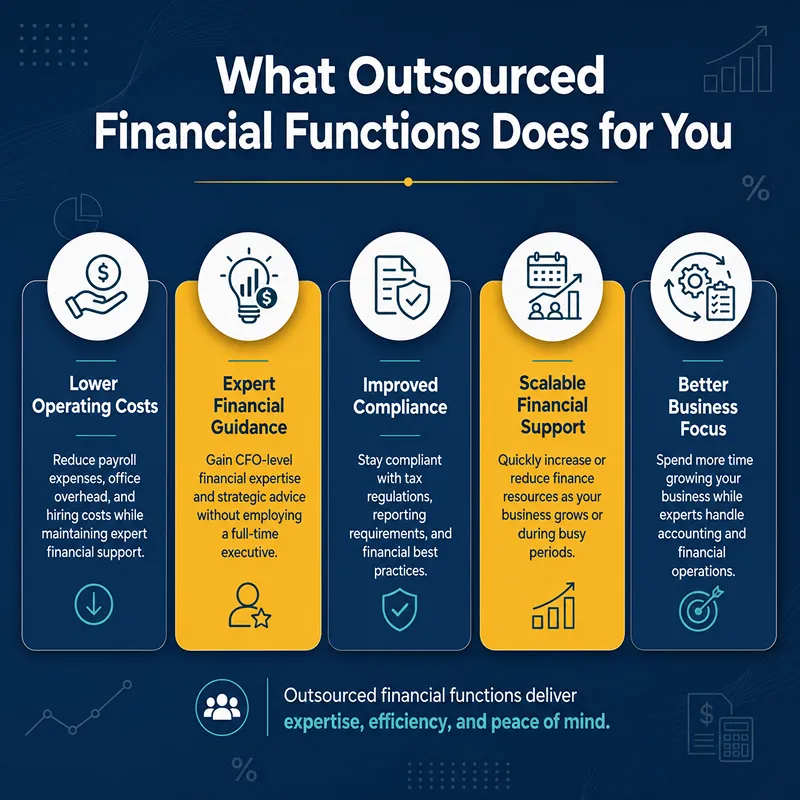
    What Outsourced Financial Functions Does for You

    The Perfect Growth Plan of Mambu: Case Study

    In 2016, Mambu expanded its operations in the UK, but they needed a finance function to support their rapid growth. However, they didn’t want to build an in-house team from scratch. So, Mambu partnered with an outsourced finance provider to manage their key financial activities.

    While Mambu established its operation in the UK, the outsourced finance functions managed their key financial tasks. It managed HMRC registrations, managed payroll, VAT compliance, supplier payments and monthly financial reports. This allowed Mambu’s leadership to focus on expanding the business instead of building an in-house finance department. As a result, Mambu streamlined its UK financial operations while supporting its continued growth and expansion. 

    Conclusion

    An outsourced finance function gives you access to expert financial services without the overhead cost. It helps reduce costs, improve accuracy, strengthen cash flow and gives you more time to focus on growing your business. Sterling Cooper understands your financial needs and provides tailored support to help you achieve your goals.

    As your business grows, your financial needs become more complex. Finance function outsourcing provides flexible support that adapts to your changing requirements while keeping your finances organised and compliant. Whether you need bookkeeping, payroll, forecasting or strategic financial advice, outsourcing gives you the expertise and insight to make informed business decisions.

    With the right partner, you gain more than just financial support. You gain a trusted adviser who helps your business grow. To make things even easier, Sterling Cooper offers a range of financial accounting services tailored to your business needs.

    Do you struggle with costs of financial functions?

    Outsourcing financial functions can help your business grow, only when you find the right partner. Our financial solutions are tailored to your business, so you don’t have to worry about anything else. Just click and reach the Financial Experts.
    +443300102526
    Book an Appointment

    FAQs


    What is an outsourced finance function?


    An outsourced finance function is when a business hires an external provider to manage some or all of its financial operations. This may include bookkeeping, payroll, VAT, financial reporting, forecasting and strategic financial advice.


    Many SMEs outsource finance function services to reduce costs, improve financial accuracy, save time and access experienced finance professionals without hiring a full in-house team.


    Businesses can outsource a wide range of finance tasks, including bookkeeping, payroll, VAT and tax compliance, management accounts, cash flow forecasting, budgeting, financial reporting and Virtual Finance Director (FD) or CFO services.


    In many cases, yes. Finance function outsourcing removes costs such as recruitment, salaries, pensions, staff training and accounting software. Businesses only pay for the services they need, making it a cost-effective option for many SMEs.

    Yes. Dormant and non-trading companies must still submit a confirmation statement each year, even if no company information has changed.


    Yes. Finance function outsourcing UK services are designed for businesses of all sizes. Small businesses and startups often benefit the most because they gain expert financial support without the cost of employing a full finance department.


    Choose a provider with relevant industry experience, transparent pricing, secure cloud accounting systems, clear reporting processes and scalable services. The right partner should understand your business goals and provide support that grows with your business.

    Share This Article!

    Recent Posts

  • What Happens If You Miss a Confirmation Statement Deadline?

    What Happens If You Miss a Confirmation Statement Deadline?

    confirmation statement deadline

    Posted by:

    Admin

    Date:

    July 29, 2026

    Category:

    blogs

    Error: Contact form not found.

    What Happens If You Miss a Confirmation Statement Deadline?

    Did you know Companies House removed over 16,000 companies from the register between 2023 and 2024 as part of efforts to tackle non-compliance activity?

    If you own a company in the UK, then there are some key legal tasks that you must take care of.

    One of the key tasks is meeting your confirmation statement deadline each year. Many people focus on tax returns and accounts, but they forget this filing.

    Missing a confirmation statement deadline may seem like a small issue at first. However, it can lead you to warnings from Companies House, public compliance issues and even company strike-off.

    “Keeping company records accurate is a key responsibility of every director.”

    – Companies House Guidance

    Key Takeaways

    • A confirmation statement deadline is a legal filing requirement that every UK limited company and LLP must meet each year.
    • A confirmation statement (CS01) confirms that your company information held by Companies House is accurate and up to date.
    • All companies must file a confirmation statement, including dormant and non-trading businesses.
    • The filing deadline is 14 days after the end of the 12-month review period.
    • Missing a confirmation statement deadline will cause your company record to show as overdue on the public register.
    • There are no automatic late filing penalties for a late confirmation statement, but Companies House can still take enforcement action.
    • If you miss the deadline, file the confirmation statement as soon as possible and correct any inaccurate information before submission.
    • Common reasons for missing a filing include forgetting the date, authentication code problems, poor record-keeping, and confusion with annual accounts.
    • Setting reminders, maintaining accurate records, and seeking professional support can help you avoid a late confirmation statement in the future.
    • Staying compliant with Companies House requirements protects your business, supports credibility, and helps prevent unnecessary legal and financial risks.

    What Is a Confirmation Statement (CS01)?

    A confirmation statement is also known as CS01. It is an annual filing that must be submitted to Companies House. It confirms that your company’s details on the public register are correct and up to date.

    This includes details such as directors, shareholders, registered office details and people with significant control (PSC). If details have changed, they should be updated before you file.

    Why Does Every UK Company File It?

    Limited companies and LLPs of the UK have a legal duty to file it. This applies whether your business is active, dormant or not trading.

    The purpose is to ensure that Companies House holds the correct and current details. Right records help customers, banks, investors and suppliers to trust your business.

    Missing a confirmation statement deadline can make your company appear non-compliant. This may create issues for you when you are dealing with lenders.

    Who Needs to File a Confirmation Statement?

    Many people think that only active businesses need to file it. But in reality, almost every registered company has this obligation.

    The filing requirement applies on the size of the company, income or trading status. Understanding who needs to file a CS01 helps you to prevent a late confirmation statement.

    1. Limited Companies

    Every private and public limited company that registered in the UK must submit a CS01 each year.

    Even if nothing has changed within the business, directors still need to confirm that all info remains accurate.

    If you fail to meet the confirmation statement deadline, then it can lead to compliance concerns and Companies House action.

    2. Limited Liability Partnerships (LLPs)

    LLPs are also required to file the CS01. The process is very similar to that used by limited companies.

    The filing helps Companies House to maintain accurate info about members and registered offices.

    An LLP that misses its confirmation statement deadline may face the same enforcement action as a limited company.

    3. Dormant and Non-Trading Companies

    Many people believe that dormant companies do not need to file. This is incorrect.

    Even if a company has not traded during the year, it must still submit a CS01 and annual accounts where required.

    If filing obligations are ignored, a dormant company can still receive the warnings for a late confirmation statement.

    Did You Know?
    Thousands of dormant companies are struck off each year because directors fail to meet basic filing duties.

    What Expenses Can a Limited Company Claim?

    The range of expenses to claim for limited company tax purposes is wider than many directors think. Here are some expenses that you can claim for a limited company:

    1. Office Rent and Workspace Costs

    Office rent is one of the most common business expenses. If your company rents premises to operate from, the rent paid is usually a tax deductible.
    The cost of leasing offices, co-working spaces and meeting rooms can often be claimed. These costs are directly linked to the business activities.

    1.1 Utility Bills and Running Costs

    You need electricity, water and internet access to run a business. These costs are usually allowable when they are related to the business concern.
    Claiming these costs helps you to ensure that profits are not overstated.

    1.2 Office Supplies and Stationery

    Every business needs the basic supplies. Pens, paper, folders and printers are all examples of the expenses.
    These purchases may seem small, but they can add up over a year.
    Office supplies are among the simplest expenses to claim for limited company tax purposes. Because they are clearly linked to day-to-day operations.

    1.3 Printing and Courier Cost

    Courier services used to ship goods. These costs can also be claimed. Printing costs for brochures, forms and documents for a business usually qualify as well.
    Companies should retain receipts and invoices to support these expenses to claim for limited company.
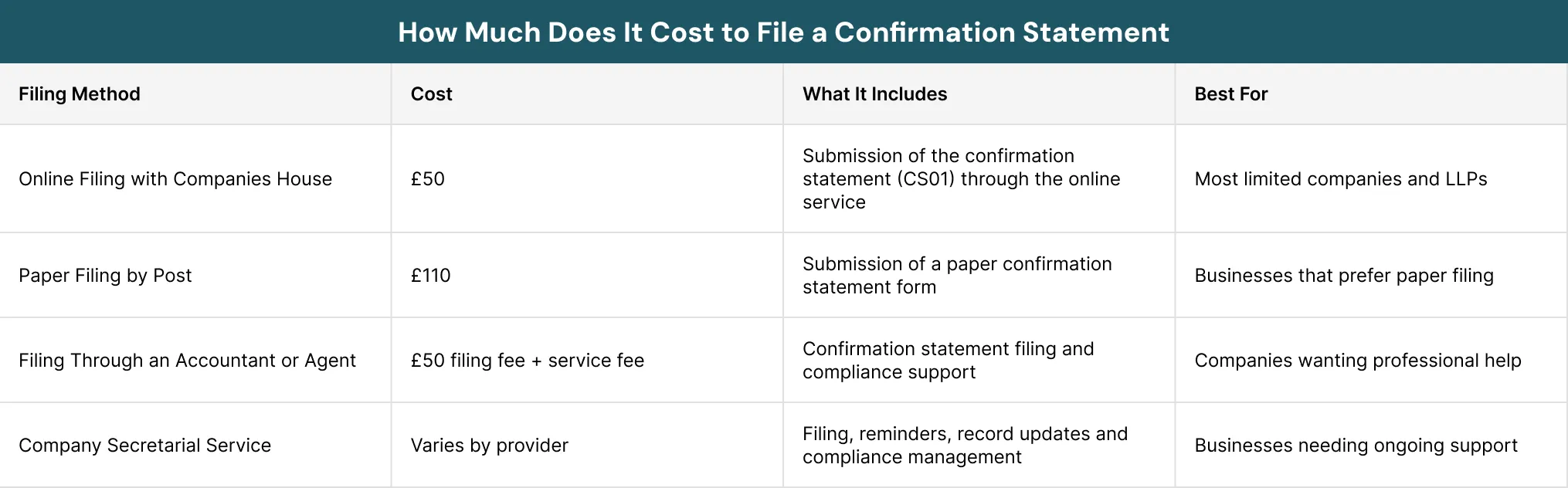
    How Much Does It Cost to File a Confirmation Statement

    Pro Tip:
    Filing online is usually the quickest and most cost-effective option. It also reduces the risk of missing your confirmation statement deadline because you receive instant submission confirmation.

    Confirmation Statement Deadline Explained

    Every company has a filing due date. Knowing where to find it is essential for you to stay compliant.

    A missed confirmation statement deadline often happens because directors simply lose track of the date.

    How to Check Your Due Date?

    The easiest way to check your due date is through your Companies House account.

    You can also search your company on the Companies House register and review the previous filing records.

    Checking your due date regularly helps you to avoid a late confirmation statement.

    Example of a Confirmation Statement Deadline

    Imagine your company was formed on 10 June 2025.

    Your review period would normally end on 9 June 2026. You would then have until 23 June 2026 (14 day rule) to file the confirmation statement.

    What Happens If You Miss a Confirmation Statement Deadline?

    Missing a CS01 deadline does not usually result in an instant fine. However, it can create serious issues related to compliance.

    If delays continue then there is a greater risk of an enforcement action.

    1. Your Company Will Be Marked as Overdue

    When you miss the filing, The records of Companies House will show that your confirmation statement is overdue.

    This information is publicly visible and can be seen by customers, lenders, suppliers and also investors.

    An overdue filing may raise concerns about how the company is being managed.

    2. Public Visibility of Non-Compliance

    Companies House records are available to the public. Anyone searching for your company can see whether your filings are up to date or not. A late confirmation statement may create doubts about your business.

    This can be especially damaging when you are seeking finance or new contracts.

    3. Impact on Company Reputation

    Public records of the company helps to build trust among the investors. When you miss the filings then banks, investors or suppliers may question the reliability of your business.

    Filings on time helps to protect your reputation and also support the future growth of your business.

    Pro Tip:
    If you miss a confirmation statement deadline, file as soon as possible rather than waiting for a reminder.

    Common Mistakes That Cause Missed Deadlines

    Many companies miss the filing dates due to simple errors.

    Common mistakes include:

    • Forgetting the deadline
    • Losing the authentication code
    • Assuming accounts and confirmation statements are the same
    • Poor company record keeping

    Small mistakes can quickly lead to a late confirmation statement.

    Did You Know?
    A confirmation statement and annual accounts are two completely different legal filings.

    What to do if you miss your confirmation statement deadline?

    Missing your CS01 deadline is stressful, but it is not the end of the road. The most important thing is to act quickly and not ignore the issue.

    Companies House does not usually charge an automatic fine for a missed confirmation statement deadline, but delays can still lead to warnings, strike-off risk and also damage the record of your company. The faster you act, the lower the risk of further action.

    1. File your confirmation statement immediately

    The first step is to submit your CS01 as soon as you realise it is overdue.

    Even if you have missed the confirmation statement deadline, filing now shows the compliance and reduces risk.

    Do not wait for reminders from Companies House. A late confirmation statement should always be treated as urgent. Delays can make your company appear inactive or poorly managed.

    Pro Tip:
    If you are unsure about details, still file first and correct errors later. This is better than waiting and missing your confirmation statement deadline further.

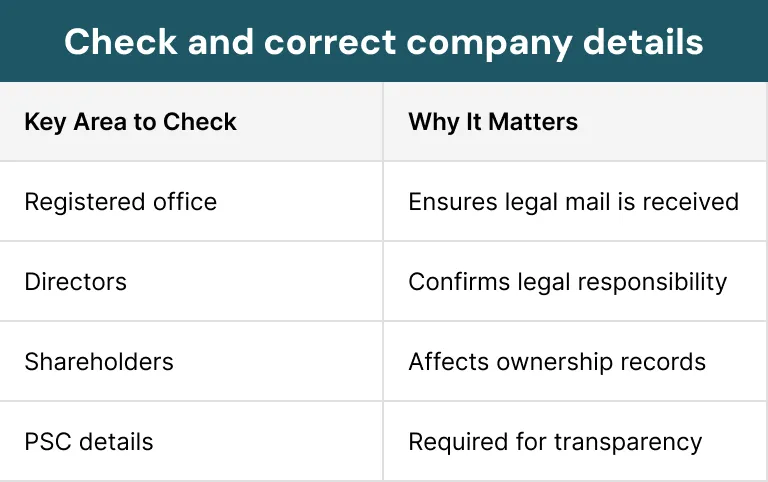
    2. Check and correct company details

    Before submitting your overdue filing, you have to review all the company info carefully. This includes directors, shareholders, PSC details, office address and share capital.

    A late confirmation statement is often caused by outdated records, so fixing errors at this stage is very important. Incorrect data can create compliance problems in future.

    Check and correct company details

    How the Confirmation Statement Review Period Works?

    The review period is the time frame that is used to find when your next filing is due. Understanding how it works can help you to avoid missing a confirmation statement deadline.

    Many directors assume that the filing date stays the same every year. However, the review period can change if you file early.

    12-Month Review Period

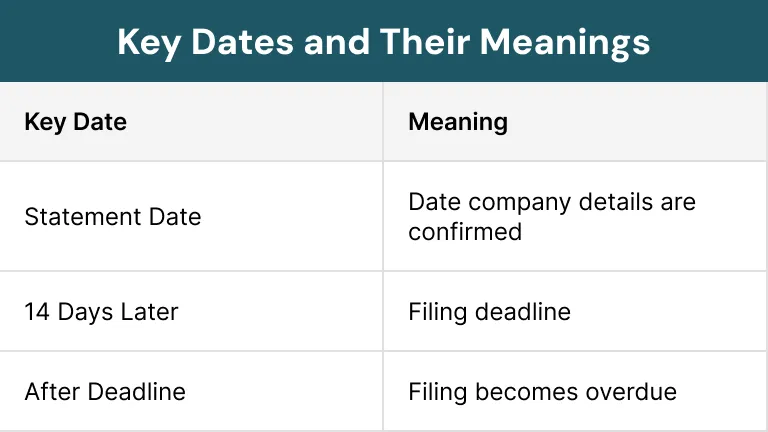
    Every company has a review period that usually lasts 12 months. It begins either on the incorporation date or the statement date of the last confirmation statement.

    During this period, Companies House expects that records of the company remain accurate and up to date. If you make any major changes in a business then you have to report it when it happens.

    Knowing your review period is one of the easiest ways to avoid a late confirmation statement.

    How is the Statement Date Calculated?

    The statement date is the date on which you confirm that the info of your company is correct and up to date.

    All details included in the filing should reflect the position of the company on that specific date. This ensures the public register remains accurate.

    The statement date is important because it determines your next confirmation statement deadline.

    Filing Deadline: The 14-Day Rule

    After the statement date, companies have 14 days to submit their confirmation statement.

    If the filing is not delivered within this period, it becomes overdue. Companies House may then begin sending reminders or warnings to you.

    Many directors think that they have a full month to file, but the 14-day rule is strict.

    Key Dates and Their Meanings

    Case Study: Missing a Confirmation Statement Deadline

    James who runs a small marketing agency in Manchester. The business had been trading successfully for several years. But he became busy managing client projects and overlooked his annual CS01 deadline.

    Because the filing only happens once a year, James assumed he still had plenty of time. A few weeks later, he noticed that Companies House had marked his company record as overdue.

    The Problem

    Shortly after missing the CS01 deadline, James applied for a business loan to support growth of his company. During the lender’s review, the overdue filing appeared on the Companies House register.

    The Solution and Outcome

    As soon as James realised the issue, he submitted the late CS01 online and also he checked all details of the company for accuracy.

    The filing was accepted by the Companies House, and the overdue status was eventually updated.

    This simple change has helped him to avoid future issues and maintain a strong business reputation.

    Key Lesson:
    Even a small filing like a confirmation statement can affect funding applications, business credibility and compliance status if it is overlooked.

    Conclusion

    Meeting your CS01 deadline is one of the key legal duties for a UK company. The filing confirms that Companies House holds accurate info about your business and helps to gain trust of banks, investors, suppliers and customers.

    A late confirmation statement does not normally result in an immediate penalty. But ignoring the issue can lead to warnings, legal action and even company strike-off. These risks can affect the reputation of your company.

    The best approach is to keep your company records accurate, monitor filing dates and submit your CS01 on time every year.

    By planning ahead, you should use reminders and seek help from experts where needed.

    At Sterling Cooper, we help you to stay compliant with Companies House requirements, so you never have to worry about missing a CS01 deadline.

    Worried about missing your next confirmation statement deadline?

    Feel free to contact us today. We handle your filings and compliance tasks, so you can focus on running your business with confidence.

    FAQs


    Can I file a confirmation statement after the deadline?


    Yes. If you miss the filing date, you can still submit the statement. It is best to file as soon as possible to reduce the risk of further action from Companies House.


    There are no automatic financial penalties for a late confirmation statement. However, continued failure to file can result in enforcement action, prosecution, or strike-off procedures.


    If you miss the deadline, Companies House issues an automatic warning (not a fine) and continued failure to file can lead to prosecution of directors and the company being struck off the register.


    You can check your filing date by logging into your Companies House account or searching for your company on the Companies House register.


    Yes. Dormant and non-trading companies must still submit a confirmation statement each year, even if no company information has changed.

    Share This Article!

    Recent Posts

  • What Expenses Can be Claimed for a Limited Company?

    What Expenses Can be Claimed for a Limited Company?

    expenses to claim for limited company

    Posted by:

    Admin

    Date:

    July 28, 2026
    Category:

    blogs

    Error: Contact form not found.

    What Expenses Can be Claimed for a Limited Company?

    Running a limited company comes with many costs. Some of these costs are necessary to keep the business operating every day.

    The good news is that many of these costs can be deducted from your profits before tax is calculated.

    Understanding expenses to claim for limited company purposes is important for every director and business owner.

    A business expense is usually a cost that is incurred wholly and exclusively for business purposes. This means the expense must be directly related to running the company and not for personal use.

    Research shows that more than 500 UK business owners found that only 26% of small business owners believe they claim every business expense. While 21% admit they claim half of their expenses or less.

    Key Takeaways

    • A limited company can reduce its Corporation Tax by claiming allowable business expenses that are incurred wholly and exclusively for business use.
    • Understanding expenses to claim for limited companies helps directors avoid overpaying tax and improves overall business profitability.
    • Common claimable costs include office rent, utilities, stationery, software, marketing, professional fees, and business travel.
    • Employee-related costs such as salaries, pensions, bonuses, and employer National Insurance are usually deductible business expenses.
    • Home office, internet, mobile phone, and technology costs can often be claimed if they are used for genuine business activity.
    • Travel expenses such as mileage, hotels, transport, and subsistence are allowable when directly linked to business purposes.
    • Some costs, like client entertainment, personal spending, and commuting, are generally not allowed for tax relief.
    • Accurate record keeping is essential when claiming expenses limited company deductions to avoid HMRC issues and missed claims.
    • Capital expenses like equipment and machinery may not be fully deductible immediately but can qualify through capital allowances.
    • Many small businesses fail to claim all eligible expenses, which means they often pay more tax than necessary.
    • Using accounting software or a qualified accountant can help ensure all expenses to claim for limited companies are correctly identified and recorded.
    • Proper expense management not only ensures compliance but also improves cash flow and financial planning for long-term business success.

    Why Claiming Business Expenses Matters?

    Every pound spent on legitimate business costs can help you to reduce the taxable profits.

    Many small businesses focus heavily on sales. While income is important, controlling expenses is equally valuable for a business. A company that tracks its costs properly often improves its profit.

    When claiming expenses limited company owners should ensure that every cost is supported by the proper records. Missing receipts can lead to missed tax savings.

    This is why claiming expenses in a limited company can help businesses to reduce tax.

    Accurate expense claims also help you to improve the financial reporting. You gain a clearer picture of where money is being spent and where savings can be made.

    HMRC Rules on Allowable Expenses

    HMRC expects companies to claim only those expenses that are related to the activities of the business. Personal expenses should never be included in a company expense claim.

    For example, if you buy software and use it for business needs, that cost is allowable for a claim. But, if the software is mainly for personal use, the expense may not qualify for the claim.

    When reviewing the expenses to claim for limited company tax relief, HMRC is mainly concerned about: “Was this cost necessary for the business?”

    Pro Tip:
    Keep digital copies of receipts and invoices. Cloud accounting software makes this process much easier and helps during HMRC reviews.

    What Expenses Can a Limited Company Claim?

    The range of expenses to claim for limited company tax purposes is wider than many directors think. Here are some expenses that you can claim for a limited company:

    1. Office Rent and Workspace Costs

    Office rent is one of the most common business expenses. If your company rents premises to operate from, the rent paid is usually a tax deductible.

    The cost of leasing offices, co-working spaces and meeting rooms can often be claimed. These costs are directly linked to the business activities.

    1.1 Utility Bills and Running Costs

    You need electricity, water and internet access to run a business. These costs are usually allowable when they are related to the business concern.

    Claiming these costs helps you to ensure that profits are not overstated.

    1.2 Office Supplies and Stationery

    Every business needs the basic supplies. Pens, paper, folders and printers are all examples of the expenses.

    These purchases may seem small, but they can add up over a year. 

    Office supplies are among the simplest expenses to claim for limited company tax purposes. Because they are clearly linked to day-to-day operations.

    1.3 Printing and Courier Cost

    Courier services used to ship goods. These costs can also be claimed. Printing costs for brochures, forms and documents for a business usually qualify as well.

    Companies should retain receipts and invoices to support these expenses to claim for limited company.

    Did You Know?
    Many businesses lose tax savings simply because they forget to record small purchases such as postage, courier and printing costs.

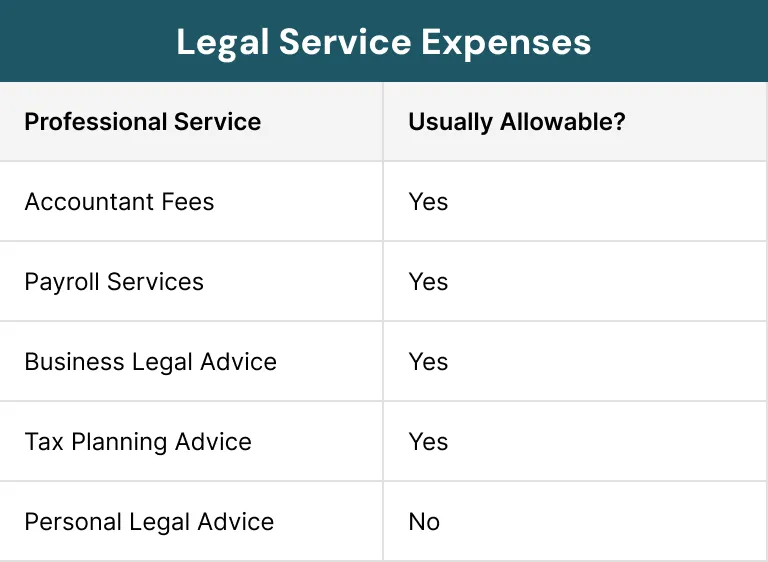
    2. Legal Service Expenses

    Expert advice helps you to remain compliant and financially strong. HMRC allows these costs when they relate to the operations of the business.

    2.1 Accountant Fees

    Accountants help you to prepare the annual accounts, tax returns and financial reports of your business. Their fees are usually included in the expenses of a business.

    2.2 Legal Fees

    Solicitors provide you key support on contracts and business disputes. Many legal costs are claimed as the expenses of a business.

    Legal Service Expenses

    3. Marketing Expenses

    Marketing helps you to attract the customers and grow revenue. Investing in ads helps you to generate good sales. While it also provides tax relief through the allowable expense claims.

    3.1 Paid Ads

    Businesses now advertise their goods or services through search engines and social media.

    Ad costs that promote the products or services are allowable for claim. This forms a valuable category of expenses to claim for limited company tax relief.

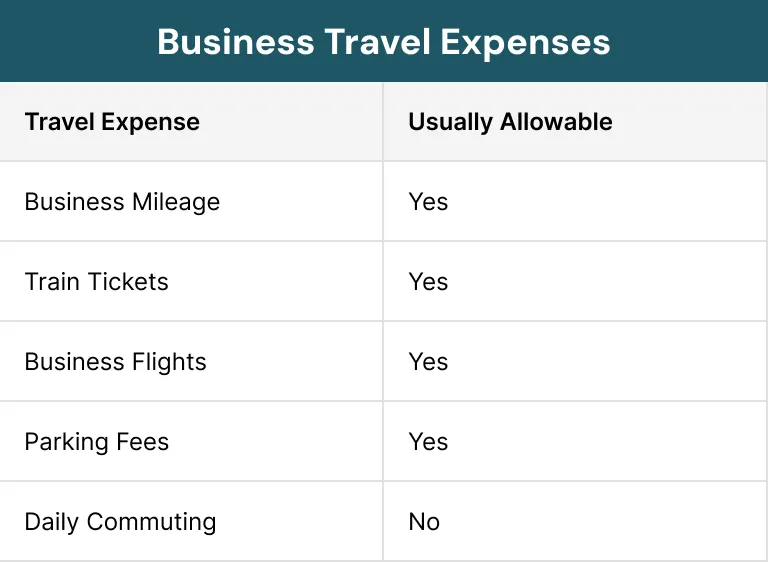
    4. Business Travel Expenses

    Business travel is a common cost for many companies. HMRC allows claims when travel is necessary for the needs of business.

    These expenses can quickly add up throughout the year. Proper tracking helps to ensure that businesses receive all available tax relief.

    4.1 Public Transport Costs

    Train tickets, bus fares and air travel costs can be claimed when the journey is necessary for the business.

    Public transport is often used for meetings and client visits. These expenses should be supported by the receipts.

    Many companies include the transport costs among their regular expenses to claim for limited company.

    4.2 Parking Charges and Toll Fees

    Parking fees that are incurred during business travel are allowable expenses for claim. Toll charges may also qualify for the claim.

    These costs are often ignored because they are small. However, over a year they can become significant.

    You should include these charges when reviewing expenses to claim for limited company tax deductions.

    Business Travel Expenses

    5. Using Your Home as an Office

    Many directors now work from home for part or all of the week. HMRC allows certain household costs to be claimed where appropriate.

    If any part of your home is used for business activities, some related costs may be claimable. This could include a spare room, dedicated office space or garden office used primarily for work.

    Home working creates the valuable expenses to claim for limited company tax relief opportunities for many directors.

    Home office claims should be reasonable and based on genuine business use of the property.

    5.1 Calculating Household Cost

    A common method involves working out how much of the home is used for business. The percentage of the business is then applied to household expenses.

    For example, if one room out of five is used as an office, part of the household costs may qualify for claim.

    When claiming expenses limited company tax relief, calculations should be supported by records.

    Did You Know?
    Home office claims can cover more than electricity. Broadband and heating costs may also qualify in certain circumstances.

    6. Internet and Mobile Expenses

    The internet and phone are often essential for daily business operations. These costs are allowable for a claim when used for business purposes.

    6.1 Business Mobile Phone Contracts

    A mobile phone contract that is held in the company name can usually be claimed as a business expense.

    The phone should support the business activities, such as calls and emails.

    Mobile contracts are common expenses to claim for limited company tax deductions for directors and employees.

    6.2 Internet Costs

    The internet plays a major role in business. Internet costs are often claimed where they support the operations of the company.

    Internet costs often form the part of ongoing expenses to claim for limited company tax relief.

    7. Software Expenses

    Software helps businesses to improve their efficiency and security. Most software that is used for business is allowable for claim.

    Pro Tip:
    Review software subscriptions every six months. Many businesses pay for tools they no longer use.

    8. Equipment and Office Furniture Expenses

    There are some equipment and office furniture that qualify for allowable expenses or capital allowance

    Businesses need them to do work in a more effective way. Keeping records of purchases and usage is important for tax compliance.

    8.1 Computers and Laptops

    PCs are essential for businesses. Those PCs that are used for business purposes may qualify for tax relief.

    Many directors invest in laptops to support remote working. PCs remain one of the most valuable expenses to claim for limited company tax deductions.

    8.2 Desks and Chairs

    Office furniture helps to support the productivity of the employee and workplace comfort.

    Desks, chairs, filing cabinets and storage units that are used for business purposes may qualify for tax relief.

    When claiming expenses limited company tax deductions, businesses should keep their purchase invoices and proof of business use.

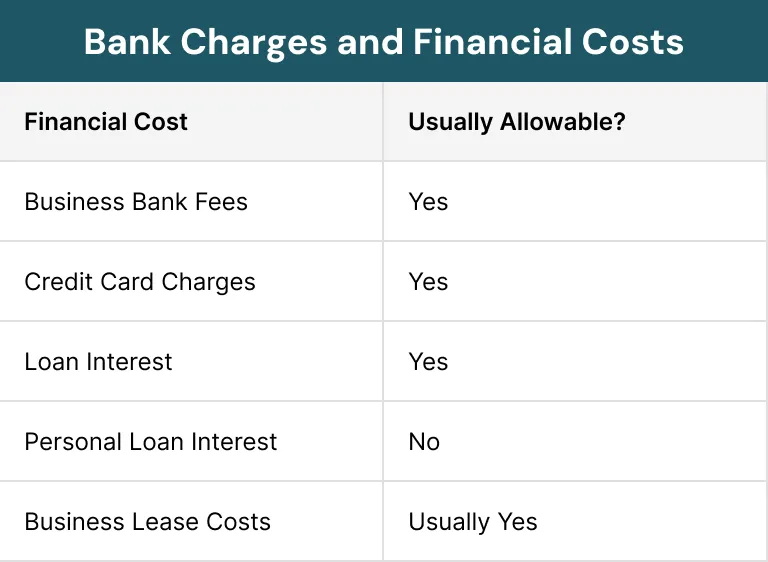
    9. Bank Charges and Financial Costs

    Most limited companies use banks and credit cards as a part of their daily operations. The costs linked to these services are claimed as business expenses.

    Many directors overlook the small financial charges throughout the year. However, these costs can add up and become valuable expenses to claim for limited company tax relief.

    9.1 Business Bank Account Fees

    Bank accounts of the business often come with monthly charges. These fees are allowable when the account is used only for the activities of the company.

    Charges for transactions and international payments may also qualify. These costs are directly linked to running the business.

    9.2 Credit Card Charges

    Many companies use business credit cards to manage their purchases and cash flow. Annual fees are allowable expenses.

    The key rule is that the card must be used for business spending. Personal uses should never be included in the company claims.

    When reviewing expenses to claim for limited company, directors should check all the credit card statements carefully.

    Bank Charges and Financial Costs

    10. Annual Events and Staff Functions

    Company events reward their employees and strengthen the workplace. Certain staff functions may qualify for tax relief when HMRC conditions are met.

    10.1 Company Events

    Many businesses organise their training days and meetings. Costs that are related to these events can often be claimed.

    Venue hire and event materials are also included within allowable costs.

    Such events may create useful expenses to claim for limited company tax deductions while supporting business growth.

    10.2 Employee Engagement Activities

    It helps to build teamwork and to improve the culture of the workplace. These activities may include staff celebrations and team-building events

    Where the conditions of HMRC are met, some costs may qualify.

    “Staff events are not only good for morale. They can also be a tax-efficient way to reward employees.” 

    —Business Adviser 

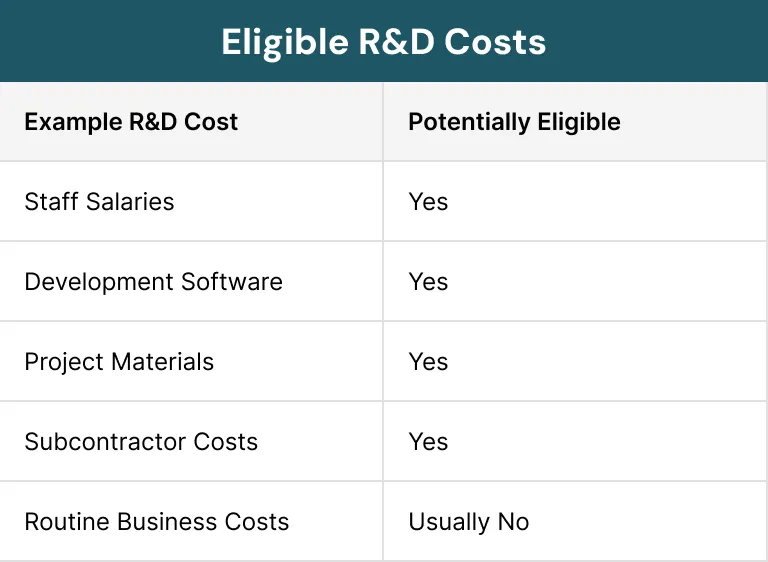
    11. Research and Development (R&D) Tax Relief

    Innovation can be expensive. To encourage the investment, the UK offers tax relief for R&D activities.

    Companies that make new products, improve processes or solve any technical problem may qualify.

    What Qualifies as R&D?

    R&D involves seeking an advance in science or technology. The work must attempt to overcome the issues that are not easily solved.

    Projects that are qualifying may include software development, improvement of engineering or new innovations.

    Businesses that are involved in these steps should review potential expenses to claim for limited company tax relief.

    Eligible R&D Costs

    12. Startup Costs

    Starting a business often requires investment before profit begins. Some pre-trading costs may still qualify for the tax relief.

    Startup costs may include website, software, legal advice and accounting support.

    How to Claim Expenses as a Limited Company?

    To claim the business expenses, you must first make sure the cost is related to your company. The expense should be used for business purposes. Personal costs cannot be included in your claim.

    Keep records of every business expense throughout the year. Save receipts, invoices, bank statements and mileage logs as a proof. If HMRC asks for evidence, good record keeping makes it easier to support your claims.

    When preparing your company accounts and Corporation Tax Return, include all allowable expenses.

    Many companies use accounting software or an accountant to make sure expenses are recorded correctly and no valid claims are missed. 

    Case Study

    Sarah runs a small marketing company in the UK. At first, she did not keep all her receipts and missed many business costs. This meant she paid more tax than she needed to.

    After speaking with her accountant, Sarah started claiming expenses for limited company under the rules of HMRC.

    She claimed office rent, internet bills, business travel, accounting fees and software that she used for work. She also kept digital copies of every receipt.

    At the end of the tax year, claiming expenses of limited company costs helped her to reduce taxable profit.

    Sarah now checks her expenses every month and keeps clear records. By claiming expenses limited company costs the right way, she stays compliant with HMRC.

    Conclusion

    Understanding expenses to claim for limited company tax relief can make a significant difference to the finances of your company.

    Every expense reduces the taxable profits and helps to improve the cash flow.

    From office costs to software and travel costs, there are many opportunities to claim the allowable deductions.

    Businesses that maintain their records are better placed to support their claims and remain compliant with HMRC requirements. Good record keeping also makes tax returns easier to prepare.

    Understanding what expenses can a limited company claim helps you to keep your records accurate and up-to-date throughout the year.

    If you are unsure about any claim, we at Sterling Cooper help you to get expert advice for a sensible step.

    Have questions about claiming expenses for your limited company?

    Contact us today. Our team is ready to give you expert, tailored advice.
    +443300102526
    Book an Appointment

    FAQs


    Can a limited company claim home office expenses?


    Yes. If part of your home is used for business activities, certain household costs may be claimable, provided reasonable calculations are used.


    Yes. Directors can usually claim business mileage when using their personal vehicle for qualifying business journeys.


    A limited company can claim any cost that’s incurred wholly and exclusively for business purposes, such as office rent, utilities, travel, software, equipment, and professional fees.


    Yes. Software and online subscriptions used solely for business activities are generally allowable expenses.


    Accurate records support your claims, help with HMRC compliance and reduce the risk of errors during tax reporting.

    Share This Article!

    Recent Posts

  • Management Reporting Mistakes That Hurt Business Growth

    Management Reporting Mistakes That Hurt Business Growth

    management reporting

    Posted by:

    Admin

    Date:

    July 27, 2026
    Category:

    blogs

    Error: Contact form not found.

    Management Reporting Mistakes That Hurt Business Growth

    Running a business means making decisions every day. Some decisions help your business grow, while others can slow it down. Good decisions depend on good information.

    That is where management reporting becomes important.

    Research involving more than 600 senior finance professionals found that 73% believe management reports lead to more insightful discussions during leadership meetings.

    Many business owners look only at sales or bank balances. These numbers are useful, but they do not tell you the full story. Without clear management reports, it becomes harder to spot issues before they become serious.

    In this guide, you will learn the most common management reporting mistakes that hurt your business growth. You will also discover simple ways to avoid them and make better decisions for business growth.

    Key Takeaways

    • Management reporting supports better business decisions. It gives managers clear and accurate information to track performance, monitor cash flow and measure progress towards business goals.
    • Avoid common reporting mistakes. Overloading reports with data, focusing only on past results, delaying reports and using inaccurate data can slow business growth and lead to poor decisions.
    • Track the right KPIs and review reports regularly. Choose KPIs that match your business goals and update your reports on time to keep them relevant and useful.
    • Turn data into action. Reports should explain trends, highlight risks and recommend practical next steps instead of only presenting numbers.
    • Keep reports simple, accurate and tailored to the audience. Clear, focused reports help managers understand key information quickly and make informed decisions.

    What Is Management Reporting?

    Management reporting is the process of collecting, organising and presenting the business details that help managers to make better decisions.

    It turns numbers into useful information that shows how your business is performing.

    These reports can include sales, expenses, profits, cash flow and key performance indicators (KPIs).

    “Without data, you’re just another person with an opinion.”

    — W. Edwards Deming

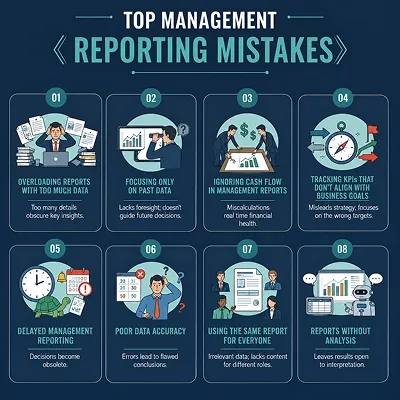
    Top Management Reporting Mistakes

    Here are some management reporting mistakes that hurt your business growth:

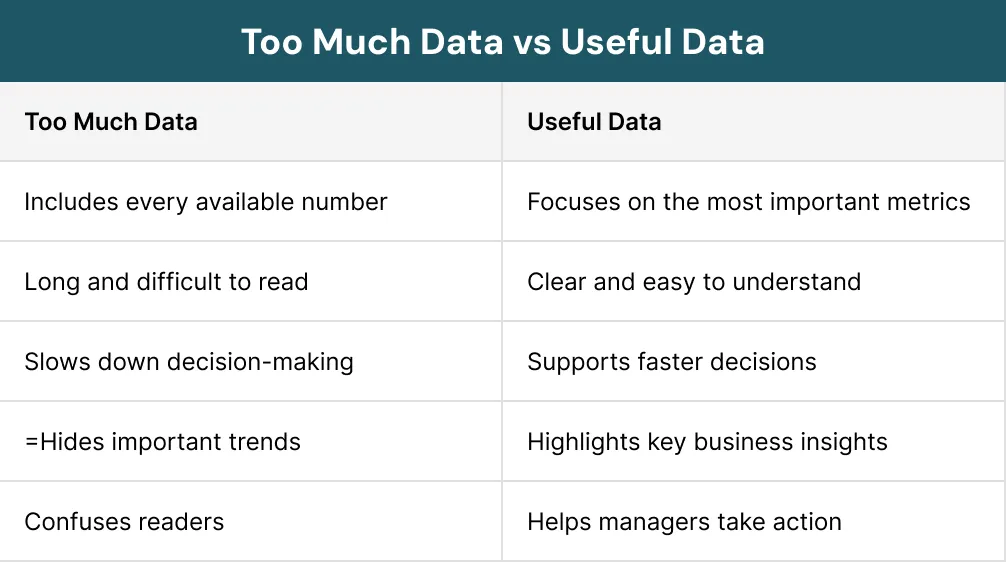
    Mistake #1: Overloading Reports with Too Much Data

    Many businesses believe that adding more details makes a report better. In reality, too much data can make reports confusing. When reports are full of numbers, it becomes difficult to find the information that really matters.

    Managers often have limited time to review the reports. If they must search through pages of figures, they may miss warning signs.

    Another common problem is including data that does not support the goals of business. Every number in management reports should have a clear purpose.

    Simple and focused reports are easier to read and understand.

    Too Much Data vs Useful Data

    Pro Tip:
    Ask yourself one simple question before adding a chart or figure: “Will this help someone make a better business decision?” If the answer is no, leave it out.

    How to Avoid This Mistake

    You can improve management reporting by keeping reports simple and focused. Start with the KPIs that matter most to your business goals. Group similar information together and remove figures that do not support decision-making.

    Review your management reports on a regular basis to make sure they still meet the needs of managers.

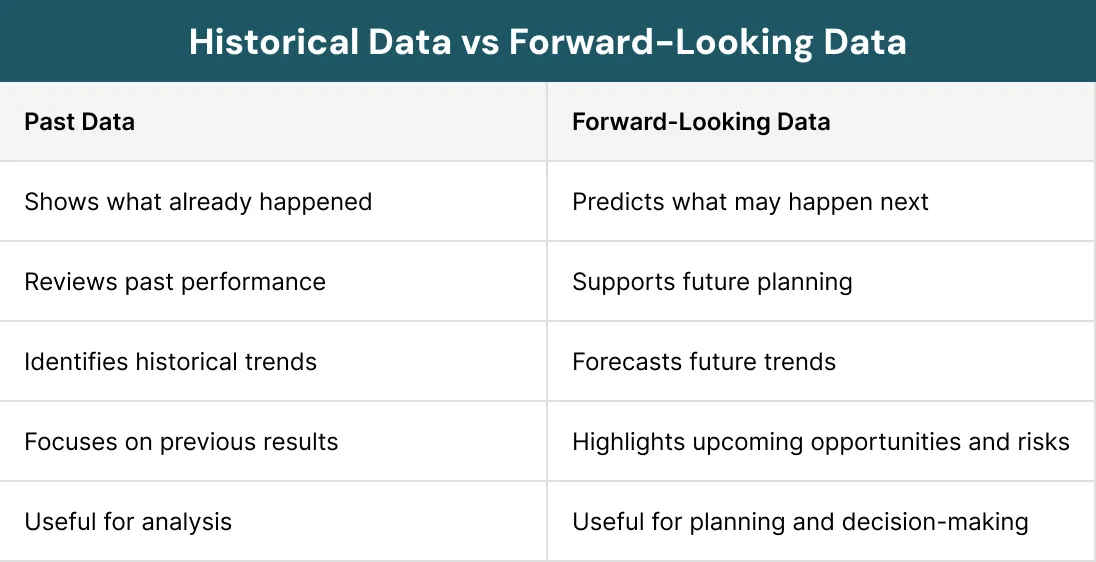
    Mistake #2: Focusing Only on Past Data

    Looking at past results is important, but it is not enough. Good management reporting should explain what happened and help to predict what could happen next.

    Past data shows previous sales, costs and profits. While this detail is useful, it cannot prepare your business for future challenges on its own. You also need reports that highlight the trends, forecasts and possible risks.

    For example, sales may have increased over the last six months. However, customer demand could be falling now. If you only look at old figures, you may miss this change and make poor decisions.

    Why Looking Only at the Past Is a Problem

    When you rely only on past data, you may:

    • Miss changes in customer behaviour.
    • Fail to prepare for future costs.
    • React to issues too late.
    • Miss new growth opportunities.
    • Make decisions based on outdated information.

    Historical Data vs Forward-Looking Data

    Did You Know?
    Many successful businesses use forecasting alongside past data to prepare for changes in sales, expenses and customer demand.

    How to Avoid This Mistake

    Review past performance, but always look ahead as well. Compare past figures with budgets, forecasts and current market conditions. This helps you to understand where your business is heading, not just where it has been.

    Mistake #3: Ignoring Cash Flow in Management Reports

    Many businesses focus on sales and profits, but they forget about cash flow. This is a common mistake.

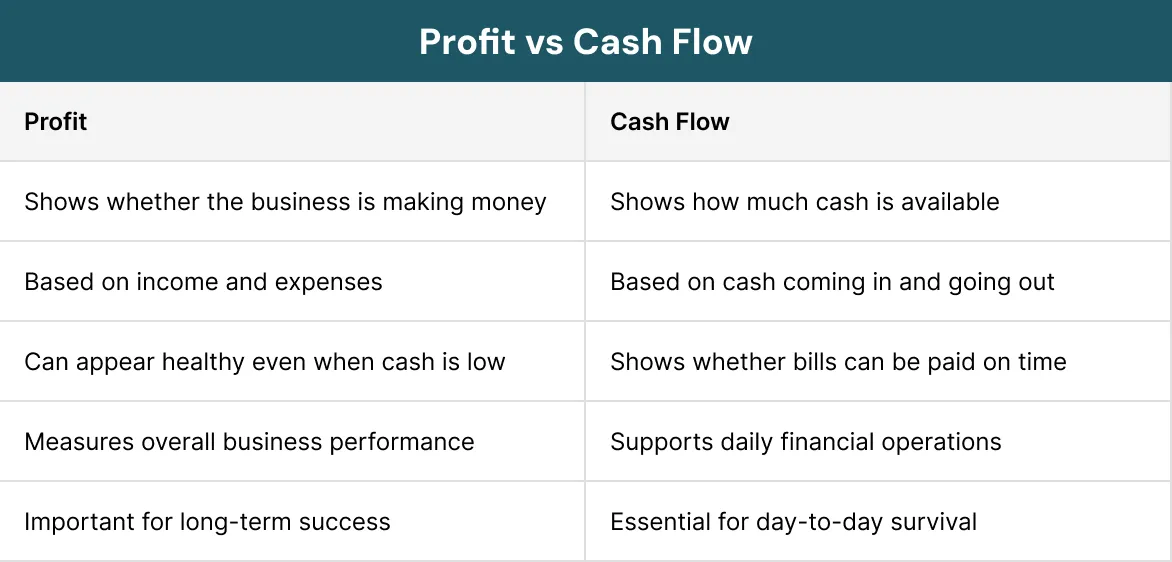
    Your business can make a profit and still run into financial trouble if it does not have enough cash to pay its own bills on time.

    Cash flow shows you how money moves in and out of a business. It helps you to see whether there is enough cash to cover wages, rent, supplier payments and other daily costs.

    Some businesses only review their cash flow at the end of the month or quarter. By then, it may be too late to fix an issue. Regular cash flow reporting helps you to take action before small issues become serious.

    Profit vs Cash Flow

    Pro Tip:
    Include a simple cash flow summary in every reporting cycle. Tracking expected income and upcoming payments helps you spot shortages early and avoid unexpected financial pressure.

    How to Avoid This Mistake

    Review your cash flow on a regular basis instead of waiting until problems appear.

    Compare expected cash inflows with planned expenses so you can identify shortages early. This gives you time to reduce costs, follow up on unpaid invoices or adjust spending.

    Pro Tip:
    Set clear cash flow targets and monitor them consistently.

    Mistake #4: Tracking KPIs That Don’t Align with Business Goals

    Key Performance Indicators (KPIs) help you to measure the success of a business. However, tracking the wrong KPIs can lead to poor decisions.

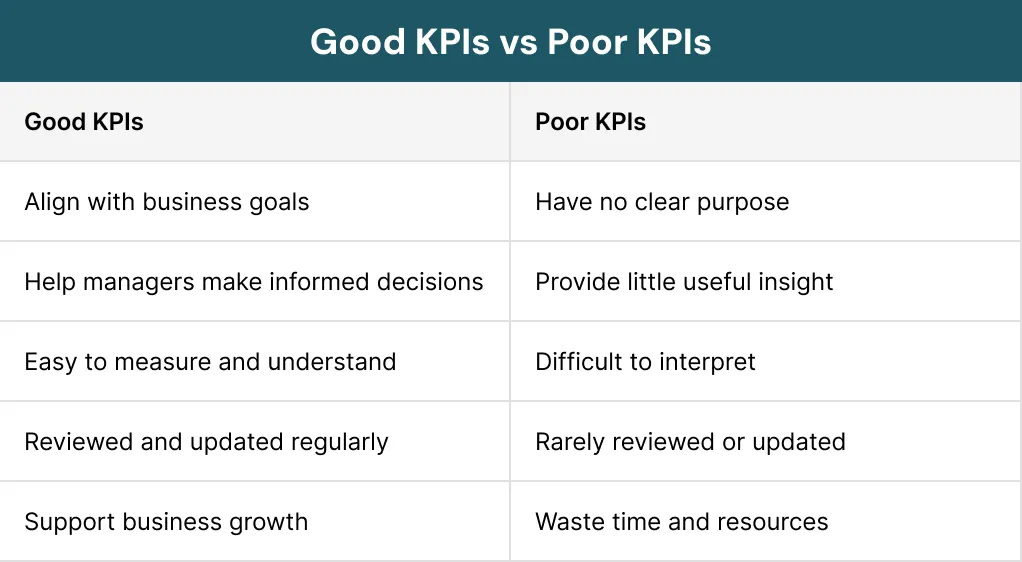
    Many businesses continue tracking old KPIs even when their goals have changed. As a result, managers focus on numbers that no longer matter. Reviewing KPIs on a regular basis helps to keep reports useful and relevant.

    Good management reporting focuses on useful KPIs. It highlights the measures that show whether your business is moving towards its goals instead of simply collecting data.

    Good KPIs vs Poor KPIs

    “If you can’t measure it, you can’t improve it.”

    — Peter Drucker

    How to Avoid This Mistake

    Choose KPIs that directly support your business goals. Review KPIs regularly as your business grows.

    Mistake #5: Delayed Management Reporting

    Reports lose their value when they arrive too late. Conditions of your business can change quickly, so you need current information to make good decisions. Delayed reports often mean missed opportunities and slower responses to issues.

    Some businesses prepare their reports only at the end of each quarter. By that time, small issues may have become much bigger.

    Regular reporting allows you to identify the problems early and take action before they affect the performance of your business.

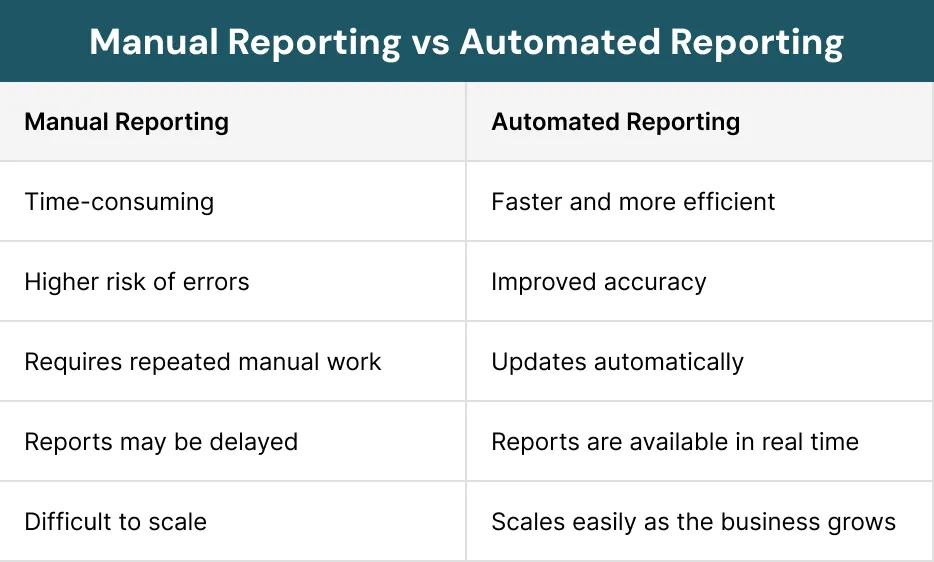
    Manual reporting is one of the main causes of delays. Collecting data from multiple sheets takes time and increases the chance of errors. Automating routine tasks can speed up the reporting and improve accuracy.

    Manual Reporting vs Automated Reporting

    Did You Know?
    Businesses that automate routine reporting tasks often spend less time on preparing reports and more time analysing business performance.

    How to Avoid This Mistake

    Prepare reports on a regular schedule, such as weekly or monthly. Decide who is responsible for collecting, reviewing and sharing the details.

    Mistake #6: Poor Data Accuracy

    A report is only as good as the data it contains. If the data is incorrect, you may make poor decisions. Even small errors can lead to financial losses or incorrect planning.

    Data errors can happen for many reasons. Staff may enter figures incorrectly, duplicate records may exist or data may not be updated on time.

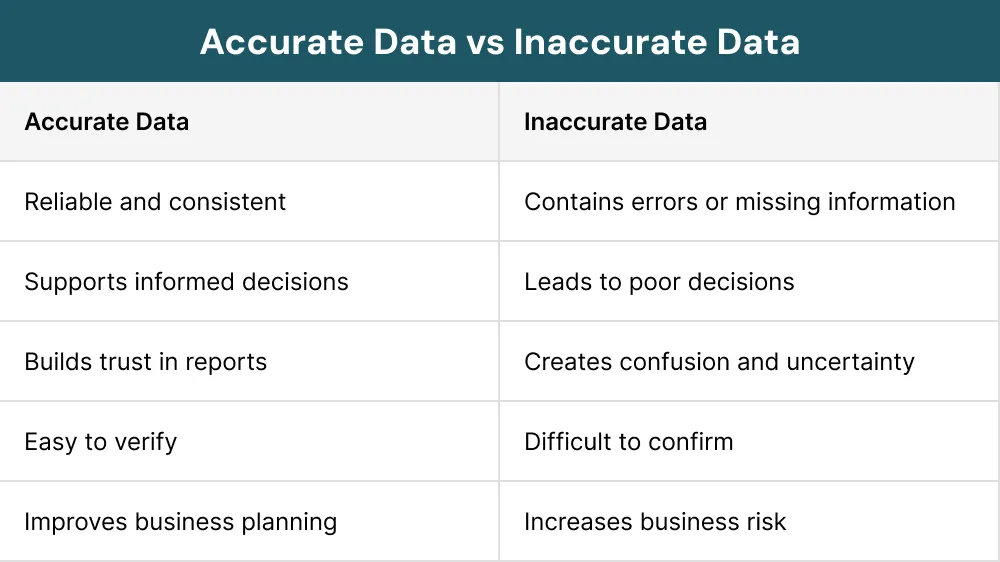
    Accurate data builds the trust in reports. When you know the figures are reliable, you can make decisions with confidence. Good management reporting depends on accurate and consistent data.

    Accurate Data vs Inaccurate Data

    How to Avoid This Mistake

    Create a clear process for collecting and checking the business data. Encourage staff to report the errors quickly so they can be corrected.

    Use reliable accounting software and keep records updated.

    Mistake #7: Using the Same Report for Everyone

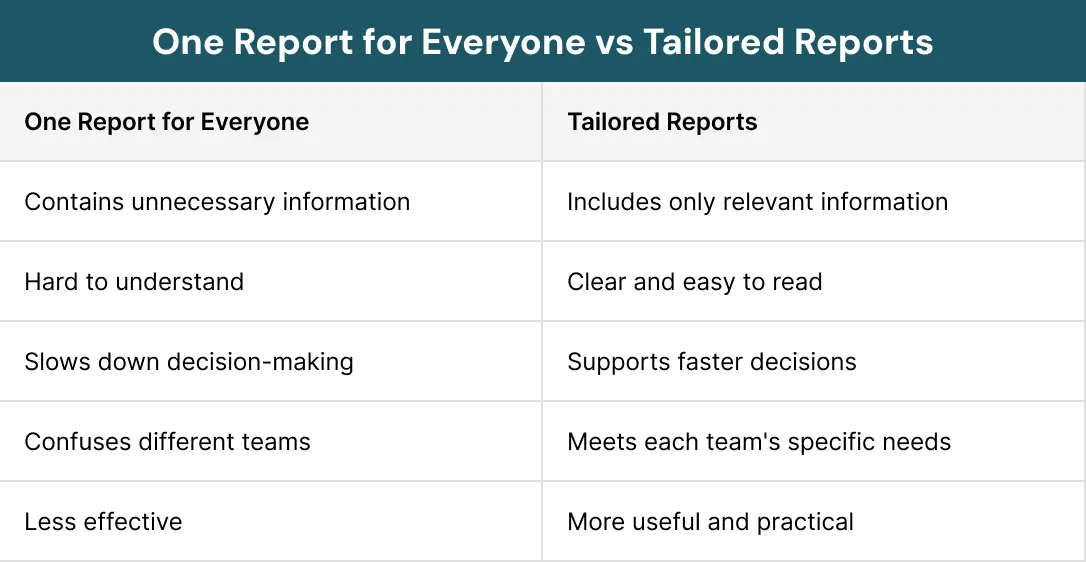
    Not every manager needs the same detail. A sales manager, finance manager and business owner all have different roles. Giving everyone the same report can make it difficult to find the information they need.

    For example, the finance team may need detailed cash flow figures, while the sales team wants to track customer orders and revenue. A single report filled with every metric can confuse the readers instead of helping them.

    Effective management reporting delivers the right information to the right people. Clear and focused reports help managers to understand the performance of the business.

    One Report for Everyone vs Tailored Reports

    Pro Tip:
    Ask each department what information they use most often. Design reports around those needs instead of sending one report to everyone.

    How to Avoid This Mistake

    Identify who will use each report before creating it. Focus on the detail that helps a person to perform their job better. Keep reports short, relevant and easy to understand.

    Mistake #8: Reports Without Analysis

    Numbers alone do not improve your business. Managers need to understand what the numbers mean and what action they should take. Reports that only present data without any explanation often create more questions than answers.

    For example, a report may show that sales have fallen by 10%. Without analysis, managers do not know why this happened or what they should do next.

    Strong management reporting does more than just present figures. It explains trends, highlights risks and also recommends practical actions that support your business growth.

    How to Avoid This Mistake

    Do not stop at presenting numbers. Explain why changes have happened and how they may affect the business. Add short comments that help readers to understand the results.

    Use charts and graphs carefully. Keep them simple, label them clearly and make sure they support the main message.

    Top management reporting mistakes

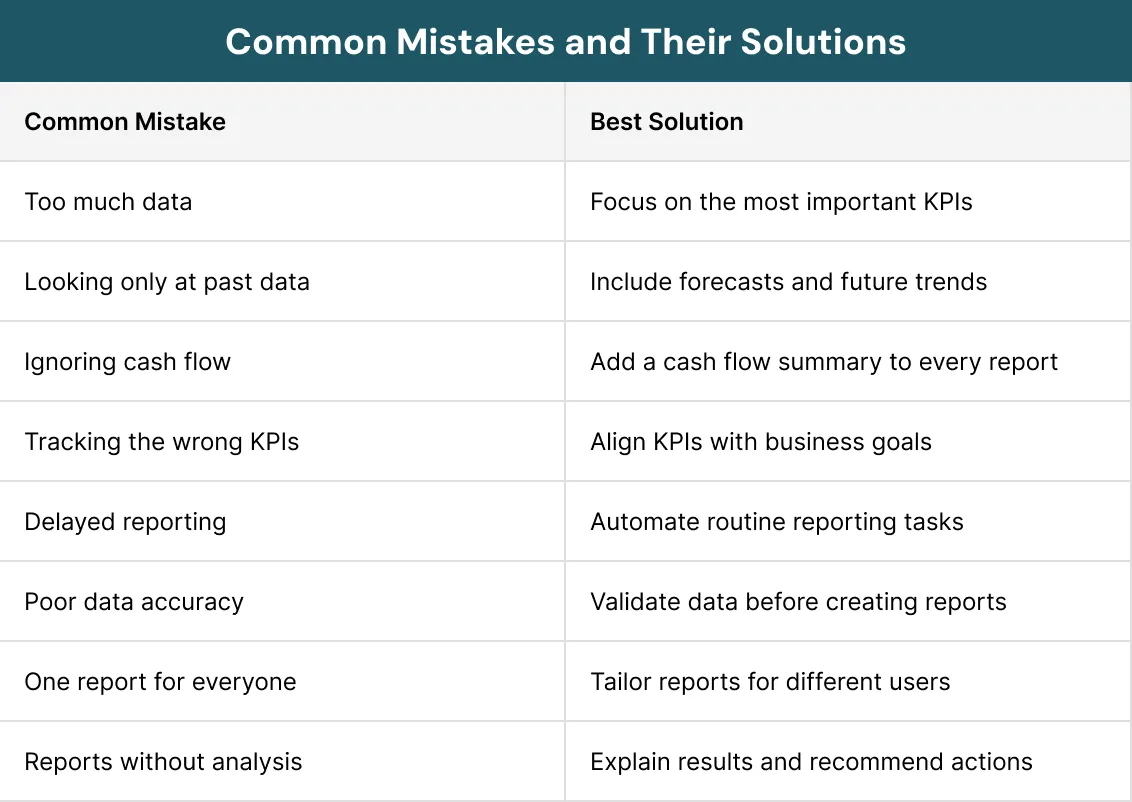
    How to Fix These Management Reporting Mistakes?

    Avoiding reporting mistakes does not have to be difficult. The goal is to create reports that are clear, accurate and useful for the decision-making process.

    Start by reviewing your current reporting process. Ask yourself whether your reports help managers to make better decisions.

    You should use simple dashboards and focus on the most important KPIs. Check your data on a regular basis and update the reports on a set schedule.

    Most importantly, turn every report into a decision-making tool. Reports should not only explain what happened but also suggest what should happen next.

    Practical Ways to Improve Management Reporting

    • Keep reports short and easy to read.
    • Track KPIs that support business goals.
    • Include cash flow in every reporting cycle.
    • Check data for accuracy before sharing reports.
    • Prepare reports on a regular basis.
    • Use automation to reduce manual work.
    • Create reports for different users and departments.
    • Add clear analysis and recommended actions.

    Case Study

    A UK-based manufacturing company was facing falling profits even as their sales grew. Managers relied on outdated data and received reports several weeks late.

    As a result, rising costs of production and cash flow issues were not identified at the right time.

    The company decides to improve its management reporting by introducing monthly dashboards, tracking relevant KPIs and reviewing cash flow.

    Within six months, the business reduced its unnecessary costs, improved cash flow and made faster decisions based on reliable data. This helped the company to perform better and support business growth.

    Conclusion

    Good reporting helps you to make better decisions. Clear reports show what is working well and where improvements are needed. They also help managers to respond quickly to new challenges.

    Many reporting problems can be avoided with simple changes. Focusing on the right KPIs, checking data accuracy, monitoring cash flow and providing useful analysis all improve the value of business reports.

    Remember that reports should support action, not just collect details. At Sterling Cooper, we help businesses to create clear and accurate management reports that support smarter decisions and sustainable growth.

    Looking for accurate management reports that help you make smarter business decisions?

    Feel free to contact us today and let our experts help you create reports that matter.
    +443300102526
    Book an Appointment

    FAQs


    What are the most common management reporting mistakes?


    The most common mistakes include using too much data, focusing only on past information, ignoring cash flow, tracking the wrong KPIs, delayed reporting, poor data accuracy, using the same report for everyone and presenting data without analysis.


    It provides managers with reliable information to make informed decisions. It also helps identify risks, monitor performance, improve planning and support long-term business growth.


    A business management report template is a ready-made format used to organise and present important business information, such as sales, expenses, cash flow and KPIs.


    A good report should include key KPIs, cash flow information, financial performance, business trends, clear analysis and practical recommendations for action.


    Businesses can improve reporting by using accurate data, automating routine tasks, focusing on relevant KPIs, preparing reports on time and adding clear explanations instead of only presenting numbers.

    Share This Article!

    Recent Posts

  • Common Bookkeeping Mistakes That Trigger HMRC Problems

    Common Bookkeeping Mistakes That Trigger HMRC Problems

    common bookkeeping mistake

    Posted by:

    Admin

    Date:

    July 23, 2026
    Category:

    blogs

    Error: Contact form not found.

    Common Bookkeeping Mistakes That Trigger HMRC Problems

    Many HMRC problems start with simple bookkeeping mistakes that can be avoided with a little attention and care. HMRC states that record-keeping errors are a leading cause of tax filing mistakes that can lead to compliance checks for UK SMEs. These errors can also be costly, as HMRC collected £2.6 billion in fines and penalties during the 2023–2024 financial year. 

    This shows why accurate bookkeeping is essential for every UK business. It helps you manage your finances, keep records up to date, file the right tax returns and stay compliant with HMRC. Most compliance issues start with simple bookkeeping mistakes that could have been avoided. These errors can lead to fines, penalties and compliance issues.

    In this blog, you’ll learn the most common bookkeeping mistakes that result in HMRC problems and simple ways to avoid bookkeeping mistakes.

    Key Takeaways

    • Good bookkeeping helps businesses stay HMRC compliant and avoid penalties.
    • HMRC uses digital systems to detect unusual financial activity and bookkeeping errors.
    • Mixing personal and business finances can create confusion and increase HMRC scrutiny.
    • Delaying bookkeeping tasks increases the risk of missing transactions, late filings and inaccurate tax records.
    • Regular bank reconciliation helps identify duplicate entries, missing payments and financial errors.

    What Are Common Bookkeeping Mistakes That Trigger HMRC Problems?

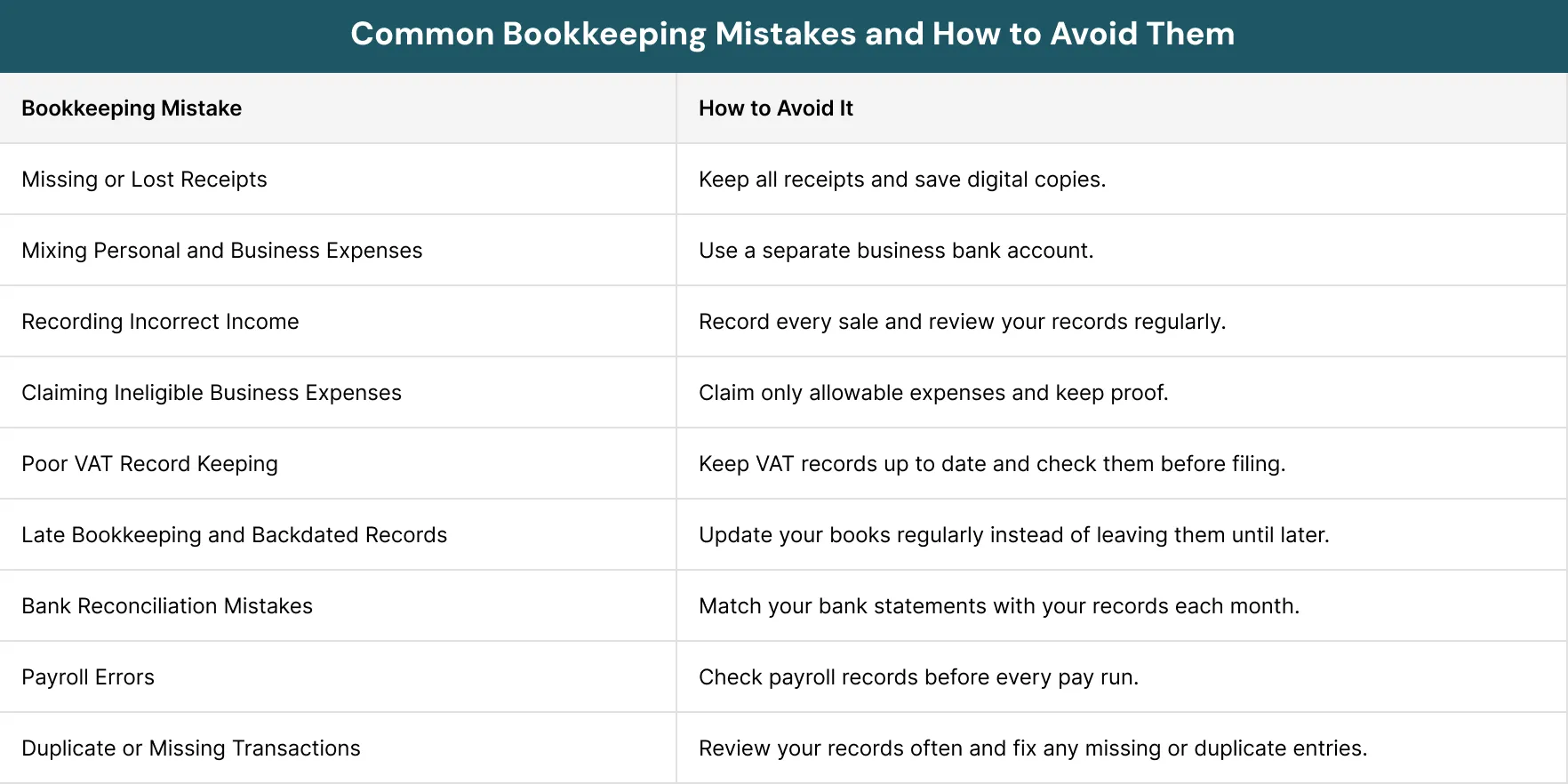
    The most common bookkeeping mistakes include missing receipts, mixing personal and business expenses, incorrect recording of revenue, wrong claim of expenses, poor VAT records, late bookkeeping, mistakes in bank reconciliation, payroll errors and duplicate entries. These mistakes can then lead to HMRC inquiries, fines and penalties.

    Below are some of the common bookkeeping mistakes that every business should avoid:

    1. Missing or Lost Receipts

    Receipts and invoices prove that your business earned from the sale of a product or service or paid for one. Every business should keep them as part of its financial records. Paper receipts can get lost, damaged or thrown away. Digital receipts can also be deleted by mistake. This is one of the most common bookkeeping mistakes made by small businesses. Keeping complete records makes it easier to manage your accounts and meet HMRC rules.

    Why It’s a Problem

    HMRC may ask to see proof of your business expenses and revenue. If you cannot provide receipts, your claims may be rejected. This can increase your taxable profit. As a result, you may pay more tax than necessary or underpay entirely. Missing records can also slow down an HMRC compliance check. In some cases, poor record-keeping may lead to penalties. Good records protect your business and support every claim you make.

    How to Avoid It

    Make a copy of every receipt as soon as you receive it. Store paper receipts in labelled folders. Scan them and keep digital copies as a backup. Save digital files in secure cloud storage. Record each expense in your bookkeeping system straight away. Check your records every month to make sure nothing is missing. This simple habit helps you avoid one of the most common bookkeeping mistakes.

    2. Mixing Personal and Business Expenses

    Many business owners use one account for both personal and business spending. This often happens when a business is new. It may seem simple at first. However, it makes your records harder to manage and confusing. This is one of the most common bookkeeping mistakes for small businesses. Keeping business and personal money separate makes bookkeeping much easier.

    Why It’s a Problem

    While you can pay for business expenses through your personal account, it leads to problems when filing for self-assessment and business taxes. Using the same account for personal and business expenses can lead to errors and problems in bookkeeping. This complicates filing tax returns, leading to missing tax deductions or an HMRC inquiry.

    How to Avoid It

    Open a different account for business expenses. Pay business expenses through one account and keep personal spending separate. This will make bookkeeping easier and ensure HMRC compliance for self and business.

    3. Recording Incorrect Income

    Each transaction must be recorded accurately. Your income records should match your invoices and bank statements. Any missing or incorrect figures may affect your accounts. Errors, even minor ones, tend to grow over time. It is one of the common bookkeeping mistakes that affect tax records. Accurate income records provide you with details of how your business is performing.

    Why It’s a Problem

    Incorrect figures for income lead to incorrect tax returns. There could be cases where you end up paying either too much or too little tax. HMRC may question your records if there is a mismatch in the values. There are chances of missing out on crucial data relating to your business. Fixing old mistakes takes extra time and valuable resources.

    How to Avoid It

    Record all sales at the time they occur. Maintain copies of all the bills. Compare your income with the bank statements each month. Check your records before filing your taxes. Fix all errors once detected. Use accounting software to reduce mistakes. Regular checks keep accuracy in your records.

    4. Claiming Ineligible Business Expenses

    All costs cannot be claimed as business expenses. There are rules issued by HMRC on the type of expenses that are included. Personal costs are not allowed to be considered. The wrong claiming of the expenses can lead to issues in the future. This is one of the most common bookkeeping mistakes that businesses should avoid. Knowing the rules helps you claim the right expenses.

    Why It’s a Problem

    HMRC may also refuse expenses that cannot be claimed. It will affect your tax payments in a way that you will end up paying more taxes. In some cases, the incorrect claim for tax deductions will mean that you have to repay the tax money that you claimed. Wrong claims can also delay your tax process. They may also trigger an HMRC review. Accurate claims help keep your records compliant.

    How to Avoid It

    Read HMRC guidance before claiming any expenses. Always keep your receipts for all purchases. Always record the reason why that expense was made. Ask an accountant in case you have doubts. Examine your expense records often. Reduce any expenses that do not qualify. Careful checks help prevent mistakes.

    5. Poor VAT Record Keeping

    All businesses that have VAT registration need to keep proper VAT records. Such records show the VAT charges that a business pays and invoices. It is vital to store all VAT invoices safely. In case of loss of such records, VAT accounting will be more difficult to conduct. This is one of the common bookkeeping mistakes in VAT-registered businesses. Good records make VAT reporting much easier.

    Why It’s a Problem

    Poor VAT records can lead to errors on your VAT returns. You may pay the wrong amount of VAT. HMRC may charge interest or penalties. Missing invoices can delay your filing and return. Errors may also trigger an HMRC check. Correcting VAT mistakes takes considerable time and effort. Accurate records help you avoid these problems.

    How to Avoid It

    Keep every VAT invoice in one place. Update your VAT records throughout the year. Check your figures before submitting your return. Store digital copies as a backup. Use accounting software if possible. Review your VAT records regularly. This makes VAT filing easier and more accurate.

    6. Late Bookkeeping and Backdated Records

    Bookkeeping should be done regularly. Waiting until the end of the month or year can create problems. It is easy to forget important details. Receipts and invoices may also go missing. This is one of the most common bookkeeping mistakes for busy business owners. Regular updates keep your records accurate.

    Why It’s a Problem

    Many of these bookkeeping errors happen because records are not updated regularly. A simple bookkeeping routine can help you avoid bookkeeping mistakes before they affect your business. Late bookkeeping increases the chance of mistakes. You may forget income or expenses. Missing information can affect your tax return. Filing late may lead to HMRC penalties. It also makes year-end work more stressful. Finding old records can take hours. Regular bookkeeping saves time and reduces errors.

    How to Avoid It

    Update your bookkeeping every week or month. Record income and expenses as they happen. Keep your receipts organised. Set reminders for bookkeeping tasks. Do not leave everything until tax season. Review your records often. Small updates are easier to manage.

    Good record-keeping helps you manage your business and can save you time and money. HM Revenue & Customs

    7. Bank Reconciliation

    Bank reconciliation means comparing your bookkeeping records with your bank statements. It helps you make sure every transaction is correct and verifiable. This process can find missing or duplicate entries. It also shows if any payments have been recorded incorrectly. Skipping this step is one of the common bookkeeping mistakes businesses make. Regular checks help keep your accounts accurate.

    Why It’s a Problem

    Without bank reconciliation, mistakes can stay hidden. Your account balance may be incorrect. You may miss payments or record transactions twice. These errors can affect your financial reports. They may also lead to tax mistakes. Finding old errors is often difficult. Accurate records depend on regular reconciliation.

    How to Avoid It

    Compare your bank statements with your records every month. Check each payment and deposit carefully. Correct any differences as soon as possible. Look for duplicate or missing transactions. Use accounting software to speed up the process. Keep your bank records organised. Regular checks improve accuracy.

    8. Payroll Errors

    Payroll includes employee wages, tax and National Insurance. Every payroll record should be correct. Even small mistakes can affect your employees. Wrong figures can also create tax problems. Payroll errors are among the most common bookkeeping mistakes made by employers. Accurate payroll keeps your business compliant.

    Why It’s a Problem

    Payroll mistakes can lead to incorrect employee pay. Tax or National Insurance may also be wrong. HMRC may charge penalties for payroll errors. Employees may lose trust if they are paid incorrectly. Fixing mistakes often takes time. You may need to submit corrected payroll records. Accurate payroll protects both your staff and your business.

    How to Avoid It

    Check employee details before every payroll run. Review wages and tax amounts carefully. Keep payroll records updated. Use payroll software where possible. Check every payroll report before submitting it. Fix mistakes as soon as they are found. Regular reviews reduce payroll errors.

    9. Duplicate or Missing Transactions

    Every payment should appear once in your records. Sometimes transactions are entered twice. Other times, they are missed completely. Both mistakes can affect your accounts. These are common bookkeeping mistakes that can happen during manual data entry. Checking your records often helps you spot these errors.

    Why It’s a Problem

    Duplicate transactions can overstate your income or expenses. Missing transactions can understate them. This makes your financial reports inaccurate. Your tax return may also contain errors. HMRC may question records that do not match your bank statements. Correcting these mistakes later takes time. Accurate records help avoid these issues.

    How to Avoid It

    Review your transactions every month. Compare them with your bank statements. Check for missing or duplicate entries. Correct mistakes as soon as you find them. Use accounting software to detect errors automatically. Keep your records updated throughout the year. Regular reviews improve accuracy and save time.

    Common Bookkeeping Mistakes and How to Avoid Them

    Simple Mistake, Heavy Fines: Case Study

    A self-employed taxi driver did not keep accurate bookkeeping records. When HMRC carried out a compliance check, it compared the driver’s bank payments, income records and tax return. The figures did not match. HMRC found that some business income had not been reported. Because of these bookkeeping mistakes, the driver had to pay the unpaid tax along with a penalty. This HMRC example shows that keeping clear and accurate bookkeeping records can help businesses avoid HMRC problems.

    Did you Know?
    A missing receipt or an incorrect entry may seem minor. However, repeated bookkeeping mistakes can lead to HMRC penalties, compliance checks and extra tax. Checking your records regularly can help you avoid these problems.

    Final Thoughts

    Accounting errors happen all the time, but they may turn into something more serious when not corrected. Most of the HMRC checks usually begin due to poor records. Even the smallest problem can lead to penalties.

    The best way to avoid bookkeeping errors is to maintain clear records throughout the year. Separate your personal and business finances, secure your receipts and manage your accounts. Also, ensure that you file your tax returns on time. By avoiding these bookkeeping errors and checking your records regularly, you can save time, reduce stress and keep your business compliant.  Good bookkeeping helps businesses to manage their cash flow better. 

    At Sterling Cooper, our experts can help you to keep your accounts accurate and HMRC compliant. Contact us today if you want to avoid HMRC penalties for poor bookkeeping errors.

    Are your bookkeeping records fully HMRC-compliant?

    Even small mistakes can put your business at risk. Our bookkeeping experts help you identify errors, maintain accurate records and stay prepared for HMRC checks. Contact us today for reliable professional support.
    +443300102526
    Book an Appointment

    FAQs


    What triggers an HMRC compliance check?


    HMRC may start a compliance check if it notices errors, inconsistencies or unusual patterns in tax returns. Checks can also be triggered by late filings, inaccurate records, significant changes in income or expenses or information received from third parties that does not match the details provided by the taxpayer.


    An HMRC investigation can be triggered when there are concerns about the accuracy of a tax return or signs of potential tax avoidance or evasion. Common triggers include unexplained income, unusually high expense claims, repeated mistakes in tax filings or discrepancies between reported figures and information held by HMRC.


    Yes, poor bookkeeping can lead to HMRC penalties if it results in inaccurate tax returns, missing records or incorrect calculations. Keeping complete and accurate financial records helps businesses comply with tax rules and reduces the risk of fines.


    There is no fixed schedule for HMRC compliance checks. A business may be selected at random or HMRC may conduct a check if it identifies a specific risk or concern related to the business’s tax affairs.


    Businesses should keep records of income, expenses, invoices, receipts, payroll information, bank statements and tax documents. Maintaining organised and accurate records makes it easier to complete tax returns correctly and respond to any HMRC enquiries.

    Share This Article!

    Recent Posts

  • The Role of Financial Forecasting in Business Growth

    The Role of Financial Forecasting in Business Growth

    financial forecasting in business

    Posted by:

    Admin

    Date:

    July 22, 2026
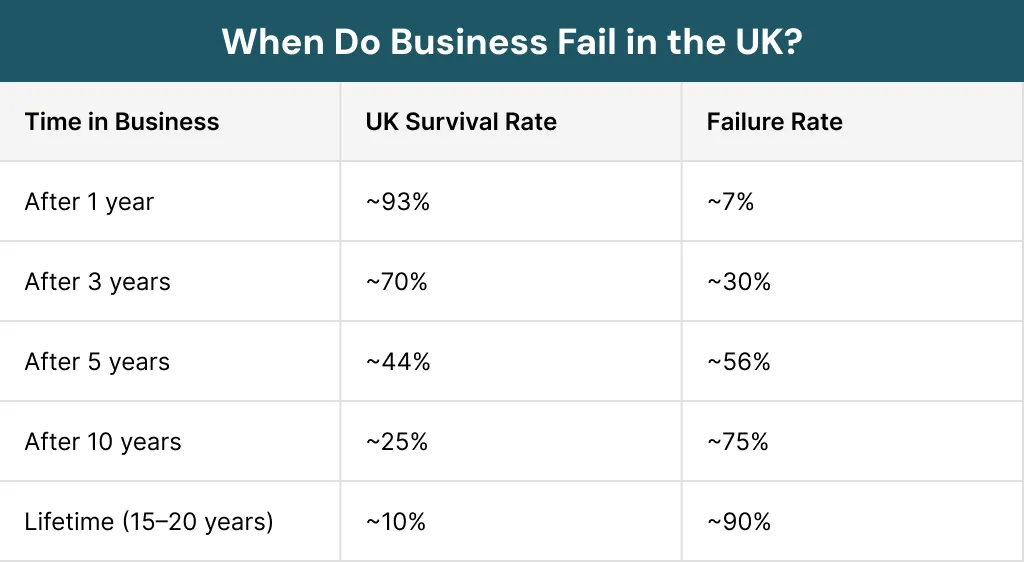
    Category:

    blogs

    Error: Contact form not found.

    The Role of Financial Forecasting in Business Growth

    Financial forecasting in business is the process of estimating future income, expenses and cash flow using current and historical financial data. It helps businesses plan ahead, reduce financial risks and support business growth.

    Does it surprise you that 90% of businesses close down in the UK? One of the reasons why this happens is because of poor financial forecasting in business. Running a business without a financial plan is risky. You can make the right decisions today but struggle with cash tomorrow.

    That is why financial forecasting in business is vital. It predicts future income, expenses and cash flow issues before they arise. Whether you run a startup or an established business in the UK, financial planning helps you manage cash flow, reduce financial risks and plan for sustainable business growth.

    In this guide, you’ll learn about financial forecasting and why it matters for business growth. You will also learn the best ways to forecast business growth.

    Key Takeaway

    • Financial forecasting in business helps you plan future income, expenses and cash flow.
    • Accurate forecasting supports better decisions and reduces financial risks.
    • Regular forecasts improve cash flow management and prepare businesses for growth.
    • AI financial forecasting and modern software make forecasting faster and more accurate.
    • Reviewing and updating forecasts regularly helps businesses stay competitive and financially stable.

    What Is Financial Forecasting?

    Financial forecasting is the process of predicting future financial performance of a business. It uses past results, present data and market trends to judge what might come next. Businesses use forecasting to plan their finances with more confidence.

    Good forecasting helps answer questions like:

    • Will the business have enough cash next month?
    • Is it the right time to hire new staff?
    • Can the business afford to expand?
    • Will extra funding be needed?

    Quick Tip
    Start with a simple 12-month financial forecast. It is easier to manage, more accurate and gives you enough time to plan for future opportunities and risks.

    What Is the Role of Financial Forecasting in Business Growth?

    Business growth does not rely solely on a good product or service. It also needs a clear financial plan and regular financial reporting. This makes financial planning in business so crucial. It helps you prepare for challenges and make plans for growth. As a result, you make better financial decisions.

    Financial forecasts support business growth through the following ways:

    1. Support Better Decision-Making

    Financial forecasting in business gives you the insight to make informed decisions. You make better decisions when you know the potential future incomes, expenses and profit. A trusted forecast helps you choose when to hire staff, buy stock or bring a new product. Financial forecasting is often the first for financial freedom for any business.

    2. Improve Cash Flow Management

    Even profitable businesses can fall in trouble if they run out of cash. That is why a positive cash flow is important for every business. A good financial forecast predicts the amounts coming in and going out from your business. This helps you manage expenses and avoid cash shortages to keep business operations smooth.

    Did you know?
    A profitable business can still fail if it runs out of cash. That is why cash flow forecasting is just as important as increasing sales.

    3. Helps Secure Funding and Investment

    Investors, lenders and UK banks want to see a clear financial plan before they join you. A strong forecast shows that your business knows its finances and has realistic growth plans. It also shows how borrowed or invested money will support future success. This builds confidence and raises your chances of investment.

    4. Reduces Financial Risks

    Every business faces doubts. Changes in customer demand, costs or market conditions can affect your finances. Financial planning helps you prepare for these changes early. Planning ahead reduces risk and helps your business respond in time.

    5. Measure Business Performance

    A forecast gives you a benchmark to measure success. You can compare actual results with your forecast. This helps you know what works and what needs attention. Regular reviews also keep your financial goals on track.

    6. Supports Business Expansion

    Growth often requires careful planning. You need to plan before you open a new location, hire new staff or enter a new market. You should know if your business can afford the expansion. Financial forecasting in business helps you predict future costs, revenue and risks. This allows you to expand with more confidence and avoid mistakes.

    The risk of poor planning becomes clearer when you look at how many UK businesses struggle to survive.

    Business Failure Rate in UK

    How Does Financial Model Help Different Businesses?

    To pick the best forecasting model that suits you, it is vital to know that every business has different needs. A startup will plan its finances differently than a growing company. Financial forecasting in business helps you make sound financial choices regardless of your stage.

    1. Financial Forecasting for Startups

    Financial forecasting for startups helps new business ventures with effective predictions. It estimates costs, sales and cash flow to help you make better choices. It can also help you plan methods for growth and predict profitability of your business. Forecasting also results in investor confidence. It confirms that the business has potential for growth.

    2. Financial Forecast for Small Businesses

    Often, small businesses face budget constraints that limit their growth and operations. Financial forecasting in business allows you to have more control over the budget. It helps you control spending and manage cash flow. With this, small businesses can be ready for slow seasons and unplanned costs. Such forecasts make new purchases, team building and expansion easier and planned.

    3. Financial Forecast for Growing Businesses

    A growing business often faces problems with new challenges and expenses. New market options, new products or bigger staff need careful planning. A financial forecast allows you to predict future costs and potential returns before making any decision. This helps reduce the financial risk of growth and brings steady growth. As Warren Buffett wisely said:

    ‘Risk comes from not knowing what you’re doing.’ Warren Buffett

    When Financial Projections Go Wrong: Case Study

    The case of BrewDog shows the effect of delayed forecasting on a business.

    The famous Scottish brewery suffered the effect of poor forecasting. This affected their profits and investors’ trust. Rapid expansion and rising costs placed pressure on the company’s financial performance, highlighting the importance of accurate forecasting.

    This shows why an updated financial forecasting in business is vital.

    Conclusion

    Business growth does not happen by luck. It is a result of informed decisions and planning. Financial forecasting in business allows you to know the future and make better decisions. This improves your cash flow, reduces risk and supports business growth.

    For every business stage, financial planning is vital for you. It gives you the confidence to make informed choices. You can achieve your goal with reliable data, regular reviews and right tools. That is how forecasting models in business help you scale.

    Business growth becomes easier when you have the right financial guidance. Sterling Cooper Consultants study your business carefully and provide clear forecasting support to help you plan revenue growth with confidence. Reach us for expert financial planning.

    Ready to use financial forecasting and grow?

    We help you understand your numbers, forecast future performance and plan smarter ways to grow revenue. Contact us today for expert financial forecasting support.
    +443300102526
    Book an Appointment

    FAQs


    What is financial forecasting in business?


    Financial forecasting in business is the process of estimating future income, expenses, cash flow and profits. It helps businesses plan ahead, make informed decisions and prepare for growth using historical data and market trends.


    Financial forecasting helps businesses make better decisions, manage cash flow, reduce financial risks and plan for expansion. It provides a clearer picture of future financial performance, making growth more sustainable.


    A budget sets financial goals and spending limits, while financial forecasting predicts future financial performance based on current data and expected trends. Businesses often use both together for better financial planning.


    Most businesses should review and update their financial forecast every month or quarter. However, forecasts should also be updated whenever there are major changes in sales, costs, or market conditions.


    Yes. AI financial forecasting helps businesses analyse large amounts of financial data, identify trends and generate more accurate forecasts. It also saves time by automating many forecasting tasks.


    A financial forecast usually includes projected sales, cash flow, income and expenses and a balance sheet forecast. Together, these reports help businesses understand their future financial position and make informed decisions.

    Share This Article!

    Recent Posts

  • The Hidden Costs of Poor Bookkeeping for Growing Businesses

    The Hidden Costs of Poor Bookkeeping for Growing Businesses

    consequences of poor bookkeeping

    Posted by:

    Admin

    Date:

    July 21, 2026
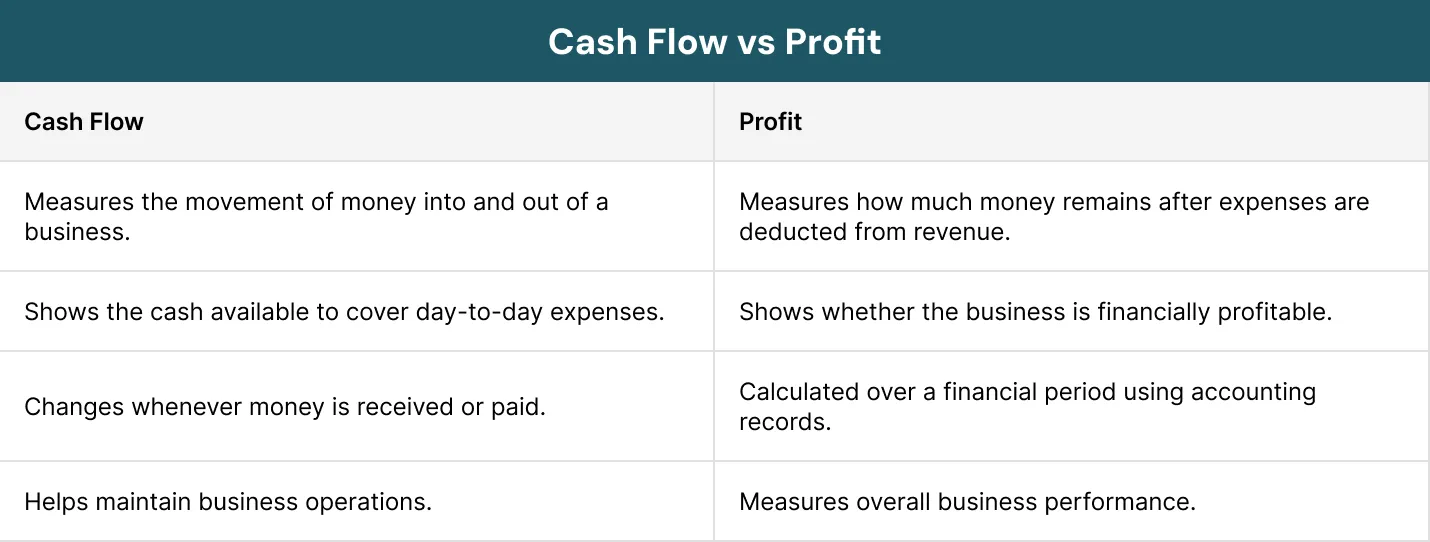
    Category:

    blogs

    Error: Contact form not found.

    The Hidden Costs of Poor Bookkeeping for Growing Businesses

    A growing business needs more than good sales. It also needs good bookkeeping. Many owners focus on winning new customers and leave financial records until later. An estimated 1.1 million taxpayers missed the Self Assessment deadline in the year 2025. This shows how poor record-keeping and late bookkeeping can quickly become expensive.

    This is where the consequences of poor bookkeeping begin. Small mistakes, like a missing receipt or forgotten invoice, can soon grow into bigger problems. They can hurt cash flow, increase tax bills and slow business growth.

    The bad bookkeeping cost is not only about paying extra money. It also includes wasted time, stress and missed business chances. Many owners only notice these hidden costs when it is too late.

    This guide explains the consequences of poor bookkeeping, why they happen and how to avoid them. Small changes today can save a growing business a lot of money tomorrow.

    Key Takeaways

    • The consequences of poor bookkeeping can lead to cash flow problems, poor decisions, HMRC penalties and slower business growth
    • The bad bookkeeping cost includes more than fines. It also covers missed tax deductions, wasted time, hidden expenses and lost business opportunities
    • Hiring a bad bookkeeper or delaying financial records can increase errors, create compliance risks and make financial reports unreliable
    • Keeping accurate records throughout the year helps reduce the consequences of poor bookkeeping on small business taxes and makes HMRC reporting easier
    • Regular bank reconciliations, organised records and cloud accounting software help prevent the consequences of bad bookkeeping before they become costly
    • Reviewing financial records regularly helps identify problems early and supports better business planning, stronger cash flow and long-term growth

    What Is Poor Bookkeeping?

    Poor bookkeeping means financial records are incomplete, inaccurate or not up to date. Some income or expenses may be missing, receipts may be lost and bank records may not match the accounts.

    Bookkeeping shows how money is earned and spent. It also helps determine whether or not the firm is profitable. Sometimes records are wrong and they make every report less reliable. A business owner thinks everything is going well but this may not be the case at all.

    This is one of the first consequences of poor bookkeeping. Inaccurate data causes wrong conclusions.

    Why Accurate Record-Keeping Matters for Business Growth?

    Accurate record-keeping matters for business growth because it helps owners make better decisions, manage cash flow, prepare tax returns and secure funding.

    Good bookkeeping shows where money comes from and where it goes. It also makes VAT returns and year-end accounts easier to prepare.

    Banks and lenders also check financial records before approving finance. Poor records can make a healthy business look risky. One of the consequences of poor bookkeeping is losing funding because the records cannot be trusted.

    Key Point:
    Poor records can damage cash flow, delay business growth and lead to costly financial mistakes.

    What Are the Hidden Costs of Poor Bookkeeping for Growing Businesses?

    The hidden costs of poor bookkeeping include missed tax deductions, HMRC penalties, cash flow problems, unexpected expenses, poor decisions, missed growth chances and wasted time. These costs often build slowly, so many business owners do not notice them until they start losing money.

    The consequences of poor bookkeeping are often hidden because they build slowly. One mistake leads to another. Before long, the business starts losing money without knowing why. Some costs are easy to see. Others stay hidden for months.

    The following are the hidden costs of poor bookkeeping for growing businesses:

    Hidden Costs of Poor Bookkeeping

    1. Missed Tax Deductions

    Businesses can claim many expenses to reduce their tax bill. But these expenses must be recorded correctly. If receipts are missing, some expenses cannot be claimed.

    For example, travel costs, office supplies, software and training costs may all qualify as business expenses. If they are not recorded, the business may pay more tax than needed. This is one of the biggest consequences of poor bookkeeping on small business taxes.

    Paying extra tax because of poor records is money that cannot be used to grow the business. Missing one expense may not matter much. Missing many expenses every year can become very costly.

    2. HMRC Penalties and Fines

    One of the biggest consequences of poor bookkeeping is paying HMRC penalties. Every business must keep clear records and submit correct tax returns on time.

    Poor bookkeeping can also become expensive when company accounts are filed late. Companies House can charge private companies up to £1,500 for late filing, and repeat late filing can double the penalty.

    Poor bookkeeping makes mistakes more likely. Figures may be wrong. Important documents may be missing. Deadlines may also be missed.

    HMRC may charge penalties and interest for these mistakes. The longer the problem continues, the more the cost can grow.

    The bad bookkeeping cost is not always one large fine. It is often many small penalties that slowly reduce business profits.

    Good bookkeeping keeps records ready throughout the year. This makes tax returns easier and helps avoid unnecessary penalties.

    3. Cash Flow Problems

    Cash flow is the money moving in and out of a business. A business can make a profit and still have cash flow problems.

    Poor bookkeeping makes it hard to see how much money is available. Some invoices may not be sent on time. Others may never be chased. Supplier bills may also be forgotten.

    Imagine a business ordering new stock because the bank balance looks healthy. A few days later, several unpaid supplier invoices appear. Suddenly, there is not enough cash to pay everyone.

    This is one of the most common consequences of poor bookkeeping. Good bookkeeping helps owners see future payments before they become a problem.

    Did you know?
    A missing receipt, unpaid invoice or delayed record may seem minor but these small errors often become hidden costs that affect profits, taxes and business decisions.

    4. Unexpected Expenses and Financial Losses

    Poor bookkeeping often creates costs that no one expects. Late payment fees are one example. Interest charges are another. Duplicate payments can also happen if records are not updated.

    Some businesses keep paying for software they no longer use because no one checks the monthly payments. Others pay the same supplier twice because earlier payments were never recorded.

    Each mistake may seem small. Together, they can cost hundreds or even thousands of pounds each year. Many business owners do not notice this hidden cost of bad bookkeeping until they review their accounts.

    These costs are another example of the consequences of poor bookkeeping for growing businesses.

    Beware of little expenses. A small leak will sink a great ship.

    – Benjamin Franklin

    5. Poor Business Decisions

    Good decisions need good information. Business owners use financial reports to decide when to hire staff, buy equipment or increase stock.

    If the reports are wrong, the decisions may also be wrong. A bad bookkeeper can produce inaccurate financial reports, making it harder for business owners to make the right decisions.

    For example, a business may think profits are rising. It hires more staff and spends more money. Later, updated records show that several expenses were never recorded. The business was making much less profit than expected.

    These are serious consequences of poor bookkeeping because poor decisions often affect future growth. Correct records help owners make better decisions with confidence.

    6. Missed Growth Opportunities

    Growing businesses often need finance. They may apply for loans or look for investors. Banks and investors usually ask for financial reports first.

    If the records are incomplete, they may lose confidence in the business. Even a profitable business can struggle to secure funding if the accounts contain mistakes.

    The consequences of bad bookkeeping are not always immediate. Sometimes they appear months later when the business is ready to grow. Good bookkeeping helps show that a business is organised and financially healthy.

    7. Wasted Time and Stress

    Poor bookkeeping creates extra work. Business owners spend hours looking for receipts, checking invoices and fixing old mistakes.

    Tax season becomes stressful because important records cannot be found. Instead of growing the business, time is spent solving problems that could have been avoided.

    The consequences of poor bookkeeping affect more than money. They also affect confidence and peace of mind. Many owners only realise this after improving their bookkeeping system.

    What Are the Warning Signs of Hidden Costs from Poor Bookkeeping?

    Bookkeeping problems build up over time. Spotting the warning signs early can prevent costly mistakes. The following are the key warning signs:

    1. Red Flags That Indicate Your Records Are Hurting Your Business

    Several signs show that bookkeeping needs attention. One sign is when bank balances do not match the accounts. Another is when customer invoices stay unpaid for a long time. Supplier bills may also be paid late because they were forgotten.

    Missing receipts are another warning sign. Financial reports may also change every time they are checked.

    These signs should not be ignored. The longer they continue, the greater the consequences of poor bookkeeping become.

    2. Outdated Books Can Hinder Decision-Making

    Business owners need current financial information. If the books are several weeks or months behind, the reports no longer show the true picture. This can lead to poor spending decisions.

    For example, an owner may think there is enough cash to buy new equipment. Later, updated records show that several unpaid bills were missing from the accounts.

    Keeping records up to date helps reduce the consequences of poor bookkeeping and supports better business decisions.

    Fast Facts:
    Accurate bookkeeping improves HMRC compliance and gives business owners reliable financial information for better decisions.

    How to Avoid Hidden Costs of Poor Bookkeeping?

    The following are the steps to avoid the hidden costs and consequences of poor bookkeeping:

    1. Separate Personal and Business Expenses

    Personal spending should never be mixed with business spending. Using separate bank accounts makes bookkeeping much easier. Every payment has a clear purpose. This also makes tax work faster and more accurate.

    2. Reconcile Bank Accounts Regularly

    Bank reconciliation means checking business records against bank statements. This helps find missing payments, duplicate transactions and recording mistakes. Doing this every month is much easier than correcting a full year’s records.

    3. Monitor Accounts Receivable

    Customers should pay on time. Outstanding invoices should be checked often. Late payments should be followed up quickly. This improves cash flow and helps the business avoid cash shortages.

    4. Use Cloud Accounting Software

    Cloud accounting software saves time and reduces errors. Many systems import bank transactions automatically. They also create invoices and produce reports in minutes.

    Business owners can view their accounts at any time. Their accountant can also access the same records when needed. Cloud software cannot fix poor habits but it makes good bookkeeping much easier.

    5. Keep Records of Petty Cash Expenses

    Small purchases matter. A coffee for a client, parking charges or office supplies may seem unimportant. Together, they can become a large business expense. Keeping every receipt helps create complete financial records.

    6. Choose a Suitable Accrual or Cash Method

    Businesses should use an accounting method that suits their needs. Some record income when money is received. Others record it when it is earned. Using the right method gives a clearer picture of the business. Professional advice can help if there is any doubt.

    7. Record Sales and Loans Properly

    Sales and loans should never be mixed. Each transaction should be recorded correctly. This helps produce accurate profit figures and reduces confusion during tax time.

    Accurate records help prevent the consequences of poor bookkeeping and keep financial reports reliable.

    8. Set Reminders for Deadlines

    Important dates should never be forgotten. Reminders for VAT returns, payroll and tax payments help businesses stay organised. Simple reminders can prevent penalties and reduce stress.

    These habits reduce the consequences of poor bookkeeping and help a business grow with confidence.

    Simple Steps to Avoid Poor Bookkeeping

    Case Study

    Source: Cooke v HMRC (2024), First-tier Tribunal Tax Chamber

    In 2024, the First-tier Tribunal heard the case of Cooke v HMRC. The taxpayer believed they met the 5% shareholding requirement for Business Asset Disposal Relief. However, a small calculation error meant the recorded shareholding was slightly below the required threshold. This led to a tax dispute with HMRC.

    The Tribunal later accepted that the parties had intended the taxpayer to hold a 5% shareholding. The case shows how even small mistakes in financial records or calculations can lead to costly tax disputes. It highlights the importance of keeping accurate records and checking financial information carefully before submitting it to HMRC.

    Conclusion

    The consequences of poor bookkeeping often start with small mistakes, such as a missing receipt or an unpaid invoice. If left unchecked, these small errors can become costly problems.

    The bad bookkeeping cost goes beyond fines and missed tax deductions. It can also lead to poor decisions, cash flow issues, lost opportunities and wasted time. These are common consequences of bad bookkeeping, but they are often preventable.

    Accurate records support better planning, stronger cash flow and easier tax reporting. They also reduce the consequences of poor bookkeeping on small business taxes and help businesses meet HMRC requirements.

    Whether bookkeeping is handled in-house or by a professional, choosing an experienced bookkeeper instead of a bad bookkeeper can help prevent costly mistakes and support long-term business growth.

    Sterling Cooper helps growing businesses keep their finances accurate, organised and HMRC-compliant. Contact us today and take the first step towards better bookkeeping and stronger financial control.

    Are the consequences of poor bookkeeping affecting your business?

    Sterling Cooper keeps your records accurate, organised and HMRC-compliant. We have helped businesses improve financial accuracy. Get in touch to protect your business from costly bookkeeping mistakes.
    +443300102526
    Book an Appointment

    FAQs


    What are the consequences of poor bookkeeping?


    The consequences of poor bookkeeping include cash flow problems, HMRC penalties, missed tax deductions, poor financial decisions, wasted time and slower business growth. Small mistakes can become costly if they are not fixed early.


    The bad bookkeeping cost can include late filing penalties, interest charges, missed tax savings, duplicate payments and lost business opportunities. The total cost depends on how long the bookkeeping problems continue.


    The consequences of bad bookkeeping can make it harder to manage cash flow, secure funding, prepare accurate reports and meet tax deadlines. These issues can slow growth and increase financial risk.


    One of the main consequences of poor bookkeeping on small business taxes is paying the wrong amount of tax. Missing records or incorrect figures can also lead to missed deductions, HMRC enquiries and financial penalties.


    A bad bookkeeper can record incorrect figures, miss deadlines, fail to update accounts and produce unreliable reports. This can lead to costly mistakes and make it difficult to make informed business decisions.


    Businesses can reduce the consequences of poor bookkeeping by keeping accurate records, reconciling bank accounts regularly, using cloud accounting software and reviewing financial reports throughout the year.


    Yes. A professional bookkeeper helps keep records accurate, supports HMRC compliance, improves financial reporting and reduces the risk of costly bookkeeping errors as the business grows.

    Share This Article!

    Recent Posts

  • Common Self Assessment Mistakes and How to Avoid Them

    Common Self Assessment Mistakes and How to Avoid Them

    self assessment mistake

    Posted by:

    Admin

    Date:

    July 20, 2026

    Category:

    blogs

    Error: Contact form not found.

    Common Self Assessment Mistakes and How to Avoid Them

    A self-assessment tax return is a process that is completed annually by millions of people within the UK. Yet many still leave it until the deadline. HMRC reported that 11.48 million returns were filed by 31 January, with 475,722 submitted on the final day and more than 27,000 in the final hour alone.

    When tax returns are rushed, mistakes become more likely. A missed detail or incorrect figure can lead to unexpected tax bills, penalties, interest charges or time spent correcting avoidable self-assessment errors.

    In this guide, you will learn the most common Self Assessment mistakes, why they occur, how to avoid them and how to file your HMRC Self Assessment tax return correctly.

    Key Takeaways

    • Register for self assessment early to receive your UTR and avoid filing delays.
    • Keep accurate financial records throughout the year to make tax reporting easier.
    • Report all taxable income, capital gains and other required information correctly.
    • Claim all eligible expenses, tax reliefs and allowances to avoid paying more tax than necessary.
    • Double-check your return before submission and correct any mistakes promptly if you find them later.

    What Is Self Assessment?

    Self-assessment is a system that HM Revenue and Customs (HMRC) uses to collect Income Tax and National Insurance. Most employed people have tax deducted from their wages. However, individuals with untaxed income must submit an annual tax return. This includes self-employed people, landlords and some higher earners. They use the tax return to report their income and calculate their tax bill.

    The table below highlights the main Self Assessment deadlines you should remember before filing your tax return.

    Self Assessment Deadlines at a Glance

    Common Self Assessment Mistakes and How to Avoid Them

    Let’s discuss the most prevalent HMRC self assessment mistakes and how to prevent them:

    1. Registering for Self Assessment Too Late

    Late registration can delay your Unique Taxpayer Reference (UTR). As a result, you may not submit your tax return on time. This also increases the chances of late filing penalties.

    How to Avoid It

    To avoid this self-assessment mistake, you must register through the official Self Assessment Registration portal before the deadline. After registration, HMRC will send you a UTR. Note down the UTR number as you’ll need it to file your actual tax return.

    If you miss the registration deadline, i.e., October 5, you can return and pay your tax bill by the filing date, i.e., January 31. If your tax liability is calculated and fully paid by this date, HMRC typically waives the late registration penalty.

    If you’ve overlooked both deadlines but have a reasonable excuse (such as serious illness or IT failures), you can appeal the decision through the official tax appeals portal. In that case, HMRC may waive the penalty.

    Did you know?
    HMRC received over 27,000 Self Assessment tax returns in the final hour before the 31 January deadline, showing how many people leave filing until the last minute.

    2. Not Keeping Proper Records

    If you are not keeping your income and expenses well-documented, you can overlook some of your income or understate your allowable business expenses. This may lead to an incorrect tax return, over-payment of taxes or an enquiry from HMRC.

    How to Avoid It 

    Keep accurate records throughout the year and use accounting software where possible. Record all income, expenses, invoices, receipts and bank transactions in one place. If you are unsure what to report, speak to a qualified accountant before submitting your tax return.

    3. Not Reporting Capital Gains

    Many people only report their income and overlook capital gains. If you sold shares, an investment property or other chargeable assets in the tax year, you may need to declare the gain and pay Capital Gains Tax (CGT). Otherwise, it may result in an incorrect tax return and extra tax charges.

    Remember, not all sales are subject to tax. You may qualify for tax exemptions or fall within the tax-free allowance. However, it’s important to check whether a sale needs to be reported.

    How to Avoid It

    Review any assets you sold during the tax year and calculate your capital gains before filing your tax return. Make sure to record the purchase price, the sale price and any associated costs. They are necessary for you to accurately calculate your gain. If you do not know whether you have to pay tax or what the amount is, you should contact a qualified tax adviser or accountant.

    4. Ignoring Pension Contributions

    Often, people do not remember to report their pension payments or do not record the correct amount on their tax return. As a result, they may miss valuable tax relief or submit an incorrect tax return. You can correct this self assessment mistake by logging into your account and amending the return within 12 months of the filing deadline.

    How to Avoid It

    To prevent this self-assessment mistake, make sure you save details of all pension contributions you made in the tax year and submit the tax returns accordingly. Check your pension statements or contact your pension provider if you’re unsure about the amounts. If you are entitled to more tax relief than you’ve currently claimed, be sure to claim it before filing your return.

    5. Not Declaring Charitable Donations

    If you fail to register your Gift Aid charitable donations on your tax return, you may be missing out on valuable tax relief. Charitable donations are gifts, usually in the form of money or qualifying gifts, made to registered charities. Eligible Gift Aid donations can be claimed as an additional tax relief for higher or additional rate taxpayers. However, if you have taken Gift Aid benefit but paid insufficient tax, you may need to pay back some of the tax relief that you claim for the charity.

    How to Avoid It

    Only claim Gift Aid if you’re eligible. Maintain details of all Gift Aid donations you make during the tax year. Include them correctly on your Self Assessment tax return to claim any tax relief you’re entitled to and avoid reporting errors.

    6. Failing to Claim All Allowable Expenses

    Failing to claim all allowable expenses usually won’t result in a penalty. However, it can increase your tax bill. Allowable expenses are costs that are completely and exclusively related to running your business. For example, self-employed individuals can claim business expenses like travel, office supplies and professional services. If you don’t claim them, you may pay more tax than necessary.

    How to Avoid It

    Separate business and personal finances to keep track of expenses more easily. Track your business costs all year round and keep receipts or invoices as proof. Accounting software can also be used to keep your records organised. Before claiming expenses, check the guidance from HMRC to find out if they’re allowed.

    7. Not Checking Personal Allowances and Tax Reliefs

    Not checking your personal allowances and tax reliefs can also increase your tax bill. These are tax benefits that can reduce the amount of tax you pay based on your personal circumstances. For example, you may qualify for Marriage Allowance, pension tax relief or other HMRC reliefs. If you don’t claim them, you could end up paying more tax than necessary.

    How to Avoid It

    To prevent this self-assessment mistake, you can check what allowances and tax reliefs are available before filing your Self Assessment tax return. See if you have the legal right to claim them and have properly reported them on your tax return.

    8. Forgetting to Include the Right Supplementary Pages

    Forgetting to include the correct supplementary pages can make your Self Assessment tax return incomplete. Supplementary pages are additional sections used to report specific types of income or gains. For example, you may need them if you’re self-employed, receive rental income, have foreign income or need to report capital gains. Missing these pages can delay the processing of your return or result in HMRC asking for more information.

    How to Avoid It

    To avoid this HMRC self assessment mistake, you must check which sources of income you had during the tax year before completing your tax return. Make sure you include all the supplementary pages that apply to your circumstances.

    9. Making Calculation Errors

    Manual calculations can easily lead to self-assessment mistakes. Even a small error when entering figures or calculating tax can affect your return. A slight error can result in paying too much or too little tax, delay the processing of your return or prompt HMRC to contact you to correct the information.

    How to Avoid It

    To avoid this, double-check all figures before submitting your tax return. Compare them with your records, such as invoices, bank statements and payslips. If you file your return online, use HMRC’s automatic calculations where possible. This can help reduce the risk of errors.

    10. Skipping the Final Review Before Submission

    Once you fill out your tax return, it’s easy to submit. But without the last review, there can be expensive self-assessment mistakes. There is a possibility that you may input the wrong numbers, forget to include all the necessary information or fail to include the proper supplemental pages. The processing of your return may be delayed if there are even minor errors or information is incorrect, which may result in a penalty.

    How to Avoid It

    Spend a few minutes reviewing your tax return before you submit it. Verify all figures and sections are correct. Ensure that you’ve provided the correct supplemental pages and claimed any eligible expenses and tax reliefs. A final review will help you catch errors before it becomes expensive.

    The table below summarises the most common Self Assessment mistakes, why they matter and how to avoid them.

    Common Self Assessment Mistakes

    How to Correct a Self-Assessment Mistake?

    You can correct an error even if the tax return has already been filed. HMRC allows you to amend a tax return within 12 months of the original filing deadline. For example, if you submitted your 2024/25 tax return, you can amend it until 31 January 2027.

    Once your return is updated, your tax bill could be adjusted. You might need to pay more tax if you underreported your income. If you overpaid, you may receive a refund instead.

    Correct the mistake as soon as you find it. Fixing self-assessment mistakes early can help reduce interest and penalties. It also keeps your tax records accurate.

    Did you know?
    If you discover a mistake after submitting your Self Assessment tax return, you can usually amend it within 12 months of the original filing deadline instead of submitting a new return.

    Final Check Pays Off: Case Study

    Mr Dolan submitted a Self Assessment return with incorrect information about his UK dividend income and tax residency status. HMRC investigated the return and imposed a £46,199.63 penalty. HMRC claims the error was deliberate. The First-tier Tribunal found the mistake was careless, not deliberate, and reduced the penalty to £19,799.84. The case shows why you should check complex tax rules and review your Self Assessment return carefully before filing.

    Conclusion

    Filing your Self Assessment tax return before the HMRC deadline helps reduce unnecessary penalties, interest and delays. Avoiding most self assessment errors can be achieved by maintaining accurate records and reviewing your numbers. It is also important to know about any tax reliefs and allowances that you are eligible for, as these may help to reduce your tax bill. If you find a self-assessment mistake in your return, fix it as soon as you can to minimise the chances of extra charges. Sterling Cooper Consultants helps individuals and businesses stay compliant with HMRC requirements through expert tax advice, accurate tax return preparation and ongoing compliance support.

    Need Help With Your Self Assessment?

    Avoid costly mistakes and file your Self Assessment tax return with confidence. Sterling Cooper Consultants offers expert self-assessment preparation, filing and tax compliance support to help you stay compliant with HMRC. Contact us today to make your tax return simple and stress-free.
    +443300102526
    Book an Appointment

    FAQs


    What are common self assessment mistakes?


    The most common self assessment mistakes include registering late and failing to keep proper records. Many taxpayers also forget to report all taxable income or capital gains. Other common mistakes include missing allowable expenses or tax reliefs, making calculation errors and submitting a tax return without a final review.


    No. HMRC does not manually review every Self Assessment tax return. Most returns are processed automatically, while HMRC uses its Connect system to identify inconsistencies, unusual claims and differences between your return and information received from other sources.


    HMRC is more likely to investigate if your business operates in a high-risk industry, especially one that handles a lot of cash. Filing tax returns late or reporting income that does not match your lifestyle may also attract attention. Sometimes, HMRC also targets specific industries as part of its compliance checks.


    Avoid submitting your Self Assessment tax return with missing or incorrect information. You should also avoid filing late, claiming ineligible expenses, overlooking tax reliefs and skipping a final review before submission.


    Yes. HMRC can make mistakes, including incorrect tax calculations, penalties or assessments. If you believe HMRC has made an error, you should review the decision and contact HMRC as soon as possible to have it corrected.

    Share This Article!

    Recent Posts

  • Cash Flow Strategies for Businesses: How to Improve and Increase Cash Flow

    Cash Flow Strategies for Businesses: How to Improve and Increase Cash Flow

    cash flow strategies for businesses​

    Posted by:

    Admin

    Date:

    July 16, 2026

    Category:

    blogs

    Error: Contact form not found.

    Cash Flow Strategies for Businesses: How to Improve and Increase Cash Flow

    Your business can be making sales and still run out of cash. Many profitable businesses struggle to pay suppliers, employees and everyday expenses because of poor cash flow. Research shows that between 47% and 82% of small businesses experience cash flow problems. Cash flow is the money moving into and out of your business. Healthy cash flow keeps your business stable, while poor cash flow can lead to financial stress, missed opportunities and even business closure.

    The good news is that the right cash flow strategies for businesses can improve cash inflow, control spending and strengthen your financial position. In this guide, you’ll learn practical business cash flow improvement strategies to help your business stay financially healthy and grow with confidence.

    Key Takeaways

    • Positive cash flow is essential for paying expenses, managing daily operations and supporting business growth.
    • Cash flow strategies for businesses focus on increasing cash inflow, controlling outflow and improving financial planning.
    • Profit and cash flow are different. A profitable business can still face cash shortages.
    • Regular forecasting, timely invoicing and cost control are among the best ways to improve business cash flow.
    • Small improvements in cash flow management can strengthen financial stability and prepare your business for future growth.

    What Is Cash Flow?

    Cash flow is the movement of money to and from the business. Money that comes in the business is known as cash inflow, e.g, sales and revenue. Money spent on salaries, payments, rent and expenses is called cash outflow.

    There are signals of a good cash flow that you need to aim for. Cash flow is positive when you can cover your business expenses and still invest in growth. Even profitable businesses can face difficulty in operations when their cash flow health is weak. A weak cash flow means that you do not have enough cash to pay your immediate expenses.

    That is why you need to learn how cash moves to and from your business. This is the first step to choose effective cash flow strategies for business. It will help you learn about problems early and make better decisions. Before developing your business cash flow improvement strategies, you should know its types. These are given below:

    Types of Cash Flow

    Businesses often have three main types of cash flow. Each type of cash flow provides vital insight about the financial health of your business. This forms the basis for effective cash flow strategies for businesses.

    1. Operating Cash Flow

    This is the money earned through and spent on normal business operations. This is the money earned from customers and sales and spent on salaries, rent and payments. A positive operating cash flow means a good financial health of the business. It means that you can fund your business operations without loans or external funding. 

    2. Investing Cash Flow

    This is the money spent on or received from long-term investments. This includes selling or buying assets, investing in technology or earnings from past investments. Investing can reduce cash flow in the short-term, but it supports future growth and improves performance. 

    3. Financing Cash Flow

    This is the money received from investors or given to lenders. This can be business loans, loan repayments, issuing shares or paying dividends. When you understand these cash flow types, you can create better cash flow strategies for businesses.

    Each type has a distinct impact on how best you form cash flow strategies for business.

    Why Is Cash Flow Important for Small Businesses?

    Cash flow is a critical factor that decides if a business scales or struggles. Know that even businesses with great sales can struggle because of poor cash flow. This means that your business can face problems to cover everyday expenses.

    With effective cash flow strategies for businesses, you can maintain financial stability, improve operations and attain growth. Cash flow is often the difference between surviving and closing for small businesses. Here is why cash flow is so important for small businesses:

    1. Ensure Survival

    Your business needs cash to operate every day. You cannot pay vendors, employees, rent and utility bills without funds. Most businesses fail because they run out of operational funds, even when they have customers. You can prevent failure with effective cash flow strategies for businesses. A healthy cash flow ensures you have working capital to stay operational for a long time.

    2. Funds Daily Operations

    Every business has daily operational costs. These costs include wages, inventory, maintenance and daily expenses. 

    A healthy cash flow ensures these expenses are paid on time without loans or credits. It also reduces financial pressure on the business. You can focus on growth rather than short-term cash shortages. 

    One of the most effective business cash flow improvement strategies is to monitor daily cash movement. This allows you to identify needless spending before it becomes a problem. 

    3. Drives Business Growth

    Investment is vital for business growth. You need cash to hire staff, buy inventory, expand operations or launch new products. A healthy cash flow supports you to make these decisions. You can take advantage of new opportunities and expand when needed without loans or credits. Many of the best cash flow strategies for businesses focus on steady cash flow. This is important for business growth and expansion.

    4. Builds Financial Resilience

    Businesses often face unexpected costs. Equipment failure, price hike or delayed payments can come without warning. These can become quite a challenge for small businesses. A healthy cash flow of your business allows you to manage these situations. You can deal with sudden expenses without disturbing business operations or taking on debt. Cash flow strategies for business create financial stability and keep a margin for sudden expenses. 

    5. Improve Supplier and Lender Trust

    Paying vendors, suppliers and lenders on time builds trust and strong relationships. A better relationship will help you negotiate better payment terms and discounts. A good cash flow of a business is a sign for lenders and investors of low-risk investment. By applying cash flow management strategies for small businesses, you can show financial growth. This builds trust and confidence in suppliers and lenders.

    “Never take your eyes off the cash flow because it’s the lifeblood of business.”

    — Richard Branson 

    How to Improve and Increase Cash Flow for Businesses?

    A healthy cash flow depends on cash flow strategies. It needs careful strategy, regular revisions and smart financial decisions. The right cash flow strategies for businesses help you scale operations, reduce financial pressure and allow growth.

    Some of the most effective ways to improve business cash flow are:

    Accelerate Cash Inflow (Receivable)

    The sooner the customer pays you, the more cash your business has. Late payments can create cash shortages, even when sales are strong. One of the most effective business cash flow improvement strategies is to improve your accounts receivable. These small changes can greatly improve your financial position.

    1. Fast-track Invoicing

    Delayed invoicing can lead to delays in payments. So, send invoices as soon as the work is done or goods are sent. You can also use automated invoicing software to reduce error, generate invoices instantly and remind customers about upcoming due dates. It forms effective cash flow strategies for businesses.

    2. Tighten Payment Terms

    Review your payment terms often for every client. If you allow 60-day payments, try reducing them to 30 days. Clear payment deadlines make customers know your terms and ensure faster payments.

    3. Offer Early Payment Discounts

    Some customers want to pay early if there is a benefit for them. You can use this to get early payments. A discount offer on payments made within ten days can increase inflow and reduce overdue invoices. Even though you get less revenue, a better cash flow provides greater financial stability.

    4. Enforce Credit Controls

    Carry out credit checks for new customers and set credit limits based on payment history. Regularly monitor overdue accounts and follow up with them to clear the payments. This reduces bad debts and ensures healthier cash flow. Such cash flow management strategies for small businesses help you grow.

    Manage Daily Cash Outflow (Payables)

    Improving cash flow is not about collecting money faster. It also means the effective management of outgoing payments. By carefully managing payments, your business can hold cash for a longer time. This will ensure you have effective cash flow strategies for businesses in place. Here is you can manage daily cash outflow:

    1. Negotiate Extended Payment Terms

    If you create a strong working relation with suppliers, many are open to having longer payment periods. By extending payment terms for a longer period, you can have greater short-term cash flow. This gives your business more financial flexibility. 

    2. Leverage Credit Limits

    Credit facilities and lenders help manage temporary cash flow gaps in the business. If used effectively, they can help during slower trading periods or with unexpected expenses.

    3. Reduce Payment Frequencies

    Rather than making multiple payments in a month, try a different approach. Discuss with your suppliers and group them in a payment schedule with easy dates. Fewer payments improve cash planning, reduce financial log and help manage available funds.

    A combination of these cash flow strategies for businesses allow you to focus on growth. 

    Optimise Existing Operations

    Effective cash flow strategies for businesses use available resources in a better way. When you review daily operations, you can find needless costs that do not add value to the business.

    These upgrades can create better cash flow strategies for business:

    1. Clear Excess Inventory

    Too much inventory can hold up valuable cash. Review slow-moving inventory regularly and sell excess stock through promotions and discounts. Low inventory reduces storage costs and improves cash flow. 

    2. Cut Non-essential Overheads

    Review your monthly expenses to find costs that do not help your business goals. Unused software, needless services and extra utilities can all hurt cash flow. By cutting these expenses you can free up cash. You can then invest it in more productive areas of the business.

    3. Focus on High-margin Customers

    Every customer does not bring the same value to your business. Identify products, services and customers that bring high profit margins and focus on them. When you focus on high-profit customers, you increase your revenue and improve cash flow as well.

    These practices help in shaping cash flow strategies for businesses for growth.

    Implement Cash Flow Forecasting

    This helps businesses to be ready for future income and expenses timely. Forecasting allows you to plan and make informed decisions before cash shortage happens. This is one of the most reliable cash flow management strategies for small businesses. It improves cash flow and reduces uncertainty.

    1. 13-Week Rolling Forecast

    This estimates the money expected to enter and leave the business over the next 13 weeks. When you update forecasts every week, you find problems and design solutions timely. This simple planning tool helps businesses make better financial decisions.

    2. Utilise Cloud Accounting

    Accounting software gives you real-time insight about your business finances. They automatically track income, expenses and bank transactions to make it easier to manage cash flow. With accurate financial data present in real-time, business owners can make informed decisions. They can see trends and apply cash flow strategies for businesses more effectively. 

    Find the best Cloud based Accounting Software for your business.

    Cash flow problems gradually lead to the closure of a business. Recent findings have created a timestamp for the survival and failure rate of businesses in the UK based on their years of operations. The table below shares that information.

    When Do Business Fail in the UK

    What Is the Difference Between Cash Flow and Profit?

    Business owners often confuse cash flow and profit. In reality, they are not the same thing. A business can be profitable and still face cash flow problems. Profit is what is left after all the expenses are paid from total revenue. While cash flow is the measure of money moving in and out from your business. 

    For example, a business may record a profit after making many sales. Even then, the business may not have enough cash to pay the bills. This happens because the customers are yet to pay their invoices.

    This is why successful businesses focus on both profit and cash flow. While profit measures performance, healthy cash flow keeps the business operational. This difference allows you to choose the right cash flow strategies for business instead of just profit.

    The table below shows the main differences between cash flow and profit.

    Cash Flow vs Profit

    What Common Mistakes Hurt Business Cash Flow?

    Many businesses face cash flow problems because of simple mistakes. When you find these issues early, you can take action before they affect your business performance. Avoiding these errors is one of the most effective cash flow strategies for business financial stability. 

    Here are the cash flow mistakes that can affect your business:

    1. Delaying Invoicing and Poor Collections

    Late invoices often lead to late payments. When invoices are delayed, customers take longer to pay. Also, when follow-ups on overdue payment do not happen, it can create needless cash shortages. Send invoices at once and have a clear process for collecting payables. 

    Find out if Cloud Accounting is better for your business or Traditional Accounting.

    2. Confusing Profit with Cash

    Many business owners think that a profitable business means healthy cash flow. In reality, profits shown in financial statements do not mean cash is available to spend. Regularly monitor your cash position to avoid cash shortages. 

    3. Overestimating Future Sales

    Scheduling spending on expected sales can lead to financial pressure when those sales delay. Instead, make financial decisions on cash in hand. This reduces risk and supports better cash flow management strategies for small business owners. 

    4. Failing to Maintain a Cash Reserve

    Unexpected expenses can happen any time. Without a cash reserve, businesses rely on costly borrowing or delay essential payments. When you have an emergency fund, it improves your financial stability. It also provides greater flexibility in challenging times. 

    5. Ignoring Seasonal Trends

    Many businesses experience high and low periods of demand throughout the year. When you are not prepared for seasonal changes, it can lead to cash shortages. Review trends and cash flow patterns to better prepare for expected changes. 

    6. Mixing Personal and Business Finances

    When you use the same account for personal and business expenses, it affects cash flow accuracy. Keep both these finances separate to have a clear image of business performance. This makes budgeting, forecasting and tax reporting easier. 

    7. Under-pricing Products or Services

    Low prices can attract customers but it affects the cash flow. It can reduce profit margins and limit the available cash. Assess your prices regularly to check if it aligns with your costs, market and product value. A sustainable pricing strategy supports healthier cash flow and business growth. 

    Once you address these common mistakes, you ensure the implementation of the best cash flow strategies for businesses.

    Case Study

    The case of Walmart shows how cash flow strategies for businesses can affect growth. The company negotiated extended payment terms with its vendor, and ensured their inventory moved quickly. This allowed Walmart to have payments ready before their deadline, allowing them to negotiate better.

    These cash flow management strategies allowed them to grow rapidly and built trust with vendors. They not only focused on sales but on improving cash flow of the business. Better forecasting and inventory management can improve cash flow. This ensures sustainability and long-term growth. 

    Conclusion

    Healthy cash flow helps businesses cover their daily expenses, invest in growth and prepare for unseen challenges. Timely invoicing, effective cost management and regular forecasting all contribute to healthy cash flow and long-term stability. Sterling Copper Consultants can help your business build practical cash flow strategies for sustainable growth.

    Cash flow reviews and small improvements can have a great impact on the business. It can make you better prepared for challenges and ready for new opportunities. So, access the best financial expert advice.

    Still struggling with cash flow?

    Our experts can help you identify cash flow gaps, improve financial stability and keep your business on track for growth. Get in touch today to see how we can help.
    +443300102526
    Book an Appointment

    FAQs


    What are some of the cash flow strategies for businesses?


    Some of the best cash flow strategies for businesses include sending invoices promptly, following up on late payments, managing expenses carefully, reducing unnecessary costs, forecasting cash flow and reviewing payment cycles regularly. These strategies help maintain healthy cash flow and improve financial stability.


    A business can improve its cash flow by collecting customer payments faster, delaying non-essential spending, reducing unnecessary expenses, negotiating better payment terms and selling unused assets. These business cash flow improvement strategies help increase available cash and strengthen financial health.


    Poor cash flow happens when more money leaves a business than comes in. Common causes include late customer payments, high operating costs, excessive inventory, poor budgeting and unexpected expenses.


    Common warning signs of poor cash flow include struggling to pay employees or suppliers, relying on debt for daily expenses, delayed bill payments, inconsistent revenue, excess inventory and missing business growth opportunities.


    Yes. A business can be profitable but still have poor cash flow if customer payments are delayed or too much cash is tied up in inventory or unpaid invoices. Profit shows earnings, while cash flow shows the money available to run the business.

    Share This Article!

    Recent Posts