Blog

  • Making Tax Digital Explained: All of What UK Businesses Need to Know

    Making Tax Digital Explained: All of What UK Businesses Need to Know

    making tax digital

    Posted by:

    Admin

    Date:

    January 19, 2026

    Category:

    blogs

    Error: Contact form not found.

    Making Tax Digital Explained: All of What UK Businesses Need to Know

    Making Tax Digital (MTD) is a programme by the government through HMRC to transform the way organisations and individuals deal with their taxes. Introduced as a component of a bigger shift to digitalise the UK tax system, MTD is expected to lessen mistakes, enhance precision, and simplify tax reporting by using authorised digital software. If you are a VAT-registered business, a self-employed sole trader or a landlord receiving rental income, MTD is expected to impact the way you declare your tax returns and keep financial records. This blog covers all about Making Tax Digital HMRC. 

    Understanding Making Tax Digital

    Making Tax Digital (MTD) is an essential change in the system of tax reporting and handling in the UK. Instead of the current system based on annual returns and manual record keeping, It will bring an era of continuous digital reporting. This will allow HMRC to:

    • Get tax information in near real time
    • Detect discrepancies
    • Reduce the burden of last-minute filings

    Making Tax Digital for VAT was the first step in this direction. Now, it is expanding to income tax and finally, corporation tax. 

    “Making Tax Digital (MTD), an initiative announced in 2015 by MP George Osborne in his autumn statement, brings with it the most impactful change to the UK tax administration for a generation. The Making Tax Digital vision aims to revolutionise the way businesses, landlords, individuals, and tax accountants interact with Her Majesty’s Revenue and Customs (HMRC).”

    Sadiq
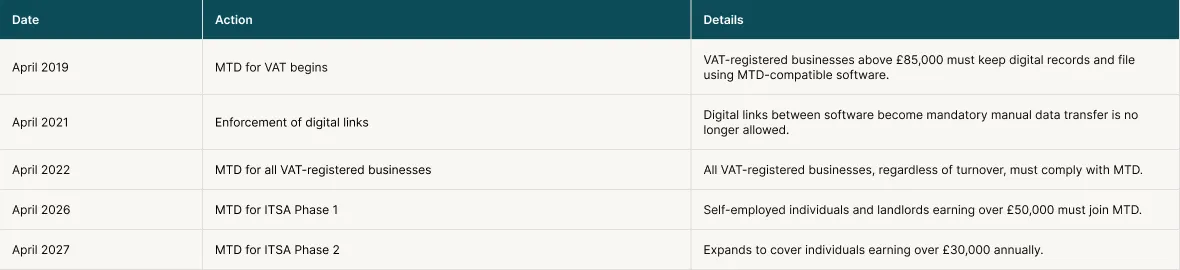
    Table 01

    What is HMRC doing to help with Making Tax Digital? The Making Tax Digital toolkit

    HMRC is determined to assist you regardless of being a landlord or a letting agent. HMRC launched the Making Tax Digital toolkit for landlords and agents to further help you. This toolkit contains:

    • Tailored advice 
    • Examples 
    • Checklist

    This means that HMRC recognises your challenges no matter what tax group you belong to. They also realise your need for effective guidance. 

    Who needs to comply with Making Tax Digital?

    Since the HMRC is rolling out MTD in steps, it is important to know if you will have to comply with it. If you do, you need to know the starting dates and how to prepare. Here is when you need to comply:

    • You are a sole trader or a landlord registered for Self Assessment
    • Your income is from self-employment, property, or both
    • You earn more than £20,000 in your qualifying income

    Qualifying income means your total income from your property and self-employment. It does not include pensions, savings or dividends. 

    Making Tax Digital starting dates

    Your qualifying date depends on how much your income was for the tax years. Here is a detailed insight:

    • Your MTD start date is between 6 April 2026 if your qualifying income in the previous tax year (2024-2025) was more than 50,000.
    • Your MTD start date is on or after 6 April 2027 if your qualifying income in tax year 2025-2026 is more than 30,000.
    • If your qualifying income is planned to be over  £20,000 in tax year 2026-2027, your Making Tax Digital start date will be decided later on.
    Tax Year Qualifying Income Threshold MTD Start Date
    2024 to 2025 Over £50,000 From 6 April 2026
    2025 to 2026 Over £30,000 From 6 April 2027
    2026 to 2027 (planned) Over £20,000 (legislation pending) TBC

    You don’t have to use Making Tax Digital for income tax until you have submitted the relevant year’s Self Assessment. Early sign-up is encouraged by the HMRC.

    Landlords and business partnerships

    Landlords have to follow the above-described timeline based on their rental income. As for business partnerships, HMRC will decide a date later for their joining.

    Exemption from Making Tax Digital for income tax

    You don’t have to follow MTD for income tax rules in the following cases:

    • Your qualifying income is less than £20,000
    • You are automatically exempted, i.e., it is not practical to use electronics, or you belong to some religion that does not allow electronic devices
    • You requested HMRC for an exemption and they granted it

    In these cases, just keep following the standard Self Assessment procedure.

    How to Check If You Need to Use MTD for Income Tax

    HMRC reviews your Self Assessment returns annually. If your qualifying income goes over the threshold, they’ll inform you via letter. Even if they do not, you’ll have to check for yourself if you are over the threshold. You can sign up for the HMRC service if needed.

    What does Making Tax Digital for Business and Individuals entail?

    Here are a few key aspects of MTD:

    1. Digital Recordkeeping

    Either you or your agent must maintain HMRC-compatible software and maintain digital records. Your records must be up-to-date. These include:

    • Records of income and expenses from property or self-employment, or both.
    • Maintaining records that are correct, up-to-date and in line with MTD rules.
    • Fixing potential mistakes right in the software

    The software that you select should be able to connect to the systems of HMRC. It should also facilitate the entire reporting process, starting with the quarterly updates and the final submission.

    2. Quarterly Updates to HMRC

    Rather than making a single yearly tax filing, you will need to:

    • Provide updates on the income and expenses quarterly (4 times a year)
    • Summarise earnings using your MTD software
    • Keep up with your tax requirements during the year, which will enhance precision and minimise shocks

    These updates do not replace tax returns but will act as a real-time picture of your financial situation. They will enable HMRC and taxpayers to manage liabilities better.

    3. Final Declaration and Payment

    At the end of the tax year, by 31 January, you have to:

    • Provide a final declaration (also known as the End of Period Statement) using their MTD software
    • Ensure that the information is correct from the first to the last year
    • Pay whatever tax you owe, just as you would with the old Self Assessment regime.

    The government intends to present the legislation that would demand the final tax return to be filed only via the MTD-compatible software. The paper returns or the individual digital uploads will no longer be accepted.

    4. Pre-Signup Planning: Key Considerations

    Some of the key considerations before filing for Making Tax Digital are:

    • Evaluate your business requirements: Find out if you qualify depending on your qualifying income
    • Select the appropriate software: Find a provider that HMRC integrates with and helps to sustain your accounting process
    • Provide agent details (where applicable): If you are using the services of a tax advisor or accountant, they must have an agent services account and should be authorised to represent you

    If you are an agent, pre-registration comprises the following:

    • Establishing an agent services account
    • Obtaining the client’s authorisation
    • Linking software to HMRC as well as to client profiles

    5. Ongoing Responsibilities After Signup

    The following tasks should be part of your routine once you are enrolled in MTD for income tax:

    • Continuously store and maintain digital records
    • Submit quarterly updates on time
    • File the annual declaration
    • Adapt to changing circumstances, such as when you are no longer self-employed or your income is below the threshold.

    Making Tax Digital for VAT

    As of April 2022,  Making Tax Digital for VAT is a requirement for all VAT-registered businesses, with no turnover exemption. Unless you fall in the exemption category, you’ll have to follow MTD rules.

    Who Does MTD for VAT Apply To?

    You must comply with MTD for VAT rules if you are any of the following:

    • Your business is VAT-registered even if your earnings are below the £85,000 threshold
    • You are a sole trader registered for VAT
    • You are a sole landlord registered for VAT
    • You are a limited company or LLP registered for VAT
    • You are either a partnership or a registered society
    • You got your business voluntarily registered for VAT

    It is important to note that if your earnings fall below £85,000, you can avoid the MTD rules by cancelling your VAT registration. You will still have to submit a final VAT return. HMRC will then confirm it.

    Quarterly Digital VAT Returns

    Here is what what VAT -VAT-registered businesses are supposed to do under MTD rules:

    • They should keep their VAT records by using an MTD-compatible software
    • They should submit quarterly returns using that software
    • They should retain digital evidence of income and expenses

    Your software must track the following:

    • Sales and purchases
    • VAT amounts (charged and paid)
    • Adjustments and VAT schemes
    • Time and value of supply
    • Reverse charge transactions

    Learn more: How do I get a VAT Certificate: A Complete Guide

    Common misconceptions of Making Tax Digital

    Here are some of the common misconceptions about MTD for VAT:

    1. You can still submit VAT manually

    This is not true. All your submissions must now go through digital software that is connected directly with the HMRC.

    2. You need expensive software

    This is also not true. There are many affordable options as well. Some of them (bridging software) are free. These software let you connect spreadsheets with HMRC.

    3. You have to scan every receipt

    Even though you have to keep digital records, scanning paper receipts is not needed.

    4. Only large businesses need to comply.

    This, too, is false. As of 2022, all businesses must comply.

    Exemption from MTD for VAT

    The exemptions are exactly the ones that are applicable in Making Tax Digital for income tax, i.e., you cannot use software due to any of the following reasons:

    • Age
    • Disability
    • Religion
    • Practicality
    • Location

    Applying for exemption

    If you want to apply for an exemption, contact HMRC with the following:

    • Your VAT number
    • Your current filing method
    • Why MTD isn’t practical for you
    • Written authorisation

    Get detailed insights on 2025–26 Tax Year Updates.

    Penalties Under the New Points-Based System

    Since January 2023, HMRC has implemented a new system for imposing penalties. It is a points-based system, and here is how it works:

    • Every time you miss a deadline, you get 1 point.
    • Once you get to a threshold (2, 4 or 6 points), you will get a fine of 200 pounds.
    • Thereafter, every further missed deadline = an extra 200 pounds fine.

    Here are the penalty thresholds:

    Submission Frequency Points Threshold
    Annual 2 points
    Quarterly 4 points
    Monthly 5 points

    Your points can be reset if you file timely for 12 months.
    Contact us for VAT Preparation & Submission to HMRC

    Choosing the Right Software for Making Tax Digital

    What software you choose depends on the needs of your business. Here are a few key considerations:

    1. Your income source

    You need to choose your software based on your income source. For instance, check if your income is any of the following:

    • Self-employment
    • UK property
    • Foreign property
    • Personal income (e.g. dividends, savings)

    2. Record-keeping preference

    The next thing you need to choose is your preference in keeping the records. You can choose from the following options:

    • Enter the data manually in the software
    • Link the software to your bank account
    • Link a bridging software to the spreadsheets

    3. The user of the software

    You have to check who is going to use the software and whether the software supports these needs. You can use the account yourself, or your agent may be using it. You can both be using it too. In this case, check if agent access is supported. Speak to your agent; they might already be using software.

    4. Your accounting period

    Check your accounting period. Some software supports calendar updates, others don’t. For instance, if your period is from 1 April to 31 March, you will have to check the calendar updates.

    5. Features you need

    You need to check if the software has all the features that you need. For instance:

    • Creating and correcting digital records
    • Sending quarterly updates
    • Submitting your final Self-Assessment tax return

    Get expert personal tax return filing.

    Types of software for Making Tax Digital

    The following are the three types of software that you can choose from for Making Tax Digital. Each has its own use:

    1. Record-Keeping Software

    This software helps in record-keeping. It helps you enter your income and expenses digitally. It is good for your business if you keep day-to-day records

    2. Bridging Software

    This software connects spreadsheets or existing systems to HMRC. You can use this if you use Excel or other older tools.

    3. Hybrid tools

    This tool supports both functions, i.e, keeping records and submitting. This software can give you complete compliance with Making Tax Digital rules.

    Example Software Options (2025–26 Tax Year)

    A list of software is available on the website of the Government of the UK. Here are some examples of software:
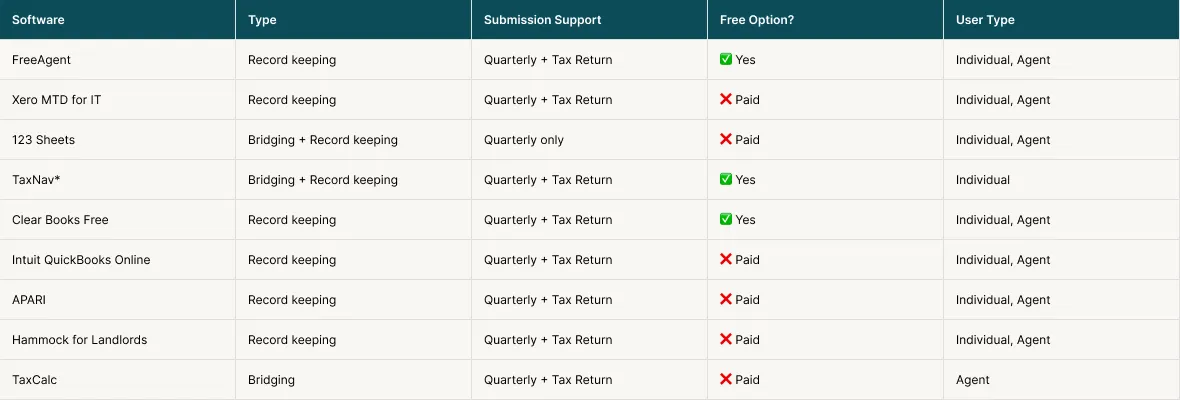
    Table 02

    Consult Sterling Cooper Consultants for expert opinion

    With the changing landscape of filing tax returns, you may find it hard to follow the process. We at Sterling Cooper Consultants are there to help you navigate the process. Our accountants and bookkeepers ensure that your records are in order. We also make sure that all your reports are ready on time for tax filing. Using our help, you can avoid penalties and get top tax-saving tips. 

    To get help, contact us now.

    Simplify taxes with expert planning, self-assessment,

    VAT returns & corporation tax services in the UK. Ensure maximize savings today.

    FAQs


    Can I join Making Tax Digital before it becomes mandatory?


    Yes. HMRC is asking volunteers to take part in the MTD for Income Tax testing phase before the 2025/26 tax year. This will enable you to become familiar with the system at an early stage and also contribute towards its evolution. You should pass the eligibility and have compatible software.


    When you attempt to sign up, your circumstances will be automatically compared with the HMRC eligibility rules.


    An Accountex survey conducted recently shows that MTD is seen by 81.7% of accountants as their greatest challenge in 2025. It is demanding significant reforms, involving digital record-keeping, quarterly reporting, and the use of software. There are still a lot of unprepared firms, as 34% of them report not being ready by the 2026 rollout.


    79.08% of accountants view MTD as a great opportunity. It allows for interaction with clients more often, has better insights on the business performance, and paves the way to upselling, advisory services, and closer relations with clients.


    It entails moving from paper-based or spreadsheet accounting to an electronic system. It also removes the time-consuming job of manually entering data onto the HMRC website.

    Share This Article!

    Recent Posts

  • How Much Tax Do You Pay on a Second Home in the UK?

    How Much Tax Do You Pay on a Second Home in the UK?

    tax on second homes

    Posted by:

    Admin

    Date:

    January 15, 2026
    Category:

    blogs

    Error: Contact form not found.

    How Much Tax Do You Pay on a Second Home in the UK?

    Buying a second home can be beneficial in multiple ways. It can contribute to additional income if you rent it out on holidays or regularly. However, you have to understand its tax implications. Tax on second homes is different from your main residence. A second home is taxed differently because it is not essential housing. So, the government charges extra to discourage speculative buying and free up homes for first-time buyers. Here is everything you need to know about it.

    What qualifies as a second home?

    A second home is a property you own apart from your main residence. You can have bought it or inherited it. In either case tax on second homes is levied on it. If your spouse buys a second home, then you’ll still have to pay tax on the second home. Here is what qualifies as a second home:

    1. Buy-to-let properties

    These homes are bought to be rented to tenants. So, even if the house is being used as someone’s main residence, it’s not yours so it counts as a second home.

    2. Long-term investment properties

    If you buy a property for the sake of using it as an investment, it is still considered a second home. The implication of tax on second homes does not change even if the property is empty.

    3. Holiday homes

    These properties are used for vacations. You may use them for residence occasionally but the tax on second homes has to be paid on them.

    4. Short-term or seasonal lets (e.g., Airbnb)

    If your property is rented out on a short-term basis like holiday rentals or Airbnb, it is considered a second home for tax purposes.

    “In the United Kingdom, according to the English Housing Survey, the number of second homes more than doubled between 1995 and 2013, to 671,000 units.”

    Christian A.L. Hilber and Olivier Schoeni

    Tax on second homes:

    Here are the taxes you may be liable to if you own a second home.

    1. Stamp Duty Land Tax (SDLT):

    This tax is a government tax on properties that are purchased in England and Northern Ireland. It applies only if the purchase price is above a certain threshold. It is paid when your property is:

    • A freehold or leasehold property
    • A property with a mortgage or bought outright
    • Land or commercial buildings (separate rules)

    Exemptions from SDLT:

    You are exempted from this tax on second homes in the following cases:

    • The home is inherited in a will
    • You take ownership in a divorce or civil separation
    • You buy a property worth under £40,000.
    • You’re buying a caravan, mobile home, or houseboat
    • You lease for over 7 years but pay under £40,000 and rent under £1,000/year

    Stamp duty rates on a second home:

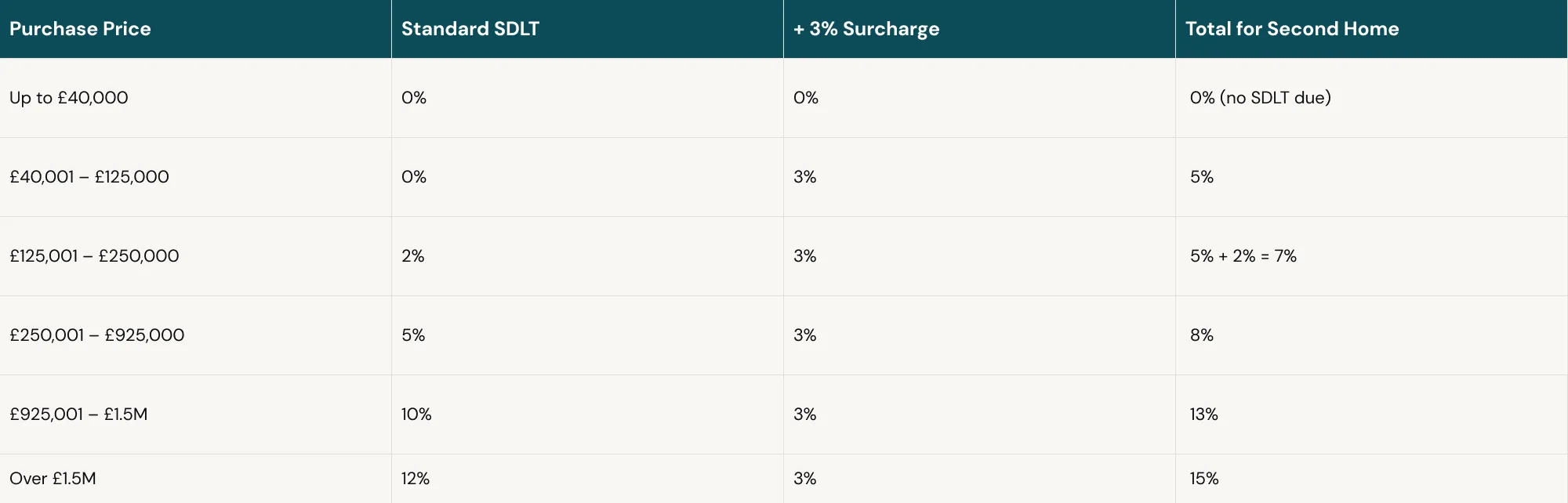
    Second homes are charged with normal SDLT. The following surcharge is applied based on your location:

    • 3% extra in England & NI
    • 6% extra in Scotland
    • Higher base rates in Wales

    Here is how it is applied based on different purchase prices.

    Stamp duty rates on a second home
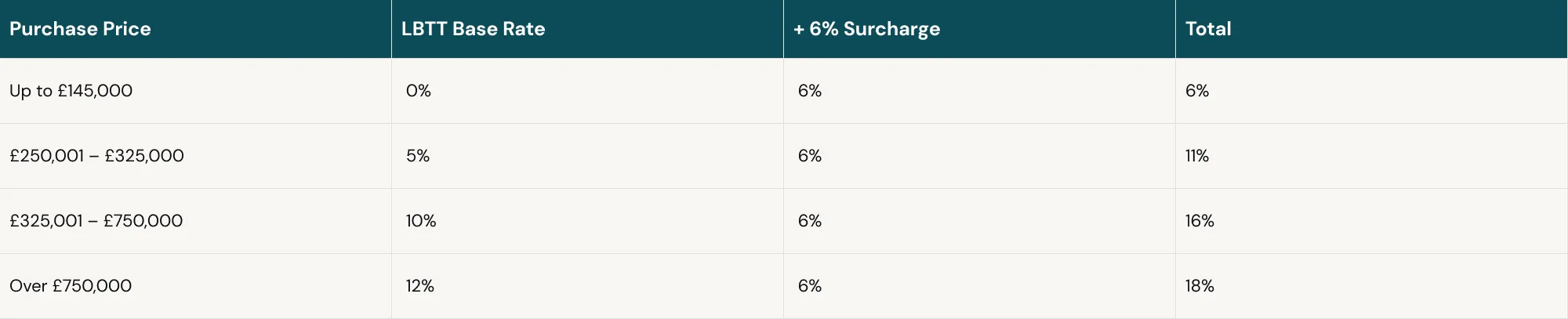
    In Scotland, it is called Land and Buildings Transaction Tax – LBTT and is applied in the following way:
    Land and Buildings Scotland Transaction Tax
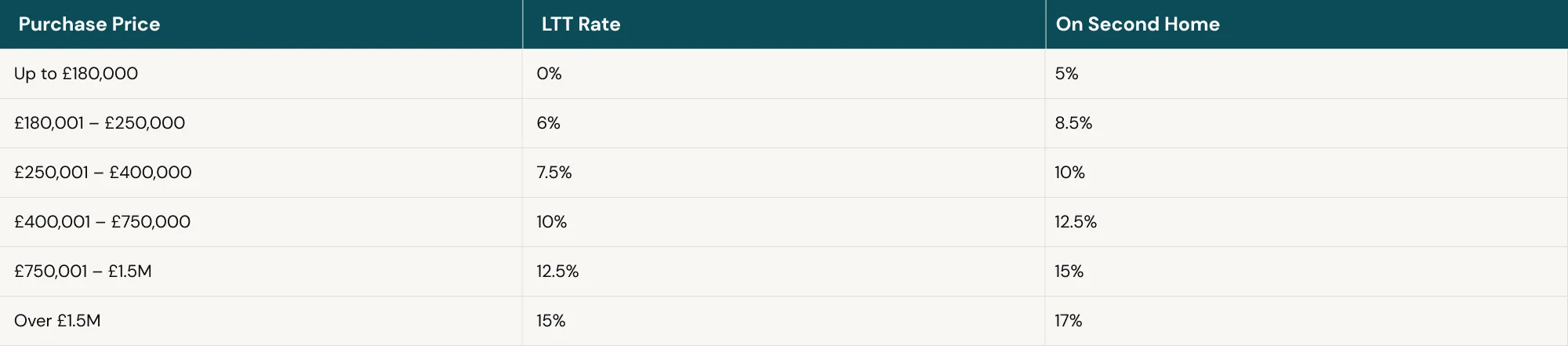
    In Wales, it is called Land Transaction Tax – LTT and applied as follows
    Wales Land Transaction Tax

    Refund of SDLT:

    In England and Northern Ireland, you can get a refund of the 3 % surcharge in the following cases: 

    • You buy a second property before selling your main home.
    • Then sell your old home within 3 years.
    • You make a claim to HMRC within 12 months of selling the old home, or 12 months after filing the SDLT return (whichever is later).

    Here is how you do it:

    • Go to GOV. UK SDLT refund form.
    • Create a Government Gateway ID.
    • Fill in the online SDLT repayment form.
    • Include details of both properties (first and second home), purchase and sale dates and tax amounts paid and requested.

    2. Council tax

    Council tax is a local tax that councils collect for domestic property. In exchange for this tax, councils provide you with services such as road maintenance, social services, waste collection, etc.. You have to pay council tax according to the following rules on a second home:

    • You’ll usually have to pay full Council Tax on second homes.
    • Some councils may offer a discount (e.g., 10%-50%), but this is entirely up to the local authority.
    • Some councils charge more, applying a “second homes premium” — up to 2x the normal Council Tax.

    For an empty home, it depends on your council how much they charge you. Some councils can offer a discount from 0% to 100% spending on their policy. 

    Second and empty homes premium:

    Local authorities can now charge up to 100% extra (i.e., double the standard Council Tax) on properties classed as second homes. There is no grace period as the premium can apply as soon as the property meets the criteria. The authority must have given 12 months’ public notice of its intention to apply the premium. It can also be applied to empty homes that have been unoccupied and unfurnished for more than 12 months. The increase in charges is dependent on how much time has passed since they have been empty. Here is the increase after time:

    • 100% extra after 1 year (i.e., 2× bill)
    • 200% extra after 5 years
    • 300% extra after 10 years

    Second and empty home premiums are applied to council tax bills. There is no requirement for the council to notify individual taxpayers beyond public notice.

    Exemption from Council tax:

    There are exemptions to this tax on second homes. These exemptions can be temporary and permanent. Here is how they are applied:

    Temporary 12-month Exemptions:

    The following exemptions can be given for 12 months each:

    • Probate Exemption

    This is given the property’s owner has died. It is granted from the date of the owner’s death.

    • Marketing Exemption

    This exemption is applied if the property is being actively marketed for sale or let. 

    These exemptions can apply in succession i.e., 12 months for probate and 12 months for sale, a total 24 months exemption. 

    Other than these, you can apply for removal from the council tax list if your property:

    • Is undergoing major structural work
    • Is derelict, meaning not wind or watertight, unsafe for inhabitation or requiring extra repairs

    You will have to apply to the council and inform them when the repairs are done. You’ll have to pay backdated tax if there is a delay. 

    Permanent Exemptions:

    You can be given a permanent exemption from this tax on second homes if any of the following is true for you:

    • Annexes used as part of the main home
    • Armed forces accommodation requirement
    • Caravan pitches and boat moorings
    • Planning restrictions preventing full-time use. The following conditions should also be followed in this case.
      • Cannot be occupied for more than 28 continuous days
      • Must be used only as a holiday let
      • Prohibited from use as a sole/main residence

    These exemptions do not remove the standard Council Tax liability, only the premium.

    Here is a summary of council tax on second homes being applicable in different situations:

    Situation Second Home Premium? Empty Home Premium? Exemptions?
    Holiday home Possible No Depends on use/planning
    Probate (12 months) No No Yes
    Renovating Maybe Maybe If derelict or uninhabitable
    Armed Forces home No No Yes
    For sale/let Maybe Maybe 12 months
    Planning use restricted No Maybe Yes
    Annex No No Yes

    3. Income tax: 

    If you rent out your second home, you will have to pay tax on rental income. The amount of tax depends on your total income which includes your salary, rental income, and any other business or investment income. Here is how the tax rate is applied.

    Income Tax Rate
    Personal Allowance Up to £12,570 0%
    Basic Rate £12,571 – £50,270 20%
    Higher Rate £50,271 – £125,140 40%
    Additional Rate Over £125,141 45%

    For instance, you earn £35,000 from your job and £10,000 net rental income from your second home. Your total income is £45,000. You fall under the basic rate so you’ll pay 20% tax on your income over your personal allowance. 

    As for rental income, you are only charged tax on your profit, not the entirety of your income. Your rental profits can be reduced by using allowable expenses such as accountant fees, letting agent fees, service charges, maintenance and repair, etc.

    4. Capital Gains Tax

    Capital gains tax on second homes is the tax that you pay on profit when you sell your second home at a higher price than it was bought for. Capital gains tax on second homes is higher than on other assets. Therefore you should ask how to avoid capital gains tax on second homes.

    Taxpayer Status Residential Property CGT Rate
    Basic Rate (20% income tax) 18% on the gain
    Higher or Additional Rate 24% on the gain

    For non-property assets like shares,it ranges from 10-20%. 

    Capital gains tax on second homes is to be reported immediately. From April 2020 it is to be reported in 60 days. So as soon as you sell your property, you have to calculate the gain. After that you have to report it to the HMRC online using the ‘Capital Gains Tax on UK Property’ service. Then, you have to pay this tax on second homes. All of this should be within 60 days of sale completion, or else there will be penalties. 

    How to calculate capital gains tax on second home

    The formula for calculating capital gains tax on a second home is as follows:

    Capital Gain = Sale Price – (Purchase Price + Allowable Costs)

    Allowable costs include:

    • Buying costs (legal fees, stamp duty, survey costs)
    • Selling costs (estate agent fees, solicitor fees)
    • Improvements (e.g., extension, loft conversion — but not repairs like repainting or replacing broken appliances)

    How to avoid capital gains tax on second homes UK

    You can’t avoid paying this tax on second homes altogether. We still must find ways on how to avoid capital gains tax on second homes uk. You can reduce it using the following ways:

    1. Use Your Annual Capital Gains Tax (CGT) Allowance

    Every individual gets a tax-free CGT allowance (£3,000 for the 2025/2026 tax year). You don’t have to pay any CGT if the gain is below this amount. Married couples can combine their allowances. This helps them shield £6,000 from this kind of tax on second homes.

    2. Offset Allowable Costs

    Another way of reducing the tax on second homes is to incorporate allowable costs. The allowable costs that you can offset include legal, professional, and estate agent fees. You can also offset improvements to the property but not the repairs and maintenance. 

    3. Transfer Ownership to Spouse

    You can transfer a part of your property to your spouse or civil partner with no CGT. In this way, you’ll probably be in the lower CGT band, i.e., 18% tax on the gain. 

    4. Letting Relief:

    If you have lived in your property as your main residence before renting it out, you are eligible for letting relief. However, it only applies if you share occupancy with your tenants. This relief on tax on second homes is not widely available anymore unless the second home was your actual residence before letting. 

    5. Plan the timing:

    Spread property or asset sales over multiple tax years to use CGT allowances in both years and stay within a lower tax bracket. 

    Whether it be a job or a second home. Tax situation differs with each type of income. To learn more about taxes on your second job, check out our blog on how much taxes you pay on your second job.

    Conclusion:

    Owning a second home can be a good investment as well as a source of income. However, the myriad of taxes that are applied to it can be a hassle to calculate. Therefore, you should use professional services for tax calculations. At Sterling Cooper Consultants, we not only understand your tax liability, but we also make sure to claim every available allowance. With our taxation services, we make the most of tax reliefs and strategies and do your taxes on time to avoid penalties.

    Taxes can be hectic, especially with a second home or a job.

    For you it don’t have to be. Contact us now to get hassle free taxation done.
    +443300102526
    Book an Appointment

    FAQs


    Can you have two main residences to avoid the second home tax?


    No, you cannot have two main residences. Married couples and civil partners can also have only one main residence.


    Coastal hotspots such as Padstow in Cornwall and Blakeney in Norfolk have 1 in 10 homes designated as holiday homes.


    Day-to-day costs include utility bills, cleaning and gardening costs, admin costs and taxes.


    According to data provided by the UK parliament, the number of second homes has not decreased because of the second home premium. It may be because the empty home premium is only applied after a year of the house remaining vacant.


    No stamp duty does not apply to caravans or motorhomes.

    Share This Article!

    Recent Posts

  • What You Need to Know About CIS Tax Repayment Claims?

    What You Need to Know About CIS Tax Repayment Claims?

    cis repayment claim

    Posted by:

    Admin

    Date:

    January 14, 2026
    Category:

    blogs

    Error: Contact form not found.

    What You Need to Know About CIS Tax Repayment Claims?

    The construction industry scheme, or CIS, is how the contractor pays subcontractors, such as plumbers, electricians, and others.
    When they pay you, they take out tax from your pay. This means that if they have to pay you £1,000, they’ll pay you only £800 and send the rest to the HMRC. Since, they charge the basic rate i.e., 20%, you can file a CIS repayment claim afterwards. This may let you claim CIS refund. Here is all the information you need to do that.
    “81% of all respondents agree that CIS is effective in ensuring that construction businesses pay income tax.”
    (Evaluating the Construction Industry Scheme Report for HM Revenue and Customs) 

    Eligibility to file a CIS claim:

    Your eligibility to file a CIS repayment claim is defined by the following criteria.

    • Either your tax or national insurance is overpaid
    • You are a subcontractor or agent of a limited company.

    Who can claim repayment of deductions from CIS:

    Following qualify as someone who can claim repayment of deductions from CIS:

    • Sole trader who is self-employed and registered under CIS.
    • Partnership that works in construction.
    • Limited company that works as subcontractor.

    Even if you are an unregistered worker, you may still claim repayment of deductions from CIS if you eventually register.

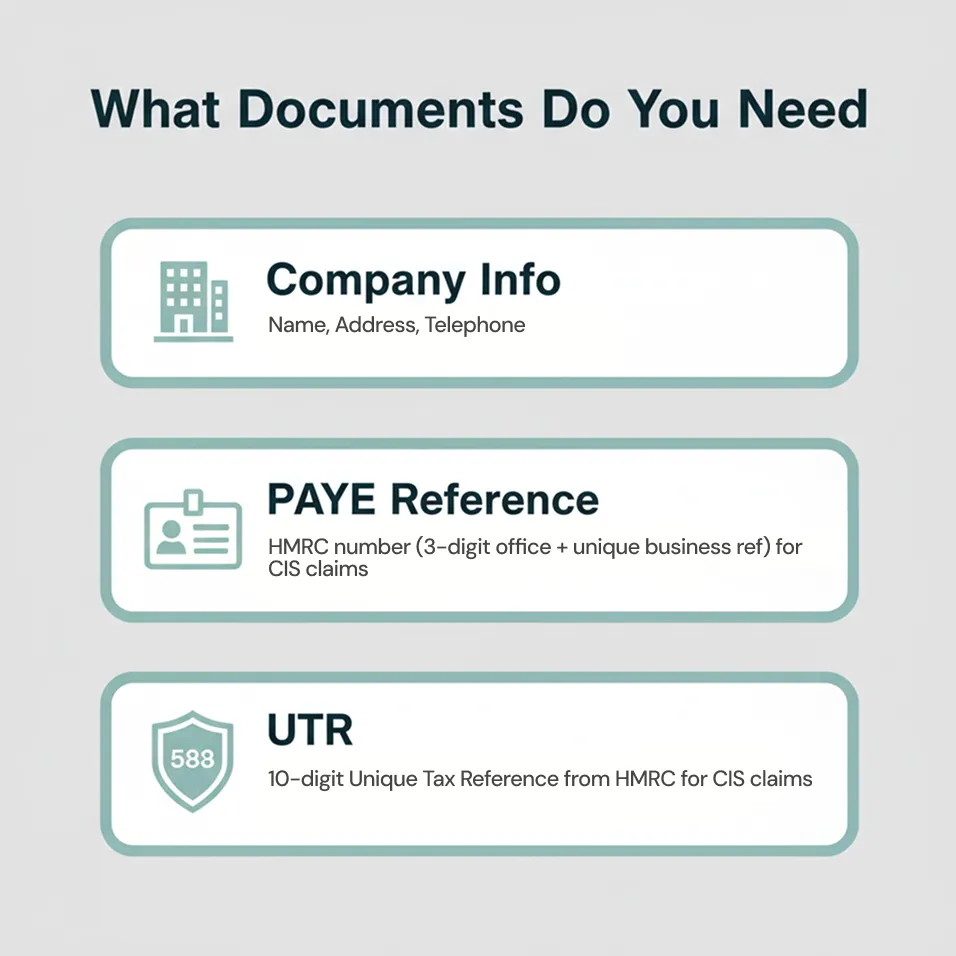
    What documents do you need

    To file a CIS repayment claim, you need the following documents:

    Information of the company:

    You need the following information of your company to file a CIS repayment claim:

    • Name of the company
    • Address
    • Telephone number

    Here is some other documents that you may need for CIS repayment claim:

    PAYE Reference number:

    A PAYE reference number is allotted by the HMRC to businesses. It helps them pay their employees through the UK tax system i.e., the PAYE system. It is composed of some letters and numbers. The PAYE reference number has two parts. The first is the office number of HMRC and consists of 3 digits. The second is a reference number which is unique to your business. You need this to file a CIS repayment claim.

    UTR of the company

    A UTR or unique tax reference is issued by the HMRC to all the new limited companies. Its purpose is the identification of the company for tax and related matters. It consists of 10 digits. This is required for CIS repayment claims.
    What Documents Do You Need

    Tax amount

    You have to provide the amount of tax you overpaid for a CIS repayment claim. 

    Deduction from Taxes:

    If you wish, you can claim repayment of deductions from CIS from your taxes, you need to tell HMRC the amounts you owe or will owe. Following are the taxes from which your CIS repayments can be deducted and the documents you need to do so. 

    Corporation tax:

    You have to include your corporation tax unique taxpayer reference.

    VAT

    In this case, your VAT registration number will be included. 

    Additional information:

    Additional documents for information are only needed in case your CIS repayment claim is for the current year. You’ll have to submit all your bank statements and Payment and Deductions statements. 
    For submission to the agent or any other representative, your claim is to be submitted with a signed authority or form R 38. 
    If your details do not match your records, HMRC might request for additional information. 

    Claiming a CIS tax repayment

    To claim a CIS tax repayment, you have to follow either of these procedures depending on your status. 

    Self Employment:

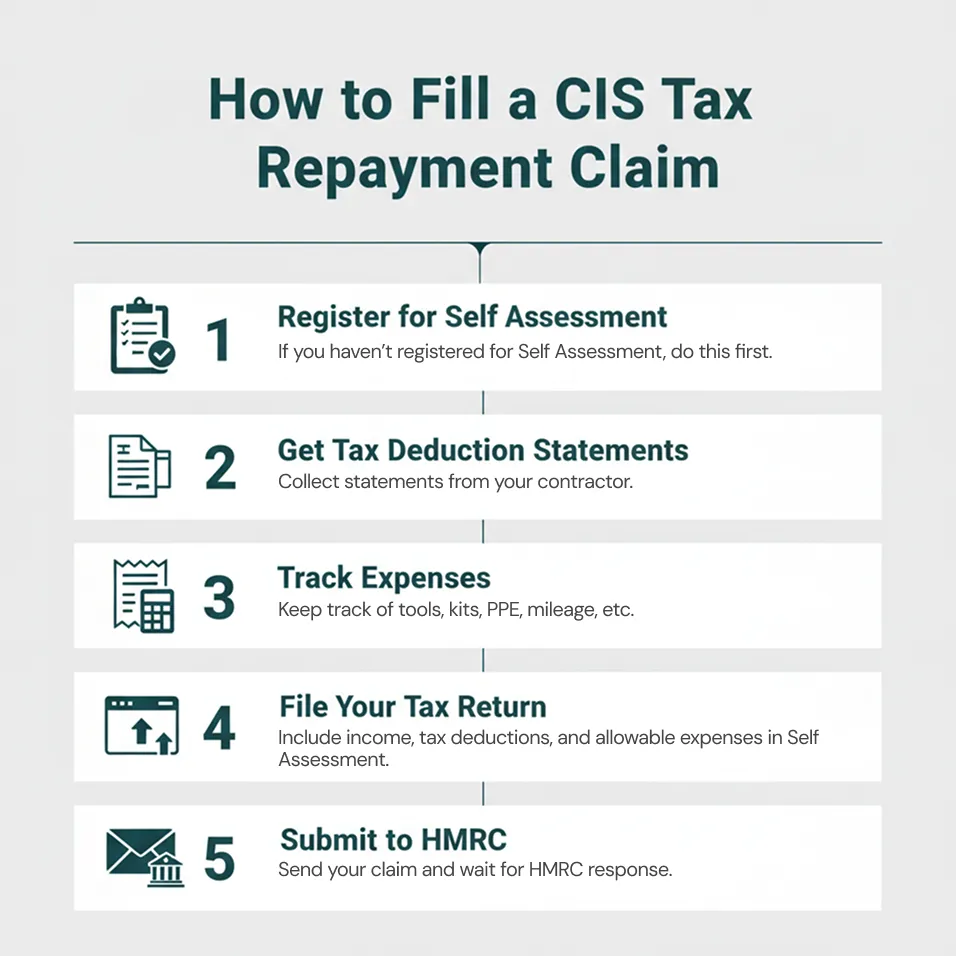
    Here are the steps for filing the claim:

    1. Firstly, register for Self Assessment if you have not done that till now. 
    2. Next, get your tax deduction statements from the contractor. 
    3. Your expenses should be kept track of. Some of the expenses include tools, kits, PPE, mileage, etc. 
    4. File your tax return with Self Assessment. Include your income, tax deductions and allowable expenses. 
    5. Make a submission to HMRC and wait for their response. 

    As an individual, you can claim CIS repayment in the current year. For this refund you’ll have to fill the CIS repayment claim form i.e., CIS40.
    How to Fill a CIS Tax Repayment Claim

    Limited Companies:

    You can be either of two situations described here as a limited company.

    Gross Payment status:

    This means that your contractor has paid you the complete amount. They have not deducted the tax. You have to declare it on your corporation tax return.

    Tax Deducted:

    Don’t claim CIS refund on your corporation tax return. It may lead to a penalty. Instead do the following:

    Send FPS:

    FPS stands for full payment summary. This is your regular monthly payroll report to HMRC. It contains complete details of who you paid( the employees and directors) and the tax and National Insurance due.

    Send EPS:

    The EPS or Employer Payment Summary tells HMRC that you have CIS tax deducted. This also includes the total CIS deductions that have happened this year.

    Partnership:

    To claim CIS refund:

    • Declare income tax and deductions.
    • File the tax return. One of the partners, the designated one, can do it on behalf of the partnership.

    How to claim

    You can claim CIS repayment in either of the following ways:

    1. Online claim

    You can claim CIS repayment online using your government gateway account. Sign in with your user ID and password. If you don’t have this, you can create one.

    2. Claim by post

    You can also claim CIS repayment by post. You can write a request to HMRC using the required documents. Mark it as CIS. Send your claim to this address.

    PT Operations North East England

    HM Revenue and Customs

    BX9 1BX

    United Kingdom

    “Most businesses (87%) still use at least some paper-based methods to administer CIS and around half (49%) use a mix of paper and electronic methods.”

    How does the HMRC pay

    The HMRC, as described earlier, uses the amount they owe you to pay other taxes of your company (say VAT, PAYE). They can also pay late tax penalties with this amount. This repayment appears as confirmation on your company’s tax system. The rest of the amount (if any) is refunded to you in the following ways:

    • It can be returned to you as payable order on the address of your company.
    • It can also be returned to the payment card that was used to pay originally.

    Payment of Interest

    HMRC pays you interest on your tax in the following cases:

    • You paid tax early:

    If you have paid tax early, HMRC pays you interest up to the deadline of the filing returns. They only start adding interest from 6 months and 13 days after the start of your accounting period.

    • You paid more than you owe

    In this case HMRC will pay interest from the date the tax was due.

    Amendments of claim

    If you do not include your full information, you can amend your CIS refund claim. You can do this through online form or by post. You should mark this claim as ‘revised claim’. Mention the entire amount that you are claiming and your original claim.

    For filing accurate claims, contact Sterling Cooper Consultants. Our taxation services will make sure that you add all the relevant documents. We make sure that the process is smooth and efficient.

    Don’t wait up on making your claim.

    Each passing day it gets more difficult. The time to do it is now. Contact us to avail premium tax repayment claims services.
    +443300102526
    Book an Appointment

    FAQs


    Can you claim your tax refund in-year?


    Yes, you can claim in-year. This happens when your employment is complete and your affairs are up to date. You have to complete the CIS40 form in this case.


    HMRC calculates interest after they know your final bill. They start calculating interest from the first installment date. They can also start from the date your balance goes over what you owe.


    Yes, you can do this. You just have to open the return you have to resubmit and just click the ‘resubmit to HMRC’ option.


    If you don’t have them, include the reason you don’t have all of your statements in addition to all the other required documents.


    It can take up to 4-8 weeks after submission. It can take longer if HMRC needs any verification or clarification.

    Share This Article!

    Recent Posts

  • The Ultimate Guide to Business Start-Up Loans

    The Ultimate Guide to Business Start-Up Loans

    start-up loan

    Posted by:

    Admin

    Date:

    January 13, 2026
    Category:

    blogs

    Error: Contact form not found.

    The Ultimate Guide to Business Start-Up Loans

    Starting a business often means spending money before the business starts generating revenue. From equipment and stock to marketing and day-to-day costs, those early expenses can add up quickly.

    A UK Start-Up Loan could help cover those early costs, but is it right for you? How much could you borrow, what could you use the funding for and what would the repayments involve? Do you qualify and what alternatives are available?

    This guide covers Start-Up Loans in the UK, from eligibility and costs to how the funding works, how to apply and what alternatives are available.

    Key Takeaways

    • Start-Up Loans are government-backed personal loans for people starting or growing a business in the UK.
    • Eligible applicants can borrow between £500 and £25,000 at a fixed interest rate of 7.5% per year.
    • The loan can be repaid over one to five years, with no arrangement fee or early repayment charge.
    • Funding can be used for a range of business costs, including equipment, stock, premises, marketing and working capital.
    • Applicants need to meet the scheme’s eligibility, credit and affordability requirements.
    • Other funding options, including grants, equity investment and crowdfunding, may be more suitable depending on the business.

    What Is a Start-Up Loan?

    A Start-Up Loan is a government-backed personal loan for people starting or growing a business in the UK. Eligible applicants can borrow between £500 and £25,000 at a fixed interest rate, with repayment terms of one to five years.

    Although the money is used for business purposes, the loan is taken out personally and is unsecured, so no business asset is required as security. The scheme is available to people starting a business or running one that has traded for less than five years. Successful applicants can also receive business-plan support and up to 12 months of free mentoring.

    Who Is Eligible for a Start-Up Loan in the UK?

    Start-Up Loans are designed for people who are starting a new business or have an existing business that has been trading for less than five years. However, applicants must meet several conditions before they can receive funding.

    Eligibility Requirements

    The applicant must be 18 or over, be a UK resident and have the right to work in the UK. The business must be UK-based and either new or trading for less than five years. Applicants must also meet the scheme’s credit and affordability requirements and be unable to secure finance elsewhere.

    When You May Not Be Eligible

    Eligibility also depends on the type of business and how the funding will be used. The scheme does not fund certain activities, including weapons, gambling, pornography, illegal activities and some regulated financial services. The loan also cannot be used to repay existing debt, pay for training or education, or fund investments unrelated to the business.

    Once you know whether you meet the eligibility requirements, the next question is how much you could borrow and what the loan would cost.

    How Much Can You Borrow and What Does It Cost?

    Understanding the amount available and the repayment terms can help you decide whether a Start-Up Loan is suitable for your business.

    Key Costs and Terms
    Term Details
    Loan amount £500 to £25,000 per person
    Interest rate Fixed at 7.5% per year
    Repayment term One to five years
    Arrangement fee None
    Early repayment fee None

    Loan Amount and Interest Rate

    The scheme offers £500 to £25,000 per person, with a fixed interest rate of 7.5% per year. Each eligible owner or director can apply for up to £25,000 individually. If four people in the same business each qualify for the maximum amount, the business could receive up to £100,000 in total. 

    The amount borrowed affects the size of the monthly repayment, while the repayment term determines how quickly the balance must be paid back.

    Repayment Terms

    The loan can be repaid over one to five years, with the repayment period agreed as part of the application. A longer term spreads the borrowing across more monthly payments, which can make individual repayments easier to manage, but interest is paid over a longer period. A shorter term means higher monthly repayments but allows the balance to be cleared sooner.

    Before applying, consider whether the expected monthly repayment can be covered alongside the business’s other regular costs, particularly during the early months when income may be unpredictable.

    Fees and Early Repayment

    There are no arrangement fees and no charge for repaying the loan early. This means there is no additional fee for settling the loan before the agreed repayment period ends.

    What Can You Use a Start-Up Loan For?

    A Start-Up Loan can be used for reasonable business costs that support the launch or growth of the business. Common examples include:

    • Equipment and machinery
    • Initial stock and materials
    • Premises and associated costs
    • Website development and product development
    • Marketing and advertising
    • Working capital and other day-to-day business expenses

    The planned spending should be included in the business plan and cash flow forecast, showing how the funding will support the business and its expected costs. With the intended use of the funding clear, the next step is to prepare the documents needed for the application.

    How to Apply for a Start-Up Loan

    Applying for a Start-Up Loan involves preparing information about your business, demonstrating how the funding will be used and undergoing credit and affordability checks.

    Prepare Your Business Plan and Cash Flow Forecast

    The application starts with a business plan and a 12-month cash flow forecast. The business plan should cover the business idea, target market, pricing, marketing and operations. The cash flow forecast should set out expected income and spending, including how the loan will be used and how repayments will be covered.

    Quick tip:

    Keep the figures in the business plan and cash flow forecast realistic and consistent. The forecasts should clearly show how the business expects to generate enough income to cover its costs and loan repayments.

    With these documents ready, the next step is to submit the application and provide the required information.

    Submit Your Application

    The application requires details about the applicant, business and proposed borrowing, along with the supporting documents. The information provided should be consistent with the business plan and cash flow forecast, including the amount requested and how the funds will be spent.

    After submission, the application goes through credit and affordability checks.

    Credit and Affordability Checks

    The application includes a personal credit check and an assessment of whether the proposed repayments are affordable. The assessment considers the applicant’s financial position alongside the information provided about the business before a lending decision is made.

    If the application meets the scheme’s requirements, the loan can then be approved and completed.

    What Are the Benefits and Risks?

    Like any form of borrowing, a Start-Up Loan has advantages and potential drawbacks. Considering both can help you decide whether it fits your financial position and business plans.

    Pros and Risks of a Start-Up Loan
    Benefits Risks and Considerations
    Fixed interest rate makes borrowing costs more predictable. You are personally responsible for repaying the loan.
    No arrangement fee. Interest means the total amount repaid will be higher than the amount borrowed.
    No charge for early repayment. Monthly repayments must be maintained even if the business performs below expectations.
    Access to business-plan support and mentoring. Taking on debt creates a financial commitment during the early stages of the business.
    Funding can be used for a range of eligible business costs. The amount available may not cover all of a business’s funding requirements.

    What Are the Alternatives to Start-Up Loans?

    A Start-Up Loan is not the only way to fund a new business. Depending on your circumstances, another source of finance may offer a better fit.

    Business Grants

    Some grants provide funding that does not need to be repaid. Availability varies by location, industry and eligibility criteria, so businesses need to research the schemes relevant to them.

    Equity Investment

    Equity investment involves raising money from investors in exchange for a share of the business. This can provide substantial funding without monthly loan repayments, but it means giving up some ownership and potentially some control.

    Crowdfunding

    Crowdfunding allows a business to raise smaller amounts of money from a large number of people. Depending on the model used, supporters may receive a product, reward or equity in return.

    Alternative Online Lenders

    Online lenders may offer business finance with different eligibility requirements and repayment structures. However, businesses should compare interest rates, fees and repayment terms carefully before committing.

    Bootstrapping

    Bootstrapping involves funding the business through personal savings and the revenue it generates. This avoids borrowing costs and external investment, but may limit how quickly the business can grow.

    Case Study: How a Start-Up Loan Helped Launch Entropy Olfactory

    Entropy Olfactory is a fragrance business founded in Bristol. The business used Start-Up Loan funding to support several costs involved in establishing and developing the company.

    The funding helped with expenses such as product development, materials, packaging and other costs involved in getting the business operational.

    The business now sells its fragrances online and at markets in Bristol and Bath, while continuing to develop new products. The example shows how Start-Up Loan funding can support several practical costs involved in turning a new business idea into a trading business.

    Final Thoughts: Are Start-Up Loans Right for Your Business?

    A Start-Up Loan can be useful if you need funding for specific business costs and can comfortably manage the repayments. Before applying, consider how much you actually need, what the money will fund and whether the expected business income can support the repayments alongside other costs.

    It is also worth comparing the loan with other funding options and considering whether professional financial advice could help you assess your funding needs and early cash flow. Good financial planning can help you make that assessment before committing to borrowing.

    Need Help Planning Your Start-Up Finances?

    Sterling Cooper Consultants can help you build a realistic budget, manage cash flow and plan for upcoming business costs. Get in touch to discuss your financial needs.
    +443300102526
    Book an Appointment

    FAQs


    Is it hard to get a start-up business loan?


    It can be more challenging for a new business because there may be little trading history to assess. For a Start-Up Loan, applicants must meet the scheme’s eligibility requirements and satisfy credit and affordability checks.


    There is no single option that suits every business. The right choice depends on how much funding you need, how quickly you can repay it, whether you meet the eligibility requirements and whether you are comfortable taking on debt or giving up part of the business.


    Eligible applicants can borrow between £500 and £25,000. Where multiple owners or directors apply individually, a business can potentially receive up to £100,000 in total, subject to the scheme’s rules.


    The application requires information about you and your business, along with a business plan and 12-month cash flow forecast. The application then goes through credit and affordability checks before a lending decision is made.


    The timeframe varies depending on the application and whether additional information or checks are needed. Providing accurate, complete financial information can help avoid unnecessary delays.

    Share This Article!

    Recent Posts

  • Late Tax Return Penalties: What to Expect and How to Avoid Them

    Late Tax Return Penalties: What to Expect and How to Avoid Them

    late tax return penalty

    Posted by:

    Admin

    Date:

    January 12, 2026
    Category:

    blogs

    Error: Contact form not found.

    Late Tax Return Penalties: What to Expect and How to Avoid Them

    Missing a tax return deadline can happen more easily than many business owners expect. A busy period, missing records or a problem with an online account can all lead to a return being filed late. The key is to act quickly once the deadline has passed, because a late return can result in more than one charge.

    For Self Assessment, HMRC can issue an initial £100 penalty as soon as a return is late. If the return remains outstanding, further charges can build up, including daily penalties and additional penalties after six and 12 months.

    Knowing the rules before a deadline arrives can save both money and stress. This guide explains the penalties for late tax return submissions, what to do if you have already missed the deadline and when you may be able to appeal a tax penalty.

    Key point:
    A late tax return and late tax payment are separate issues. You can face a filing penalty even when no tax is owed, so filing on time still matters.

    Key Takeaways

    • The initial late tax return penalty for Self Assessment is £100.
    • Further penalties can apply when a return is more than three, six or 12 months late.
    • Late filing and late payment are separate, so both can result in charges.
    • You may be able to appeal a tax penalty if you have a reasonable excuse.
    • Tax evasion penalties are different from penalties for filing a return late.
    • Filing early and keeping accurate records can help you avoid unnecessary HMRC penalties.

    What Is a Late Tax Return Penalty?

    A late tax return penalty is a charge from HMRC when a tax return is submitted after the required deadline. For people who file through Self Assessment, the usual deadline for an online return is 31 January following the end of the tax year. Paper returns generally need to be submitted by 31 October.
    Deadlines can vary in some circumstances, so it is important to check the date that applies to your return. Missing it can lead to an HMRC late filing penalty, even if the return is only slightly late.
    For example, a sole trader may have all the information needed to complete their return but delay filing it because of other business commitments. If the deadline passes, the return can still attract a penalty, even if the final tax bill is £0.

    ‘Completing a tax return often requires time, organisation and detailed information, all of which are harder to manage under last-minute pressure.’
    Alice Haine, Personal Finance Analyst at Bestinvest

    What Is the HMRC Tax Filing Deadline Penalty?

    The initial penalty for filing a Self Assessment tax return late is £100. If the return remains outstanding, further penalties can apply.
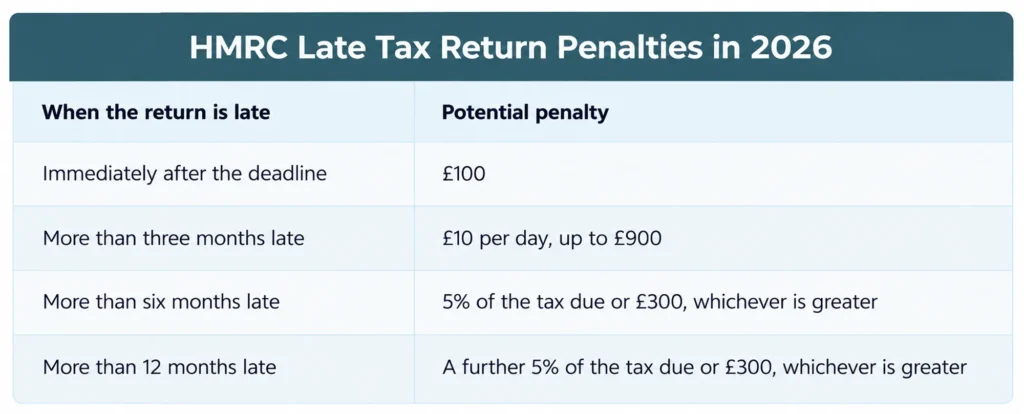
    Here is how HMRC late tax return penalties increase over time:
    HMRC Late Tax Return Penalties in 2026
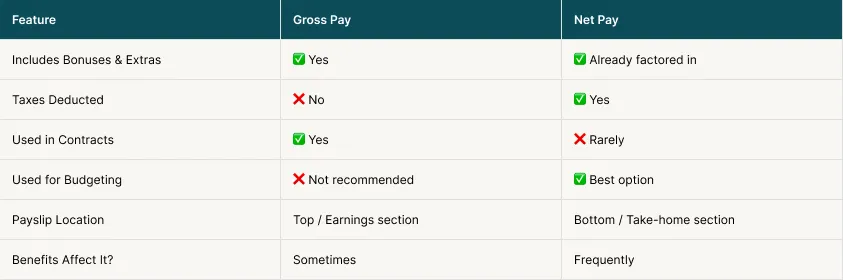
    These are the standard Self Assessment late filing penalties. Higher penalties may apply in certain cases involving deliberate withholding of information.
    The penalties can build up over time. Delaying a return because the initial £100 penalty seems manageable can therefore result in a much larger bill later.

    Does the £100 Penalty Apply If No Tax Is Due?

    Yes. The initial late filing penalty can apply even if you have no tax to pay.
    That is why filing your return on time remains important, even when you expect little or no tax to pay. A return can still be late and attract a penalty based on the filing deadline.

    What Happens If a Tax Return Is Very Late?

    The longer a return remains outstanding, the more the penalties can increase. After three months, daily penalties of £10 may apply for up to 90 days. Further charges can then arise after six and 12 months.
    As a result, a return that was only slightly late can become much more expensive if it is left unresolved.
    If your return is already overdue, submitting it as soon as possible can help prevent further late filing penalties from accumulating.

    Late Filing and Late Payment Are Different

    HMRC treats late filing and late payment separately.
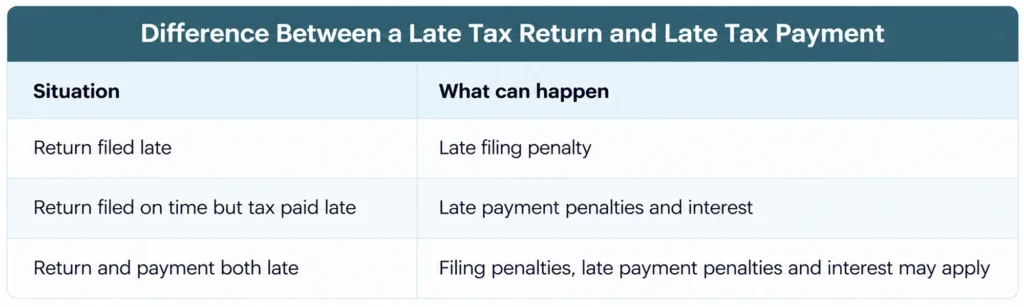
    A late return can lead to filing penalties, while unpaid tax can lead to late payment penalties and interest. Someone who files their return late and also fails to pay the tax due may therefore face charges for both issues.
    Difference Between a Late Tax Return and Late Tax Payment

    Understanding this distinction is important because resolving one issue does not automatically resolve the other.

    What Are the Penalties for Late Tax Return Filing and Late Payment?

    The penalties for late tax return filing depend on how long the return remains outstanding. Late payment follows a separate set of rules.

    For Self Assessment, late payment penalties can apply when tax remains unpaid 30 days after the payment deadline, with further penalties at six and 12 months. Interest can also be charged on unpaid tax.

    It is therefore useful to deal with both issues separately. Filing the return tells HMRC what is owed, while paying the amount due helps prevent further payment-related charges.

    You can check the current rules in the official HMRC Self Assessment penalties guidance.

    What Should You Do If Your Tax Return Is Late?

    A late return does not mean the situation cannot be corrected. The most important step is to deal with it rather than allowing more time to pass.

    1. File the Return as Soon as Possible

    Submit the outstanding return as soon as you can. Waiting longer can lead to additional penalties, so there is usually little benefit in delaying the filing.

    2. Check How Much You Owe

    Once the return has been submitted, check the tax due and any penalties that have already been added to your account.

    If you cannot pay the full amount immediately, contact HMRC rather than ignoring the debt. In some circumstances, payment arrangements may be available.

    3. Check Whether You Have a Reasonable Excuse

    If something outside your control prevented you from filing or paying on time, you may be able to appeal a penalty.

    Examples of possible reasonable excuses can include serious illness, an unexpected hospital stay, the death of a close relative, certain computer or software problems and problems with HMRC’s online services.

    However, simply having insufficient funds or forgetting the deadline will not usually be enough. HMRC considers the circumstances of each case, so an appeal is not guaranteed to succeed.

    You can read the official guidance on appealing a Self Assessment penalty.

    How Can You Avoid Penalties for Late Tax Return Filing?

    Avoiding a late tax return is mainly about having a process in place before the deadline arrives.

    Keep a Tax Calendar

    Record the relevant filing and payment dates in a calendar. Set reminders well before each deadline so you have enough time to collect records and deal with any problems.

    Keep Records Throughout the Year

    Do not wait until January to start gathering financial information. Keeping records up to date as transactions happen makes the tax return easier to prepare and reduces last-minute pressure.

    Put Money Aside for Tax

    If you expect to owe tax, set money aside throughout the year. This can make the payment easier to manage when the deadline arrives.

    Get Help Before the Deadline

    If your return is complex or your records are incomplete, getting professional help early can reduce the risk of missing the deadline.

    This is particularly useful for business owners with several income sources, expenses, investments or other tax matters to report.

    Pro tip: File your return even if you cannot pay the tax straight away. Late filing and late payment are treated separately, so filing on time can help you avoid late filing penalties even if you still owe tax.

    A Simple Example of a Late Tax Return

    Imagine a sole trader needs to submit an online Self Assessment return by 31 January. They miss the deadline and submit the return two months later.

    The initial £100 late filing penalty may apply. Because the return was submitted before it became more than three months late, the additional daily late filing penalties would not normally apply.

    Now consider a different situation. The same person submits the return on time but does not pay the tax due by the payment deadline. In this case, late payment penalties and interest may apply instead.

    These examples show why filing and payment need to be treated as two separate responsibilities.

    Final Thoughts: Stay Ahead of HMRC Penalties

    A late tax return penalty can start at £100 and become much higher if the return remains outstanding. The longer the delay, the greater the potential cost.

    Filing early, keeping accurate records and checking payment dates can make a significant difference. If a genuine problem has already caused a delay, acting quickly and checking whether you have grounds to appeal can also help.

    Keeping up with tax deadlines can be difficult when you are also managing a business. Sterling Cooper Consultants can help with tax returns, accounting and wider compliance requirements, making it easier to manage your financial responsibilities and stay on top of important deadlines.

    Professional support can also help you identify potential issues before they lead to unnecessary penalties.

    Need Help Staying on Top of Your Tax Deadlines?

    Get in touch with our team to discuss your tax and accounting requirements.


    +443300102526
    Book an Appointment

    FAQs


    What is the penalty for filing a tax return late?

    The initial Self Assessment late filing penalty is £100. Further penalties can apply if the return remains outstanding for more than three, six or 12 months


    Yes. You may be able to appeal if you had a reasonable excuse for filing or paying late. Your appeal should explain what happened, why it prevented you from meeting the deadline and what steps you took to address the problem.

    A late filing penalty can still apply even if there is no tax to pay. Having a £0 tax bill does not necessarily remove the requirement to file your return on time.


    No. Late filing and tax evasion are different matters. Tax evasion involves deliberate actions such as hiding income or providing false information to reduce tax. It can result in more serious consequences than an ordinary late filing penalty.


    File the return as soon as possible, check what tax and penalties are due, and consider whether you have a reasonable excuse that could support an appeal. If you are unsure how to proceed, seek professional advice promptly.


    Share This Article!

    Recent Posts

  • Cash vs. Accrual Accounting: Which Method Is Right for You?

    Cash vs. Accrual Accounting: Which Method Is Right for You?

    accrual accounting vs cash accounting

    Posted by:

    Admin

    Date:

    January 8, 2026

    Category:

    blogs

    Error: Contact form not found.

    Cash vs. Accrual Accounting: Which Method Is Right for You?

    The accounting method you use affects when your business records income and expenses. In the UK, businesses may use cash or accrual accounting, depending on their structure, tax rules and reporting requirements. Cash accounting records income and expenses when money is received or paid. Accrual accounting records income when it is earned and expenses when they are incurred, even if payment happens later. 

    The difference can affect how your business reports profits, tracks outstanding invoices and bills, and assesses its financial performance. This guide explains how each method works and helps you determine which approach may be suitable for your business.

    Key Takeaways

    • Cash accounting records income and expenses when money is received or paid.
    • Accrual accounting records income when it is earned and expenses when they are incurred.
    • The UK cash basis can simplify tax calculations for eligible sole traders and partnerships.
    • Accrual accounting can provide a clearer picture of performance when invoices, bills, stock or other timing differences are involved.
    • The accounting method available to you depends on your business structure, tax rules and reporting requirements.

    Cash vs. Accrual Accounting: What Is the Difference?

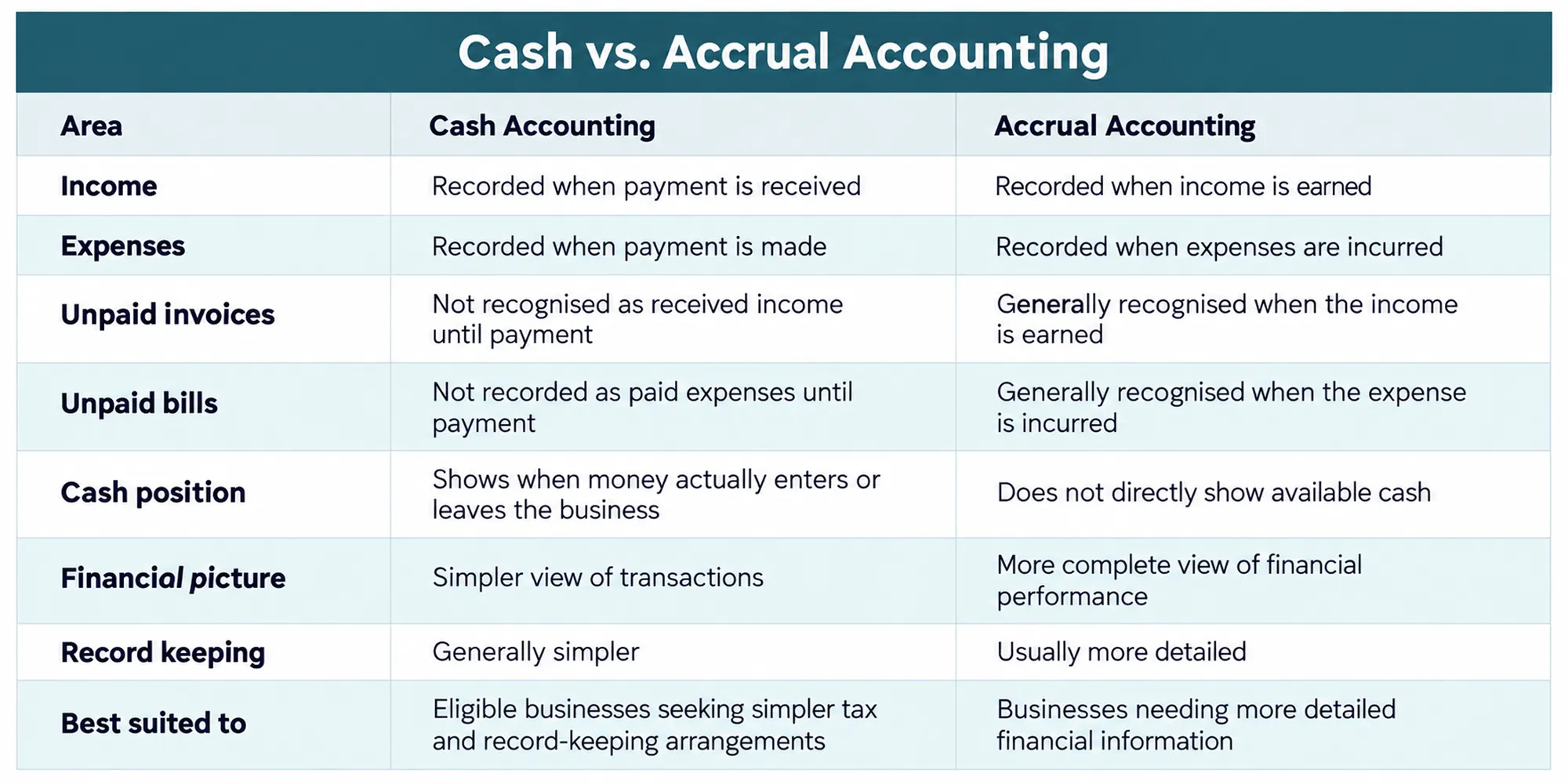
    The main difference between cash and accrual accounting is when income and expenses are recognised. Under cash accounting, income is generally recorded when payment is received and expenses when they are paid. Under accrual accounting, income is recognised when it is earned and expenses when they are incurred, regardless of when the money changes hands:

    For example, suppose you invoice a customer £1,000 in March, but they pay you in April. Under cash accounting, the £1,000 is recorded when you receive the payment in April. Under accrual accounting, the income is generally recognised when it is earned in March. The same principle applies to expenses. Cash accounting records an expense when you pay it, while accrual accounting records it when you incur the expense. 

    This timing difference can affect reported profits and the way your business’s financial position is understood.

    What Are the Advantages and Disadvantages of Cash Accounting?

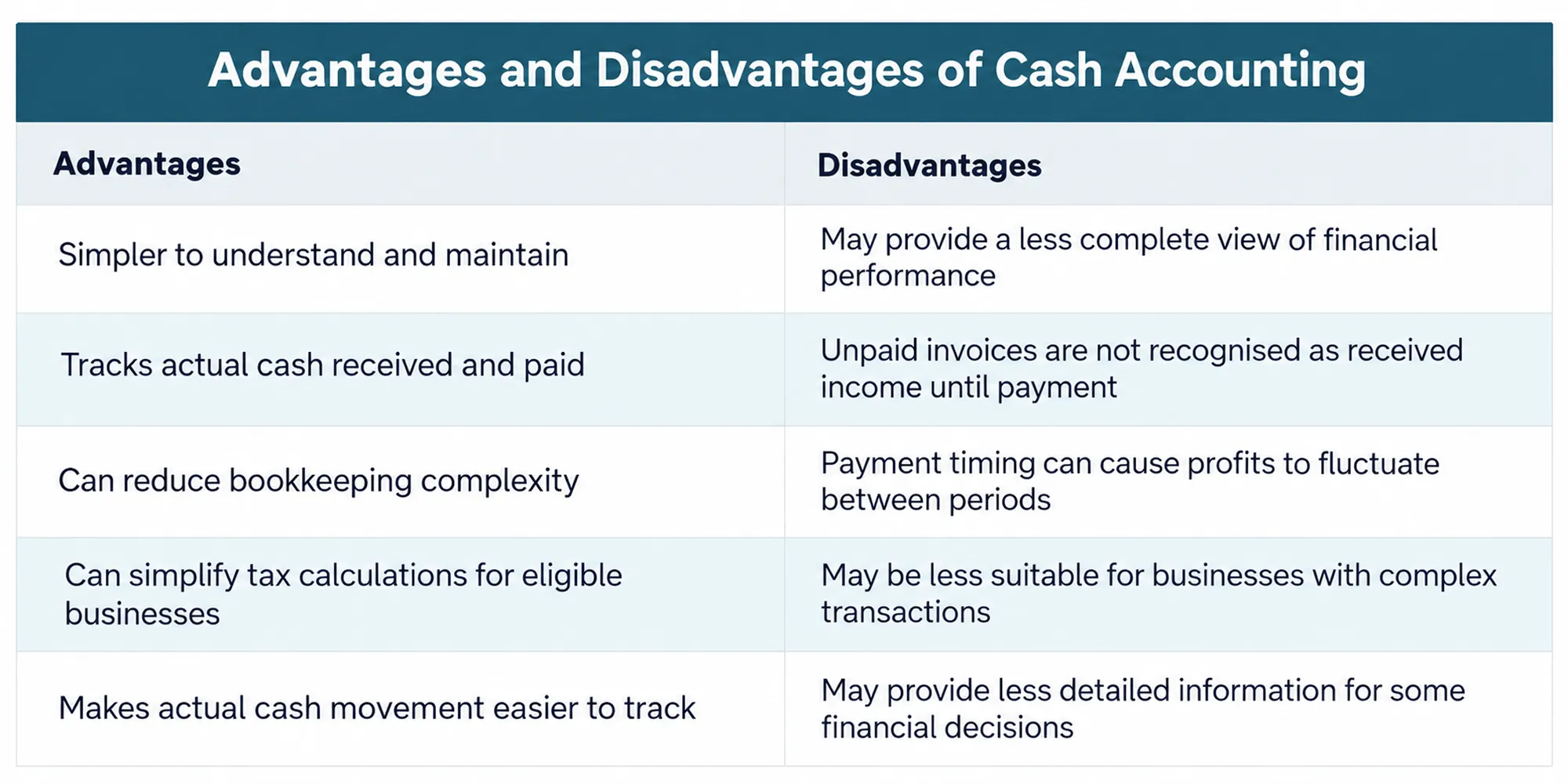
    Cash accounting can simplify bookkeeping because transactions are recorded when money is received or paid. For eligible UK businesses using the cash basis, it can also simplify the calculation of taxable trading profits. However, cash accounting does not always provide a complete picture of business performance. 

    For example, an invoice may remain unpaid at the end of an accounting period, meaning the business has earned income that is not yet reflected in its cash records. The table below describes the advantages and disadvantages of cash accounting for a business:

    What Are the Advantages and Disadvantages of Accrual Accounting?

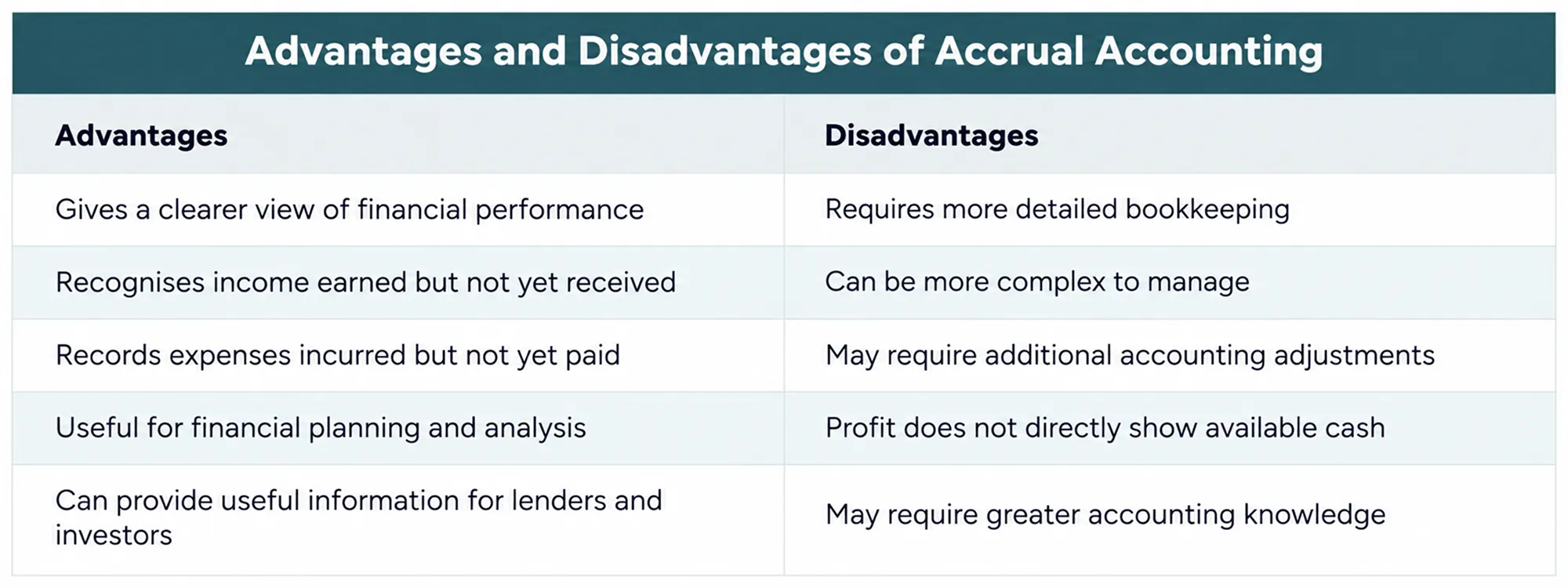
    Accrual accounting gives a broader view of business performance by recognising income and expenses in the period they relate to. This can be particularly useful when a business has unpaid invoices, outstanding bills, stock or other transactions that span different periods.

    It can help you understand what your business has earned and incurred during a reporting period, rather than focusing only on when payments are made.

    However, accrual accounting generally requires more detailed bookkeeping and accounting adjustments. It also does not show how much cash is currently available, so businesses still need to monitor cash flow separately.

    Accrual accounting is often more suitable for businesses with complex transactions or those that need detailed financial information for planning and reporting.

    Cash vs. Accrual Accounting: Which Method Applies to Your Business?

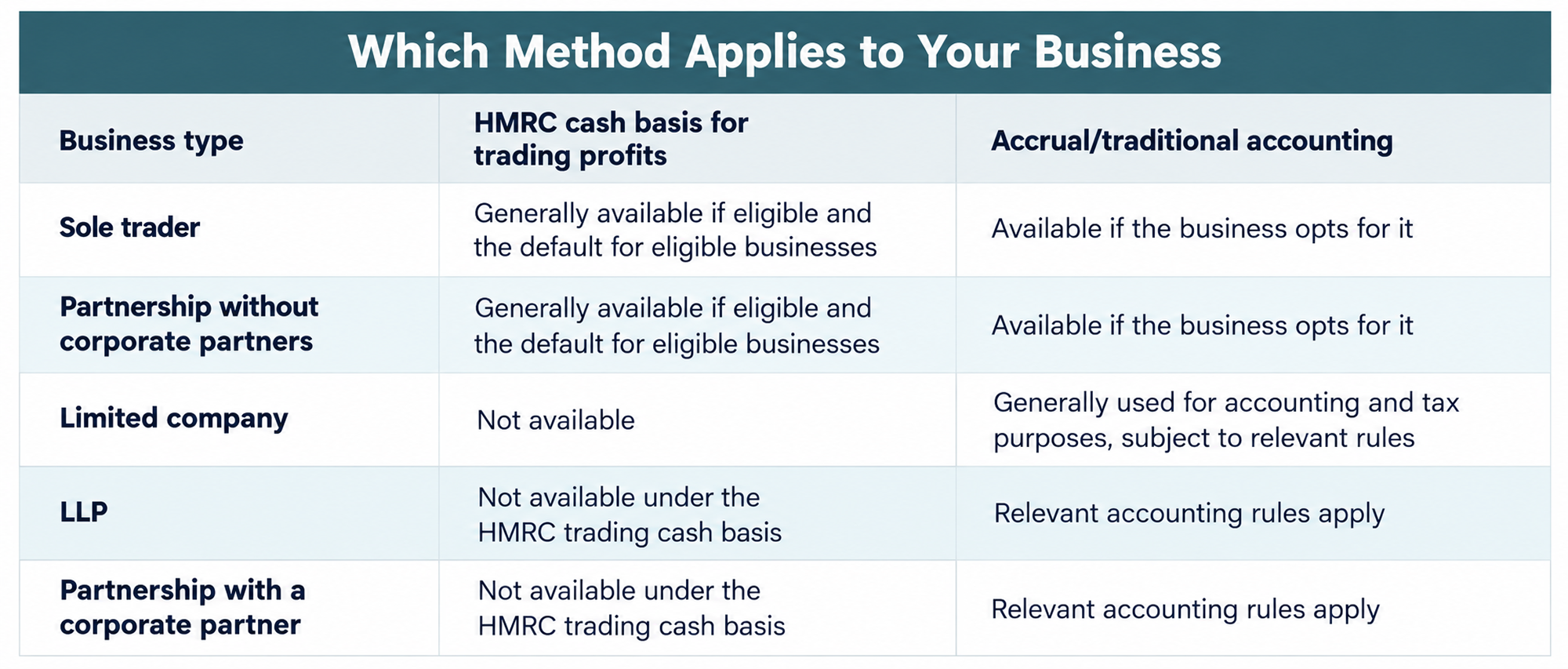
    In the UK, the accounting method available to you depends partly on your business structure. It also depends on whether you are calculating tax or preparing financial statements. 

    For eligible sole traders and partnerships without corporate partners, the cash basis is generally the default method for calculating trading profits from the 2024/25 tax year. However, they can choose traditional accounting instead. The cash basis is subject to eligibility requirements and specific rules.

    Limited companies cannot use the HMRC cash basis to calculate their Corporation Tax profits. They generally calculate taxable profits using accounts prepared under the relevant accounting rules. Tax adjustments may then be required.

    Limited liability partnerships (LLPs) and partnerships with corporate partners are also outside the HMRC trading cash basis.

    It is also important to distinguish tax calculations from statutory financial reporting. Businesses that prepare accounts under an applicable accounting framework, such as FRS 102, may need to use accrual-based accounting for their financial statements.

    The method used for statutory accounts does not necessarily match the method used to calculate taxable profits.

    Because the rules differ according to business structure and purpose, businesses should check the current HMRC requirements and applicable accounting framework before changing their accounting method.

    Which Accounting Method Is Right for You?

    The right accounting method depends on your business structure, transaction patterns, reporting requirements and the rules that apply to your business. There is no single method that is suitable for every business. Cash accounting may suit you if:

    • You are eligible to use the HMRC cash basis.
    • Your transactions are relatively straightforward.
    • Most customers pay soon after receiving an invoice.
    • You want simpler bookkeeping.
    • Tracking actual cash received and paid is a priority.
    • You do not need detailed accrual-based financial information.

    On the other hand, accrual accounting may suit you if:

    • Customers regularly pay invoices after they are issued.
    • Your business has significant receivables or unpaid bills.
    • You hold stock or have more complex transactions.
    • You need a clearer view of profitability for each accounting period.
    • You need detailed financial information for planning or finance applications.
    • Your business structure or reporting requirements mean that an accrual-based approach applies.

    If you are eligible for the cash basis but unsure whether it suits your business, consider how each method affects your tax calculations and financial reporting. Also consider which method gives you a clearer view of your business performance.

    Conclusion

    Cash and accrual accounting mainly differ in when income and expenses are recognised. Cash accounting records them when money is received or paid, while accrual accounting recognises them when income is earned and expenses are incurred.

    For eligible UK businesses, the cash basis can simplify trading profit calculations and record-keeping. Accrual accounting can provide a clearer view of financial performance and may be required for certain businesses or financial reporting.

    The right approach depends on your business structure, tax position and reporting requirements. If you are unsure which method applies, professional accounting advice can help you choose an appropriate approach.

    Need Help Choosing The Right Accounting Method?

    Sterling Cooper Consultants provides accounting and bookkeeping support tailored to your business needs. Speak to our consultants to understand your options and choose an appropriate approach.

    +443300102526
    Book an Appointment

    FAQs


    Does cash accounting affect VAT?

    No. The HMRC cash basis for calculating trading profits is separate from VAT accounting. VAT-registered businesses must follow the VAT rules and use the VAT accounting scheme that applies to them.

    Under the cash basis, stock and work in progress are generally treated differently from traditional accounting, which can simplify the calculation of taxable trading profits. However, businesses with significant stock may still benefit from more detailed accounting records to understand their financial position and performance.

    Yes. Eligible sole traders and partnerships can use simplified expenses for certain costs, such as qualifying vehicle expenses and working from home. Simplified expenses are separate from the choice between the cash basis and traditional accounting.

    Yes, but the rules apply to each trade. If you have more than one business, you can choose cash basis or traditional accounting for each business, subject to the relevant eligibility rules.

    Yes. An eligible business can choose to move from the cash basis to traditional accounting. However, changing methods can require adjustments to prevent income or expenses from being counted twice or omitted.

    Yes. The cash basis has specific rules for claiming relief on capital expenditure. In many cases, qualifying capital expenditure can be deducted directly under the cash basis, subject to exclusions and restrictions. The treatment of cars and other assets can differ, so check the current HMRC rules before making a claim.

    Yes. The rules for calculating and using trading losses can differ depending on whether you use the cash basis or traditional accounting. If your business has made a loss, check the current HMRC rules or seek professional advice before deciding how to use it.

    No. Cash accounting determines when income and expenses are recognised for accounting or tax purposes. Cash flow refers to the movement of money into and out of a business. A business using cash accounting still needs to monitor its cash flow to understand how much money is available.

    Share This Article!

    Recent Posts

  • VAT on Imports: How It Works and What You Need to Know

    VAT on Imports: How It Works and What You Need to Know

    vat on imports

    Posted by:

    Admin

    Date:

    January 7, 2026

    Category:

    blogs

    Error: Contact form not found.

    VAT on Imports: How It Works and What You Need to Know

    VAT or value added tax is a consumer tax. It is added at each step of production, from manufacturing to final sale. It indicates the addition of value on each step. VAT on imports is a tax that you have to pay if you import goods in the UK from outside the kingdom. VAT on imports also applies on services that are provided in the UK from outside. It is also effective upon the services that a vendor from the rest of the world provides in the UK. Businesses should understand the impact of VAT on imports owing to its effects on costs and cash flow. So, here is all you need to know about the UK import VAT.

    Importance of Import VAT in the UK

    This tax plays a very significant role since it affects different aspects of the economy. Here are some of the ways in which it affects the economy.

    • Ensuring trade prices that are fair
    • Maintaining tax uniformity and balancing markets across borders
    • Generating revenue
    • Regulating the goods that can be brought into the country

    “Tax revenue mobilization is important for economic development, particularly in countries with low levels of state capacity. The value added tax (VAT) is a large and growing source of government revenue in most countries of the world.”

    Peter Morrow

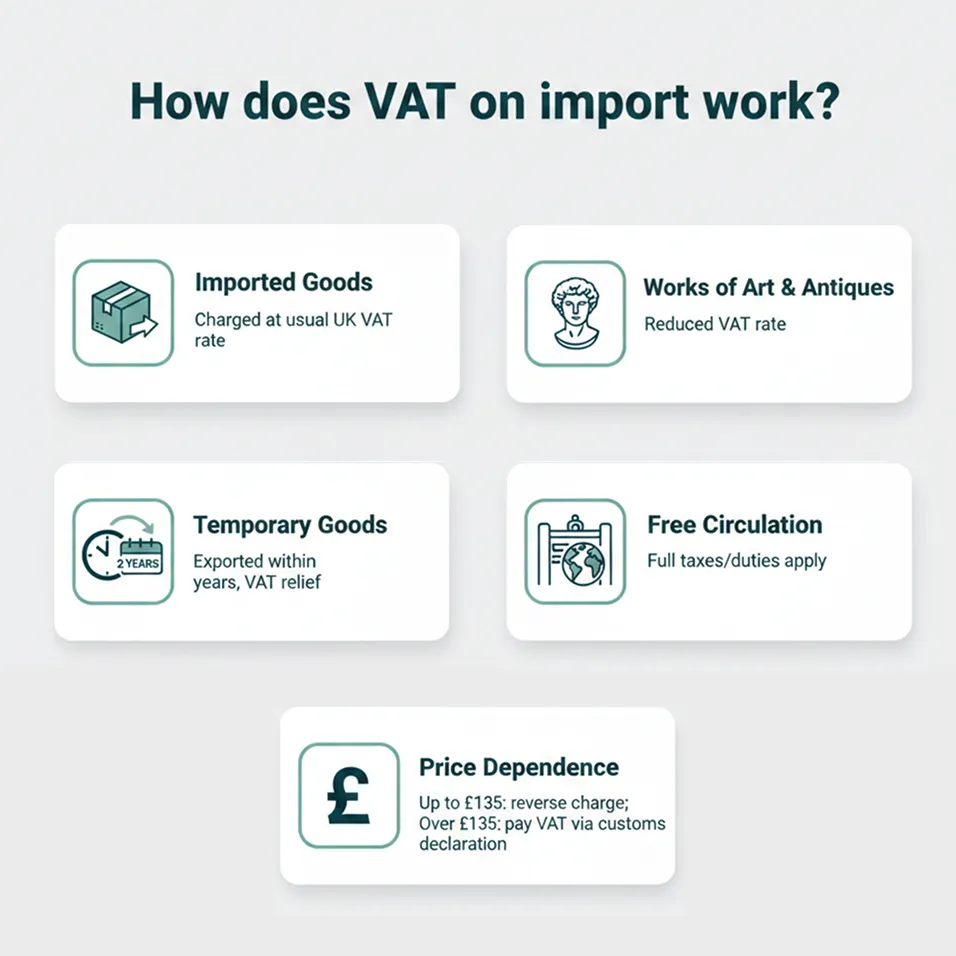
    How does VAT on import work?

    The implication of VAT on import depends upon the types of goods. On most goods, the rate of import VAT in the UK is the same. However, goods such as works of art, collector items, and antiques have VAT on import applied differently. Here are the details on its implications.

    Types of goods:

    The types of goods you are importing are important in deciding this tax.
    Here is how it works on different types of goods.

    Imported goods

    They are charged at the usual amount i.e., the one you pay when supplying them in the UK.

    Works of art

    On any type of antiques or collectors items, you pay a reduced rate.

    Temporary goods

    Temporary goods mean goods that you’ll export in the next two years. Relief is provided in this situation.

    Free circulation of temporary goods

    If your goods are temporary, but they are put in free circulation, you’ll have to pay all kinds of taxes and duties depending on the type.

    Price Dependence:

    The amount of import VAT also depends upon the price of the goods.

    Up to £135

    The tax is reported to HMRC as a reverse charge. This means that you don’t pay the tax but you make HMRC aware of the transaction.

    Over £135

    Over this amount, you pay the VAT on import depending upon your customs declaration.
    How does VAT on import work

    How To Calculate Import Duty And VAT UK?

    Calculation of VAT on import is fairly simple. Custom value of the goods form the basis of this tax. This includes

    • Purchase price
    • Transportation
    • Insurance costs
    • Custom duties

    Standard formula

    Formula for calculating import VAT is:
    Import VAT= (Price of goods + Duty) * rate of VAT

    How to pay VAT on imports

    For paying VAT on import, use any of the following.

    Make a duty deferment account

    If you already have one, you can make a payment once a month. This can be done by direct debit and frees you from paying on each assignment. If you don’t, you can apply for one at the website of the UK government.

    Cash accounting

    This warrants an access to Customs Declaration Service. You can use its cash accounting service to pay this tax.

    Authorise someone on your behalf

    You need access to Custom Declaration Service for this too. After having access to it, you can authorize someone else to pay on your behalf using any of the above options.

    Immediate payment

    You can make immediate payments if you have declared your imported items using the Custom Declaration Service. You can pay online, through bank transfer or through debit or credit (corporate) card.

    Other methods:

    Other methods include getting an import VAT certificate or declaring import VAT on VAT returns.
    If you want to learn more about obtaining  a VAT certificate, you can read our blog: How do I get a VAT Certificate: A Complete Guide

    What if I am not VAT registered?

    If you are not registered for VAT, you still have to pay it. You just won’t be able to reclaim it. You can do either of the following.

    Use an agent:

    If you are not a UK based trader, you can hire an agent based in the UK to import and sell goods. The agent’s services to you will have VAT tax of 20% which cannot be reclaimed. Under section 47 of the VAT act, your agent can act as a principal. This allows them to do the following:

    • They can import goods in their own name.
    • They can reclaim the VAT on import.
    • They can charge you for their services. This includes VAT that you cannot reclaim.

    Use of delayed declaration:

    You can also use delayed declaration. This means a customs entry is made in your own records. If you have made an import record earlier without authorisation, you have to file a declaration later. On filing this you’ll pay the VAT on import. You still cannot reclaim the VAT.

    Import VAT on Services

    Import VAT in the UK also applies on services if you are buying them from another country. This is paid through reverse charge
    For this to work, you have to act as both supplier and customer. Import VAT is then charged on you by yourself. You then claim it back as input tax. The amounts are the same and cancel out each other.
    The reverse charge applies on services described in the Notice 741A. It implies that reverse charge is only applicable if the following conditions are fulfilled:

    • You live in the UK and run a business here.
    • The  provider of the services lives outside the UK.
    • The services fall under the general rule for place of supply of services

    Some of the services on which reverse charge applies are:

    • Land services (such as construction, demolition, etc)
    • Transport services (such as cars, trucks, ships, boats, etc.)
    • Intermediary services (patents, advertising, etc.)

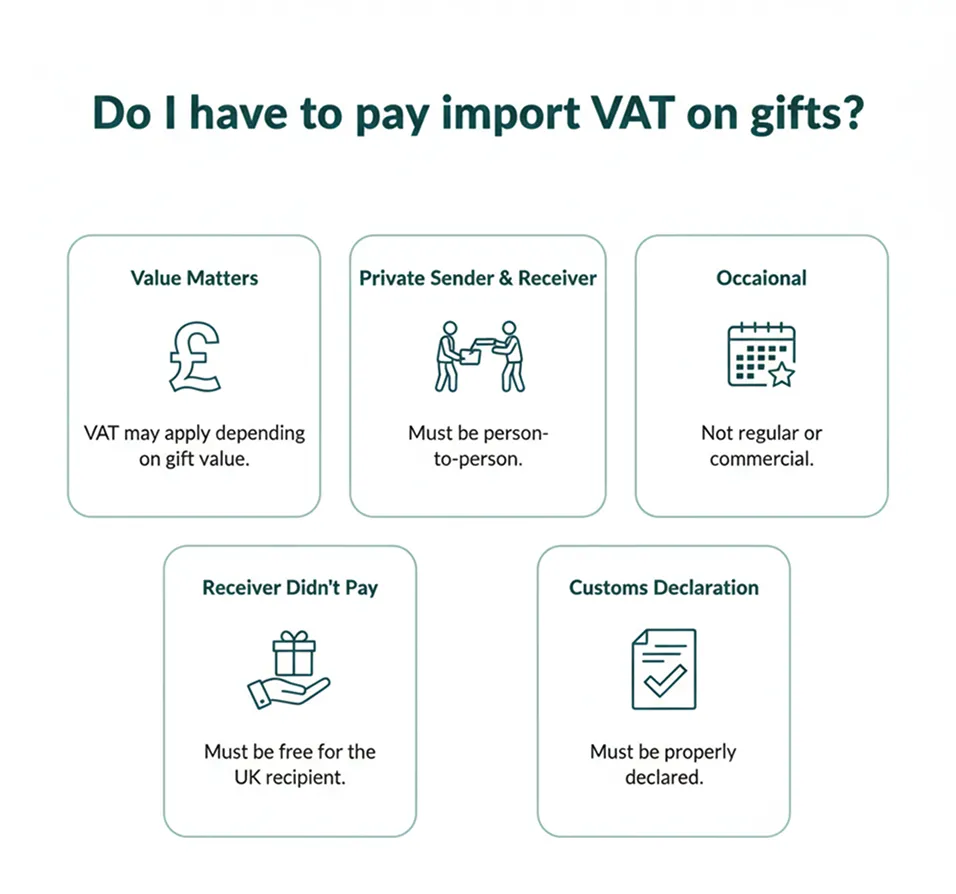
    Do I have to pay import VAT on gifts

    You may have to pay it depending on the value of the gifted items.

    Qualification for a gift:

    For an item to be qualified as a gift, it should fulfil the following conditions.

    • It should be sent by a private person to a private person.
    • It should be occasional.
    • The receiver in the UK should not have paid for it in any way.
    • Customs declaration should be done.

    Threshold value

    If your gift costs more than £39, then you have to pay VAT on import. If the costs go over the threshold value of  £135, you’ll also have to pay customs duty.
    Do I have to pay import VAT on gifts

    VAT on different types of gifts:

    Excise duty is payable in all types of gifts regardless of the value. Custom duty relief is applied on the following quantities:
    VAT on different types of gifts
    If these quantities are exceeded, then custom duty is payable so you won’t get the benefit of VAT on import relief.

    Claiming relief

    Re-imported exported goods

    You can claim back the VAT on these. If you exported them out of the UK for some time and then brought them back, you don’t have to pay VAT.  If you did pay, you can get Returned Goods Relief.

    Postponement

    You can use your VAT returns to pay it on imports if you have a VAT certificate. This can be done by using postponed VAT accounting.
    Learn more about getting a VAT certificate here.

    Deferment

    You have to pay full import VAT if

    • You do not choose to add this tax in your VAT returns
    • You are not VAT registered

    In this case, you can apply for deferment. You have to set up an account with HMRC with a bank guarantee.

     Suspension

    If the goods that you have imported are stored in a customs warehouse, your import duties and VAT can be suspended. Custom warehouse is a type of inventory and a number of goods can be stored there.

    Need help calculating UK import VAT?

    At Sterling Cooper Limited, we offer you expert advice on paying your VAT on imports, its importance and implication on your business. Explore our Taxation services and get expert support today! To avail our help, contact us now.

    +443300102526
    Book an Appointment

    FAQs


    What is the difference between import VAT and duty?


    Import VAT and duty are different types of taxes that you pay the government when you import. Each is applicable on goods of varied value.


    Yes you can if you are registered for VAT. If you have paid VAT on importation, then you can reclaim it under conditions described above.


    If you import from the EU in Ireland, you have to term your goods as “Acquisition.” If the sale is between Northern Ireland and the UK, it is treated as a domestic sale. If the import is from outside these regions, you have to follow the rules applicable in Britain.


    If they are for the same person then normal conditions apply i.e., import VAT is applicable above the cumulative value of £39. If it is intended for different people, then their value should be described independently on customs declaration.


    Yes, you still have to pay for it. Only difference is that you cannot reclaim it.

    Share This Article!

    Recent Posts

  • The Key Benefits of HR Outsourcing You Can’t Afford to Ignore

    The Key Benefits of HR Outsourcing You Can’t Afford to Ignore

    benefits of outsourcing hr

    Posted by:

    Admin

    Date:

    January 6, 2026

    Category:

    blogs

    Error: Contact form not found.

    The Key Benefits of HR Outsourcing You Can’t Afford to Ignore

    Modern people management goes beyond admin, and the benefits of outsourcing HR make it easy to stay ahead. By outsourcing HR, you hand over payroll, benefits and compliance to specialists. They handle each task accurately and speed up every process. That means fewer mistakes and faster pay runs. Your team regains hours each week. They can use that time to learn new skills, improve teamwork and plan the next stage of growth.

    Why Does HR Outsourcing Matters Today?

    Every month, struggling with payroll deadlines or interpreting a new employment rule can overwhelm your team. Calculating salaries, setting up benefits and updating policies eats into the time you need for growth. Handling payroll figures, coordinating benefit plans and keeping policies up to date can chew up hours that belong to growth efforts. Passing these duties to a specialist partner gives your team room to focus on critical work. They can nurture a positive culture, coach future leaders and chart strategic growth. Those benefits of outsourcing HR let your people deliver impact where it matters most.
    The CIPD’s 2024 report reveals that 63 percent of UK employers now outsource at least one HR function . Those organisations tell us they spend less time on admin, make fewer compliance missteps and respond to change faster. Those organisations tell us they spend less time on paperwork, avoid compliance mistakes and adapt more quickly to change.
    Sterling Cooper is like an extra addition to your team when it comes to outsourcing HR. They handle payroll runs and tax filings, manage pension contributions, maintain employee records up to date, and administer benefits.  You can expand your business with Sterling Cooper by knowing that your payroll and HR tasks are being handled by professionals.

    Common HR Functions You Can Outsource

    Many businesses start by outsourcing one or two specific tasks and then add more as they go. Here is a list of common HR outsourcing tasks, along with short descriptions of each:

    HR Function What Does It Entail?
    Recruitment and Selection When professionals write your job ads, screen applicants, interview them, and handle hiring, you can get new team members on board more quickly and easily.
    Payroll Processing For precise and legal pay cycles, hire trained professionals to handle payroll runs, tax computations, pension deductions, and payslip distribution.
    Benefits Administration Letting professional teams handle health insurance, retirement plans, and employee benefits makes sure that enrolment, claims processing, and policy revisions are all done on time.
    Employee Training and Development Working with experts to plan and run workshops, e-learning modules, and development roadmaps that help employees improve their abilities and move up in their careers.
    Performance Management Outsourcing to create, set up, and assess systems for performance reviews, goal monitoring, and giving constructive feedback.
    HR Compliance and Risk Management It can feel like a full-time job to keep up with corporate practises and employment laws. Our lawyers and HR experts take care of it for you. One of the benefits of outsourcing HR is that they keep your handbooks up to date and find new regulations as soon as they come out. They also help you work through any problems that come up.

    Signs It’s Time to Outsource HR

    Before exploring the key benefits of outsourcing HR, here are some indications that your business should consider:

    1. Work Piles Up

    You’re wasting time on payroll, benefits setup, and policy administration if they take up all your time. You might need assistance from others to get the basics done.

    2. No Self-Service For Staff

    When employees email you for paychecks or vacation requests, things become stuck quickly. Giving them a way to handle simple jobs promotes morale and lets HR focus on other things.

    3. Clunky Tools

    When you switch between different generic programmes, you have to do the same task twice, which is frustrating. A custom system from a professional partner cuts down on mistakes and saves you hours every week.

    4. Rules Keep Shifting

    Employment law and pensions are always changing. To be on top, you have to work hard every day, which draws your team’s focus away from important projects.

    5. Costs Keep Rising

    Even in slow months, salaries, software licences, and office space everything add up. When you turn those fixed expenses into basic service fees, the benefits of outsourcing HR become evident.
    If you look for these indicators, you can get the most out of outsourcing HR. A good partner takes care of the day-to-day tasks so your employees can focus on culture, strategy, and growth.
    Signs It’s Time to Outsource HR

    Benefits of Outsourcing HR

    Here are the main advantages of HR outsourcing for companies that are growing:

    1. Cost Efficiency and Financial Flexibility

    One of the best benefits of outsourcing HR is that it saves you money. Even when things are slow, you still have to pay for labour, software licenses, and office rent when you have an in-house team. When you outsource, those set costs become variable prices, which means you only pay for the help you need.
    When employees leave, it can cost you a lot of money. Oxford Economics reports that it costs more than £30,000 to hire and train one new employee in the UK. You can save money on hiring and keeping employees by outsourcing those tasks. That example shows how outsourcing HR can help your bottom line right away.

    2. Access to Expertise and Bulletproof Compliance

    Regulations on hiring, retirement plans, and safety change all the time, and even a well-trained in-house workforce can have trouble keeping up. When you outsource HR, you have a group of professionals that keep an eye on changes in regulations daily. They write and keep policies that meet the law, do frequent risk reviews, and teach line managers how to do things the right way.
    This particular lens lowers your risk of getting fined, sued, or damaging your reputation. Instead of having to figure out a new statutory instrument on your own, you have a partner who can give you clear instructions and policy templates. This makes sure you satisfy all of your legal obligations without any stress.

    3. Scalability and Strategic Focus

    Your HR support needs to keep up with the changing markets. One of the benefits of outsourcing HR is that you can change the services you get in just a few days. You can acquire support straight away if you need extra hands for a huge hiring push. You can cut back when things slow down without having to pay more. That freedom lets your team focus on strategy instead of paperwork.
    You have more time to enhance the culture at work, train managers, or come up with new reward programmes, which is where your in-house expertise can help the most. Outsourced providers can help you when you need it:

    • They can speed up the process of hiring people while your business is growing.
    • They can slow down some services when business is slow.

    Your executives may concentrate on important projects like enhancing corporate culture, developing new leaders, and devising more effective employee rewards by outsourcing HR. The HR department takes care of the specifics so you may concentrate on the next step.

    4. Enhanced Employee Experience and Engagement

    Although some people fear that outsourcing HR will make it less personal, this is not true. An account manager who is familiar with your company will be assigned by your HR provider. Additionally, they will provide employee well-being training and a round-the-clock help centre for any enquiries. Employees today prefer personalised online access, and outsourcing human resources streamlines benefit administration and vacation scheduling. You can get short surveys every week to find out how people feel.
    You can also notice the benefits of outsourcing HR in your daily life. Employees may check their benefits or book time off without having to wait for HR to get back to them. You give people personalised coaching and wellness resources that alter as their goals change. When technology and human advice work together like this, people feel supported. That means fewer sick days, easier collaboration, and higher productivity overall.

    5. Excellent Technology Without the Upfront Cost

    It can be quite stressful to buy and run HR software on your own. One of the greatest benefits of outsourcing HR is that you can use your provider’s best technologies right away. These include cloud-based HR platforms, recruitment tools, online training portals, and real-time analytics, all without having to pay setup fees or add to your IT effort.
    Your partner handles the installation, security updates, and version upgrades. You can get real-time data on time to hire, training completion rates, and absence patterns by just logging in. You only pay for what you need, but it’s the same high-quality technology that big companies use. When you outsource HR, your IT team may focus on projects that really help the business grow.

    6. Mitigating Risk Through Specialist Support

    Having a staffing conflict or going to a redundancy consultation might ruin your day. One of the benefits of outsourcing HR is that you can always get in touch with professional consultants that know UK employment legislation and what your business needs. They look over and change your policies, point out new rules, and help you through every stage of a disciplinary or grievance procedure.
    It’s beneficial to hire someone else to handle your HR work. As it lowers the danger of tribunal claims and protects your reputation. You won’t have to rush to get legal help at the last minute. Your team can keep doing their regular work.

    7. Deepening Strategic Partnerships

    A real HR outsourcing collaboration isn’t just about checking off boxes. Your provider has new ideas about salaries, hiring trends, and planning for the future workforce. They help you set goals for your culture and keep track of how well you’re doing at meeting them. You can change how you do performance reviews, use brief surveys to find out how well people are included and how healthy they are, and train your best employees.
    These outsourcing HR benefits let you trial new ideas with minimal risk and catch small problems early. Over time, outsourcing HR can help a business grow and get better all the time.
    Benefits of Outsourcing HR

    Making the Right Choice for Your Business

    Not all businesses need to outsource all of their HR work. You may try out a “payroll-only” or “recruitment process outsourcing” experiment to see how it goes. Some important things to think about while choosing the right fit are:

    1. Expertise Fit

    Do they know the regulations and job market in your field? Your provider should know a lot about your field. They can provide you guidance that actually works for you when they know your individual rules and skill problems.

    2. Service Flexibility

    Can you add or remove modules without any problems? You can change the size of your services as needed without paying more. You just pay for what you use, and you may change your support anytime your business requires it.

    3. Technology Platform

    Is their system easy to use, safe, and able to work with your current tools? A good system is easy to use and works with the tools you already have. You won’t have to waste time learning new applications or dealing with integrations that don’t work well.

    4. Cultural Alignment

    Will your employees be able to work well with their teams? Opt for one who shares your ideals. When your team feels like it’s part of theirs, communication is easier and projects go faster.

    5. Transparent Pricing

    Are the charges predictable, logical, and matched relevant outcomes? To find out exactly where your money is going, look for itemised costs. There are no hidden costs, so you can prepare ahead of time and avoid surprises. By establishing specific objectives for cost savings, compliance, and employee satisfaction, you can track ROI and alter the mix of services over time.

    Drive Your People Strategy with Sterling Cooper

    With regulations ever-shifting and talent costs rising, Sterling Cooper applies the benefits of outsourcing HR through hr outsourcing to deliver rock-solid compliance, lower your overheads and boost employee engagement so you can focus on growth.
    Contact Sterling Cooper for a free, no-obligation consultation to make your people function more agile and strategic.

    Contact Sterling Cooper for a free,

    no-obligation consultation to make your people function more agile and strategic.

    FAQs


    What are the advantages and disadvantages of outsourcing HRM functions?


    Advantages include cost savings, access to expertise and flexibility in scaling services. Disadvantages can be less direct control over day-to-day processes and the need to carefully manage the provider relationship.


    Many start with payroll processing or benefits administration, then add recruitment support, compliance audits or learning and development as needs grow.


    Monitor metrics like reduction in payroll errors, time saved on admin tasks, headcount turnover rates and improvements in employee satisfaction scores.


    Reputable providers use encrypted systems, GDPR-compliant processes and regular security audits to protect sensitive information.


    Most partners offer flexible agreements that let you adjust service levels within days or weeks, so you only pay for what you need at any given time.

    Share This Article!

    Recent Posts

  • The Ultimate VAT Exemption Guide

    The Ultimate VAT Exemption Guide

    vat exemption

    Posted by:

    Admin

    Date:

    January 2, 2026

    Category:

    blogs

    Error: Contact form not found.

    The Ultimate VAT Exemption Guide

    Are you confused about VAT categories and not so sure about which one your business falls in? We have got you covered. Knowing how VAT exemption works is empirical for people and businesses working in the UK.
    VAT can be a complex area, mainly when certain goods or services do not carry VAT at all. If you fall into a category for VAT exemption, you could legally avoid paying VAT. It can help you save a large amount of money. Our guide will explain all you need to know about the topic.

    What is VAT Exemption?

    It means a good, service, or activity is totally free from VAT. Unlike zero-rated goods, exempt items do not carry VAT. Same way the setups that sell them cannot reclaim VAT on related purchases.
    This makes VAT exemption different from zero rating. Even though both result in no VAT charged to the final consumer.

    VAT Exemption vs. Zero-Rating

    Even though both can result in no VAT charged to the customer, the business impact is different. Zero-rated supplies are still taxable supplies at 0%. Exempt supplies are not treated the same way.
    Table
    Simplify your  taxes with expert planning, VAT returns & corporation tax services in the UK.

    What Are the Common Categories for VAT Exemption?

    Exempt supplies are mostly linked to essential services where VAT would make access harder. That is why many exemptions cover education, health, and other areas of welfare.
    Still, these rules can have conditions, and not every service in these sectors is exempt. Below are common areas that often fall under exemption in the UK.

    1. Education

    Teaching and training from approved schools and tutors are usually exempt. This helps learning stay more affordable for students. Many private lessons also fall under VAT exemption.

    2. Health

    Medical care from doctors, nurses and clinics is often exempt. This includes treatment, tests and hospital care. The rule helps keep basic health services easier to access.

    3. Charity Fundraising

    It may get VAT exemption for some events. The fundraising event must raise money for their main work. This saving helps charities spend more on their cause.

    4. Financial Services

    Banking, loans, credit, and insurance services often qualify. These services are common in daily life, so exemption keeps costs low.

    5. Gambling

    Betting, lotteries and gaming are exempt from VAT. These setups follow separate tax rules set by the government.

    6. Land and Property

    Renting a home or dealing with some land agreements can be exempt. Most residential property rentals fall into this group.

    7. Burial

    Funeral services, burial plots and cremations are exempt. This reduces the financial burden during difficult times.
    The UK government has shared the VAT rates on different goods and services which also shows the VAT exempt items.

    Who is Eligible for VAT Exemption?

    Eligibility depends on what is being supplied and who is receiving it. Some exemptions are based on the type of service, such as healthcare. Others depend on the buyer, such as goods for disabled people.
    A business also needs to understand how exemption affects its VAT registration position. Because exemption does not always remove duties.
    Here is a detailed account of people, businesses and services eligible for VAT exemption:

    1. Individuals

    Some VAT exemptions are based on the personal situation of the buyer. These rules are mainly designed to support daily living, health needs, and mobility. In most cases, the exemption applies only when the goods are for personal use and meet strict conditions.

    i. Elderly People

    Many aids made for older people qualify for VAT exemption. This includes equipment that helps with daily living.

    ii. Disabled People

    Disabled people can buy medical and mobility products without VAT. The rule supports independence and comfort.

    iii. Tourists

    Some tourists may qualify for VAT refunds, depending on current UK rules. This usually applies to goods taken out of the country.

    2. Businesses

    Many VAT exemptions depend on the nature of the service being supplied. These exemptions are common in sectors that provide essential or public interest services. Businesses must still check how exemption affects VAT registration and input VAT recovery.

    i. Small Setups and Startups

    Some small firms provide exempt services by nature. They do not charge VAT on these supplies.

    ii. Charities

    These may get exemption for fundraising and welfare work. It lets them use more of their income on community needs.

    iii. Healthcare Providers

    Doctors, clinics, dentists and therapists often give exempt services.

    iv. Educational Institutions

    Schools, colleges and training centres often fall under exemption. Their main teaching work qualifies for relief.

    v. Financial Service Providers

    In this case, banks, insurers and mortgage firms offer exempt services that follow strict rules.

    vi. Mixed Supply Setups

    Some businesses sell both VAT exemption products and taxable goods. These firms must handle VAT carefully and follow partial exemption rules.

    vii. Exports

    Some global services are not charged VAT at all. They may fall outside UK VAT rules.

    viii. Land and Property

    Residential rents and some land services qualify for exemption.

    3. Products & Items

    Certain goods qualify for VAT exemption because of how they are used. Most of these items support medical care, disability needs, or essential living requirements. Eligibility often depends on who the item is for and how it will be used.

    i. Medical Equipment

    Wheelchairs, hospital beds and care items are VAT exempt goods. They support basic medical needs.

    ii. Mobility Aids

    Stairlifts, scooters and walking aids often qualify for exemption products. This is for eligible buyers.

    iii. Children’s Clothing and Footwear

    These items do not have VAT, but they are zero-rated rather than exempt.

    iv. Books

    Printed books and newspapers are also zero-rated. They remain VAT free for buyers.

    v. Prescription Medicines

    These are also VAT exempt goods. It makes the vital treatment affordable.

    vi. Energy-saving Products

    Some energy-saving items may qualify for VAT relief under current rules.

    vii. Specific Disability Products

    Adapted vehicles, assistive devices and similar items can be bought without VAT.

    How to Claim or Apply VAT Exemption?

    The process usually comes down to proof and correct paperwork. Suppliers need to confirm eligibility before selling without VAT. Buyers need to provide the right details. When this is done the proper way it stays simple. Ignoring it creates problems later. Here are the key steps to follow while applying for exemption:

    • Check That the Product Qualifies

    Confirm that the item or service is listed under UK VAT relief rules.

    • Declare Your Eligibility

    Suppliers must know you are exempt or eligible before starting the purchase.

    • Complete a VAT Relief Form

    This form confirms that the buyer meets the criteria for exemption. It is usually simple and asks for basic details.

    • For Online Purchases

    Most websites include a VAT relief section at checkout. Customers tick a box and submit the form online.

    • For In-Store or Telephone Purchases

    You may need to provide the completed form to the retailer or sign a written declaration.

    • For Charities

    Such setups must give the supplier a certificate. It must show why the purchase qualifies for exemption.

    How VAT Exemption Works?

    Given below is how it actually works in different scenarios:

    1. No Output VAT: Businesses do not charge VAT on exempt supplies.
    2. No Input VAT Reclaim: They cannot recover VAT on related purchases. It increases overall business costs.
    3. Partial Exemption: For those selling both exempt and taxable goods, they must calculate how much input VAT they are allowed to reclaim. This requires careful record keeping.

    Get more insights on How to get a VAT Certificate? 

    What Are the Pros and Cons of VAT Exemptions?

    Lets walk through some general pros and cons of VAT Exemptions:

    Pros of VAT Exemption

    • No VAT is added to the final price for customers
    • Helps keep essential services more affordable
    • Reduces tax burden for certain activities
    • Supports access to health, education, and welfare services
    • Can make pricing clearer for customers
    • Avoids the need to charge and collect VAT on exempt supplies
    • Useful for businesses focused on non-commercial or social goals

    Cons of VAT Exemption

    • Input VAT on purchases cannot be reclaimed
    • Business running costs can increase
    • Less flexibility in tax planning
    • Can reduce profit margins for cost-heavy businesses
    • Mixed activities create extra complexity
    • Requires careful record keeping to avoid mistakes
    • Confusion between exempt and zero-rated supplies is common
    • May limit growth options if VAT recovery becomes important

    VAT exemption can be helpful, but it is not always “better.” It depends on the business model. For some, it reduces customer prices. For others, it reduces recoverable VAT and increases costs. The key is knowing which side matters more for the specific setup. Let’s go through the pros and cons of different setups:
    What Are the Common Categories for VAT Exemption

    What Are the Common VAT Mistakes?

    VAT errors usually happen due to confusion, rushed invoicing, or weak records. Most mistakes are avoided once the VAT status is clear and the team follows one consistent process.
    Here are a few mistakes that are commonly made and should be avoided:

    • VAT on Exempt Services: Many firms add VAT by accident. This must be corrected.
    • Reclaiming VAT on Exempt Supplies: Input VAT on exempt sales cannot be reclaimed. Incorrect claims may cause penalties.
    • Confusing Exempt with Zero-Rated Supplies: These two categories work in different ways. Mixing them causes VAT errors.
    • Incorrect Invoicing: Invoices must show clearly that the supply is exempt.
    • Mixing Exempt and Taxable Items: Poor separation leads to wrong VAT returns.
    • Exceeding the Threshold: Some activities may force the business to register even if many sales are exempt.
    • Claiming Wrong Input VAT: Partially exempt firms often make mistakes in this area.
    • Poor Record-Keeping: Weak records make VAT checks harder and risk penalties.

    What Are the Record-Keeping Tips?

    Knowing the category early saves time later. It also reduces panic during VAT deadlines. Here are a few tips to be kept in mind for avoiding any confusions about your status:

    • Know Your VAT Status: Know if you are exempt, partially exempt or taxable. This guides all VAT actions.
    • Keep Thorough Records: Store all invoices, forms and receipts. Good records protect you in case of checks.
    • Organise Documents Clearly: Separate exempt and taxable items. This keeps things simple and clean.
    • Separate Personal Expenses: Clear separation prevents confusion during VAT reviews.
    • Retain Records: Keep your records for at least six years.
    • Include a Clear Note: Write “VAT exempt” or a similar note. This avoids confusion for customers and HMRC.

    Conclusion

    Being fully aware of VAT exemption is always needed. It helps to reduce the costs. Firms can then operate in an efficient way. For new business owners, the safest approach is to set up clean systems early. Even simple steps like correct invoices, neat records, and clear separation may prevent future stress. For established ones, reviewing VAT treatment once a year is a smart move. Services change. Supplies change. And VAT rules also get updated.
    Sterling Cooper Consultants guide you on  how VAT works. We will let you know who qualifies, and how to apply. In this way we ensure you stay compliant and avoid mistakes.
    For further guidance about managing your VAT, reach out to our experts.

    Know your VAT.

    Contact us today for tailored VAT support and professional accounting advice.

    FAQs


    What Is the VAT Exemption Rule?


    The VAT exemption rule means some goods and services do not have VAT added at all. These supplies are outside the VAT system, so businesses do not charge VAT and cannot reclaim on related costs. Examples include education, healthcare, insurance, charity fundraising and some financial services.


    You can remove the 20 percent VAT only if the item is VAT exempt or zero rated. If the supply qualifies, the invoice must show “VAT exempt” or “Zero rated”. You cannot exclude VAT from standard-rated items unless the law allows it.


    In most cases, there is no official VAT exemption certificate. Instead, buyers complete a simple VAT relief declaration form provided by the supplier. Charities may give a certificate confirming they qualify for VAT relief on certain purchases.


    For VAT-exempt items, no VAT is added, so the computation is simply the net price. Businesses with mixed supplies must separate exempt and taxable sales and follow HMRC’s partial exemption rules for input VAT.


    As of January 1, 2021, the UK government discontinued the VAT refund scheme for tourists. For many visitors, this decision ended an era of cost-effective shopping in Britain.

    Share This Article!

    Recent Posts

  • Gross Pay vs. Net Pay: Understanding the Key Differences

    Gross Pay vs. Net Pay: Understanding the Key Differences

    Gross Pay vs Net Pay

    Posted by:

    Admin

    Date:

    January 1, 2026

    Category:

    blogs

    Error: Contact form not found.

    Gross Pay vs. Net Pay: Understanding the Key Differences

    Have you ever glanced through your payslip and asked yourself why the amount that you take home is lower than the amount you get paid? The solution is simple: to know the difference between gross pay vs net pay. It is a critical distinction that could often be a source of confusion among those who are just starting out in the workforce or those whose jobs are changing. Gross pay is, essentially, what you earn annually before deductions, and net pay is what you can receive after payment of taxes, pension and other deductions. The knowledge of how to read and interpret gross vs net salary is required in situations where one has to carry out budgeting, tax planning, and make some important decisions when negotiating the offering of a job.

    Understanding Gross Pay

    Your gross pay would be the first figure you would see when revising your payslip. This is what you earn before any deductions such as tax, National Insurance contributions, student loan repayment and pension contributions. It forms the basis of the amount of net salary that you will finally get in your net salary. It includes all of the income you earn in a pay period, for instance:

    • Salary
    • Hourly wages
    • Overtimes
    • Bonuses
    • Commissions

    How to calculate gross pay

    The method of calculating gross pay depends on the way you are paid. It can be salaried, or you might be paid hourly. Here is how you calculate both:

    1. Calculation of gross pay for salaried employees

    If your salary is fixed for a period of time, then you can find your gross pay by dividing your annual salary by the number of pay periods in a year.

    Gross pay frequency

    You need to understand how your salary is spread over the year. Here are the frequencies by which you can be paid gross pay:
    Calculation of gross pay for salaried employees

    Formula:

    Based on the annual salary and pay periods, gross pay is calculated by the following formula:
    Gross Pay = Annual Salary / Number of Pay Periods

    Example

    Suppose you earn £48,000 annually. You are paid your salary per month. Here is how you can find your gross pay.
    £48,000 ÷ 12 months = £4,000 gross pay per month
    This amount can vary if you receive any of the following along with your regular pay:

    • Bonuses
    • Commissions
    • Overtime

    2. For hourly employees

    If you work on an hourly basis, your gross pay is found out in the following way:
    Gross pay = Hourly Wage × Number of Hours Worked in the Pay Period

    Example

    Suppose you work for 35 hours per week. Your hourly working rate is £12 / hour. Your gross weekly pay is calculated as follows:
    35 × £12 = £420 gross weekly pay

    Overtime

    If you work overtime, i.e., more than your designated hours, these would factor in too in your gross weekly pay. It is calculated a little differently from your hourly pay. There is a threshold of hours, for most areas 40 hours, below which your overtime is calculated like your hourly salary. Over this threshold, the calculation changes. Now, it is 1.5× the normal rate.

    Example with overtime

    Suppose you worked 45 hours a week. Your pay would be calculated as follows:

    • Regular pay: 40 × £12 = £480
    • Overtime pay: 5 × (£12 × 1.5) = £90
    • Total gross pay = £570
    How to Calculate Gross Annual Income

    To calculate your gross pay when you are paid hourly, multiply your weekly pay by the number of pay periods in a year.
    Suppose you earn £900 per week. You work all 52 weeks. Here is how your annual salary will be calculated:
    £900 × 52 = £46,800 gross annual income.

    What is a net income?

    The net pay is the money that the employees receive when all necessary and extra deductions are completed and are deducted from the gross pay. It is the last number that you check on your payslip, the money that is deposited into your bank account.
    Also known as the take-home pay, the net pay provides employees with a more accurate understanding of their actual income. It is important since this is the amount of money that they can spend, save or plan with.

    The Formula for Net Pay

    Based on the gross pay and deductions, net pay is calculated by the following formula:
    Gross pay – voluntary and mandatory deductions = net pay

    How to calculate your net pay

    Suppose you earn a £30,000 gross salary. Your tax code is 1257L. Your tax and other deductions are £4800. Then your net salary is calculated as follows:
    Net salary = 30,000 – 4,800 = £25,200

    How to monitor your net pay

    Use the following ways to keep track of your net income:

    • Check your payslip; your deductions are clearly listed there.
    • Verify your tax code.
    • Use a net pay calculator.
    • Correspond with your HR.

    What is net pay vs gross pay: Looking at key differences

    Here are a few key differences in gross vs net salary:

    1. Gross pay vs net pay: What is included in each one?

    Since gross pay is the total salary before the deductions, it includes:

    • Base salary or hourly wages
    • Overtime
    • Bonuses and commissions
    • Stipends
    • Paid leave and holidays

    On the other hand, the net pay is the pay you take pay after all the key deductions are taken out from the gross pay.

    2. Gross pay vs net pay: Deductions

    The gross pay is the starting point salary that is used to calculate taxes and benefits. No deductions are applied in this.
    Net pay has the following deductions:

    1. Mandatory deductions:

    These deductions are required by the law. They are automatically taken out of your salary. The following are a few mandatory deductions:

    • Income tax
    • National Insurance
    • Student loan repayment
    • Wage garnishments

    2. Voluntary Deductions

    These deductions are the ones that you voluntarily opt for with your employer. These include the following:

    • Health & Life Insurance
    • Pension Contributions
    • Charitable Donations
    • Other Deductions

    3. Gross pay vs net pay: Visibility on payslips

    Gross pay and net pay both appear clearly on your payslip. However, they are written in different places on your payslip. Here is where you can find them:

    • Gross pay appears at the top of your payslip
    • Net pay is usually at the bottom of your payslip as the final amount you are receiving

    It is important that your employer is transparent about how your gross pay transforms into net pay. Therefore, on your payslip, the breakdown of deductions should be clearly stated.

    4. Gross pay vs net pay: Financial planning

    While you do your financial planning, remember that gross pay is used for:

    • Salary negotiations
    • Benefit calculations (e.g. statutory sick pay)
    • Tax bracket determination

    Net pay, on the contrary, is used for the following:

    • Budgeting and expense planning
    • Loan applications and affordability checks
    • Estimating actual disposable income

    5. Gross pay vs net pay: impact of benefits

    Benefits impact gross vs net salary in different ways. Here are two examples:

    • Pre-tax benefits, such as pensions or some insurance plans, lower taxable income.  This, then, lowers net pay but leaves gross pay the same.
    • Bonuses and taxable stipends are examples of taxable benefits that raise gross pay. However, they may lower net pay because of increased deductions.

    Gross pay vs net pay impact of benefits
    This maximum amount is payable if the family’s net income (after income tax and NICs) is lower than a threshold (£77.15 per week in 1997-98). Net income in excess of this threshold reduces entitlement to Family Credit from the maximum by 70p for every £1 of excess income.

    Gross Pay vs Net Pay: Why It Matters More Than You Think

    It is crucial for both employers and employees alike to understand gross pay vs net pay. The difference may seem slight at first glance, but you need it for better financial planning, transparency and understanding trends of your industry. Here is how it matters:

    1. Expense management

    Gross pay vs net pay has an impact beyond payroll. It can shape all of your finance-related issues. Some of them are:

    Budgeting

    Many times, you may mistakenly plan your budget according to your gross income. This causes money wastage or unmet savings targets.

    Loan applications

    Lenders should evaluate your net income for loan applications, but if you are unaware, they can use gross income. This would lead to wrong assumptions about affordability.

    Retirement goals

    Your retirement goals, i.e, contributions to pensions and saving plans, are deducted when you receive your net salary. This is imperative for your long-term financial health.

    2. Industry-specific impact

    Based on what sector you work in, you may experience gross pay vs net pay differently. This is because different sectors have different:

    • Structure
    • Deductions
    • Compensation Models

    Here is a breakdown of a few key sectors.

    • Freelancers and contractors

    If you work as a freelancer or a contractor, you’ll be paid a gross salary without any deductions. You’ll have to pay tax, insurance, pensions, etc., on your own.

    • Public sector workers

    If you work as a public sector worker, you’ll have a greater difference in gross pay vs net pay. This is because your deductions may also include:

    • Union dues
    • Government pension schemes
    • Student loan repayments
    • Corporate employees

    As a corporate employee, you may experience the difference between gross pay vs net pay due to the following:

    • Bonuses and stock options (included in gross)
    • Pre-tax benefits (affecting net pay)
    • Flexible savings plans or wellness stipends

    3. Employer’s responsibilities

    Employers need to clarify gross pay vs net pay to their employees when hiring them. They should make sure to effectively communicate all the relevant information, such as payslip, deductions, tax codes, etc..
    They can also use the gross pay vs net pay to their advantage while structuring salaries:

    • Provide pre-tax benefits such as childcare vouchers or pensions, which lower the losses in net income.
    • Balance the salary and benefits so as to offer a more competitive take-home value.

    Gross Pay vs Net Pay Why It Matters More Than You Think

    Consult Sterling Cooper Consultants to learn more about gross pay vs net pay

    The difference between gross pay vs net pay UK is necessary to understand. Its impact on payroll, taxes, benefits and deductions can, however, be very hard to navigate. This is where we come in to help you. We at Sterling Cooper Consultants will make sure that payroll is done in the correct way, deductions are done with current regulations, and financial planning is in line with the actual take-home pay.
    To get help, contact us now.

    Need help making sense of gross and net pay?

    At Sterling Cooper Consultants, we simplify payroll, ensure accurate deductions, and align your financial planning with your real take-home pay.

    FAQs


    What does my tax code mean in the UK?


    Your tax code notifies you and your employer how much money you can make in earnings before being taxed. To illustrate, the current tax code is 1150L, which implies that you can receive a tax-free income of not more than 12,500 a year.


    The following are the current UK income tax rates: 

    • £0–£12,500: 0% (personal allowance)
    • £12,501–£50,000: 20% (basic rate)
    • £50,001–£150,000: 40% (higher rate)
    • Over £150,000: 45% (additional rate)

    You can request a review from HMRC if you think your tax code is off. A new tax code may also result from changes in your situation, such as getting a larger personal allowance because of your age or disability.


    Here are the 3 best practices to manage your payroll more effectively:

    • As many payroll procedures as you can should be automated.
    • Make sure your records are accurate.
    • Continue to abide by UK tax laws.


    Employee transparency is ensured and payroll trust is increased when gross pay and net pay are clearly shown in financial statements. Additionally, it assists employers in precisely tracking salaries for regulatory compliance and tax reporting.


    A payroll automation solution automates payroll processing by applying tax withholdings, pre-tax contributions, and post-tax deductions, decreasing errors, enhancing compliance, and lowering payroll errors.

    Share This Article!

    Recent Posts