Posted by:
Admin
Date:
June 15, 2026
Category:
blogs
Error: Contact form not found.
VAT Return Deadlines for the 2025/2026 Tax Year: Complete Guide
A VAT return deadline can look like just another date on the calendar. Until it slips past you.
With so much to manage, it is easy for businesses to lose track of when their VAT return needs to be filed and payment made. The consequences, however, can be costly. Last year, 582,000 businesses were fined for late VAT payments, totalling £302 million. The year before, there were 569,000 fines.
Missing a VAT deadline is not usually about failing to understand the numbers. It is often about overlooking a date until it is too late.
So, when is your VAT return actually due? This guide explains the deadline, how it varies by VAT scheme and what happens if you miss it.
Key Takeaways
- Every VAT return deadline follows the same rule: one calendar month plus seven days after your accounting period ends
- Filing and paying are treated as two separate obligations by HMRC, so submitting your return on time does not protect you from a late payment penalty
- A payment only counts as on time once it has actually been received by HMRC, not simply sent
- Since January 2023, late filing works on a points system, with a £200 penalty only once you cross your scheme’s threshold, while late payment runs on its own faster track with penalties and interest
- Annual Accounting works differently from other schemes, using estimated payments throughout the year with one final balancing payment two months after the accounting year ends
- Treating filing and paying as separate tasks, and understanding your scheme’s exact deadline, is what keeps most businesses out of HMRC’s penalty system
The Rule Behind Every VAT Return Deadline
There’s only one formula here, and once you know it, every date on the calendar makes sense. One calendar month plus seven days after your VAT accounting period ends. For example, a quarter closing 31 March gives you a deadline of 7 May. It is as simple as that.
Jaspal Dhillon, VAT partner at Lubbock Fine, has an explanation for why so many businesses still get tripped up despite the simplicity of the rule. He points to growing costs, regulatory pressure and an uncertain economic climate pulling business owners’ attention elsewhere.
The return submission and VAT payment usually have the same deadline but late filing and late payment are subject to separate penalty rules.
One important detail is that only sending a payment won’t suffice; you have to make sure that the payment has been received.
Pay by Bacs a day or two before your deadline. In case it settles late, that counts as a late payment irrespective of when you clicked send.
Jaspal Dhillon, VAT partner at Lubbock Fine, has an explanation for why so many businesses still get tripped up despite the simplicity of the rule. He points to growing costs, regulatory pressure and an uncertain economic climate pulling business owners’ attention elsewhere.
Breaking Down the Deadlines for VAT Return Filing by Scheme
All VAT-registered businesses do not run on the same clock. Here’s how the main schemes compare:
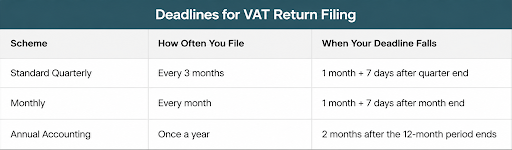
For example, a business whose VAT accounting period ends on 31 March would normally have a return and payment deadline of 7 May. Other businesses may have different quarterly accounting periods and therefore different deadlines.
Monthly filers, mostly businesses regularly reclaiming VAT, follow the exact same rule (i-e one month plus seven days) just on a shorter cycle.
Annual Accounting does not work like other VAT schemes. You make estimated VAT payments throughout the year, usually monthly or quarterly. At the end of your accounting year, you submit one VAT return to work out the exact amount owed. Any difference is then settled with a balancing payment, due two months after your accounting year ends.
It suits steady, predictable businesses well. It suits businesses with unpredictable turnover far less, since your advance payments are built on estimates that can drift a long way from what you actually owe.
Missed a Deadline? Here’s What Follows
HMRC overhauled this system back in January 2023, and plenty of businesses are still operating on outdated assumptions about how it works.
Under the penalty system for late submission, a late VAT return normally leads to one penalty point. Once the applicable points threshold is reached, a £200 penalty applies, which is followed by further £200 penalties for late submissions while the threshold conditions continue to apply.
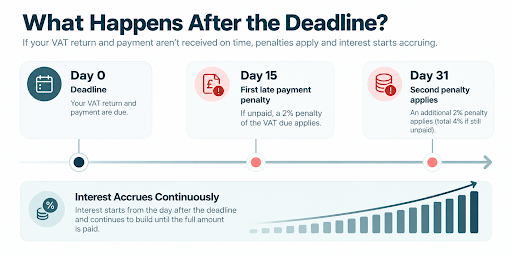
If your VAT payment is up to 15 days overdue, you will not normally receive a late-payment penalty. From day 16, a penalty can apply based on the VAT outstanding. Further penalties can apply when the payment remains overdue for 31 days or more.
Still unpaid at day 31? A second penalty stacks on top. Interest runs the entire time, currently at the Bank of England base rate plus 4%, with no pause button once it starts.
The system isn’t built to punish honest mistakes. It’s made to spot the difference between a one-off slip and a pattern.
Did You Know? VAT interest doesn’t stop building just because you’ve agreed a Time to Pay arrangement with HMRC. It keeps accruing on the outstanding balance the entire time, so spreading a payment over several months still costs more than paying it in one go, even without a formal penalty attached.
Conclusion
Strip away the penalties and the schemes and every VAT return deadline comes down to the same short formula. One month and seven days, no exceptions. The businesses that struggle aren’t usually bad at maths. They’re treating filing and paying as one task instead of two, or assuming a late return is a minor slip rather than the start of a countdown. Get the rule straight, and the whole system stops feeling like a trap.
If you’d rather hand the deadline tracking over to someone else entirely our team at Sterling Cooper Consultants can help.
Tired of keeping track of every VAT return deadline?
Get in touch with Sterling Cooper Consultants today. Let us handle your filing, your payments and everything HMRC throws at either one.
FAQs
What are the deadlines for a VAT return?
Standard VAT returns are due one calendar month and seven days after the end of your VAT accounting period, whether you file monthly or quarterly.
What are the VAT return deadlines for 2026?
For standard quarterly filers, the 2026 deadlines fall on 7 May, 7 August, 7 November and 7 February 2027 depending on which quarter applies to you.
What is the UK VAT return deadline if I file monthly?
Monthly filers follow the same one-month-plus-seven-days rule as quarterly filers, just applied to each month rather than each quarter.
What is the annual VAT return deadline under the Annual Accounting Scheme?
Under Annual Accounting, your VAT return and balancing payment are due two months after your twelve-month accounting period ends, separate from your regular advance payments.
What happens if I miss a VAT return deadline?
You’ll pick up a penalty point for the late return. Once you hit your points threshold, a £200 fine applies, followed by a further £200 for every late return after that.
Is late payment penalised differently from late filing?
Yes. Late filing runs on the points system described above, while late payment triggers separate percentage-based penalties plus daily interest starting from day 15 after the deadline.
Share This Article!
Recent Posts
edit post

Compliance Risk vs Operational Risk: What’s the Difference?
August 13, 2026
edit post

How to Build a Cash Reserve for Business Stability
August 11, 2026
edit post

How to Forecast Cash Flow During Economic Uncertainty
August 6, 2026