Tag: Financial Statements

  • How to Read Financial Statements: A Simple Guide for Non-Accountants

    How to Read Financial Statements: A Simple Guide for Non-Accountants

    financial statements

    Posted by:

    Admin

    Date:

    May 6, 2026

    Category:

    blogs

    Error: Contact form not found.

    How to Read Financial Statements: A Simple Guide for Non-Accountants

    Have you ever wondered how to check your business’s financial health?

    Knowing financial statements is vital. However, many people don’t grasp what financial statements mean.

    In the FinWell Index 2025, young adults aged 18‑24 secured an 87.7 score in financial health. This score is lower than that of older age groups. This shows that younger UK adults may find it harder to know basic financial management and information.

    There are three main financial statements to read. You will explore them here in detail, one by one.

    These financial statements give key insight into your company’s financial position, production and cash flow.

    For instance, a balance sheet tells what a company owns and owes. On the other hand, the income statement shows how much profit the firm produces over time. In addition, the cash flow statement tells whether the company has enough money to pay its bills.

    In this blog, you will learn how to read financial statements. Also, you will be able to make smart business or investment choices.

    Key Takeaways:

    • How to read financial statements is essential for understanding your business’s financial health
    • Start with how to read a financial statement of a company, focusing on assets, liabilities, and equity
    • Reading financial statements helps you assess a company’s profitability and cash flow
    • Use the balance sheet to track what a company owns and owes, and how do I read a balance sheet to understand its financial position
    • The income statement shows how much profit or loss a company has made
    • The cash flow statement reveals if the company has enough money to cover its bills
    • Regular reading of financial statements is key to making informed business decisions
    • Understanding financial statements is crucial for making smarter business and investment choices

    What Are Financial Statements?

    Financial statements are official data of a business’s or a person’s economic position and activities. They provide a review of the money dealings and goings-on of a company over a period of time.
    For firms, financial statements assist in getting loans, tracking performance and attracting investors. Its main types include:

    1. Balance sheet
    2. Income statement
    3. Cash flow statement

    With the help of these documents, you can know your business’s financial health. This helps both internal and external parties to make wise selections.

    Did You Know?

    Financial statements are not just for accountants. Business owners and investors use them to make crucial decisions about growth, investment, and financial planning. Knowing how to read these statements can save you time and money in the long run.

    Why Are Financial Statements Important?

    Business owners, employees, managers and investors see the progress of a company with the help of financial statements. They use these details to make better decisions. They give crucial data about cash flow, profit, debt and how smoothly the business runs.

    Consider an example, if an investor wants to buy stock, they will study the balance sheet. The purpose of this is to check the firm’s financial position. They will also look over the income statement to analyse profit trends.

    On the other side, a business owner might also check the cash flow statement. With the help of this, they will know that the business has enough money to pay its bills.

    In addition, knowing financial statements is also good for handling accounts.

    Knowing how to read financial statements is one of the most valuable skills an investor can possess. They provide essential insights into a company’s financial health, helping to make informed decisions about the future.

    Warren Buffett

    How to Read Financial Statements?

    To understand financial statements, each document should be reviewed separately. All these statements are important for assessing your business’s financial position. Let’s begin:

    How Do I Read a Balance Sheet?

    If you want to know the firm’s financial position at a certain time, the balance sheet needs to be read. It explains to you what the company owns (assets) and what it owes (liabilities). Besides this, it also shows shareholders’ equity (the difference between liabilities and assets).

    If you want to know how do i read a balance sheet, the given formula will help you:

    Assets = Liabilities + Owner’s Equity

    The main parts of a balance sheet are given below:

    1. Assets

    The valuable things a company owns are called assets. They are divided into:

    Current Assets

    The assets of a company that can be transformed into cash in one year. Their examples are cash, inventory and accounts receivable.

    Non-Current Assets

    The long-term assets are called non-current, such as property, equipment and patents.

    2. Liabilities

    The debts that the company has to pay are called liabilities. They are divided into two groups:

    Current Liabilities

    These are the short-term debts, such as short-term loans and accounts payable.

    Non-Current Liabilities

    Mortgages or long-term loans are examples of long-term debts.

    3. Owner’s Equity

    This term is called the net worth, too. It represents the value left for shareholders when all the debts are paid. It is worked out as:
    Owner’s equity is found by subtracting debts from assets.

    You can know its financial stability by comparing its assets, debts and equity.

    If a business has £500,000 in assets and £200,000 in debts, its value is £300,000 (£500,000 – £200,000). This tells that the company’s value is £300,000 after submitting all its debts.
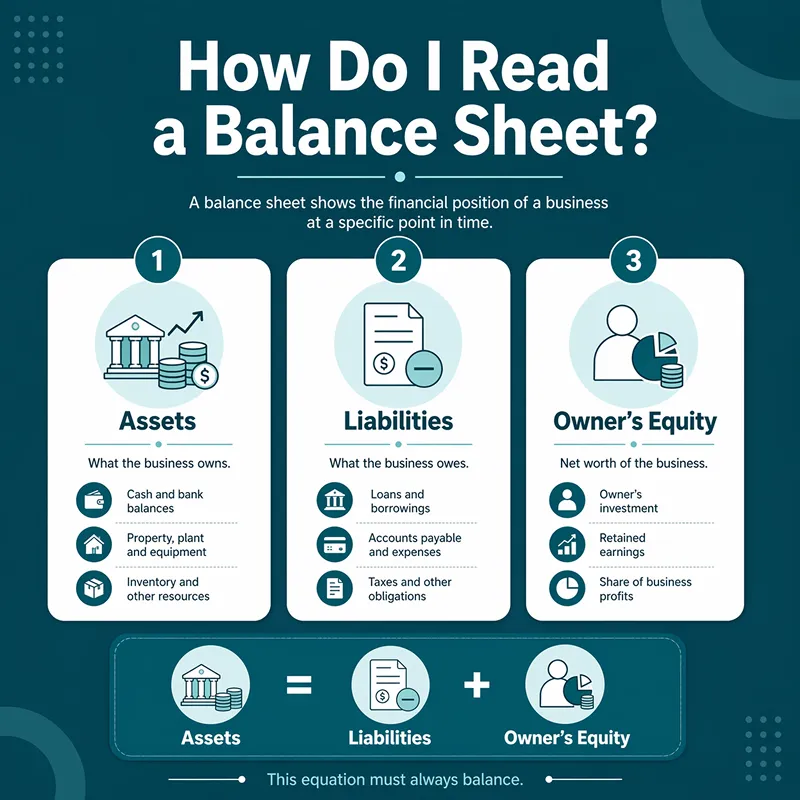
    How do I read a balanace sheet

    Pro Tip

    When reading a balance sheet, always compare current assets with current liabilities to assess the company’s short-term financial health. A current ratio above 2 is generally considered a good sign of financial stability.

    How Do I Read an Income Statement?

    The other name of the income statement is also the profit and loss statement. It shows, at a certain time, how much profit or loss the business made. This can be a month, quarter or year. You can find out the net income by taking out expenses from revenue.

    The income statement includes:

    Revenue

    The total money the company receives from sales or services is called revenue. 

    Cost of Goods Sold

    It is the direct cost involved in creating the products or services the business offers.

    Gross Profit

    You can find the gross profit by subtracting the cost of goods sold from sales.

    Operating Expenses

    These are the expenses needed to run the business, such as utilities, salaries and rent.

    Operating Income

    You can find out operating income by subtracting operating expenses from gross profit.

    Net Income

    Net income tells the final profit or loss after all expenses, including taxes and interest, are subtracted.

    If a firm makes £1 million and spends £600,000, the profit is £400,000. This is the business’s profit after all values are subtracted.

    How Do I Read a Cash Flow Statement?

    The cash flow statement shows how money comes in and goes out of a firm. It helps you review whether the firm has enough cash to pay its bills and progress.

    Key components of the cash flow statement are given below:

    Operating Activities

    It is the cash flow from the company’s main business activities, such as payments and sales to suppliers.

    Funding Activities

    Cash flow from buying and selling lasting assets, like property or equipment.

    Financing Activities

    Cash flow from raising money (like selling stock) or paying off debts (like loans).

    A firm would have £150,000 in cash if it makes £200,000 from operations and spends £50,000 on equipment.

    Mistakes to Avoid When Reading Financial Statements

    When reading financial statements, avoid the following mistakes:

    Misunderstanding Financial Ratios

    Ratios like the current ratio are helpful, which is current assets divided by current liabilities. However, you should not look at them only. If a ratio is low, it could mean liquidity issues. On the other hand, it might also indicate that a firm is investing in growth.

    Ignoring Qualitative Data

    You will not understand the full story from financial statements only. Market situation or management changes can have a huge impact on the company’s performance. These may not be visible in the numbers.

    Depending Too Much on One Statement

    Among these three major financial statements, each one provides different details. If you rely on just one, it will result in a misguided understanding of the company’s financial health.

    Overlooking Trends

    One-time events might not tell the complete performance of the company. Therefore, you should also look at trends over time. This is helpful in understanding if the firm is improving or getting worse.
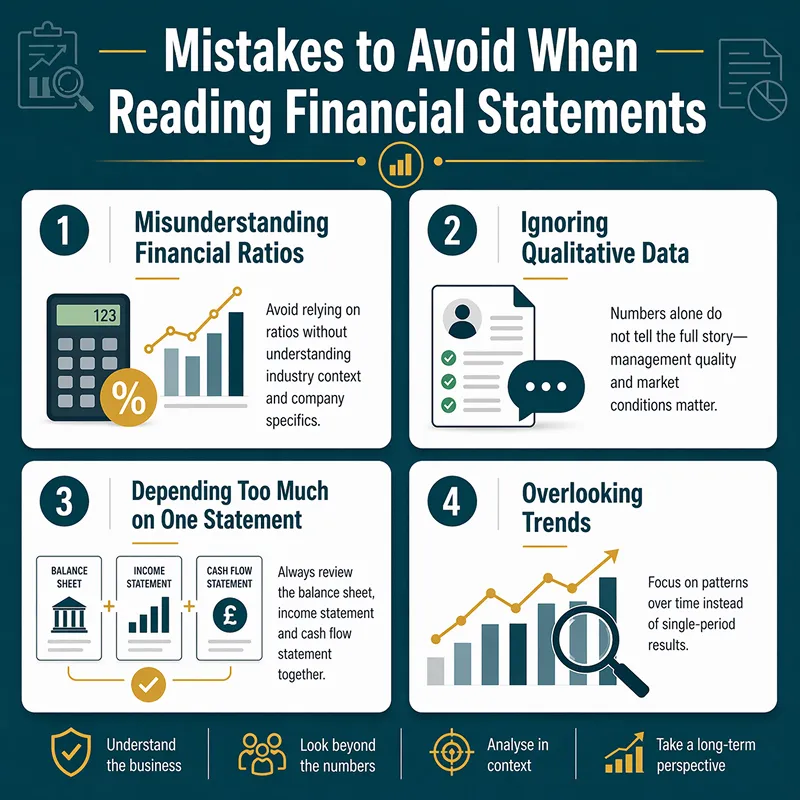
    Mistakes to Avoid When Reading Financial Statements

    How to Analyse Financial Statements Effectively?

    To know the finances is one thing, but interpreting them is another. I have explained below how to get the most from your financial statements.

    How to Analyse a Balance Sheet?

    The balance sheet shows a company’s financial state at some time. Focus on areas:

    Current Ratio

    You can achieve this ratio by dividing current assets by current liabilities. It will explain if the firm has enough assets to cover temporary debts. If a ratio is above 2, it is considered good. It means the business has twice as many assets as liabilities.
    The current ratio can be calculated by dividing current assets by current liabilities.
    For example, the ratio will be 2 if a firm has £500,000 in assets and £250,000 in debts. This tells a good position.

    Debt-to-Value Ratio

    This ratio compares a company’s total debts to its owners’ value. This represents how much the business depends on debt compared to its own equity.
    Its formula is given below:

    Debt-to-value ratio = total liabilities ÷ shareholder equity
    For instance, if a business has £1 in debt for every £1 in value, the ratio is 1. If the ratio is over 1, it means the company depends more on debt.

    Quick Ratio

    You can also call the quick ratio the acid-test ratio. It checks if a firm can pay temporary debts without selling inventory.

    The quick ratio can be calculated by first subtracting inventory from current assets. After this, divide it by current debts.
    For example, if a business has a quick ratio of 1 or more, it means the firm can pay its temporary debts without selling inventory.

    How to Analyse an Income Statement?

    The income statement tells us how much profit a company is delivering. It focuses on:

    Gross Profit Margin

    This shows how much money is left after subtracting the expense of goods sold (COGS). This will tell you how efficiently the firm makes its goods or services.

    Gross profit margin = (revenue – COGS) ÷ revenue × 100
    The margin is 60% if sales are £500,000 and COGS is £200,000. This means the business keeps 60% of its sales after production costs.

    Net Profit Margin

    This margin will tell you the percentage of revenue left after all expenses. This includes taxes and interest and shows the company’s overall profitability.
    Its formula is as follows:

    Net profit margin = profit ÷ sales × 100
    For instance, the margin will be 10% if profit is £50,000 and sales are £500,000. This means the business keeps 10% as profit.

    Operating Income

    With this income, we become aware of how well the company is working in its core operations. It keeps out income and expenses from things like taxes or interest.

    Operating income = gross profit – expenses
    Consider an example, operating income is £150,000 if gross profit is £300,000 and expenses are £150,000.

    How to Analyse a Cash Flow Statement

    You can read the cash flow statement to know how cash is being generated and used. It’s key to know a company’s ability to grow, invest and pay bills.

    Operating Cash Flow

    This tells about how much cash the firm makes from regular business activities. A positive number shows the business can cover its costs.
    Calculate it by:

    Operating cash flow = cash from business – cash from working capital changes

    The cash flow will be £150,000 if a firm makes £200,000 but has a £50,000 increase in working capital.

    Free Cash Flow

    Free cash flow is the cash left after a business has paid for capital expenditures like equipment or property. It’s vital for investing again or returning money to shareholders.
    You can find it by:

    Free cash flow = operating cash flow – money spent on assets
    Free cash flow will be £150,000 if operating cash flow is £200,000 and asset spending is £50,000.

    Cash Flow from Financing Tasks

    This represents cash increased through debt or equity or cash used to settle debts and dividends. It helps you check how the firm is financing itself.
    For example, if a company issues stock and increases £100,000, this will be indicated as a cash inflow in financing activities.

    Vodafone Annual Report: Case Study

    Vodafone is amongst the biggest phone companies in the United Kingdom. Every year, Vodafone publishes a report with all its financial information.

    This report shows how much money Vodafone earned, spent, and the profit it made. In addition, there is also some information about the firm’s debts and cash flow.

    This report includes:

    Revenue

    How much income Vodafone earned from its clients.

    Profit

    After paying for the costs, the amount left.

    Cash Flow

    This tells how payments are moving in and out of the firm.

    Debt

    The cost that the company owes to others.

    You can see if the company is progressing or losing money by looking at these records. This is helpful for investors and managers to make smart decisions about the future.

    You can understand real financial statements in a simple way through this case study.

    Read more: Why annual reports still matter for businesses?

    Final Thoughts

    In conclusion, financial statements provide key tools for grasping a company’s financial health. You can make better decisions for your business by reading balance sheets, income statements and cash flow statements. For instance, the balance sheet tells your firm’s assets and liabilities. On the other hand, the income statement shows profitability.

    However, reading these statements should not be a single task. Reviewing these statements often will help you find trends and make good choices. Also, knowing these documents allows you to handle cash flow and plan for progress.

    At Sterling Cooper, we know the value of financial literacy. Our team is available to help you navigate these core tools. They give insights to improve your decision-making. For more help or information, contact us today.

    Struggling to understand your financial statements?

    We help businesses interpret balance sheets, income statements, and cash flow for smarter decisions. Contact us today to get started!
    +443300102526
    Book an Appointment

    FAQs


    What is the purpose of reading a financial statement of a company?


    Reading a financial statement of a company helps you understand its financial health, including profits, losses, assets, liabilities, and cash flow. It allows business owners and investors to make informed decisions about the company’s performance.


    The main components include the balance sheet, income statement, and cash flow statement. Each provides insights into different aspects of the company’s financial position, such as assets, liabilities, revenue, expenses, and cash flow.


    To read a financial statement of a company, start with the balance sheet to check assets and liabilities, then review the income statement for profits or losses. Finally, analyse the cash flow statement to understand how cash moves in and out of the business.


    The balance sheet shows what a company owns (assets), what it owes (liabilities), and the value left for shareholders (equity). It gives you a snapshot of the company’s financial position at a specific point in time.


    For investors, reading a financial statement of a company helps evaluate its financial stability, profitability, and potential for growth. It provides critical data to make investment decisions.

    Share This Article!

    Recent Posts

  • What Are Annual Accounts? Everything You Need to Know

    What Are Annual Accounts? Everything You Need to Know

    Annual Accounts Explained

    Posted by:

    Admin

    Date:

    February 9, 2026

    Category:

    blogs

    Error: Contact form not found.

    What Are Annual Accounts? Everything You Need to Know

    Did you know that in the UK, about 98.5% companies filed their annual accounts on time. That shows how important this job is for companies. 

    Annual accounts show a business’s finances for one year. They show profit or loss, plus what the business owns and what it owes. They also help calculate how much Corporation Tax is due. Limited companies must file annual accounts with Companies House and send accounts to HMRC as part of the Company Tax Return process. This is a legal duty.

    What Are Annual Accounts?

    At the end of your business’s financial year, you make annual accounts, which are a set of financial statements. Your bookkeeping records, such as invoices, bank transactions, payroll, and expenses, are what they are based on. Companies in the UK usually have to send their statutory accounts to Companies House and HMRC as part of the process of filing their Company Tax Return.

    Think of your annual accounts as a ‘financial story’ for that year. They answer simple questions like:

    • Whether the business made money or lost money.
    • How much cash it had at key points.
    • What it owned, like stocks or tools.
    • What it owed, such as bills that weren’t paid or loans.

    They also help you figure out how much Corporation Tax you owe. The UK Government official webpage on accounts and tax responsibilities for private limited companies lists annual accounts and the Company Tax Return as two important things that must be done at the end of the year.

    Why Do Annual Accounts Matter?

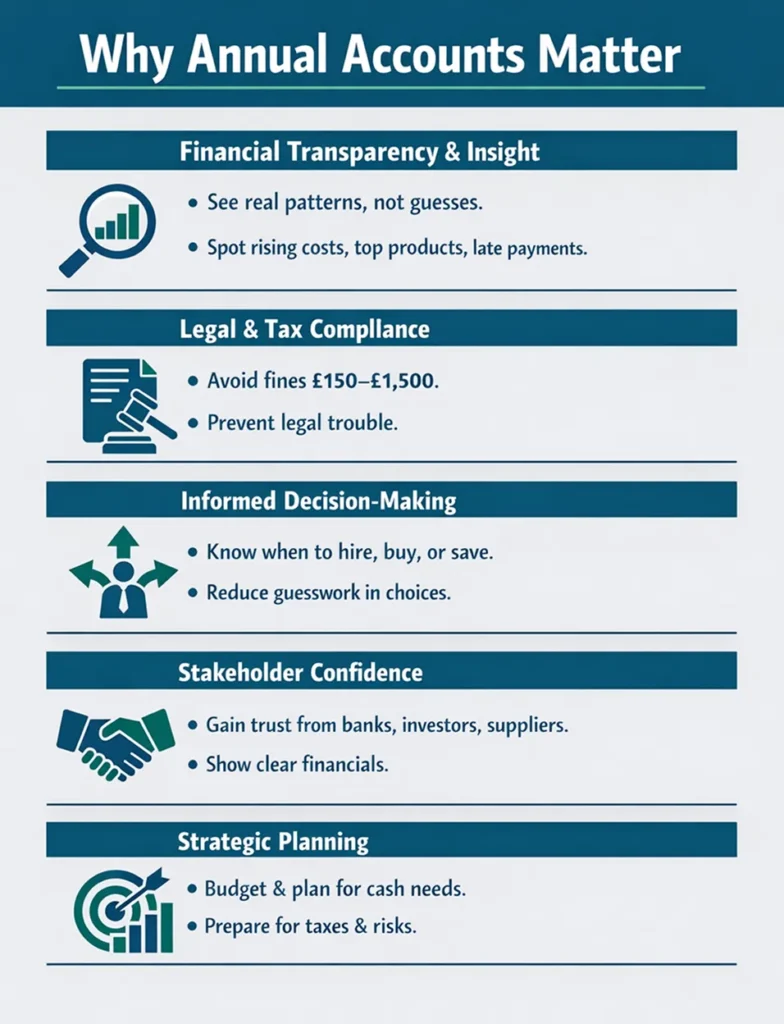
    You don’t just file yearly accounts. They also give you an idea of how well your business is doing. The following points explain why they are important.

    1. Financial Transparency and Insight

    You can see the business clearly with good annual accounts. You can see patterns, not just guesses.

    You might see, for instance:

    • Costs went up faster than sales.
    • One line of products makes more money.
    • Customers are paying late, which is bad for cash flow.

    You cannot judge profit just by checking the bank balance. A business can show a profit on paper even when cash is tight. That’s why accounts are important.

    2. Legal and Tax Compliance

    If you file your accounts late in the UK, you could be fined anywhere from £150 to £1,500, depending on how late you are. Not filing on time can lead to legal action. Directors or LLP designated members may face penalties in serious cases.

    3. Informed Decision-Making

    When your yearly accounts are correct, it is easier to make choices.

    You can choose:

    • If you can hire someone.
    • If you can afford a new van.
    • If you should raise prices.
    • If you need to save money.

    Without solid accounts, decisions are mostly guesswork.

    4. Stakeholder Confidence

    People depend on your numbers.

    This could include:

    • Lenders and banks.
    • People who invest.
    • Credit from suppliers.
    • People who might want to buy the business.

    They can trust what they see because of clear yearly financial accounts.

    5. Strategic Planning

    When planning is based on real data, it works best.

    Strong annual accounts help you to:

    • Make a budget that you can stick to.
    • Make a guess about how much money you’ll need.
    • Make plans for tax bills sooner.
    • Find risks before they turn into problems.

    Why Annual Accounts Matter

    What Are the Components of Annual Accounts?

    There are a few important papers that make up annual accounts. Some are main financial statements, while others are annual accounts reports and accounts that back them up. Let’s make them easier to understand.

    1. Core Financial Components

    A few main statements make up most sets of annual accounts.

    i. Income Statement

    The income statement is often called the profit and loss account.

    It shows:

    • Sales (money made).
    • Costs that come directly from things like materials.
    • Costs that aren’t directly related to the business, like rent and software.
    • The year’s profit or loss.

    A simple thought can help here:

    • What is left after costs is profit.
    • When costs are higher than income, you lose money.

    ii. Balance Sheet

    The balance sheet shows what the company looked like on the last day of the financial year.

    It includes:

    • Assets are things that the company owns.
    • Liabilities (what the company owes).
    • Equity (the value left for owners).

    The balance sheet in UK statutory accounts must have a director’s name on it and be signed by a director.

    iii. Cash Flow Statement

    A cash flow statement shows how money came in and went out.

    It usually divides cash flow into:

    • Day-to-day trading is an example of operating activities.
    • Investing activities, like buying equipment.
    • Activities that involve cash movement (loans, repayments).

    This is worth noting: UK rules say that a lot of small and micro businesses don’t have to file as many forms. The size of your business and the reporting framework you use will determine the exact annual statements you need to include.

    2. Other Key Components

    Extra annual accounts reports may also be included in yearly accounts, depending on the size and type of the company.

    i. Director’s Report

    This is a brief annual accounts report from the directors about the year.

    It could have:

    • A review of business performance.
    • Main risks.
    • Plans for the future.

    Companies House lets small businesses choose whether or not to send in the director’s annual accounts report and profit and loss account.

    ii. Auditor’s Report

    There is an auditor’s annual accounts report with your company’s audit if it needs one.

    Many private limited companies do not need an audit, unless they meet audit rules or an audit is required by their governing documents or shareholders.

    iii. Letter to Shareholders

    Some businesses send a short letter to their shareholders. It’s more common in bigger companies or those that get money from investors.

    It often explains results in simple terms, such as:

    • What worked out well.
    • What changed?
    • What comes next?

    iv. Management Discussion and Analysis (MD&A)

    This is a more in-depth ‘plain-language’ explanation of the results.

    It often includes:

    • Why revenue changed.
    • What caused the costs to change?
    • What are the main risks?
    • What management intends to do next?

    Most small private companies do not include MD&A as a formal section, but a clear plain-language summary of results can still help.

    v. Corporate Governance

    Corporate governance is the system that tells a company what to do and how to do it.

    In bigger companies, governance annual accounts reporting might include:

    • The structure of the board.
    • Rules and policies.
    • Managing risk.

    Smaller businesses may be able to keep this lighter, but good governance still helps cut down on mistakes and fraud.

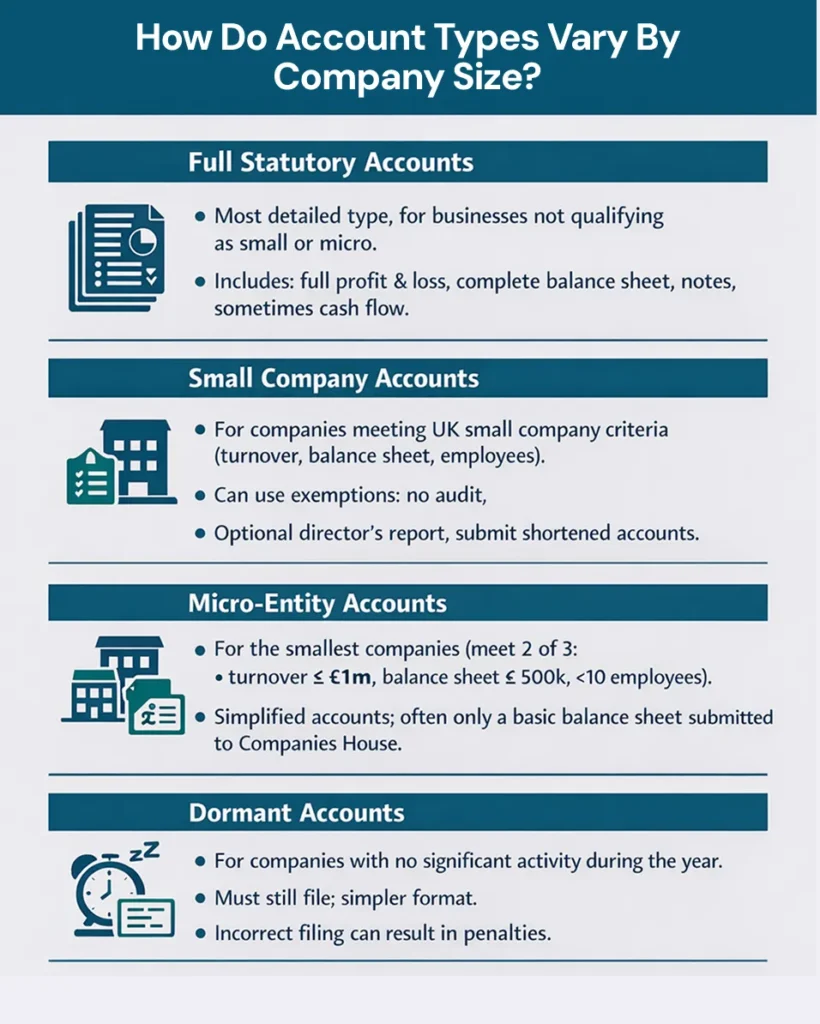
    How Do Account Types Vary by Company Size?

    Not all businesses file the same kinds of accounts. The rules in the UK let you use different formats depending on the size and type of activity. These are the most common types of accounts you will see.

    1. Full Statutory Accounts

    The most detailed version is the full statutory accounts.

    They are usually needed when a business doesn’t qualify for small or micro rules or when it decides to file full accounts.

    Full accounts usually have:

    • Account of profit and loss with more information.
    • A balance sheet with all the information.
    • Notes that explain the rules of accounting and important numbers.
    • It might be a cash flow statement, depending on the framework.

    2. Small Company Accounts

    A company that meets the UK small company criteria is treated as small for reporting. The test is based on turnover, balance sheet total, and employee numbers. Check the current thresholds before filing, as they can change. 

    You can do the following if your business is small:

    • Use the exemption so that your company’s books don’t have to be checked.
    • You can choose whether or not to send Companies House a copy of the director’s annual accounts report and the profit and loss account.
    • Send Companies House your shortened accounts.

    So, for many small companies, what the public sees on Companies House can be less detailed than what you prepare internally.

    3. Micro-Entity Accounts

    Micro-entities are even smaller than small businesses. UK Government official website says that a micro-entity must meet at least two of the following conditions:

    • A turnover of less than £1 million.
    • £500,000 or less on its balance sheet.
    • Fewer than 10 people work there.

    Micro-entities can make simpler accounts and may only send a simpler balance sheet to Companies House.

    4. Dormant Accounts

    A dormant company is one that doesn’t do any ‘significant’ business during the financial year. Dormant companies still have filing duties. Many people send Companies House dormant company accounts, which are easier to read. It’s better to ask an accountant if you’re not sure. Filing incorrectly can still lead to penalties.

    How Do Account Types Vary by Company Size

    Who Must Prepare and Receive Annual Accounts?

    Not just accountants need yearly accounts. A lot of people and businesses depend on them to make decisions, check things, and follow the rules. These are the main groups that are involved.

    1. Anyone with a Business Entity

    This depends on the type of business.

    • Most of the time, limited companies have to make and file statutory accounts.
    • Sole traders don’t have to send their company accounts to Companies House, but they still have to keep records and annual accounts report to HMRC in other ways.

    So, ‘business entity’ is important. The rules don’t work for everyone.

    2. Directors

    It is the job of directors to make sure that yearly accounts are made and filed on time. Directors are still legally responsible for the work, even if an accountant does it.

    3. Chief Executive and One Director

    In smaller businesses, the CEO and a board member are often the same person. The CEO of a large company may not be on the finance team, but they still use accounts to make decisions.

    4. Chief Financial Officer (CFO)

    A finance manager or CFO often:

    • Reviews performance results.
    • Checks for risks.
    • Helps with forecasting.
    • Works with accountants to get ready for the end of the year.

    5. Shareholders

    Shareholders get statutory accounts. According to the UK Government official website, you have to send copies of your statutory accounts to all of your shareholders.

    6. Regulators

    Companies House is the main place where UK businesses register and send in their accounts. As part of filing taxes, HMRC gets accounts.

    7. Stock Exchanges

    If a company is listed, it has to follow more rules about annual accounts reporting. This is mostly about filing for UK companies in general, but listed companies usually have more rules and shorter deadlines.

    8. Other Stakeholders

    Other people who have a stake can be:

    • Lenders.
    • Vendors.
    • Possible investors.
    • People who might buy.
    • Agencies that check credit.

    A lot of financial information before trusting a business. 

    If you are improving your finance skills, you may like this guide on how to become a bookkeeper. It helps you understand the basics that sit behind annual accounts.

    When to File Annual Accounts?

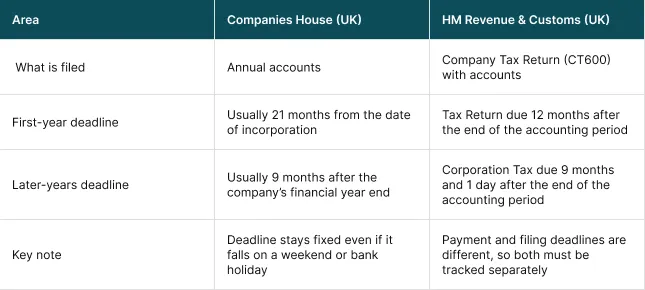
    Deadlines can be confusing because Companies House and HMRC use different timelines. The key is to track them separately.

    When to File Annual Accounts

    1. First-Year Accounts

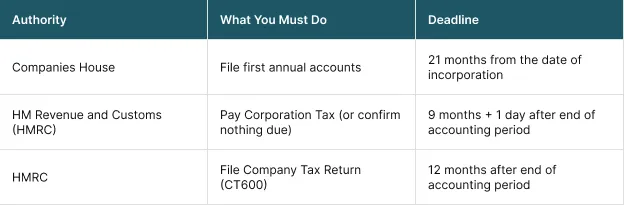
    In some cases, your first year has different rules and longer timeframes. You still have to keep track of two different deadlines. This is how it works for each body.

    First Year Accounts

    i. Companies House (UK)

    UK Government official website says this about a private limited company:

    • You have 21 months from the date you registered with Companies House to file your first accounts.

    It’s also helpful to know your accounting reference date (ARD). The annual accounts filing guide from Companies House tells you how to figure out the filing deadline from the ARD and how new companies get their ARD. On its first accounts guidance page, the UK Government official website also gives clear examples of how first accounts cover an unusual first period.

    ii. HMRC (UK)

    There are two important deadlines for HMRC:

    • Pay Corporation Tax (or tell HMRC you owe none): usually 9 months and 1 day after the end of your accounting period.
    • File the Company Tax Return: 12 months after the end of the accounting period to file the Company Tax Return.

    People get confused because of this. The deadlines for Companies House and HMRC are not the same.

    2. Subsequent Accounts

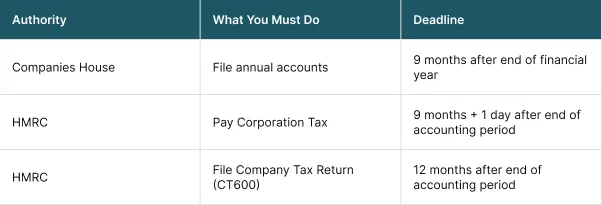
    After the first year, the deadlines happen more often. But you still have to meet the deadlines set by both Companies House and HMRC. Here are the usual timelines.

    Subsequent Accounts

    i. Companies House (UK)

    A private company usually files 9 months after the end of your company’s financial year, which is after the first year.

    Also, if your deadline is on a Sunday or a bank holiday, you still have to file by that date. The Companies House accounts guidance makes this very clear.

    ii. HMRC (UK)

    The deadlines for HMRC stay the same:

    • Corporation Tax Payment: 9 months and 1 day after the end of the accounting period.
    • Company Tax Return: One year after the end of the accounting period.

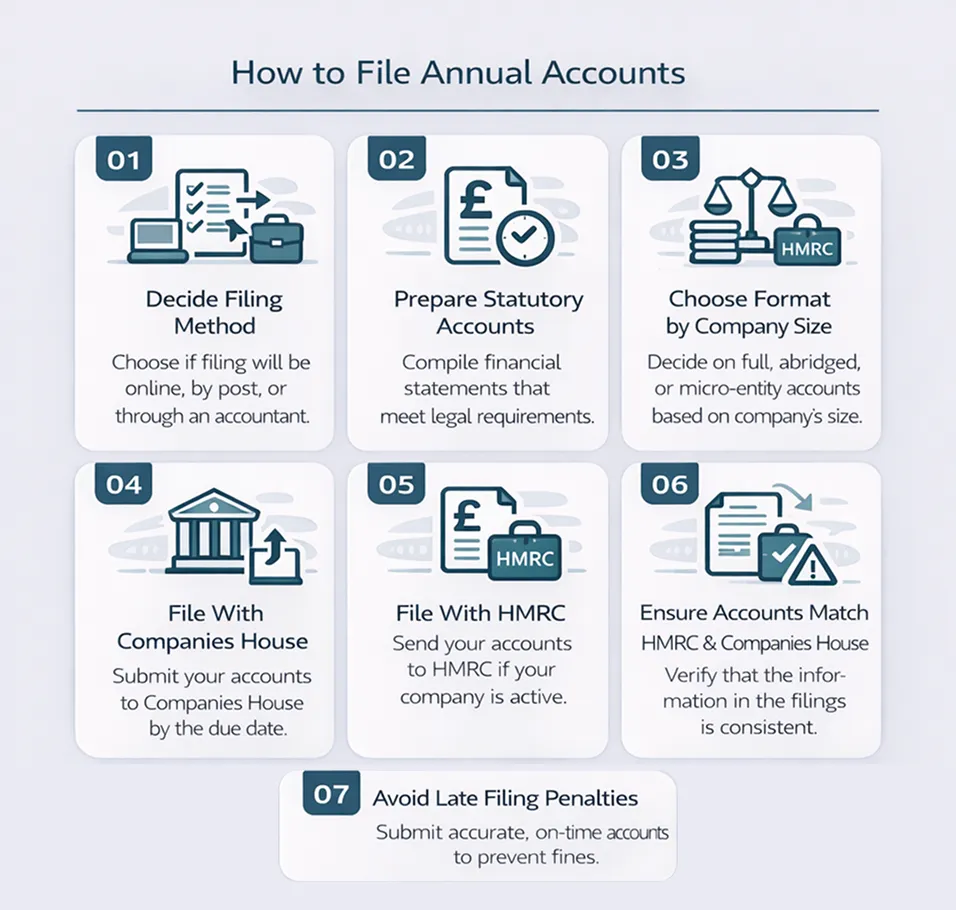
    How to File Annual Accounts?

    Filing may seem hard, but if you follow the steps in the right order, it’s not too hard. The process usually starts with making sure the records are clean and ends with sending them to the right places. Here is the easy-to-follow flow.

    1. Decide Filing Method

    There are a few ways you can file:

    • You can file directly with Companies House using software or the internet.
    • As part of the Company Tax Return process, send this to HMRC.
    • Use the joint filing service to file your accounts and tax return at the same time.

    The best way depends on how your business is set up and what tools your accountant has.

    2. Prepare Statutory Accounts

    You need to get the accounts ready before you file.

    That means:

    • Balance your bank accounts.
    • Make sure that all sales and expenses are in order.
    • Check your payroll and VAT if you are registered.
    • Check on debtors and creditors.
    • Make note of year end accounts changes, such as depreciation.

    This is the part where a lot of small businesses need professional help.

    3. Choose Format by Company Size

    Use the right size for your format:

    • All accounts.
    • Accounts for small businesses.
    • Accounts for micro-entities.
    • Accounts that are not active.

    4. File With Companies House

    Companies House keeps track of when it gets acceptable accounts. You don’t get more time if you file close to the deadline and your accounts are turned down. The Companies House accounts guide on the UK Government official website makes this very clear.

    5. File With HMRC

    When you file with HMRC, how you format it is important. According to HMRC, most companies’ accounts that are part of an online Company Tax Return must be in iXBRL format, but there are some exceptions. If you use the government’s joint filing service, it says that the service will change your accounts to the right iXBRL format.

    6. Ensure Accounts Match HMRC and Companies House

    Try to keep one ‘source of truth’ clean.

    Some common reasons for mismatches are:

    • Used the wrong year-end dates by accident.
    • Changes made late after one filing.
    • Different ways of depreciating are used.
    • Missing changes to the director’s loan.
    • Matching your numbers lowers risk and saves time later.

    7. Avoid Late Filing Penalties

    Late filing fees can add up fast. Companies House charges private companies:

    • £150 for being less than a month late.
    • £375 for being late more than a month but less than three months.
    • Late by more than three months but less than six months: £750.
    • £1,500 if you’re more than six months late.

    If you file late in two consecutive financial years, the fees double in all cases.

    How to File Annual Accounts

    What Are the Benefits of Proper Annual Accounts?

    Keeping proper accounts does more than keep you legal. They can help you run your business better and lower your risk. The benefits below are divided into two groups: business benefits and compliance benefits.

    1. Business And Financial Benefits

    These benefits are about making the business work better every day. They concentrate on planning, doing things well, and making better choices. Let’s look at each one.

    i. Informed Decision-Making

    Clean annual accounts help the companies show:

    • What is profitable.
    • Where costs are high.
    • Where cash gets stuck.

    ii. Budgeting And Planning

    It’s easier to make a budget once you know the real numbers from last year.

    You can make plans:

    • Spending each month.
    • Getting hired.
    • Tax savings.
    • Goals for growth.

    iii. Improved Financial Performance

    You can make things better by measuring them.

    You could, for instance:

    • Stop wasting things.
    • Talk to your suppliers again about prices.
    • If your margins are too low, raise your prices.

    iv. Increased Access To Funding

    Banks and lenders often want to see recent accounts.

    Strong yearly accounts can help:

    • Applications for loans.
    • Overdrafts go up.
    • Talks with investors.

    v. Enhanced Operational Efficiency

    Accounts show where money and time are being wasted. For instance, if the cost of running the business keeps going up, you might want to automate invoicing or collect debts faster.

    vi. Fraud Detection And Prevention

    Fraud often hides in messy records. Regular checks and reconciliations make it less likely that mistakes or fraud will go unnoticed.

    2. Legal And Compliance Benefits

    These benefits help you follow the rules. They also make doing taxes and annual accounts reporting less stressful. Here are the main benefits.

    i. Regulatory Compliance

    Filing correctly is important for following Companies House rules and staying in good standing. You could be charged with a crime if you don’t file.

    ii. Simplified Tax Preparation

    Filing taxes is easier when your books are clean. You don’t have to worry about missing receipts, panicking at the last minute, or rushing to get numbers.

    iii. Proof Of Active Status

    Filing on time shows that your business is still open and following the rules.

    That can be important when:

    • Putting in bids for contracts.
    • Getting money.
    • Trusting your suppliers.

    iv. Legal Evidence

    Your annual accounts can show what the business did and when. This can help with business sales, due diligence, and disagreements.

    Conclusion

    Annual accounts are more than just paperwork. They show how much money your business makes each year. They help you file your taxes, make sure you follow the rules, and run your business clearly. Knowing what goes into them makes the whole thing less stressful. You can also find problems sooner, make better plans, and talk to lenders, investors, and partners with confidence. The easiest way to make the process feel easy is to keep it simple. Keep good records all year, then get ready and file on time.

    Worried your annual accounts might be late or incorrect?

    That is exactly where we can help. Sterling Cooper Consultants can support you with tidy bookkeeping, accurate year-end reporting, and smooth filing. Explore our accounting and bookkeeping services for ongoing support.
    Ready to get started? Contact us and we will talk you through the next steps.

    +443300102526
    Book an Appointment

    FAQs


    What Are the Annual Accounts?


    They are the yearly statutory financial statements for a company. They are prepared after the financial year ends. In the UK, you send statutory accounts to Companies House, and also to HMRC as part of the Company Tax Return process.


    A simple way to think about it is:
    1. Collect records, like sales, bills, and bank statements.
    2. Record transactions in your books.
    3. Reconcile bank accounts.
    4. Review and adjust entries.
    5. Produce a trial balance.
    6. Prepare financial statements.
    7. File and store records safely.


    For most small businesses, the ‘big five’ are:
    1. Income (sales).
    2. Expenses (costs).
    3. Assets (things you own).
    4. Liabilities (things you owe).
    5. Equity (value left for owners).


    It means ‘once each year’. In practice, it usually means covering one full financial year, then preparing annual accounts at the end of that period.


    Most annual accounts include a profit and loss account (income statement), a balance sheet, and notes. Many sets also include a director’s report and, if required, an auditor’s report.

    Share This Article!

    Recent Posts