Tag: HMRC

  • What Is a Payroll Report and Why Is It Essential for Every Business?

    What Is a Payroll Report and Why Is It Essential for Every Business?

    Payroll Reports

    Posted by:

    Admin

    Date:

    February 12, 2026

    Category:

    blogs

    Error: Contact form not found.

    What Is a Payroll Report and Why Is It Essential for Every Business?

    Payroll is one of those jobs that sounds simple: pay people, send payslips, done. In practice, it is easy for errors to slip in. Starters, leavers, overtime, bonuses and changes to the tax rules make things more complicated. This is why payroll reports matter.

    When you look at guidance from most payroll and accounting platforms, they all land on the same core points. A payroll report is a record of what you paid, what you withheld, and what you owe. It helps you pay staff correctly and stay compliant.

    Some payroll platforms note that small businesses can spend up to 5 hours each pay period on payroll tasks before automation. That adds up fast over a year. This guide explains what a payroll report includes, the main report types, and why it helps UK businesses stay accurate and organised.

    What Is a Payroll Report?

    A payroll report is a document that summarises pay data for a chosen time period. It can be a week, a month, a quarter, or a tax year.

    Most reports include:

    What the Report Shows What It Means
    Employee names and pay periods Who was paid and for which pay period
    Hours worked and pay rates Hours worked and the rate paid, for hourly staff
    Gross pay Pay before any deductions are taken
    Taxable pay The amount of pay that is subject to tax
    Deductions Pension, student loan, salary sacrifice, and other deductions
    Tax deducted Income tax taken from pay
    National Insurance Employee and employer National Insurance, where shown
    Net pay The amount of pay that is subject to tax
    Employer costs and payroll liabilities What the business owes in total

    In the UK, payroll reporting is closely linked to PAYE and RTI submissions. HMRC guidance explains that employers report an employee’s pay, deductions, and any payrolled benefits through a Full Payment Submission (FPS) on or before payday, and an Employer Payment Summary (EPS) is used for things like reductions (for example statutory pay) and can be due by the 19th of the following tax month.

    HMRC also shows the kind of ‘pay and deductions’ data that is reported per period, such as taxable pay, tax deducted, and student loan deductions.

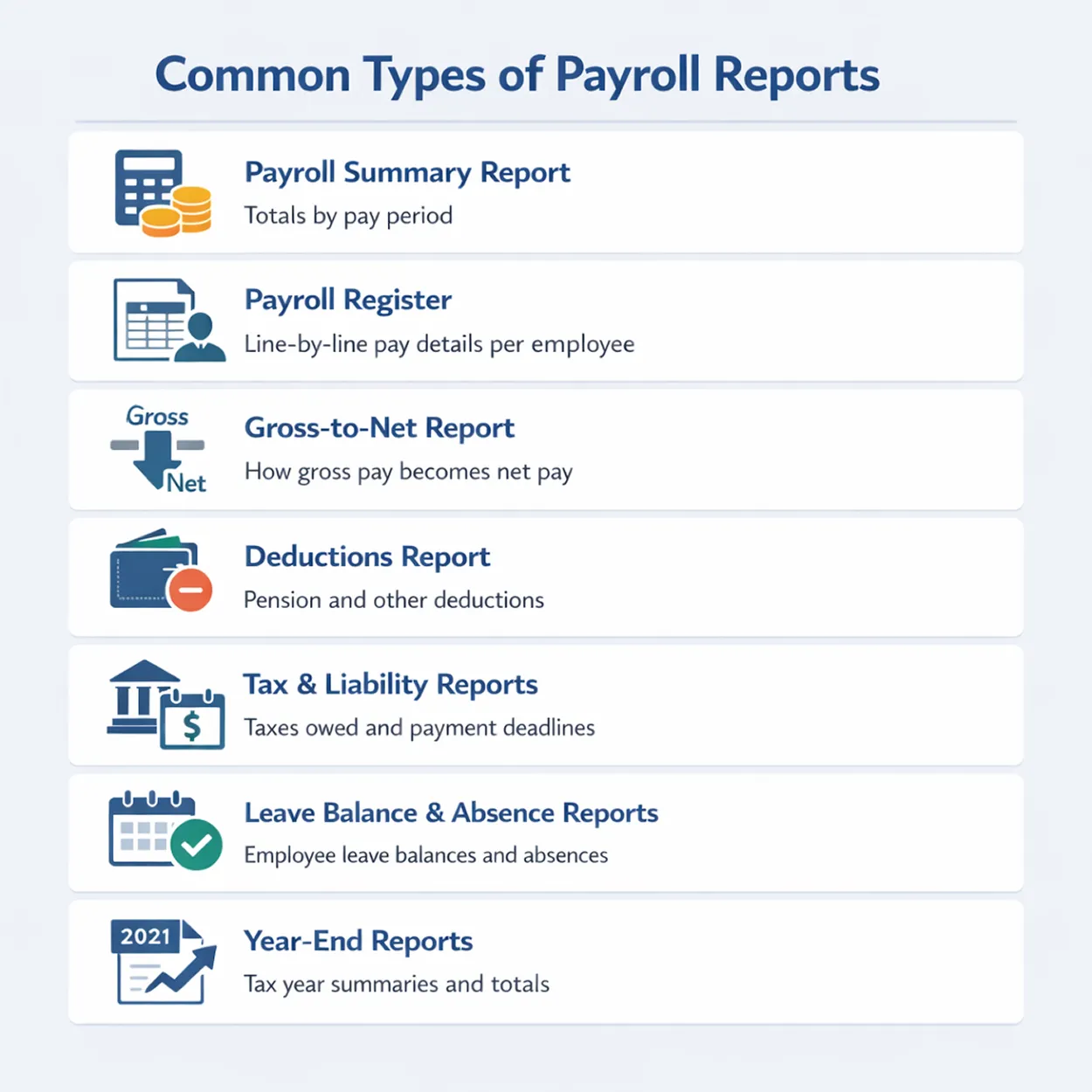
    Common Types of Payroll Reports

    Different businesses use different payroll reporting types, but these are the ones you will see most often:

    • Payroll summary report (totals by period).
    • Payroll register (line-by-line pay details per employee).
    • Gross-to-net report (how gross pay becomes net pay).
    • Deductions report (pension and other deductions).
    • Tax and liability reports (what you owe and when).
    • Leave balance and absence reports.
    • Year-end reports (tax year summaries and totals).
    Common Types of Payroll Reports

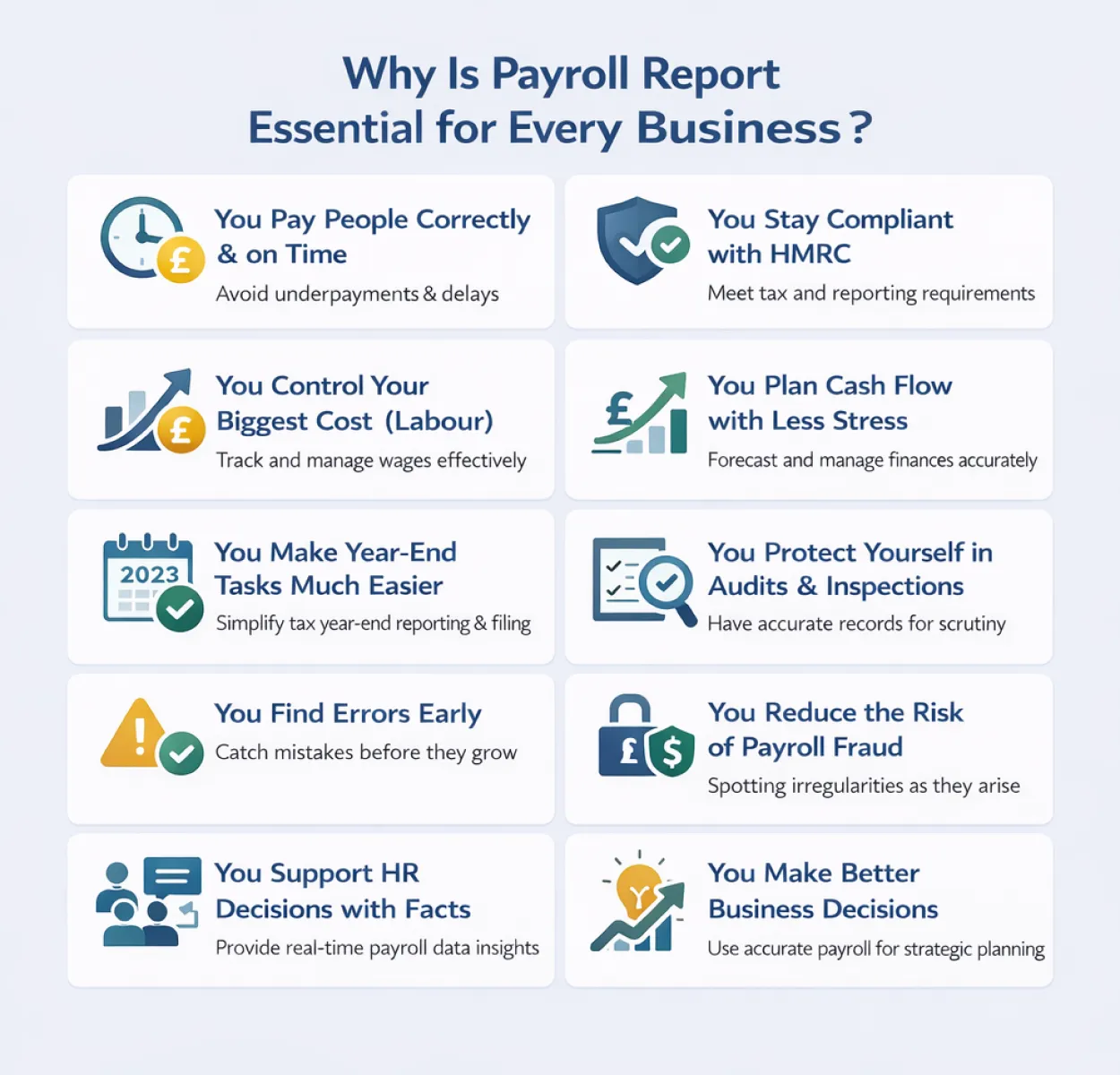
    Why Is Payroll Report Essential for Every Business?

    Below are 10 clear reasons payroll reports matter for UK businesses:

    1. You Pay People Correctly & on Time

    The first thing payroll reports do is easy. They help you pay individuals the correct amount.

    Common payroll mistakes include:

    • Unpaid overtime.
    • Missing hours.
    • Wrong rate (overtime rate).
    • Duplicated payments.
    • Wrong deductions.

    Why Is Payroll Report Essential for Every Business

    A payroll register or gross-to-net report. It makes it easy to see each employee’s numbers. You can spot unexpected drops in net pay or unusual differences. That gives you time to fix issues before payroll is processed. That also helps with cash flow. One wrong payroll can mean having to make emergency bank transfers, make changes quickly, and waste time on paperwork.

    2. You Stay Compliant with HMRC

    ‘Doing payroll’ is not the same as compliance. Compliance shows that payroll has been done correctly.

    In the UK, RTI reporting means that firms have to provide payroll information through FPS on or before payday. They also have to use EPS when necessary, such as when they don’t pay anyone in a tax month.

    This is where payroll reports come in handy. They back up your RTI numbers. They also help you answer questions like these:

    • What taxable pay did we report this period?
    • How much tax did we deduct?
    • What student loan amounts were taken?

    HMRC provides examples of the data reported for each pay period, such as taxable wages, tax that was taken out or returned, and student loan deductions. You are less likely to need last-minute corrections or send in the wrong reports if you keep your reports neat.

    3. You Control Your Biggest Cost (Labour)

    For many firms, payroll is the most expensive thing they do every month.

    A clear payroll summary shows you exactly where your payroll money is going, including:

    • Total wages.
    • Total employer costs.
    • Overtime spend.
    • Department or location totals (if your system supports it).

    This helps you make smart choices, like:

    • Do we need more staff, or better rota planning?
    • Are overtime costs climbing for one team?
    • Are we paying too much in one role compared to output?

    This is where payroll reports become more than basic administration. They turn into tools for business.

    4. You Plan Cash Flow with Less Stress

    There is a set date for payroll. It doesn’t wait.

    A payroll summary report or payroll liabilities report might assist you figure out when and how much money you need to take out of your bank account. It also helps you separate:

    • What goes to employees?
    • What do you owe as deductions?
    • What do you owe as employer contributions? (where applicable)

    This is particularly more important when money is limited or when your income changes with the seasons.

    Your management accounts and budget should reflect real payroll costs, so planning stays accurate. This is one reason some businesses use payroll support or outsource payroll.

    5. You Make Year-End Tasks Much Easier

    When records are sloppy, the end of the year is hard. You often need to know the exact amount of payroll for:

    • Annual accounts.
    • Benefits and expenses reporting.
    • Pensions records and checks.
    • Audit trails.

    For instance, HMRC sets deadlines for expenses and benefits reporting and warns about penalties for late submissions. Dates can change, so confirm the current deadlines for your reporting duties before year end.

    When you keep your payroll reporting in order every month, the end of the year is a time to check and confirm, not to worry and start over.

    6. You Protect Yourself in Audits & Inspections

    Not every ‘audit’ is a real audit. Sometimes it’s just:

    • An HMRC check.
    • A pension provider query.
    • An employee dispute.
    • A bank asking for proof of payroll costs.

    This is when payroll reports come in handy as proof.

    In the UK, employers must keep PAYE records for the required period. Poor records can lead to penalties and extra HMRC questions, so keeping reports organised is a practical safeguard. It also warns that poor record keeping can lead to penalties, and HMRC may assess what is due based on the information available. So, reports are more than just ‘nice to have.’ They help protect your business.

    7. You Find Errors Early (Before They Get Expensive)

    People generally don’t notice payroll mistakes until they happen again. That means that one mistake can affect a lot of pay runs.

    Some such examples are:

    • Wrong tax code carried forward.
    • Pension not applied correctly.
    • A deduction continuing after it should stop.
    • Wrong leaver date causing overpayment.

    A simple check routine goes a long way:

    • Run a payroll summary report.
    • Compare it to last period.
    • Review the biggest changes.
    • Review exceptions (new starters, leavers, sick pay).

    Many payroll systems also recommend reconciling payroll totals with your accounts and budgets.

    8. You Reduce the Risk of Payroll Fraud

    Payroll fraud does exist and can come from both internal and external sources. Some examples are:

    • Fake employees.
    • Inflated hours.
    • Changed bank details.
    • Unauthorised bonuses.
    • Payroll diversion scams.

    Use payroll reports in a controlled way to reduce risk:

    • Restrict access.
    • Use approval steps.
    • Run ‘change reports’ (bank detail changes, new employees).
    • Check overtime spikes.
    • Match headcount to HR records.

    The Government of the UK has an official way to report tax fraud (both an online payroll report facility and a phone line) if you think someone is cheating on their taxes or not paying their payroll taxes. If an employee has concerns, Acas (the Advisory, Conciliation and Arbitration Service) explains whistleblowing as the disclosure of wrongdoing in the public interest and provides guidance on the relevant legal framework.

    9. You Support HR Decisions with Facts (Not Guesses)

    Payroll data is strongly related to HR. It depicts what is really going on, not what people think.

    Reports can assist you answer questions like:

    • Who is doing repeated overtime?
    • Which role has the highest turnover cost?
    • Are absences affecting payroll costs?
    • Are allowances and deductions consistent?

    Your payroll system might also let you see how much leave you have left. For instance, QuickBooks Advanced Payroll has a report option for leave balances. This makes it easier for HR and finance to work together. It also helps you make rules about equitable pay.

    For people growing into finance roles, it also helps to understand the basics of bookkeeping and record keeping. If that is you, our guide on becoming a bookkeeper is a useful next read. 

    10. You Make Better Business Decisions (Pricing, Hiring, Growth)

    Lastly, payroll reports provide you the confidence to make major choices.

    Here are some basic business decisions that payroll data can help with:

    • Pricing: ‘If labour costs go up, can we still afford this contract?’
    • Hiring: ‘Is it cheaper to hire someone full-time than to work overtime all the time?’
    • Hours of Operation: ‘Are we overstaffed when it’s quiet?’
    • Raises and Bonuses: ‘How much does it all cost, including what the employer has to pay?’
    • Planning for Growth: ‘How much does payroll go up with 10 more workers?’

    You don’t have to be a data pro. You only need numbers that are accurate and reliable. That’s why companies use payroll services and experienced help when things get hard. A structured payroll management service can help make sure that reports are correct, consistent, and ready for an audit.

    Case Study of HMG Paints (UK)

    HMG Paints in the UK shared a big win. Payroll that once took three days was reduced to around three hours.

    What Happened?

    They moved to an all-in-one HR + payroll system and said their monthly payroll run dropped from a three-day process to a three-hour process (over 80% faster). They also said reports became easy to access and they were no longer hunting for them.

    Why Does It Support Payroll Reports?

    It shows that easier access to reports can save time and reduce back-and-forth during payroll.

    What’s the Key Takeaway?

    HMG Paints shared that their monthly payroll used to take around three days. After changing their payroll setup, they said it dropped to around three hours. They also said payslips and reports became easy to access, so they stopped wasting time searching for information. This shows how payroll reports help you work faster and spot problems sooner.

    Conclusion

    A payroll report is more than a spreadsheet or a software download. It gives you a clear record of pay, deductions, and employer costs. It also helps you check payroll, stay organised for HMRC reporting, and reduce avoidable errors.

    When your payroll reports are clear, you pay people right, meet HMRC requirements, manage cash better, and reduce risk. You also make smarter business decisions using real data, not assumptions. If you want a calmer payroll process, start with the reports. Then build a simple routine around them.

    Want payroll to feel simpler and safer?

    Sterling Cooper Consultants can take payroll off your plate and keep your reporting accurate and compliant through our Payroll Management service.
    If you are ready, contact us today and tell us what you need help with.

    +443300102526
    Book an Appointment

    FAQs


    What Is a Payroll Report?

    A payroll report is a record of employee pay for a time period. It normally shows earnings, deductions, taxes, and net pay. In the UK, payroll records also support RTI submissions like FPS and EPS.

    If you use QuickBooks Online Payroll, QuickBooks explains a simple route:

    i. Go to the Payroll section in Reports

    ii. Select Payroll Summary

    iii. Set the date range and apply

    iv. Customise if needed, then run the report

    If you use QuickBooks Online Advanced Payroll (UK), QuickBooks shows steps like:

    i. Go to Payroll → Reports tab

    ii. Pick the report (for example Gross to Net, Employee payment history, Deductions)

    iii. Set filters (date range, employees, pay schedule)

    iv. Run and download the report


    Start with your internal process first (manager, HR, finance, or whistleblowing policy). Acas explains whistleblowing as reporting wrongdoing that affects others and is in the public interest. If you believe it involves tax fraud or evasion, GOV.UK provides an official way to report tax fraud to HMRC, including an online service and a hotline option.


    Accuracy and timing. People must be paid correctly and on time. Then your reporting must match what happened, so you can prove it later.

    The core calculation and reporting flow:

    i. Correct pay inputs (hours, salary, overtime)

    ii. Correct deductions and tax treatment

    iii. Clean reports that match what was paid and what is owed

    In the UK, that also means RTI-ready reporting (FPS and EPS).

    A detailed payroll report usually means a payroll register or a gross-to-net report. It shows line-by-line detail per employee, like:

    i. Gross pay

    ii. Taxable pay

    iii. Tax deducted

    iv. Deductions (pension, loans, other items)

    v. Net pay

    For UK payroll reporting fields like taxable pay and tax deducted, HMRC gives examples of ‘pay and deductions’ data reported per period.

    Share This Article!

    Recent Posts

  • What Are Annual Accounts? Everything You Need to Know

    What Are Annual Accounts? Everything You Need to Know

    Annual Accounts Explained

    Posted by:

    Admin

    Date:

    February 9, 2026

    Category:

    blogs

    Error: Contact form not found.

    What Are Annual Accounts? Everything You Need to Know

    Did you know that in the UK, about 98.5% companies filed their annual accounts on time. That shows how important this job is for companies. 

    Annual accounts show a business’s finances for one year. They show profit or loss, plus what the business owns and what it owes. They also help calculate how much Corporation Tax is due. Limited companies must file annual accounts with Companies House and send accounts to HMRC as part of the Company Tax Return process. This is a legal duty.

    What Are Annual Accounts?

    At the end of your business’s financial year, you make annual accounts, which are a set of financial statements. Your bookkeeping records, such as invoices, bank transactions, payroll, and expenses, are what they are based on. Companies in the UK usually have to send their statutory accounts to Companies House and HMRC as part of the process of filing their Company Tax Return.

    Think of your annual accounts as a ‘financial story’ for that year. They answer simple questions like:

    • Whether the business made money or lost money.
    • How much cash it had at key points.
    • What it owned, like stocks or tools.
    • What it owed, such as bills that weren’t paid or loans.

    They also help you figure out how much Corporation Tax you owe. The UK Government official webpage on accounts and tax responsibilities for private limited companies lists annual accounts and the Company Tax Return as two important things that must be done at the end of the year.

    Why Do Annual Accounts Matter?

    You don’t just file yearly accounts. They also give you an idea of how well your business is doing. The following points explain why they are important.

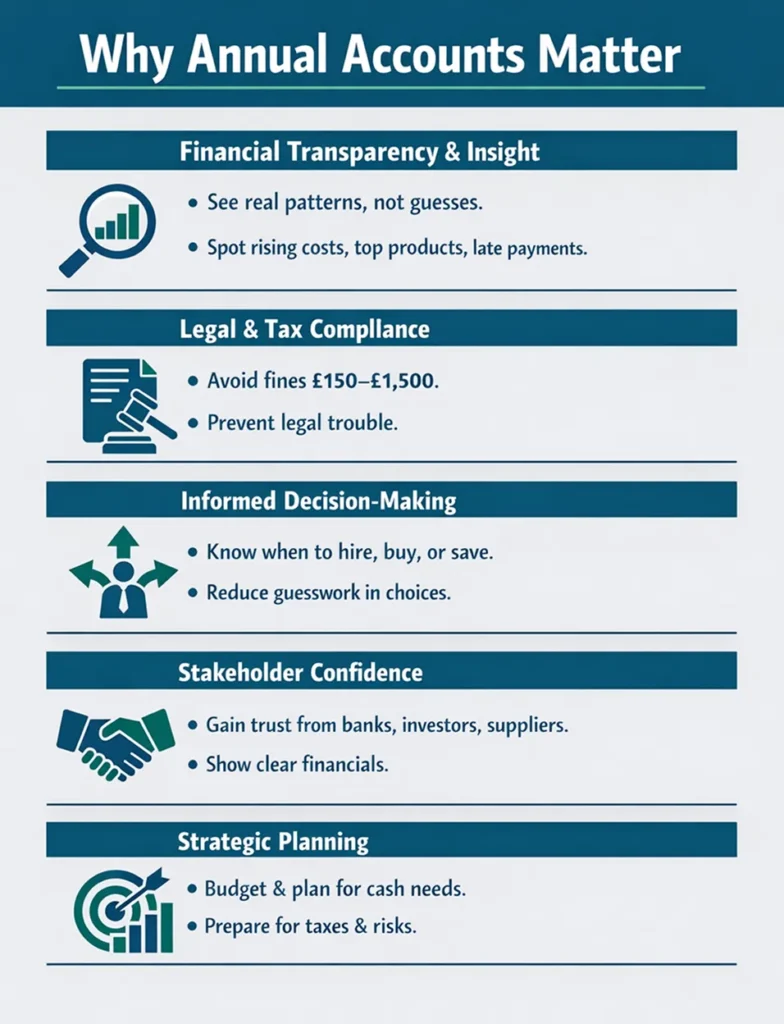
    1. Financial Transparency and Insight

    You can see the business clearly with good annual accounts. You can see patterns, not just guesses.

    You might see, for instance:

    • Costs went up faster than sales.
    • One line of products makes more money.
    • Customers are paying late, which is bad for cash flow.

    You cannot judge profit just by checking the bank balance. A business can show a profit on paper even when cash is tight. That’s why accounts are important.

    2. Legal and Tax Compliance

    If you file your accounts late in the UK, you could be fined anywhere from £150 to £1,500, depending on how late you are. Not filing on time can lead to legal action. Directors or LLP designated members may face penalties in serious cases.

    3. Informed Decision-Making

    When your yearly accounts are correct, it is easier to make choices.

    You can choose:

    • If you can hire someone.
    • If you can afford a new van.
    • If you should raise prices.
    • If you need to save money.

    Without solid accounts, decisions are mostly guesswork.

    4. Stakeholder Confidence

    People depend on your numbers.

    This could include:

    • Lenders and banks.
    • People who invest.
    • Credit from suppliers.
    • People who might want to buy the business.

    They can trust what they see because of clear yearly financial accounts.

    5. Strategic Planning

    When planning is based on real data, it works best.

    Strong annual accounts help you to:

    • Make a budget that you can stick to.
    • Make a guess about how much money you’ll need.
    • Make plans for tax bills sooner.
    • Find risks before they turn into problems.

    Why Annual Accounts Matter

    What Are the Components of Annual Accounts?

    There are a few important papers that make up annual accounts. Some are main financial statements, while others are annual accounts reports and accounts that back them up. Let’s make them easier to understand.

    1. Core Financial Components

    A few main statements make up most sets of annual accounts.

    i. Income Statement

    The income statement is often called the profit and loss account.

    It shows:

    • Sales (money made).
    • Costs that come directly from things like materials.
    • Costs that aren’t directly related to the business, like rent and software.
    • The year’s profit or loss.

    A simple thought can help here:

    • What is left after costs is profit.
    • When costs are higher than income, you lose money.

    ii. Balance Sheet

    The balance sheet shows what the company looked like on the last day of the financial year.

    It includes:

    • Assets are things that the company owns.
    • Liabilities (what the company owes).
    • Equity (the value left for owners).

    The balance sheet in UK statutory accounts must have a director’s name on it and be signed by a director.

    iii. Cash Flow Statement

    A cash flow statement shows how money came in and went out.

    It usually divides cash flow into:

    • Day-to-day trading is an example of operating activities.
    • Investing activities, like buying equipment.
    • Activities that involve cash movement (loans, repayments).

    This is worth noting: UK rules say that a lot of small and micro businesses don’t have to file as many forms. The size of your business and the reporting framework you use will determine the exact annual statements you need to include.

    2. Other Key Components

    Extra annual accounts reports may also be included in yearly accounts, depending on the size and type of the company.

    i. Director’s Report

    This is a brief annual accounts report from the directors about the year.

    It could have:

    • A review of business performance.
    • Main risks.
    • Plans for the future.

    Companies House lets small businesses choose whether or not to send in the director’s annual accounts report and profit and loss account.

    ii. Auditor’s Report

    There is an auditor’s annual accounts report with your company’s audit if it needs one.

    Many private limited companies do not need an audit, unless they meet audit rules or an audit is required by their governing documents or shareholders.

    iii. Letter to Shareholders

    Some businesses send a short letter to their shareholders. It’s more common in bigger companies or those that get money from investors.

    It often explains results in simple terms, such as:

    • What worked out well.
    • What changed?
    • What comes next?

    iv. Management Discussion and Analysis (MD&A)

    This is a more in-depth ‘plain-language’ explanation of the results.

    It often includes:

    • Why revenue changed.
    • What caused the costs to change?
    • What are the main risks?
    • What management intends to do next?

    Most small private companies do not include MD&A as a formal section, but a clear plain-language summary of results can still help.

    v. Corporate Governance

    Corporate governance is the system that tells a company what to do and how to do it.

    In bigger companies, governance annual accounts reporting might include:

    • The structure of the board.
    • Rules and policies.
    • Managing risk.

    Smaller businesses may be able to keep this lighter, but good governance still helps cut down on mistakes and fraud.

    How Do Account Types Vary by Company Size?

    Not all businesses file the same kinds of accounts. The rules in the UK let you use different formats depending on the size and type of activity. These are the most common types of accounts you will see.

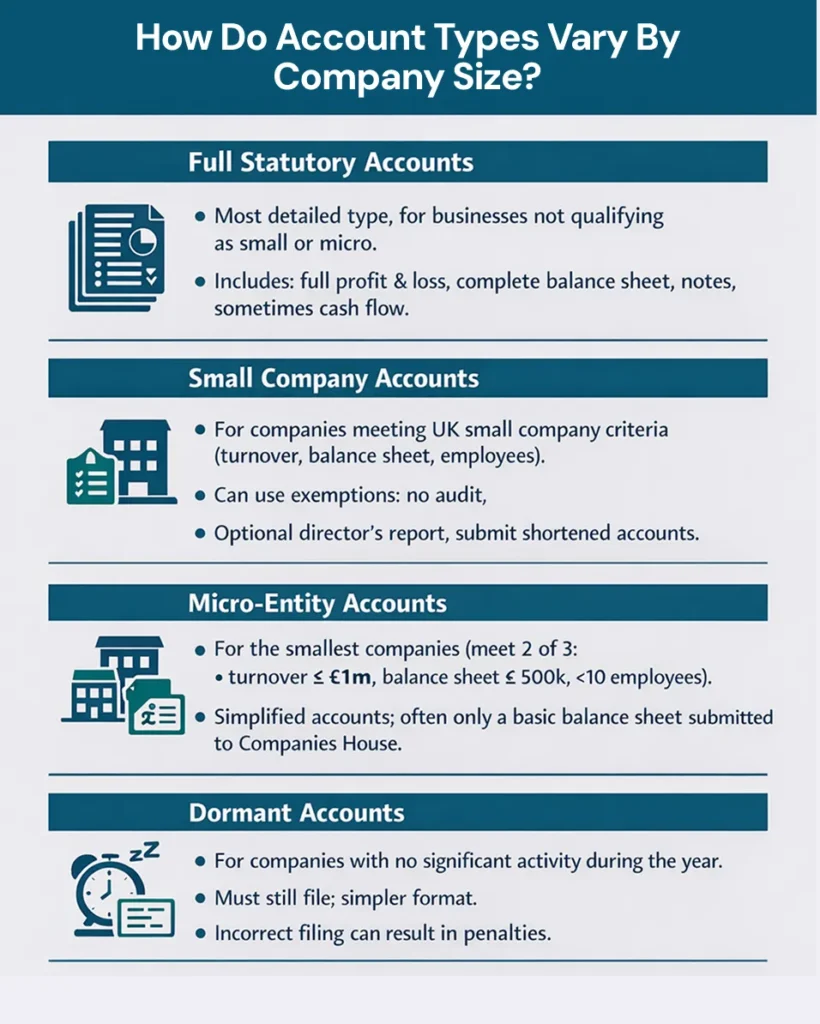
    1. Full Statutory Accounts

    The most detailed version is the full statutory accounts.

    They are usually needed when a business doesn’t qualify for small or micro rules or when it decides to file full accounts.

    Full accounts usually have:

    • Account of profit and loss with more information.
    • A balance sheet with all the information.
    • Notes that explain the rules of accounting and important numbers.
    • It might be a cash flow statement, depending on the framework.

    2. Small Company Accounts

    A company that meets the UK small company criteria is treated as small for reporting. The test is based on turnover, balance sheet total, and employee numbers. Check the current thresholds before filing, as they can change. 

    You can do the following if your business is small:

    • Use the exemption so that your company’s books don’t have to be checked.
    • You can choose whether or not to send Companies House a copy of the director’s annual accounts report and the profit and loss account.
    • Send Companies House your shortened accounts.

    So, for many small companies, what the public sees on Companies House can be less detailed than what you prepare internally.

    3. Micro-Entity Accounts

    Micro-entities are even smaller than small businesses. UK Government official website says that a micro-entity must meet at least two of the following conditions:

    • A turnover of less than £1 million.
    • £500,000 or less on its balance sheet.
    • Fewer than 10 people work there.

    Micro-entities can make simpler accounts and may only send a simpler balance sheet to Companies House.

    4. Dormant Accounts

    A dormant company is one that doesn’t do any ‘significant’ business during the financial year. Dormant companies still have filing duties. Many people send Companies House dormant company accounts, which are easier to read. It’s better to ask an accountant if you’re not sure. Filing incorrectly can still lead to penalties.

    How Do Account Types Vary by Company Size

    Who Must Prepare and Receive Annual Accounts?

    Not just accountants need yearly accounts. A lot of people and businesses depend on them to make decisions, check things, and follow the rules. These are the main groups that are involved.

    1. Anyone with a Business Entity

    This depends on the type of business.

    • Most of the time, limited companies have to make and file statutory accounts.
    • Sole traders don’t have to send their company accounts to Companies House, but they still have to keep records and annual accounts report to HMRC in other ways.

    So, ‘business entity’ is important. The rules don’t work for everyone.

    2. Directors

    It is the job of directors to make sure that yearly accounts are made and filed on time. Directors are still legally responsible for the work, even if an accountant does it.

    3. Chief Executive and One Director

    In smaller businesses, the CEO and a board member are often the same person. The CEO of a large company may not be on the finance team, but they still use accounts to make decisions.

    4. Chief Financial Officer (CFO)

    A finance manager or CFO often:

    • Reviews performance results.
    • Checks for risks.
    • Helps with forecasting.
    • Works with accountants to get ready for the end of the year.

    5. Shareholders

    Shareholders get statutory accounts. According to the UK Government official website, you have to send copies of your statutory accounts to all of your shareholders.

    6. Regulators

    Companies House is the main place where UK businesses register and send in their accounts. As part of filing taxes, HMRC gets accounts.

    7. Stock Exchanges

    If a company is listed, it has to follow more rules about annual accounts reporting. This is mostly about filing for UK companies in general, but listed companies usually have more rules and shorter deadlines.

    8. Other Stakeholders

    Other people who have a stake can be:

    • Lenders.
    • Vendors.
    • Possible investors.
    • People who might buy.
    • Agencies that check credit.

    A lot of financial information before trusting a business. 

    If you are improving your finance skills, you may like this guide on how to become a bookkeeper. It helps you understand the basics that sit behind annual accounts.

    When to File Annual Accounts?

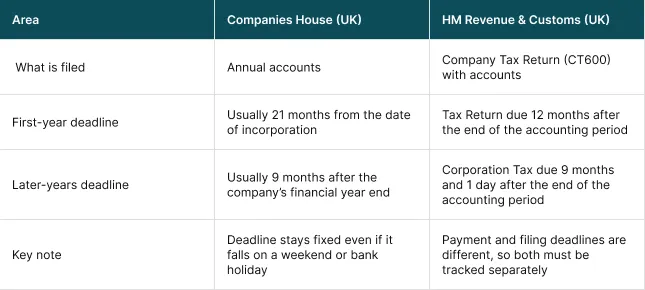
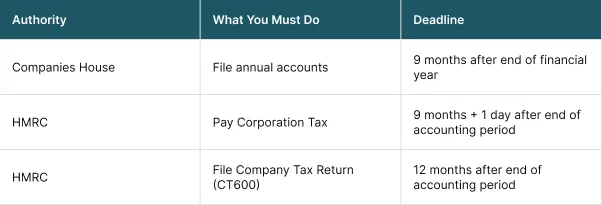
    Deadlines can be confusing because Companies House and HMRC use different timelines. The key is to track them separately.

    When to File Annual Accounts

    1. First-Year Accounts

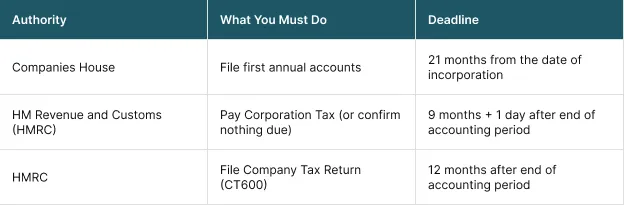
    In some cases, your first year has different rules and longer timeframes. You still have to keep track of two different deadlines. This is how it works for each body.

    First Year Accounts

    i. Companies House (UK)

    UK Government official website says this about a private limited company:

    • You have 21 months from the date you registered with Companies House to file your first accounts.

    It’s also helpful to know your accounting reference date (ARD). The annual accounts filing guide from Companies House tells you how to figure out the filing deadline from the ARD and how new companies get their ARD. On its first accounts guidance page, the UK Government official website also gives clear examples of how first accounts cover an unusual first period.

    ii. HMRC (UK)

    There are two important deadlines for HMRC:

    • Pay Corporation Tax (or tell HMRC you owe none): usually 9 months and 1 day after the end of your accounting period.
    • File the Company Tax Return: 12 months after the end of the accounting period to file the Company Tax Return.

    People get confused because of this. The deadlines for Companies House and HMRC are not the same.

    2. Subsequent Accounts

    After the first year, the deadlines happen more often. But you still have to meet the deadlines set by both Companies House and HMRC. Here are the usual timelines.

    Subsequent Accounts

    i. Companies House (UK)

    A private company usually files 9 months after the end of your company’s financial year, which is after the first year.

    Also, if your deadline is on a Sunday or a bank holiday, you still have to file by that date. The Companies House accounts guidance makes this very clear.

    ii. HMRC (UK)

    The deadlines for HMRC stay the same:

    • Corporation Tax Payment: 9 months and 1 day after the end of the accounting period.
    • Company Tax Return: One year after the end of the accounting period.

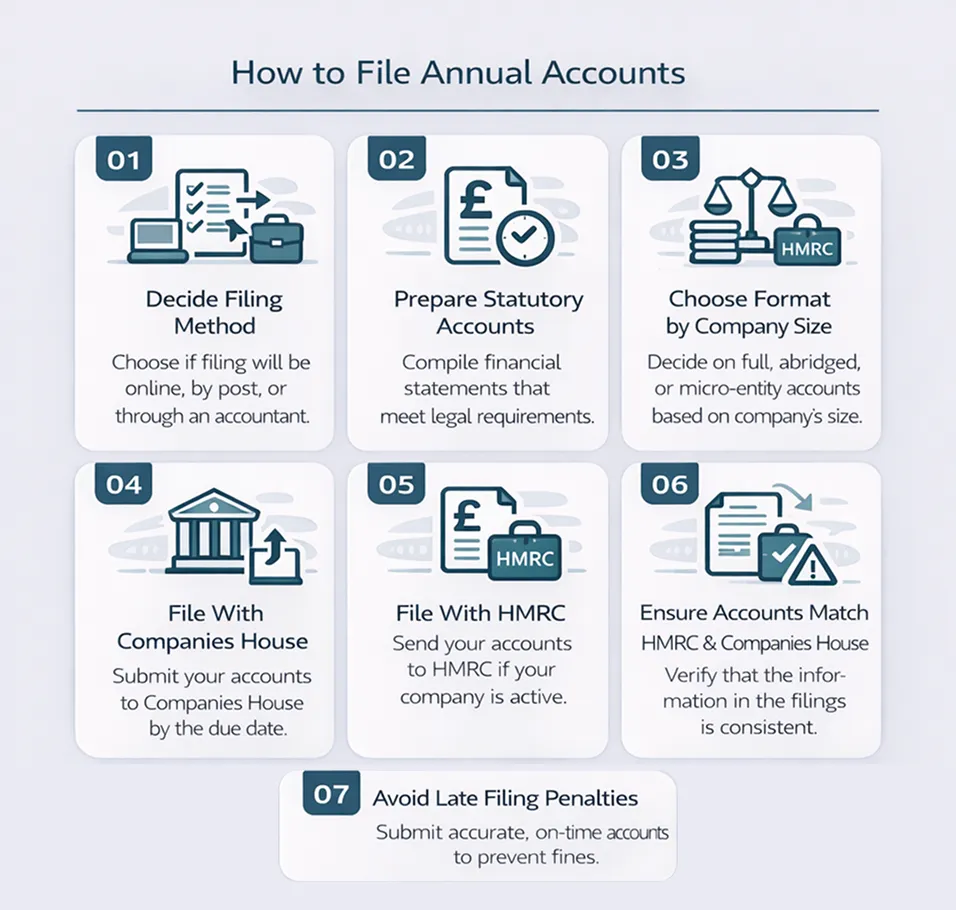
    How to File Annual Accounts?

    Filing may seem hard, but if you follow the steps in the right order, it’s not too hard. The process usually starts with making sure the records are clean and ends with sending them to the right places. Here is the easy-to-follow flow.

    1. Decide Filing Method

    There are a few ways you can file:

    • You can file directly with Companies House using software or the internet.
    • As part of the Company Tax Return process, send this to HMRC.
    • Use the joint filing service to file your accounts and tax return at the same time.

    The best way depends on how your business is set up and what tools your accountant has.

    2. Prepare Statutory Accounts

    You need to get the accounts ready before you file.

    That means:

    • Balance your bank accounts.
    • Make sure that all sales and expenses are in order.
    • Check your payroll and VAT if you are registered.
    • Check on debtors and creditors.
    • Make note of year end accounts changes, such as depreciation.

    This is the part where a lot of small businesses need professional help.

    3. Choose Format by Company Size

    Use the right size for your format:

    • All accounts.
    • Accounts for small businesses.
    • Accounts for micro-entities.
    • Accounts that are not active.

    4. File With Companies House

    Companies House keeps track of when it gets acceptable accounts. You don’t get more time if you file close to the deadline and your accounts are turned down. The Companies House accounts guide on the UK Government official website makes this very clear.

    5. File With HMRC

    When you file with HMRC, how you format it is important. According to HMRC, most companies’ accounts that are part of an online Company Tax Return must be in iXBRL format, but there are some exceptions. If you use the government’s joint filing service, it says that the service will change your accounts to the right iXBRL format.

    6. Ensure Accounts Match HMRC and Companies House

    Try to keep one ‘source of truth’ clean.

    Some common reasons for mismatches are:

    • Used the wrong year-end dates by accident.
    • Changes made late after one filing.
    • Different ways of depreciating are used.
    • Missing changes to the director’s loan.
    • Matching your numbers lowers risk and saves time later.

    7. Avoid Late Filing Penalties

    Late filing fees can add up fast. Companies House charges private companies:

    • £150 for being less than a month late.
    • £375 for being late more than a month but less than three months.
    • Late by more than three months but less than six months: £750.
    • £1,500 if you’re more than six months late.

    If you file late in two consecutive financial years, the fees double in all cases.

    How to File Annual Accounts

    What Are the Benefits of Proper Annual Accounts?

    Keeping proper accounts does more than keep you legal. They can help you run your business better and lower your risk. The benefits below are divided into two groups: business benefits and compliance benefits.

    1. Business And Financial Benefits

    These benefits are about making the business work better every day. They concentrate on planning, doing things well, and making better choices. Let’s look at each one.

    i. Informed Decision-Making

    Clean annual accounts help the companies show:

    • What is profitable.
    • Where costs are high.
    • Where cash gets stuck.

    ii. Budgeting And Planning

    It’s easier to make a budget once you know the real numbers from last year.

    You can make plans:

    • Spending each month.
    • Getting hired.
    • Tax savings.
    • Goals for growth.

    iii. Improved Financial Performance

    You can make things better by measuring them.

    You could, for instance:

    • Stop wasting things.
    • Talk to your suppliers again about prices.
    • If your margins are too low, raise your prices.

    iv. Increased Access To Funding

    Banks and lenders often want to see recent accounts.

    Strong yearly accounts can help:

    • Applications for loans.
    • Overdrafts go up.
    • Talks with investors.

    v. Enhanced Operational Efficiency

    Accounts show where money and time are being wasted. For instance, if the cost of running the business keeps going up, you might want to automate invoicing or collect debts faster.

    vi. Fraud Detection And Prevention

    Fraud often hides in messy records. Regular checks and reconciliations make it less likely that mistakes or fraud will go unnoticed.

    2. Legal And Compliance Benefits

    These benefits help you follow the rules. They also make doing taxes and annual accounts reporting less stressful. Here are the main benefits.

    i. Regulatory Compliance

    Filing correctly is important for following Companies House rules and staying in good standing. You could be charged with a crime if you don’t file.

    ii. Simplified Tax Preparation

    Filing taxes is easier when your books are clean. You don’t have to worry about missing receipts, panicking at the last minute, or rushing to get numbers.

    iii. Proof Of Active Status

    Filing on time shows that your business is still open and following the rules.

    That can be important when:

    • Putting in bids for contracts.
    • Getting money.
    • Trusting your suppliers.

    iv. Legal Evidence

    Your annual accounts can show what the business did and when. This can help with business sales, due diligence, and disagreements.

    Conclusion

    Annual accounts are more than just paperwork. They show how much money your business makes each year. They help you file your taxes, make sure you follow the rules, and run your business clearly. Knowing what goes into them makes the whole thing less stressful. You can also find problems sooner, make better plans, and talk to lenders, investors, and partners with confidence. The easiest way to make the process feel easy is to keep it simple. Keep good records all year, then get ready and file on time.

    Worried your annual accounts might be late or incorrect?

    That is exactly where we can help. Sterling Cooper Consultants can support you with tidy bookkeeping, accurate year-end reporting, and smooth filing. Explore our accounting and bookkeeping services for ongoing support.
    Ready to get started? Contact us and we will talk you through the next steps.

    +443300102526
    Book an Appointment

    FAQs


    What Are the Annual Accounts?


    They are the yearly statutory financial statements for a company. They are prepared after the financial year ends. In the UK, you send statutory accounts to Companies House, and also to HMRC as part of the Company Tax Return process.


    A simple way to think about it is:
    1. Collect records, like sales, bills, and bank statements.
    2. Record transactions in your books.
    3. Reconcile bank accounts.
    4. Review and adjust entries.
    5. Produce a trial balance.
    6. Prepare financial statements.
    7. File and store records safely.


    For most small businesses, the ‘big five’ are:
    1. Income (sales).
    2. Expenses (costs).
    3. Assets (things you own).
    4. Liabilities (things you owe).
    5. Equity (value left for owners).


    It means ‘once each year’. In practice, it usually means covering one full financial year, then preparing annual accounts at the end of that period.


    Most annual accounts include a profit and loss account (income statement), a balance sheet, and notes. Many sets also include a director’s report and, if required, an auditor’s report.

    Share This Article!

    Recent Posts

  • Common Errors on VAT Returns and How to Avoid Them?

    Common Errors on VAT Returns and How to Avoid Them?

    Common Errors on VAT Returns and How to Avoid Them

    Posted by:

    Admin

    Date:

    February 3, 2026

    Category:

    blogs

    Error: Contact form not found.

    Common Errors on VAT Returns and How to Avoid Them?

    Did you know that 24% of UK businesses have faced a VAT audit for mistakes? Even small slip-ups can cost hundreds or thousands in fines! VAT return errors are mistakes businesses make when calculating, reporting, or claiming VAT to HMRC.

    VAT may look simple, but it involves a lot of regulations, rates, and plans for imports, exports, and expenses. People often make blunders like utilising the wrong VAT rate, registering too late, or claiming VAT incorrectly. These VAT errors waste time and make you feel stressed. 

    The good news is that you can prevent most VAT errors. Make sure your records are organised, utilise software that works with MTD, and check every bill. Learn the VAT rules and train the people who handle your invoices and returns. That simple habit can cut mistakes, reduce risk, and help you avoid penalties.

    This guide explains common VAT return errors in the UK. It also shows what to check, what to fix, and how to stay compliant with fewer surprises.

    Introduction to VAT

    Introduction to VAT

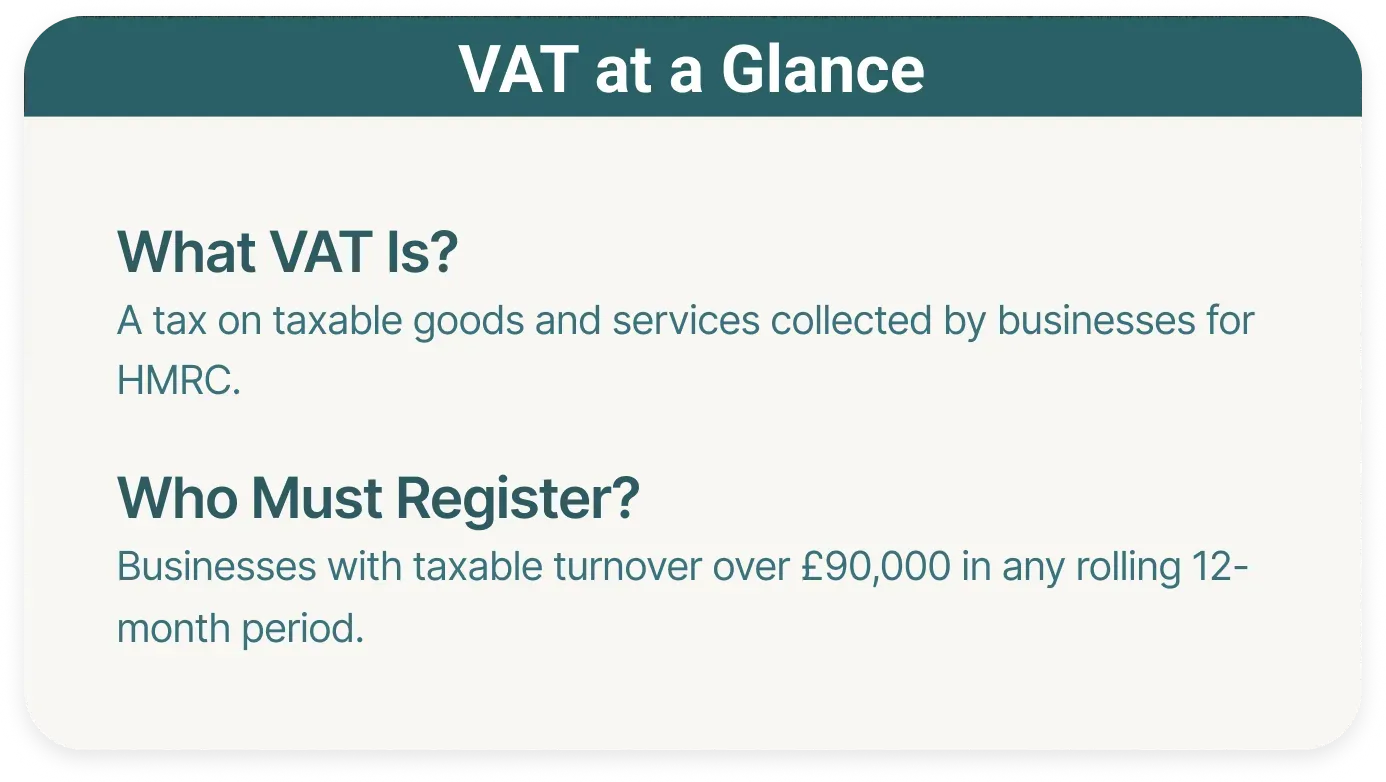
    Value Added Tax (VAT) is a UK tax charged on many goods and services. If a business is VAT-registered, it usually adds VAT to sales and pays that VAT to HMRC.

    VAT applies to taxable supplies, but not everything is treated the same. Some supplies are:

    • Standard-rated (20%)
    • Reduced-rated (5%)
    • Zero-rated (0%)
    • Exempt (for example, some financial and postal services)

    Zero-rated and exempt can look similar because both can show “no VAT charged,” but they are not the same in VAT terms.

    A business must register for VAT if its taxable turnover goes over £90,000 in any rolling 12-month period. This is not based on a calendar year. If the threshold is crossed, the business must register within 30 days of the end of the month in which it went over the limit. Smaller businesses can register voluntarily if it suits their situation.

    Note: This is general UK guidance. VAT rules can change, and some cases are tricky, so check HMRC guidance for edge cases.

    VAT Penalties for Errors

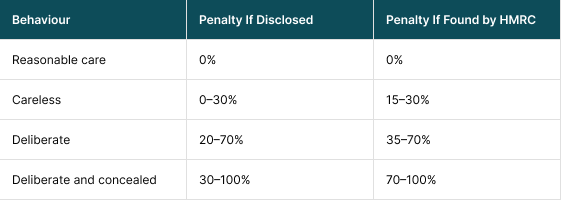
    VAT mistakes can be expensive if HMRC finds them. The penalty depends on what caused the error and whether you tell HMRC before they contact you. In some cases, penalties can range from 0% up to 100% of the VAT due. HMRC looks at the type of mistake and how it was handled before setting a penalty. The main types of VAT penalties for errors are:

    HMRC Penalties by Behaviour

    What Are the Top 11 Common Errors on VAT Returns & Ways to Avoid Them?

    VAT returns can be tough, and even small mistakes can lead to delays, interest, or penalties. Many businesses make VAT errors without noticing at the time. Spotting the common issues early can save time and money later. Below are 11 frequent VAT return errors in the UK, plus simple ways to avoid them.

    1. Misclassifying Goods or Services

    Many businesses charge the wrong VAT rate. This is called misclassification. Here is why it happens:

    • Some items have multiple possible rates.
    • Staff are confused by catering and lodging packages.
    • Hot and cold foods have different rates.

    For instance:

    • Hot takeaway food is charged at a normal rate of 20%.
    • Takeaway cold food may be 0%.
    • Medical supplies and child car seats are charged at the reduced VAT rate of 5%.

    Using the wrong VAT rate can lead to VAT being overpaid or underpaid. HMRC may investigate, especially for food and catering, where rules differ for hot takeaway food, cold takeaway food, and eat-in sales under HMRC guidance.

    How to Avoid?

    Here is how you can correct VAT error:

    • Review HMRC VAT guidelines regularly.
    • List all items and services with valid rates.
    • Changing products? Update your list.
    • Consider accounting software for rate tracking.
    • Ask a VAT expert if unsure.

    2. Incorrect Invoicing

    Valid VAT invoices have particular details. Their absence poses problems. Here are some common mistakes:

    • No invoice or VAT number.
    • Missing VAT rate.
    • Incorrect total VAT amount.
    • Missing company name or place.

    VAT claims and payments might be delayed by errors.

    How to Avoid?

    Here is how you can avoid such mistake:

    • Create VAT-compliant invoices with software.
    • Teach staff invoice requirements.
    • Check invoices before shipping.
    • Hold templates for all goods/services.

    3. Late or Missed VAT Registration

    VAT registration is necessary for businesses over £90,000 in 12 months. Here’s why such VAT errors occur:

    • Businesses rarely track turnover.
    • Registration is optional until turnover develops.
    • No defined financial year, 12-month barrier.
    • Late registration incurs VAT backdates and penalties.

    How to Avoid?

    Here is how you can correct VAT error:

    • Keep track of monthly turnover.
    • Alert when VAT threshold approaches.
    • Consider voluntary registration for growth.
    • Consult an accountant if uncertain.

    4. Overclaiming VAT on Expenses

    Companies overclaim VAT on costs. This is hazardous and fineable. Here are some common mistakes:

    • Client entertainment.
    • Items for personal use.
    • Uninvoiced VAT items.
    • Full business claim for mixed-use commodities.

    How to Avoid?

    Here is how you can correct VAT error:

    • Save VAT invoices and receipts.
    • Track VAT on each purchase with software.
    • VAT should only be claimed for business.
    • Double-check gift and entertainment guidelines.

    5. Errors on Imports and Exports

    International trade complicates VAT. Post-Brexit mistakes are widespread. Here are some common VAT errors:

    • Import VAT accounting delayed due to misunderstanding.
    • Missing export zero-rating.
    • Incorrect EU sales documentation.

    How to Avoid?

    Here is how you can avoid such mistake:

    • Learn export and import VAT rules.
    • Maintain proper import/export records.
    • Need help? Ask a VAT or customs specialist.
    • Use cross-border VAT software.

    6. Failing to Comply With MTD

    Making Tax Digital (MTD) requires digital records. Non-compliance leads to fines. Here is why such VAT errors happen:

    • Some businesses employ paper methods.
    • Staff may not know digital submission rules.

    How to Avoid?

    Here is how you can correct VAT error:

    • Accounting software that supports MTD.
    • Teach staff the software.
    • Make digital copies of invoices.
    • Regularly reconcile records.

    7. Late VAT Returns or Payments

    Missing VAT deadlines can lead to fines and extra charges.Late submission can build penalty points, while late payment leads to interest and payment penalties.

    These issues often happen because:

    • Forgetting deadlines.
    • Miscalculating payment dates.
    • Manual bookkeeping errors.

    How to Avoid?

    Here is how you can avoid such mistake:

    • Mark deadlines in a calendar.
    • Use reminders or software notifications.
    • Automate payments where possible.
    • Submit returns early if you can.

    8. Missing VAT Rule Updates

    VAT rates and restrictions vary often. Not updating can result in fines and VAT problems. For instance:

    • Rate reductions.
    • New late submission penalty.
    • Export/import rules.

    How to Avoid?

    Here is how you can avoid such mistake:

    • Get HMRC updates.
    • Participate in VAT seminars.
    • Rules should be reviewed quarterly.
    • Ask your accountant for updates.

    9. Using the Wrong VAT Scheme

    VAT schemes affect VAT reporting. Using the wrong one creates VAT issues. Here are some common schemes:

    • Flat-rate plan.
    • Accounting for Cash.
    • VAT standard accounting.

    How to Avoid?

    Here is how you can avoid such mistake:

    • Review all VAT schemes routinely.
    • Quarterly scheme comparisons.
    • An accountant can recommend the best VAT scheme or option for the business.
    • If cashflow improves, switch plans.

    10. Incorrect VAT Calculations

    VAT errors are common with manual calculations. Minor mistakes result in large fines. Here are some common mistakes:

    • Incorrect totals
    • Incorrect VAT amounts
    • Rates misapplied

    How to Avoid?

    Here is how you can avoid such mistake:

    • All VAT calculations should use MTD-compatible software.
    • Monthly reconcile sales and purchases.
    • Check totals before making returns.

    11. Claiming VAT Without Proper Evidence

    HMRC demands VAT evidence. Missing evidence can defeat your claim. Here are some common VAT errors:

    • Lacking invoices.
    • Personal cost claims.
    • Bad recordkeeping.

    How to Avoid?

    Here is how you can correct VAT errors:

    • Keep paper and digital invoices.
    • Use your company name on invoices.
    • Sort records by date and vendor.
    • Securely back up VAT paperwork.

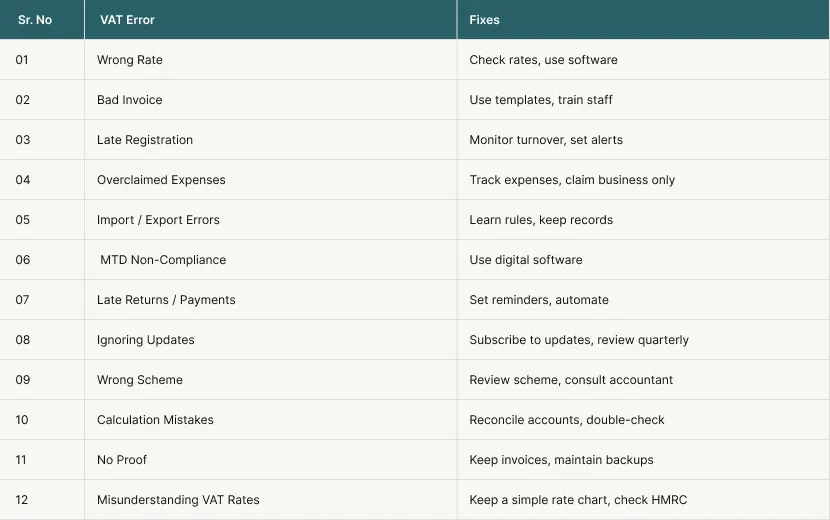
    VAT Error Vs Fix Overview Table

    Here is the VAT errors and solutions to overview table:

    VAT Error Vs Fix Overview

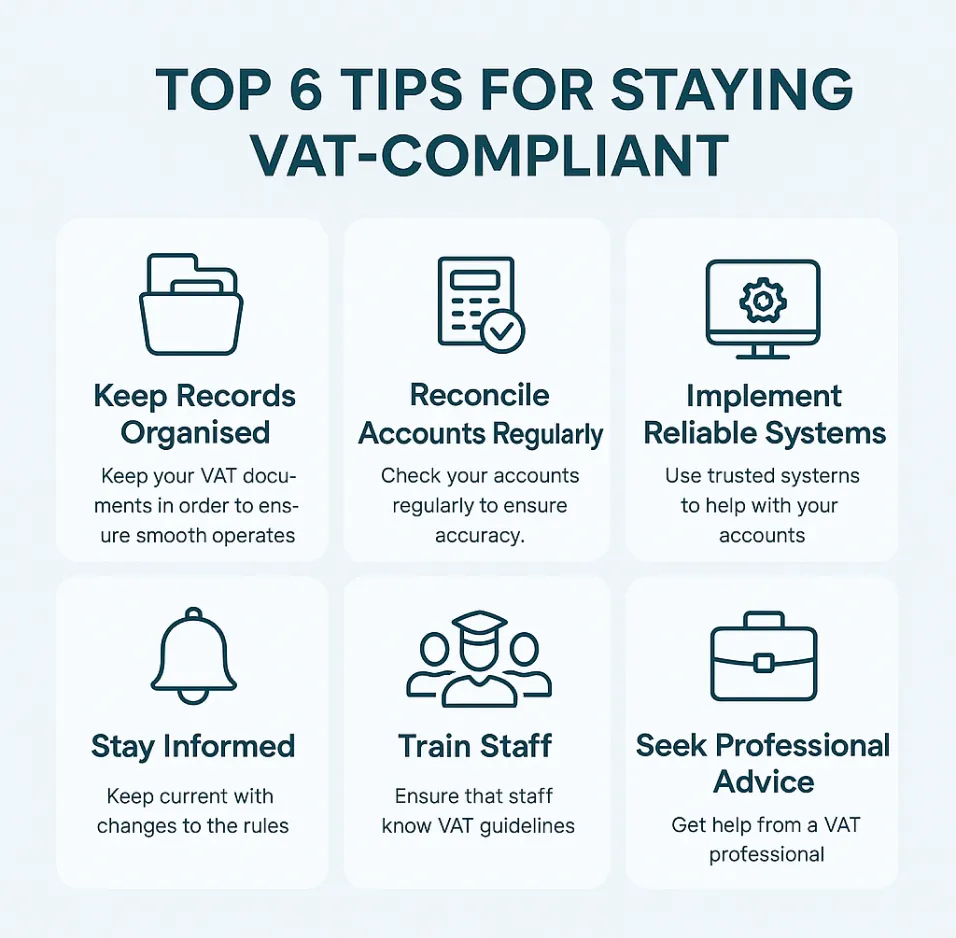
    Top 6 Tips for Staying VAT-Compliant

    Following the appropriate steps makes it easier to follow VAT rules. These ideas can help you keep your records clear, reduce stress, and easily obey HMRC laws. Here are the six best methods to keep on track.

    1. Keep Records Organised

    Keeping your VAT documents in order helps your business work smoothly. Clear files help you stay calm during checks. You need to maintain all of your VAT papers for six years. This includes receipts, bills, sales notes, bank slips, and VAT forms. Keep VAT records in labeled, safe files. Avoid losing or destroying important papers by scanning and backing up.

    2. Reconcile Accounts Regularly

    Every month, check your accounts. Make sure your VAT account matches your sales and purchases. Check for strange amounts or inappropriate dates. Look at the tax rates on each bill. Make sure the VAT code is correct. Little mistakes can add up quickly. A simple scan lets you correct VAT errors before they get worse. This also keeps you from getting large fines.

    3. Implement Reliable Systems

    Use systems that you can trust to help with your accounts. Choose accounting software that is compatible with Making Tax Digital (MTD). HMRC publishes guidance and a list of software that works with MTD for VAT, which businesses should check before choosing a system. These apps get information from your accounts. They do the maths for you on VAT. They also leave a clean digital trail. You can find out who made each adjustment. This makes it easier for you to believe your numbers. It also lowers the chance of making mistakes.

    4. Stay Informed

    Keep current with changes to the rules. Every year, the rules for VAT can change. You may get HMRC alerts or read short tax guidelines online. This helps you plan ahead and not be surprised at the last minute.

    5. Train Staff

    Make sure that the people who record sales or deliver bills know the regulations about VAT. Show them what you do and how you check things. Many VAT errors can be avoided with good training. Your overall VAT process stays seamless and safe when your team knows what to do.

    6. Seek Professional Advice

    Sometimes, VAT requirements can be hard to follow. When you need help, a VAT pro can help. They can help you with sales across borders. They can find out if you need to utilise the reverse charge. They can aid when the rules change. A pro keeps you safe and on the right path.

    You can read our blog to learn how to get a VAT certificate.

    Top 6 Tips for Staying VAT Compliant

    Conclusion

    Mistakes with VAT happen a lot, but they can be avoided. Businesses may avoid VAT error and fines by keeping good records, using software that works with MTD, checking invoices, and following HMRC rules. Simple things like reviewing VAT schemes and educating staff can help. Being careful and consistent saves you time, money, and stress. These recommendations will help your business stay legal and run effectively. 

    This guide is general UK VAT information and may not fit every business. For complex cases like cross-border sales or partial exemption, check HMRC guidance or speak to a VAT adviser.

    Are you worried about making costly VAT errors on your returns? Sterling Cooper Consultants can help.

    Our expert Taxation Services ensure your returns are accurate, compliant with HMRC, and submitted on time. Let our specialists take care of your VAT compliance so you can focus on growing your business.
    +443300102526
    Book an Appointment

    FAQs


    How to Correct Errors on VAT Return?


    You can correct mistakes on your next VAT return if the total net error is under £10,000, or if it is between £10,000 and £50,000 and less than 1% of your turnover for that period. Errors above these limits, or those that do not qualify for adjustment, must be reported directly to HMRC.


    A careless error happens when a taxpayer does not take reasonable care, such as failing to inform HMRC within 30 days that an assessment is too low. For example, if a VAT return is late and HMRC issues an estimate that understates what is owed, not notifying HMRC within 30 days may result in a penalty.


    Check that the totals for your sales and purchases match the figures shown on your VAT return. Review the underlying data to confirm that all transactions have been categorised correctly and that the VAT amounts agree with your accounting records.


    If you believed your VAT return was correct but later discovered an error, HMRC may apply a penalty of 0% to 30% of the tax involved, provided you inform them. The penalty depends on how the error occurred and how promptly you disclose it.


    You can correct VAT errors for up to four years from the filing deadline of the VAT return in which the mistake was originally made, including cases of under-claimed input tax.


    If you discover a mistake on a submitted VAT return, small errors under HMRC thresholds can often be corrected on your next return. For larger errors, you must notify HMRC directly. Using accounting software or consulting a VAT expert ensures accurate amendments.


    To correct VAT errors, first identify the mistake and determine its value. Minor errors may be adjusted in your next VAT return, while significant errors must be reported to HMRC. Keeping detailed records and seeking professional advice helps prevent penalties and ensures compliance.

    Share This Article!

    Recent Posts

  • What Is Double Taxation Relief? A Complete Guide for Individuals & Businesses

    What Is Double Taxation Relief? A Complete Guide for Individuals & Businesses

    double taxation relief

    Posted by:

    Admin

    Date:

    January 26, 2026

    Category:

    blogs

    Error: Contact form not found.

    What Is Double Taxation Relief? A Complete Guide for Individuals & Businesses

    Individuals and businesses with cross-border income or gains may sometimes be taxed in more than one country. For example, a UK resident may pay foreign tax on overseas income and also be liable to UK tax on the same income.
    This is known as double taxation. To reduce the impact of being taxed twice, the UK provides Double Taxation Relief (DTR) through tax treaties and domestic rules. Depending on the circumstances, relief may be available through a foreign tax credit, an exemption, a reduced tax rate or another treaty provision.
    This guide explains how Double Taxation Relief works in the UK, who may qualify and how to claim it.

    Key Takeaways

    • Double taxation can occur when the same income or gain is taxed in two countries.
    • UK Double Taxation Relief can reduce the UK tax arising on qualifying foreign income or gains.
    • Relief may be available under a Double Taxation Agreement (DTA) or UK domestic rules.
    • Foreign Tax Credit Relief (FTCR) can provide a credit for qualifying foreign tax already paid.
    • The available relief depends on the type of income or gain, tax residence, foreign tax paid and applicable rules.
    • Individuals and businesses may be subject to different rules and relief mechanisms.

    What Is Double Taxation and How Does It Happen?

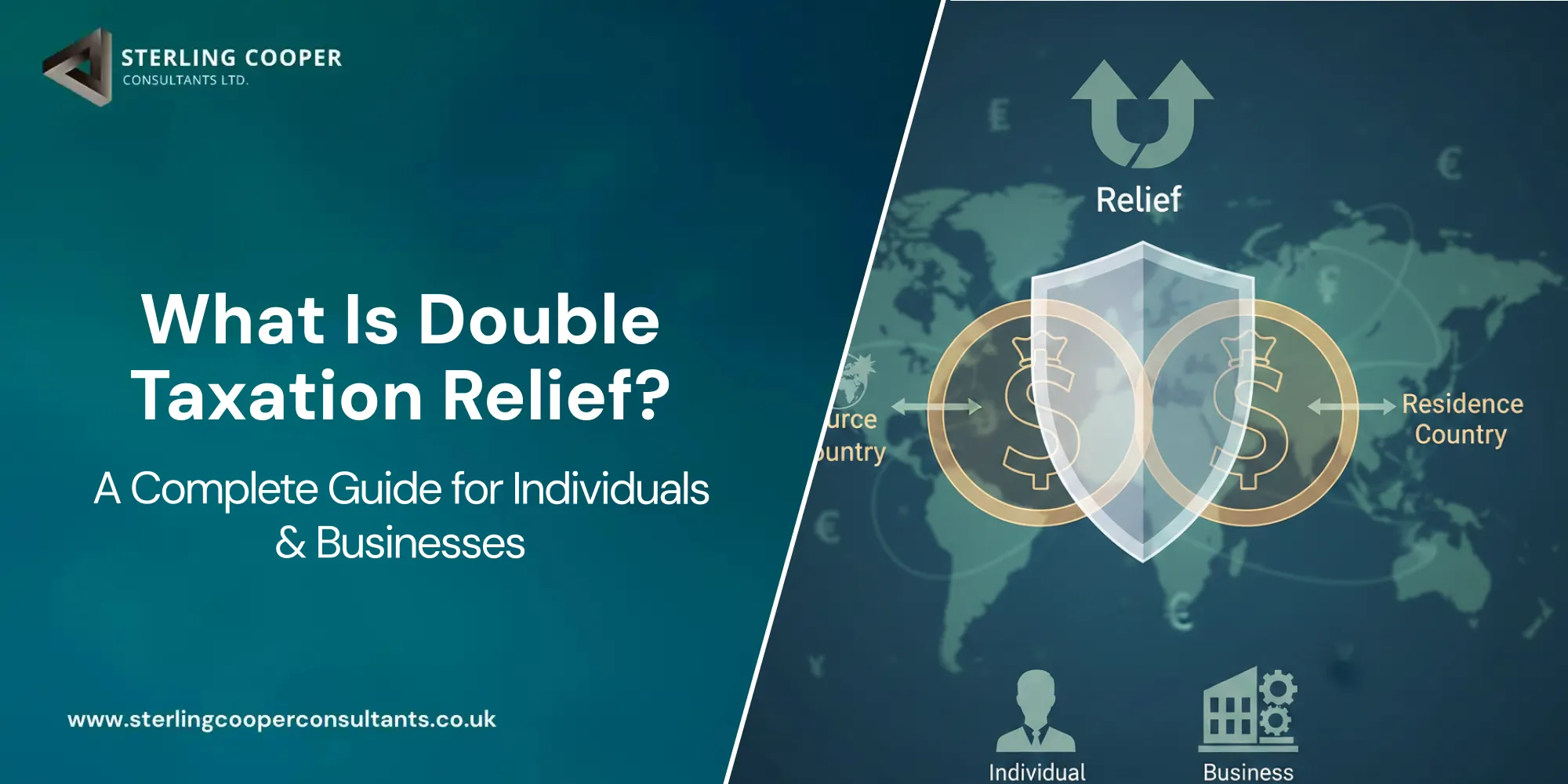
    Double taxation occurs when two countries tax the same income or gain. This can happen when one country taxes income based on where it arises, while another taxes it because the individual or company is resident there.

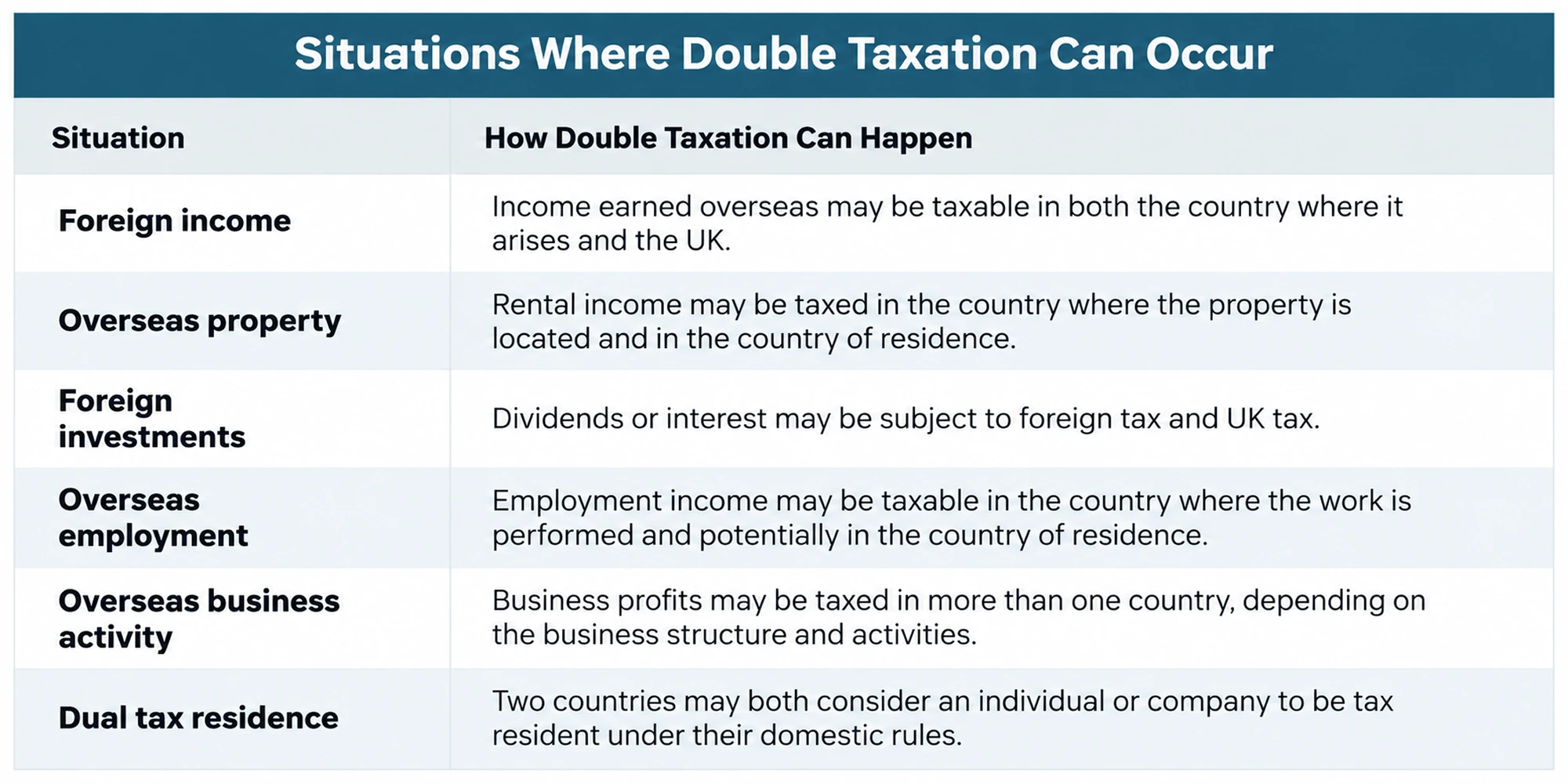
    For example, a UK resident may receive rental income from an overseas property. The country where the property is located may tax the rental income, while the UK may also tax it under its rules for UK residents. Double taxation can arise in several situations:

    double taxattion relief
    However, the actual tax treatment depends on the domestic rules of the countries involved and, where applicable, the relevant Double Taxation Agreement (DTA).

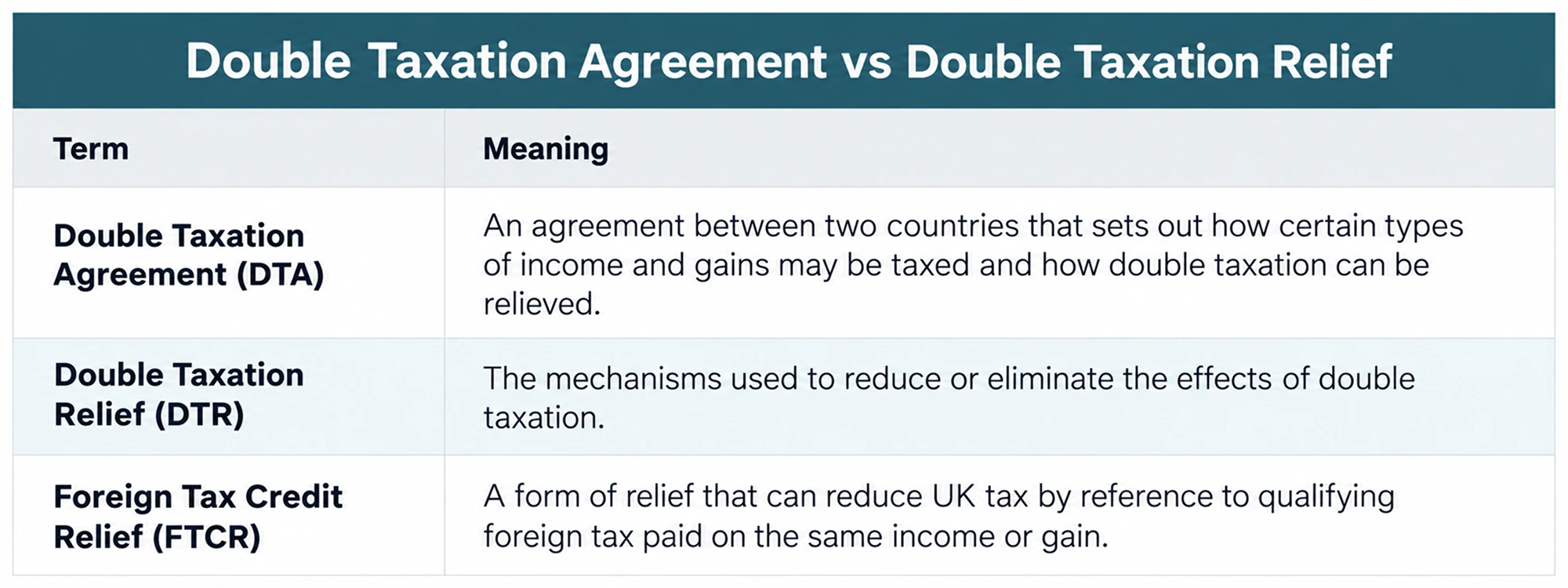
    What Is Double Taxation Relief?

    Double Taxation Relief (DTR) refers to rules that can reduce or eliminate the effects of the same income or gain being taxed in two countries. For UK taxpayers, relief may be available when foreign income or gains have also been subject to foreign tax. The method of relief depends on the relevant Double Taxation Agreement, UK domestic rules, the type of income or gain and the taxpayer’s circumstances.
    For example, Foreign Tax Credit Relief (FTCR) may allow qualifying foreign tax already paid to be credited against the UK tax due on the same income or gain. However, the credit is subject to limits and does not necessarily refund all foreign tax paid.
    double taxattion relief

    A DTA does not simply provide a tax refund. It can allocate or limit taxing rights between the countries involved and may provide for exemption, reduced taxation or credit relief.

    The UK may also provide unilateral relief under domestic rules where the relevant conditions are met, even where there is no applicable DTA.

    How Does Double Taxation Relief Work?

    The way Double Taxation Relief works depends on the countries involved, the type of income or gain, the amount of foreign tax paid and the applicable UK rules or tax treaty.

    Credit Relief

    Foreign Tax Credit Relief (FTCR) can allow qualifying foreign tax paid on income or gains to be credited against UK tax charged on the same income or gain.

    The credit is generally limited to the lower of:

    • the qualifying foreign tax paid; or
    • the UK tax attributable to the same income or gain.

    This means that paying more foreign tax than the UK tax attributable to the same income or gain does not normally create an equivalent UK tax credit. The excess cannot simply be refunded by HMRC.

    Exemption Relief

    Some tax treaties provide for certain income or gains to be exempt from tax in one of the countries. Where an exemption applies, the relevant income or gain may be taxed in only one country, subject to the conditions of the treaty.

    Whether exemption relief applies depends on the specific DTA and the type of income or gain involved.

    Partial or Reduced Relief

    A DTA may limit the amount of tax that a country can charge rather than remove the tax completely. For example, a treaty may reduce the withholding tax rate on certain dividends, interest or royalties. The applicable rate depends on the relevant treaty and the conditions that must be met.

    Unilateral Relief

    The UK may provide unilateral relief under domestic legislation where qualifying foreign tax has been paid, but there is no applicable DTA or where the domestic rules otherwise provide for relief. However, foreign tax does not automatically qualify for unilateral relief. The relevant conditions and limits must be met.

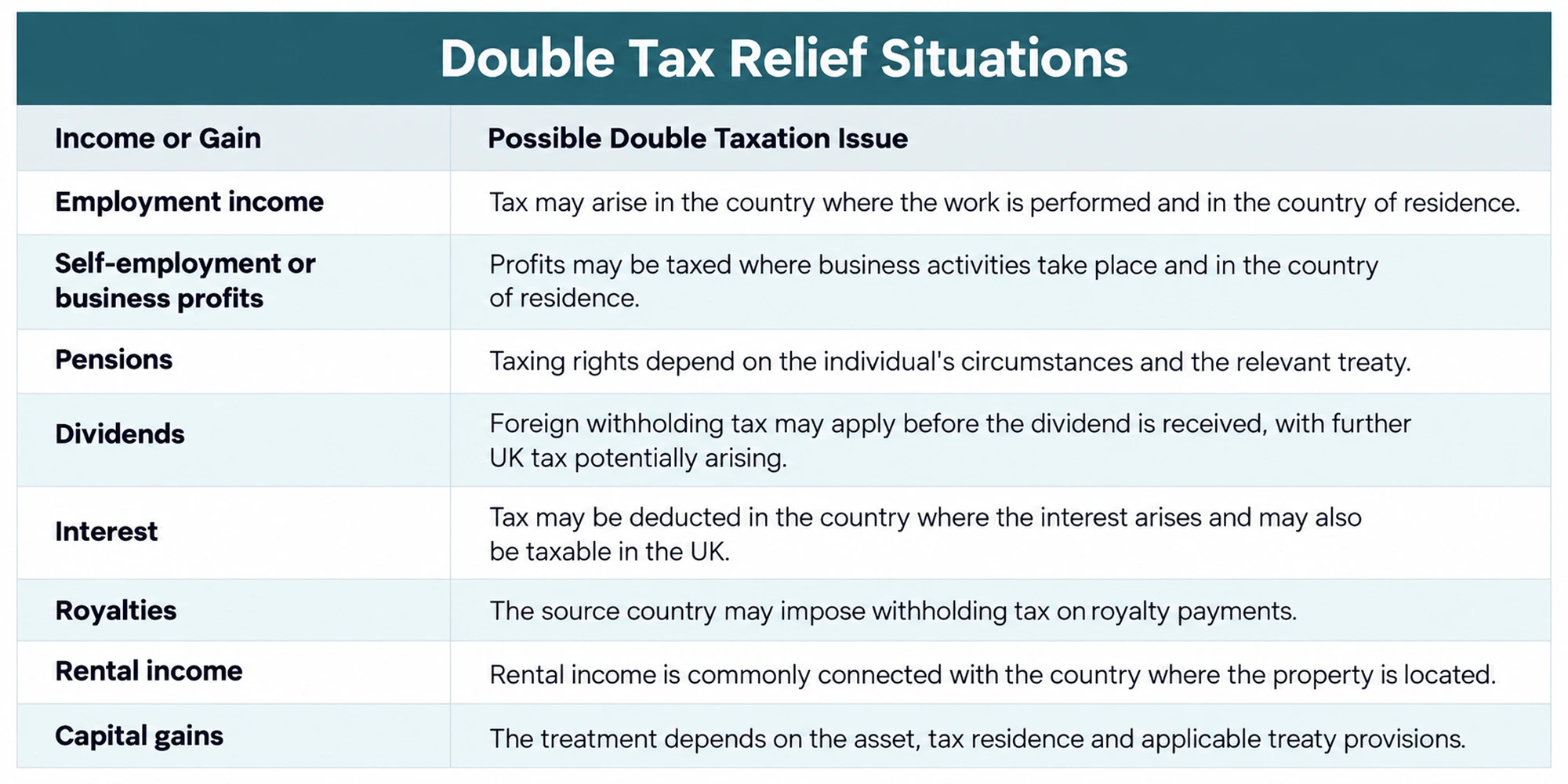
    What Types of Income and Gains Can Be Subject to Double Taxation?

    Different types of foreign income and gains can be taxed differently depending on the countries involved and the relevant tax treaty. Common examples include:

    double taxation relief taxation

    Not every type of income or gain receives the same form of relief. The relevant UK rules and DTA should therefore be checked for the specific income or gain.

    Double Taxation Relief for Individuals

    For individuals, Double Taxation Relief depends on tax residence, the country where the income or gain arises, the type of income or gain and whether foreign tax has been paid.

    UK Residents With Foreign Income

    UK residents may be liable to UK tax on foreign income, although the treatment depends on the individual’s circumstances and any applicable special regime.

    Where foreign income is also subject to foreign tax, Foreign Tax Credit Relief may be available if the relevant conditions are met. The credit can reduce the UK tax charged on the same income, subject to the applicable limits.

    UK Residents With Foreign Capital Gains

    Foreign capital gains may be subject to tax in both the UK and the country where the gain arises. If both countries tax the same gain, relief may be available under a DTA or UK domestic rules. The available relief depends on factors such as the type and location of the asset, the individual’s tax residence and the provisions of the relevant treaty.

    The Foreign Income and Gains Regime

    Since 6 April 2025, the UK’s Foreign Income and Gains (FIG) regime has provided a separate form of relief for qualifying new UK residents. An individual may qualify if they become a UK tax resident after at least 10 consecutive tax years of non-UK residence. A qualifying individual can claim relief on eligible foreign income and gains for their first four years of UK tax residence.

    The FIG regime is separate from ordinary Foreign Tax Credit Relief. An individual cannot generally claim both FIG relief and FTCR on the same foreign income or gain, so the correct treatment should be established before making a claim.

    Non-UK Residents With UK Income

    Non-UK residents may still be liable to UK tax on certain UK-source income. If the same income is also taxed in their country of residence, the relevant DTA may provide full, partial or credit relief. The treatment depends on the type of income, the individual’s tax residence and the specific provisions of the treaty between the UK and the other country.

    Some treaty claims require supporting documentation or specific claim forms, so the relevant treaty and HMRC requirements should be checked before making a claim.

    Double Taxation Relief for Businesses

    Businesses operating across borders may face tax in more than one country on foreign profits, gains or cross-border payments. UK companies may be able to obtain relief through foreign tax credits, treaty provisions or specific UK exemptions, depending on their circumstances.

    Foreign Business Profits

    A UK-resident company is generally subject to UK Corporation Tax on its UK and overseas profits. If the same profits are also taxed overseas, foreign tax credit relief may be available where the relevant conditions are met.

    The amount of relief depends on the foreign tax that qualifies for credit and the UK tax attributable to the same profits.

    Dividends, Interest and Royalties

    Cross-border payments such as dividends, interest and royalties may be subject to withholding tax in the country from which the payment is made. A DTA may reduce the withholding tax rate or, in some circumstances, allocate taxing rights between the countries. UK domestic rules may also affect how foreign income is treated.

    The exact treatment depends on the type of payment, the countries involved and the applicable treaty provisions.

    Overseas Branches and Permanent Establishments

    A UK company operating through an overseas permanent establishment may be subject to tax in both jurisdictions.

    The UK has a foreign branch exemption regime that can allow qualifying profits and losses attributable to an overseas permanent establishment to be excluded from UK Corporation Tax, provided the relevant conditions and election requirements are met.

    Businesses should consider the longer-term consequences before making an election because the choice can affect the treatment of future profits and losses.

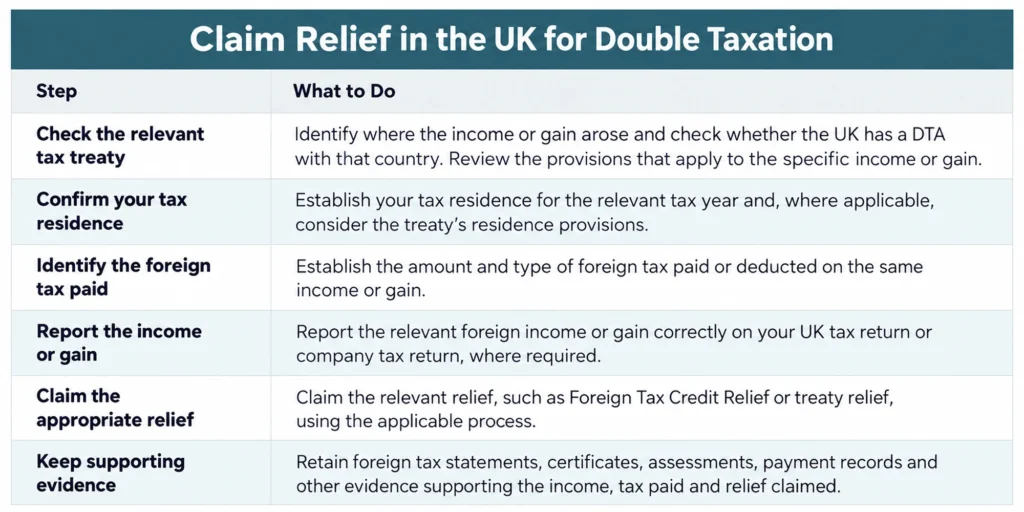
    How Do You Claim Double Taxation Relief in the UK?

    The process for claiming Double Taxation Relief depends on the type of income or gain and the relevant treaty or UK domestic rules. However, the following steps provide a useful starting point:

    claim double taxation relief

    Bonus: Double Taxation Relief Checklist

    Use this checklist to prepare for a potential Double Taxation Relief claim:

    • Identify the country where the income or gain arose
    • Confirm your UK tax residence status
    • Check whether a UK Double Taxation Agreement applies
    • Identify the relevant type of income or gain
    • Confirm how much foreign tax was paid or deducted
    • Check whether the foreign tax qualifies for relief
    • Calculate the available relief
    • Report the foreign income or gain correctly
    • Make the appropriate relief claim
    • Keep evidence of the foreign tax paid and supporting documents

    Conclusion

    Double Taxation Relief can help reduce the UK tax impact when the same income or gain is taxed in more than one country. However, the relief available depends on factors such as tax residence, the type of income or gain, the foreign tax paid and the relevant Double Taxation Agreement or UK domestic rules.
    Before making a claim, check which rules apply, report the foreign income or gain correctly and keep evidence of any foreign tax paid. Where the circumstances are complex, professional tax advice can help determine which relief is available and how it should be claimed.

    Need Help With Cross-Border Tax?

    Double Taxation Relief depends on your circumstances and the countries involved. Sterling Cooper Consultants can help you understand your tax position and navigate the relief available to you.

    FAQs


    What Is a Double Taxation Agreement?

    A Double Taxation Agreement (DTA) is an agreement between two countries that sets out how certain types of income and gains are taxed and how double taxation can be relieved.

    Individuals and businesses with qualifying cross-border income or gains may be able to claim relief. Eligibility depends on factors such as tax residence, the type of income or gain, foreign tax paid and the applicable UK rules or tax treaty.

    Potentially. If the same capital gain is taxable in both the UK and another country, relief may be available under the relevant DTA or UK domestic rules. The treatment depends on the asset, tax residence and applicable treaty provisions.

    Yes. A business may be able to claim relief where qualifying foreign tax has been paid on income or gains that are also subject to UK tax. However, some income may instead be covered by specific exemptions or treaty provisions.

    Not necessarily. Foreign Tax Credit Relief is generally limited to the lower of the qualifying foreign tax paid and the UK tax attributable to the same income or gain. Therefore, paying more foreign tax does not automatically result in a full UK tax credit.

    Share This Article!

    Recent Posts