Tag: small business corporation tax

  • Corporation Tax for Small Businesses Explained

    Corporation Tax for Small Businesses Explained

    corporation tax for small businesses

    Posted by:

    Admin

    Date:

    July 6, 2026

    Category:

    blogs

    Error: Contact form not found.

    Corporation Tax for Small Businesses Explained

    Most small business owners do not see any tax issues coming their way. But one day, when the tax bill arrives, it puts pressure on the cash flow of the business. In the UK, corporation taxes are charged against a company’s profits. According to the UK government, the standard rate is 25%.

    If you are on the lookout for corporation taxes for small businesses, then you need to know about the rules right from the start. While dealing with the corporation taxes, essential processes are often overlooked.

    Corporation tax for small businesses sounds complicated until you understand it. Once that is done, it becomes very easy and clear. All you have to do is know what to pay, when to pay and how to pay. Tax planning will help protect your cash flow and your business from fines and penalties.

    Key Takeaways

    • Corporation tax applies to profits made by limited companies in the UK.
    • The main UK corporation tax rate is 25% on taxable profits.
    • Small businesses must register, file returns, and pay HMRC on time to avoid penalties.
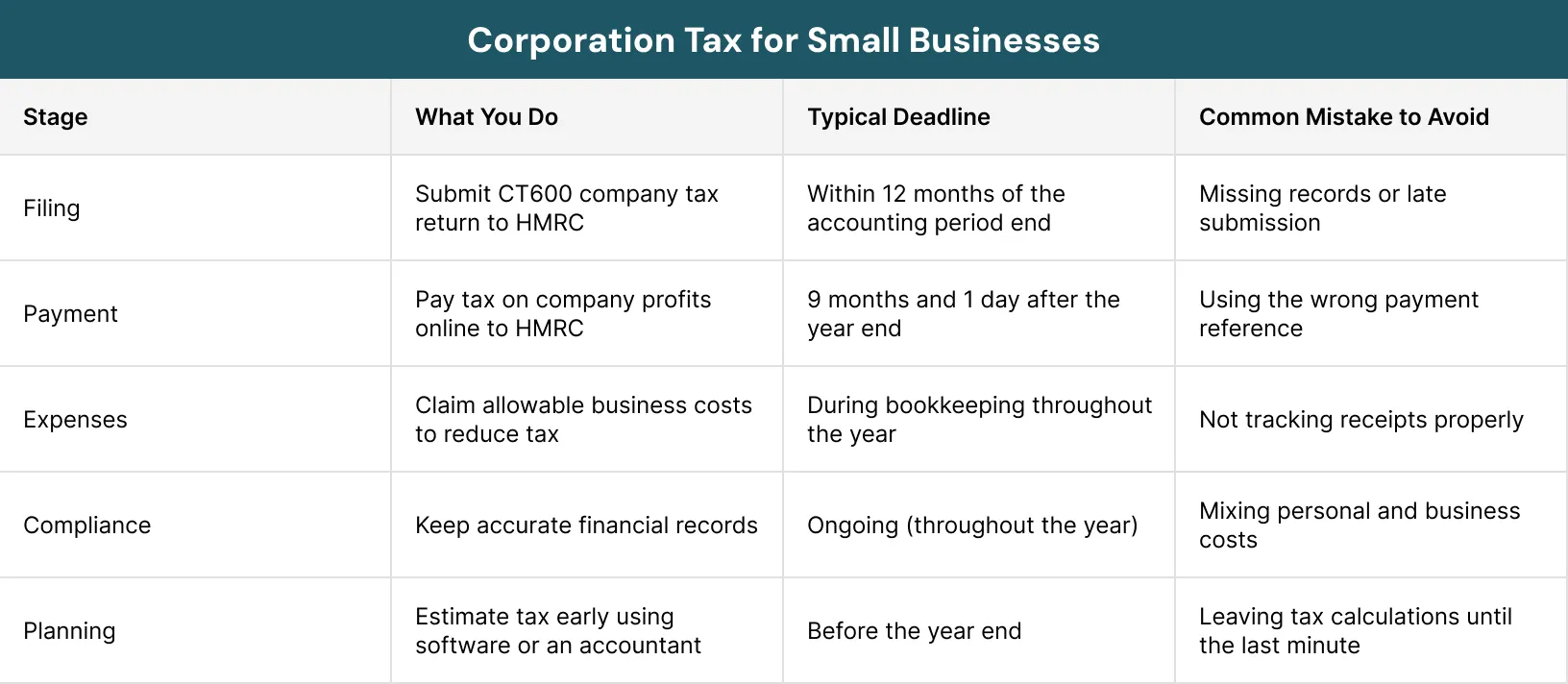
    • Deadlines matter: tax is usually due 9 months and 1 day after the accounting period ends.
    • Allowable expenses can reduce your overall tax bill legally.
    • Filing is done online through HMRC using a CT600 return or accounting software.
    • Using corporation tax software or an accountant helps reduce errors and saves time.
    • Planning ahead improves cash flow and prevents unexpected tax pressure.

    What Is Corporation Tax for Small Businesses?

    Corporation tax is a tax that a UK limited company pays on its taxable profit. This income may be earned from trading, investment activities or selling business assets.

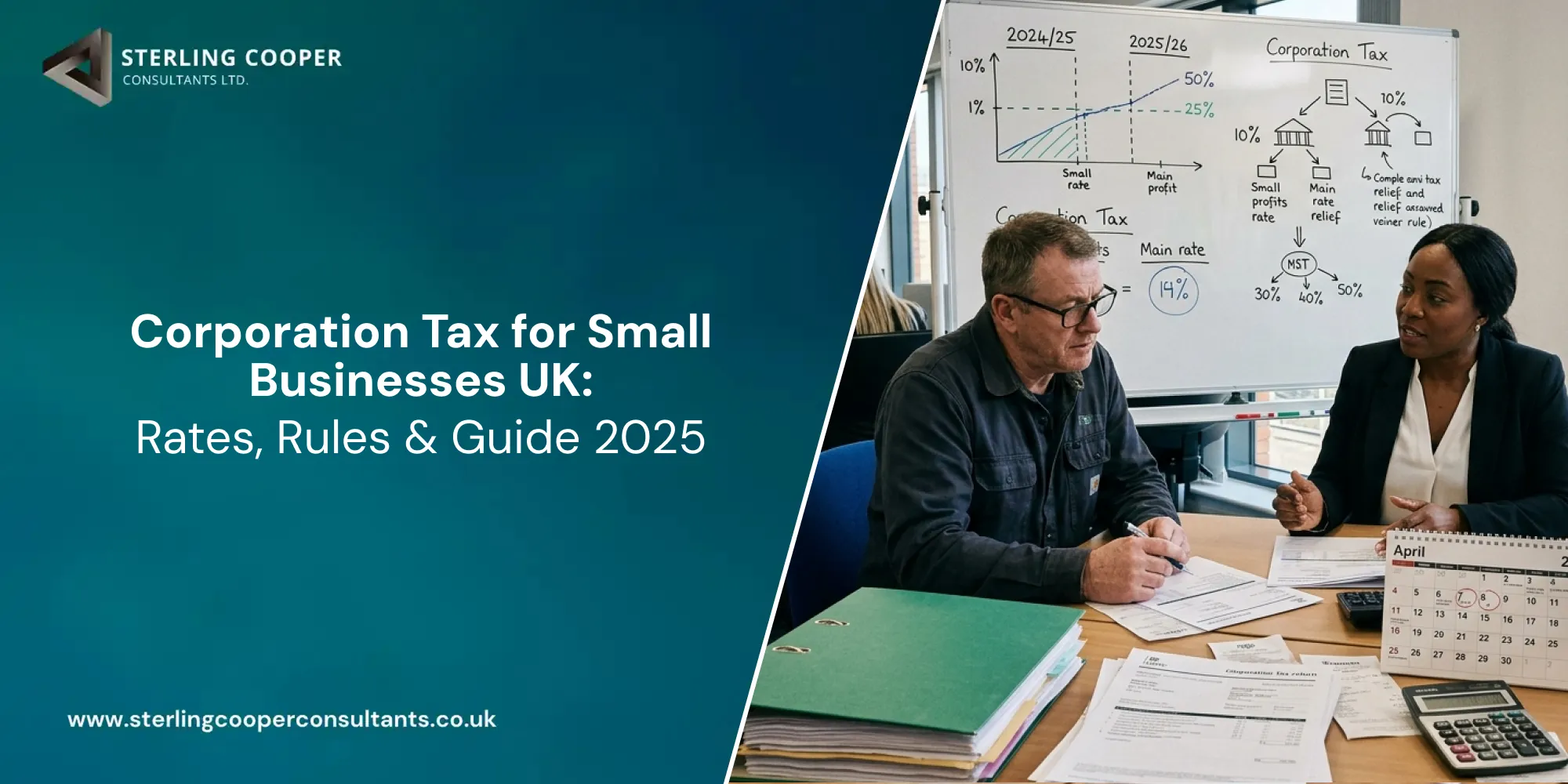
    Knowledge about corporate tax for small businesses is necessary to plan their financial matters and comply with HMRC regulations. Small businesses have to pay a 19% profit rate on income up to £50,000. The income exceeding £250,000 is taxed at the 25% main rate. Businesses with profits between £50,001 and £250,000 may receive Marginal Relief, which lowers the amount of tax they pay.

    Which Type of Small Businesses Need to Pay Corporation Tax in the UK?

    In the UK, corporation tax is paid by limited companies. Corporation tax is also applied to foreign companies that earn income from within the UK. Corporation tax does not apply to sole traders or partnerships. Only registered companies have to pay this tax. This tax becomes due for payment only if a company starts trading and making a profit.

    Corporation Tax is charged on the taxable profits of limited companies operating in the UK.

    Source: HMRC Corporation Tax Guidance

    When Do You Pay Corporation Tax for Small Businesses?

    The corporation tax deadline depends on your company’s accounting period. For example, if your financial year ends on 31 March, your corporation tax must be paid by 1 January the following year.

    The key deadlines are shown below:

    1. Payment Deadline

    The deadline for paying corporation tax for small businesses is 9 months and 1 day after the end of your company’s accounting period.

    2. Company Accounts

    The deadline for paying company accounts is 9 months after your financial year-end.

    3. Payment Deadline

    The deadline for paying your tax returns is 12 months from the end of the accounting period.

    Important:
    Even if your business is making low profit or loss, you may still need to register for Corporation Tax with HMRC if you are a limited company. Missing this step can lead to penalties.

    How to File Corporation Tax for Small Businesses?

    For filing corporation tax for small businesses in the UK, calculate your taxable profit, prepare annual accounts and send the Company Tax Return (CT600) to HMRC using authorised accounting software. Record-keeping of invoices, receipts and bank statements is also an essential part of the process.

    The step-by-step filing process is as follows:

    1. Keep Accurate Records

    Keep all business records such as bank statements, invoices and receipts. They will be required for preparing your account and tax returns.

    2. Use Commercial Accounting Software

    Use HMRC-approved commercial accounting software that supports iXBRL (Inline eXtensible Business Reporting Language) tagging. HMRC’s free service joint filing is not available anymore.

    3. Claim Allowable Expenses

    You can reduce the amount of taxable profit by subtracting allowable business expenses such as salaries, equipment and travel from your income.

    4. Submit to HMRC and Companies House

    Submit your Company Tax Return (CT600) form to HMRC and also file your annual accounts to Companies House using your accounting software.

    5. Pay Your Corporation Tax

    You can pay your tax payments through electronic payment methods, like Faster Payments, CHAPS and Direct Debit. Ensure that the payment is made by the due date.

    By following the five steps above, you can file your small business corporation tax with confidence.

    Read More: The Ultimate Guide to Small Business Taxes

    Important Note
    Corporation Tax software is mainly used to prepare and file your CT600 return with HMRC. The right choice depends on whether you want simple automation, professional-level control, or a pay-per-use option.

    How to Pay Corporation Tax for Small Businesses?

    To pay corporation tax for small businesses, you need to calculate your taxable profit, submit a Company Tax Return (CT600) and pay any tax due to HMRC. The payment deadline is generally 9 months and 1 day after the end of your accounting period.

    The steps below explain the process:

    1. Calculate Your Taxable Profit

    Calculate your profit after deducting costs such as machinery, salaries and training from your income. Your tax depends on your profit level. Tax is 19% when the profit is below £50,000 or 25% when above £250,000, with Marginal Relief applying in between.

    2. Choose a Payment Method

    HMRC accepts only electronic payments. You can pay via Faster Payments, online banking or telephone banking, direct debit, or using a debit card/credit card (fees might be applicable for corporate cards).

    3. File Your Company Tax Return (CT600)

    You have to submit the CT600 form and company accounts online via HMRC-approved software or the GOV.UK website. This confirms your final tax calculation.

    4. Pay Your Corporation Tax Bill

    When you have completed filing your tax returns, pay your corporation tax to HMRC using your chosen payment method. Make sure your payment reaches HMRC within the deadline to avoid penalties.

    It is a must to follow this process if you want to file the corporate tax rate for small business​es.

    Corporation Tax for Small Businesses

    What Is the Best Corporation Tax Software for Small Businesses in the UK?

    Corporation tax software varies depending on the size of your business. Small businesses typically go for programs that will do all the accounting work and automatically submit the CT600 form to HMRC.

    Given below is the list of the best corporation tax software for small businesses in the UK:

    1. FreeAgent

    It is suitable for small and single-director companies. FreeAgent creates and files CT600 returns for you automatically based on your accounting records. This software directly submits the file to HMRC and Companies House.

    2. TaxCalc

    This is best for both the accountants and for preparing taxes. This software allows complete CT600 reporting and filing to HMRC. It is a widely used software among UK accountants.

    3. Easy Digital Filing

    It suits pay-as-you-go users. The tool enables you to file the CT600 return forms online without monthly subscription fees. You pay only when you file.

    The above are the best software options to pay the corporation tax for small businesses in the UK.
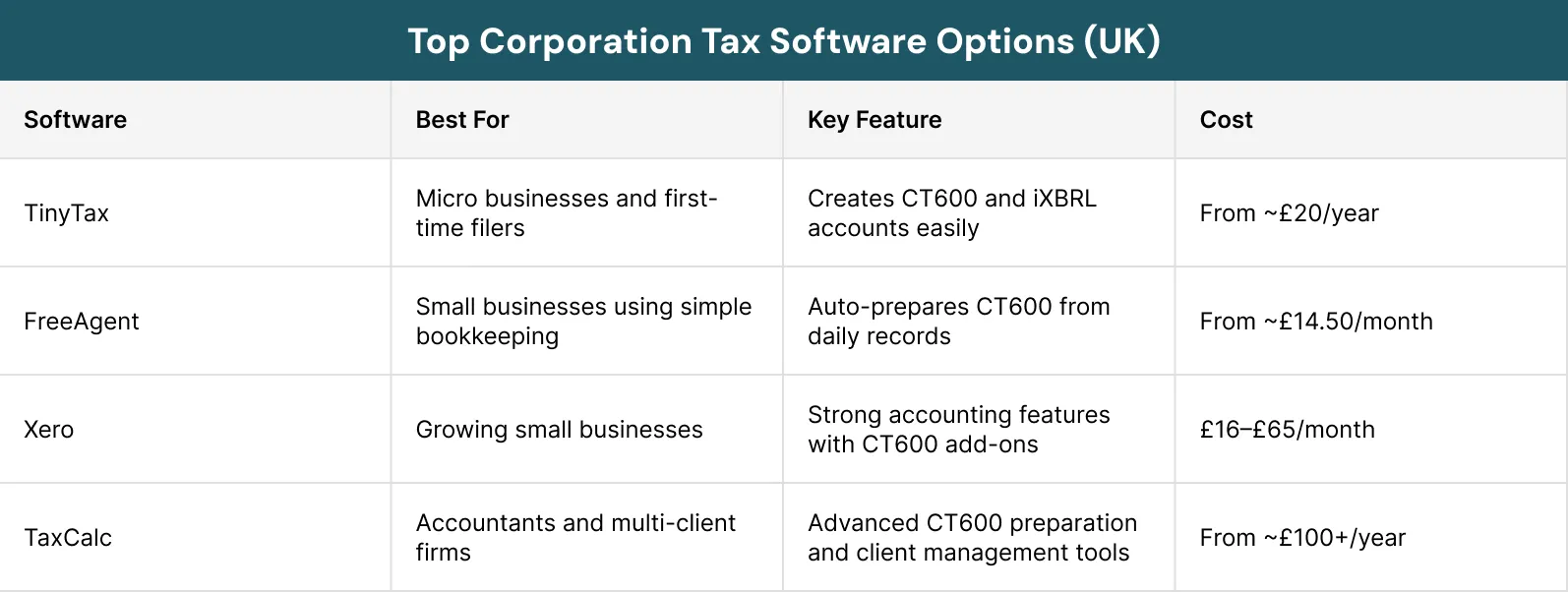
    Top Corporation Tax Software Options UK

    Corporation Tax Small Profits Relief Example (HMRC Case Study)

    This case study shows the computation of corporation tax, where the rate for small companies was increased from 19% to 20% in the financial year 2007.

    The company had an accounting period ending 30th September 2007, having:

    • Chargeable profits: £150,000
    • Franked investment income: £0
    • No associated companies
    • Total taxable profits = £150,000

    As the period covers two different tax rates, the profit will be divided based on time.

    1 October 2006 – 31 March 2007

    Tax rate: 19%

    Tax: £150,000 × 19% × 182/365 = £14,210.95

    1 April 2007 – 30 September 2007

    Tax rate: 20%

    Tax: £150,000 × 20% × 183/365 = £15,041.09

    Total corporation tax due is £29,252.04.

    Tip:
    Keep track of your business costs throughout the year. Expenses such as rent, software, staff pay, and travel can reduce your taxable profit and lower your corporation tax bill. Good records also make filing your tax return much easier.

    Conclusion

    Corporation Tax is mandatory for all UK limited companies. Corporation Tax depends on the income that remains once expenses have been deducted. So, planning is crucial right from the start. Knowing about corporation tax for small businesses will ensure that you don’t end up making any errors when it comes to dealing with HMRC.

    At Sterling Cooper, we help with bookkeeping and tax consultancy. We make the process simple and easy for you. Get in touch with us now if you want to develop your business with ease.

    Need help with your corporation tax?

    Sterling Cooper is here to support you. We handle filing, payments, and HMRC compliance in a simple way. Contact us today to get expert help with your taxes and keep your business stress-free and on track.
    +443300102526
    Book an Appointment

    FAQs


    Does a small business need to pay corporation tax?

    As soon as companies start operating or receiving an income, they must submit a tax return to HMRC once a year. Corporation tax is charged on taxable profits; there are no tax-free allowances for companies, so a company with any amount of taxable profit has to pay.


    From 1 April 2023, the main rate of Corporation Tax increased from 19% to 25%.


    Corporation tax for small businesses in the UK is a tax on company profit. It is paid by limited companies after expenses are deducted. The rate depends on the profit level.

    You can pay corporation tax online to HMRC. Most businesses use bank transfer. Payment must be made within 9 months and 1 day after the accounting year ends.


    Yes, most small businesses now use software. HMRC no longer provides free filing tools. Software helps you calculate tax, file CT600, and avoid mistakes.


    You must pay within 9 months and 1 day after your accounting period ends. The tax return must be filed within 12 months.

    Share This Article!

    Recent Posts

  • The Ultimate Guide to Small Business Taxes

    The Ultimate Guide to Small Business Taxes

    small business tax

    Posted by:

    Admin

    Date:

    May 12, 2026

    Category:

    blogs

    Error: Contact form not found.

    The Ultimate Guide to Small Business Taxes

    Are you excited to run a small business in the UK but don’t know the details of its tax system? Most small businesses focus on daily operations, clients and progress. However, it is important not to overlook tax duties.

    Small business taxes in the UK are the various costs imposed by the government. These fees apply to profits, earnings, sales and jobs. In general, this consists of business rates, national insurance, VAT, income tax and corporation tax.

    In 2025, the UK private industry had about 5.7 million businesses. 5.64 million of them were small enterprises with 0–49 workers. This means that nearly 99% of UK businesses are classified as small. This detail also clarifies that for the UK economy, small business and taxes are so important.

    For instance, when sole traders earn profits, they have to pay income tax on them. However, limited companies have to pay corporation tax on the revenue of the company. This points out the vital role of business tax for small business in the UK economy.

    According to HMRC policies, all businesses must keep correct records and file their taxes on time. If you do not pay all the taxes on time, this will result in cash flow pressure, interest charges and penalties.

    Learning about your tax obligations early allows you to plan more wisely. Also, you will sell your services in a more effective way and will avoid hassle later.

    In this blog, you will explore the workings of small business and taxes in the UK. You will also know what you have to pay and how to keep yourself in compliance.

    Key Takeaways

    • Small business tax rules depend on your business structure, profit level, and HMRC filing duties
    • Business tax for small business owners may include VAT, Income Tax, National Insurance, and Business Rates
    • Small business corporation tax applies to limited company profits after allowable expenses and reliefs are deducted
    • Small business company tax becomes easier to manage with good record keeping and digital accounting software
    • Small business and taxes are easier to handle when you understand deadlines, compliance rules, and tax-saving options

    What Is Small Business Tax in the UK?

    Business tax for small businesses involves HMRC collecting payments on the income, profits and sales. The aim of this policy is to make contributions to the public services like pensions, facilities and healthcare.

    No matter how small a business is, it is impacted by tax laws. The primary concern is that the tax is neither flexible nor optional. It follows exact deadlines and structured reporting systems.

    You must remember it; otherwise, you will get penalties promptly. Thus, it is not just compliance that makes you understand your tax responsibility.

    Therefore, knowing your tax duties is more than just compliance. It means that you have to protect your business from financial risk and keep it stable for a long time.

    Knowing small business and taxes is vital to staying compliant and preventing unneeded economic fines.

    Small business taxes are not only about staying compliant. They are about building a business that can grow with confidence, manage cash flow wisely, and stay prepared for change.

    Sarah Mitchell, UK Small Business Tax Adviser

    What Business Structures Impact Small Business Tax?

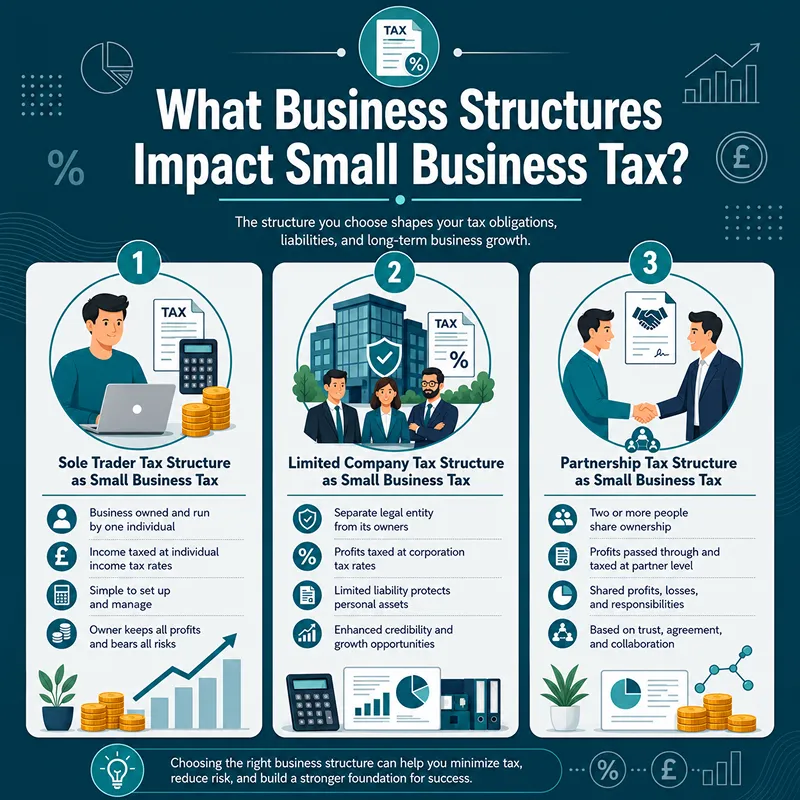
    For the system of your tax, a business structure is the basis for it. This framework must decide which form to submit and how to pay taxes. Also, it tells how profits are handled.

    Each business structure has different levels of difficulty and duties. You should select one that greatly affects your workload and compliance obligations. These rules are explained below:

    1. Sole Trader Tax Structure as Small Business Tax

    Most of the small business tax examples are sole traders. Legally, you and your business are the same entity.

    In other words, you use self assessment to pay tax on your business profits. On the basis of those points, you also pay national insurance.

    Between business and personal financial affairs, there is no separation. Although this provides full authority, this also means that you must be responsible for any tax that is due.

    When your earnings become more than your personal allowance, tax becomes payable. This is why it is so important to keep records from the very beginning.

    2. Limited Company Tax Structure as Small Business Tax

    In legal terms, a limited company is separate from its owner. This setup results in a distinct tax structure.

    The company has to pay the corporation tax on its earnings. Directors usually receive income through a mix of salary and dividends.

    Dividends are taxed through self-assessment, while salaries are taxed via PAYE. In many cases, this structure offers more tax planning choices.

    However, in comparison to sole traders, it also needs compliance work, accounts setup and more reporting.

    Learn more about dividends: The complete guide to UK dividend tax

    3. Partnership Tax Structure as Small Business Tax

    Two or more individuals share ownership of the company in a partnership. The earnings are divided among all the partners.

    Each member is liable for national insurance and income tax on their portion of profits. All this is carried out by means of self assessment.

    The partnership itself also registers separately with HMRC. To prevent conflicts concerning profit distribution and tax responsibility, it is important to have clear contracts.

    What Business Structures Impact Small Business Tax

    What Is Small Business Corporation Tax?

    Whatever expenses limited companies incur, they pay corporation tax on their profits. Profits are determined by taking out salaries, costs and allowances from income.

    On the other hand, sole traders do not have to pay corporation tax. They self assess this tax and give their report to HMRC.

    Corporation Tax Rates and Thresholds

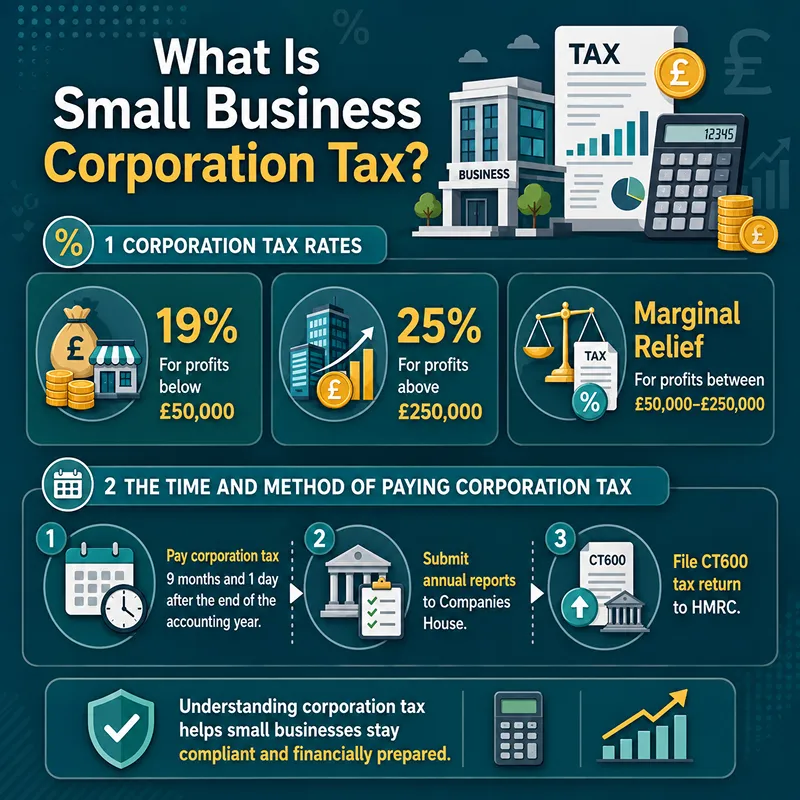
    The rate of corporation tax relies on the profit levels. For small business tax, it includes:

    • 19% for little profits (lower than £50,000)
    • 25% for profits more than £250,000
    • A range of £50,000–£250,000 utilises marginal relief

    This system ensures that the fair tax increases as profit increases.

    The Time and Method of Paying Corporation Tax

    Corporation tax is paid 9 months and 1 day after the end of the accounting year. Companies need to file:

    • Annual reports to Companies House
    • Tax return to HMRC (CT600)

    You can use the online platform of HMRC accounts to make payments. You must not wait for a bill; you need to calculate and pay taxes on time.

    What Is Small Business Corporation Tax

    Important Detail

    Even if your limited company makes no profit, you may still need to file a company tax return unless HMRC confirms your business is dormant.

    What Counts as Taxable Profit?

    Taxable profit is the profit on which tax is calculated. It is found by subtracting allowable expenses, salaries and tax reliefs from total income. 

    It may include many expenses, such as:

    • Workers pay
    • Rent
    • Equipment
    • Marketing expenses

    This decreases the overall amount of taxes due.

    What Is Small Business Income Tax?

    Profits derived from dividends, salaries and business profits are subject to income tax. It only comes into play if you earn more than £12,570 a year. Also, income tax is payable by sole traders and company directors similarly.

    Personal Allowance and Tax Bands for Small Business Tax

    A tax-free personal allowance of £12,570 is permissible in the UK. After that, income is taxed according to bands.

    Moreover, higher income means more costly rates of tax. This process is applicable to workers, sole traders and directors.

    Self Assessment System for Small Business Tax

    Income is reported and taxes are figured out using self-assessment.

    You must do the following:

    • Sign up with HMRC
    • Obtain a Unique Taxpayer Reference (UTR)
    • File tax return annually

    The due date is 31 January each year. Thus, if you did not submit on time, it will result in penalties.

    Income Tax for Directors vs Sole Traders

    Sole traders must pay tax on profits. On the other hand, directors must pay tax on:

    • Salary through PAYE
    • Dividends through self assessment

    However, both should report their earnings every year to HMRC.

    What Are NICs for Small Business Tax?

    With the help of national insurance, public services and pensions are funded. This rule is the same for self-working people, employers and employees. The amount that they should have to pay depends on their status and earnings.

    Employee NICs for Small Business Tax

    Class 1 NICs are paid for by employees.

    They must make payment for the following:

    • 12% on income below the lower limit
    • 2% on earnings above

    It’s taken out by default through PAYE.

    Employer NICs for Small Business Tax

    Employers must also pay NICs on the salaries of the staff. They pay about 13.8%-15% more than the lowest possible earnings. For recruiting staff, this is an added expense.

    Self-Employed NICs for Small Business Tax

    The people who are self-employed must pay:

    • Class 2 NIC (if eligible, flat rate)
    • Class 4 NIC (according to the profit)

    Self-employed workers use self assessment to calculate and submit NICs.

    What Is VAT for Small Business Tax?

    Value added tax (VAT) is a UK consumption tax applied to goods and services, which businesses collect from customers. Firms then pay this VAT to HMRC, while reclaiming VAT on their own business transactions. 

    VAT is a tax added to most products and services in the UK. Companies pay VAT to HMRC after collecting it from clients. On business transactions, they can also claim back VAT.

    VAT Threshold and Registration Rules

    In the following cases, you must sign up for VAT:

    • When turnover goes above £90,000 in 1 year
    • Or if it is expected within 1 month

    To reclaim VAT, you can also sign up free of charge.

    VAT Rates in the UK

    The rates of VAT consist of:

    • 0% no rate
    • 5% lower rate
    • 20% standard rate

    VAT Returns and Making Tax Digital (MTD)

    VAT is paid to HMRC on a three-month basis. You must file your taxes online through approved software. Paying taxes in this way is called making tax digital (MTD). If you did not pay VAT on time, you will have to pay fines ahead.

    Related: Complete guide to VAT accounting schemes

    What Are the Business Rates for Small Business Tax?

    The taxes made on commercial properties are business rates. They are applicable to:

    • Factories
    • Warehouses
    • Offices
    • Shops

    Home businesses might not always pay them.

    When Business Rates Apply

    If you have to use other than residential property, you have to pay business rates. You can be exempted if you work from home. However, in some cases exceptions apply, such as:

    • Clients visit regularly
    • Property is designed specifically for business
    • Employees work from home

    Business Rates Relief for Small Business Taxes

    The business tax for small business relief is accessible to companies. However, this relies on usage and property value. Some businesses have to pay lower charges or nothing at all.

    What Are Other Small Business Taxes?

    There are also some extra charges that small businesses might have to pay, depending on the activity.

    Capital Gains Tax

    Small businesses may have to pay capital gains tax if they sell business assets for profit. The things involved in it are equipment, shares and real estate. Tax relies on the earnings, after expenses are taken out.

    Stamp Duty Land Tax

    This is another form of business tax for small business which is paid when purchasing land or property. This amount depends on the type of property and value.

    Industry-Specific Taxes

    There are many industries that pay additional taxes, such as:

    • Gambling tax
    • Tobacco tax
    • Alcohol tax

    All these taxes are imposed through controlled sectors.

    What Are Small Business Tax Registration and Deadlines?

    The due dates for your small business and taxes are according to the type of your business.

    Self Assessment Registration

    Once you start trading, register the self assessment by 5 October. Each year, you must file your tax return by 31 January.

    Corporation Tax Registration

    Within 3 months of trading, limited companies must register for corporation tax.

    VAT Registration

    When turnover increases above £90,000 or is voluntarily reported sooner, you must register for VAT.

    What Is Making Tax Digital (MTD) in Small Business Tax?

    The digital tax system of HMRC is called MTD. With the help of this, businesses can keep online information safe. Use its software to submit the tax returns.

    What MTD Means

    This system has replaced the paper details with online systems. With the help of this updated system, accuracy has improved a lot and errors have been reduced.

    Who Must Follow MTD

    The businesses that are already registered with VAT must already follow it. Over time, an income tax MTD is set up.

    Allowable Business Expenses for Small Business Tax

    With the help of allowable expenses, businesses can lower their taxes.

    Common Allowable Expenses

    Some of the common allowable expenses are as follows:

    • Equipment
    • Supplies
    • Staff salaries
    • Marketing
    • Travel
    • Office costs

    These costs decrease the taxable profit.

    Tax Reliefs and Allowances

    Businesses might claim the following:

    • Investment allowances
    • R&D relief
    • Pension contributions

    These allowances minimise corporation tax.

    Importance of Record Keeping

    It is vital to keep records and receipts safe. The reason is that you can take help from these invoices in case of need. All the crucial information is written over it.

    Compliance and Penalties for Small Business Tax

    Compliance with all legal regulations is referred to as HMRC. With the help of this, you can lower the risk of penalties and legal issues.

    Common Compliance Areas

    Its main areas are as follows:

    • Health & safety
    • AML regulations
    • Data safety
    • Employment law
    • Tax laws

    Results of Missing Deadlines

    It’s important to file on time because, in case of delay, you may face the following:

    • Legal action
    • Fines
    • Interest charges

    What Are the Tips for Managing Small Business Tax?

    You can make your tax system easy if you plan properly. Some effective tips are given below:

    Budgeting for Tax Payments

    For tax bills, keep some money safe and don’t spend it on other expenses. With the help of this strategy, you will not encounter cash flow problems.

    Quick Tip

    Set aside money for taxes every month instead of waiting for deadlines. This helps you avoid cash flow problems when VAT, self-assessment, or corporation tax payments are due.

    Using Accounting Software

    You can use some accounting software, such as QuickBooks and Xero. These tools are very helpful in lowering mistakes and they are time-saving too.

    Hiring an Accountant.

    If you hire an accountant for your tax-related matters, it will reduce risk and stress a lot. An accountant is very helpful in:

    • Compliance
    • Filing returns
    • Tax saving

    Case Study: An Improved Tax Management Helped a Rising Small Business

    A developing hospitality business in the UK had roughly 50 workers. They had difficulty with tax management and VAT reports after low assistance from their prior accountant.

    The company had ignored many VAT claims and did not know much about financial education. Also, they did not understand the relief of available taxes.

    The business introduced an improved financial organisation and regular reporting to enhance the situation. Also, it set up a more structured VAT process.

    This way, the company paid VAT returns on time and reclaimed overlooked tax reliefs. In addition, got a clearer and more open awareness of its finances.

    As a result, the company lowered its tax burden and improved compliance. The business becomes able to manage cash flow and economic planning.

    This real-life example reveals that when the tax management is organised and the record keeping is correct, it can support lasting business growth.

    Final Thoughts

    Once you understand the basics of UK small business tax, they become easier to manage. However, at the start, they seem to be complicated. Business rates, national insurance, VAT, corporation tax and income tax all rely on your business income and structure.

    For instance, limited companies and sole traders follow different due dates and tax rules. Also, HMRC wants businesses to keep up-to-date online details and stay compliant all year.

    However, if you plan properly and record correctly, businesses can avoid fines and handle cash flow more smoothly.

    Paying HMRC does not mean that you are aware of taxes; rather, it is all about managing a stable and profitable business.

    At Sterling Cooper, we know the worth of practical and clear business instructions. Contact us today if you want to learn more about enhancing your business skills and staying up to date.

    Struggling to keep up with small business taxes and HMRC deadlines?

    We help businesses understand complex topics with clear, practical guidance and reliable support. We have helped many businesses stay informed and organised.
    +443300102526
    Book an Appointment

    FAQs


    What is small business corporation tax in the UK?


    Small business corporation tax is the tax limited companies pay on their taxable profits. In the UK, the rate depends on profit levels, with smaller businesses often qualifying for the lower Corporation Tax rate.


    Small business company tax usually includes Corporation Tax, VAT, PAYE, and National Insurance responsibilities. Limited companies must report profits to HMRC and file tax returns within the required deadlines.


    Self-employed people can reduce higher-rate tax by claiming allowable expenses and making pension contributions.
    Keeping profits below the higher-rate threshold may also help reduce tax liability. However, tax planning should always follow HMRC rules and reporting requirements.


    The 60% tax trap happens when people earning over £100,000 start losing their personal allowance.
    This creates a much higher effective tax rate on income between £100,000 and £125,140. Pension contributions and salary planning may help reduce the impact.


    Small business tax is usually calculated based on profits after allowable expenses are deducted.
    The type of tax depends on your business structure, such as a sole trader or a limited company. You must also consider VAT, National Insurance, and any applicable reliefs or allowances.

    Share This Article!

    Recent Posts