Tag: vat exemption

  • What Disabilities Qualify for VAT Exemption?

    What Disabilities Qualify for VAT Exemption?

    VAT exemption for disabled people

    Posted by:

    Admin

    Date:

    May 21, 2026

    Category:

    blogs

    Error: Contact form not found.

    What Disabilities Qualify for VAT Exemption?

    Living with a disability often requires special equipment to maintain a normal quality of life. However, this equipment comes at a cost with VAT, which makes it difficult for most people to buy it. In the UK, the government has allowed VAT exemption for disabled people so that they can buy goods without the need to pay VAT.

    According to a source, in the UK a household with at least one disabled person has to face an additional cost of £975 per month.

    The government has introduced this scheme to help disabled people. It makes buying special equipment like mobility aids, wheelchairs, adapted cutlery, shower chairs, etc. easier.

    Many people might have heard about the value added tax exemption scheme. However, they don’t know who is actually exempt from VAT and how this scheme works. They assume that they just need a disability certificate to qualify for the VAT relief scheme. This is not true. There are certain criteria set by HMRC which makes you eligible for this scheme.

    If you are someone who wants to know if you are eligible for the VAT scheme or not, then this guide is for you. In this guide, we will see in detail what VAT is. We will also explore what makes you eligible for a value added tax exemption.

    Key Takeaways

    • Disabled people with long-term physical, mental, or chronic conditions may qualify for VAT exemption for disabled people under HMRC rules.
    • You do not need PIP (Personal Independence Payment), DLA (Disability Living Allowance), or a Blue Badge to claim VAT relief.
    • VAT exemption for disabled people removes the standard 20% VAT from eligible disability products and services.
    • VAT-free items may include wheelchairs, mobility aids, stairlifts, adjustable beds, bathroom aids, and emergency alarms.
    • Products must usually be designed specifically for disabled people and used personally or domestically.
    • People over 60 may qualify for a reduced 5% VAT rate on certain mobility aids and home adaptations.
    • Claiming VAT relief is simple and usually only requires a short eligibility declaration form.
    • VAT relief may also apply to repairs, installations, home adaptations, and charities supporting disabled people.

    In order to understand VAT exemption for disabled people, first let’s see what VAT is.

    What Is VAT?

    VAT (Value Added Tax) is a tax that is charged on goods or services sold in the country. The standard VAT rate for the UK is 20% as of 2026. It means that whatever product you buy, an additional 20% will be charged on it.

    According to HMRC:
    ‘VAT is a tax added to most products and services sold by VAT registered businesses.’

    VAT is charged on goods ranging from everyday household items to electronics and furniture. In the UK, VAT is collected by HMRC. The money collected through VAT is used to fund public services.

    Read more: VAT on Private School Fees

    What Is VAT Exemption for Disabled People?

    VAT exemption for disabled people means that eligible disabled persons can buy disability equipment without the need to pay VAT. Suppliers will not charge you an additional 20% at the time of sale. For example, if a mobility aid costs £1,000 with VAT, then you will have to pay only the original price, which would be around £833.

    The VAT relief scheme is introduced by the government of the UK so that disabled people do not have to pay an additional 20% to buy specialised equipment. It is important to know that not every single item bought by disabled people will become VAT free. Only certain products and services that meet HMRC conditions come under VAT exemption for disabled people.

    Example of VAT Exemption in Practice

    A person with mobility issues buys a wheelchair priced at £1,000 including VAT. With value added tax exemption for disabled people, they only pay around £833. This shows how the scheme directly reduces financial burden.

    Who Is Eligible for Value Added Tax Exemption in the UK?

    If you are chronically sick or disabled, then you are eligible for VAT exemption for disabled people.

    Under the guidelines of HMRC, a person with any kind of:

    • Physical disability
    • Mental impairments
    • Chronic illness
    • Terminal illness

    Or any condition that has a long term effect on the ability to carry out daily life tasks qualifies for the VAT exemption for disabled people scheme.

    Many other conditions like asthma, blindness, deafness, diabetes, epilepsy, cancer, heart disease and multiple sclerosis may also be exempted from VAT if they have a significant effect on your daily life.

    Certain common conditions also qualify for VAT if they have a long term effect on daily life. Examples include back pain, dyslexia, psoriasis, etc.

    Once you qualify for the value added tax exemption for disabled people scheme, you can easily buy goods without the need to pay VAT. Common goods and services that are exempted from VAT for disabled people include:

    • Mobility aids like wheelchairs, mobility scooters, etc.
    • Medical equipment like adjustable beds, riser recliner chairs, etc.
    • Emergency alarms
    • Blind aid devices
    • Communication aids

    One misconception you might have heard is that elderly persons are also exempted from VAT but that’s not true. Being elderly does not automatically make you eligible for the exemption scheme. They will only qualify if they have a disability and chronic illness that affects their daily life activities severely.
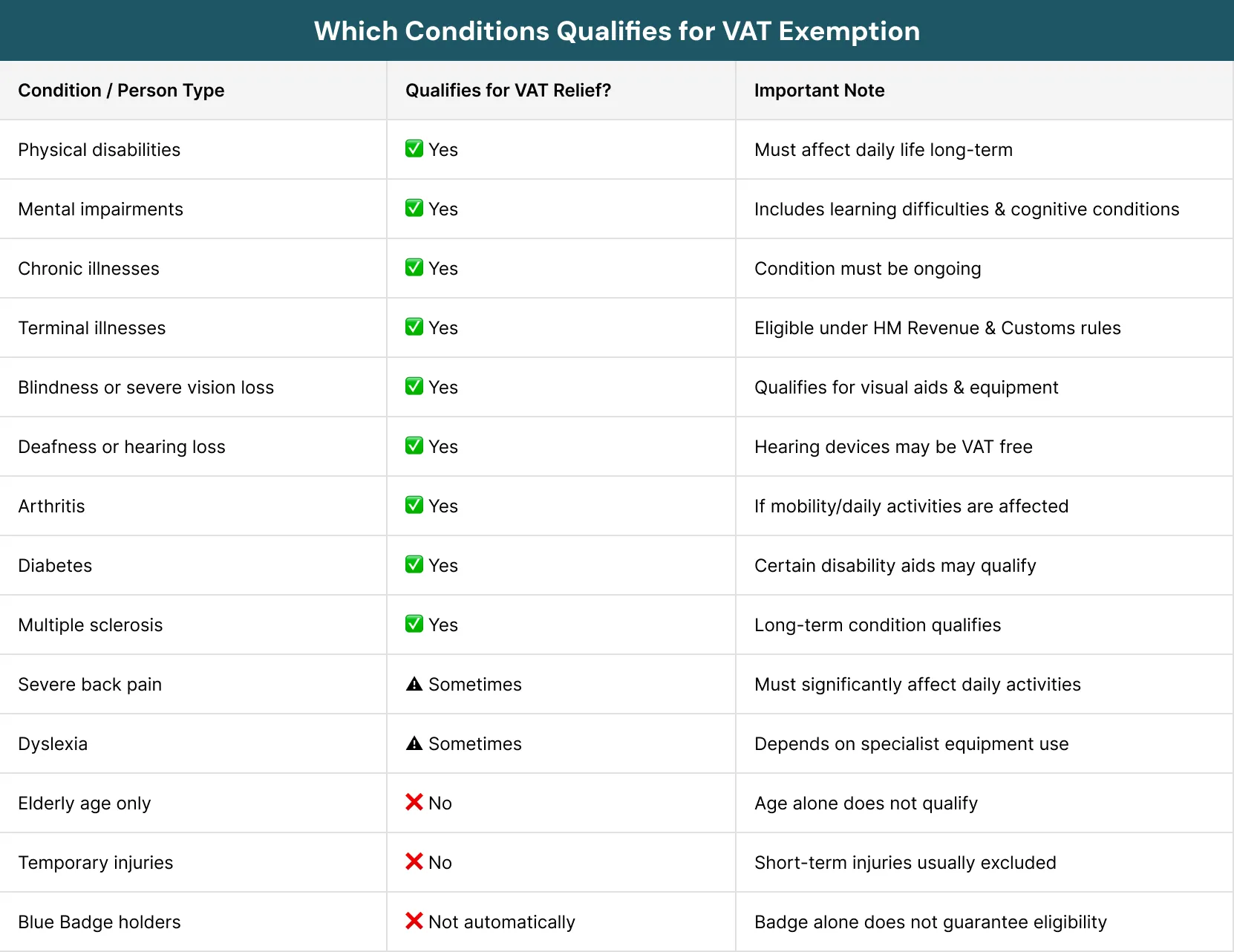
    Which Conditions Qualifies for VAT Exemption

    Quick Eligibility Checklist

    You may qualify for value added tax exemption for disabled people if:

    • You have a long term illness or disability
    • Your condition affects daily activities
    • The product is designed for your condition
    • You are buying for personal use
    • You can complete a VAT relief form

    Important Detail

    Temporary injuries like a broken leg usually do not qualify for VAT exemption because HMRC only considers long-term conditions.

    VAT Exemption List for Disabled

    Many disability products come under the VAT relief scheme. Here’s a list for disabled people who are exempted from VAT.

    • Wheelchairs, which include manual wheelchairs, powered wheelchairs, walking aids, etc.
    • Adjustable beds specifically designed for disabled persons
    • Stairlifts and chair lifts, which include ceiling hoists and transfer hoists
    • Bathroom and toilet aids, which include commode chairs, shower stools, toilet frames, bath lifts and accessible sanitary devices
    • Low vision aids, which include magnifiers, braille equipment, white canes and specialist reading aids
    • Hearing aids, which include induction loops, text telephones, vibrating pillows and TV hearing devices
    • Hoist and lift equipment, which include transfer equipment, lifting slings and standing aids
    • Home change, which include wheelchair ramps, installing stairlifts, adapting shower rooms and installing alarm systems
    • Emergency alarm systems used to contact carers, family members and emergency support services

    In addition to this, certain assistive technology products may also come under VAT if they are specifically designed to help disabled persons. Examples include voice recognition systems, communication systems and accessibility technology under.

    It is important to note that certain products like ordinary wheelchairs are not exempted from VAT, as they are also used for general purposes.

    VAT relief may also apply to adaptation services, repair and maintenance of the qualifying products. This means that you do not have to pay VAT for repairing, servicing and installing such products.

    What Does Not Qualify for Value Added Tax Exemption

    • General use products not designed for disability
    • Luxury or non essential items
    • Items bought for business use
    • Items used by non disabled individuals

    Which People/Products Are Partially Exempt from VAT?

    Partial exemption VAT refers to a situation where some disability products are sold without VAT, while some products are subject to reduced VAT (5%) or standard VAT (20%).

    People over the age of 60 who are not chronically ill fall under the category of reduced VAT for some products.

    Some products which are not specifically designed for disabled persons but help them, e.g. standard recliners or wheelchairs, are subject to reduced VAT.

    If a disabled person has bought a car, then the car itself will be subject to full VAT. However, wheelchair adaptation for the car will be VAT free under VAT exemption for disabled people.

    HMRC Rules You Should Know

    • The product must be for personal use
    • The item must be designed or adapted for disability
    • The buyer must meet eligibility criteria
    • A VAT relief form must be completed

    Pro Tip

    Always ask the supplier whether the product is VAT exempt before making payment online or in-store.

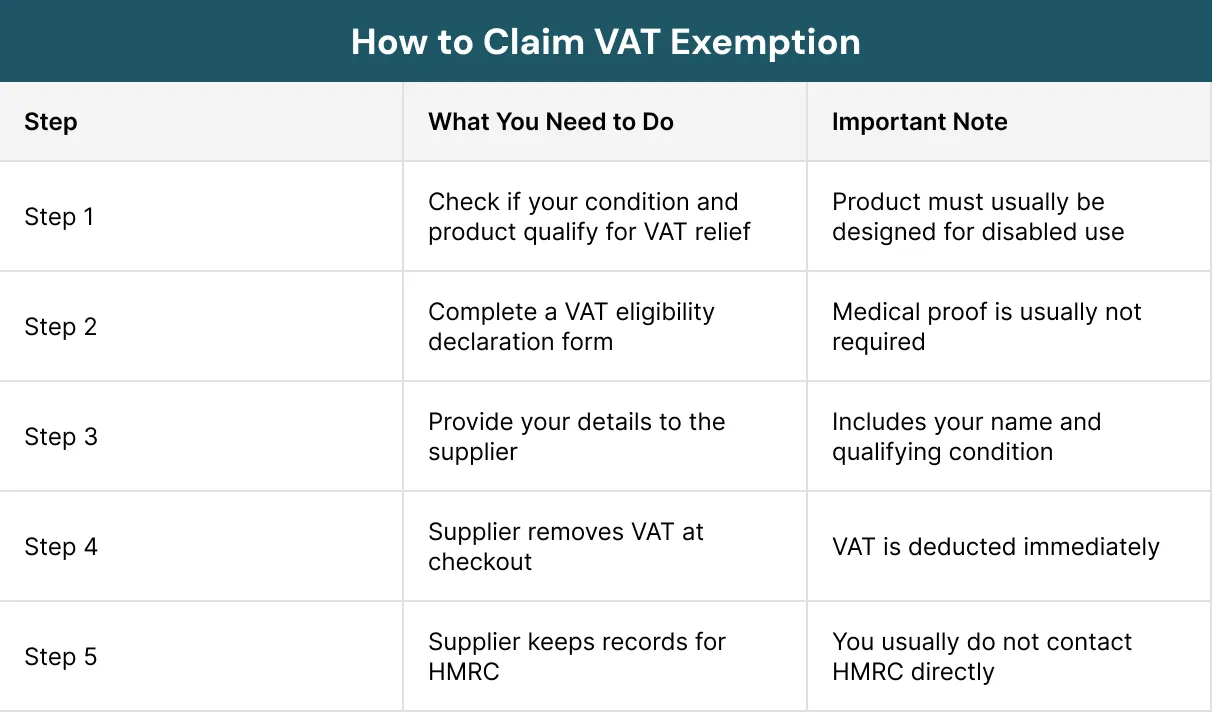
    How to Claim VAT Exemption

    Many people think that claiming VAT is a difficult thing but it’s actually a simple process. Following is a breakdown:

    1. Confirm Your Eligibility

    To claim a value added tax exemption for disabled people, you have to first confirm your eligibility. You must ensure that your condition qualifies for VAT and that the item you need also qualifies.

    2. Complete VAT Declaration

    You have to complete a VAT relief form to confirm that you have a disability or chronic illness that makes you eligible for VAT relief under VAT exemption for disabled people. You also have to declare that you are using the item for personal or domestic use.

    The form usually contains:

    • Your name
    • Your condition
    • VAT confirmation

    3. Suppliers Remove VAT

    Once your eligibility has been confirmed, suppliers remove VAT from your purchase. They keep records for HMRC, so you do not need to contact HMRC directly.

    VAT claims are handled completely by suppliers and they apply for VAT relief under VAT exemption for disabled people.

    Step by Step Buying Process

    1. Choose a qualifying product
    2. Confirm eligibility
    3. Fill out VAT relief form
    4. Supplier removes VAT
    5. Complete purchase

    How to Claim VAT Exemption

    Do You Need to Fill a VAT Declaration Form to Claim VAT Exemption for Disabled People?

    To claim a value added tax exemption for disabled people, completing the VAT relief form is the most important step. Many people lose the benefit simply because they do not understand how this form works.

    The VAT declaration is a simple statement where you confirm that you are eligible for an exemption and that the product is for personal or domestic use. This form is required by suppliers so they can legally remove VAT from your purchase.

    The form usually asks for basic details such as your name, address and the nature of your condition. You do not need to provide medical proof, but your statement must be honest and accurate.

    It is important to understand that this form is not sent by you to HMRC. Instead, the supplier keeps it as a record in case HMRC asks for proof later. This is why filling it correctly is essential when claiming VAT exemption for disabled people.

    You may be asked to complete this form:

    • At checkout in a physical store
    • Online before making payment
    • Or sometimes after placing an order

    If the form is not completed, the supplier cannot apply exemption and you may be charged full VAT.

    Always double check your details before submitting. Incorrect or false statements can lead to penalties, even if done by mistake.

    Do You Need Medical Proof to Claim VAT?

    No, you usually do not need medical proof to claim VAT. You do not require any medical evidence like a doctor’s letter or certificate.

    You only need to make a statement that confirms you are eligible for a value added tax exemption for disabled people. Avoid making false statements, as this may lead to penalties.

    Good to Know

    You normally do not need to send medical proof to HMRC. Most suppliers only require a simple eligibility declaration form.

    VAT Relief for Charities

    VAT relief may also apply to certain charities that support disabled people. These charities support disabled people through care services, medical support and accessibility services.

    Charities may be exempt from VAT on:

    • Disability aids
    • Accessibility equipment
    • Medical supplies
    • Adapted vehicles

    This may also fall under conditions similar to VAT exemption for disabled people.

    VAT Exemption for International Customers

    International customers who buy disability products from the UK are not usually charged VAT. However, they may have to pay customs charges or import tax depending on their country.

    Some countries allow tax free imports of disability products, while others apply local taxes. These rules are separate from VAT exemption for disabled people.

    VAT Exemption in the UK vs Other Countries

    The UK offers VAT exemption for disabled people at the point of sale, while many other countries require refunds or partial tax relief after purchase.

    Common Misconceptions About VAT Relief

    Here are some common misunderstandings about value added tax exemption for disabled people:

    • Elderly people automatically qualify (not true)
    • Every disabled person qualifies (both person and product must qualify)
    • All disability products are VAT free (only specific products qualify)
    • Benefits like a blue badge are required (not true)
    • HMRC approval is needed (self declaration is enough)

    Read more: Common Errors on VAT Returns

    Importance of VAT for Disabled People

    VAT exemption for disabled people is important because it reduces financial burden. Many disability related products like wheelchairs, adjustable beds and mobility scooters are expensive.

    In addition, home changes and assistive technologies also cost money. Removing VAT can save thousands of pounds.

    It improves the quality of life by making essential products more accessible. It also helps charities reduce their operating costs.

    How Much Can You Save?

    With VAT exemption for disabled people, removing 20% VAT can save hundreds or even thousands of pounds on equipment like mobility aids, home change and medical devices.

    Final Thoughts

    There is no doubt that disability products come as an additional expense. The VAT exemption scheme for disabled people by the UK government is a great step in managing this cost.

    VAT schemes can only be used properly if you have complete knowledge about them. You must know which products and conditions qualify for VAT exemption for disabled people. Always confirm that both the product and your condition qualify before buying.

    Many people miss out on value added tax exemption for disabled people simply because they are unaware of the eligibility criteria. The process is simple. No medical evidence is required. You only need to make a declaration. It can become difficult only when there is a lack of understanding about eligibility, products and the process.

    Understanding VAT exemption for disabled people can sometimes be confusing. Sterling Cooper Consultants can guide you on eligibility, qualifying products and correct declarations to ensure you do not miss out on available relief. Reach out to us today.

    At Sterling Cooper, we help you stay compliant and reduce tax stress.

    Trusted by UK individuals and businesses, we make VAT relief and exemption easier to understand. Contact us today!
    +443300102526
    Book an Appointment

    FAQs


    Can I claim VAT back if I am disabled?

    Yes, disabled people can receive VAT relief on certain eligible products and services designed specifically for disability use. However, VAT relief is usually applied at the time of purchase, meaning you do not pay the VAT upfront rather than claiming it back later.
    You may qualify if you have a long-term physical or mental condition that affects your daily activities.

    Physical disabilities, mental impairments, chronic illnesses, and terminal illnesses may qualify for VAT relief if they have a long-term effect on daily life. Conditions such as blindness, deafness, diabetes, epilepsy, arthritis, multiple sclerosis, cancer, and severe mobility issues can qualify under HMRC rules. Temporary conditions, minor injuries, or simply being elderly do not usually qualify for full VAT exemption.

    No, having a Blue Badge alone does not automatically qualify you for VAT exemption.
    Eligibility depends on whether you have a long-term disability or chronic illness that affects your daily activities under HMRC rules. You can still qualify for VAT relief even if you do not receive benefits or have a Blue Badge.


    Yes, arthritis can qualify for VAT exemption if it has a long-term and substantial impact on your ability to carry out everyday activities. Under HMRC rules, chronic conditions such as arthritis are considered eligible when purchasing qualifying disability-related products or services. The products must also be for personal or domestic use to receive VAT relief.


    To apply for VAT exemption in the UK, you usually need to complete a simple VAT eligibility declaration form provided by the supplier. You must confirm that you have a qualifying long-term disability or chronic illness and that the product is for personal or domestic use. Once approved, the supplier removes the VAT at the time of purchase.

    Share This Article!

    Recent Posts

  • What Disabilities Qualify for VAT Exemption?

    What Disabilities Qualify for VAT Exemption?

    VAT exemption for disabled people

    Posted by:

    Admin

    Date:

    May 21, 2026

    Category:

    blogs

    Error: Contact form not found.

    What Disabilities Qualify for VAT Exemption?

    Living with a disability often requires special equipment to maintain a normal quality of life. However, this equipment comes at a cost with VAT, which makes it difficult for most people to buy it. In the UK, the government has allowed VAT exemption for disabled people so that they can buy goods without the need to pay VAT.

    According to a source, in the UK a household with at least one disabled person has to face an additional cost of £975 per month.

    The government has introduced this scheme to help disabled people. It makes buying special equipment like mobility aids, wheelchairs, adapted cutlery, shower chairs, etc. easier.

    Many people might have heard about the value added tax exemption scheme. However, they don’t know who is actually exempt from VAT and how this scheme works. They assume that they just need a disability certificate to qualify for the VAT relief scheme. This is not true. There are certain criteria set by HMRC which makes you eligible for this scheme.

    If you are someone who wants to know if you are eligible for the VAT scheme or not, then this guide is for you. In this guide, we will see in detail what VAT is. We will also explore what makes you eligible for a value added tax exemption.

    Key Takeaways

    • Disabled people with long-term physical, mental, or chronic conditions may qualify for VAT exemption for disabled people under HMRC rules.
    • You do not need PIP (Personal Independence Payment), DLA (Disability Living Allowance), or a Blue Badge to claim VAT relief.
    • VAT exemption for disabled people removes the standard 20% VAT from eligible disability products and services.
    • VAT-free items may include wheelchairs, mobility aids, stairlifts, adjustable beds, bathroom aids, and emergency alarms.
    • Products must usually be designed specifically for disabled people and used personally or domestically.
    • People over 60 may qualify for a reduced 5% VAT rate on certain mobility aids and home adaptations.
    • Claiming VAT relief is simple and usually only requires a short eligibility declaration form.
    • VAT relief may also apply to repairs, installations, home adaptations, and charities supporting disabled people.

    In order to understand VAT exemption for disabled people, first let’s see what VAT is.

    What Is VAT?

    VAT (Value Added Tax) is a tax that is charged on goods or services sold in the country. The standard VAT rate for the UK is 20% as of 2026. It means that whatever product you buy, an additional 20% will be charged on it.

    According to HMRC:
    ‘VAT is a tax added to most products and services sold by VAT registered businesses.’

    VAT is charged on goods ranging from everyday household items to electronics and furniture. In the UK, VAT is collected by HMRC. The money collected through VAT is used to fund public services.

    Read more: VAT on Private School Fees

    What Is VAT Exemption for Disabled People?

    VAT exemption for disabled people means that eligible disabled persons can buy disability equipment without the need to pay VAT. Suppliers will not charge you an additional 20% at the time of sale. For example, if a mobility aid costs £1,000 with VAT, then you will have to pay only the original price, which would be around £833.

    The VAT relief scheme is introduced by the government of the UK so that disabled people do not have to pay an additional 20% to buy specialised equipment. It is important to know that not every single item bought by disabled people will become VAT free. Only certain products and services that meet HMRC conditions come under VAT exemption for disabled people.

    Example of VAT Exemption in Practice

    A person with mobility issues buys a wheelchair priced at £1,000 including VAT. With value added tax exemption for disabled people, they only pay around £833. This shows how the scheme directly reduces financial burden.

    Who Is Eligible for Value Added Tax Exemption in the UK?

    If you are chronically sick or disabled, then you are eligible for VAT exemption for disabled people.

    Under the guidelines of HMRC, a person with any kind of:

    • Physical disability
    • Mental impairments
    • Chronic illness
    • Terminal illness

    Or any condition that has a long term effect on the ability to carry out daily life tasks qualifies for the VAT exemption for disabled people scheme.

    Many other conditions like asthma, blindness, deafness, diabetes, epilepsy, cancer, heart disease and multiple sclerosis may also be exempted from VAT if they have a significant effect on your daily life.

    Certain common conditions also qualify for VAT if they have a long term effect on daily life. Examples include back pain, dyslexia, psoriasis, etc.

    Once you qualify for the value added tax exemption for disabled people scheme, you can easily buy goods without the need to pay VAT. Common goods and services that are exempted from VAT for disabled people include:

    • Mobility aids like wheelchairs, mobility scooters, etc.
    • Medical equipment like adjustable beds, riser recliner chairs, etc.
    • Emergency alarms
    • Blind aid devices
    • Communication aids

    One misconception you might have heard is that elderly persons are also exempted from VAT but that’s not true. Being elderly does not automatically make you eligible for the exemption scheme. They will only qualify if they have a disability and chronic illness that affects their daily life activities severely.

    Which Conditions Qualifies for VAT Exemption

    Quick Eligibility Checklist

    You may qualify for value added tax exemption for disabled people if:

    • You have a long term illness or disability
    • Your condition affects daily activities
    • The product is designed for your condition
    • You are buying for personal use
    • You can complete a VAT relief form

    Important Detail

    Temporary injuries like a broken leg usually do not qualify for VAT exemption because HMRC only considers long-term conditions.

    VAT Exemption List for Disabled

    Many disability products come under the VAT relief scheme. Here’s a list for disabled people who are exempted from VAT.

    • Wheelchairs, which include manual wheelchairs, powered wheelchairs, walking aids, etc.
    • Adjustable beds specifically designed for disabled persons
    • Stairlifts and chair lifts, which include ceiling hoists and transfer hoists
    • Bathroom and toilet aids, which include commode chairs, shower stools, toilet frames, bath lifts and accessible sanitary devices
    • Low vision aids, which include magnifiers, braille equipment, white canes and specialist reading aids
    • Hearing aids, which include induction loops, text telephones, vibrating pillows and TV hearing devices
    • Hoist and lift equipment, which include transfer equipment, lifting slings and standing aids
    • Home change, which include wheelchair ramps, installing stairlifts, adapting shower rooms and installing alarm systems
    • Emergency alarm systems used to contact carers, family members and emergency support services

    In addition to this, certain assistive technology products may also come under VAT if they are specifically designed to help disabled persons. Examples include voice recognition systems, communication systems and accessibility technology under.

    It is important to note that certain products like ordinary wheelchairs are not exempted from VAT, as they are also used for general purposes.

    VAT relief may also apply to adaptation services, repair and maintenance of the qualifying products. This means that you do not have to pay VAT for repairing, servicing and installing such products.

    What Does Not Qualify for Value Added Tax Exemption

    • General use products not designed for disability
    • Luxury or non essential items
    • Items bought for business use
    • Items used by non disabled individuals

    Which People/Products Are Partially Exempt from VAT?

    Partial exemption VAT refers to a situation where some disability products are sold without VAT, while some products are subject to reduced VAT (5%) or standard VAT (20%).

    People over the age of 60 who are not chronically ill fall under the category of reduced VAT for some products.

    Some products which are not specifically designed for disabled persons but help them, e.g. standard recliners or wheelchairs, are subject to reduced VAT.

    If a disabled person has bought a car, then the car itself will be subject to full VAT. However, wheelchair adaptation for the car will be VAT free under VAT exemption for disabled people.

    HMRC Rules You Should Know

    • The product must be for personal use
    • The item must be designed or adapted for disability
    • The buyer must meet eligibility criteria
    • A VAT relief form must be completed

    Pro Tip

    Always ask the supplier whether the product is VAT exempt before making payment online or in-store.

    How to Claim VAT Exemption

    Many people think that claiming VAT is a difficult thing but it’s actually a simple process. Following is a breakdown:

    1. Confirm Your Eligibility

    To claim a value added tax exemption for disabled people, you have to first confirm your eligibility. You must ensure that your condition qualifies for VAT and that the item you need also qualifies.

    2. Complete VAT Declaration

    You have to complete a VAT relief form to confirm that you have a disability or chronic illness that makes you eligible for VAT relief under VAT exemption for disabled people. You also have to declare that you are using the item for personal or domestic use.

    The form usually contains:

    • Your name
    • Your condition
    • VAT confirmation

    3. Suppliers Remove VAT

    Once your eligibility has been confirmed, suppliers remove VAT from your purchase. They keep records for HMRC, so you do not need to contact HMRC directly.

    VAT claims are handled completely by suppliers and they apply for VAT relief under VAT exemption for disabled people.

    Step by Step Buying Process

    1. Choose a qualifying product
    2. Confirm eligibility
    3. Fill out VAT relief form
    4. Supplier removes VAT
    5. Complete purchase

    How to Claim VAT Exemption

    Do You Need to Fill a VAT Declaration Form to Claim VAT Exemption for Disabled People?

    To claim a value added tax exemption for disabled people, completing the VAT relief form is the most important step. Many people lose the benefit simply because they do not understand how this form works.

    The VAT declaration is a simple statement where you confirm that you are eligible for an exemption and that the product is for personal or domestic use. This form is required by suppliers so they can legally remove VAT from your purchase.

    The form usually asks for basic details such as your name, address and the nature of your condition. You do not need to provide medical proof, but your statement must be honest and accurate.

    It is important to understand that this form is not sent by you to HMRC. Instead, the supplier keeps it as a record in case HMRC asks for proof later. This is why filling it correctly is essential when claiming VAT exemption for disabled people.

    You may be asked to complete this form:

    • At checkout in a physical store
    • Online before making payment
    • Or sometimes after placing an order

    If the form is not completed, the supplier cannot apply exemption and you may be charged full VAT.

    Always double check your details before submitting. Incorrect or false statements can lead to penalties, even if done by mistake.

    Do You Need Medical Proof to Claim VAT?

    No, you usually do not need medical proof to claim VAT. You do not require any medical evidence like a doctor’s letter or certificate.

    You only need to make a statement that confirms you are eligible for a value added tax exemption for disabled people. Avoid making false statements, as this may lead to penalties.

    Good to Know

    You normally do not need to send medical proof to HMRC. Most suppliers only require a simple eligibility declaration form.

    VAT Relief for Charities

    VAT relief may also apply to certain charities that support disabled people. These charities support disabled people through care services, medical support and accessibility services.

    Charities may be exempt from VAT on:

    • Disability aids
    • Accessibility equipment
    • Medical supplies
    • Adapted vehicles

    This may also fall under conditions similar to VAT exemption for disabled people.

    VAT Exemption for International Customers

    International customers who buy disability products from the UK are not usually charged VAT. However, they may have to pay customs charges or import tax depending on their country.

    Some countries allow tax free imports of disability products, while others apply local taxes. These rules are separate from VAT exemption for disabled people.

    VAT Exemption in the UK vs Other Countries

    The UK offers VAT exemption for disabled people at the point of sale, while many other countries require refunds or partial tax relief after purchase.

    Common Misconceptions About VAT Relief

    Here are some common misunderstandings about value added tax exemption for disabled people:

    • Elderly people automatically qualify (not true)
    • Every disabled person qualifies (both person and product must qualify)
    • All disability products are VAT free (only specific products qualify)
    • Benefits like a blue badge are required (not true)
    • HMRC approval is needed (self declaration is enough)

    Read more: Common Errors on VAT Returns

    Importance of VAT for Disabled People

    VAT exemption for disabled people is important because it reduces financial burden. Many disability related products like wheelchairs, adjustable beds and mobility scooters are expensive.

    In addition, home changes and assistive technologies also cost money. Removing VAT can save thousands of pounds.

    It improves the quality of life by making essential products more accessible. It also helps charities reduce their operating costs.

    How Much Can You Save?

    With VAT exemption for disabled people, removing 20% VAT can save hundreds or even thousands of pounds on equipment like mobility aids, home change and medical devices.

    Final Thoughts

    There is no doubt that disability products come as an additional expense. The VAT exemption scheme for disabled people by the UK government is a great step in managing this cost.

    VAT schemes can only be used properly if you have complete knowledge about them. You must know which products and conditions qualify for VAT exemption for disabled people. Always confirm that both the product and your condition qualify before buying.

    Many people miss out on value added tax exemption for disabled people simply because they are unaware of the eligibility criteria. The process is simple. No medical evidence is required. You only need to make a declaration. It can become difficult only when there is a lack of understanding about eligibility, products and the process.

    Understanding VAT exemption for disabled people can sometimes be confusing. Sterling Cooper Consultants can guide you on eligibility, qualifying products and correct declarations to ensure you do not miss out on available relief. Reach out to us today.

    At Sterling Cooper, we help you stay compliant and reduce tax stress.

    Trusted by UK individuals and businesses, we make VAT relief and exemption easier to understand. Contact us today!
    +443300102526
    Book an Appointment

    FAQs


    Can I claim VAT back if I am disabled?

    Yes, disabled people can receive VAT relief on certain eligible products and services designed specifically for disability use. However, VAT relief is usually applied at the time of purchase, meaning you do not pay the VAT upfront rather than claiming it back later.
    You may qualify if you have a long-term physical or mental condition that affects your daily activities.

    Physical disabilities, mental impairments, chronic illnesses, and terminal illnesses may qualify for VAT relief if they have a long-term effect on daily life. Conditions such as blindness, deafness, diabetes, epilepsy, arthritis, multiple sclerosis, cancer, and severe mobility issues can qualify under HMRC rules. Temporary conditions, minor injuries, or simply being elderly do not usually qualify for full VAT exemption.

    No, having a Blue Badge alone does not automatically qualify you for VAT exemption.
    Eligibility depends on whether you have a long-term disability or chronic illness that affects your daily activities under HMRC rules. You can still qualify for VAT relief even if you do not receive benefits or have a Blue Badge.


    Yes, arthritis can qualify for VAT exemption if it has a long-term and substantial impact on your ability to carry out everyday activities. Under HMRC rules, chronic conditions such as arthritis are considered eligible when purchasing qualifying disability-related products or services. The products must also be for personal or domestic use to receive VAT relief.


    To apply for VAT exemption in the UK, you usually need to complete a simple VAT eligibility declaration form provided by the supplier. You must confirm that you have a qualifying long-term disability or chronic illness and that the product is for personal or domestic use. Once approved, the supplier removes the VAT at the time of purchase.

    Share This Article!

    Recent Posts

  • The Ultimate VAT Exemption Guide

    The Ultimate VAT Exemption Guide

    vat exemption

    Posted by:

    Admin

    Date:

    January 2, 2026

    Category:

    blogs

    Error: Contact form not found.

    The Ultimate VAT Exemption Guide

    Are you confused about VAT categories and not so sure about which one your business falls in? We have got you covered. Knowing how VAT exemption works is empirical for people and businesses working in the UK.
    VAT can be a complex area, mainly when certain goods or services do not carry VAT at all. If you fall into a category for VAT exemption, you could legally avoid paying VAT. It can help you save a large amount of money. Our guide will explain all you need to know about the topic.

    What is VAT Exemption?

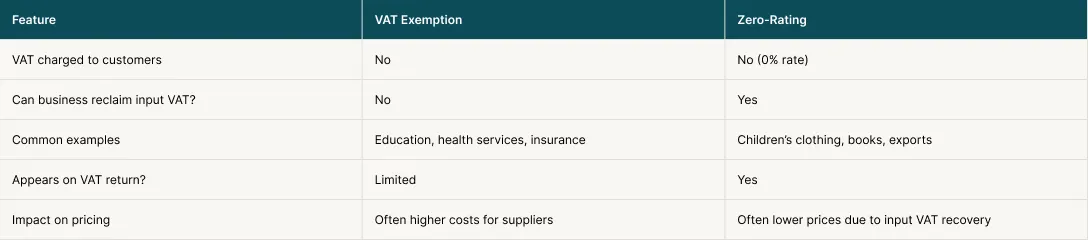
    It means a good, service, or activity is totally free from VAT. Unlike zero-rated goods, exempt items do not carry VAT. Same way the setups that sell them cannot reclaim VAT on related purchases.
    This makes VAT exemption different from zero rating. Even though both result in no VAT charged to the final consumer.

    VAT Exemption vs. Zero-Rating

    Even though both can result in no VAT charged to the customer, the business impact is different. Zero-rated supplies are still taxable supplies at 0%. Exempt supplies are not treated the same way.
    Table
    Simplify your  taxes with expert planning, VAT returns & corporation tax services in the UK.

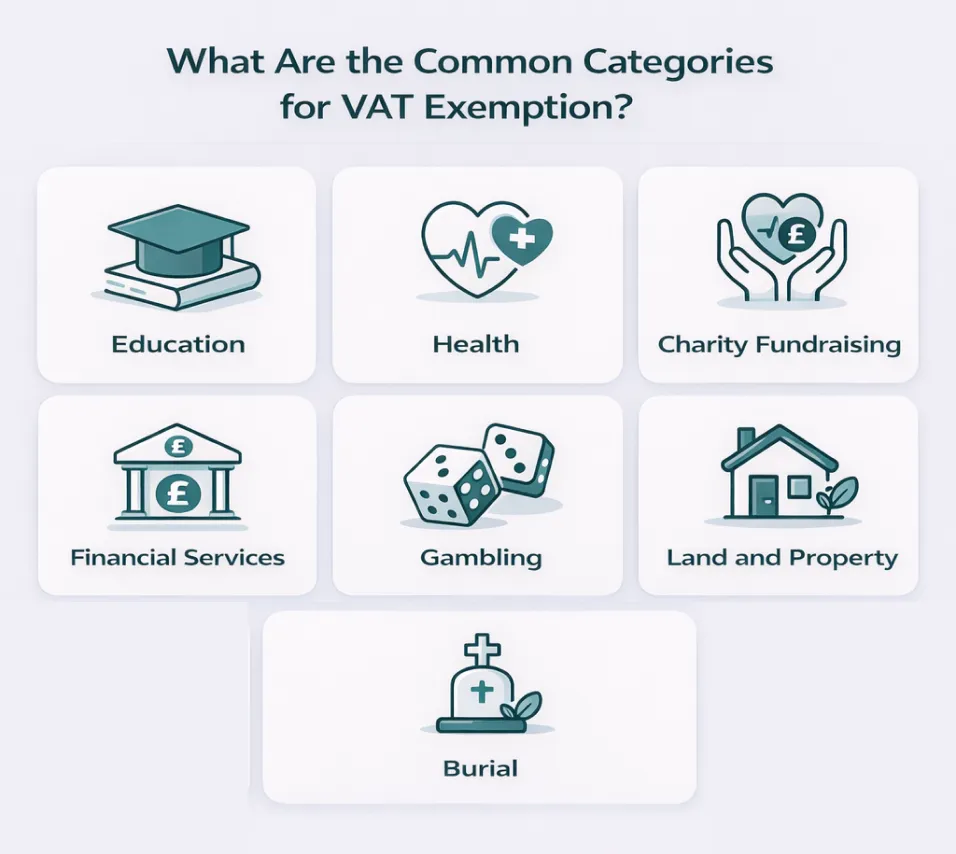
    What Are the Common Categories for VAT Exemption?

    Exempt supplies are mostly linked to essential services where VAT would make access harder. That is why many exemptions cover education, health, and other areas of welfare.
    Still, these rules can have conditions, and not every service in these sectors is exempt. Below are common areas that often fall under exemption in the UK.

    1. Education

    Teaching and training from approved schools and tutors are usually exempt. This helps learning stay more affordable for students. Many private lessons also fall under VAT exemption.

    2. Health

    Medical care from doctors, nurses and clinics is often exempt. This includes treatment, tests and hospital care. The rule helps keep basic health services easier to access.

    3. Charity Fundraising

    It may get VAT exemption for some events. The fundraising event must raise money for their main work. This saving helps charities spend more on their cause.

    4. Financial Services

    Banking, loans, credit, and insurance services often qualify. These services are common in daily life, so exemption keeps costs low.

    5. Gambling

    Betting, lotteries and gaming are exempt from VAT. These setups follow separate tax rules set by the government.

    6. Land and Property

    Renting a home or dealing with some land agreements can be exempt. Most residential property rentals fall into this group.

    7. Burial

    Funeral services, burial plots and cremations are exempt. This reduces the financial burden during difficult times.
    The UK government has shared the VAT rates on different goods and services which also shows the VAT exempt items.

    Who is Eligible for VAT Exemption?

    Eligibility depends on what is being supplied and who is receiving it. Some exemptions are based on the type of service, such as healthcare. Others depend on the buyer, such as goods for disabled people.
    A business also needs to understand how exemption affects its VAT registration position. Because exemption does not always remove duties.
    Here is a detailed account of people, businesses and services eligible for VAT exemption:

    1. Individuals

    Some VAT exemptions are based on the personal situation of the buyer. These rules are mainly designed to support daily living, health needs, and mobility. In most cases, the exemption applies only when the goods are for personal use and meet strict conditions.

    i. Elderly People

    Many aids made for older people qualify for VAT exemption. This includes equipment that helps with daily living.

    ii. Disabled People

    Disabled people can buy medical and mobility products without VAT. The rule supports independence and comfort.

    iii. Tourists

    Some tourists may qualify for VAT refunds, depending on current UK rules. This usually applies to goods taken out of the country.

    2. Businesses

    Many VAT exemptions depend on the nature of the service being supplied. These exemptions are common in sectors that provide essential or public interest services. Businesses must still check how exemption affects VAT registration and input VAT recovery.

    i. Small Setups and Startups

    Some small firms provide exempt services by nature. They do not charge VAT on these supplies.

    ii. Charities

    These may get exemption for fundraising and welfare work. It lets them use more of their income on community needs.

    iii. Healthcare Providers

    Doctors, clinics, dentists and therapists often give exempt services.

    iv. Educational Institutions

    Schools, colleges and training centres often fall under exemption. Their main teaching work qualifies for relief.

    v. Financial Service Providers

    In this case, banks, insurers and mortgage firms offer exempt services that follow strict rules.

    vi. Mixed Supply Setups

    Some businesses sell both VAT exemption products and taxable goods. These firms must handle VAT carefully and follow partial exemption rules.

    vii. Exports

    Some global services are not charged VAT at all. They may fall outside UK VAT rules.

    viii. Land and Property

    Residential rents and some land services qualify for exemption.

    3. Products & Items

    Certain goods qualify for VAT exemption because of how they are used. Most of these items support medical care, disability needs, or essential living requirements. Eligibility often depends on who the item is for and how it will be used.

    i. Medical Equipment

    Wheelchairs, hospital beds and care items are VAT exempt goods. They support basic medical needs.

    ii. Mobility Aids

    Stairlifts, scooters and walking aids often qualify for exemption products. This is for eligible buyers.

    iii. Children’s Clothing and Footwear

    These items do not have VAT, but they are zero-rated rather than exempt.

    iv. Books

    Printed books and newspapers are also zero-rated. They remain VAT free for buyers.

    v. Prescription Medicines

    These are also VAT exempt goods. It makes the vital treatment affordable.

    vi. Energy-saving Products

    Some energy-saving items may qualify for VAT relief under current rules.

    vii. Specific Disability Products

    Adapted vehicles, assistive devices and similar items can be bought without VAT.

    How to Claim or Apply VAT Exemption?

    The process usually comes down to proof and correct paperwork. Suppliers need to confirm eligibility before selling without VAT. Buyers need to provide the right details. When this is done the proper way it stays simple. Ignoring it creates problems later. Here are the key steps to follow while applying for exemption:

    • Check That the Product Qualifies

    Confirm that the item or service is listed under UK VAT relief rules.

    • Declare Your Eligibility

    Suppliers must know you are exempt or eligible before starting the purchase.

    • Complete a VAT Relief Form

    This form confirms that the buyer meets the criteria for exemption. It is usually simple and asks for basic details.

    • For Online Purchases

    Most websites include a VAT relief section at checkout. Customers tick a box and submit the form online.

    • For In-Store or Telephone Purchases

    You may need to provide the completed form to the retailer or sign a written declaration.

    • For Charities

    Such setups must give the supplier a certificate. It must show why the purchase qualifies for exemption.

    How VAT Exemption Works?

    Given below is how it actually works in different scenarios:

    1. No Output VAT: Businesses do not charge VAT on exempt supplies.
    2. No Input VAT Reclaim: They cannot recover VAT on related purchases. It increases overall business costs.
    3. Partial Exemption: For those selling both exempt and taxable goods, they must calculate how much input VAT they are allowed to reclaim. This requires careful record keeping.

    Get more insights on How to get a VAT Certificate? 

    What Are the Pros and Cons of VAT Exemptions?

    Lets walk through some general pros and cons of VAT Exemptions:

    Pros of VAT Exemption

    • No VAT is added to the final price for customers
    • Helps keep essential services more affordable
    • Reduces tax burden for certain activities
    • Supports access to health, education, and welfare services
    • Can make pricing clearer for customers
    • Avoids the need to charge and collect VAT on exempt supplies
    • Useful for businesses focused on non-commercial or social goals

    Cons of VAT Exemption

    • Input VAT on purchases cannot be reclaimed
    • Business running costs can increase
    • Less flexibility in tax planning
    • Can reduce profit margins for cost-heavy businesses
    • Mixed activities create extra complexity
    • Requires careful record keeping to avoid mistakes
    • Confusion between exempt and zero-rated supplies is common
    • May limit growth options if VAT recovery becomes important

    VAT exemption can be helpful, but it is not always “better.” It depends on the business model. For some, it reduces customer prices. For others, it reduces recoverable VAT and increases costs. The key is knowing which side matters more for the specific setup. Let’s go through the pros and cons of different setups:
    What Are the Common Categories for VAT Exemption

    What Are the Common VAT Mistakes?

    VAT errors usually happen due to confusion, rushed invoicing, or weak records. Most mistakes are avoided once the VAT status is clear and the team follows one consistent process.
    Here are a few mistakes that are commonly made and should be avoided:

    • VAT on Exempt Services: Many firms add VAT by accident. This must be corrected.
    • Reclaiming VAT on Exempt Supplies: Input VAT on exempt sales cannot be reclaimed. Incorrect claims may cause penalties.
    • Confusing Exempt with Zero-Rated Supplies: These two categories work in different ways. Mixing them causes VAT errors.
    • Incorrect Invoicing: Invoices must show clearly that the supply is exempt.
    • Mixing Exempt and Taxable Items: Poor separation leads to wrong VAT returns.
    • Exceeding the Threshold: Some activities may force the business to register even if many sales are exempt.
    • Claiming Wrong Input VAT: Partially exempt firms often make mistakes in this area.
    • Poor Record-Keeping: Weak records make VAT checks harder and risk penalties.

    What Are the Record-Keeping Tips?

    Knowing the category early saves time later. It also reduces panic during VAT deadlines. Here are a few tips to be kept in mind for avoiding any confusions about your status:

    • Know Your VAT Status: Know if you are exempt, partially exempt or taxable. This guides all VAT actions.
    • Keep Thorough Records: Store all invoices, forms and receipts. Good records protect you in case of checks.
    • Organise Documents Clearly: Separate exempt and taxable items. This keeps things simple and clean.
    • Separate Personal Expenses: Clear separation prevents confusion during VAT reviews.
    • Retain Records: Keep your records for at least six years.
    • Include a Clear Note: Write “VAT exempt” or a similar note. This avoids confusion for customers and HMRC.

    Conclusion

    Being fully aware of VAT exemption is always needed. It helps to reduce the costs. Firms can then operate in an efficient way. For new business owners, the safest approach is to set up clean systems early. Even simple steps like correct invoices, neat records, and clear separation may prevent future stress. For established ones, reviewing VAT treatment once a year is a smart move. Services change. Supplies change. And VAT rules also get updated.
    Sterling Cooper Consultants guide you on  how VAT works. We will let you know who qualifies, and how to apply. In this way we ensure you stay compliant and avoid mistakes.
    For further guidance about managing your VAT, reach out to our experts.

    Know your VAT.

    Contact us today for tailored VAT support and professional accounting advice.

    FAQs


    What Is the VAT Exemption Rule?


    The VAT exemption rule means some goods and services do not have VAT added at all. These supplies are outside the VAT system, so businesses do not charge VAT and cannot reclaim on related costs. Examples include education, healthcare, insurance, charity fundraising and some financial services.


    You can remove the 20 percent VAT only if the item is VAT exempt or zero rated. If the supply qualifies, the invoice must show “VAT exempt” or “Zero rated”. You cannot exclude VAT from standard-rated items unless the law allows it.


    In most cases, there is no official VAT exemption certificate. Instead, buyers complete a simple VAT relief declaration form provided by the supplier. Charities may give a certificate confirming they qualify for VAT relief on certain purchases.


    For VAT-exempt items, no VAT is added, so the computation is simply the net price. Businesses with mixed supplies must separate exempt and taxable sales and follow HMRC’s partial exemption rules for input VAT.


    As of January 1, 2021, the UK government discontinued the VAT refund scheme for tourists. For many visitors, this decision ended an era of cost-effective shopping in Britain.

    Share This Article!

    Recent Posts