Posted by:
Admin
Date:
April 14, 2025
Category:
blogs
Error: Contact form not found.
How do I get a VAT Certificate: A Complete Guide
A VAT certificate is a document that every listed business needs to have. It lets you properly charge Value-Added Tax (VAT) on sales. Items and services on which VAT applies need a certificate of VAT to be sold. If your yearly sales go over a certain amount, you have to do it by law.
Importance of VAT certificate
Getting a certificate of VAT is very important for businesses. It is a legal proof that you are registered. It also indicates that you can charge value-added tax on your items or services.
A VAT certificate in the UK holds great value. It indicates that you have passed the criteria of VAT registration. You need to then add VAT to your sales. You also have to report your returns to HM Revenue and Customs (HMRC).
Here are the reasons that make it important:
- You can get penalties without it.
- Without it, you can lose VAT registration.
- It boosts the credibility of your business.
- This certificate can help you attract customers since you are seen as legit.
Which businesses need a VAT registration?
Businesses with turnover above £90,000
A certificate of VAT is mandatory for these businesses. Legally, it is essential. It applies to all companies that are above this value of £90,000.
Businesses with turnover below £90,000
Below a £90,000 turnover, businesses do not need VAT registration. They can register on their own. This may get them benefits e.g., reclaiming VAT on purchases before registering.
Businesses with VAT-exempt goods
They do not have to register for VAT. These businesses include goods and services considered vital for society. Services like schooling, health care, and others are not subject to VAT.
“VAT exemption means that while sellers are not required to charge VAT on their output, neither are they able to reclaim any VAT paid on inputs to their production process”.
Ross Warwick et al.
Step by Step guide for application of VAT certificate
“How do I get a VAT certificate” is the question you might be thinking now. Here is a step-by-step guide for applying for a certificate of VAT.
Step 1: Collect information
The information depends on the type of your company.
Limited company:
For the limited company you need:
- Registration number of company
- Bank account details of company
- Unique Taxpayer Reference
- Annual turnover details
- Self Assessment
- Corporation Tax
- Pay As you Earn (PAYE)
Individual or Partnership:
As an individual or partnership, you’ll need:
- National insurance number
- Identity document (passport/driving license)
- Bank account details of yours
- Annual Taxover details
- Unique Taxpayer Reference (UTR)
- Self-Assessment
- Your payslip
- P60
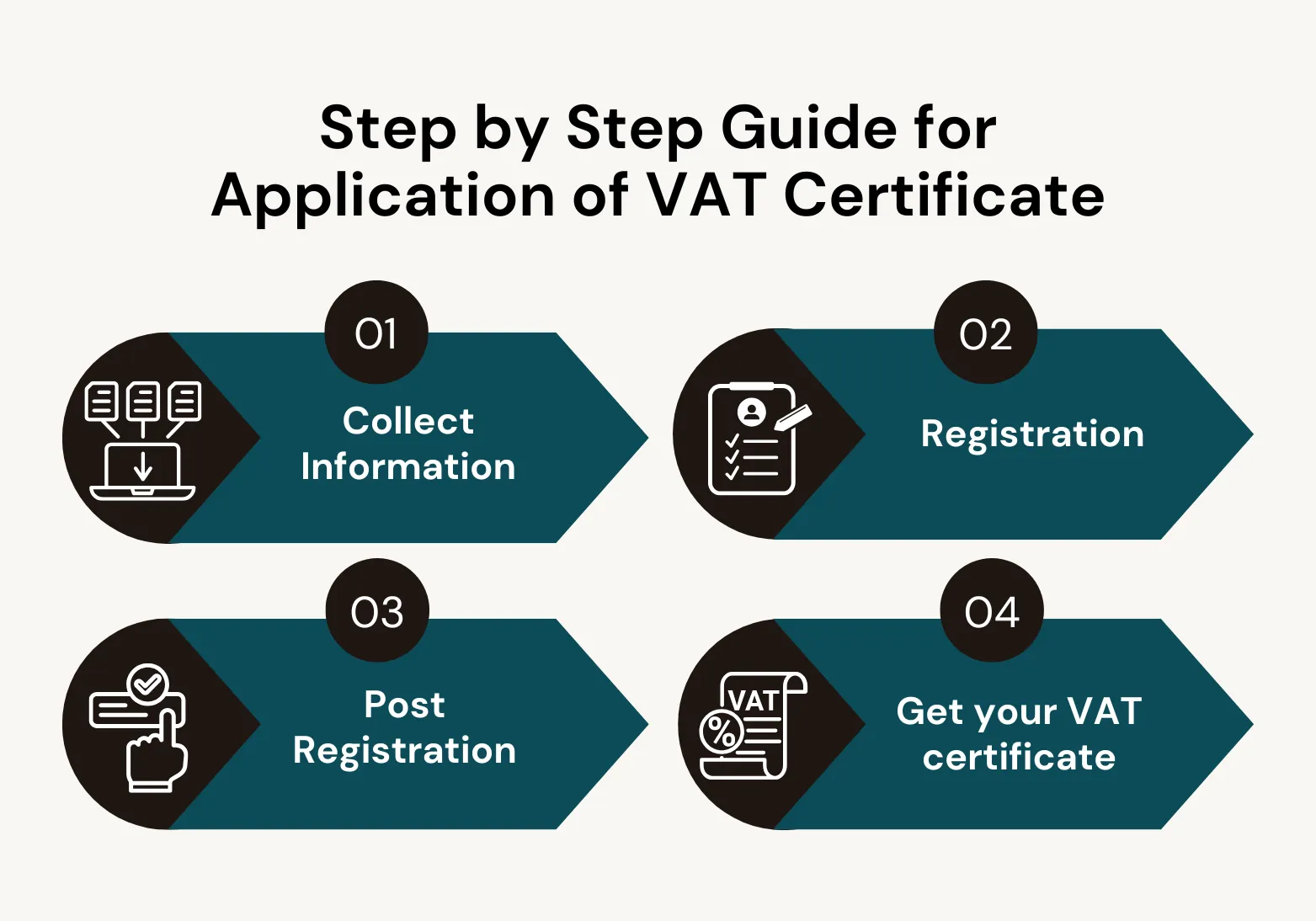
Step 2: Registration
Register online
After you have the information, you have to register on the HMRC website. Here you’ll need
- Government gateway user ID
- password
You then fill out the forms as required for your company.
Registration by Post
There are some cases in which you cannot apply online. For them, the registration will be done by post. Some of these cases are:
- If you need a registration exception. This application may be because your turnover is temporarily above the value of £90,000.
- If you have to register different divisions of your business for different VAT registration numbers separately.
- If you have to register an overseas partnership
Registration through agent
You can apply for registration using accountant services. Your VAT returns will be submitted by them. They will also deal with HMRC. Getting your HMRC VAT certificate is their job.
Contact us for VAT registration.
Step 3: Post Registration
After registering, you’ll get the following by post:
- A VAT registration number that has 9 digits (to be mentioned on all invoices)
- Instructions to set up your account
- Information about submission of first VAT return and payment
- Registration date confirmation
Step 4: Get your VAT certificate
Once you receive the VAT registration number, do this:
- Sign in to the account of Government Getaway.
- Select the options of “Add a Tax, Duty, or Scheme”. Access the MTD enrolment option.
- An option about viewing your VAT account is present here. Choose this.
- Now choose “Manage your VAT”.
- Here, you’ll see an option. It allows you to view your VAT certificate. Choose that.
Keeping VAT registration up to date
You must keep your information up to date. If changes happen, HMRC should be informed in 30 days.
These changes can include
- Contact details of business
- Details of bank
- Information such as the name of the business
- Dates of return
If you don’t change your VAT registering information by the due date, you may have to pay fines and fees. It depends on the situation, the fine for registering late can be anywhere from 0% to 100%.
Fines apply in failure of opposite two. This means that VAT registration should be called off in 30 days of returns falling below the required value.
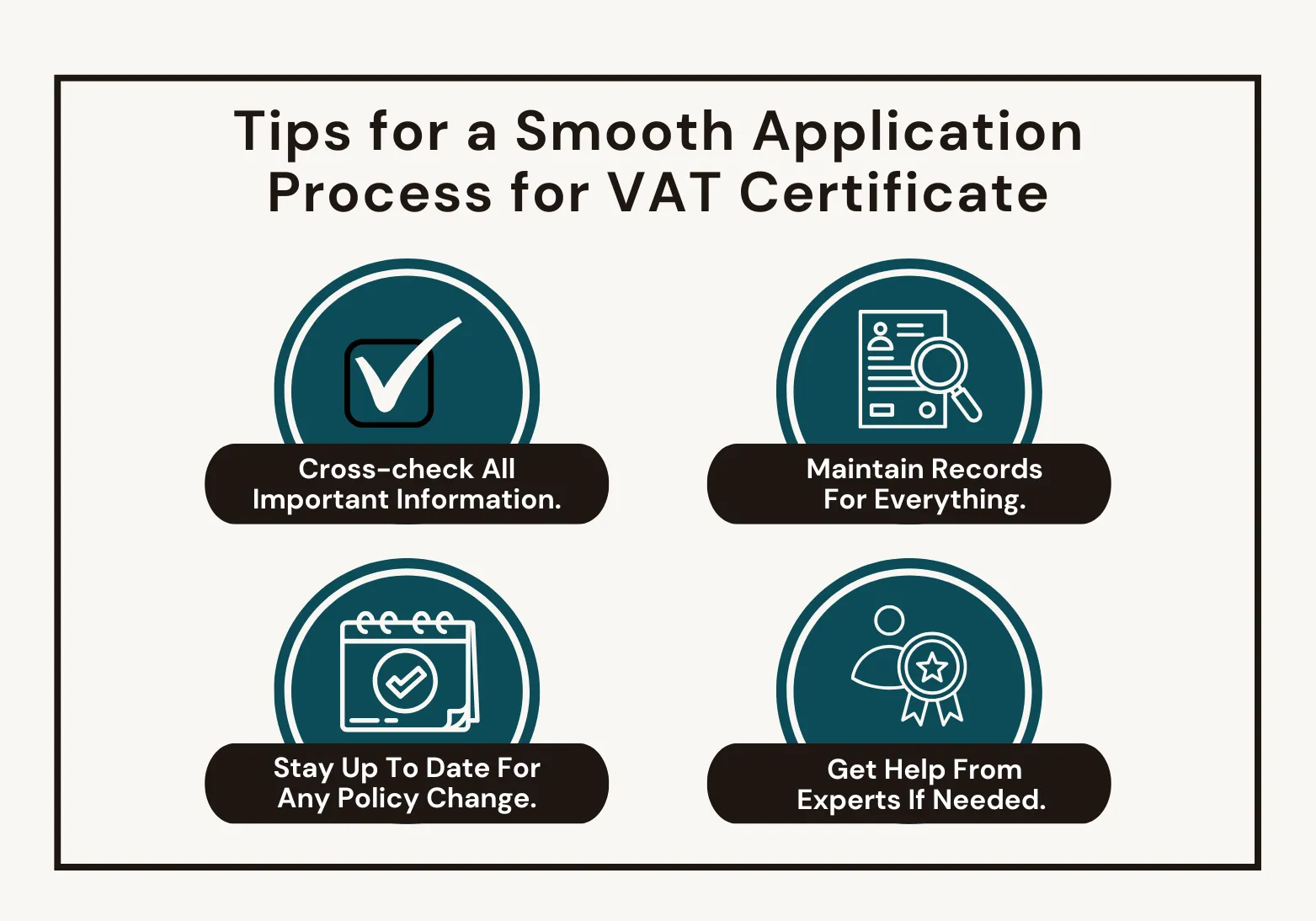
Tips for a smooth application process
You can follow these tips to ensure your application for the certificate is a smooth process.
- Cross-check all important information.
- Maintain records for everything
- Stay up to date for any policy change.
- Get help from experts if needed.
Contact Sterling Cooper Consultants for expert advice
VAT registration can be tricky. Whether you have an established company or you are just starting, get advice from us. We, at Sterling Cooper Consultation Limited, are aware of the importance of this important document.
We offer you practical advice on getting your registration and certificate. So, for all your VAT-related queries, contact us now!
Need help with VAT registration?
Sterling Cooper Consultants Limited offers professional guidance to make the VAT certificate process easy and hassle-free. Whether you’re registering for the first time or updating details, our experts are here to assist you.
FAQs
Can VAT registration be canceled?
Yes, if the turnover of your company falls below the threshold value.
Is a VAT certificate needed for international trade?
Yes, you need a VAT certificate to trade internationally.
How to check if VAT certificates are valid?
For this, you should go to the VIES website. Enter the VAT number of the business to be verified. Choose the country code. (GB for the UK). Select Verify.
Will my accountant be able to see my VAT certificate?
Provide the ‘agent authority’ on your account. The accountant will be able to see that after this.
If I am in another country, can a VAT refund be claimed from there?
For this, you need more proof than a VAT certificate. Contact HMRC. Request a “Vat Certificate of Status” from them.
Share This Article!
Recent Posts
edit post
Budget vs Actual Reporting Explained
July 13, 2026
edit post
Why Cash Flow Problems Cause Profitable Businesses to Fail
July 9, 2026
edit post
Tax-Free Benefits Directors Can Claim
July 8, 2026