Category: blogs

  • Final Accounts: A Complete Guide for UK Businesses

    Final Accounts: A Complete Guide for UK Businesses

    final accounts

    Final Accounts: A Complete Guide for UK Businesses

    Every business needs a clear picture of its financial position. You need to know how much money your business has earned, what it owns, what it owes and how much profit it has made. But how do you bring all this information together and make sure your business meets its legal reporting duties? This is where final accounts play an important role.

    Final accounts bring together your financial records for a particular period. They help you understand your business’s performance, prepare financial statements and meet relevant reporting requirements.

    This guide explains what final accounts include, how UK accounting periods work, which businesses need to prepare accounts and how to prepare and file them correctly. You will also learn about filing deadlines, late filing penalties, common accounting mistakes and how professional support can help.

    Key Takeaways

    • Final accounts summarise a business’s financial performance and position at the end of an accounting period.
    • A company’s financial year is usually 12 months, although its first accounts can cover a longer period.
    • The accounting period for Corporation Tax cannot exceed 12 months and may differ from the period covered by annual accounts.
    • Company accounts usually include a profit and loss account, a balance sheet and notes to the accounts.
    • Most UK private limited companies must file annual accounts with Companies House within nine months of their financial year-end. Public limited companies generally have six months.
    • A Company Tax Return has a separate deadline, usually 12 months after the end of the Corporation Tax accounting period.
    • Keeping accurate records and understanding your deadlines can help you avoid errors and late filing penalties.

    What Are Final Accounts?

    Final accounts are financial statements prepared at the end of an accounting period. They bring together the transactions recorded during that period to show how your business has performed and what it owns and owes.
    Final accounts serve two important purposes. First, they help you understand your business’s financial performance and make informed decisions. Second, they provide financial information for shareholders, Companies House, HM Revenue and Customs (HMRC) and other relevant parties.
    For many UK limited companies, the main financial statements include a profit and loss account, a balance sheet and notes to the accounts. A directors’ report and an auditor’s report may also be required, depending on the company’s size and circumstances.

    What Is an Accounting Period in the UK?

    An accounting period is the period covered by a set of financial records or accounts. However, the exact meaning depends on the type of accounts being prepared.
    For a UK limited company, the financial year used to prepare annual accounts is usually a 12-month period. It is determined by the company’s accounting reference date, which sets the date on which its financial year ends.
    For an existing company, the next financial year normally begins the day after the previous one ends. A new company starts its first financial year on the date it is incorporated. For example, if a company’s financial year ends on 31 December, its next financial year will normally run from 1 January to 31 December.
    A company’s first annual accounts may cover more than 12 months. This is because the period starts on the date the company is incorporated and ends on its first accounting reference date. In the usual statutory framework, the first accounting reference period can be longer than 12 months, up to a maximum of 18 months.
    The Corporation Tax accounting period is different. It is the period covered by a Company’s Tax Return and cannot be longer than 12 months. It will usually match the company’s financial year, but this is not always the case. If the first annual accounts cover more than 12 months, the company may need to submit two Company Tax Returns to cover the same overall period.
    Understanding this difference is important because the deadlines for filing annual accounts, submitting a Company Tax Return and paying Corporation Tax are not necessarily the same.

    5 Final Accounts UK Businesses Should Know

    Final accounts typically include several key financial statements and reports, depending on the size and type of business. These are the five main components to understand.

    1. Profit and Loss Account

    The profit and loss account, often called the P&L, shows your company’s financial performance over an accounting period. It records income and relevant expenses to show whether your business has made a profit or a loss.
    For example, a company may have £500,000 in sales but £420,000 in allowable business costs and other expenses. Its accounts help show the resulting profit after the relevant accounting adjustments.
    Reviewing your P&L can help you understand your income, monitor spending and identify areas where you may need to make changes.

    2. Balance Sheet

    The balance sheet provides a snapshot of your company’s financial position on a specific date, usually at the end of its financial year. It shows the business’s assets, liabilities and shareholders’ funds.
    Assets may include cash, stock, equipment, property and amounts customers owe your company. Liabilities can include loans, unpaid bills and other amounts your business owes.
    The balance sheet is particularly useful when assessing your business’s financial position. A company can report a profit but still experience cash flow problems, so looking at the P&L alone does not give you the full picture.

    3. Notes to the Accounts

    Notes to the accounts explain important details behind the figures in your financial statements.
    For example, your balance sheet may show the total value of the equipment your business owns. The notes may explain how that equipment has been valued and how depreciation has been calculated.
    Depending on the applicable reporting requirements, the notes may also cover accounting policies, fixed assets, loans, share capital, creditors and other relevant information.
    These details help readers understand how the figures have been calculated and what they represent.

    4. Directors’ Report

    A directors’ report provides information about the company and its directors where required. The reporting requirements depend on the company’s size and circumstances.
    Some smaller companies can benefit from exemptions. For example, certain companies may not need to deliver a directors’ report to Companies House, even where other reporting requirements apply.
    Companies House has also announced changes to corporate reporting requirements planned to take effect from April 2028. These include requiring small companies and micro-entities to file profit and loss accounts, with an option to opt out of publishing this information on the public register. The reforms will also require companies to use commercial software to file their accounts.
    If you run a small company, keep up to date with these changes so you can prepare for the new requirements.

    5. Auditor’s Report

    An auditor’s report gives an independent auditor’s opinion on a company’s financial statements where an audit is required.
    However, not every UK company needs an audit. Many companies that qualify as small can claim audit exemption, subject to the relevant rules and exclusions.
    You should check whether your company qualifies for an exemption rather than assuming an audit is unnecessary because your business is small.

    Which Businesses Need to Prepare Final Accounts?

    The need to prepare and file accounts depends on your business structure and the rules that apply to it. Different requirements apply to limited companies, partnerships and sole traders.
    Here are the main business types and what you need to know.

    Private Limited Companies

    UK private limited companies generally need to prepare annual statutory accounts and deliver them to Companies House, even if they have made a loss or had little trading activity.
    Your accounts must meet the legal requirements that apply to your company. Depending on its size, your company may qualify for certain reporting exemptions or be able to use simpler accounts.
    Directors remain responsible for ensuring that the company’s accounts are properly prepared and filed on time. They can appoint an accountant to help with this work, but they retain their legal responsibilities.

    Limited Liability Partnerships (LLPs)

    Limited Liability Partnerships also have annual accounting responsibilities. LLPs generally need to prepare and file annual accounts with Companies House, including when they are dormant.
    The accounts usually include a profit and loss account, a balance sheet and notes, with other reports required where applicable. LLP members have legal responsibilities for ensuring that the accounts are properly prepared and filed.

    Sole Traders and Ordinary Partnerships

    Sole traders and ordinary partnerships also need to keep accurate financial records and work out their business income and expenses.
    Their year-end accounts can help them calculate taxable profits and complete the relevant tax returns. However, sole traders and ordinary partnerships do not generally file annual accounts with Companies House in the same way as limited companies and LLPs.
    The exact records and tax reporting requirements depend on the business structure and the rules that apply to it.

    Dormant Companies

    Being dormant does not automatically mean there is nothing to file.
    A company that is dormant for Companies House purposes generally still needs to file annual accounts and a confirmation statement. Dormant companies may qualify to file simpler accounts if they meet the relevant conditions.
    If your company has stopped trading, check which filing requirements still apply. You should not assume that you can stop submitting accounts simply because the business is inactive.

    Community Interest Companies (CICs)

    Community Interest Companies have additional reporting responsibilities.
    A CIC must prepare and deliver accounts to Companies House. It must also file a CIC report, known as CIC34, which explains how the company has used its assets to benefit the community.
    If you operate a CIC, make sure you understand these additional requirements alongside your usual accounting and filing responsibilities.

    How to Prepare Final Accounts in the UK

    Preparing your accounts becomes easier when you follow a clear process. The aim is to make sure your financial records are complete, your figures are accurate and your business meets its reporting duties.
    Here are four practical steps to follow.

    Step 1: Gather Your Financial Records

    Start by collecting the records for the full accounting period. These will normally include:

    • Bank statements
    • Sales invoices
    • Purchase invoices and receipts
    • Payroll information
    • Loan statements
    • Asset records
    • VAT records
    • Details of money owed to or by the business

    Having these records ready makes it easier to check your figures and identify missing information.
    You should also review your bookkeeping before preparing the accounts. Missing transactions or incorrect classifications can affect both your financial statements and your tax calculations.

    Step 2: Review and Adjust the Accounts

    Once your records are complete, your accounts can be prepared.
    At this stage, an accountant will usually review the trial balance and make appropriate year-end adjustments. These may include:

    • Accruals: Expenses that relate to the accounting period but have not yet been paid or invoiced.
    • Prepayments: Payments made in advance for goods or services that relate to a future accounting period.
    • Depreciation: The allocation of the cost of a fixed asset over its useful life.
    • Stock adjustments: Changes needed to reflect the value of stock held at the end of the period, where relevant.

    The correct accounting framework and company size must also be considered. These factors affect how your accounts should be prepared and which reporting requirements apply.

    Step 3: Prepare and File Your Annual Accounts

    Once the accounts have been prepared and approved, the relevant accounts are delivered to Companies House if your business is required to file them.
    For most private companies, subsequent annual accounts are due nine months after the end of the accounting reference period. Public companies generally have six months.
    The deadline for first accounts can be different, particularly if they cover more than 12 months. For example, a private company’s first accounts covering more than 12 months are generally due within 21 months of incorporation or three months after the accounting reference date, whichever is later.
    Check your company’s specific deadline and allow enough time to review the accounts before filing. Companies House must receive acceptable accounts by the deadline. Simply sending them before the deadline does not guarantee they will be accepted on time.

    Step 4: Submit Your Company Tax Return

    Companies normally also need to submit a Company Tax Return to HMRC when required to do so.
    The CT600 is the form used to report your company’s Corporation Tax position. The return is supported by the relevant accounts and tax computations.
    The normal deadline for filing a Company Tax Return is 12 months after the end of the Corporation Tax accounting period.

    Remember:
    A company can have one deadline for paying Corporation Tax and a later deadline for filing its CT600. Missing one deadline does not automatically mean the other deadline has also passed.

    For many companies that are not required to pay Corporation Tax by instalments, payment is due nine months and one day after the end of the accounting period. Different payment rules can apply, including to some larger companies.

    Make sure you track these obligations separately so you do not overlook a payment or filing deadline.

    Final Accounts Filing Deadlines in the UK

    Meeting your filing deadlines helps you avoid penalties and keeps your business compliant with UK rules.

    However, the deadline for filing annual accounts with Companies House is different from the deadlines for submitting your Company Tax Return and paying Corporation Tax to HMRC. Understanding these differences helps you plan ahead and avoid unnecessary problems.

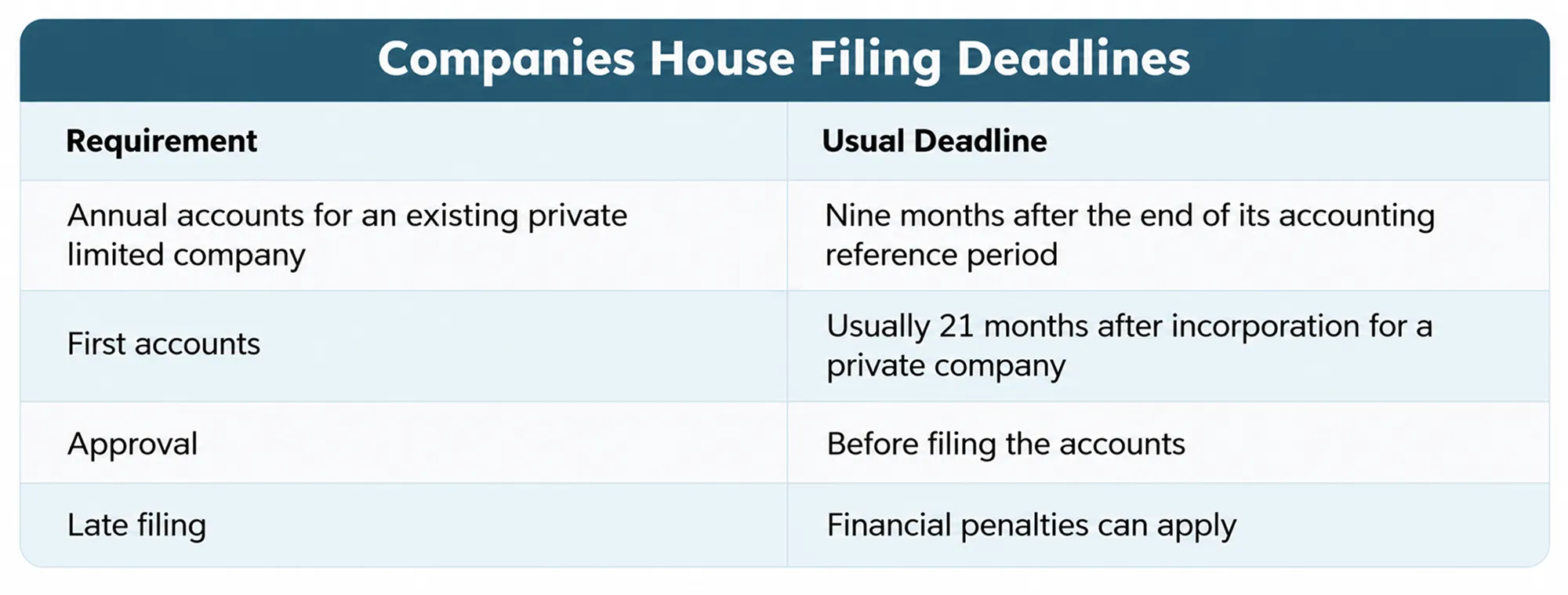
    Companies House Filing Deadlines

    The deadline depends on your business structure and whether you are filing your first accounts or subsequent accounts.
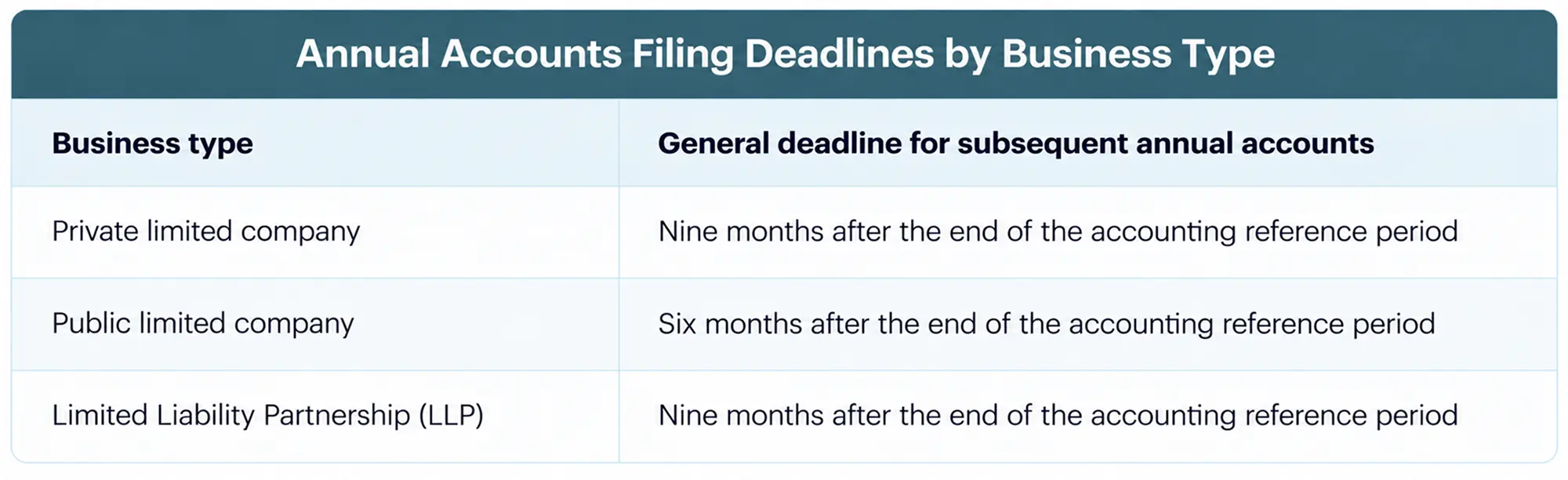
     

    account filing deadlines

    First accounts may have different deadlines, particularly when they cover more than 12 months. Changes to a company’s accounting reference date can also affect its filing deadline.

    For example, if a private company’s financial year ends on 31 December, its annual accounts would normally be due by 30 September of the following year.

    Check your company’s specific deadline rather than relying only on the general rule.

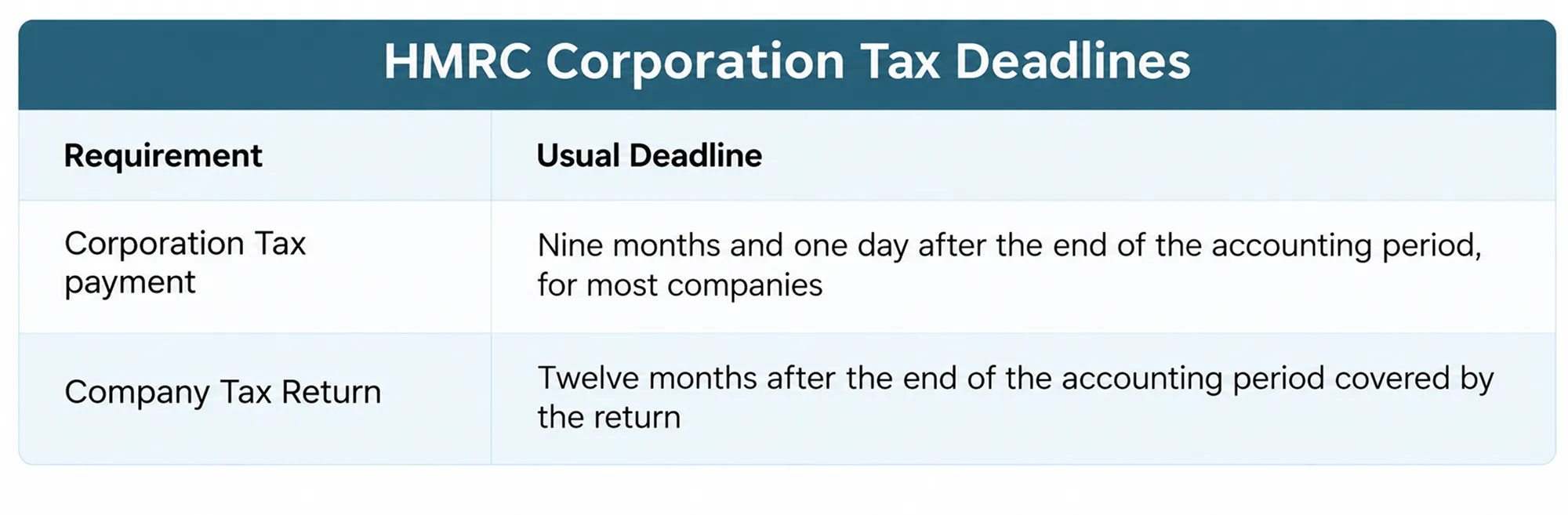
    Company Tax Return and Corporation Tax Deadlines

    Companies also need to keep track of their Corporation Tax obligations.
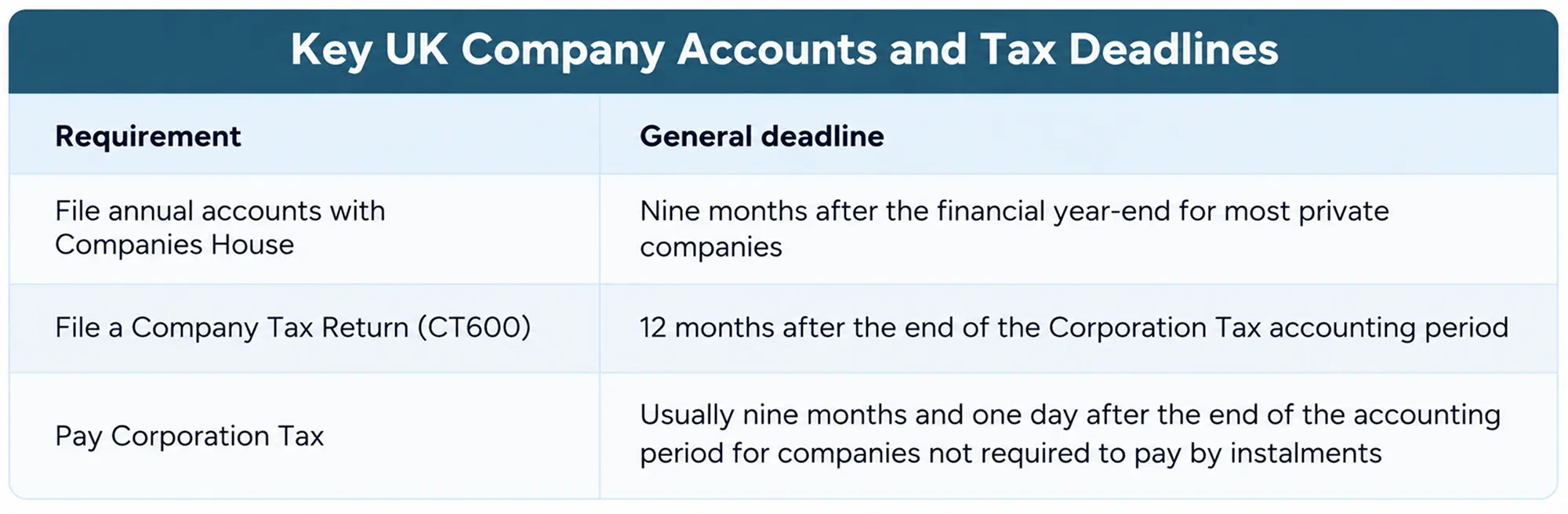
     

    uk company account tax deadlines

    These deadlines are general rules. The exact dates can vary, particularly in a company’s first year or when its financial year and Corporation Tax accounting period do not match.

    Late Filing Penalties

    Missing the filing deadline can result in an automatic late-filing penalty. The following table shows the penalties for private companies and LLPs under current Companies House guidance.
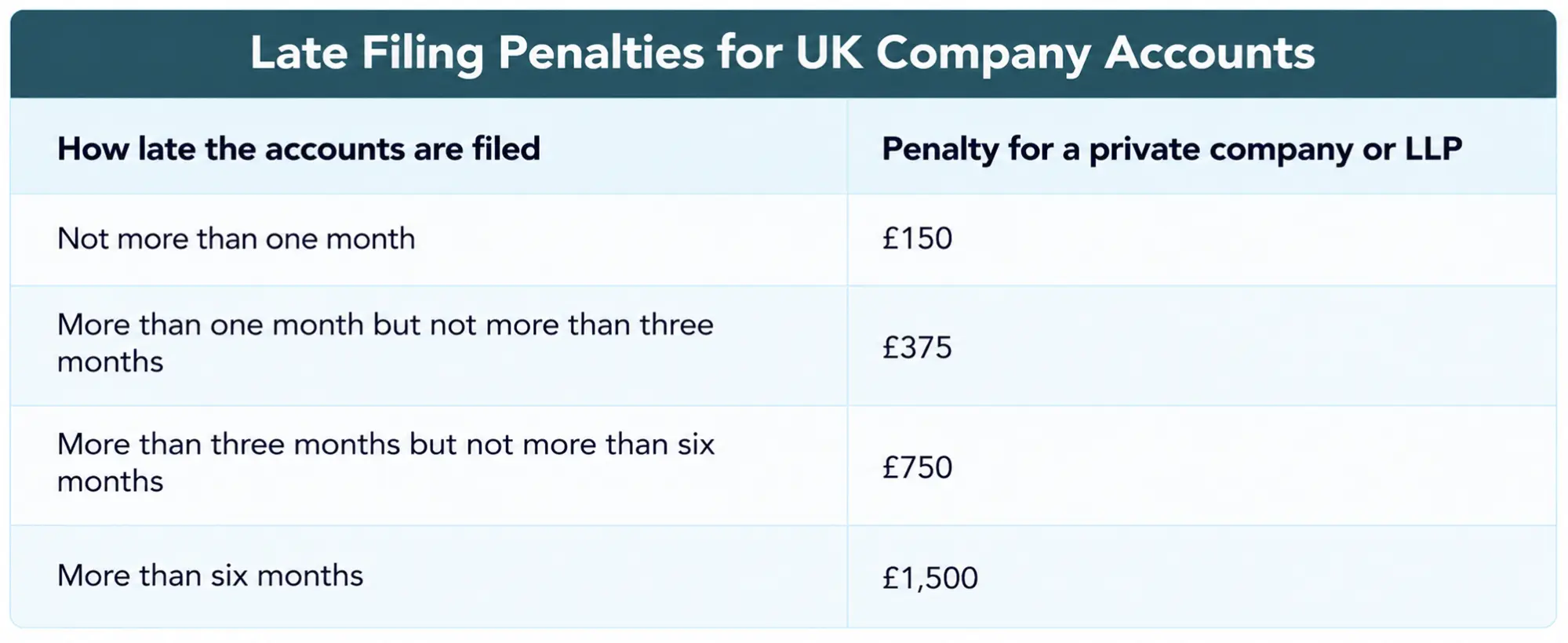
    late tax filing penalties Public companies face higher penalties. For example, a public company that files its accounts more than six months late can face a £7,500 penalty.
    If accounts are filed late in two successive financial years, the penalty is doubled.
    To reduce the risk of penalties, keep a record of your filing dates and start preparing your accounts well before the deadline. If an unexpected event may prevent you from filing on time, you may be able to apply for an extension. You must do so before the deadline, and an extension is granted only in exceptional circumstances.

    Common Mistakes to Avoid When Preparing Final Accounts

    Small accounting errors can create bigger problems at year-end. A careful review can prevent many of them.
    Here are three common mistakes to avoid.

    1. Failing to Reconcile Accounts

    One common mistake is failing to reconcile balance sheet accounts.
    You should check bank balances, loans, VAT accounts, payroll balances, customer debts and supplier balances against the supporting records.
    Reconciliation helps you identify missing transactions, incorrect balances and other discrepancies before the accounts are finalised.

    2. Missing Accruals and Prepayments

    Missing unpaid expenses, known as accruals, or costs paid in advance, known as prepayments, can make your year-end profit and liabilities inaccurate.
    Check that expenses such as wages, pensions, bonuses and holiday pay are recorded in the correct accounting period.
    Getting these adjustments right helps ensure that your accounts give a more accurate picture of your company’s financial performance.

    3. Misclassifying Transactions

    Another common issue is recording transactions in the wrong account.
    For example, an asset purchase should not automatically be treated as an ordinary business expense. Similarly, personal spending should not be mixed with company transactions.
    Good bookkeeping throughout the year makes the year-end process much easier. Keeping your records up to date also helps you identify errors before they become more difficult to resolve.

    Can Accounting Software Help You Prepare Final Accounts?

    Accounting software can make it easier to organise financial records, track transactions and prepare information for year-end accounts.
    Common software used by UK businesses includes Sage, Xero and QuickBooks. The right option depends on the size and needs of your business.
    Some software also supports year-end accounts preparation and tax reporting. These tools can help you organise trial balances, journals and other accounting data.
    However, accounting software does not remove the need for professional judgement. Your records still need to be accurate, adjustments must be appropriate and the accounts must meet the reporting requirements that apply to your business.
    If you are unsure whether your accounts are complete or correctly prepared, professional support can help you identify potential issues before filing.

    How Sterling Cooper Can Help With Your Final Accounts

    Preparing final accounts can be challenging when bookkeeping is incomplete, deadlines are approaching and tax calculations need careful review. Professional support can make the process more straightforward and help you avoid common accounting errors.
    At Sterling Cooper, we support you throughout the final accounts process, from reviewing your financial records and preparing accurate accounts to helping you manage the relevant filing requirements. Our aim is to provide a clear picture of your business’s financial position while helping you stay on top of your UK reporting obligations.
    With well-prepared accounts and the right support, you can manage your year-end responsibilities with greater confidence and spend more time focusing on running your business.

    Protect your business from costly accounting errors and missed deadlines with expertly prepared final accounts. Contact us today for accurate, compliant accounts and complete peace of mind.


    +443300102526
    Book an Appointment

    FAQs


    What Are Final Accounts?


    Final accounts are financial statements prepared at the end of an accounting period. They show a business’s financial performance and position, helping owners understand their finances and meet relevant reporting requirements.


    A company’s financial year is usually 12 months. Its first annual accounts can cover more than 12 months, up to 18 months in the usual statutory framework. However, a Corporation Tax accounting period cannot exceed 12 months. This means the period covered by annual accounts may differ from the period covered by a Company Tax Return.


    For most private companies, subsequent annual accounts are due nine months after the end of the financial year. First accounts can have a different deadline, so you should check your company’s specific filing date.


    Yes. A dormant company generally still needs to file annual accounts and a confirmation statement with Companies House. It may qualify to file simpler accounts if it meets the relevant conditions.


    A CT600 is the form a company uses to submit its Company Tax Return to HMRC. It reports the company’s Corporation Tax position and is supported by the relevant accounts and tax computations.


    For many companies that are not required to pay Corporation Tax by instalments, payment is due nine months and one day after the end of the Corporation Tax accounting period. Different rules apply to some larger companies, so check the deadline that applies to your business.


    Yes. An accountant can prepare and submit accounts on behalf of a company where the appropriate arrangements and filing methods are in place. However, the directors remain legally responsible for ensuring that the company’s accounts are properly prepared and filed on time.
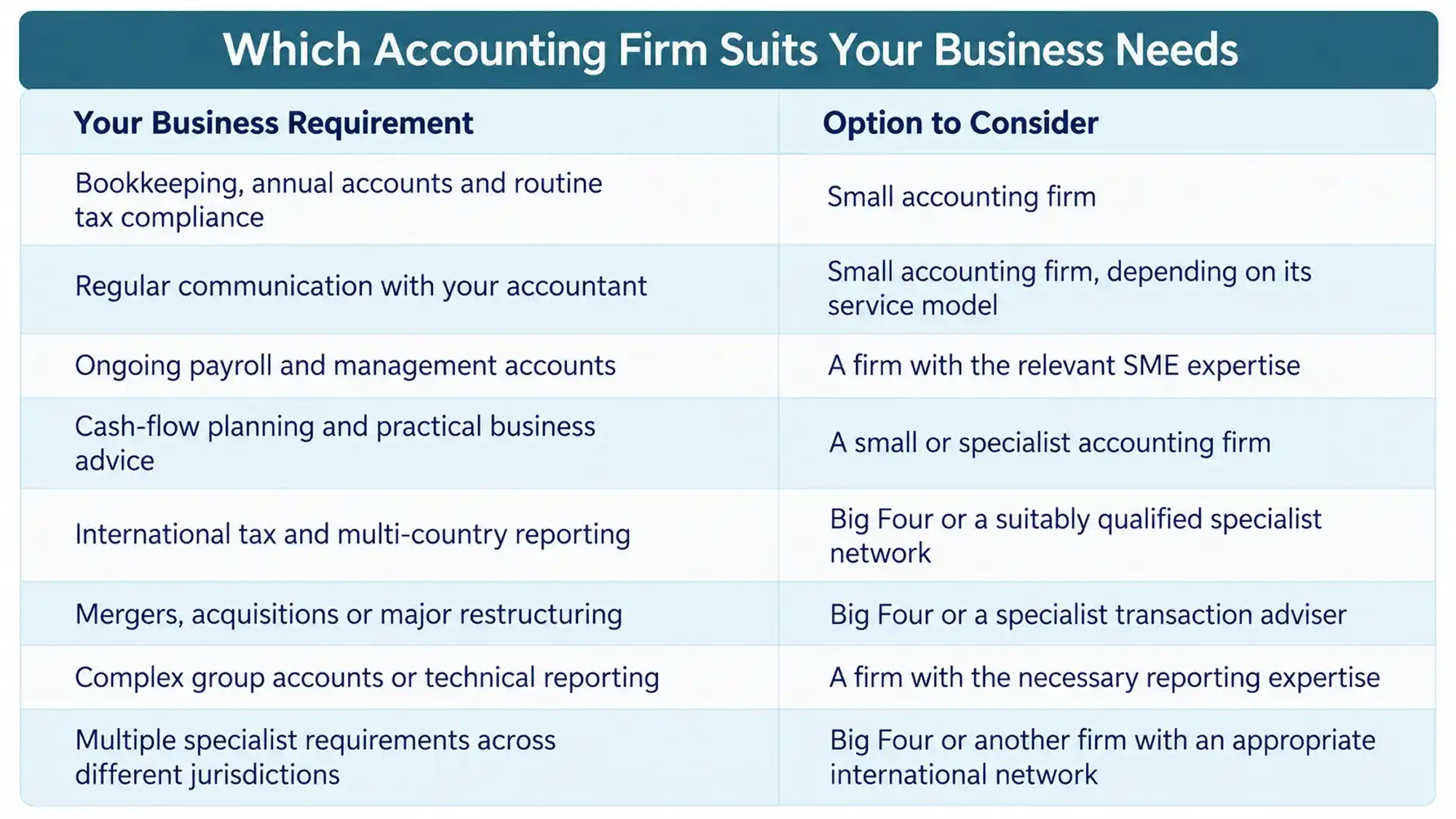
  • How to Choose the Right Accounting Firm for Your Business

    How to Choose the Right Accounting Firm for Your Business

    How to Choose the Right Accounting Firm for Your Business

    How to Choose the Right Accounting Firm for Your Business

    As a business owner, you might be overseeing every aspect of your business operations, including your finances. However, when it comes to managing your books and taxes, professional support can make a significant difference.

    Choosing an accountant is an important decision for any business. The right firm can help you manage your accounts, meet tax deadlines and understand what your numbers are telling you. The wrong choice can lead to poor communication, unexpected fees or advice that does not fit your business.

    This matters because most small businesses already rely on professional support for their tax affairs. HMRC’s 2025 Agents, Small and Mid-Sized Businesses Customer Survey found that 73% of small businesses had used a tax agent or external accountant in the previous 12 months. Of those businesses, 92% were satisfied with the support and advice they received.

    So, how do you choose an accounting firm that is right for your business rather than simply choosing the first one you find?

    This guide explains what to look for when comparing accounting firms, from professional qualifications and industry experience to accountancy services, fees, technology and the level of business advice you can expect.

    Key Takeaways

    Before comparing firms, it helps to know which factors matter most. Keep these points in mind as you assess your options:

    • Check the firm’s qualifications, experience and professional membership.
    • Choose an accounting firm that understands your industry and business structure.
    • Compare the full range of accountancy services rather than looking at price alone.
    • Ask how the firm uses accounting software and supports Making Tax Digital.
    • Find out who will manage your account and how you will communicate.
    • Check what is included in the fees and what will cost extra.
    • Choose an accountant who can provide useful financial advice as your business grows.

    Why Choosing the Right Accounting Firm Matters

    An accountant can become an important part of your business support network, rather than simply the person who prepares your accounts once a year.

    ICAEW advises small businesses to consider more than basic charges when choosing an accountant. It recommends discussing the scope of your needs, communication frequency and turnaround times during the initial consultation.

    This matters because accounting firms can offer very different levels of service.

    One firm may only prepare annual accounts and tax returns. Another may provide bookkeeping, payroll, VAT, management accounts, forecasting and business planning.

    The cheapest option may therefore not be the best fit. The better question is whether the firm provides the services, expertise and support your business actually needs.

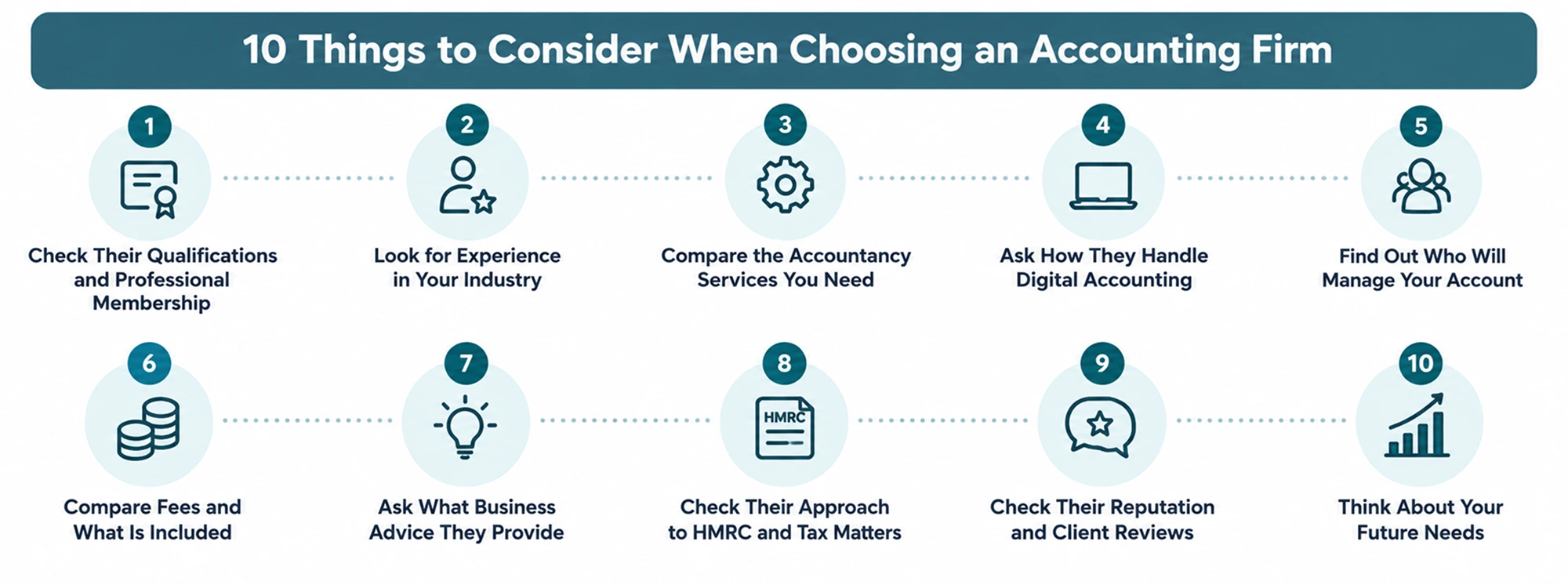
    10 Things to Consider When Choosing an Accounting Firm

    Choosing an accounting firm involves more than comparing prices. The firm’s qualifications, experience, services and approach to client support can all affect the value you receive. Use these 10 factors to compare your options and identify a firm that fits both your current needs and future plans.

    1. Check Their Qualifications and Professional Membership

    A good starting point is to establish whether the firm has the professional credentials and experience you would expect from an accounting provider.

    Look at its qualifications, experience and professional body membership. Professional organisations such as ICAEW and ACCA provide directories that allow businesses to check firms and members.

    ICAEW recommends looking for an accountant with a professional qualification and explains that appointing an ICAEW Chartered Accountant or regulated firm provides qualified and accountable professional support.

    You can also search the official ICAEW directory for a chartered accountant or firm by location and specialist area.

    ACCA also provides a directory of accountancy firms. Its guidance explains that businesses should check a firm’s certificates to understand whether it is regulated by ACCA for specific activities.

    This does not mean you have to choose a firm from one particular professional body. It means you should verify the firm’s credentials and understand what those credentials cover.

    2. Look for Experience in Your Industry

    Professional qualifications are important, but an accountant also needs to understand the commercial realities of your business.

    Different businesses face different financial and tax issues. A construction company may have different VAT and subcontractor requirements from a consultancy. An online retailer may need help with stock, payment platforms and international sales.

    Ask whether the accounting firm already works with businesses similar to yours.

    You can ask:

    • Do you work with businesses in my industry?
    • Do you understand my business structure?
    • Have you supported businesses at a similar stage?
    • Can you help if the business expands?
    • What financial or tax issues do businesses like mine usually face?

    Industry experience can help an accountant understand your problems faster and provide advice that is more relevant to your business.

    3. Compare the Accountancy Services You Need

    Before comparing fees, make sure you understand what support your business actually needs.

    Common accountancy services include:

    • Bookkeeping
    • Annual accounts
    • Self Assessment
    • Corporation Tax
    • VAT returns
    • Payroll
    • Management accounts
    • Cash flow forecasting
    • Budgeting
    • Tax planning
    • Financial forecasting
    • Business planning

    However, not every accounting firm provides all of these services.

    Ask each firm for a clear list of what is included in its package and what would cost extra.

    This can also prevent you from having to change accountants later because the firm cannot provide a service your growing business needs.

    4. Ask How They Handle Digital Accounting

    Technology should also be part of your decision when comparing accounting firms.

    Cloud accounting software can make it easier for you and your accountant to access financial records, keep information up to date and work together.

    This is becoming more important as Making Tax Digital expands.

    From 6 April 2026, sole traders and landlords with qualifying income above £50,000 have had to use Making Tax Digital for Income Tax. The threshold falls to more than £30,000 from April 2027 and more than £20,000 from April 2028.

    Businesses within the rules need compatible software to keep digital records and send quarterly updates to HMRC.

    Therefore, ask a potential accounting firm:

    • Which accounting software do you use?
    • Is the software compatible with Making Tax Digital?
    • Can you help me move from spreadsheets to accounting software?
    • Will you manage my digital records or will I?
    • Can I access my accounts and reports?

    A good firm should be able to explain the process clearly rather than simply telling you which software to buy.

    5. Find Out Who Will Manage Your Account

    This is easy to overlook, but it can have a significant impact on your experience with the firm.

    You may meet a partner or senior accountant during the sales process but later deal mainly with another member of the team.

    Ask who your main contact will be and how the relationship will work.

    You should know:

    • Who prepares your accounts?
    • Who reviews the work?
    • Who answers tax questions?
    • Can you speak directly to a qualified accountant?
    • How quickly does the firm usually respond?

    ICAEW highlights communication frequency and turnaround time as matters worth discussing during your initial consultation.

    A firm can have excellent technical skills but still be frustrating to work with if you cannot get a response when you need one.

    6. Compare Fees and What Is Included

    Once you understand the level of support you need, you can compare fees more fairly.

    Price matters, but it should not be the only thing you compare.

    Two accounting firms may quote very different fees because they offer different levels of service.

    For example, one quote may cover annual accounts and Corporation Tax only. Another may include bookkeeping, VAT returns, payroll and regular management reports.

    Ask each firm to explain:

    • The total fee
    • What accountancy services are included
    • What is charged separately
    • Whether fees are fixed or based on time
    • Whether there are setup costs
    • How often you will be billed
    • What happens if your business needs change

    A clear fee structure makes it easier to compare firms fairly.

    7. Ask What Business Advice They Provide

    Your accountant should be able to help you understand your numbers, not simply record them.

    Ask whether the firm provides advice on cash flow, margins, budgeting, tax planning and business growth.

    This can become more valuable as your business develops.

    A growing business may need an accountant who can help assess whether it can afford to hire staff, invest in equipment, take on finance or expand into a new market.

    That is why it is worth asking what happens after the accounts have been prepared.

    Will the firm explain what the numbers mean and highlight issues that need your attention?

    For a growing business, this kind of financial insight can be just as valuable as getting the compliance work completed.

    8. Check Their Approach to HMRC and Tax Matters

    Tax support is another area where it is useful to understand exactly what an accounting firm will handle for you.

    If your accountant acts as your tax agent, you may authorise them to deal with HMRC on your behalf.

    HMRC’s current guidance explains that authorised agents can perform different tasks depending on the tax service involved, including dealing with Self Assessment and VAT matters.

    Before giving authority, make sure you understand what the accounting firm will handle for you.

    You should also ask how the firm deals with tax enquiries, late filings and changes to your circumstances.

    A professional accountant should be able to explain your responsibilities as well as their own.

    9. Check Their Reputation and Client Reviews

    Once you have narrowed down your options, it is worth looking at what existing or previous clients say about the firm.

    Reviews can give you useful information about how a firm communicates and works with clients.

    However, do not rely on reviews alone.

    Look for client testimonials, professional memberships, years of experience and evidence of the firm’s work. You can also ask for references or speak to another business owner who uses the firm.

    ICAEW recommends asking colleagues and friends for recommendations when looking for an accountant.

    Pay attention to recurring comments about communication, accuracy, responsiveness and the quality of advice.

    10. Think About Your Future Needs

    Finally, consider whether the firm can continue to support you as your business changes.

    The accounting firm you choose today may still be working with you several years from now.

    Your business could move from sole trader to limited company. You may take on employees, register for VAT, need management accounts or start planning for expansion.

    Therefore, ask the firm how it supports growing businesses.

    A useful question is:

    ‘If my business doubles in size over the next few years, how could your services change with it?’

    The answer can tell you whether the firm is thinking about a long-term relationship or simply the immediate compliance work.

    choosing accounting firm

    Case Study: Why the Right Accountant Can Offer More Than Tax Support

    The difference between basic compliance and wider financial support becomes clearer when you look at a real business example.

    Bhangra Blends, a UK ready-to-drink cocktail and mocktail business, provides a useful example of what a growing business may need from an accountant.

    The founders realised they needed more than basic bookkeeping and tax filing. They wanted help understanding cash flow, margins and financial decisions as they built the business.

    Founder Arshia Bhatnagar explained:

    ‘What we really needed was someone who could help us build the financial side of the business like cash flow, understanding our margins properly.’

    The business also needed industry-specific support. When the company experienced a VAT fraud incident involving the misuse of its VAT number, its accountant helped chase the issue with HMRC and provided guidance while it was being resolved.

    The founders also used their accountant for unit economics, cash flow management and investment planning.

    The case demonstrates why choosing an accounting firm should not be based solely on whether it can prepare your annual accounts. For a growing business, the right accountant can become a source of financial insight and practical support.

    10 Questions to Ask Before Hiring an Accounting Firm

    Once you have shortlisted two or three firms, an initial consultation gives you an opportunity to compare what each one actually offers. Rather than focusing only on price, use these questions to understand the firm’s experience, communication, services and ability to support your business as it grows.

    1. What accountancy services are included in your fees?
    2. Do you work with businesses in my industry?
    3. Who will manage my account?
    4. How often will we communicate?
    5. Which accounting software do you use?
    6. Can you support my Making Tax Digital requirements?
    7. Do you provide tax planning and business advice?
    8. How quickly do you normally respond to queries?
    9. What happens if my business grows or changes?
    10. Are there any additional fees I should know about?

    The answers will make it easier to compare accounting firms based on the support you will actually receive, rather than simply comparing headline prices.

    Conclusion

    Choosing the right accounting firm is about finding the right balance between technical expertise, reliable service and useful business advice.

    Start by checking qualifications and experience. Then look at the accountancy services you need, the firm’s approach to technology, communication, fees and future business support.

    The best accountancy firm for your business should understand where you are now and have the skills to support where you want to go.

    Need Help With Your Business Accounts?

    If you are looking for reliable accountancy services covering your business accounts, tax and wider financial needs, the team at Sterling Cooper Consultants can help you find an approach that fits your business.

    FAQs


    Are accounting firms only for large businesses?

    No, accounting firms also work with sole traders, start-ups and small businesses. The level of support can be tailored to the size and needs of the business.

    Yes, many accounting firms provide tax advice alongside their wider accountancy services. However, the services offered vary between firms, so check what is included before hiring one.

    Yes, industry experience can be valuable because different sectors can have different tax, accounting and commercial issues. Ask potential firms which businesses and industries they regularly support.

    No, a higher fee does not automatically mean better service. Compare the firm’s qualifications, experience, services, communication and advice alongside the total cost.

    Yes, an accounting firm can help you prepare for Making Tax Digital and may act as your authorised agent. Businesses that need to use Making Tax Digital for Income Tax must use compatible software to keep digital records and send quarterly updates to HMRC.

    Yes, comparing two or three firms can help you assess their services, fees, experience and communication before making a decision.

    A small business may need bookkeeping, annual accounts, tax returns, VAT, payroll and tax planning. As the business grows, management accounts, cash flow forecasting and wider business advice may also become useful.

    Share This Article!

  • How Much Does an Accountant Cost in the UK?

    How Much Does an Accountant Cost in the UK?

    How Much Does an Accountant Cost in the UK

    Posted by:

    Admin

    Date:

    October 15, 2026

    Category:

    blogs

    Error: Contact form not found.

    How Much Does an Accountant Cost in the UK?

    The cost of an accountant in the UK varies according to the size and structure of your business, the complexity of its finances and the level of support required. A sole trader with simple income and expenses may only need help with an annual self-assessment return, while a growing limited company may require bookkeeping, VAT, payroll, statutory accounts, corporation tax and ongoing financial advice.

    Current market benchmarks suggest that small UK businesses can pay roughly £25–£150 a month for standard accounting support, while more comprehensive work can cost more. In addition, one-off self-assessment services are commonly quoted at around £150–£600, depending on complexity. Remember that these are market benchmarks, not government-set costs.

    In this guide, we explain the typical UK accountant costs, what affects their fees, tax return pricing, costs for specific accounting tasks and how to choose the right accountant for your business.

    In this guide, we explain the typical cost of hiring an accountant in the UK, the factors that influence accounting fees, pricing for common accounting services and how to choose the right accountant for your business needs.

    Key Takeaways

    • There is no fixed UK-wide accountant fee. Accountants set their own prices according to the work involved.
    • Current 2026 market benchmarks put many sole-trader packages at around £39–£89 per month and micro-limited-company packages at around £83–£227 per month.
    • A straightforward self-assessment return may cost around £150–£600, with complex returns potentially costing more.
    • Fixed monthly packages can make accounting costs easier to budget, but businesses should check exactly what is included.
    • The best comparison is total annual cost versus the scope, expertise and support provided, rather than the cheapest headline price.

    How Much Does an Accountant Cost in the UK?

    In the UK, there is no official average accountant fee published by HMRC or Companies House. However, a 2026 benchmark places typical small-business accountant fees at £25–£150 per month, with limited-company packages commonly around £50–£150 per month for specified compliance services. Another 2026 UK benchmark places sole-trader packages at approximately £39–£150 per month and micro-limited-company packages at £83–£227 per month.

    These figures should not be treated as a universal price list. The actual cost can change substantially according to transaction volume, bookkeeping requirements, VAT, payroll, business structure and the level of advice you required. Here are some costs to consider:

    Monthly Fees

    For small businesses, monthly accounting fees can start from £50, depending on the services required. Sole traders may typically pay around £39–£150 per month, while start-up businesses may incur £300–£400. More established businesses with greater accounting needs can expect fees of around £500–£1,000 per month.

    Hourly Rates

    UK accountants commonly charge between £35 and £100 per hour for small business accounting services. However, cost can range from around £15 to £150 or more, depending on the accountant’s experience, specialisation, location and complexity of the work. 

    Tax Return Costs

    The cost of preparing an annual self-assessment tax return typically ranges from £150 to £300. The final fee depends on factors such as the number of income sources, expenses, property income, investments and other tax considerations.

    Other Costs to Consider

    Several factors can influence the overall cost of accounting services. These include the complexity and volume of financial transactions, the number of accounts that need to be managed, the level of bookkeeping required and the accountant’s experience and location.

    What Affects the Cost of an Accountant?

    The cost of an accountant is mainly driven by the complexity of your finances, the volume of your transactions and the scope of the services you require. The following factors can have a significant impact on the final quote.

    Business Structure

    Business structure is one of the first things an accountant will consider. A sole trader generally reports business profits through self-assessment. A private limited company has additional responsibilities, including statutory annual accounts and a company tax return. For a private limited company, annual accounts are normally due at Companies House nine months after the company’s financial year ends, while the company tax return is normally due 12 months after the end of the corporation tax accounting period. That additional compliance work helps explain why limited-company accounting fees are generally higher than simple sole-trader packages.

    Type of Services Required

    Accountants offer a wide range of services, including bookkeeping, payroll, tax returns, VAT, year-end accounts and business advisory support. Some small businesses may only need help with payroll or annual accounts, while others may require a complete accounting package. Many firms therefore use service-based pricing, allowing businesses to pay only for the services they need.

    Frequency of Services

    How often accounting support is required can also affect the overall cost. A business that needs daily or weekly bookkeeping will generally pay more than one that only requires annual accounts and tax returns. Ongoing services such as payroll, VAT returns and regular financial reporting may be charged monthly or quarterly.

    Level of Experience and Specialisation

    An accountant’s experience and specialist knowledge can influence their fees. An accountant with a strong understanding of your industry can provide more relevant tax guidance, financial planning and compliance support. For example, a limited company may benefit from an accountant experienced in Corporation Tax, statutory accounts and company compliance, particularly when the business has more complex financial needs.

    Firm Size and Location

    The size and location of an accounting firm can also influence its pricing. Firms in London and the South East often charge 20% to 30% more due to overhead. Larger firms may charge higher fees because they have larger teams, broader expertise and greater resources. Smaller or local practices may offer more competitive rates and personalised support for small businesses.

    How Much Do Accountants Charge for Self-Assessment Tax Return?

    An accountant will typically charge a one-off fee for preparing and submitting an annual self-assessment tax return, which can range from £150 to £600 or more, depending on the complexity and the level of support you require. However, basic self-assessment services may cost around £200, while returns involving self-employment, property income, investments, capital gains or multiple income streams may require significantly more work.

    How Much Do Accountants Charge for Specific Tasks?

    Accountant fees vary depending on the services you required, the complexity of your finances and the accountant’s experience. The best way to understand how much an accountant will charge for the work you need is to speak with an accountancy firm like Sterling Cooper and request a tailored quote based on your business needs and ongoing requirements.

    Accountants Charge for VAT Returns

    VAT return fees can range from £50 to £200 or more, depending on the size and complexity of the business. A quarterly VAT return with accurate bookkeeping is likely to cost less than one involving high transaction volumes, multiple sales channels or complex VAT treatment. 

    Accountants Charge for Year-End Accounts

    The cost of preparing year-end accounts varies according to the business structure, quality of financial records and level of work required. For sole traders, fees may start at around £300–£1500 or more. For limited company accounts, fees can range from £500 to £3,000 or more, where the service also includes corporation tax returns, Companies House filings, director loan account reviews and salary or dividend planning. 

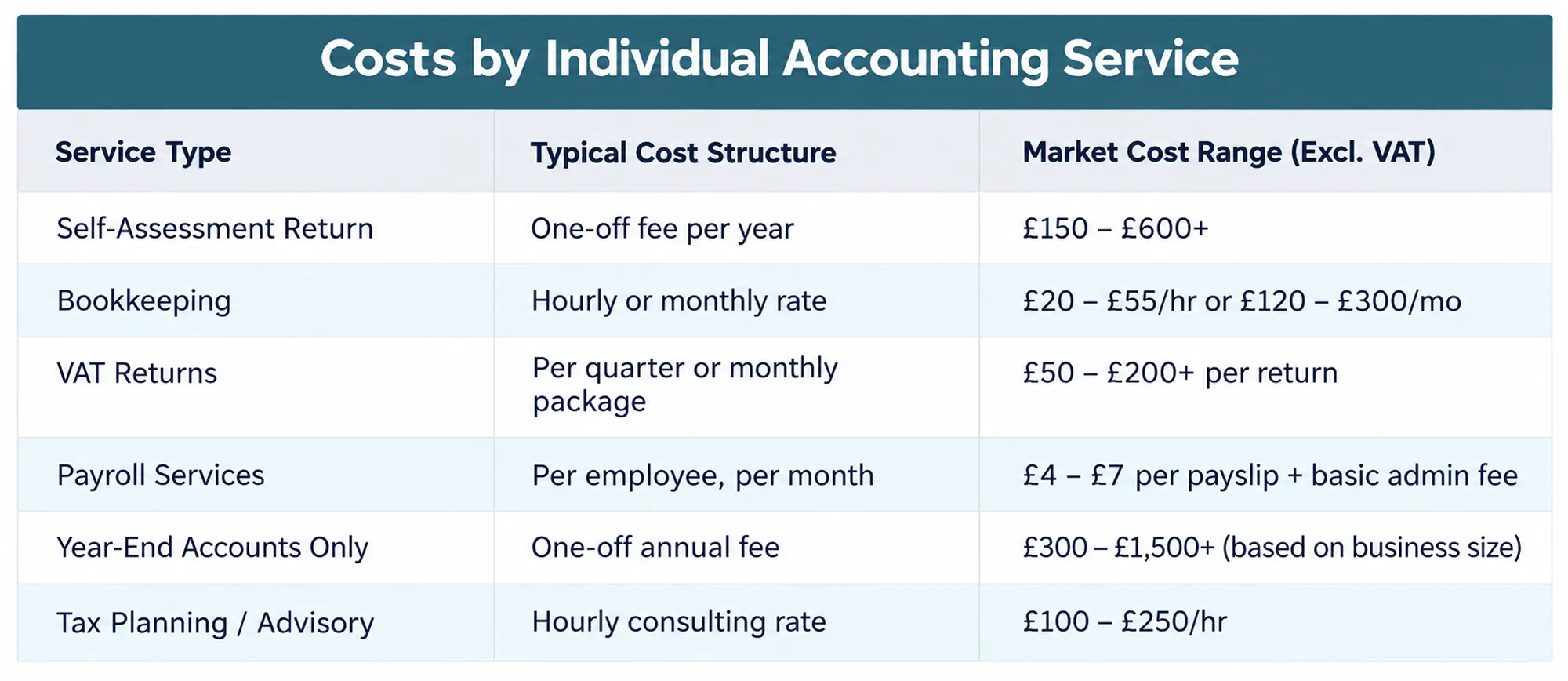
    Costs by Individual Accounting Service

    If you choose a menu-based or one-off billing approach rather than a monthly package, here is what specific individual services cost on average across the UK:

    How to Choose the Right Accountant for Your Business?

    You should look for an accountant who understands your business structure, industry and financial goals. Compare their experience, services, pricing and communication style and check exactly what is included in the quoted fee. A good accountant should not only handle your accounts and tax obligations but also provide practical guidance that supports better financial decisions and sustainable business growth.

    Sterling Cooper as Your Accountancy Firm

    Choosing the right accountancy firm can make managing your finances easier and help your business stay on track. Sterling Cooper provides reliable accounting support tailored to your business needs, from day-to-day financial management to tax planning and compliance. Our experienced team helps you maintain accurate records, meet your financial obligations and make informed decisions with confidence for business growth.
    +443300102526
    Book an Appointment

    FAQs


    How much does an accountant cost for a small business in the UK?


    Current 2026 market benchmarks place many small-business packages somewhere between £25 and £500+ per month.


    A straightforward one-off self-assessment return may cost around £150–£600 based on current 2026 UK market benchmarks.


    Not necessarily. Monthly payments mainly spread the cost and make budgeting easier. The better comparison is the total annual fee and what the package includes.


    Qualifying accountancy costs incurred for business purposes can generally be allowable expenses, subject to the relevant HMRC rules.


    For many UK businesses, it can be. A capable accountant can help a business understand cash flow, margins, tax exposure and financial performance.

    Share This Article!

    Recent Posts

  • What’s the Difference Between Management and Financial Reporting?

    What’s the Difference Between Management and Financial Reporting?

    What the Difference Between Management and Financial Reporting

    Posted by:

    Admin

    Date:

    October 15, 2026

    Category:

    blogs

    Error: Contact form not found.

    What’s the Difference Between Management and Financial Reporting?

    For every successful business, numbers tell a story. However, business owners need to understand which numbers matter and how they should influence decisions. This is where financial reporting and management reporting play important roles.

    Financial reporting presents a business’s financial position and performance. It helps stakeholders assess financial health and understand compliance with reporting requirements. In contrast, management reporting provides internal insights to support better decisions. It helps business owners improve operations, control costs and growth plan.

    For growing UK businesses, understanding the difference between these reporting approaches supports better financial control, informed decisions and a clearer growth strategy.

    Key Takeaways

    • Financial reporting presents a business’s financial results, while management reporting supports internal decision-making.
    • Financial reports serve external stakeholders and internal users, whereas management reports primarily support internal decision-makers.
    • Financial statements follow the applicable accounting framework, while management reports can be tailored to business needs.
    • Management reports can combine financial data with operational insights and forecasts.
    • Using both helps businesses assess financial performance and identify opportunities for improvement.

    What Is Financial Reporting?

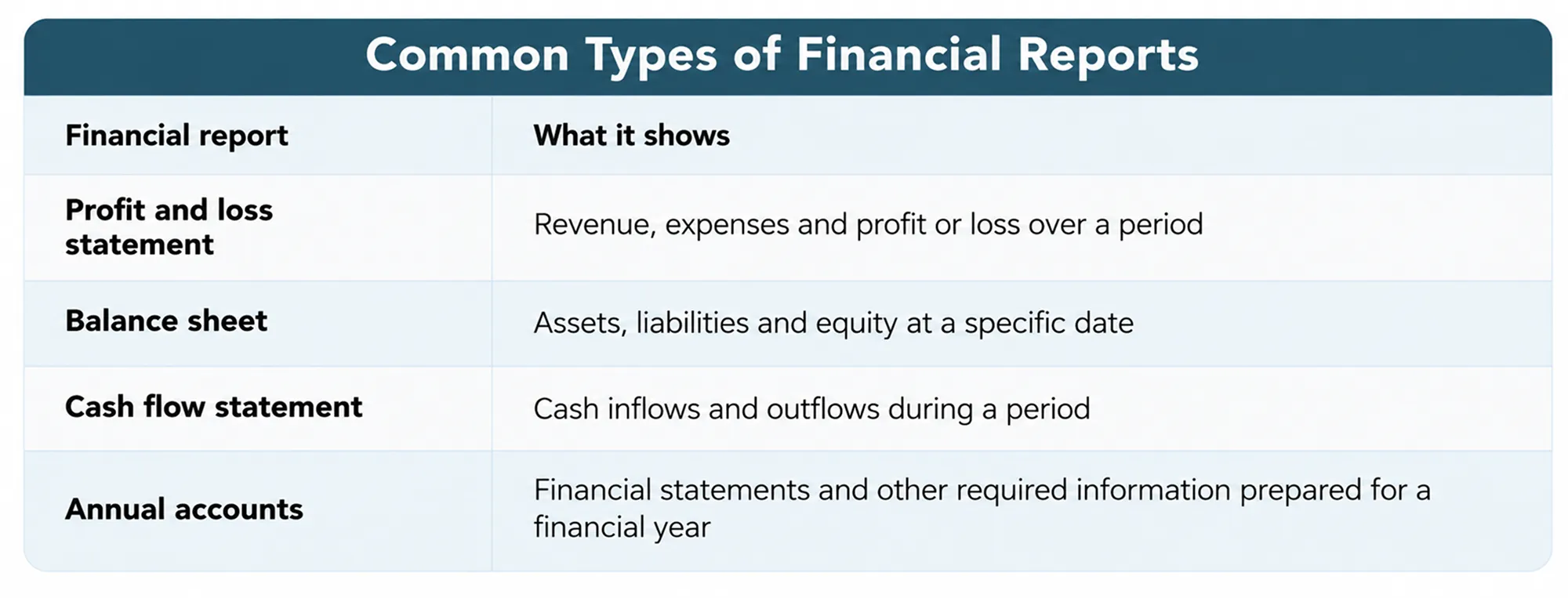
    Financial reporting is the process of preparing financial statements that communicate a company’s financial performance and position over a specific period. The primary purpose of financial reporting is to provide reliable and consistent financial information to stakeholders who need to evaluate the performance, stability and financial strength of a business:

    Common Types of Financial Reports

    What Is Management Reporting?

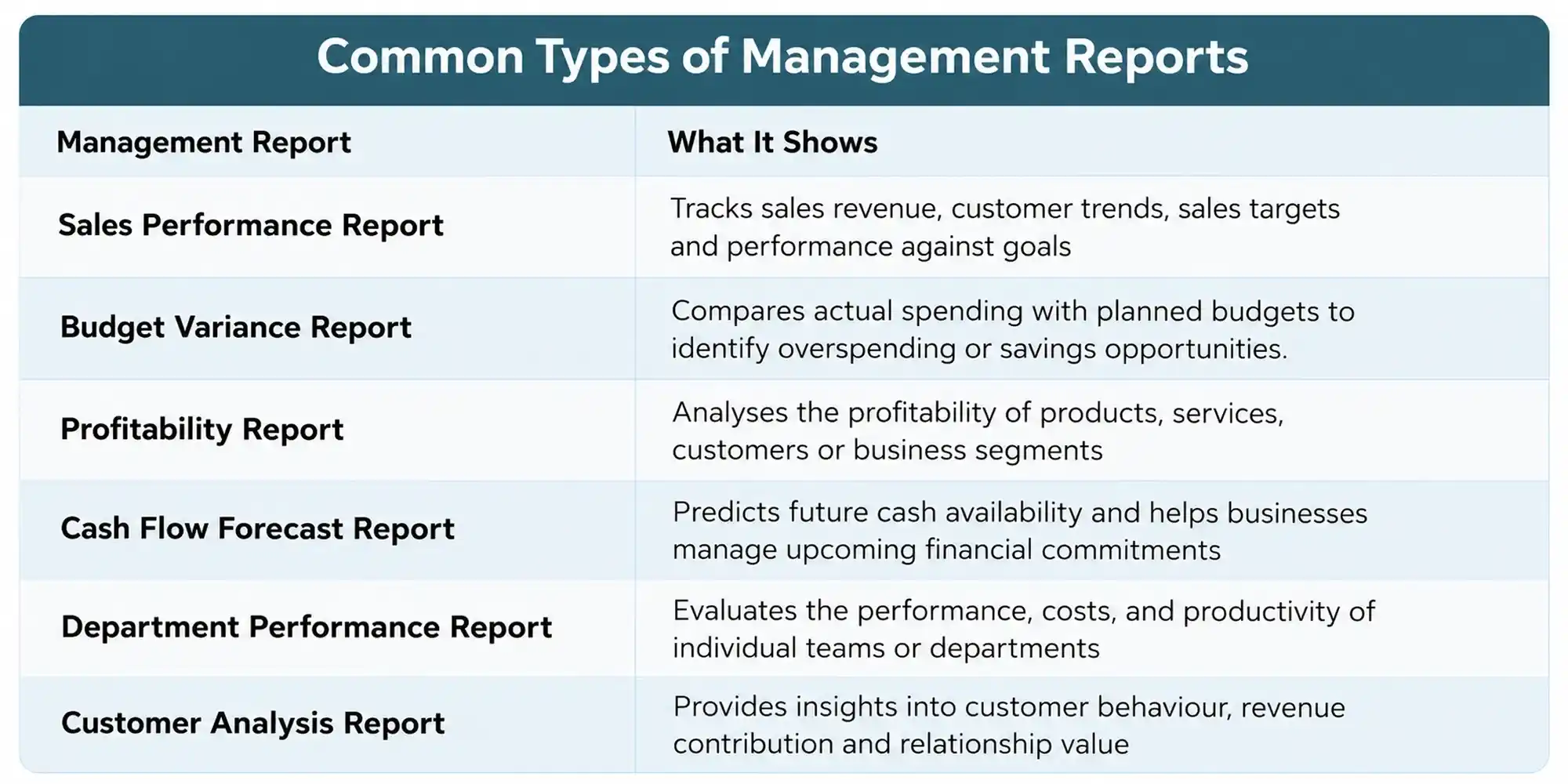
    Management reporting involves preparing internal reports that help business owners and managers plan, monitor operations and make informed decisions. These reports are tailored to the needs of internal decision-makers. Their main purpose is to turn raw business data into meaningful insights:

    Common Types of Management Reports

    These reports help businesses identify underperforming areas, allocate resources effectively and respond to changing conditions.

    Key Differences Between Management and Financial Reporting

    Management reporting and financial reporting both use business data, but they serve different purposes. The key differences relate to their objectives, audiences, reporting focus and use in decision-making:

    Purpose and Objectives

    The main difference between management and financial reporting is their purpose. Financial reporting provides a clear view of a business’s financial position and performance. It helps stakeholders assess its financial health and supports transparency.

    In contrast, management reporting helps internal decision-makers improve business performance. It goes beyond presenting figures by providing explanations and insights that support business decisions.

    Primary Audience

    Another key difference is who uses the information. Financial reports serve both internal and external users, particularly those who need to assess a business’s financial performance. External users include shareholders, investors, banks, lenders and other relevant stakeholders.

    Management reports are primarily prepared for people within the organisation who make business decisions. These users include business owners, managing directors, finance teams and department managers.

    Reporting Focus

    Financial and management reporting also differ in their focus. Financial reporting presents the overall financial position and performance of a business. It covers revenue, expenses, profitability, assets, liabilities and cash flow. It helps users assess financial results over a specific reporting period.

    Management reporting focuses on understanding business performance in greater detail. It examines department performance, customer profitability, sales trends, operational efficiency and budget performance. It may also include forecasts to help managers identify issues and plan future actions.

    Data and Information Used

    The types of data used also differ between the two reporting methods. Financial reporting primarily uses accounting data recorded in financial systems. This includes sales transactions, expenses, payroll costs, assets, liabilities and other financial information.

    Management reporting uses a broader range of information. Alongside financial data, it may include customer behaviour, sales pipeline data, employee performance, market trends, operational metrics and project performance.

    Reporting Frequency

    Reporting frequency depends on the purpose of each report. Financial statements are generally prepared annually to meet reporting requirements and provide stakeholders with an overview of the business’s financial position and performance. Some businesses also prepare monthly or quarterly financial reports.

    Management reports are prepared according to business needs. A growing business may review them weekly, monthly or quarterly. More frequent reporting can help managers identify issues sooner and make timely decisions.

    Rules and Standards

    Financial and management reporting also differ in their reporting requirements. Financial statements must follow the applicable accounting framework. In the UK, this may include UK-adopted international accounting standards or UK Generally Accepted Accounting Practice (UK GAAP), depending on the reporting requirements. These frameworks promote consistency and comparability in financial reporting.

    Management reports do not generally follow the same prescribed format. Businesses can tailor them to their needs and objectives. For example, a professional services firm may focus on client profitability, staff utilisation and project margins.

    Level of Detail and Customisation

    The level of detail is another important difference. Financial reports follow applicable reporting requirements and provide information about a business’s financial position and performance. The level of detail depends on the reporting framework and the type of report.

    Management reports can provide more detailed analysis tailored to specific business needs. They may include department-level performance, individual project analysis, service profitability, cost breakdowns and forecast scenarios. This helps business owners identify areas for improvement.

    Impact on Decision-Making

    Both reporting methods support decision-making, but they do so in different ways. Financial reporting helps users assess profitability, financial stability and overall business performance. This information can support decisions about investment, lending and business planning.

    Management reporting supports day-to-day operations and strategic planning. It helps business owners control costs, allocate resources, improve efficiency, identify growth opportunities and manage risks.

    How Management and Financial Reporting Work Together

    Financial and management reporting are most effective when used together. Financial reporting provides reliable information about a business’s financial position and performance. Management reporting builds on this information by analysing results and identifying opportunities for improvement.

    For example, a financial report may show that profit decreased by 12% over the year. A management report can help explain why. It may reveal that customer acquisition costs increased, a particular service became less profitable, operating expenses exceeded targets or sales declined in a specific market.

    Together, these reports help business owners move beyond reviewing financial results to making informed decisions that improve business performance.

    How Sterling Cooper Helps with Management and Financial Reporting

    At Sterling Cooper, we help UK businesses understand their financial performance through accurate reporting and practical insights. Our accounting expertise and management reporting support help businesses assess profitability, monitor costs, identify financial risks and plan for growth.

    Whether you need more reliable financial reporting or detailed insights into business performance, we can help you strengthen financial control and make informed decisions.

    Need a clearer picture of your business finances?

    Contact us to discuss your reporting needs and explore suitable accounting support.
    +443300102526
    Book an Appointment

    FAQs


    Is management reporting a legal requirement for UK businesses?

    No, management reporting is not generally a statutory requirement. However, it helps businesses monitor performance, control costs and plan ahead.

    No. Financial reporting presents financial results, while management reporting provides detailed insights to support business decisions.

    Many businesses prepare management reports monthly, while others may need weekly reports depending on their operational needs.

    Financial reports show business performance, while management reports help explain results and guide decisions. Together, they support better financial control and planning.

    Share This Article!

    Recent Posts

  • What Do Accounting and Bookkeeping Services Include?

    What Do Accounting and Bookkeeping Services Include?

    What Do Accounting and Bookkeeping Services Include

    Posted by:

    Admin

    Date:

    October 15, 2026

    Category:

    blogs

    Error: Contact form not found.

    What Do Accounting and Bookkeeping Services Include?

    Every business needs accurate financial records, clear reporting and proper compliance to make informed decisions and manage its finances effectively. Professional accounting and bookkeeping services help businesses achieve this by keeping financial records organised and turning them into useful insights.

    Although the terms accounting and bookkeeping are often used interchangeably, they serve different purposes. Bookkeeping involves recording and organising daily financial transactions, while accounting uses these records to analyse performance, prepare financial reports, manage tax obligations and support business growth.

    This guide explains what accounting and bookkeeping services include, how they differ, what they typically cost and how to choose the right services for your business.

    Key Takeaways

    • Bookkeeping services cover transaction recording, bank reconciliation, invoicing and expense tracking.
    • Accounting services include financial reporting, tax preparation, forecasting and business advice.
    • Both services support accurate financial records and compliance with relevant reporting obligations.
    • Service costs depend on transaction volume, business size, complexity and scope of work.
    • Choosing a provider involves assessing expertise, software, fees and ongoing support.

    What Does Accounting Services Mean?

    Accounting services help businesses understand their financial position. They involve analysing financial data, preparing reports and supporting tax compliance. Bookkeeping focuses on recording and organising daily transactions. Accounting uses these records to assess performance, support financial planning and guide business decisions.

    What Do Bookkeeping Services Mean?

    Bookkeeping services involve recording, organising and maintaining a business’s financial transactions. These include sales income, supplier payments, expenses, payroll and bank transactions. Accurate bookkeeping keeps financial records organised. It also provides a reliable foundation for accounting reports and tax returns.

    What Are the Core Bookkeeping Services?

    Bookkeeping services help businesses maintain accurate, organised financial records. The exact services depend on the business’s size and needs. Common tasks include recording transactions, tracking cash flow, managing invoices, maintaining payroll records and preparing financial information for an accountant. Some providers also offer payroll processing and tax-related support.

    Tax Records and Compliance Support

    Bookkeeping helps businesses maintain accurate records for tax reporting. Bookkeepers categorise transactions, organise receipts and keep supporting documents. Accountants can then use these records to prepare tax returns and calculate tax liabilities. Some bookkeeping providers also offer tax return support, depending on their services and qualifications.

    Monitor Cash Flow

    Bookkeepers track money coming into and going out of a business. They record customer payments, supplier costs, operating expenses and outstanding invoices. These records help businesses identify potential cash shortages and payment delays.

    Pro tip:

    Review cash flow reports regularly. This helps you identify payment issues before they affect your finances.

    Process Payroll

    Payroll services help businesses maintain accurate employee payment records. Depending on the provider, support may include recording wages, calculating deductions, preparing payslips and processing payroll reports. Some providers also handle PAYE calculations and submissions to HMRC.

    Employers remain responsible for meeting their payroll obligations, even when they outsource the work. Accurate records help them meet these requirements and resolve discrepancies.

    Manage Accounts Payable

    Accounts payable refers to money a business owes its suppliers. Bookkeeping services help track supplier invoices, payment deadlines and outstanding balances. This makes it easier to manage expenses and avoid missed payments.

    Manage Invoices and Accounts Receivable

    Accounts receivable refers to money customers owe a business. Bookkeepers may prepare and send invoices, record customer payments and track overdue balances. They may also help follow up on late payments. These tasks support timely collections and help businesses monitor cash flow.

    Prepare Financial Reports

    Bookkeepers organise financial data and may prepare basic reports. These can include income and expense summaries, cash flow reports and information for balance sheets. The reports help business owners review financial performance. Accountants may use the records to prepare formal financial statements, depending on the business’s needs.

    Record Financial Transactions

    Recording transactions is a core bookkeeping task. This includes sales, customer receipts, supplier invoices, bank payments and business expenses. Accurate records help businesses track their income and spending. They also provide a reliable basis for financial reporting.

    Prepare Records for an Accountant

    Bookkeepers help prepare financial records for an accountant. This may involve reconciling bank accounts, categorising transactions, organising receipts and checking for missing information. Well-maintained records reduce the time accountants spend resolving discrepancies and preparing accounts.

    What Are the Core Accounting Services?

    Bookkeeping focuses on recording and organising financial transactions. Accounting services go further by analysing financial data and supporting business decisions. They can also help businesses meet tax and reporting obligations. These services become increasingly valuable as businesses grow and their finances become more complex.

    Tax Planning and Preparation

    Tax planning helps businesses manage their tax liabilities within the law. Accountants review financial records, identify available tax reliefs and assess tax-saving opportunities. They may also prepare Corporation Tax returns, Self Assessment returns and VAT returns, depending on the business’s needs.

    Tax preparation involves calculating tax liabilities and completing the required returns. Careful planning and accurate reporting help businesses meet HMRC requirements and avoid unnecessary tax costs.

    Financial Reporting and Analysis

    Financial reporting shows a business’s financial position and performance. Accountants prepare and analyse reports using financial records. These reports can highlight revenue trends, profit margins, operating costs and cash flow.

    This analysis helps business owners identify problems and assess performance. It also supports informed decisions about spending, pricing and future growth.

    Budgeting and Forecasting

    Budgeting and forecasting help businesses plan for the future. A budget sets out expected income and expenses for a specific period. A forecast estimates future financial results using current data, past performance and business assumptions.

    Accountants can help businesses prepare realistic budgets and forecasts. These plans help owners assess whether they can afford to hire staff, invest in equipment or expand operations.

    Business Advisory Services

    Business advisory services use financial information to guide business decisions. Accountants may review profitability, assess operating costs and identify opportunities for improvement. They can also advise on pricing, financial processes and growth plans.

    This support helps business owners understand their options. It also helps them assess the financial impact of important decisions.

    Compliance and Regulatory Support

    Businesses must meet relevant tax and financial reporting requirements. Accountants can help prepare annual accounts, submit tax returns and manage VAT reporting. They may also support businesses with Making Tax Digital (MTD) requirements.

    The exact support depends on the business and its obligations. For example, limited companies generally file annual accounts with Companies House and submit Corporation Tax returns to HMRC.

    Accountants can also help businesses maintain accurate records and meet filing deadlines. However, business owners remain responsible for meeting their legal obligations.

    How Much Do Accounting and Bookkeeping Services Cost?

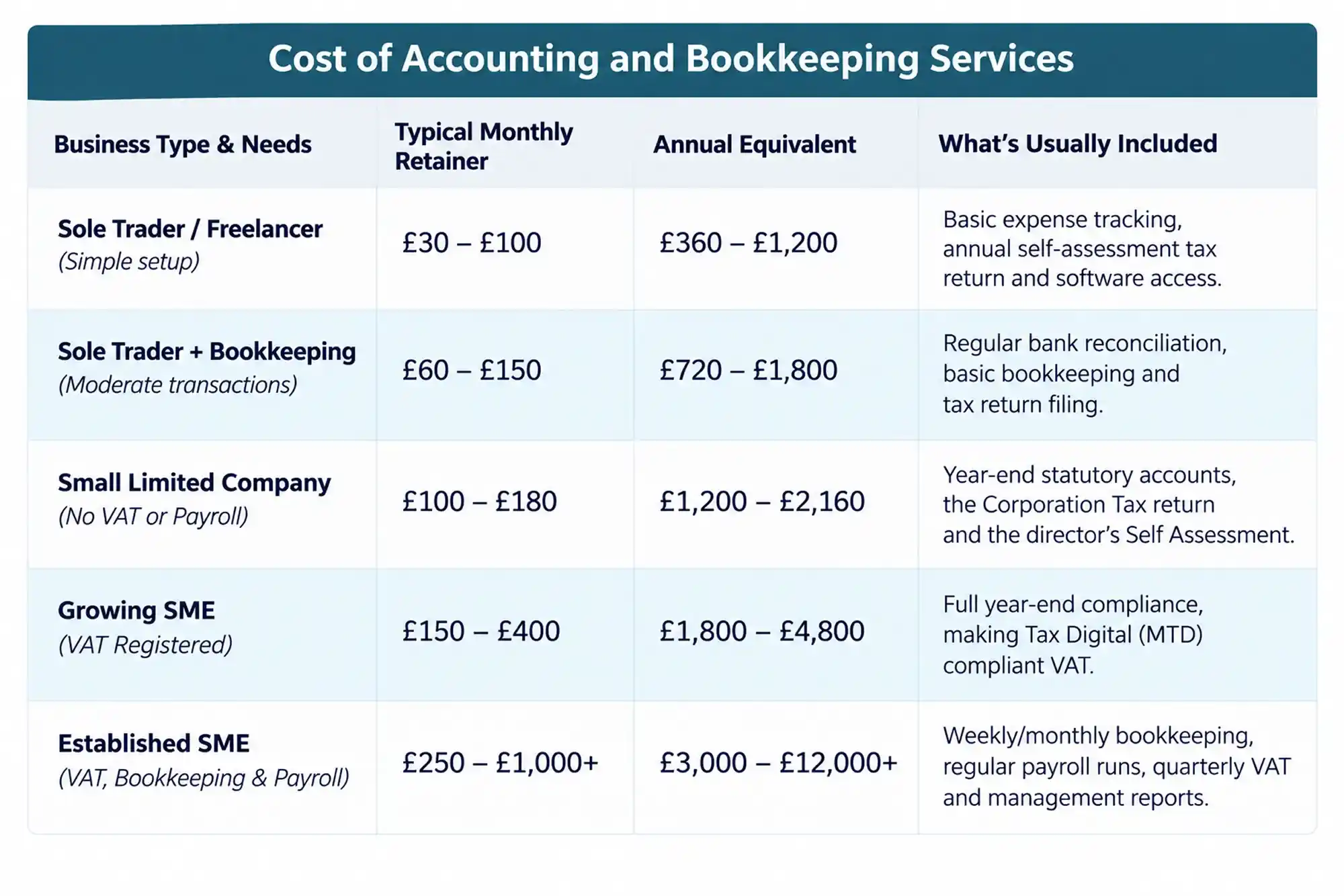
    The cost of accounting and bookkeeping services varies by business. Key factors include transaction volume, business size and financial complexity. The level of support you need also affects the price. Typical costs for UK businesses are outlined below:

    Cost of Accounting and Bookkeeping Services

    These figures are estimates, not fixed fees. Actual prices depend on the provider and services included.

    How to Choose the Right Accounting and Bookkeeping Service for Your Business

    Choosing the right accounting and bookkeeping service helps you maintain accurate records and meet your financial obligations. It can also support better planning and business decisions. Providers such as Sterling Cooper may help you save time and manage your finances more effectively.

    However, services and expertise vary between providers. Consider your business needs, industry requirements and future plans before making a choice.

    Conclusion

    Accounting and bookkeeping services help businesses maintain accurate financial records and manage their finances effectively. Bookkeeping focuses on recording daily transactions, while accounting involves analysing financial data, preparing reports and supporting tax compliance. Together, these services help businesses meet their reporting obligations and make informed financial decisions.

    Are you spending too much time managing your business finances?

    Contact us and let our professionals handle your accounting and bookkeeping so you can focus on growing your business.

    FAQs


    What is the difference between accounting and bookkeeping services?


    Bookkeeping focuses on recording and organising daily financial transactions, such as income, expenses, invoices, and payments. Accounting involves analysing financial information, preparing reports, managing taxes and providing financial advice.


    Small businesses need bookkeeping services to maintain accurate financial records, monitor cash flow, track expenses and prepare information required for tax reporting.


    Yes, professional accountants can help businesses understand tax rules, identify available allowances, organise expenses correctly and plan their finances efficiently.


    This depends on your business needs. Many small businesses start with bookkeeping support to maintain accurate records and later add accounting services as they grow.


    Many bookkeeping professionals use cloud-based software such as Xero, QuickBooks, Sage and FreeAgent.

    Share This Article!

    Recent Posts

  • How to Prepare Final Accounts in the UK

    How to Prepare Final Accounts in the UK

    How to Prepare Final Accounts in the UK

    Posted by:

    Admin

    Date:

    September 15, 2026

    Category:

    blogs

    Error: Contact form not found.

    How to Prepare Final Accounts in the UK

    Preparing a company’s final accounts involves more than summarising its annual income and expenses. The figures must be complete, reconciled and adjusted to present an accurate picture of the company’s financial position at year-end. For UK companies, the process also depends on their size, applicable accounting standards, audit requirements and filing obligations.

    The process typically starts with reviewing bookkeeping records and making year-end adjustments before preparing the annual accounts. These accounts must be filed with Companies House where required, while the company’s Corporation Tax Return is submitted separately to HMRC.

    This guide explains the key requirements and steps involved in preparing final accounts. This will help you understand your company’s responsibilities and meet the relevant filing deadlines.


    Key Takeaways

    • Final accounts summarise a company’s financial performance and position at the end of its financial year.
    • Company size determines which reporting provisions and exemptions may be available.
    • Preparation involves reconciling records, producing a trial balance and making year-end adjustments.
    • Companies must use an appropriate accounting framework, such as FRS 102 or FRS 105 where eligible.
    • Companies House and HMRC have separate filing and payment deadlines.

    What Are Final Accounts?

    Final accounts, commonly called year-end accounts, are financial statements prepared at the end of a company’s financial year. For limited companies, statutory accounts must meet the applicable legal and accounting requirements.

    These accounts help shareholders understand the company’s financial position and provide information for statutory reporting and tax calculations.

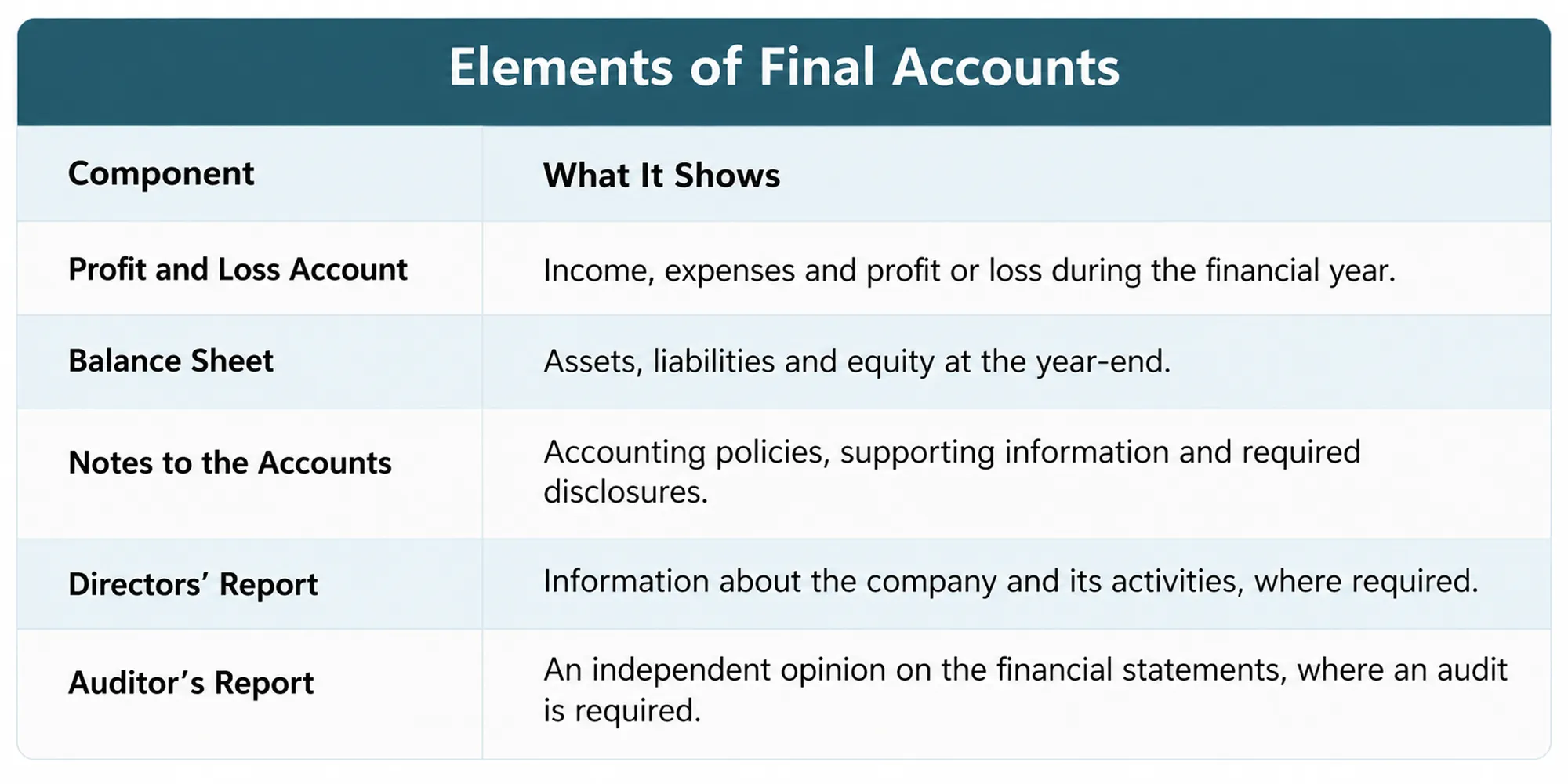
    Elements of Final Accounts

    The components of final account filing must prepare depend on its reporting regime. Some qualifying small companies and micro-entities can use simplified reporting provisions.

    What Types of Final Accounts Does Your Company Need?

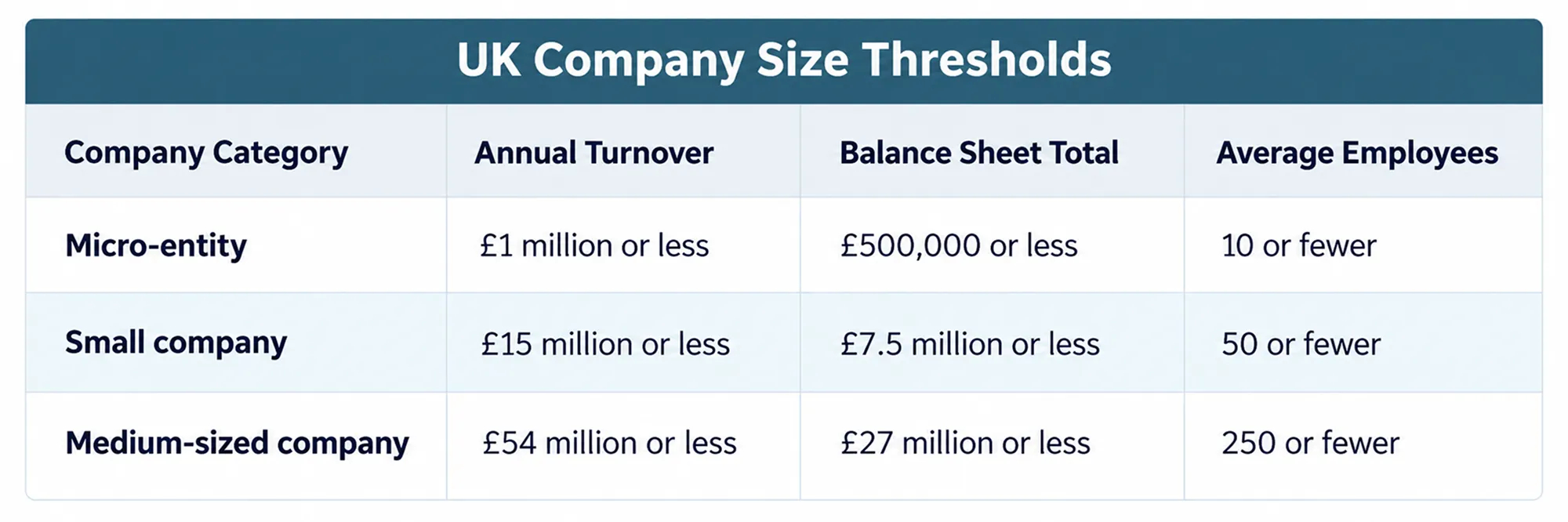
    The reporting requirements depend on the company’s size, structure and eligibility for statutory exemptions. Company size is generally assessed against three criteria: annual turnover, balance sheet total and average number of employees. A company normally needs to meet at least two criteria to qualify for a category, subject to applicable rules.

    For accounting periods beginning on or after 6 April 2025, the revised UK thresholds are:


    Companies that exceed the relevant medium-sized criteria may be classified as large, subject to the applicable rules. The two-year rule, group circumstances and other statutory conditions can also affect classification.

    These thresholds do not automatically determine every filing or audit obligation. Qualifying micro-entities may use FRS 105 and simplified accounts, while eligible small companies may benefit from reduced filing requirements and audit exemptions. The accounts prepared for shareholders may contain more information than the version filed with Companies House.

    How to Prepare Final Accounts in the UK: Step-by-Step

    To prepare final accounts, start by organising and checking your financial records. Make the necessary year-end adjustments and audit financial statements. This helps you meet filing requirements, assess profitability, track cash flow and make informed decisions about costs, investment and business growth. Here are the key steps to follow when preparing final accounts in the UK:

    Step 1: Gather and Check Your Financial Records

    Collect the documents covering the financial year you are reporting on. These provide the evidence needed to verify transactions and prepare the accounts. Your records may include:

    • Bank and credit card statements
    • Sales and purchase invoices
    • Expense receipts and payment records
    • Payroll and pension records
    • VAT returns and supporting documents
    • Loan and finance statements
    • Fixed asset registers
    • Stock records, where relevant
    • Director loan account records
    • Share capital and other relevant company records

    Check that transactions have been recorded in the correct period and that supporting documents are available. Investigate missing invoices, unrecorded expenses and unusual transactions before proceeding.

    Step 2: Reconcile Your Accounts

    Compare the balances in your accounting system with external statements and supporting records. Reconcile bank accounts and review credit cards, loans, VAT balances, payroll liabilities and other relevant control accounts. Look for:

    • Missing or duplicated transactions
    • Incorrect amounts or posting dates
    • Unrecorded bank charges or interest
    • Outstanding payments and receipts
    • Differences in opening balances

    Investigate and correct discrepancies before finalising the figures. A reconciliation confirms whether recorded balances agree with available evidence, but it does not guarantee that every transaction has been classified correctly.

    Step 3: Prepare the Trial Balance

    Prepare a trial balance from the general ledger after completing the initial checks. It lists the balances of the company’s accounts, including income, expenses, assets, liabilities and equity.

    Total debits should equal total credits. However, a balanced trial balance does not necessarily mean that the records are complete or error-free. Transactions may have been omitted or posted to the wrong accounts without affecting the totals.

    Review unusual balances and investigate unexpected movements before making year-end adjustments.

    Step 4: Apply the Appropriate Accounting Framework

    UK companies generally prepare statutory accounts under UK Generally Accepted Accounting Practice (UK GAAP) or, where permitted or required, the applicable International Financial Reporting Standards. FRS 102 is the principal UK accounting standard for entities within its scope. Eligible micro-entities may use FRS 105 under the UK micro-entities regime.

    The relevant framework determines how transactions are recognised, measured, presented and disclosed. It affects areas such as revenue, leases, financial instruments and fixed assets. Check which framework applies to your company and reporting period, particularly if the business has complex transactions or is affected by changes to accounting standards.

    Step 5: Make Year-End Adjustments

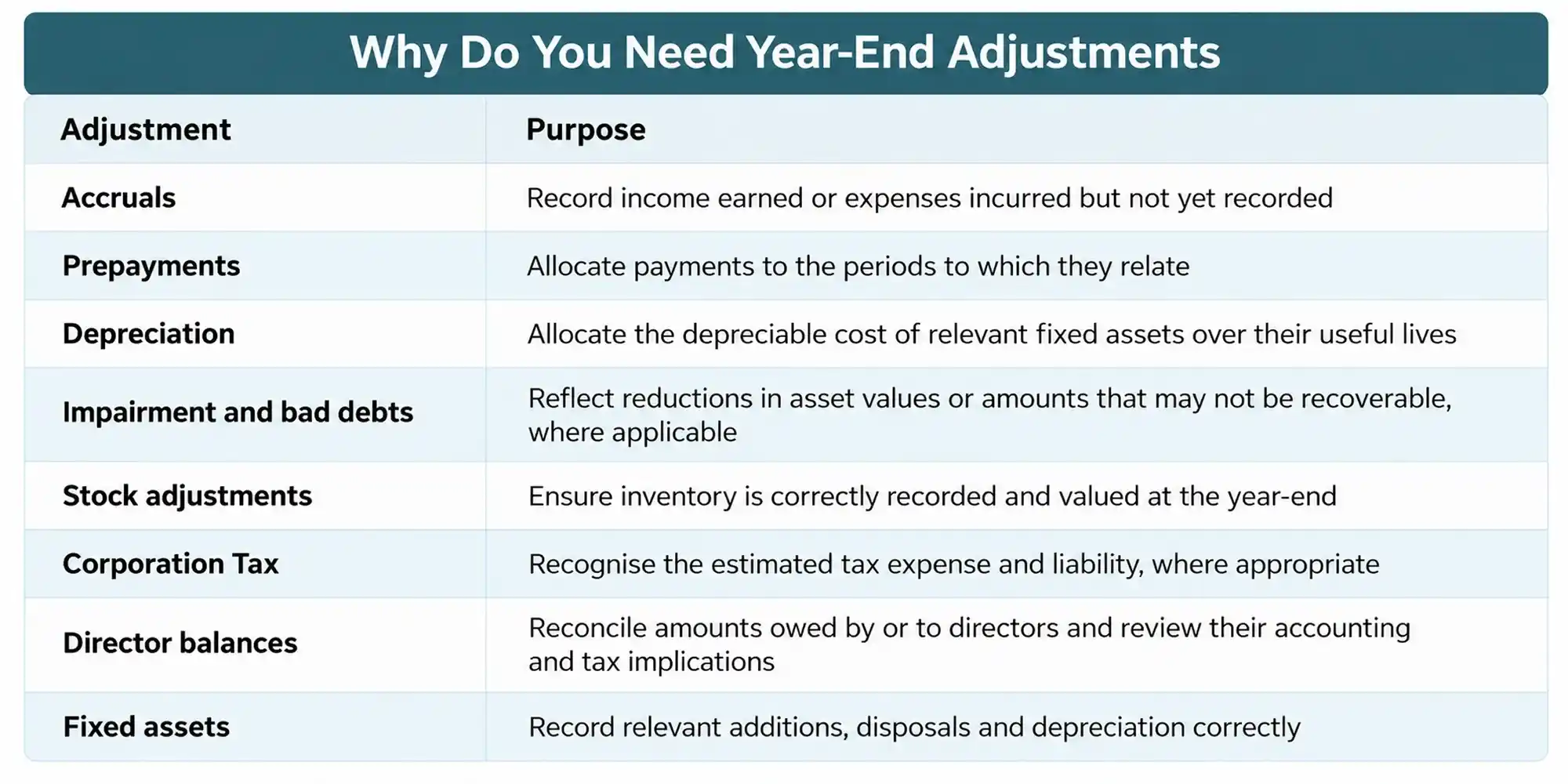
    Year-end adjustments ensure that income, expenses, assets and liabilities are recorded in the appropriate accounting period and measured according to the applicable framework:


    Why Do You Need Year-End Adjustments

    For example, an accrual may be required when a company receives a service before the year-end but receives the supplier’s invoice afterwards.

    The adjustments needed will depend on the company’s activities. Corporation Tax is calculated under tax rules, so the accounting profit may require further adjustments when preparing the tax computation.

    Step 6: Prepare and Review the Financial Statements

    Use the adjusted trial balance to prepare the financial statements required under the company’s reporting regime. These generally include the profit and loss account, balance sheet and notes to the accounts. Other reports may be necessary depending on the company’s circumstances. Before finalising the statements, check:

    • Whether revenue and expenses have changed unexpectedly compared with the previous year
    • Whether gross profit margins are consistent with trading activity
    • Whether bank and loan balances agree with supporting records
    • Whether assets, liabilities and equity are correctly classified
    • Whether the required disclosures and accounting policies are included
    • Whether significant differences from the previous year’s accounts have been explained

    Resolve any discrepancies before submitting the accounts for approval.

    Step 7: Approve the Accounts

    The company’s board of directors must approve the statutory accounts. A director must sign the balance sheet on behalf of the board and print their name in accordance with the applicable requirements. Directors remain responsible for the company’s statutory accounts even when an external accountant prepares them.

    Check that the correct version has been approved and that all required signatures and statements are present before filing.

    How to File Final Accounts with Companies House and Report to HMRC

    Once the accounts have been approved, a UK limited company generally needs to address two separate reporting obligations:

    1. File its annual accounts with Companies House.
    2. Submit its Company Tax Return to HMRC when required.

    Although both processes use the company’s accounting information, their purposes and deadlines differ.

    Filing Annual Accounts with Companies House

    Companies House receives the statutory accounts for the public register. The version filed depends on the company’s reporting category and any exemptions it can claim. The process involves:

    1. Confirming which filing requirements apply.
    2. Preparing the appropriate version of the accounts.
    3. Ensuring the directors have approved the accounts.
    4. Filing through an available Companies House service or suitable software.
    5. Checking that the submission has been accepted.

    Companies House Filing Deadlines

    Different deadlines can apply depending on the company’s circumstances and the period covered by its first accounts. Check the actual filing date recorded for your company rather than relying solely on the general deadline.

    Reporting Corporation Tax to HMRC

    The company’s financial statements provide the starting point for its Corporation Tax calculations. However, accounting profit is not necessarily the same as taxable profit because tax adjustments may be required for items such as disallowable expenses and capital allowances.

    A Company Tax Return normally includes:

    • A CT600 Company Tax Return
    • Company accounts
    • A Corporation Tax computation
    • Any required supplementary information

    Companies generally need to submit the return using appropriate software. A company that receives a notice to deliver a return must normally file it even if it has made a loss or has no Corporation Tax to pay:

    Different payment arrangements apply to some companies, including those required to pay Corporation Tax in instalments. A Corporation Tax accounting period cannot exceed 12 months, so a company with a longer financial year may need to submit more than one tax return.

    Should You Prepare Final Accounts Yourself or Use an Accountant?

    Directors can prepare their own accounts, provided they understand the relevant accounting and filing requirements. This may be manageable when the bookkeeping is straightforward, and the company has uncomplicated transactions. Professional support may be useful if you need help with:

    • Applying accounting standards and reporting exemptions
    • Resolving complex year-end adjustments
    • Preparing statutory financial statements
    • Reviewing Corporation Tax calculations
    • Managing filing obligations and deadlines

    An accountant can also explain the company’s financial results and identify issues that may require further investigation.

    If you need assistance with year-end reporting, explore Sterling Cooper Consultants’ services to establish whether its accounting and tax support meets your requirements.

    Conclusion

    Preparing final accounts requires organised records, appropriate accounting adjustments and financial statements that meet the company’s reporting obligations. The next step is to ensure the approved accounts are filed with Companies House, and the relevant Corporation Tax reporting is completed with HMRC.

    If you need help with your company’s year-end accounts, professional support can help you manage the process and address reporting requirements.

    Need help preparing your company’s year-end accounts?

    Contact us today to discuss your requirements and explore the available support.
    +443300102526
    Book an Appointment

    FAQs


    What records do you need to prepare final accounts?


    You generally need bank statements, sales and purchase invoices, expense records, payroll information, loan statements and fixed asset records. You may also need supporting documents for other financial transactions.


    The appropriate accounting standard depends on the company’s circumstances and eligibility. Many UK companies follow UK GAAP, including FRS 102, while eligible micro-entities can use FRS 105.


    Not always. Eligible small companies and micro-entities may qualify for an audit exemption. However, some companies must have an audit because of their size, circumstances or specific legal requirements.


    Not always. Eligible small companies and micro-entities may be able to omit their profit and loss account from their Companies House filing. However, they must still meet their accounting and applicable tax reporting obligations.


    Yes. Dormant limited companies generally need to file annual accounts with Companies House, even if they have not traded. Qualifying companies may file simpler accounts, while their Corporation Tax obligations depend on their circumstances and HMRC requirements.


    Yes. Company directors can prepare their own accounts if they understand the relevant accounting and filing requirements. An accountant can help with complex transactions, year-end adjustments and compliance.


    Yes. If you identify an error in filed accounts, you may need to submit amended accounts to Companies House. The correction process depends on the nature of the error and the type of accounts originally filed.

    Share This Article!

    Recent Posts

  • Small Accounting Firm vs Big Four: Which Suits an SME Best?

    Small Accounting Firm vs Big Four: Which Suits an SME Best?

    Small Accounting Firm vs Big Four Which Suits an SME Best

    Posted by:

    Admin

    Date:

    September 11, 2026

    Category:

    blogs

    Error: Contact form not found.

    Small Accounting Firm vs Big Four: Which Suits an SME Best?

    Choosing an accounting firm is an important decision for any small or medium-sized enterprise (SME). The right firm should provide the expertise, services and financial guidance your business needs without adding unnecessary costs or complexity.

    A small accounting firm may be a practical choice if you need ongoing support with bookkeeping, tax compliance, payroll and financial planning. The Big Four, Deloitte, EY, KPMG and PwC, may be more suitable if your business has complex transactions, international operations or highly specialised reporting requirements.

    So, which option is right for your SME? This guide compares small accounting firms and the Big Four, explains when each makes sense and highlights what to consider before making your decision.

    Key Takeaways

    • Small accounting firms can offer accessible, personalised support and services suited to an SME’s requirements.
    • The Big Four provide extensive specialist expertise, international networks and resources for complex financial matters.
    • Compare fees against the services, expertise and level of support included rather than choosing on price or reputation alone.
    • SMEs with international operations, major transactions or complex reporting requirements may benefit from a larger firm or specialist adviser.
    • The right accountant should meet your current needs while having the expertise or professional network to support your future growth.

    Small Accounting Firm vs Big Four: What Is the Difference?

    The main difference between a small accounting firm and the Big Four lies in their scale, service structure, specialist resources and typical client requirements.

    Small accounting firms often work with owner-managed businesses, start-ups and growing SMEs. Depending on their expertise, they can provide services such as bookkeeping, annual accounts, tax compliance, payroll, management reporting and business advice.

    The Big Four are Deloitte, EY (Ernst & Young), KPMG and PwC (PricewaterhouseCoopers). These global professional services networks offer extensive accounting, audit, tax, consulting and transaction-related expertise, often serving large organisations and businesses with complex requirements.

    However, firm size alone does not determine the quality of service an SME receives. A smaller firm with the right expertise may be better suited to a particular business than a larger organisation.


    Key Differences Between Small Accounting Firms and the Big four

    The most suitable option depends on what your business needs from its accountant. For routine financial management, a smaller firm may provide all the necessary services. If your business requires several specialist disciplines or coordinated support across countries, a larger firm may be worth considering.

    Which Is Better for an SME: A Small Firm or the Big Four?

    For many SMEs, a small or specialist accounting firm is a sensible starting point. It may provide the services needed to maintain accurate financial records, meet tax obligations and make informed business decisions without requiring the resources of a large professional services network.

    However, a smaller firm is not automatically the right choice for every SME. Businesses with complicated ownership structures, international subsidiaries, significant transactions or demanding reporting requirements may need expertise that a larger firm can provide.

    Use the following guide to identify which option is more likely to suit your circumstances.

    These are starting points rather than fixed rules. Some smaller firms handle sophisticated work, while larger firms may have dedicated teams serving smaller businesses. Before deciding, establish whether the firm can meet your specific requirements and who will be responsible for the work.

    Cost vs Value

    Accounting fees matter to an SME because they affect operating costs and the budget available for other business priorities. However, choosing the cheapest accountant may prove costly if the service does not meet your needs.

    When comparing proposals, look at what each firm includes. One quote might cover bookkeeping, year-end accounts and tax returns, while another may include management reporting, regular meetings and ongoing financial advice.

    A smaller firm may offer better value if you primarily need routine accounting and compliance support. Paying for access to a larger team may be justified if you need specialist advice for a major transaction, a complex tax position or international expansion.

    Ask each firm to clarify its fees, scope of work, additional charges and arrangements for out-of-scope advice. This makes it easier to compare the actual service you will receive rather than the headline price.

    Service and Accessibility

    Your relationship with your accountant can influence how effectively you manage your business finances. Regular access to someone who understands your operations can help you discuss cash flow, upcoming tax obligations, financial performance and growth plans.

    Smaller firms may offer a more direct working relationship, particularly when the same accountant manages your account over time. However, this depends on the firm’s structure, workload and approach to client communication.

    The Big Four can provide access to specialist teams, but the person responsible for routine communication may differ from the partner or specialist overseeing an engagement. This is not necessarily a disadvantage, especially when several areas of expertise are required.

    Before appointing a firm, ask who will handle your account, how quickly you can expect responses, whether regular meetings are included and how you can access specialist advice when needed.

    Complexity and Specialist Requirements

    An SME’s accounting needs can change as its operations grow. A business might initially require bookkeeping and annual accounts, then need more detailed management reporting, tax planning, payroll support or assistance with funding and expansion.

    A capable small accounting firm may be able to support this development, provided it has the relevant expertise and capacity. It may also work with external specialists when a particular assignment falls outside its core services.

    The Big Four become worth considering when your requirements involve several technical disciplines, multiple jurisdictions or substantial transactions. Their broader resources can help coordinate work across areas such as international taxation, transaction advisory, corporate finance and complex reporting.

    The important consideration is not simply how large your business is, but how complicated its financial arrangements have become. A business with substantial UK operations but a straightforward structure may have different needs from a smaller company with overseas subsidiaries, multiple investors and cross-border tax obligations.

    When Should an SME Consider a Big Four Accounting Firm?

    A Big Four firm may be appropriate when your business needs specialist expertise, international coordination or resources beyond its routine accounting requirements.

    Before making that decision, identify the specific problem you need the firm to solve. The following situations may justify considering a larger firm or another specialist adviser.

    Complex Transactions or Restructuring

    Mergers, acquisitions, business disposals and major restructurings can involve financial due diligence, transaction structuring, tax considerations and detailed financial analysis.

    In these situations, you may need several specialists to assess financial risks and support the transaction. A Big Four firm can be worth considering when the scale or complexity of the work requires a coordinated team.

    However, the Big Four are not the only option. Boutique transaction advisers and specialist accounting firms may also have the expertise to handle your assignment. Compare relevant experience, fees and the proposed scope of work before deciding.

    International Operations

    Expanding into other countries can introduce additional accounting, tax, reporting and regulatory requirements. These may include overseas subsidiaries, cross-border transactions and obligations in multiple tax jurisdictions.

    A Big Four firm’s international network can help coordinate advice across countries, particularly when several local teams need to work together.

    For businesses with more limited international requirements, a UK accounting firm with established overseas partners may provide sufficient support. The right choice depends on the countries involved, the complexity of your operations and the level of coordination required.

    Highly Specialised Reporting Requirements

    Some businesses face reporting requirements that call for detailed technical knowledge or industry-specific expertise. These needs may arise from complex group structures, particular accounting treatments, regulatory obligations or substantial changes to financial reporting.

    A larger firm may offer access to dedicated technical specialists who can help address these requirements.

    Nevertheless, specialist capability matters more than the firm’s name. Before appointing an accountant, confirm that the proposed team has relevant experience and can meet your reporting obligations.

    Institutional or Investor Requirements

    External investors, lenders and other stakeholders may request financial information, independent assurance or reporting to support their decisions. The precise requirements depend on the investment arrangement, financing terms and applicable regulations.

    A Big Four firm may be suitable when the assignment requires extensive specialist resources, a particular level of assurance or experience with complex transactions.

    However, an SME does not automatically need a Big Four accountant simply because it plans to attract investment or secure funding. A smaller audit firm or specialist adviser may meet the relevant requirements. Establish what the investor, lender or regulator actually requires before choosing a provider.

    Why Consider Sterling Cooper for Your SME?

    Choosing an accountant should start with your business requirements rather than the size or reputation of the firm. You need a provider that can manage your accounting responsibilities, help you understand your financial position and offer relevant support as your business develops.

    Sterling Cooper Consultants provides accounting and bookkeeping services, taxation support, payroll, management reporting and business advisory services. Depending on your requirements, these services can help bring routine financial management and wider business support together through one provider.

    For an SME seeking ongoing accounting support, the practical next step is to discuss your current responsibilities, reporting needs and future plans with the firm. You can then establish which services are appropriate, who will handle the work and whether additional specialist support may be needed as your business grows.

    This approach helps you assess the suitability of an accounting firm based on its actual services and capabilities rather than assuming that a larger firm will always provide greater value.

    Conclusion

    For many SMEs, a small or specialist accounting firm can provide the right balance of accounting support, accessibility and cost. It may be particularly suitable if your business needs routine compliance services, ongoing financial management and practical advice.

    The Big Four may be a better fit when you need extensive international resources, specialist technical expertise or support with complex transactions. Other specialist firms may also be able to meet these requirements.

    Before making your decision, compare the scope of services, relevant experience, fees, communication arrangements and capacity to support your business as it grows. The best choice is the firm that meets your actual requirements and provides value for the work involved.


    Get the Right Accounting Support for Your Business

    Take the next step towards better financial management. Contact us to discuss your accounting needs and find the right support for your business.
    +443300102526
    Book an Appointment

    FAQs


    Is a small accounting firm better than a Big Four firm for an SME?


    A small accounting firm may be a better fit for SMEs that need routine accounting, tax compliance and ongoing financial advice. The Big Four may be more suitable when a business requires extensive specialist expertise or international support. The right choice depends on your circumstances.


    They often charge higher fees for engagements requiring extensive specialist resources, although costs vary by service and scope. Compare the work included, additional charges and level of support offered before making a decision.


    Yes. A small accounting firm can support a growing business if it has the necessary expertise and capacity. Ask how it handles more complex accounting, tax and advisory requirements as a business expands.


    No. Most SMEs can assess their options based on their accounting needs rather than choosing a firm because of its size. A Big Four firm may be worth considering for complex transactions, international operations or specialist reporting requirements.


    Consider relevant experience, service range, professional credentials, fees, communication, technology and the firm’s ability to support future requirements. Clarify who will manage your account and what is included in the proposed service.


    Yes. Depending on its expertise, a small accounting firm may offer management accounts, cash-flow planning, tax planning and business advisory services. Confirm which services are available and whether they are included in your engagement.


    Price is important, but it should not be the only consideration. Compare the services included, the expertise available, communication arrangements and any additional fees to determine which firm offers the best value for your business.

    Share This Article!

    Recent Posts

  • Top Tax Saving Tips to Reduce Your Bill Legally

    Top Tax Saving Tips to Reduce Your Bill Legally

    Could you be missing out on opportunities to save tax in the UK? The right tax-saving measures can help you keep more of your income. These may include claiming eligible tax reliefs, making pension contributions and using tax-efficient savings options, such as ISAs. Self-employed professionals and business owners may also be able to claim allowable business expenses.

    In this guide, we explain practical tax-saving tips that can help you reduce your bill while staying within UK tax rules. If you need personalised guidance, you can also explore our tax planning and compliance services to understand your options and plan ahead.


    Key Takeaways

    • Pension contributions may qualify for tax relief and reduce adjusted net income.
    • ISAs offer tax-free returns on eligible savings and investments.
    • Allowable business expenses can reduce taxable profits for self-employed individuals.
    • Gift Aid, Marriage Allowance and other reliefs may lower your tax bill if you qualify.
    • Keep accurate records and review your tax position before the end of each tax year.

    What Are the Top Tax Saving Tips?

    You can potentially reduce your UK tax bill by using available allowances, claiming eligible reliefs and planning your finances carefully. Here are some options to consider.

    Maximise Pension Contributions

    Pension contributions can help you save for retirement while receiving tax relief. Depending on your pension arrangement, contributions may reduce your adjusted net income or qualify for tax relief through your pension provider.
    Higher-rate and additional-rate taxpayers may be eligible for further relief. However, the amount depends on your earnings, pension scheme and applicable allowances. Check these limits before increasing your contributions.

    Reduce the Impact of the 60% Tax Trap

    The 60% tax trap affects some taxpayers with adjusted net income between £100,000 and £125,140. Your £12,570 Personal Allowance is reduced by £1 for every £2 of adjusted net income above £100,000, leaving no allowance once income reaches £125,140.
    Eligible pension contributions and Gift Aid donations may reduce adjusted net income, potentially helping you retain more of your Personal Allowance. Review your position before the tax year ends to determine whether these options could help.

    Consider Salary Sacrifice

    Salary sacrifice allows employees to exchange part of their contractual salary for an eligible benefit provided by their employer. Depending on the arrangement, this may reduce taxable employment income and National Insurance contributions.
    However, it can affect salary-linked benefits, statutory payments and pension calculations. Check the terms with your employer before agreeing to a change.

    Use Your ISA Allowance

    An Individual Savings Account (ISA) allows you to earn eligible savings interest, dividends and investment gains without UK Income Tax or Capital Gains Tax on returns within the account. The overall annual ISA allowance is £20,000 for the 2026/27 tax year. You could use a Cash ISA for savings or a Stocks and Shares ISA for eligible investments, depending on your goals and attitude to risk.
    The allowance is individual, so review how much you have available before contributing. HMRC’s ISA guidance explains the main rules.

    Consider Business Asset Disposal Relief When Selling a Business

    Business Asset Disposal Relief (BADR), formerly known as Entrepreneurs’ Relief, may reduce the Capital Gains Tax payable on qualifying business disposals. For qualifying disposals made on or after 6 April 2026, the relief applies a Capital Gains Tax rate of 18%. Eligibility depends on the type of disposal and the relevant ownership, trading and other conditions.Pro tip:
    Keep business and personal spending separate where possible. Clear records make it easier to identify genuine business costs and support your tax return.

    Use Gift Aid for Charitable Donations

    Gift Aid increases the value of eligible charitable donations when the donor meets the relevant tax conditions. The charity can reclaim 25p for every £1 donated. Higher-rate and additional-rate taxpayers may also claim further tax relief on qualifying donations. The examples below assume the donations qualify and the taxpayer can claim the additional relief:

    Gift Aid Impact Breakdown
    Gift Aid donations may also help reduce adjusted net income when calculating eligibility for certain allowances. Keep records of your donations and ensure you meet the relevant conditions.

    Consider Enterprise Investment Scheme Relief

    The Enterprise Investment Scheme (EIS) offers tax relief to eligible individuals who invest in qualifying smaller companies. Income Tax relief is generally available at 30% of the amount invested in qualifying shares, subject to the scheme’s conditions.
    For 2026/27, the maximum annual investment eligible for EIS Income Tax relief is generally £2 million. Investments above £1 million must be in qualifying knowledge-intensive companies.
    EIS investments carry significant risks and may be difficult to sell. Assess the potential for losses and the company’s prospects before investing.

    Claim Allowable Business Expenses

    Self-employed individuals can reduce their taxable profits by claiming allowable business expenses. Depending on the business, these may include professional fees, insurance, office supplies and business travel.
    Costs must meet the relevant tax rules. If an expense covers both business and personal use, you may need to apportion the cost. Keep receipts, invoices and other supporting records to substantiate your claims.

    Pro tip:
    Keep business and personal spending separate where possible. Clear records make it easier to identify genuine business costs and support your tax return.

    Consider the Rent a Room Scheme

    The Rent a Room Scheme allows eligible individuals to receive up to £7,500 a year in tax-free rental income from furnished accommodation in their main home. The threshold falls to £3,750 if the income is shared with another person.

    If your receipts exceed the threshold, you may need to report the income and calculate your tax liability under the applicable rules. Check HMRC’s Rent a Room Scheme guidance to determine whether you qualify.

    Check Your Eligibility for Marriage Allowance

    Eligible married couples and civil partners may reduce their combined Income Tax bill through Marriage Allowance. It allows one partner to transfer £1,260 of their unused Personal Allowance to the other. The transferring partner must meet the relevant eligibility conditions, and the receiving partner must generally pay tax at no more than the basic rate. Check the current rules before applying.

    Review Joint Savings and Investments

    Couples may improve their tax efficiency by reviewing how savings and investments are owned. Interest and investment income can be taxed differently depending on each person’s income, available allowances and the type of investment. Any transfer must reflect genuine ownership and comply with the relevant tax rules. Consider the wider financial implications before changing ownership arrangements.

    Make Use of Your Capital Gains Tax Allowance

    Selling investments or other chargeable assets for a profit may trigger Capital Gains Tax (CGT). For individuals, the annual exempt amount is £3,000 for the 2026/27 tax year. You may be able to reduce taxable gains by using this allowance and deducting eligible losses. The timing of disposals can also affect your tax position, but decisions should reflect your wider financial goals.

    Check the current CGT rules before selling assets, particularly if you are planning several disposals within the same tax year.

    Conclusion

    Reducing your UK tax bill legally starts with identifying the allowances, reliefs and tax-efficient options that apply to your circumstances. Pension contributions, ISAs, Gift Aid and allowable business expenses are useful starting points. Review your finances before the end of the tax year and keep accurate records to support your claims. Sterling Cooper can help you assess your tax position and plan your affairs through our taxation services, in line with current HMRC rules

    Need guidance on your tax responsibilities?

    Contact us to discuss your requirements and find the right support for your circumstances.


    +443300102526
    Book an Appointment

    FAQs


    What are the best tax-saving tips for UK taxpayers?

    Consider pension contributions, ISAs, allowable business expenses, Gift Aid and Marriage Allowance. The most suitable options depend on your income and financial circumstances.

    Yes. Eligible contributions can qualify for tax relief and may reduce adjusted net income. The amount depends on your pension arrangement, earnings and applicable limits.

    The overall annual ISA allowance is £20,000. Individual ISA types have their own rules, so check the applicable limits before contributing.

    No. Relief is available only for qualifying investments and eligible investors. EIS investments can result in significant losses, so assess the risks before investing.

    Eligible couples may benefit from the Marriage Allowance and review how savings and investments are owned. Any arrangements must meet the relevant tax rules.

    Share This Article!

    Recent Posts

  • How to Choose a Tax Accountant in the UK

    How to Choose a Tax Accountant in the UK

    How to Choose a Tax Accountant in the UK

    Posted by:

    Admin

    Date:

    October 15, 2026

    Category:

    blogs

    Error: Contact form not found.

    How to Choose a Tax Accountant in the UK

    Running a business means making important financial decisions every day, but choosing the right tax accountant in the UK is one decision that can have a significant impact on your finances, compliance and growth. The right tax accountant does more than prepare tax returns or calculate figures for HMRC. They can help you manage tax risks, identify legitimate tax-saving opportunities, improve cash flow and make better-informed financial decisions.

    From Corporation Tax planning and VAT compliance to payroll obligations and strategic financial advice, professional support can make complex tax responsibilities easier to manage. However, choosing a tax accountant should not be based on cost alone. You should also consider professional qualifications, relevant HMRC registration requirements, specialist expertise, reputation and the ability to provide proactive advice.

    Key Takeaways

    • Choose a tax accountant based on your business structure, tax obligations and support requirements rather than fees alone.
    • Look for relevant experience in your industry and with businesses similar to yours.
    • Check professional qualifications, membership of recognised professional bodies and any applicable HMRC registration requirements.
    • Confirm exactly what is included in the fee before signing an engagement letter.
    • Look for an accountant who can support both tax compliance and legitimate tax planning.

    Why Hire a Tax Accountant?

    Many UK business owners initially consider managing their taxes themselves or using accounting software. While these options may be suitable for straightforward situations, tax responsibilities can become more complex as a business grows. Different business structures, changing tax obligations, VAT requirements and payroll responsibilities can all increase the amount of work involved.

    A tax accountant can help you understand your obligations, prepare accurate tax submissions and identify legitimate opportunities to improve tax efficiency. They can also help you understand the financial implications of business decisions and plan for upcoming tax liabilities.

    The level of support you need will depend on your circumstances. Understanding your requirements before approaching an accountant will help you choose a professional whose services match your business.

    How to Choose a Tax Accountant

    Choosing a tax accountant is an important decision for any UK business owner because the right professional can support compliance, financial efficiency and long-term planning. Rather than viewing an accountant as someone who simply completes annual tax returns, consider whether they can provide the guidance your business needs as it develops.

    The following checks can help you assess potential accountants and make a more informed decision.

    1. Identify the Tax Services You Need

    Before contacting a tax accountant, identify the specific services your business requires. Every business has different financial responsibilities, and choosing an accountant without understanding your needs may lead to unsuitable or insufficient support.

    Some businesses need help with annual tax compliance, while others require ongoing advice, payroll support or more complex tax planning.

    Before choosing an accountant, confirm which of these services you need and whether they are included in the proposed package. If your requirements are likely to change as your business grows, ask whether the accountant can provide additional support when needed.

    2. Look for Relevant Industry Expertise

    Not all accountants specialise in the same areas. An accountant who regularly works with businesses similar to yours may understand the tax considerations, cash-flow pressures and commercial challenges common in your industry.

    For example, a construction business may need advice on the Construction Industry Scheme (CIS), while an online retailer may require support with VAT, stock costs and digital sales reporting.

    Industry experience is useful, but it should not be your only consideration. Ask potential accountants how they have handled tax matters relevant to your business and whether they understand your particular business structure and obligations. Their answers can help you assess whether their experience matches your needs.

    3. Check Professional Qualifications and Credentials

    Professional qualifications can provide evidence of relevant training and technical knowledge. In the UK, accountants and tax professionals may hold qualifications or memberships from recognised professional bodies, including:

    • Association of Chartered Certified Accountants (ACCA).
    • Institute of Chartered Accountants in England and Wales (ICAEW).
    • Chartered Institute of Taxation (CIOT).

    These organisations have professional standards and requirements for their members. However, membership and qualification requirements differ between bodies, so check the individual’s actual credentials rather than relying on a general claim of being qualified.

    You can ask which qualifications the accountant holds, whether their membership is current and whether they have experience with the specific tax matters affecting your business. This is particularly important if you need specialist advice on complex tax issues.

    4. Check the Accountant’s HMRC Registration Requirements

    If an accountant acts as a paid tax adviser on your behalf, they may need to register with HMRC and meet the applicable requirements for accessing its services. HMRC is introducing tax adviser registration requirements in stages, so the relevant requirements depend on the circumstances and timing.

    You can use the official HMRC guidance on tax adviser registration to understand the requirements that apply.

    It is also worth asking how the accountant handles HMRC enquiries, compliance checks and tax correspondence. A suitable adviser should be able to explain the support they provide, what falls outside their service and when additional specialist assistance may be necessary.

    Pro tip:

    Before appointing an accountant, ask how they would support you if HMRC raised a query or opened a compliance check. Clarify whether this assistance is included in the agreed fee or charged separately.

    5. Review Their Reputation and Client Feedback

    An accountant’s reputation can provide useful insight into their reliability, communication and approach to client service. However, reviews should be considered alongside other evidence rather than treated as proof of technical expertise.

    Before making a decision, review their Google Business Profile reviews, client testimonials, professional profiles and relevant case studies. Look for consistent feedback about accuracy, responsiveness, clarity and the ability to explain complex tax matters.

    Where possible, ask for examples of the types of businesses they support and the services they provide. If case studies include specific financial or tax-saving results, check whether the claims are supported by clear evidence and whether the circumstances are comparable to yours.

    Questions to Ask Before Choosing a Tax Accountant

    An initial consultation can help you determine whether an accountant is the right fit for your business. Use the opportunity to understand their experience, the services they provide and how they work with clients.

    Questions to Ask Before Appointing a Tax Accountant

    You should also ask who will handle your account, what documents you will need to provide and how the accountant will keep you informed about deadlines and upcoming tax liabilities. These details help establish expectations before you commit to a working relationship.

    What to Do After Choosing Your Tax Accountant

    Once you have selected an accountant, take a few practical steps to establish a clear and professional working relationship. Agreeing on responsibilities, fees and communication arrangements from the outset can help prevent misunderstandings later.

    Your accountant should provide an engagement letter setting out the services they will deliver, their fees and the responsibilities of both parties. Read it carefully and ask for clarification if any part of the agreement is unclear. Confirm whether additional work, such as responding to an HMRC enquiry, is included or charged separately.

    A written engagement letter is an important part of establishing clear expectations between an accountant and a client. You can also review the relevant guidance and professional standards issued by the accountant’s professional body.

    You may also need to authorise your accountant to deal with HMRC on your behalf. Depending on the tax service involved, this may be completed through an online authorisation process or an appropriate paper form, such as HMRC Form 64-8. Check HMRC’s current guidance to confirm the correct authorisation method for the services you require.

    Remember that authorising an accountant does not transfer your legal tax responsibilities to them. You should continue to provide accurate information, review important submissions and ensure you understand your tax obligations.

    Why Choose Sterling Cooper as Your Tax Accountant?

    Choosing a tax accountant means choosing a professional partner to help you manage your business’s tax responsibilities and financial decisions. The right support can make it easier to understand your obligations, plan for tax liabilities and approach financial decisions with greater confidence.

    Sterling Cooper Consultants provides accounting and taxation services for businesses seeking support with their financial responsibilities. Whether you need help understanding your tax requirements or want to explore more proactive tax planning, the right starting point is a clear understanding of your business, current challenges and future objectives.

    If you are reviewing your current tax arrangements or looking for professional support, explore Sterling Cooper’s taxation services to see how they may fit your requirements.

    Need Help With Your Business Tax?

    Get the right support to manage your tax responsibilities and plan ahead with confidence. Contact Sterling Cooper Consultants to discuss your business tax needs.
    +443300102526
    Book an Appointment

    FAQs


    What does a tax accountant do for a UK business?


    A tax accountant helps businesses understand and manage their tax responsibilities. Depending on the services agreed, this may include preparing tax returns, supporting HMRC compliance, calculating tax liabilities and identifying legitimate tax planning opportunities.


    The cost depends on the size and complexity of your business, the services you need and the level of ongoing support required. Before appointing an accountant, request a clear breakdown of fees and check whether additional work is charged separately.


    A tax accountant may hold qualifications or memberships from recognised professional bodies such as ACCA, ICAEW or CIOT. The most suitable credentials depend on the services you require. Check the accountant’s actual qualifications, relevant experience and any applicable registration requirements before appointing them.


    An accountant may handle broader financial tasks such as bookkeeping, financial reporting and management accounts. A tax accountant focuses more specifically on tax compliance, tax liabilities and tax planning. However, many accountants offer both general accounting and taxation services, so check the scope of support each provider offers.

    Share This Article!

    Recent Posts

  • When Should a UK Business Outsource Bookkeeping Services?

    When Should a UK Business Outsource Bookkeeping Services?

    When Should a UK Business Outsource Bookkeeping Services

    Posted by:

    Admin

    Date:

    October 15, 2026

    Category:

    blogs

    Error: Contact form not found.

    When Should a UK Business Outsource Bookkeeping Services?

    Bookkeeping is one of those tasks that can seem manageable when a business is small. A few invoices need recording, bank transactions need checking and receipts need filing. But as the business grows, these tasks can quickly take up more time and become harder to manage accurately.

    This raises an important question. When should a UK business outsource bookkeeping services?

    The answer is not based on turnover alone. A business may need support when its records are regularly behind, financial administration is taking time away from running the business or VAT and Making Tax Digital (MTD) requirements are becoming harder to manage.

    For some businesses, outsourcing provides a more reliable way to keep records up to date without hiring a full-time bookkeeper.

    Key Takeaways

    • Falling behind with bookkeeping can be a sign that it is time to outsource.
    • Growing transaction volumes can make in-house bookkeeping harder to manage.
    • VAT and MTD requirements can increase the need for accurate, timely records.
    • Outsourced bookkeeping services can save business owners time and reduce routine financial administration.
    • You can outsource bookkeeping without giving up oversight of your business finances.
    • The right time to outsource depends on your workload, the complexity of your finances and your business needs.

    What Does Outsourced Bookkeeping Involve?

    Outsourced bookkeeping means paying an external professional or firm to manage some or all of your day-to-day bookkeeping.

    The work can include recording sales and expenses, reconciling bank accounts, managing invoices, tracking payments and preparing financial information for your accountant. Depending on the provider, bookkeeping services may also include VAT support, payroll processing and management reports.

    The exact service can be tailored to your business. A small sole trader may only need help with monthly bookkeeping, while a growing limited company may need regular transaction processing, bank reconciliations, VAT records and management information.

    Outsourcing does not necessarily mean handing over every part of your financial administration. You can choose the tasks that need professional support while retaining control of your business finances.

    When Should You Outsource Bookkeeping Services?

    There is no single point at which every UK business should outsource its bookkeeping. However, several signs can indicate that your current approach is no longer working effectively.

    1. Your Bookkeeping Is Always Behind

    If invoices, expenses and bank transactions are regularly left unrecorded for weeks or months, this is one of the clearest signs that you may need additional support.

    Out-of-date records make it harder to understand how your business is performing. You may see money in the bank but still have unpaid invoices, upcoming bills or tax liabilities that are not reflected clearly in your day-to-day financial records.

    HMRC requires businesses to keep accurate records that support their tax reporting obligations. For self-employed individuals, these records must cover income, expenses and relevant VAT and PAYE information. The requirements vary according to the type of business and its circumstances. You can find further details in the official GOV.UK guidance on business records for self-employed people.

    Outsourcing can help establish a regular bookkeeping process, keeping records updated rather than allowing them to become another task to catch up on.

    Tip

    Bookkeeping is more useful when it is kept up to date throughout the year. Regular records can give you a clearer view of cash flow, outstanding payments and business performance rather than leaving everything until the end of the financial year.

    2. Bookkeeping Is Taking You Away From the Business

    Business owners often start by doing their own bookkeeping because it appears cheaper than paying someone else.

    This can work when transaction volumes are low. The problem arises when bookkeeping starts taking hours that could be spent on customers, sales, staff or business development.

    Professional accounting support can help business owners spend less time on routine financial administration and more time on other areas of their business.

    If you regularly find yourself spending evenings or weekends dealing with invoices, bank reconciliations and financial records, it may be worth calculating how much that time is costing your business.

    Outsourcing may be a practical option if the time you spend on bookkeeping is affecting your ability to manage operations, serve customers or grow the business.

    3. You Are Struggling With VAT Deadlines

    VAT registration can add another layer of financial administration.

    VAT-registered businesses must follow digital record-keeping requirements under Making Tax Digital for VAT. Certain VAT records must be kept digitally using compatible software, and businesses must use compatible software to submit their VAT returns.

    This does not mean every VAT-registered business needs outsourced bookkeeping. However, if preparing VAT information creates regular deadline pressure or you are unsure whether transactions have been recorded correctly, professional support can make the process easier to manage.

    Keeping records accurate and up to date throughout the VAT period can also reduce the pressure of preparing a return at the last minute.

    4. Your Business Is Growing Quickly

    Growth can turn bookkeeping from a simple monthly task into a much larger process.

    You may have more customers, suppliers, invoices, expenses and payment methods to reconcile. An online retailer, for example, may need to match sales across different platforms. A business taking on employees may also have payroll records to manage.

    At this stage, the issue is not necessarily that bookkeeping has become more difficult. It may simply be that the volume of transactions has increased beyond what your existing process can comfortably handle.

    Outsourcing bookkeeping services can give a growing business access to regular financial support without immediately creating a full-time bookkeeping role.

    5. You Need Better Financial Visibility

    Bookkeeping should do more than record what has already happened. Accurate records give you information that can help you understand how your business is performing.

    If you only check your bank balance to see whether the business is doing well, you may be missing important information.

    For example, your business may have a healthy bank balance because several customers have recently paid their invoices. At the same time, large supplier bills or tax payments may be due soon.

    Up-to-date bookkeeping can help you see income, expenses, outstanding payments and cash movements more clearly. This information can support better decisions about spending, payment terms and future commitments.

    6. You Are Preparing for Making Tax Digital

    Making Tax Digital is another reason some businesses may decide to outsource their bookkeeping.

    From 6 April 2026, Making Tax Digital for Income Tax applies to sole traders and landlords with qualifying income above £50,000. The threshold is due to fall to above £30,000 from April 2027 and above £20,000 from April 2028.

    Those within scope must use compatible software to create and maintain digital records of relevant income and expenses and send quarterly updates to HMRC. The requirements apply to qualifying self-employment and property income, rather than automatically applying to every business.

    For a business owner who has always managed records manually, this can be a good time to review the current bookkeeping process. You can find further information in the official GOV.UK guidance on choosing software for Making Tax Digital for Income Tax.

    You do not have to outsource simply because MTD applies to you. However, if the new requirements add work that you do not have the time or confidence to manage, outsourcing may be worth considering.

    What Bookkeeping Tasks Can You Outsource?

    The scope of outsourced bookkeeping services can vary depending on your business and the provider you choose. Common tasks include:

    • Recording sales and purchase transactions
    • Reconciling bank and credit card accounts
    • Raising and recording invoices
    • Recording business expenses
    • Monitoring accounts payable and receivable
    • Preparing information for VAT returns
    • Providing payroll support
    • Maintaining digital accounting records
    • Producing regular financial reports
    • Preparing information for year-end accounts

    You can choose to outsource all these tasks or only the areas that are creating the most pressure.

    For example, a business owner may continue to raise customer invoices but outsource bank reconciliation and monthly bookkeeping. Another business may need more comprehensive support with transaction processing, VAT records and regular financial reporting.

    The most suitable arrangement depends on the work you need help with, the complexity of your records and the level of oversight you want to retain.

    Outsource Your Bookkeeping

    Case Study of a Small Digital Business Spending Three Hours a Day on Record-Keeping

    HMRC researched how digital technology businesses managed their financial records. One small digital media and entertainment business used Xero for bookkeeping but also relied on a spreadsheet to track sales, performance against projections and profit margins.

    The owner was spending around two hours a day on record-keeping and another hour updating the spreadsheet. As sales increased, the administrative burden was expected to grow. The owner was considering paying an external accountant to take over the record-keeping.

    This example shows how bookkeeping can become increasingly time-consuming as a business grows, even when accounting software is already in place. It also highlights the importance of considering the time spent maintaining separate records and spreadsheets when deciding whether to outsource.

    Conclusion

    There is no fixed turnover or business size at which outsourcing bookkeeping becomes necessary. The more useful question is whether your current system is still working for your business.

    If records are falling behind, financial administration is taking too much time or VAT and MTD requirements are becoming harder to manage, outsourcing may be a sensible next step.

    Good bookkeeping gives you a clearer view of your business and helps keep important financial records accurate and up to date. The right time to outsource is often before bookkeeping becomes a serious problem rather than after it has already started affecting your business.

    Need Help With Your Bookkeeping?

    If you are spending too much time on bookkeeping or are unsure whether your business needs additional support, get in touch with Sterling Cooper Consultants.
    Our team can discuss your bookkeeping needs and help you find the right level of accounting and bookkeeping support for your business.
    +443300102526
    Book an Appointment

    FAQs


    Is It Worth Outsourcing Bookkeeping?


    Yes, outsourcing bookkeeping can be worthwhile if financial administration is taking too much of your time or your records are becoming difficult to manage. It can also provide regular support as your business grows. Whether it is cost-effective depends on the amount of work involved, the cost of the service and the time you could otherwise spend running your business.


    A small business should consider outsourcing when bookkeeping is regularly behind, transaction volumes are increasing or the owner no longer has enough time to manage the records properly. It may also be worth considering when tax reporting requirements become more demanding.


    Yes, you can outsource routine bookkeeping while retaining oversight of your business finances. You can still review reports, monitor cash flow and make key financial decisions. Agreeing on responsibilities and reporting arrangements with your provider can help you maintain visibility of your finances.


    Yes, bookkeeping services can help maintain the digital records needed for Making Tax Digital when the provider has the relevant software and expertise. The work required depends on whether MTD applies to your business and which services the provider offers. You should confirm the scope of support before engaging a provider.


    No, VAT registration does not automatically mean you need outsourced bookkeeping. However, VAT-registered businesses must meet digital record-keeping and filing requirements under Making Tax Digital for VAT. Professional support may be useful if managing these records and deadlines is becoming difficult.


    Not always. Outsourcing can be useful when you need regular bookkeeping support but do not have enough work to justify employing someone in-house. Hiring an in-house bookkeeper may make more sense when the business has a large and consistent finance workload or requires someone to manage financial administration on a daily basis.

    Share This Article!

    Recent Posts