Category: blogs

  • 2025–26 Tax Year Updates: Understanding the Latest Changes

    2025–26 Tax Year Updates: Understanding the Latest Changes

    2025 vs 2026 tax brackets

    Posted by:

    Admin

    Date:

    July 2, 2025

    Category:

    blogs

    Error: Contact form not found.

    2025–26 Tax Year Updates: Understanding the Latest Changes

    Each April brings new numbers and fresh questions for anyone dealing with taxes in the UK. You are not alone if you are trying to work out how 2025 vs 2026 tax brackets will affect your wallet. Here we break down the key differences between tax brackets 2025 vs 2026 and show how your net earnings could change. We also cover the main updates from HMRC MTD income tax changes 2026 to rising council tax bills so you can plan with confidence.

    Why the 2025–26 Tax Year Matters

    Understanding the 2025 vs 2026 tax brackets matters because it determines your payroll deductions and your tax free savings limit. With thresholds frozen, personal and dividend allowances adjusted and the introduction of quarterly digital reporting under HMRC’s Making Tax Digital (MTD) everyone from full time employees to subcontractors will feel the effect. Payroll teams need to load the new rates into their payroll software now. On your end, it’s a good idea to revisit your household budget and consider boosting your pension contributions so you’re fully set for April.

    Key Dates And Deadlines for 2025 vs 2026 Tax Brackets and Filings

    • 6 April 2025: Tax year begins.
    • 5 October 2025: Deadline to register for Self-Assessment if new to the system.
    • 31 January 2026: Online return and balancing payment due.
    • 31 July 2026: Second Payment on Account (if applicable).

    If you miss a deadline, you’ll face an immediate £100 fine, then daily charges on top, so be sure to note each date in your calendar.

    Income Tax Bands And Rates 2025–26

    HMRC confirms that the basic UK tax bands for 2025 and 2026 match those from 2024–25. However, inflationary pressures mean that rate freezes results into a steeper tax burden for many. Below the table shows the 2025–26 income tax bands, thresholds, and corresponding rates.

    Income Tax Bands And Rates 2025-26

    Source: Gov. UK

    Even though top-end bands remain fixed, a rise in nominal wages can push earners into higher brackets which is called a phenomenon dubbed “fiscal drag.” As the UK Parliament puts it:

    “When thresholds and allowances are ‘frozen’, there is an overall increase in tax paid to the Treasury without an actual increase in tax rates”

    UK Parliament

    Scotland’s Separate Tax Regime

    When it comes to 2025 vs 2026 tax brackets, Scottish taxpayers face a distinct set of rates and thresholds:
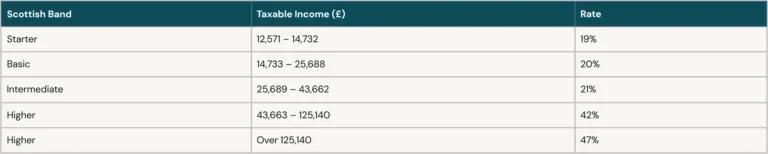
    Scotland’s Separate Tax Regime

    Source: Gov. UK

    By offering a fifth rate band at 19%, Scotland aims to ease the burden on lower-income earners, even as its higher bands become among the steepest in the UK.

    How National Insurance Changes 2025 vs 2026 tax brackets

    National Insurance sits alongside income tax but follows its own thresholds and rates. Its bands mirror the frozen figures for 2025–26, yet a lower employer cutoff means some wages now attract NI earlier, even though employee and self-employed rules stay much the same under the 2025 vs 2026 tax brackets. The table below shows how employee, employer, and self-employed NIC thresholds and rates compare with the new tax bands.
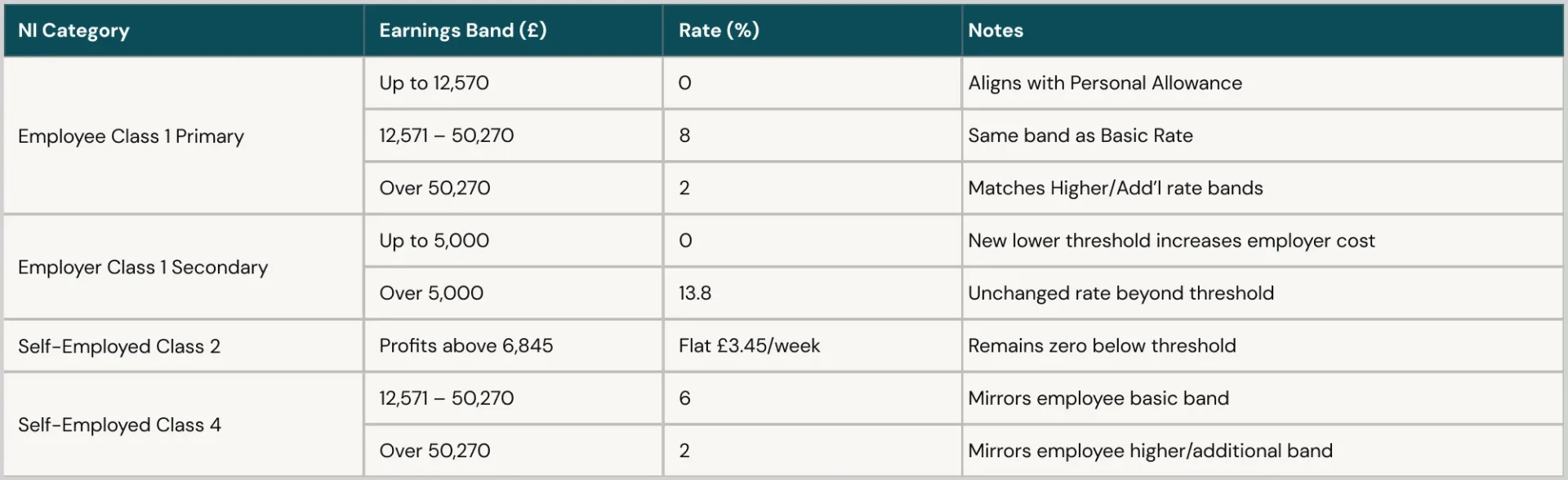
    How National Insurance Changes 2025 vs 2026 tax brackets

    Pension Allowance Updates in 2025 vs 2026 tax brackets

    Pension allowances are another vital element that interacts with the 2025 vs 2026 tax brackets. While tax bands remain frozen, your pension contributions still attract relief, making them a powerful tool for cutting taxable income. The tables below outline how the main pension caps apply in the coming year.

    Pension Allowance Updates in 2025 vs 2026 tax brackets

    Core Allowances & Reliefs in 2025 vs 2026 tax brackets

    Here’s an overview of the main allowances and reliefs under the 2025 vs 2026 tax brackets to help reduce your taxable income and keep more of your money:

    1. Personal Allowance & Tapering

    This structure determines how much of your earnings you can keep tax-free each year.

    • Personal Allowance

    You don’t pay income tax on your first £12,570 of earnings each year. Most people under state pension age get this automatically. It means HMRC ignores that slice when they calculate your bill.

    • Tapering

    Once you earn over £100,000, your tax-free slice starts to shrink. Every extra £2 you make trims £1 off your allowance. By the time you hit £125,140, there’s nothing left to spare.

    2. Marriage & Blind Person’s Allowance

    These allowances offer extra relief for couples and individuals with specific needs.

    • Marriage Allowance

    If one partner isn’t using their full allowance, they can pass £1,260 of it to the other. That can cut the recipient’s tax by up to £252 a year. It is useful when one partner earns less and does not use all of their allowance.

    • Blind Person’s Allowance

    If you are registered blind, you get an extra £3,070 tax-free. You can use this allowance in addition to your standard Personal Allowance. It offers a small but valuable boost for those with sight loss.

    3. Savings and Dividends

    A single allowance lets you keep some of your bank interest and dividend payments without paying tax. If you pay the basic rate of income tax, the first £1,000 of savings interest is yours to keep; higher-rate taxpayers keep £500. You also receive £500 of dividend income tax-free each year.

    HMRC MTD income tax changes 2026

    Starting in April 2026, anyone earning over £10,000 a year from self-employment, property, or other non-PAYE sources will need to file tax updates every quarter under MTD for Income Tax Self-Assessment. As part of the wider 2025 vs 2026 tax brackets changes, submitting quarterly MTD updates shifts all tax reporting online. This approach spots errors faster and makes managing cash flow much more straightforward.

    • Quarterly Updates via Approved Software

    You’ll record your income and outgoings every three months in approved MTD software. Think of it as a regular financial health check. It spots mistakes early and keeps you from panicking over a big annual return.

    • Digital End-of-Year Declaration

    The familiar SA100 paper form is outdated and replaced by a final digital declaration. You’ll confirm your totals once a year online, which dovetails with the quarterly submissions and ensures all your figures add up correctly.

    • Penalties for Non-Compliance

    If you file late, you’ll get fined and pay interest on what you owe. Keep track of your due dates and you won’t get hit by extra fees or headaches.

    • Check Your Software Now

    Anyone running a small business or self-employed should confirm their accounting package supports Making Tax Digital. Give it a trial run well before April 2026 to iron out any issues and familiarise yourself with the new filing steps.

    Explore our Corporation Tax Return service for expert guidance.

    How Much Will Council Tax Go Up in 2025–2026

    Local councils set your council tax, but the government has capped the average increase at 5 percent for 2025–26. Councils in England can add up to 3% extra to pay for adult social care. The Office for National Statistics reports that a typical Band D bill rose from £1,964 to £2,062 in 2024–25, a jump that will stretch household budgets and underlines the importance of knowing your full tax picture.

    Tax Rates 2025 vs 2026: What’s Shifting?

    Although headline bands remain, several nuanced changes affect your effective rate:

    1. Frozen thresholds: Income bands stay static, so any pay rise nudges you closer to higher rates.
    2. Dividend & Savings allowances have been trimmed, lowering the “tax rates 2025 vs 2026” for passive income.
    3. Capital Gains Tax allowances fell to £3,000, half the level of 2023–24.

    Together, these moves can push up your marginal rate. A basic-rate earner tapping dividends now faces more tax on that extra £1,000 than in prior years.

    UK Tax Bands 2025 2026 Summary
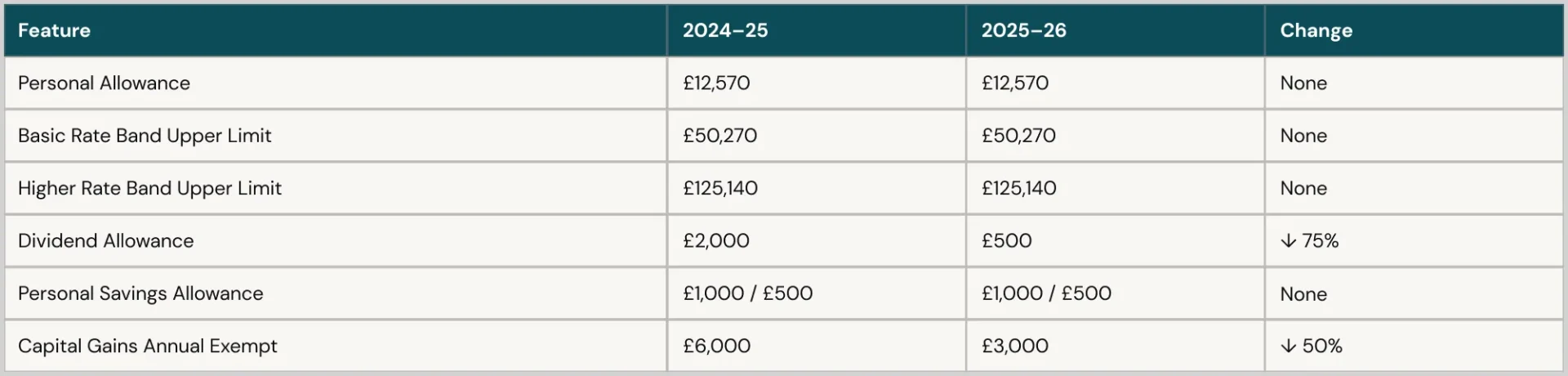
    UK Tax Bands 2025 2026 Summary

    Planning Strategies for 2025 vs 2026 tax brackets

    1. Pension Top-Ups

    Adding more to your pension pot is one of the simplest ways to cut your tax bill when 2025 vs 2026 tax brackets tighten. Every pound you contribute reduces your taxable income by that amount. Higher-rate taxpayers can reclaim extra relief through their Self-Assessment return.

    2. ISA Allocation

    Putting money into Individual Savings Accounts keeps returns out of the tax net. You can choose between Cash ISAs and Stocks & Shares ISAs depending on your goals. These accounts are invaluable now that allowances are frozen and interest or gains grow tax-free.

    3. Dividend Timing

    Think about when you declare dividends if you run your own company. Delaying payouts until after April 2026 can give you a fresh £500 dividend allowance ahead of the next 2025 vs 2026 tax brackets shift. Spreading income across tax years helps you avoid hitting the dividend threshold too soon.

    4. Charitable Giving

    Donating through Gift Aid boosts each pound you give by 25 percent at source. Higher-rate taxpayers can claim extra relief on their Self-Assessment forms.

    Ready to stay compliant and make the most of your tax allowances this year?

    Speak to our tax planning experts today and ensure you’re fully prepared for the 2025–26 tax year.
    +443300102526
    Book an Appointment

    Looking Ahead: 2026 and Beyond

    When April 2026 arrives and the bands stay frozen, you might find your tax bill creeping up before you notice. Staying on top of your MTD submissions and claiming every allowance now will help you keep more of your earnings.

    If you’d like a hand with these changes, Sterling Cooper is here for you. Contact us, we’ll put together a simple plan that fits your situation and keep your tax affairs running smoothly.

    FAQs


    What are the new tax rules for the UK in 2025?


    In 2025 the Personal Allowance stays at £12,570 and all income tax bands remain frozen, meaning the thresholds for basic, higher and additional rates do not move with inflation. The Dividend Allowance drops to £500 while the Personal Savings Allowance remains at £1,000 for basic-rate and £500 for higher-rate taxpayers. Employers face a lower secondary threshold for National Insurance, which raises their costs on lower earnings.


    The financial year 2025 brings no changes to income tax rates or bands compared with 2024–25, but council tax increases are capped at 5 percent (plus an optional 3 percent for adult social care in England). Additionally, from April 2026, everyone earning over £10,000 from non-PAYE sources will join Making Tax Digital for quarterly reporting, so the groundwork laid in 2025 is all about digital readiness.


    In England, Wales and Northern Ireland anyone with taxable income above £125,140 pulls in the additional rate of 45 percent. Scotland applies its top rate of 47 percent at the same threshold. These higher brackets kick in once your earnings exceed the upper limit of the higher-rate band.


    The 2025–26 tax regime continues the freeze on personal and savings allowances and on the thresholds that define basic, higher and additional rates under the 2025 vs 2026 tax brackets. It also extends HMRC’s Making Tax Digital framework to self-employed and landlords earning over £10,000, requiring them to file quarterly updates instead of a single annual return.


    The so-called 60 percent tax trap affects anyone with income between £100,000 and £125,140. In this band you lose £1 of Personal Allowance for every £2 you earn above £100,000 while still paying 40 percent tax on that income, resulting in an effective marginal rate of 60 percent until the allowance has fully tapered away.

    Share This Article!

    Recent Posts

  • How much tax do you pay on a second job?

    How much tax do you pay on a second job?

    tax on a second job

    Posted by:

    Admin

    Date:

    May 12, 2025

    Category:

    blogs

    Error: Contact form not found.

    How much tax do you pay on a second job?

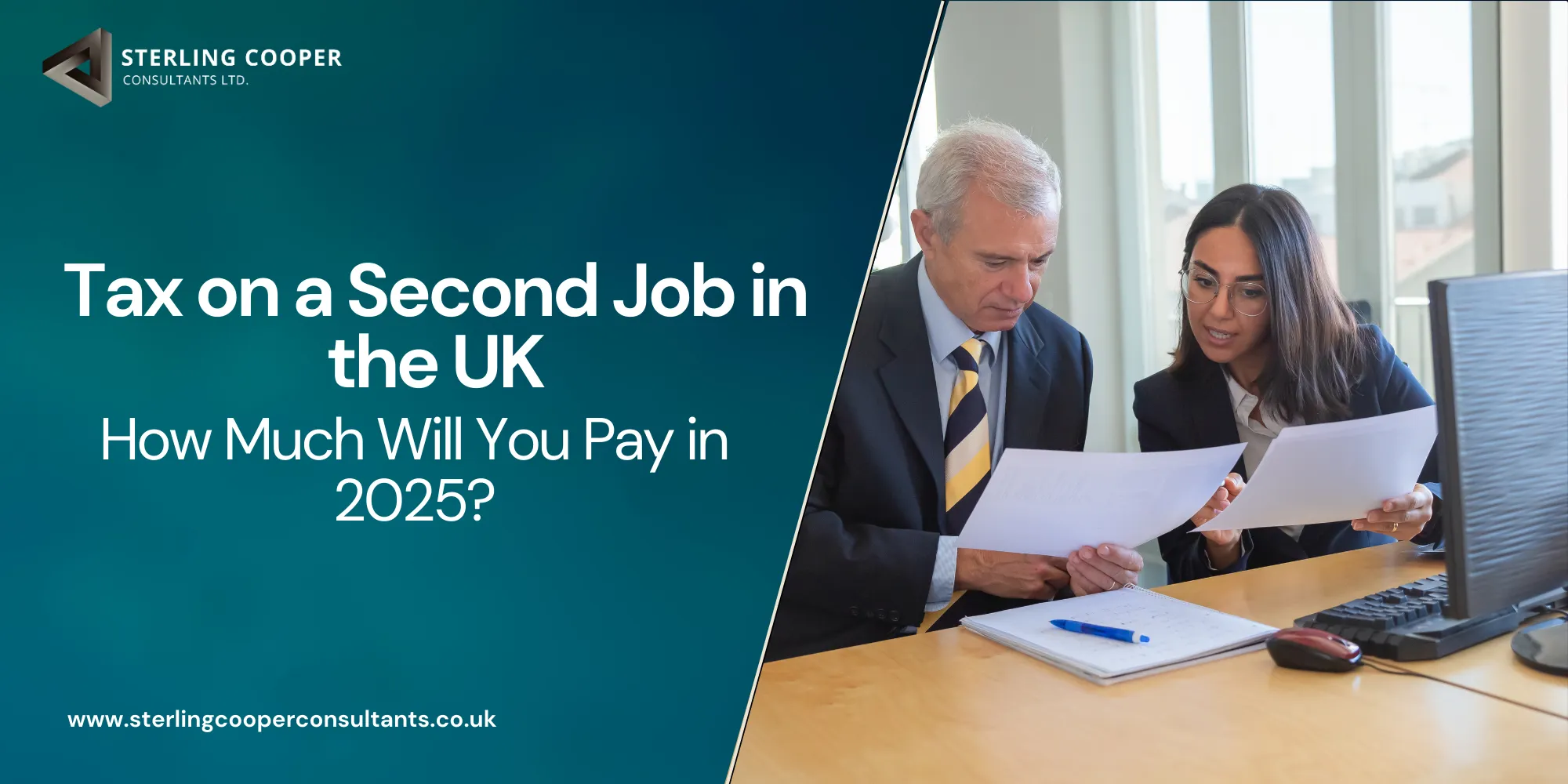
    Working a second job means extra money. People have different reasons to work two jobs. You might be saving for an event, you may want to start your business or you just want to increase your savings. In any case you need to know the tax on a second job. This is determined by many factors such as the type of the second job, income from the second job, etc.

    Here is a detailed guide to know how much tax do you pay on a second job.

    Input of employers on second job

    While taking a second job, you need to check your contract for the first job beforehand since it might not allow you a second job. This contract is a signed document that you might have received when joining. Contact the HR department for details or to clarify sections.

    Employers might not allow second jobs in two cases:

    1. Working for a company that is in competition with the first one
    2. It’s possible that your second employment will damage your employer’s reputation. 

    If there is no clause, then you can take a second job and your employer is not able to stop you. You then pay the right amount of tax on a second job.

    Rights while working second job

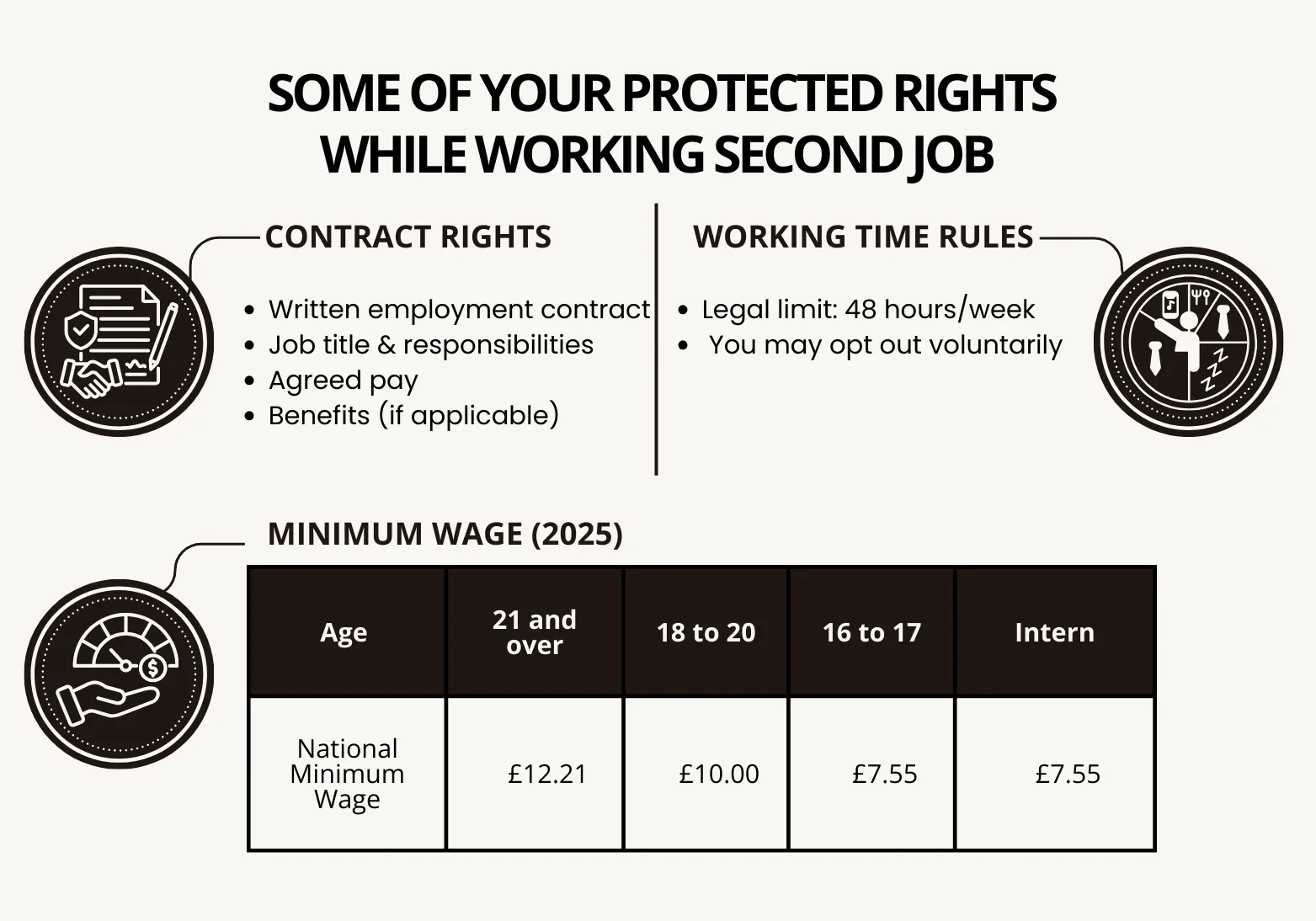
    Your rights remain the same regardless of which job you are working. Some of your protected rights are:

    Contract

    You should get a contract for a second job which should contain all the important information including title, duties, pay, benefits, etc. 

    Wages

    In the UK, workers should get at least the National Minimum Wage so if you are over 21 years of age or over, you should receive this amount or more. This year the National Minimum Wage for each age group is as follows:

    Rights while working second job

    Work Time 

    By law, you should work at most 48 hours a week. However, you can choose to work more than this, especially, when you take a second job, you might work more than this. 

    While explaining the dynamics of second job holding in Britain, Taylor and Boheim state; 

    “In the medium-term,workers who wish to work more hours can either renegotiate the employment con-tract or change employers to supply their preferred number of hours.” 

    Mark P. Taylor et al.

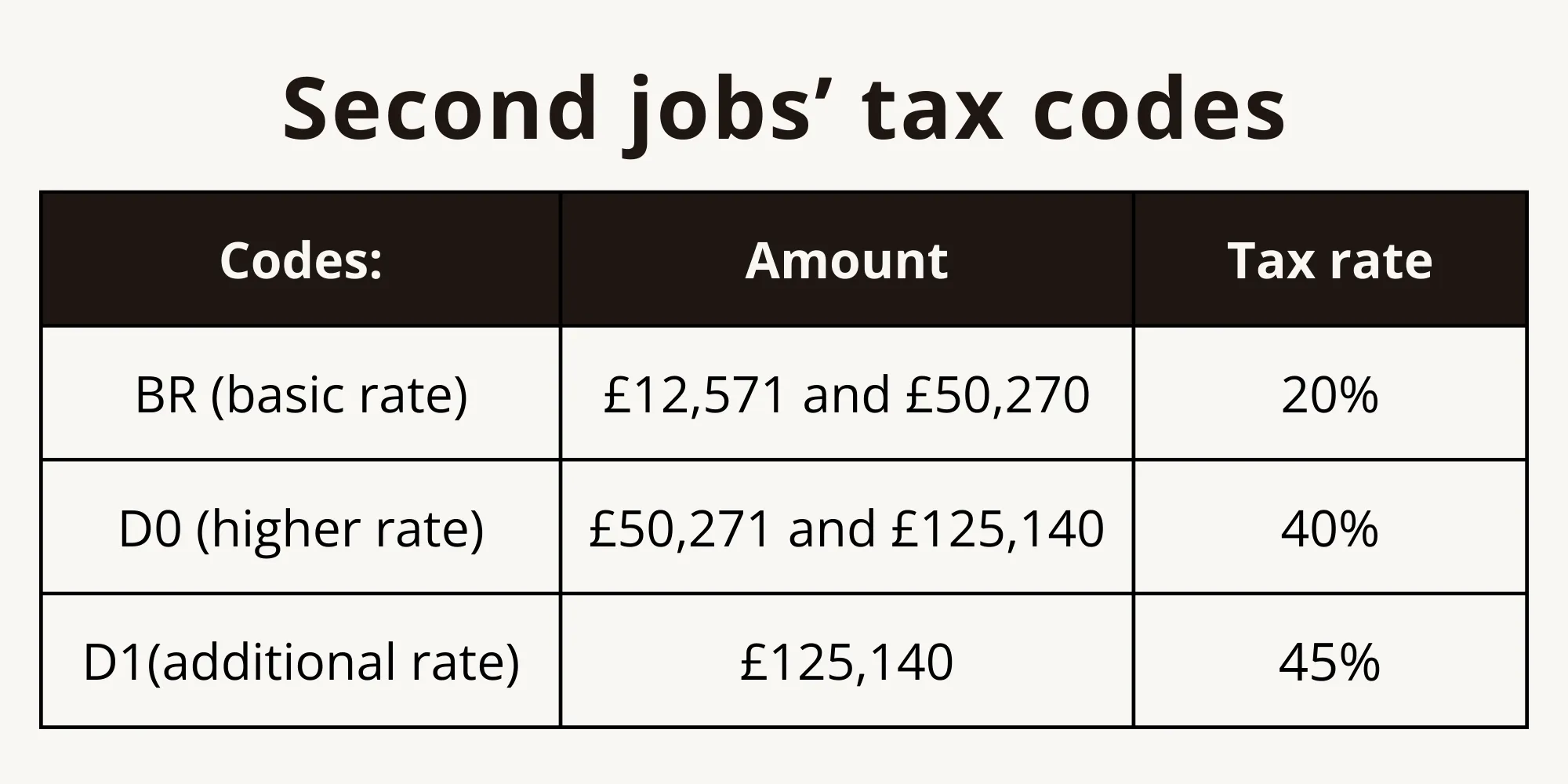
    Second jobs’ tax codes

    While finding tax on second jobs, you need to know tax codes. Following are the tax codes that might apply on your second job and determine your tax amount.

    second job tax codes

    Having BR tax code on your pay slip means that you cannot get personal allowance on your second job.

    Learn more about the BR tax code here. 

    Income tax on a second job

    Tax on a second job depends on how personal allowance, for now £12,570, is applied which is the earning on which no income tax applies. Here is how HMRC tax on a second job is applied to different scenarios while incorporating personal allowance. 

    Case 1: One job above the personal allowance

    Say you have two jobs, the first of which pays £15000 and the second one £5000. Your personal allowance is applied on the first one. HMRC tax on second jobs and the tax on the amount of your pay more than £12,570, is a basic rate which is 20%.

    Case 2: Both jobs below personal allowance

    Now you have two jobs each of which pays £10000. Both of these are below personal allowance so it can be divided on both. You can contact HMRC and ask them to divide it among both. You can also ask for a refund at the end of the year. 

    So, your income tax on a second job won’t be at a basic rate.

    Case 3: Earnings exceed £50000

    If the earnings of both your jobs sum up over £50000, you cannot apply the personal allowance on one job. In this case, tax on a second job is more than the basic rate. You have to report to HMRC, else, you’ll be underpaying tax. 

    Informing HMRC of your second job

    Tax on a second job in the UK depends upon the type of job. HMRC should be informed of your second job regardless of its nature. Else, you might be paying less or more tax than you are owed. You can check your tax code updates paperless-ly, on their app or online. 

    Regular Second Job

    Your employer will give HMRC your income details in this case which will help them in determining your tax code. You’ll be taxed accordingly and pay tax on a second job. What you need to do is:

    • Provide your employer with P45
    • Give them starter checklist if you cannot share P45 in any case

    File your taxes accurately using our Corporation Tax Return Preparation & Submission to HMRC services.

    Other Cases 

    These include 

    • Contractors
    • Free lancers
    • Traders (sole)

    In these cases, tax on a second job is calculated through Self Assessment. 

    Requirements:

    Here are the requirements for starting application for tax in these positions

    • Tax code by HMRC
    • Bank statement backed receipts and invoices

    After meeting these, fill your self assessment returns.

    Tax on a second job is then applied according to income you are making from it.

    Effect of second job on different aspects

    Apart from HMRC tax on second jobs, here are a few fiscal aspects affected by second jobs.

    Insurance Contributions:

    On exceeding the limit of £242 per week, you need to pay National Insurance Contributions. If both jobs are over this limit, you have to pay on both. You don’t have to pay for any if your income is between lower income limit and the PT.

    Loan Repayments:

    If you owe any student loans, they’ll be deducted from your total income of two jobs. You need to keep track of this decrement to avoid over or underpayments. 

    Pensions

    Having two jobs can make you capable of more money aside for pensions. By law, there is no limit on how many pensions a person can have. Thus, you can avail relief on both types of jobs by paying in pensions. You just have to be aware of annual allowance for pensions i.e., £60,000 or 100% of your income per year (whichever is lower). This limit is applied over the entirety of your pensions.

    Contact Sterling Cooper Limited for expert advice

    Calculating tax amounts on both jobs can be hard. For a hassle free experience, contact Sterling Cooper Limited. We will provide you a smooth experience on calculating and registering for tax on a second job.

    Need help with tax on jobs, contact us now.

    Need Help Navigating Tax on a Second Job?

    Sterling Cooper Limited provides expert tax consultation to ensure you don’t overpay or miss critical reporting deadlines.
    +443300102526
    Book an Appointment

    FAQs


    Can you legally work two jobs in the UK?


    Yes, it is completely legal. If the contract does not stop you, you are free to do so.


    Having a second job affects tax credits. While claiming Universal Credit and not getting work allowance, for every £1 you earn, your payment goes down by 55p.


    Yes. You have to register with them through self assessment via the Government Gateway Platform.


    It means basic rate. It is set at 20%.


    You can change them using HMRC online services or their app. Update or fill in employer details. Inform if employment has ended. You can also change pension, benefits, etc.


    Get help from accountants or accounting firms. They’ll help you in calculating accurate amounts hassle-free.

    Share This Article!

    Recent Posts

  • What Is Tax Code BR and How Does It Impact Your Pay?

    What Is Tax Code BR and How Does It Impact Your Pay?

    br tax code

    Posted by:

    Admin

    Date:

    April 30, 2025

    Category:

    blogs

    Error: Contact form not found.

    What Is Tax Code BR and How Does It Impact Your Pay?

    A tax code defines the amount of PAYE tax, decided by HMRC, to be cut from salary or pension. The BR tax code is one of these and it indicates that the basic income tax rate of 20% is applied on all income. In this case, tax-free personal allowance is not applicable. In more general terms, if you hold a second job for say £20000, you will pay a 20% pay under tax code BR. 

    How do you get a tax code

    You receive a tax code by either of these ways:

    • It is calculated by HMRC and sent to you and the company you work for. 
    • The employers calculate it on their own using the rules of HMRC. 

    In case of job change, your new employers should use your existing tax codes. They can obtain it from:

    • A P45
    • Get a starter checklist filled if a P45 is not available.

    Do self-employed people receive a tax code?

    People who are self employed, do not get a tax code. They have a Unique Taxpayer Reference (UTR) which helps them pay taxes. UTR is also a unique number which stays the same through lifetime.

    The tax of these people is calculated by a self-assessment tax return that they are supposed to submit at a fiscal-year’s end. Since they don’t receive salaries, their PAYE payments cannot be calculated. 

    UTR does not change even if a person is self employed, then goes to a regular job, and then becomes self employed again.

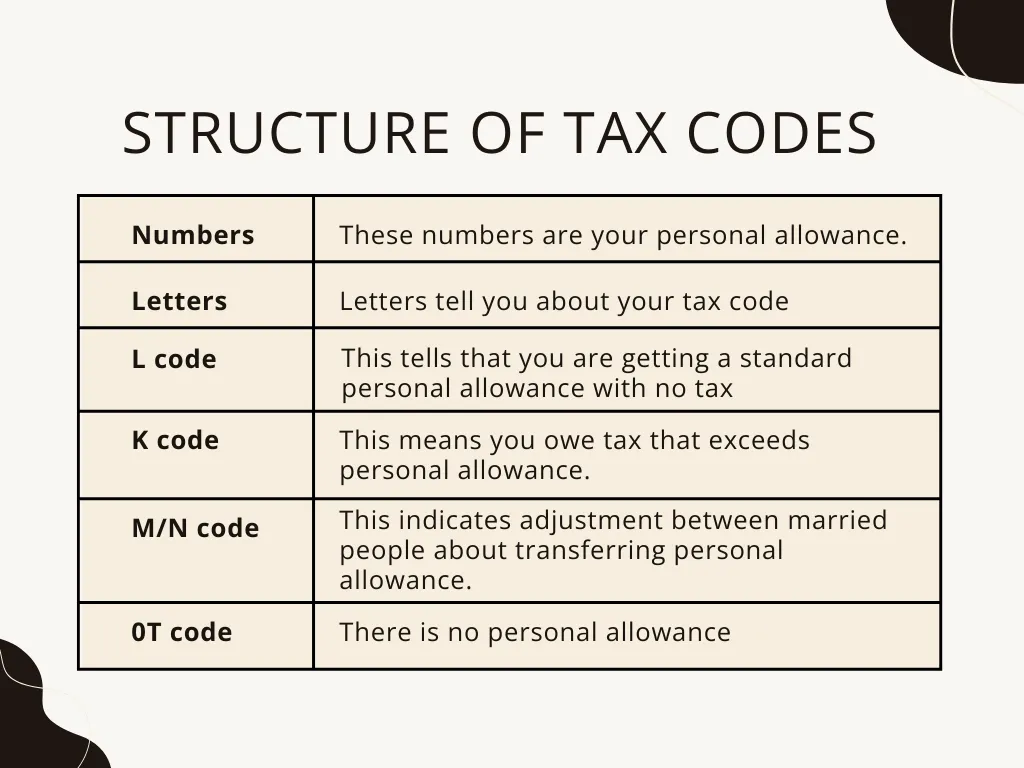
    Structure of tax codes

    If you are wondering ‘what is tax code BR’, you first need to know tax codes. A tax code constitutes some numbers and letters.
    Here is some information that they indicate:

    Numbers:

    These numbers are your personal allowance. 

    Letters:

    Letters tell you about your tax code:

    L code:

    This tells that you are getting a standard personal allowance with no tax.

    K code:

    This means you owe tax that exceeds personal allowance.

    M/N code:

    This indicates adjustment between married people about transferring personal allowance. 

    0T code:

    There is no personal allowance.

    Understanding Emergency Tax Codes

    Emergency tax codes are not forever. They are only applied when HMRC does not have enough details. Emergency codes can have you paying more tax than you are obligated to.
    They don’t account for your circumstances.
    They can be:

    • W1/M1 (weekly/ monthly income taxed without background of whole income)
    • BR (all income is taxed on basic rate)

    structure of tax codes

    Income tax on earned income is charged at three rates: the basic rate, the higher rate and the additional rate.
    For 2022/23 these three rates are 20%, 40% and 45% respectively.  Tax is charged on taxable income at the basic rate up to the basic rate limit, set at £37,700.

    Antony Seely et al.

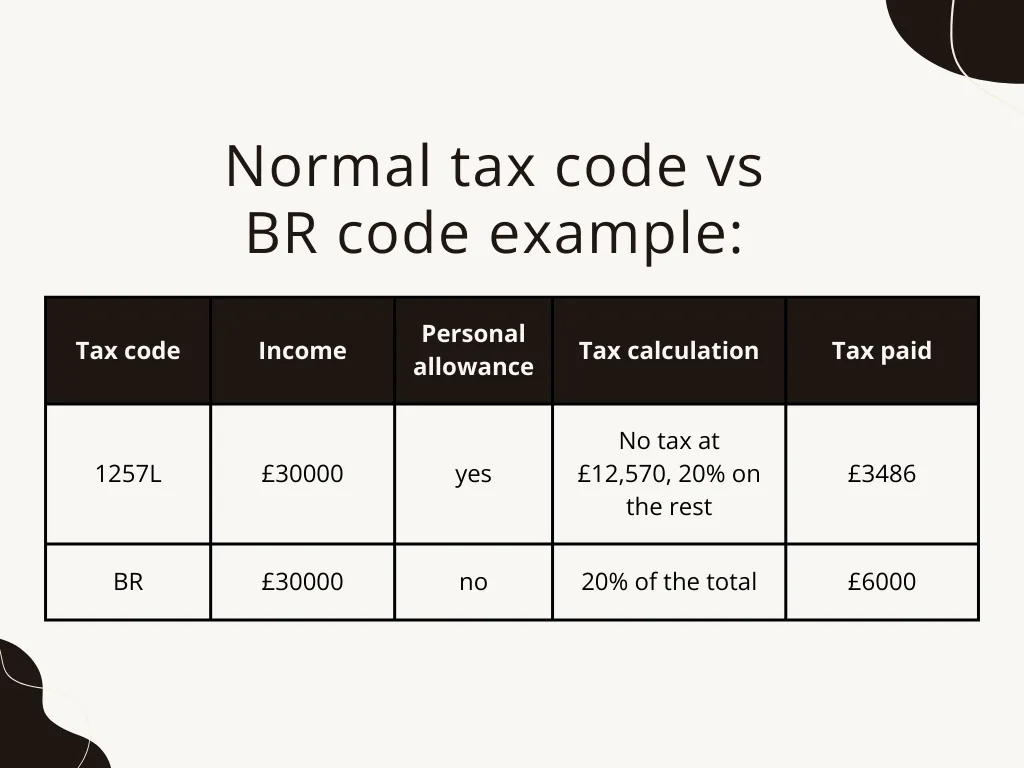
    Normal tax code vs BR code example:

    Here is an example of how much tax you have to pay if you have an emergency vs a normal tax code.

    Cases of tax code BR

    This tax code is applied in the following cases:

    More than one job/pension:

    In this case, you get a personal allowance on your first job/ pension. The other sources of income are then taxed under the basic rate.

    New Employers:

    New employers may use BR tax code for you in case of incomplete information. Once HMRC gives them updated details, this might be corrected.

    normal tax code vs br code example

    Incomplete Information:

    This code might be applied if you have not updated your information at HMRC. Your income and employment details need to be up to date for the right tax code to be applied.

    How to check for tax code BR

    Check these documents or applications to know if you fall under this category:

    1. Payslip
    2. Any correspondence from HMRC
    3. Tax account
    4. HMRC app

    Concerned About the BR Tax Code on Your Payslip?

    Our advisors at Sterling Cooper Consultants offer expert guidance to help you correct your tax code and reclaim any overpaid taxes from HMRC.

    +443300102526
    Book an Appointment

    How does the BR tax code affect earning?

    It is useful for employees to learn the effect of the BR tax code. It might make things hard for workers with more than one source of income. Net pay can decrease by a noticeable amount. Employees should learn how their different incomes will be taxed to smoothen their budgets.

    Effect of BR tax code on other fiscal matters

    The BR tax code can impact important fiscal matters apart from income. Some of these include:

    • Contributions to pension
    • Loan (student) repayments
    • Benefits eligibility

    Recommendations for employees:

    • Employees should take the following actions for improving outcomes:
    • Consult resources from HMRC so their tax codes align with their job status
    • Engage with employer and HMRC actively while changing jobs
    • Consult tax professionals for better understanding.

    To understand taxation matters, get in touch with our accountants.

    Recommendations for employers

    While the employers are giving tax codes, they should ensure these as well:

    • Perform audits of payrolls. This helps in pointing out mistakes in tax status.
    • Train staff for filling correct application in case of code changing
    • Use payroll softwares for accuracy
    • Stay in touch with professionals

    How to get BR tax code changed

    Understanding what is a br tax code can make you realize you are wrongfully put in the category. Now take the following steps to get the status changed:

    1. Contact HMRC:

    HMRC can be contacted and you can provide them with all the important details. These may include income and personal allowance details.

    2. Contact your employer

    You need to talk to your employer urgently to update your details.

    3. Check for updates

    Check your status on payslips regularly. Also visit HMRC website to check for your changed status.

    Refund on BR tax

    You might be due for a refund if you have overpaid. Mostly, you’ll get paid by the HMRC on their own. You can also claim your payment by filing for it. This is done in these case:

    • Correction of tax code after getting overtaxed
    • After leaving a job

    Contact Sterling Cooper Consultants for advice

    At Sterling Cooper Consultants, we help you understand and manage these tax codes. We offer you expert advice on all tax matters. We help you adjust your tax code based on your situation. You can avoid misconceptions and avail the refunds. Only pay the correct tax that you owe.

    To get advice on BR code and related matters, contact us now.

    FAQs


    Why do I have a BR code?


    Having a BR code means you are not getting a personal allowance which is tax free on the income.


    BR tax code can be right in some cases. One case is that you might have multiple streams of income. It is probably right then. Another case is that you are not eligible for personal allowance on a job or pension.


    The purpose of the BR tax code is to know that you are paying at least the basic tax. Since there is no surety about your details, you should pay the basic tax.

    You pay a 20% tax on BR code. This means on a £50000 income, you’ll be paying £10000 tax.

    If you have been paying the wrong tax amount due to wrong code, you might be due for a tax rebate.

    Share This Article!

    Recent Posts

  • How do I get a VAT Certificate: A Complete Guide

    How do I get a VAT Certificate: A Complete Guide

    vat certificate

    Posted by:

    Admin

    Date:

    April 14, 2025

    Category:

    blogs

    Error: Contact form not found.

    How do I get a VAT Certificate: A Complete Guide

    A VAT certificate is a document that every listed business needs to have. It lets you properly charge Value-Added Tax (VAT) on sales. Items and services on which VAT applies need a certificate of VAT to be sold. If your yearly sales go over a certain amount, you have to do it by law.

    Importance of VAT certificate

    Getting a certificate of VAT is very important for businesses. It is a legal proof that you are registered. It also indicates that you can charge value-added tax on your items or services.

    A VAT certificate in the UK holds great value. It indicates that you have passed the criteria of VAT registration. You need to then add VAT to your sales. You also have to report your returns to HM Revenue and Customs (HMRC).

    Here are the reasons that make it important:

    • You can get penalties without it.
    •  Without it, you can lose VAT registration.
    • It boosts the credibility of your business.
    • This certificate can help you attract customers since you are seen as legit.

    Which businesses need a VAT registration?

    Businesses with turnover above £90,000

    A certificate of VAT is mandatory for these businesses. Legally, it is essential. It applies to all companies that are above this value of  £90,000.

    Businesses with turnover below £90,000

    Below a £90,000 turnover, businesses do not need VAT registration. They can register on their own. This may get them benefits e.g., reclaiming VAT on purchases before registering.

    Businesses with VAT-exempt goods

    They do not have to register for VAT. These businesses include goods and services considered vital for society.  Services like schooling, health care, and others are not subject to VAT.

    “VAT exemption means that while sellers are not required to charge VAT on their output, neither are they able to reclaim any VAT paid on inputs to their production process”.

    Ross Warwick et al.

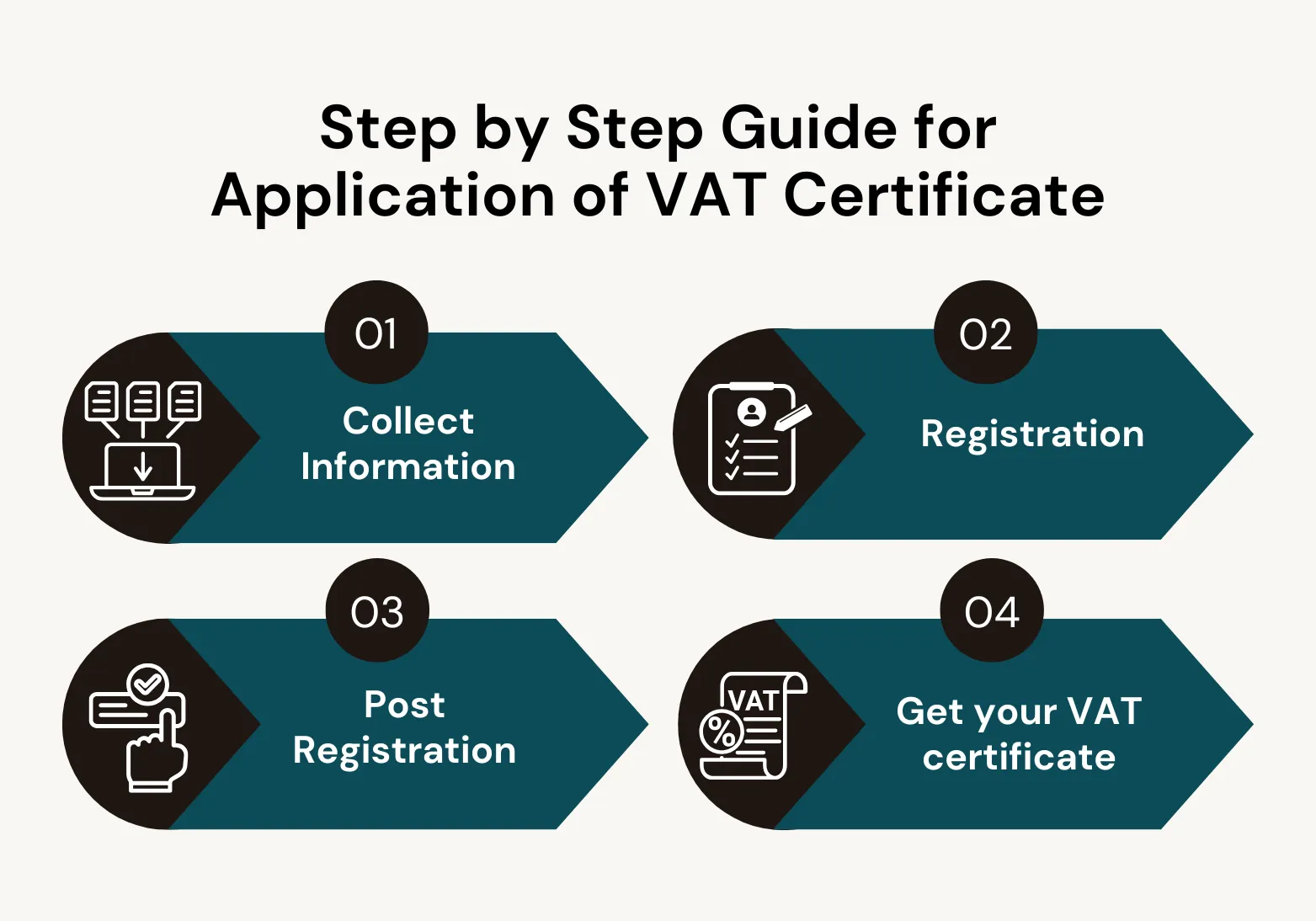
    Step by Step guide for application of VAT certificate

    “How do I get a VAT certificate” is the question you might be thinking now. Here is a step-by-step guide for applying for a certificate of VAT.

    Step 1: Collect information

    The information depends on the type of your company.

    Limited company:

    For the limited company you need:

    • Registration number of company
    • Bank account details of company
    •  Unique Taxpayer Reference
    • Annual turnover details
    • Self Assessment
    •  Corporation Tax
    •  Pay As you Earn (PAYE)

    Individual or Partnership:

    As an individual or partnership, you’ll need:

    • National insurance number
    •  Identity document (passport/driving license)
    •  Bank account details of yours
    • Annual Taxover details
    • Unique Taxpayer Reference (UTR)
    •  Self-Assessment
    • Your payslip
    • P60

    step by step guide fo application of vat certificate

    Step 2: Registration

    Register online

    After you have the information, you have to register on the HMRC website. Here you’ll need

    • Government gateway user ID
    • password

    You then fill out the forms as required for your company.

    Registration by Post

    There are some cases in which you cannot apply online. For them, the registration will be done by post. Some of these cases are:

    •  If you need a registration exception. This application may be because your turnover is temporarily above the value of £90,000.
    • If you have to register different divisions of your business for different VAT registration numbers separately.
    •  If you have to register an overseas partnership

    Registration through agent

    You can apply for registration using accountant services. Your VAT returns will be submitted by them. They will also deal with HMRC. Getting your HMRC VAT certificate is their job.

    Contact us for VAT registration.

    Step 3: Post Registration

    After registering, you’ll get the following by post:

    • A VAT registration number that has 9 digits (to be mentioned on all invoices)
    • Instructions to set up your account
    •  Information about submission of first VAT return and payment
    • Registration date confirmation

    Step 4: Get your VAT certificate

    Once you receive the VAT registration number, do this:

    • Sign in to the account of Government Getaway.
    • Select the options of “Add a Tax, Duty, or Scheme”. Access the MTD enrolment option.
    • An option about viewing your VAT account is present here. Choose this.
    • Now choose “Manage your VAT”. 
    • Here, you’ll see an option. It allows you to view your VAT certificate. Choose that.

    Keeping VAT registration up to date

    You must keep your information up to date. If changes happen, HMRC should be informed in 30 days.
    These changes can include

    •  Contact details of business
    • Details of bank
    • Information such as the name of the business
    •  Dates of return

    If you don’t change your VAT registering information by the due date, you may have to pay fines and fees. It depends on the situation, the fine for registering late can be anywhere from 0% to 100%.
    Fines apply in failure of opposite two. This means that VAT registration should be called off in 30 days of returns falling below the required value.

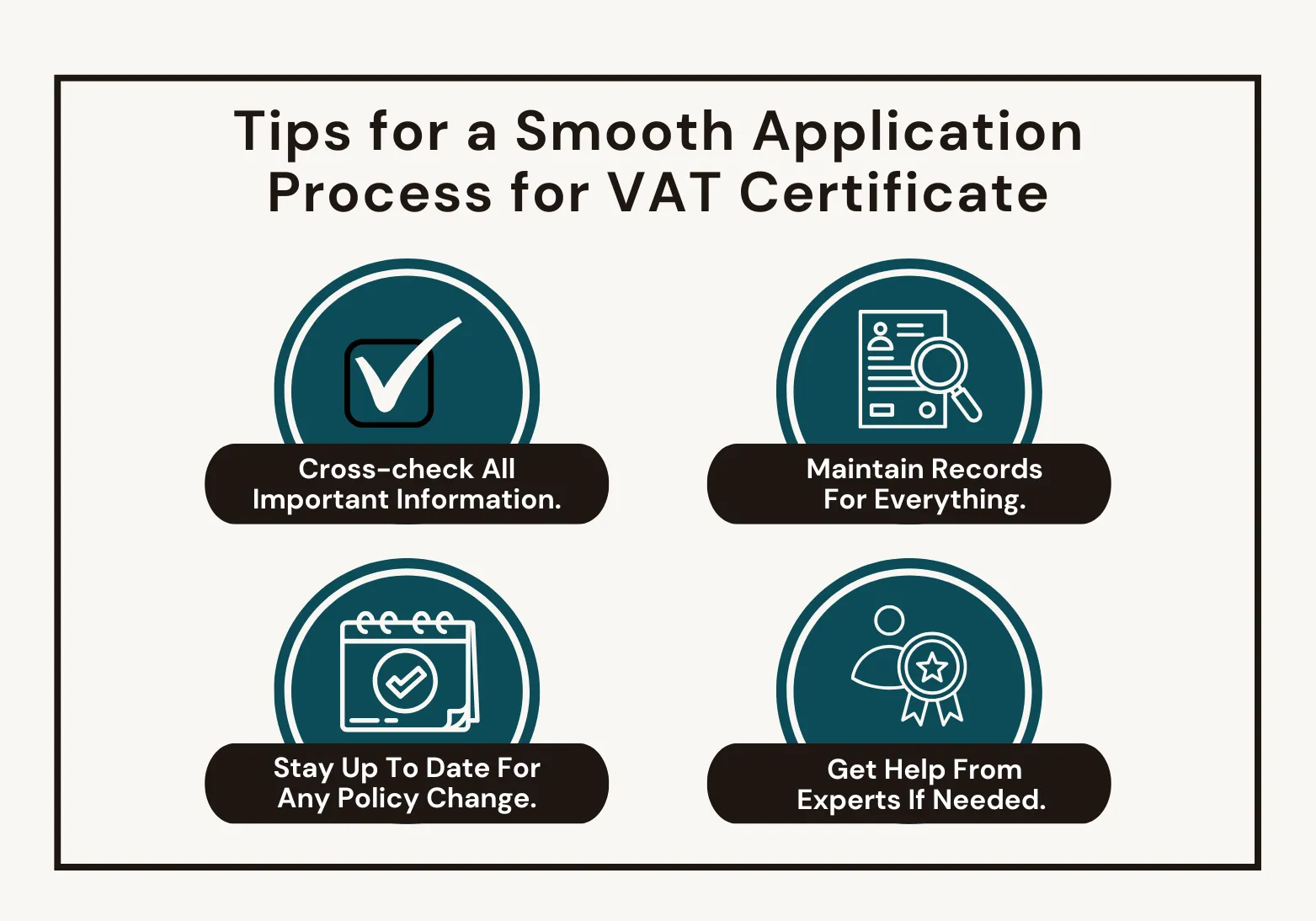
    Tips for a smooth application process

    You can follow these tips to ensure your application for the certificate is a smooth process.

    • Cross-check all important information.
    • Maintain records for everything
    • Stay up to date for any policy change.
    • Get help from experts if needed.

    tips for a smooth application process for vat certificate

    Contact Sterling Cooper Consultants for expert advice

    VAT registration can be tricky. Whether you have an established company or you are just starting, get advice from us. We, at Sterling Cooper Consultation Limited,  are aware of the importance of this important document.

    We offer you practical advice on getting your registration and certificate. So, for all your VAT-related queries, contact us now!

    Need help with VAT registration?

    Sterling Cooper Consultants Limited offers professional guidance to make the VAT certificate process easy and hassle-free. Whether you’re registering for the first time or updating details, our experts are here to assist you.

    +443300102526
    Book an Appointment

    FAQs


    Can VAT registration be canceled?


    Yes, if the turnover of your company falls below the threshold value.


    Yes, you need a VAT certificate to trade internationally.


    For this, you should go to the VIES website. Enter the VAT number of the business to be verified. Choose the country code. (GB for the UK). Select Verify.


    Provide the ‘agent authority’ on your account. The accountant will be able to see that after this.


    For this, you need more proof than a VAT certificate. Contact HMRC. Request a “Vat Certificate of Status” from them.

    Share This Article!

    Recent Posts

  • How to Become a Bookkeeper in 2025: A Step-by-Step Guide

    How to Become a Bookkeeper in 2025: A Step-by-Step Guide

    How to Become a Bookkeeper

    Posted by:

    Admin

    Date:

    April 9, 2025

    Category:

    blogs

    Error: Contact form not found.

    How to Become a Bookkeeper in 2025: A Step-by-Step Guide

    Bookkeepers keep the finances in order. A bookkeeper’s job is to keep track of and record all of a business’s financial events. These include payments, invoices, purchases, and costs. Bookkeepers are a useful addition to most businesses. Owing to their absolute importance, bookkeeping is a smart career choice. So, to choose, it is vital to know how to become a bookkeeper.

    What does a bookkeeper do?

    Some of the jobs that bookkeepers do are

    • Entering data
    • Posting financial transactions
    • Tracking of credits and debits
    • Creating financial reports
    • Monitoring records
    • Producing invoices

    Get in touch with bookkeepers at sterling cooper for these jobs.

    “Bookkeeping is made up of the identification of transactions, classifications, summarisation, storage, protection, reportage, and maintenance of financial records for the preparation and presentation of financial accounts”.

    Vincent Adela

    Here is a step by step guide to know how to become a bookkeeper in the UK.

    Step 1: Get the Qualifications

    Education

    If you are wondering how to become a bookkeeper, you need basic qualifications first. You might not need the typical advanced degrees. A high school diploma is enough to start the job.

    You might have an edge over other jobseekers if you know more about accounting. This includes how to do taxes, report finances, and use accounting tools.

    A degree in business or accounting can be helpful.

    It is not always mandatory but can be useful.

    Tool / Software What It Does Example Platforms
    Cloud Bookkeeping Store and update your books online QuickBooks, Xero
    Invoice Scanning (OCR) Turns paper receipts into digital data Dext, Hubdoc
    Bank Feeds Connects your bank account so transactions show up automatically Xero, Sage

    Certifications

    Another thing that can enhance your chances is certifications. Employers may be able to tell from your skills that you know a lot about the job. If you are looking for how to become a bookkeeper in the UK, you can get

    • The Association of Accounting Technicians.(AAT) Licensed Bookkeeper:

    There are three levels. You get awards and certificates based on these levels.

    •  AATQB status:

    This is the membership of the AAT organizations. It has increases the chances of getting hired by 11%.

    For someone wondering how long to become a bookkeeper, it depends on the lengths of these courses.

    Software

    You can always learn the software, tools, and processes on your own. This can be beneficial to proceed in the process. Learning accounting software can be useful. 

    These are 

    • Sage: 

    A software made for small businesses and entrepreneurs. It simplifies accounting processes. 

    • Quickbooks: 

    Software designed for medium and small businesses. It manages finance of the business

    • Xero: 

    A software marketed for bookkeepers and accountants. Also used by small businesses and sole traders

    Step 2: Get the skills

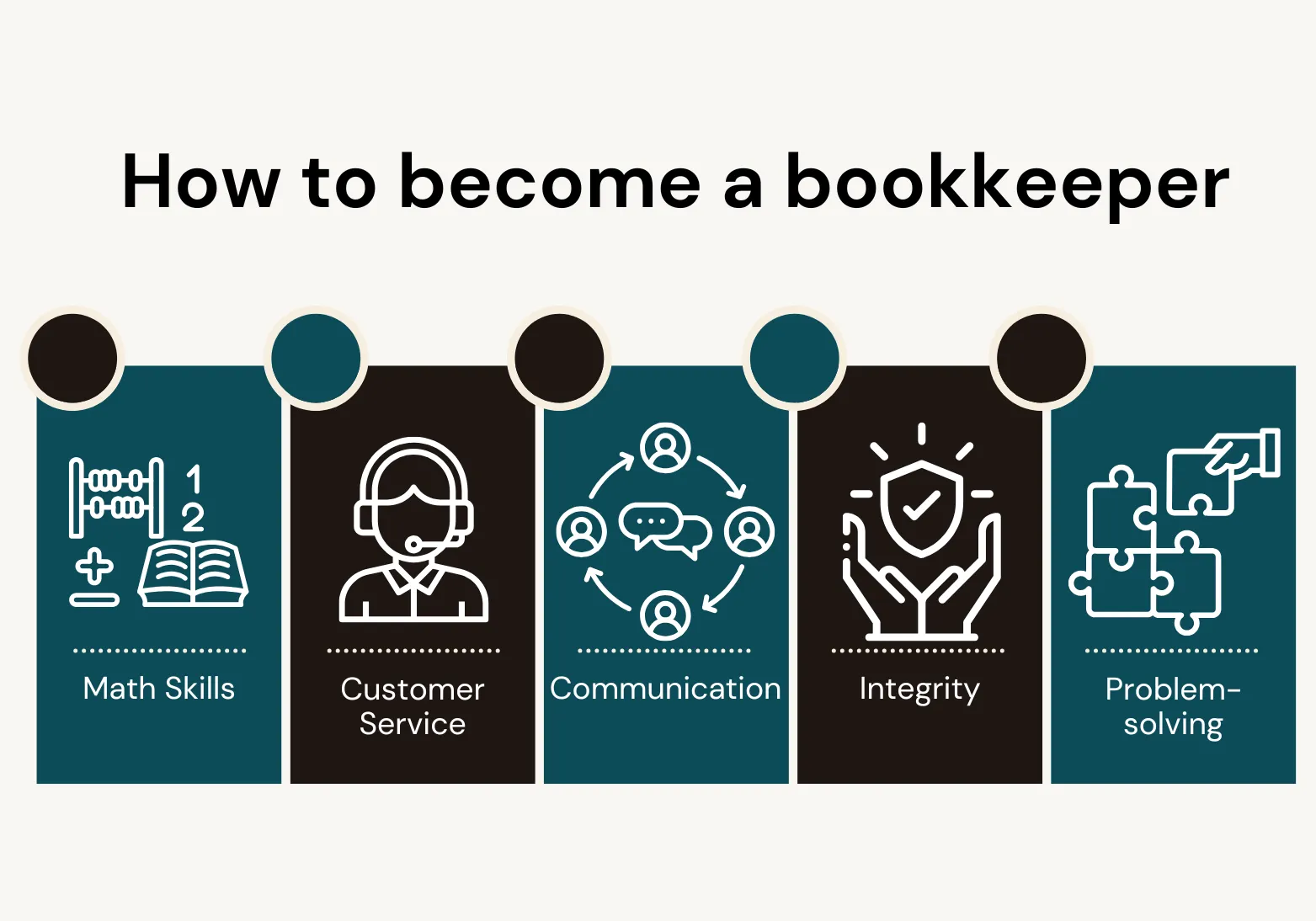
    Besides, having relevant education, there are other keys to success. If you have to learn how to become a bookkeeper, here are some skills.

    • Math Skills

    Basic math skills are a great skill to have. Computers do most of the math. Still having basic skills is an advantage.

    • Customer Service

    A lot of the job of bookkeepers involves customer service. They have to schedule consultations and manage operations.

    • Communication

    Bookkeepers have to explain difficult concepts to clients. The clients may not know finance. So, bookkeepers have to simplify and translate.

    how to become a bookkeeper

    • Integrity

    You need to keep the data of the company private. So, if you want to know how to become a bookkeeper in the UK, you need to have integrity.

    • Problem-solving

    When wondering how to become a bookkeeper, you should look for problem-solving. There might be numbers to untangle. You should be able to spot them without panic.

    So how long does it take to become a bookkeeper? The mixture of skills and qualification tells that.

    Step 3: Evaluate the Salary of Bookkeeper

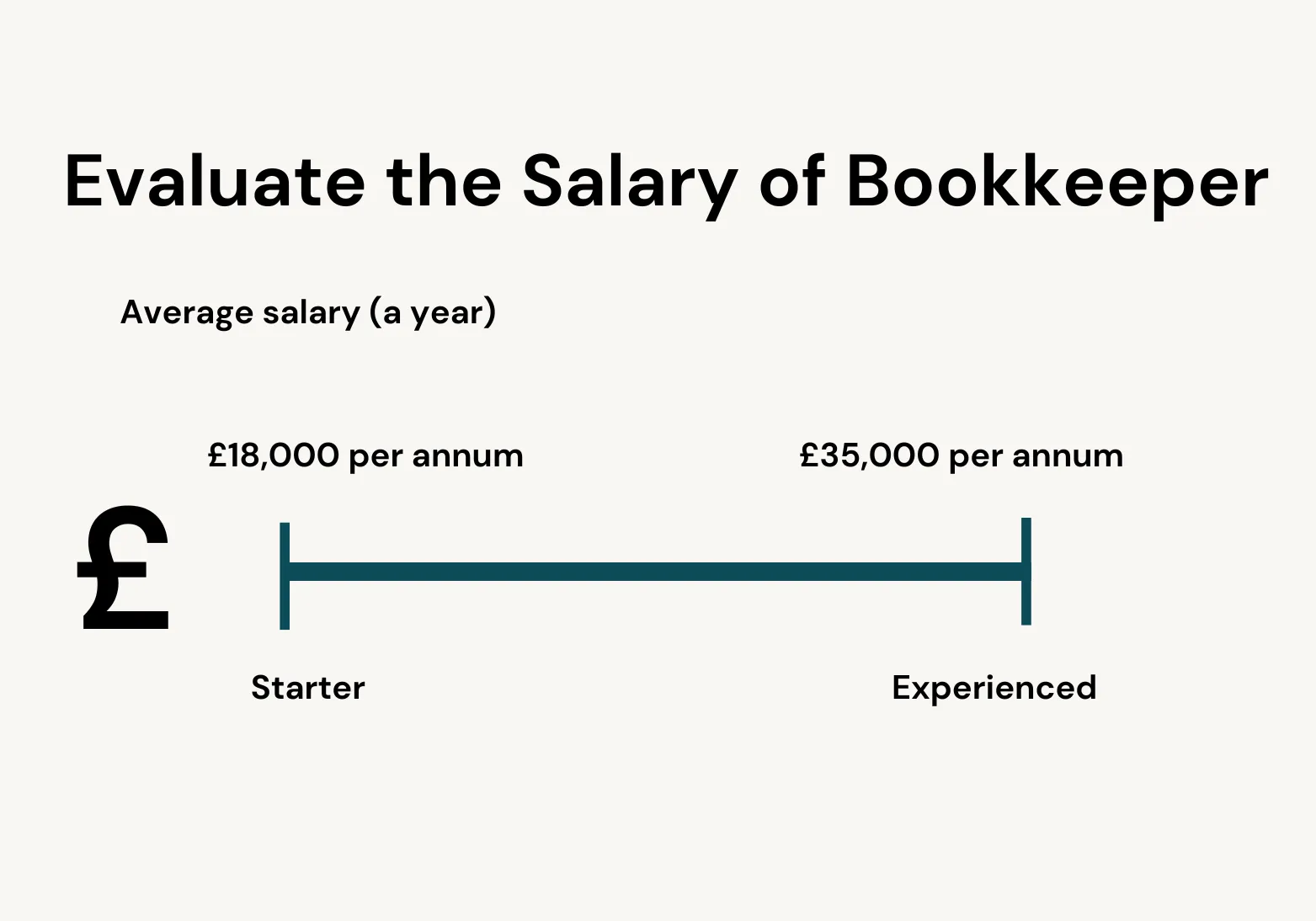
    The salary of bookkeepers varies by experience.

    Starters

    It is important to know what you will earn in the start when you learn how to become a bookkeeper.

    The average salary of starter bookkeepers is £18,000 per annum according to the government of the UK.

    Experienced:

    The salary for experienced bookkeepers is £35,000 per annum.

    Other factors affecting salary

    Some of the factors that affect salary are:

    • Industry demands
    • Qualifications
    • Track record

    evaluate the salary of bookkeeperr

    Step 4: Know Timings for a bookkeeper

    Bookkeepers usually work a 37–39-hour week. The usual time is 8 am to 6 pm. They might need to spend a few extra hours if there is more load. Sometimes, bookkeepers work on weekends too.

    Unlike some other finance jobs, bookkeepers do not need to work very long hours. Pulling a night’s worth of work is unlikely,

    Long hours, thus, are not your worry if you are learning how to become a bookkeeper.

    Step 5: Know the Difference in Accountant and Bookkeeper

    It is the job of a bookkeeper to enter deals into the system. This is an important part of accounting in general.

    The trial balance is often given to an accountant by a bookkeeper. It is a compilation of all the general ledger accounts. 

    The accountant utilises this information to create the Balance Sheet and Income Statement. The Statement of Cash Flows is also prepared by this.

    The foundation for accountants’ analysis is laid by bookkeepers, to put it one way.

    Bookkeepers use built-in data processing tools to help prepare financial statements.

    They also preset transaction classification to increase the speed of transaction recording.

    Accountants use this data for analysis. 

    Step 6: Explore Careers and Jobs for Bookkeeping

    Once you have the right qualifications, skills and information, you’ll have many opportunities.

    You can be a: 

    •  Freelance Bookkeeper: You can work periodically.
    • Virtual Bookkeeper: Work remotely using online services. 
    •  Agency Bookkeeper: Work with a bookkeeping agency. Large businesses hire them.
    • In-house Bookkeeper: A business may hire you as this for their bookkeeping.
    • Specialized Bookkeeper: You can work with a particular business or model.

    Most financial firms offer bookkeeping services. They help their clients keep track of their transactions. They are also useful for organizing information such as payroll, reports, etc. So, you can make your career with them. 

    Get Expert Bookkeeping Services with Sterling Cooper Consultants

    Sterling cooper consultants limited offers the best bookkeeping services for your  business. Our bookkeepers cater to your needs. Make an informed decision and contact us now. 

    Struggling to Keep Your Finances in Order? Let the Experts Handle It!

    At Sterling Cooper Consultants Ltd, our certified bookkeepers offer precise, HMRC-compliant bookkeeping solutions tailored to your business needs.

    +443300102526
    Book an Appointment

    FAQs


    How to start being a bookkeeper?

    Pursue a high school degree. Obtain relevant courses and experiences for better chances.

    You need to put in time to thoroughly and accurately complete all the tasks.

    College courses take 1-2 years. Online courses are a lot quicker.

    Bookkeepers work around 40 hours a week. They align with a standard full-time schedule.

    Industries like retail, manufacturing, and construction that have complex transactions need bookkeepers.

    Share This Article!

    Recent Posts