Author: admin

  • Understanding s455 Tax: When HMRC Taxes Your Company Loans

    Understanding s455 Tax: When HMRC Taxes Your Company Loans

    s455 tax

    Posted by:

    Admin

    Date:

    February 27, 2026

    Category:

    blogs

    Error: Contact form not found.

    Understanding s455 Tax: When HMRC Taxes Your Company Loans

    Did you ever consider borrowing money from your own company, hoping to pay it off without any trouble? In case you borrow as a private business, and you fail to pay it within nine months, your company will be liable to S455 tax.

    The S455 tax, as of 2026, is 33.75% of the remaining loan balance. The company is liable to payment of this tax to the HMRC. This tax aims to prevent company owners from avoiding personal tax through company loans. It is the reason it has this tax and every director must know how it operates before withdrawing money in their business.

    What Is S455 Tax?

    S455 tax is a transitional tax that an individual is charged in case a director or shareholder obtains money borrowed out of his company and fails to repay it within the required time. The charge is not charged on an individual but on the company in the case of the loan taken by the director.

    The tax is applicable in case loans are extended to the participators. A participator is normally a shareholder or a person who possesses control of the firm. This normally translates into directors who are also shareholders in the business.

    When you are a director and shareholder, and you borrow money out of your company, S455 corporate tax may take effect. Whether it was a formal or informal loan does not matter. Even personal bank money obtained casually and not in the form of salary or dividends can be considered a director loan.

    Who Does S455 Tax Apply To?

    We must talk about a couple of terms before we begin to discuss situations in which S455 can be applied.

    • Close companies: A close company according to the Corporation Tax Act 2010 is a company that is governed by fewer than five participators. These are normally small businesses or family owned enterprises. The majority of these corporations fall under S455 net.
    • Participators: A participator is a person who is a shareholder in a close company.

    S455 may apply in case a participator is borrowing the loan from the close company. Whether the loan was a formal or an informal loan is irrelevant. Even the money exchanged casually with your personal bank account can be considered as a director loan unless it is salary or a dividend.
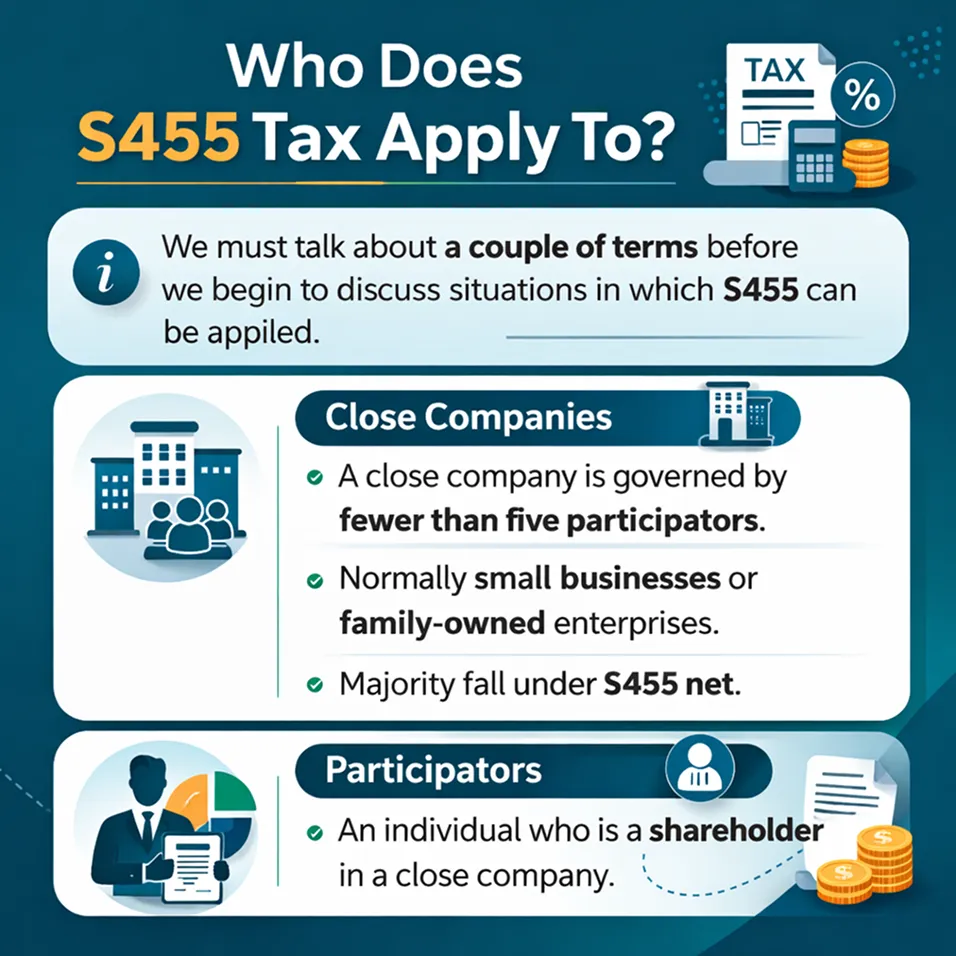
    Who Does S455 Tax Apply To

    When Is S455 Tax Due?

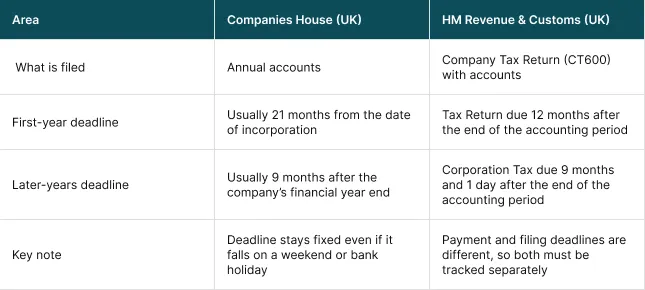
    The question that many directors ask is when does S455 corporate tax become due. Rules of timing are quite strict and have to be followed. The loan should be repaid within a period of nine months and one day once the accounting period of the company is over.

    In case the loan remains unpaid after the deadline, the tax is due. It is paid along with Corporation Tax of the company. This implies that it has to be paid between nine months and one day since the accounting year is complete. You may be subject to penalties if you fail to do so.

    To learn more, check out our guide on late tax penalties and how to avoid them.

    As an illustration, assume that your firm has an end of year date of 31 March 2025. The last date of repayment would be 1 January 2026. At the end of that date, when the loan is not cleared, S455 is imposed, and must be paid to HMRC.

    S455 Tax Rates Explained

    The rates of S455 corporate tax will have to be understood since the percentage will be substantial. The prevailing rate is 33.75 percent of the outstanding balance on the loan. This rate is equivalent to the increased rate of dividend tax which eliminates the tax benefit of borrowing rather than making dividend declaration.

    In the instance below, when a director owes such sum to the company as £30,000 at the deadline, the charge on s455 would be 33.75% of such sum. That is equal to £10,125, which the company will be paying to HMRC. This is a huge sum of money that may have an effect on the cash flow of the business.

    The regular rates are very high and hence the advice of most accountants is that directors need to repay the loans way ahead of the due time. The tax is technically a temporary one but the money can be locked away for years before it is returned.

    Why S455 Tax Exists

    To deter tax avoidance, the government came up with the S455 tax. In its absence, directors are likely to borrow big amounts of money within their company rather than dividend. They would be able to postpone the payment of personal tax over a long period of time and this would lower the government taxes.

    HMRC erases that benefit by levying S455 corporate tax. In the case you do not pay the loan, the company pays a tax which is like the tax you would have paid on a dividend had you paid the loan. This makes the tax system just to all.

    Simply put, S455 tax prevents individuals from using company loans in order to avoid or defer tax. It promotes the right practices of paying like salary using PAYE or reported dividends.

    How Director’s Loans Work

    A loan between a company and its director occurs when funds are transferred between the company and the director other than as payroll or dividend. In case the company owes you money, no tax is applied. But when you are owed money to the company, then that gives a director a loan balance.

    Any company is supposed to have a Director Loan Account (DLA). It is an account that documents the amount of money borrowed or paid. It is similar to running total in that it indicates whether the director is in debt to the company or vice versa.

    One of the key reasons why S455 tax issues occur is because of poor record-keeping. Unless accounts are regularly updated, the directors might not be aware of having such a large outstanding balance.

    What Happens After Repayment of the Loan?

    The positive thing is that the S455 tax is short-lived. In case the loan is finally re-paid, the company is able to claim tax paid. This is referred to as reclaiming the S455 corporate tax.

    Nonetheless, the refund is not immediate. The guidelines have waiting times that might postpone the refund of the money. This implies that the funds of the company may take a long time before being refunded to HMRC.

    Even though the reclaiming is feasible, it is much more preferable not to avoid the charge at all. It is always better said than done.

    Reclaiming S455 Tax: How It Works

    The question many directors will pose is how it is possible to recover S455 tax after payment of it. Once the loan has been repaid, the company will be entitled to receive the S455 corporate tax refund. Nevertheless, this assertion cannot be done immediately after repaying.

    You should wait a period of nine months and one day following the date that the accounting period of repayment of the loan ended. This is when it can reclaim tax on a formal basis. The delay is usually unexpected by the directors who are eager to get back their money fast.

    To illustrate, when the firm paid S455 corporate tax in the year 2026, and the loan was repaid in 2027, the tax refund claim may not be filed until 2028. That implies that the cash may be tied up for several years.

    How to Reclaim S455 Tax Stepwise.

    When reclaiming S455 tax, a number of steps are used. First, you should make sure that the loan is completely paid and that it is duly carried in the books of the company. To have a successful claim, there must be clear documentation.

    Then draw revised financial statements of the repayment. The amended Corporation Tax return or a given form of claim may have to be offered to HMRC by the firm itself. This part will be normally performed by your accountant.

    Last but not least, file the claim and await HMRC to make the tax refund. It is the company, and not the director himself, that is paid a refund. Good record keeping simplifies the process of reclaiming the tax.

    The 30-Day Rule and Anti-Avoidance Rules.

    HMRC has also provided regulations to ensure that the directors are not able to repay loans on a temporary basis and take a loan very soon. This is referred to as bed and breakfasting. This was previously used to evade the S455 corporate tax.

    HMRC may disregard repayment of the amount £5,000 or more repaid by a director, and re-borrowed within a period of 30 days. That is where tax is applicable. This regulation avoids the manipulation of the time of repayment.

    These anti avoidance measures demonstrate that HMRC is extremely attentive to directors’ loans. Attempting to fool the system will mostly result in reprimand and further investigation.
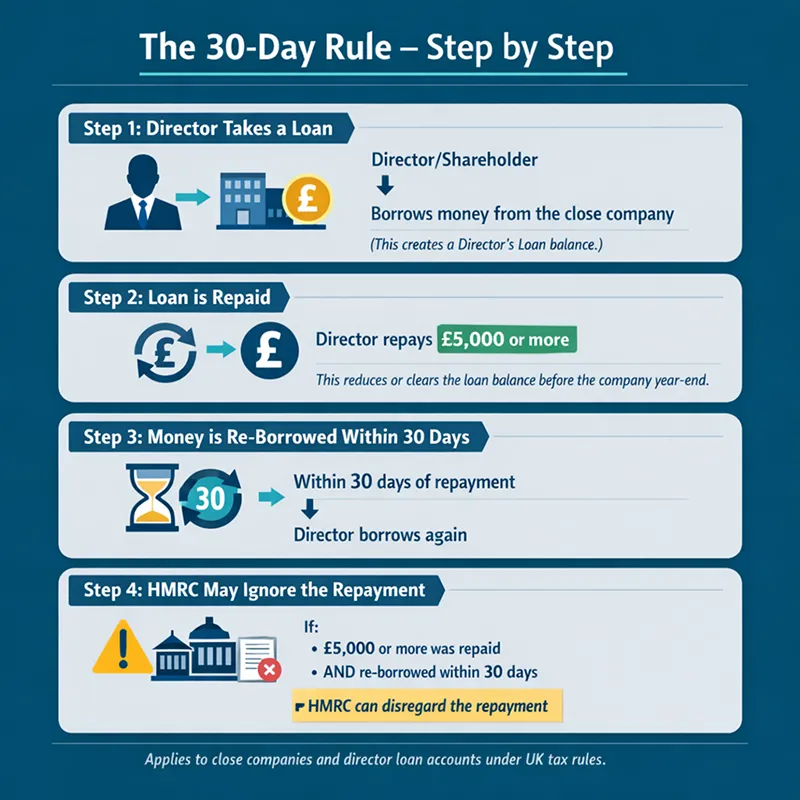
    The 30 Day Rule and Anti Avoidance Rules

    Common Mistakes Made by the Directors.

    There are numerous directors who activate S455 corporate tax unintentionally. This is an easy mistake to make because the Director does not check the Account of Loan to him regularly. Small withdrawals will accumulate to big balances in the long run.

    The other error will be the confusion between dividends and loans. Without appropriate declaration of dividends by way of board minutes and paperwork, withdrawals will be considered as loans by HMRC. This may suddenly cause taxation.

    Lastly, there are directors who lose sight of the 9 month deadline. The failure to make the date puts an automatic charge on the tax although the repayment can be made later.

    Smart Ways To Avoid S455 Tax

    Maximising the way to evade the S455 corporate tax is through planning. Automatically paying yourself a structured salary under the PAYE will take care of taxes. Dividends should be declared in the right way, official paperwork will also help avoid confusion.

    It is necessary to have regular bookkeeping and review of the Director Loan Account on a monthly basis. Balancing at all times will ensure that you work to meet deadlines. There is less risk of errors because of clear communication with your accountant.

    When there is a lack of cash flow, then consult an expert before borrowing huge amounts. Several minutes of a conversation will save many years of delayed refunds and unnecessary stress.

    Who Does S455 Tax Apply To

    Related: Top Tax Saving Tips.

    Conclusion

    S455 tax is paid in cases where directors leave loans beyond the limits without any payment. The existing tax rates are at 33.75 and that may be a big source of cash flow strain. The waiting time of tax refund can be quite frustrating, though it can be recovered.

    The knowledge of what S455 tax is, when it is due and how to reclaim it gives you the control of business finances in your hands. At Sterling Cooper Consultants, we understand that rules can be perceived to be strict but they are meant to ensure that there is fairness in the tax system. S455 corporate tax could be avoided with due planning and awareness.

    Knowing tax rules secures the cash flow. Contact us now to make better decisions for the future of your company.

    Worried about triggering S455 tax or waiting years for an S455 tax refund?

    Our tax specialists can review your Director’s Loan Account, calculate exposure, and help you stay compliant before deadlines hit.
    Get in touch with our taxation services today and protect your company’s cash flow before S455 tax becomes an expensive surprise.
    +443300102526
    Book an Appointment

    FAQs


    What Is s455 Tax And Why Does It Apply?


    s455 tax is a temporary Corporation Tax charge applied when a director or shareholder owes money to their company and does not repay it within nine months and one day after the accounting year end. It exists to prevent tax avoidance by discouraging long-term company loans instead of dividends.


    s455 tax is due nine months and one day after the end of the company’s accounting period if the loan remains unpaid. It is paid alongside the company’s Corporation Tax bill.


    The current s455 tax rates are 33.75% of the outstanding loan balance. This rate aligns with the higher dividend tax rate to remove any financial advantage from borrowing instead of taking dividends.


    Reclaiming s455 tax is possible once the loan has been fully repaid. However, the company must wait nine months and one day after the end of the accounting period in which repayment occurred before claiming the s455 tax refund from HMRC.


    The s455 tax refund is paid back to the company, not the individual director. The company must submit the appropriate claim to HMRC to recover the amount previously paid.

    Share This Article!

    Recent Posts

  • Understanding the 40% Tax Bracket in the UK

    Understanding the 40% Tax Bracket in the UK

    40 tax bracket

    Posted by:

    Admin

    Date:

    February 25, 2026

    Category:

    blogs

    Error: Contact form not found.

    Understanding the 40% Tax Bracket in the UK

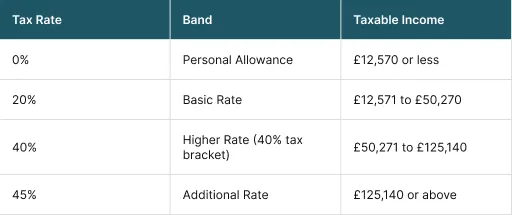
    Ever looked at a pay rise and felt underwhelmed? You just encountered the 40 tax bracket. The 40% tax bracket is the income tax applied to income between £50,271 and £125,140 for the 2025/26 tax year in the UK. Due to frozen tax thresholds until 2028, more and more people are entering this bracket.

    People hear “40% tax” and instantly think: ‘Do I lose 40% of all my money?’

    Short answer: No.

    Long answer: Keep reading and this guide will explain in simple terms..

    In this article, we’ll break down:

    • What the 40% tax bracket actually is.
    • When the 40% tax bracket starts.
    • What the 40% tax bracket 2025 looks like.
    • How much is the 40% tax bracket in real, take-home terms?

    What Is the 40 Tax Bracket 2025 to 2026?

    The 40% tax bracket is the higher rate of income tax in the UK. It only applies to the part of income taxable under this band.

    As a general rule:

    • You do not pay 40% on everything you earn.
    • You only pay 40% on the income above a certain threshold.

    Here is how the UK’s progressive tax system works:

    Table

    So the 40 income tax bracket sits in the middle, affecting higher earners but not ultra-high earners. 

    Related: 2025–26 Tax Year Updates: Understanding the Latest Changes.

    When will the 40 Tax Bracket Elevation begin?

    The starting point of 40% tax band is one of the most frequently posed questions. Under the present tax regulations:

    • The 40% tax bracket starts at £50,271.
    • It is imposed on top of usual tax free personal allowance and basic rate band.

    Thus when your taxable income goes beyond £50,270, you will be in the 40% tax bracket.

    How Much Is the 40 Tax Bracket?

    To compute the amount of 40% tax bracket 2025, it is important to know that it is only applied to the portion of the income that falls in the band. 

    For example,

    Assuming that the income is £60,000, then tax rate will be:

    • 0% for the first £12,570.
    • 20% for the next £37,700.
    • 40% for the last £9,730.

    It should be mentioned that the 40% tax rate is imposed only on the amount of income exceeding £50,270. It is not applicable to all income.

    Why the 40 Tax Bracket Hits Hard

    The 40% tax bracket is a progressive tax that targets the high earners to give their equitable share of tax. Nevertheless, it may be meaningful to a great number of individuals in this category.

    Here is why this happens.

    Nation Insurance Stacks above.

    The income tax is not all.

    In the 40 income tax bracket, you are also liable to:

    • NI 8% £12,570 to £50,270 (rates may change depending on reforms).
    • 2% NI above £50,270.

    Then in the 40% tax bracket your marginal deduction is:

    • 40% income tax.
    • 2% NI.
    • Total = 42%.

    Premium on each £100 over £50,270:

    You keep roughly £58.

    This mix has been referred to as fiscal drag because of frozen thresholds.

    Loss of Allowances Later on

    This is where technical knowledge comes in play.

    Between £100,000 and 1£25,140:

    • For every £2 of personal allowance lost is £1.
    • Any loss in allowance will increase the amount of your income that is taxable.

    This creates:

    • 40% tax on income.
    • Add 20% additional effect lost allowance.
    • Effective marginal rate of 60%.

    This does not fall under the 40% tax bracket but it falls within the tax bracket of higher rate.

    This is amongst the most misconstrued aspects of the UK tax system.

    Once you approach £100,000:

    • Your Personal Allowance begins to shrink.
    • The effective tax rate may reach 60%.

    That is well above the norm 40% tax bracket.

    The 40 Income Tax Bracket and How It Works.

    Not all of your income is subject to the 40 tax bracket. It is applicable to the portion that is above £50,000. The 40% band runs from £50,271 up to 1£25,140. Above £125,140, there is the 45% rate.

    Income greater than £100,000 is charged on other income less £12,570 tax-free allowance, which then falls to zero at £ 125,140.

    Taxable income may be minimised by pension contribution and charitable donations which may ensure that earnings are not over 40.

    Tax Reduction in the 40 Tax bracket.

    It can be overwhelming for the 40% tax bracket. Nonetheless, it can be reduced or mitigated through the law.

    Pension Contributions

    The taxable income is decreased by pension payments. It is a tax saving of 40% in £1 to pension. Making a contribution to a pension lowers taxable income.

    This constitutes one of the strongest tools to individuals in 40 income tax bracket.

    Salary Sacrifice

    You are able to trade in part of your salary with non-tax benefits.

    Common for:

    • Pensions.
    • Electric cars.
    • Childcare.
    • Pre-taxes taxable compensation.
    • Gift Aid Donations

    Gifts increase your fundamental band. It assists you to reclaim a higher tax relief. Donations to charity are subject to Gift Aid, which means that the charity receives a refund of taxes on the gift and you are subject to less taxation.

    Marriage Allowance (limited cases)

    You can transfer certain of your assets to a spouse who is in a lower tax bracket. Only when one of the partners makes a low income than the allowance. Not always helpful in earners in 40% tax bracket but worth considering. 

    Individual Savings Accounts.

    Money invested in individual savings accounts or ISAs could ensure that the money earned is not subjected to net income tax and capital gains tax.

    Tax Credits

    You can also invest in mutual funds or pensions which can help you to cut your tax bill.

    Child Benefit and the 40 Tax Bracket.

    You also pay the high-income child benefit charge in case you have a yearly income of above £50,000, plus receive child benefit.

    Example:

    Assuming that you earn £55,000 and have child benefit. You have to pay some of it back with self-judging. The benefit is recovered by £60,000.

    When this charge is added to £50,000-£60,000, your effective marginal rate can be more than 50%.

    This cross ring with the 40 tax bracket 2025 gives even more importance to tax planning.

    Dividend Income and 40 Tax Bracket.

    The taxation on dividend income is different as compared to salary. Under 40 income tax bracket, the after dividend allowance dividend tax is 33.75%.

    Example:

    When you earn £5,000 in dividends and you are already on the 40 tax bracket, a big percentage of your dividend will be taxed at 33.75%.

    This is one of the factors that business owners have to take into account when making the choice between the dividends and the salary.

    The Higher Rate Taxpayers and Capital Gains Taxpayers.

    Capital Gains Tax is also dependent on your income band.

    Assuming that you are in the 40% tax bracket:

    • Property gains are taxed at 28%.
    • Other gains are taxed at 20%.

    Example:

    Assuming that you are a higher-rate taxpayer and sell shares of a £20,000 gain, you can pay tax on the excess of the allowance at 20%.

    Does Everyone Pay the same 40 Tax-Bracket 2025?

    In the UK, not all people are subjected to the same tax bracket of 40%. The taxes depend on the total income, deductions, and personal allowances. They also rely on the regional regulations. The 40 tax bracket is 2025-2026 and is applicable to England, Wales and Northern Ireland according to HMRC rules.   

    Scotland and the Higher Rate

    Scotland has various rates and levels. They possess less regressive 6 bands of taxation. 

    Example:

    A Scottish taxpayer may enter their higher rate tax band at a lower income level than someone in England.

    While the structure is still progressive, the specific figures differ. Always check the regional rules.

    Conclusion

    The 40% tax bracket is a progressive tax measure aimed at bringing high earners under a fair tax system. For many, it may seem intimidating, but once you know how it works, it becomes easy to deal with.

    The key things to remember:

    • You only pay 40% on the portion above the threshold.
    • The 40 tax bracket 2025 still begins at £50,271.
    • Smart planning can significantly reduce your real tax bill.

    Pension contributions, salary sacrifice schemes, dividend planning, and proper structuring can all make a major difference. Small adjustments can legally save thousands over time.

    That’s where we come in. At Sterling Cooper, we help individuals and business owners navigate the 40 income tax bracket with clarity and precision. Contact us now to turn your tax planning from a burden into an advantage.

    Want to reduce what you pay in the 40 tax bracket and keep more of what you earn?

    Speak to our taxation services today and get a clear, practical tax plan tailored to your income.
    +443300102526
    Book an Appointment

    FAQs


    What Is The 40 Tax Bracket In The UK?


    The 40 tax bracket is the higher rate of income tax in the UK. You pay 40% tax on income between £50,271 and £125,140 (based on the 40 tax bracket 2025 rules).


    The 40 tax bracket starts once your taxable income goes above £50,270. Only the portion above that threshold is taxed at 40%.


    You pay 40% only on the income within the higher rate band. It does not apply to your full salary, just the part above the basic rate limit.


    Yes. Pension Contributions, Salary Sacrifice Schemes, and Gift Aid Donations can reduce your taxable income and lower how much falls into the 40 tax bracket.


    It applies in England, Wales, and Northern Ireland. Scotland has different income tax bands and rates.

    Share This Article!

    Recent Posts

  • A Complete Guide to Wealth Tax in the UK

    A Complete Guide to Wealth Tax in the UK

    Wealth Tax

    Posted by:

    Admin

    Date:

    February 24, 2026

    Category:

    blogs

    Error: Contact form not found.

    A Complete Guide to Wealth Tax in the UK

    Wealth tax has become one of the most debated topics in UK fiscal and social policy. With rising inequality, a growing public finance gap, and vocal calls from politicians, many people are asking the same question: should the UK introduce a wealth tax?

    Economists and policy commentators have diverse opinions. Some of them say that it will balance the economy. Did you know that only a 2% wealth tax can raise £160bn in around 30 years? 

    However, some economists warn that it will be complex and difficult to design, administer and apply. This guide breaks down everything you need to know about taxes in the UK.

    You will learn  what a UK wealth tax is, how it could work in the UK, why it’s being proposed, where it’s controversial, and what alternatives exist.

    What Is a Wealth Tax?

    A wealth tax is a levy on the total value of a person’s assets, minus any debts. Unlike income tax or capital gains tax, which apply to flows of money (income earned or profit realised when selling an asset), a wealth tax is charged on the stock of assets someone holds.

    These assets include property, investments, bank balances, business interests, pensions, luxury goods, and other forms of wealth. These taxes are applicable to people having a threshold of around  £10 million and a rate between 1-2%.

    Does the UK Currently Have a Wealth Tax?

    No, the UK does not have a tax that currently applies to overall net worth.

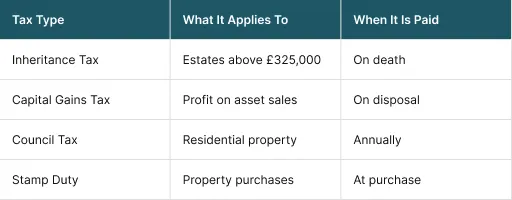
    Instead of a single wealth tax UK system, the country relies on separate taxes on assets, gains, and transfers. These taxes raise substantial revenue, but they do not treat all types of wealth consistently.

    How Does a Wealth Tax Work in the UK?

    There is no direct tax on overall net worth. Instead, the UK has different wealth-related taxes. Following is how a wealth tax works in the UK.

    Table 1

    Rather than reflecting an individual’s total wealth over time, these taxes apply on specific moments such as sales, transfer and death. 

    Wealth-Related Taxes in the UK 

    The following is the details of the taxes in the UK.

    1. Inheritance Tax

    The most common tax in the UK is the inheritance tax, which applies to acumulated wealth. The criteria of this tax are 40% on the estates and it should be above the value of £325,000 when a person dies. 

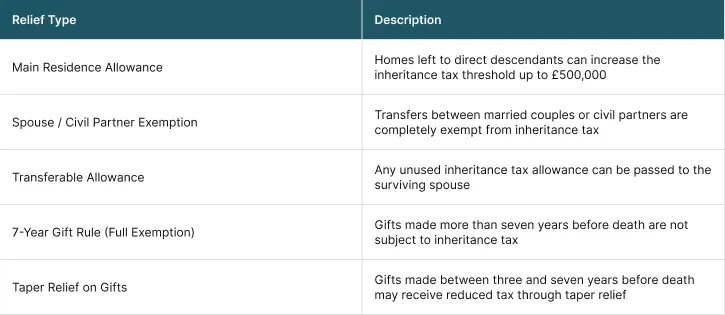
    There are some reliefs which are as follows:

    Table 2

    In the 2024 budget, the government of the UK announced amendments regarding agricultural and business property reliefs. Businesses and farms are now taxed at 20% above a higher threshold of £1 million. 

    2. Capital Gains Tax

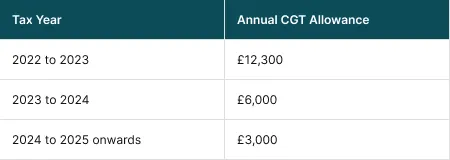
    Capital Gains tax applies when you sell an asset for more than its cost. Gains above an annual allowance of £3,000 are taxable. 

    Losses can be balanced against gains, and no CGT is payable on the sale of a main residence.

    Tax rates depend on income level and also asset type:

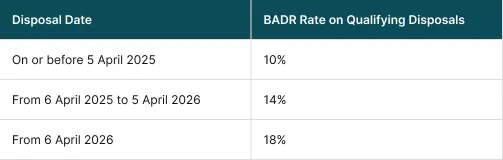
    •  18% for basic-rate taxpayers
    •  24% for higher and additional-rate taxpayers
    •  32% on carried interest

    Historically, capital gains were taxed at similar rates to income tax. Today, even after recent increases, CGT rates remain lower than income tax rates.

    3. Council Tax

    An annual property-based tax is the Council tax in the UK. It is charged on properties in England, Scotland and Wales. This tax is used for the public services such as street lighting, libraries, youth clubs, parks and care services. 

    In the year 2024-25, council tax raised an estimated £47.7 billion. Making it one of the largest property-related taxes.

    4. Property Transactions Tax

    Property transactions are heavily taxed in the UK, mainly through stamp duty land tax.

    Stamp duty applies when you are purchasing property, especially for higher-value homes and additional properties. In recent years, it has raised around £15 billion annually.

    While these taxes raise large sums, they only apply at specific moments. Such as when a property is bought, sold, or transferred, rather than reflecting ongoing wealth.

    Why Does the UK Need a Wealth Tax?

    Introducing UK wealth tax is a widely debated topic nowadays. It is not like the headline news, but there are some structural factors behind it.

    The following are the factors:

    • The wealth inequality gap between the rich and the poor.
    • After years of spending, the government’s got a huge bill to pay, especially during the pandemic.
    •  Because of frozen thresholds, people are getting into higher tax brackets.
    •  Money made from wealth gets off easier than money from work.

    One of the main reasons behind this tax thought is COVID-19. The government spent a lot to keep jobs and businesses afloat, and now the debt just sits there. 

    As a result, formal proposals for a wealth tax in the UK are now being discussed.

    What Does a UK Wealth Tax Achieve?

    Taxing wealth is not filling government reserves. It is twisted up with ideas about equality, democracy, and who really holds power. But whether it’s actually a good idea or not depends on what it actually gets, not what it says.

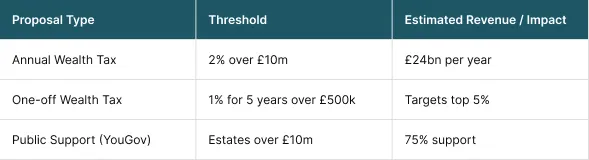
    There are different proposals by the proponents regarding this tax:

    • The plan of an annual tax of 2% on net worth above £10 million is a popular one. Researchers at the University of Warwick estimate it could raise £24 billion a year. 
    • The Wealth Tax Commission suggests a plan called a one-off tax. The criteria are 1% a year, for five years, with over £500,000 in assets. It will hit above the 5% threshold.

    Table 3

     These are not policies, just suggestions. No UK government said that we are doing this.

    Who Will Pay Wealth Tax in the UK?

    The wealthiest community is the  target. Individuals with net assets of £10 million or more are liable. Taxable assets include property, investments, jewelry, businesses and cash. Debts are not included.

    What Is the Public Opinion on Wealth Taxes?

    It might be a huge surprise for you that the public isn’t against it. Inheritance tax is hated for sure, but recent polling suggests favor on taxes on extreme wealth.

     Here is a current YouGov poll regarding wealth taxes (July 2025):

    • 49% of voters strongly support a 2% tax on estates over £10 million,
    • 26% backing it,
    • Only 13% are not in favor.

    Research shows that the majority of people are in favor of this tax system. They want to see higher taxes on extreme wealth.

    International Experiences With Wealth Tax

    This tax is very rare and many countries still do not have it. 

    Back in 1990, twelve developed countries had annual wealth taxes. By 2017, only four were left: France, Spain, Norway, and Switzerland. France has since cut its wealth tax down to just real estate.

    Many countries dropped these taxes because they were complicated and didn’t bring in as much money as expected. The cost of making people pay often ate up a big amount of the revenue.

    The global club of rich countries generally prefers broad taxes on capital income and transfers rather than wealth taxes. Still, policymakers admit that if you can’t tax capital income properly, a wealth tax might make sense.

    Administrative Challenges of the Wealth Tax

     Running it is a whole different beast from visualising. There are major challenges that would be faced by the administration. 

    Legislators have to figure out the following:

    • What counts as taxable wealth?
    • How do you actually value things like private businesses, art, or land?
    • Where do you set the threshold? What rates?
    • Do you tax individuals or households?
    • What about people who own a lot on paper but don’t have much cash?

     Some assets are easy to value, shares, bank accounts, but others not. Private businesses, jewelry, farmland, art, even a house that hasn’t sold in years, these are complicated. Arguments over value would be endless, expensive, and time-consuming.

    And a major concern is tax evasion. The higher the tax, the more incentive for the wealthy to shuffle their assets around. HMRC would be dumped a huge load and it would take years to get the system running efficiently.

    How Quickly Could a Wealth Tax Be Introduced?

    According to the UK think tank Institute for Government, it could take over four years to set up a proper wealth tax in the UK

    There’s a lot to do: 

    • Draft the rules
    • Hold consultations
    • Build political support
    • Write the laws
    • Set up the admin 

    You could rush it, but then you risk legal challenges, endless arguments over valuations, and a mass of unintended problems.

    Are There Better Alternatives Than a Wealth Tax?

    Most of the experts say the wealth tax UK should start by fixing the taxes it already has on wealth. Right now, there are loopholes: capital gains, income from assets, and inheritance are all taxed differently, often benefiting the wealthiest. 

    Following suggestions should be the possible fixes:

    • Making capital gains tax rates match income tax rates more closely
    • Reducing or removing some inheritance tax breaks
    • Updating council tax
    • Doing a better job, taxing investment income

    These measures could increase revenue and improve fairness without introducing a new tax system. 

    How Should the UK Tax Wealth Work?

    The real challenge is designing policies that actually work, not just ones that sound big and exciting. This whole argument isn’t just about making more money. Wealth shapes who get ahead, who have power, who can afford a home, and who actually get a shot at opportunity.

    If we overlook it, wealth can chip away at trust in government and even cause chaos with democracy.

    The UK needs to tax wealth better. The real fight is over how to do it. For sure, a new wealth tax is possible. But in reality, it’s complicated, slow to roll out, and no one can guarantee it’ll actually work as planned.

    Changing the taxes we already have on income, gains, and transfers might get us to fairer results faster. This could make the whole system more open and easier to follow.

    Conclusion

    A wealth tax UK is not easy to implement because of the challenges. It could increase revenue, reduce inequality, and align public policy with what people want, but there are some significant obstacles. 

    Recent polls show political support because it hits the wealthiest public. But when you turn the page, messy reality is how to keep people honest, how to value the asset and the economic reactions.

    If the UK government and parliament want to implement this tax system, then complete measures should be taken. The tax system should be clear, well-designed and smooth to implement.

    Sterlingcooperconsultants understands the importance of a perfect proposal for the wealth tax. If you want a well-designed and easy-to-implement wealth stability tax proposal, contact us today.

    If you are exploring policy options, assessing impact, or seeking clarity on wealth taxation, our team can help you navigate the complexity with clear, evidence-based insight.

    Get expert insights, policy updates, and practical guidance by connecting with us today.
    +443300102526
    Book an Appointment

    FAQs


    What Is a Wealth Tax?


    A wealth tax is a tax levied on an individual’s net wealth rather than on income or spending. Net wealth usually includes assets such as property, savings, investments, shares, and valuable possessions, minus any debts or liabilities. Unlike income tax, which is paid on what you earn each year, a wealth tax focuses on what you own.


    Most proposals suggest it would only apply to very wealthy individuals, typically those with assets above a high threshold, such as £1 million or more.


    If introduced, a UK wealth tax would likely apply to individuals whose total net wealth exceeds a set threshold. Taxpayers would be required to declare the value of their assets, including property and financial holdings, regularly. The tax would then be charged as a percentage of that net wealth, either annually or as a one-off levy.


    Supporters argue that a wealth tax could help address growing inequality by asking those with the greatest financial resources to contribute more. Wealth in the UK is far more unevenly distributed than income, and much of it is concentrated in property and investments that benefit from long-term economic growth.


    International experience shows that wealth taxes are challenging to implement. Several European countries, including France and Germany, have either abolished or scaled back their wealth taxes due to high administrative costs, valuation difficulties, and capital flight concerns. The global trend suggests that while wealth taxes are politically appealing, their success depends heavily on careful design, transparency, and public trust.

    Share This Article!

    Recent Posts

  • What Are the Best Budgeting Strategies for Young Professionals?

    What Are the Best Budgeting Strategies for Young Professionals?

    budgeting strategies

    Posted by:

    Admin

    Date:

    February 17, 2026

    Category:

    blogs

    Error: Contact form not found.

    What Are the Best Budgeting Strategies for Young Professionals?

     As a young professional, navigating your finances has never been easy. However, it has never been harder in the UK. Young professionals now find themselves juggling short-term expenses with long-term financial goals. This is due to inflation outpacing wage growth and rising rental costs. Especially in the larger cities, the cost of living keeps increasing, forcing many to dip into their savings or use their credit. According to studies, 79% of young UK professionals have never created a budget or used a budget strategy. 77% of them admit to not having emergency funds. In such an environment, it is absolutely essential to adopt budgeting strategies. This disciplined money management can lead them to be more resilient and financially agile. This blog covers all you need to know about a budget strategy. 

    Why Budgeting Strategies Matter

    Creating a solid budget strategy in your earlier career can be a financial lifeline later on. Rising rents and energy bills are making the job hard, but UK-based trends are shaping a new money mindset. 

    Low Confidence, High Financial Stress

    Nearly 45% of UK adults lack confidence when managing day-to-day money. Younger adults, aged 18 to 34, have been feeling this issue even more deeply. Every 1 in 2 young adult feels that they are anxious about their finances. As a result of this uncertainty, young people may overspend, avoid their financial responsibility or miss payments altogether. Therefore, there is a dire need for flexible and accessible financial strategies that don’t overwhelm these young people. They should not exactly require a financial know-how.  The goal is to make young people feel in control. 

    A Shift Toward Openness and Goal-Based Saving

    Young professionals in the UK are becoming more proactive and transparent about money despite financial difficulty. Recent studies suggest that around 86% of people under the age of 34 are comfortable talking about their money. They share their savings goal, spending limit and long-term plans. This reflects the growing awareness around budgeting. Young professionals are now aware that budgeting strategies are not just about saving money. It is about designing a lifestyle matching your values and ambitions. 

    Modern Budgeting: One Income, Many Goals

    For today’s young professionals, saving into one general pot isn’t the way. They are diversifying their goals. As reported by multiple sources, most UK adults use multiple savings pots. These pots frequently serve a variety of purposes:

    • Short-term travel plans
    • Starting a business
    • Investing in crypto
    • Paying off credit card debt
    • Saving for a first home

    These varied priorities suggest the need for budgeting strategies for young adults that support them in such goals. 

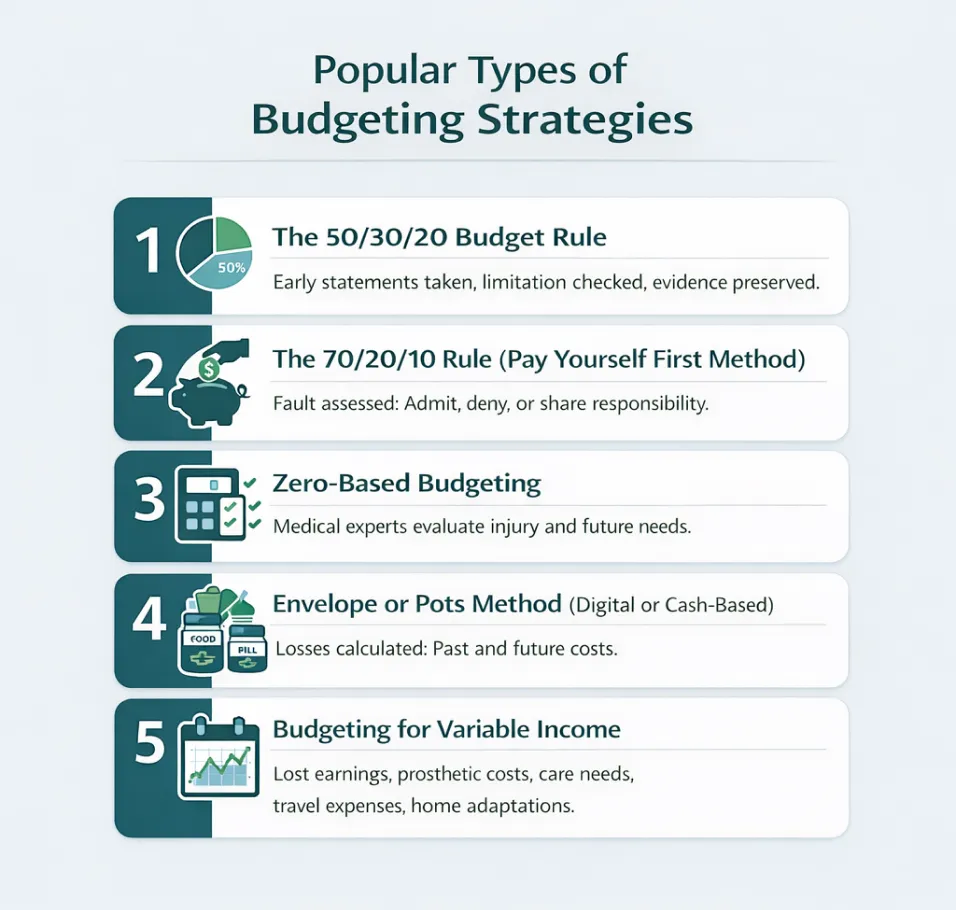
    Popular Types of Budgeting Strategies

    Here are some popular budgeting strategies that you can use as a young professional:

    1. The 50/30/20 Budget Rule

    The 50/30/20 rule is one of the most common ways through which young people in the UK are learning to manage their money. It’s a very simple method. After you are done paying tax, your income is divided into the following three parts:

    • 50% for needs: This money is for the basics that you cannot avoid. For instance, you can’t just go without paying rent, food, energy bills, council tax, etc.. Similarly, shopping, travel costs, etc., have to be paid at all times, so all of this is a necessity.  
    • 30% for wants: You have to set aside this money for fun and non-essentials. This may vary for everyone. Some common wants are meals out, Netflix, clothes or hobbies. 
    • 20% for savings and paying off debt: This money is for building your emergency fund. It can also be used as savings for a long-term goal. Another use would be for clearing out student loans or credit cards. 

    Why the 50/30/20 Budget Strategy Works Well for Young People in the UK

    This is one of the budgeting strategies that work really well because it isn’t too strict. You don’t feel like you have to give up everything when you start controlling your spending. Also, a lot of budgeting apps are there to help you follow this rule more easily. There are apps such as Emma, Moneyhub, and Snoop that let you label and track your spending. This allows you to not lose sight of your needs. If you are spending too much on wants, these apps can give you a warning. Financial advisers thus often suggest this budgeting strategy when you are just starting out your career. This is because it is easy to follow, and it can grow with you as you earn more. 

    How the 50/30/20 Budget Strategy Helps If Your Income Changes Month to Month

    This budgeting strategy can work for you even if your income is variable. Like if you are a freelancer or work shifts or rely on commissions, you won’t get the same pay every month. Your plan is just based on your lowest expected income. Suppose you earn £2000 sometimes and sometimes £1600, and you wonder what strategies can help you budget on a variable income. So, what you can do is base your budget on £1600 and treat the rest as a bonus. This extra money is your bonus. Put it in savings, pay extra debt or treat yourself with it. This budgeting strategy, thus, works the best for this kind of income. 

    An Example for the 50/30/20 Budget Strategy

    Let’s say Carrie gets paid £2000 a month. 

    • £1,000 (50%) goes to her essentials. She pays £750 for rent, £150 for groceries, £70 for bills, and £30 for council tax.
    • £600 (30%) is for her “wants”: She goes out with her friends, has a gym membership and goes clothes shopping. 
    • £400 (20%) goes to her savings and paying off debts: She puts this in her emergency fund and pays her credit card debt. 

    What the 50/30/20 Budget Rule has in common with business budgeting

    This budgeting strategy is very similar to how marketing departments allocate their budgets. Their money is divided into three parts. The first one is used to run everyday operations. The second is used for campaigns or experiments. The third one is used for long-term investments. This means that the budgeting strategy is a proven way to plan money. It may work this well in your personal life, too. 

    2. The 70/20/10 Rule (Also Called the Pay-Yourself-First Method)

    This budgeting method shifts the perspective on how you think about money. Before spending, it saves first, which is the opposite of the usual methods. Here is how it works:

    • You save 20% of your total income, i.e., put it in your savings or investments as soon as you get paid. 
    • You set aside 10% of your money for paying off debts like student loans and credit cards. You can also set it aside for charity if that is something you really care about. 
    • The final 70% is what you spend on your daily expenses. Your needs and wants are both covered in this. This means you use the 70% to pay rent, bills, groceries, meals, holidays, subscriptions, etc.. 

    This method is called the pay-yourself-first method because you make your future a priority. Your savings are as important as your bills. It is not something you would do if you are left with something. 

    Why the 70/20/10 Budget Strategy Works Well for Young People in the UK

    This method is great for building good money habits early on. Your future goals, such as a house, retirement, holiday, or a rainy day, thus always have something contributed to them. This is made easier by using apps such as Monzo, Starling, and Revolut. These apps help you in the following ways:

    • You can set up automatic transfers to your savings accounts on the day you are paid. 
    • You can round up your purchases and spare change into savings.
    • You can use them to split income into different pots. Like you may use one for taxes, one for travel and the last one for long-term saving. 

    How the 70/20/10  Budget Strategy Helps if Your Income Goes Up and Down

    This budgeting strategy also works really well for people with variable incomes. The only change you make in case of variable income is that instead of saving a fixed amount each month, you save a fixed percentage. This means no matter whether you earn £1000 or £3000, you’ll save 20% every month. Your savings are thus realistic and flexible. You can also tweak the percentages slightly to suit your unique situation.

    An Example for the 70/20/10 Budget Strategy

    Let’s have an example of John, who earns £2500 in a good month:

    • John immediately moves 20% i.e., £500, into his savings. These savings can be an emergency fund, holiday account or investment app. 
    • Then he sets aside 10% (£250) to pay off his credit card debt. 
    • He lives on the remaining £1750, which is 70% of his total income. He uses this money to cover food, travel and fun things. 

    Now imagine John’s income drops to £1800 the next month. He’ll still save 20%, which is £360, and put £180 toward debt (10%). That would leave him with £1,260 (70%) to live on.

    3. Zero‑Based Budgeting

    In this budgeting strategy, your entire income is planned such that at the end of each month, every single one of your pounds is assigned a goal. It can be paying for a bill, or funding a goal or saving the future. The key idea is as follows: 

    Income – Expenses = £0

    This strategy does not imply that all your money should be spent. It means that every one of your quids is assigned a purpose. You count your savings and emergency fund as expenses too, using this plan. 

    How Zero‑Based Budgeting Works in the UK Context

    This budgeting strategy is useful for you if you want complete control over your finances. It is one of the most effective ways to keep track of spending. This is because you view every single one of your expenses up front and make sure it fits in with your income. If you are naturally careful with money or at least want to build the habit, this method works great for you. 

    Example of Zero-Budgeting

    Suppose Linda gets £2,200 a month. Using this budgeting strategy, she’ll map out her expenses as follows:

    • £850 for rent
    • £150 for groceries
    • £70 for council tax
    • £100 for utilities
    • £150 for transport
    • £250 for debt repayment
    • £300 for savings
    • £200 for wants, like if she wants to eat out or pay for her subscriptions
    • £130 for upcoming expenses like a friend’s wedding or Christmas fund

    By the end of the month, Linda knows where all her money is going. She does not have to guess, she has no leftover amounts, and she has no guilt of impulse purchases. Even her fun money is accounted for. 

    Why Zero-Budgeting is powerful but requires more effort

    When you use this budgeting strategy, you get complete visibility into where your money is going. This is excellent for cutting back on overspending. But it is more time-intensive than other methods. You’ll have to sit down at the start of each month and adjust your plan every time based on your expenses and income. It is ideal for you in the following cases:

    • You are on a tight budget
    • Your income is irregular
    • You are working towards a big financial goal (such as buying a house)

    For this budgeting strategy, you can use apps like YNAB (You Need A Budget) and Money Dashboard Classic. They’ll help you assign money to each category and also help you re-adjust if something comes up mid-month. 

    4. Envelope or Pots Method (Digital or Cash-Based)

     This budgeting strategy is quite an old approach. It is still incredibly effective for people who are visual learners and the ones who are trying to cut down on overspending. Here is the basic idea. You split your monthly income into envelopes or pots. Each of them is labelled for specific purposes. For instance, you can divide your income into groceries, rent, shopping, transport, or entertainment. You can only spend what you allocated for each section in the envelope. Once the money is gone, it’s gone. Traditionally, paper envelopes were used for this purpose. Now this method is made safer and easier using digital banking. You can create digital pots using apps like HyperJar, Goodbudget, and Plum. You can track your spending in real time using these. 

    Why the Envelope or Pots Method Works Well for Young People in the UK

    Cashless payments have been on the rise in the entire world, and the UK is no exception. Because of this, it is easy to lose track of how much you are spending. At this point, it is people’s second nature to tap a card or use Apple Pay. As a result, you are spending more than you realise, and it doesn’t even feel like money is getting out of your hand. Using pots or envelopes helps you create natural envelopes. You can use apps like Starling and Monzo, through which you can divide your balance into named Spaces or Pots. To resist temptation, you can lock pots or establish guidelines like “add £20 every Friday.”

    How this Budget Strategy Supports Goals and Prevents Overspending

    This budgeting strategy is especially good for people who:

    • Often spend too much money without recognising it
    • Want a simple way to manage money, which is preferably low-tech or app-based
    • Prefer visual organisation, i.e., they want to know how much money is left at a glance

    This method suits most young adults who have already put their money into some sort of pots. The logic behind this can also be used for everyday budgeting, too. 

    Example for Envelope or Pots Budget Strategy

    Mia gets paid £2000 a month. She sets her monthly envelopes or digital posts as follows:

    • £800 rent
    • £150 groceries
    • £100 utilities
    • £60 council tax
    • £200 savings
    • £250 debt repayment
    • £100 travel
    • £150 entertainment
    • £190 for flexible spending (like gifts, treats, or unexpected costs)

    Having this budgeting strategy helps Mia stay in control. She knows when she is nearing the limit in any category and take action accordingly. 

    5. Budgeting for Variable Income

    You can use the 70/20/10 rule or the 50/30/20 rule when you have variable income. You also have the option to access a budgeting strategy optimised especially for your case. Here are three of them. 

    • Build your budget on the ‘worst-case month’

    When your income fluctuates, the easiest way to manage it is by using either of the two options. You can choose the lowest income of your last year and base your budget on that. Or you may take an average of your last 6 months’ income and make a budget on that. You have a solid foundation that you know you’ll be able to cover even in the quieter months. 

    • Set up a holding account and ‘pay yourself’ monthly

    Another option for variable income would be setting up a holding account. This way, you will not have to spend from your main account. Your income will land in the holding account. Then you can transfer a fixed account to your main account as if you were paying yourself a salary. This method smoothens your spending over time. It also helps you plan with confidence for the longer term. For lean months, you’ll have a buffer since you’ll be using extra income from higher months. 

    • Use two budgets: one for lean, one for flush

    A great strategy would be to build two versions of your budget. The first version would be used in a slower month. This will be the bare minimum costs you need for covering rent, bills, food, etc.. Another full version can be made for better months. Here you can add savings, social spending and non-essential.

    Popular Types of Budgeting Strategies

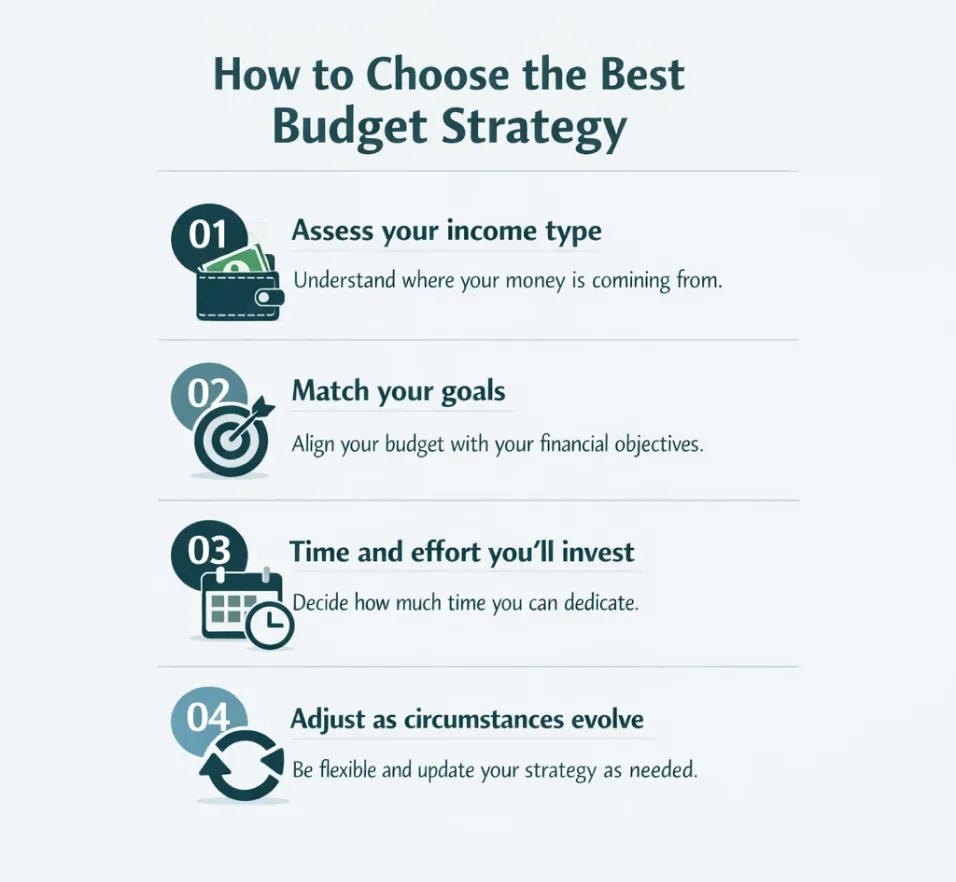
    How to Choose the Best Budget Strategy

    Choosing the best budgeting strategy depends on a number of different factors, which may vary for everyone. Here is how to narrow it down:

    • Assess your income type

    The first thing that you have to assess is how predictable your money is. If you have a steady salary, choose percentage-based methods like the 50/30/20 or 70/20/10. They offer you simplicity and consistency. If your income is variable, use methods that involve a buffer or holding account. You can use zero-based budgeting with dual budgets. You can adjust without stress. 

    • Match your goals

    Choosing the right budgeting strategy is based a lot on what your end goal is. If you are saving for a short-term goal like travel, a business idea, or a crypto investment, you should use a flexible method. For instance, you can use digital envelopes or the Pay-Yourself-First rule. But if your goal is long-term, like buying a house, you need a strong savings habit and automation to keep you on track. 

    • Time and effort you’ll invest

    Think about how much time and energy you want to spend on budgeting. If you want to have a full hands-on approach that keeps you in control, use zero-based budgeting. If you want to keep things simple, use percentage rules like the 50/30/20 budget strategy or app-based systems. They will keep things light and breezy for you.

    • Adjust as circumstances evolve

    Your budget has to grow with you. An increase in your income should increase how much you save every month. If you have a high-interest debt, you can shift more to repayments. You must realign your budgeting strategy every few months to whatever your situation evolves to.

    How to Choose the Best Budget Strategy
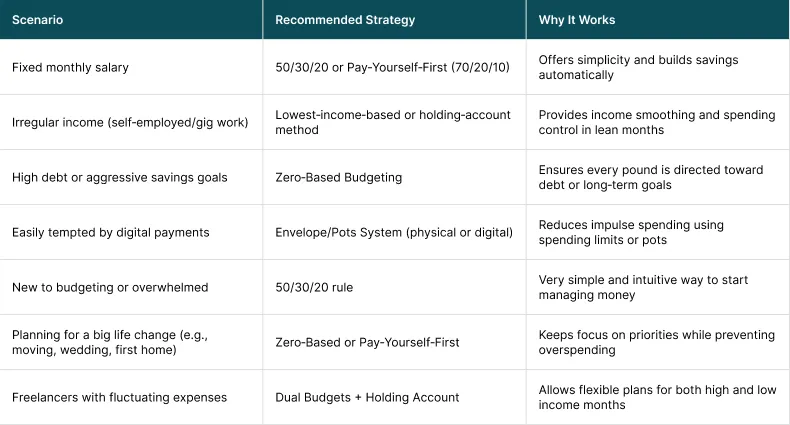
    Here is a summary of a few scenarios and the budget strategy you would use in each.
    scenarios and the budget

    Conclusion

    As important as a budgeting strategy is, there is no one-size-fits-all solution. What works for a variable income freelancer may not work for you if you have a steady job. That is why we at Sterling Cooper Consultants take a personalised, UK-focused approach to your budget strategy. Our financial experts help you manage the right style with your income, goals, and lifestyle. We support you, starting simple. And then when your confidence grows, we layer in more structure. Our tools and guidance help you build long-term habits. We also offer budget review plans cause the income isn’t always the same. So, to get help, contact us now.

    Ready to take control of your money with a budget that actually works?

    Our expert guidance and easy-to-use tools make it simple to stay on track, build savings, and reduce money stress. Book your free consultation today and start budgeting with confidence.
    +443300102526
    Book an Appointment

    FAQs


    What strategies can help you budget on a variable income?


    Base your budget on your lowest monthly income. Use a holding account to smooth out earnings and apply percentage-based methods like 50/30/20 to stay consistent.


    Yes, the 50/30/20 rule mirrors how companies split budgets between operations, growth, and savings. It creates balance and helps you stay focused.


    The 50/30/20 rule is simple, flexible, and widely supported by UK apps like Emma and Snoop. Great for getting started.


    Zero-based budgeting. It gives every pound a job so you can put more toward clearing your debt faster.


    Definitely. UK apps like Monzo, Plum, and HyperJar automate saving, track bills, and reduce overspending by keeping you accountable.

    Share This Article!

    Recent Posts

  • What Are the Benefits of Automated Payroll Processing?

    What Are the Benefits of Automated Payroll Processing?

    payroll automation

    Posted by:

    Admin

    Date:

    February 16, 2026

    Category:

    blogs

    Error: Contact form not found.

    What Are the Benefits of Automated Payroll Processing?

    In the modern dynamic world, payroll by hand is risky and painfully slow. Outdated payroll systems have been recorded to be the cause of 20% error in payroll runs. Fixing just one of these mistakes can cost as much as $291. HR teams have to spend up to 29 workweeks per year to clean up these mistakes. Automatic payroll can save you from this situation. Statistically, errors in automatic payroll systems have been reported to be less than 1%. This is a significant decrease from outdated systems. This blog covers everything you need to know about payroll automation.

    What is Payroll Automation?

    Payroll automation is the process when you use software to handle the process of paying your employees. You don’t have to do every step manually. Rather than spending hours on spreadsheets or double-checking tax calculations, the software system does the work for you. This payroll process automation helps your business run payroll faster and more accurately. You make significantly fewer mistakes when you use this automatic payroll.

    What Tasks Are Involved If You Automate Payroll Process?

    Payroll automation can be really beneficial. If you automate payroll process it can handle all of the major steps required in payroll processing:

    • Wage and salary calculations

    It automatically calculates how much each employee should be paid. Whether they are paid an hourly pay, a fixed income, or get incentives or commissions, the system handles all of the maths.

    • Tax deductions and contributions

    The software is aware of how much should be subtracted for pensions, national insurance, income tax, and other required contributions. To comply with the most recent tax regulations, it automatically updates.

    • Payslip creation

    The system creates digital pay slips for every employee after its calculations are complete. These can be accessed via an online portal or sent via email.

    • Direct deposits to employee accounts

    The system creates digital pay slips for every employee after its calculations are complete. These can be accessed via an online portal or sent via email.

    • Report filing and staying compliant

    By creating and submitting the necessary reports to HMRC and maintaining accurate payroll records, the system assists you in remaining in compliance with the law.

    Fully Automated vs Semi-Automated Payroll Systems

    There are two main types of automated payroll systems. It is important to know the distinction between the two.

    1. Fully automated payroll systems

    Once they are established, these systems operate payroll mostly independently. Without your assistance, they compute pay, deduct taxes, create pay slips, process payments, and pull data from time-tracking or HR systems. They work well for companies looking for a dependable, hands-off payroll approach.

    2. Semi-automated payroll workflows

    These systems may require some manual input, but they still save time. Here, manual input refers to handling one-time bonuses, updating salary adjustments, and approving hours worked. They handle the majority of the work for you, but if you want more control, they can give it to you.

    Who Should Use Payroll Automation?

    If you automate payroll process, it is especially beneficial to those that are growing or have complex requirements. Small businesses can take advantage of it to avoid errors. Even though their team is small. An automated payroll process can still help them avoid hefty penalties. Startups that are growing quickly and hiring rapidly can also use it. If their employees are being hired at different locations, then it is even better that they choose an automated system. Global companies can use it to pay people in different locations. It helps them follow local laws while making payments. Hybrid and remote teams can also greatly benefit from it. They can pay freelancers or part-time workers working flexible schedules with ease.

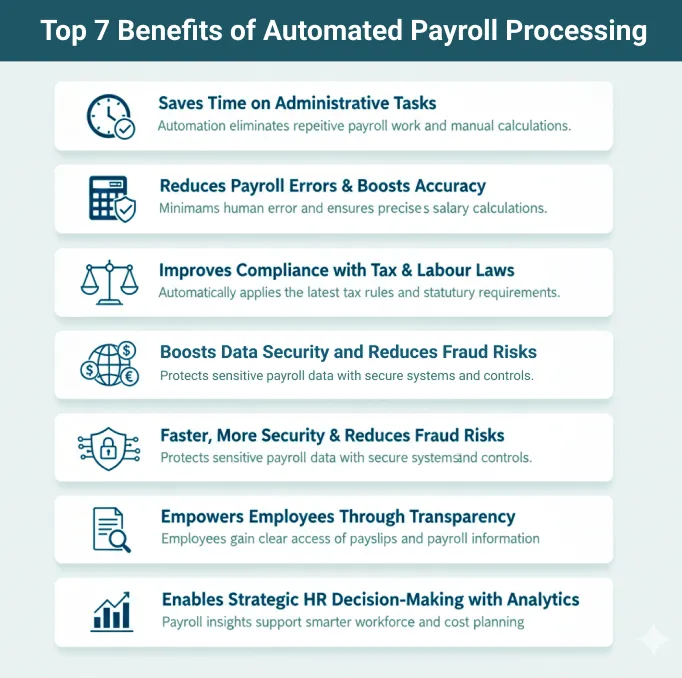
    Top 7 Benefits of Automated Payroll Processing

    The benefits of payroll automation extend far beyond saving time. It improves accuracy and reduces risk. You can scale your business more effectively. Here are some key benefits of automated payroll systems:

    1. Saves Time on Administrative Tasks

    Despite all the other benefits, saving time is still the biggest reason why many businesses use payroll automation. Doing payroll manually means a lot of repeated tasks. You have to enter data, check spreadsheets, do hourly calculations, and then get approvals. It often needs several departments to work together. When you automate payroll process, most of these steps happen on their own. The system collects employee hours from time tracking software, does the maths, and creates payslips automatically. It can also run automatic payroll on set schedules, weekly, bi-weekly, or monthly. This can be done without needing constant input. You don’t have to waste hours doing manual checks anymore.

    2. Reduces Payroll Errors and Boosts Accuracy

    A common issue with manual payroll is human error. Employees can get paid the wrong amount because of typing mistakes, forgotten deductions, or using the wrong tax rates. With payroll automation, these problems are much less likely. The system uses smart rules to make sure everything is accurate. Automated payroll processing takes care of key tasks like:

    • Tax and National Insurance (NI) deductions
    • Pension contributions
    • Overtime, bonuses, and leave balances
    • Benefits and statutory payments

    Since there are fewer manual steps, there’s a much lower risk of mistakes. That means fewer salary disputes and more trust from your team.

    3. Improves Compliance with Tax & Labour Laws

    For growing businesses, staying on top of changing tax rules and labour laws can be very difficult. Your tax bracket may change, or you may have to register for VAT. With automated payroll processing, these updates are handled by the system itself. It automatically updates its calculations based on new laws. It also creates reports that meet government standards, like those required by HMRC. Some ways payroll process automation helps include:

    • Calculating and deducting taxes correctly
    • Filing tax reports on time (CIS, PAYE, RTI)
    • Storing payroll records in line with GDPR and HMRC rules
    • Reducing mistakes that can make you suspicious of audits

    This gives business owners peace of mind. Thanks to automatic payroll, you can always stay compliant. You won’t have to worry about missing a change in the law.

    4. Faster, More Reliable Global Payroll

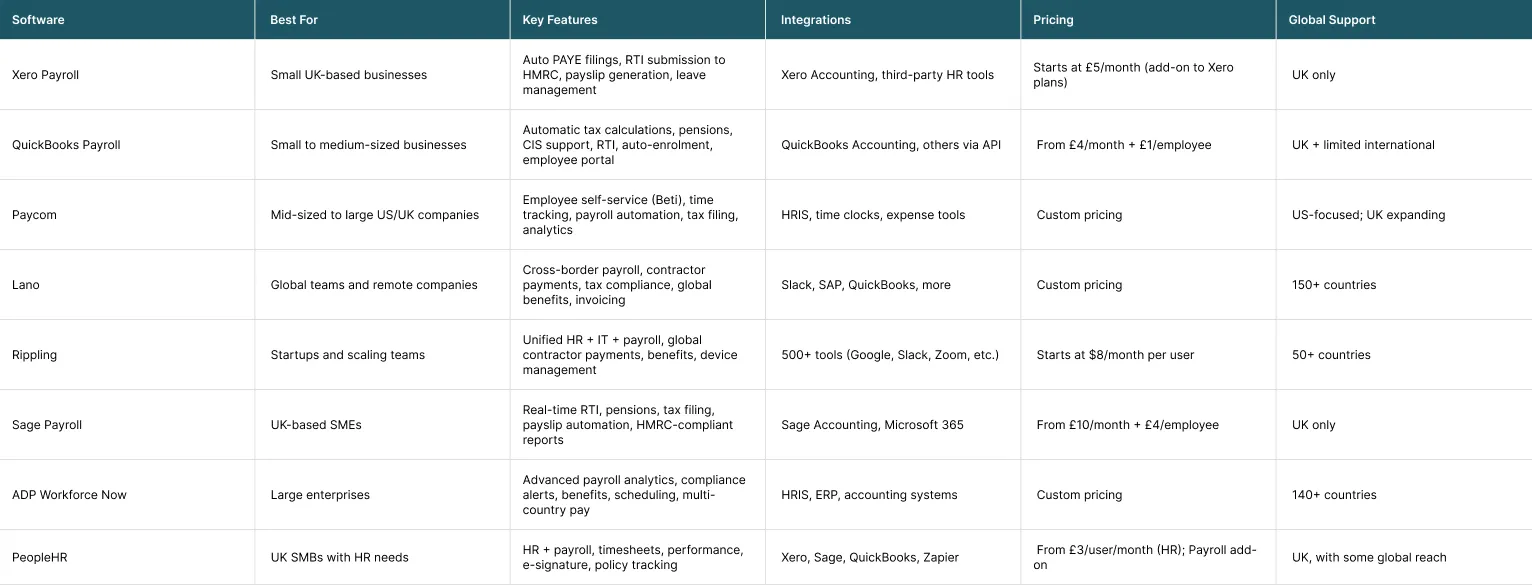
    Doing payroll manually becomes much harder when your business operates in more than one country. You have to manage different currencies, tax laws, and pay schedules. Each country also has its own labour laws, which you must follow. Payroll automation tools like Lano make this easier by handling these details for you. They support payroll process automation across multiple countries, take care of local tax rules, and manage payments in the right currencies. They also create pay slips and reports for each country. Whether you’re paying remote employees, freelancers, or whole teams in other parts of the world, automated payroll processing helps make sure everyone is paid correctly and on time.

    5. Boosts Data Security and Reduces Fraud Risks

    Payroll data includes very private details like bank account numbers, salary amounts, tax IDs, and national insurance info. If this data is handled the wrong way or seen by the wrong person, it can cause serious problems. With payroll automation, your data is better protected. These tools use strong safety features to keep your information safe. For example:

    • Only approved people can see or change payroll files thanks to encrypted access.
    • Any changes made in the system are tracked, so you always know who did what.
    • Regular cloud backups make sure your data isn’t lost, even if there’s a crash or cyberattack.

    This way, automated payroll processing doesn’t just stop outside threats. It also helps prevent internal fraud, because there’s less need for manual input or paper documents.

    6. Empowers Employees Through Transparency

    Automated payroll processing helps employees clearly understand their pay. They can easily see how much they are getting paid and what amounts are taken out for taxes or other reasons. There’s no more confusion about deductions or paid time off. Most payroll automation systems come with self-service portals. These let employees do things like:

    • Download payslips and P60s
    • See how much tax was taken and how much they earned so far
    • Check how many holidays or leaves they have left
    • Update their personal or bank information

    This saves a lot of time for the HR team since they don’t have to answer the same payroll questions again and again. It also makes things more open for employees. For example, Paycom’s Beti software gives workers a look at their payslip before payday. They can check if everything is right and fix anything that’s wrong early. This helps avoid payment mistakes and keeps employees happier.

    7. Enables Strategic HR Decision-Making with Analytics

    Payroll process automation creates a lot of useful data. If this data is easy to access and understand, it can help businesses make smart decisions. Most tools have built-in dashboards that turn numbers into easy insights. These insights help HR and finance teams:

    • Spot patterns like too much overtime or frequent delays
    • Track salary spending by job, team, or location
    • Plan ahead for hiring needs and payroll budgets
    • Look at past trends to set better financial plans

    This means payroll automation isn’t just about payments anymore. It also helps leaders plan smarter for the company’s future.

    Top 7 Benefits of Automated Payroll Processing

    How to Automate Your Payroll Process

    Payroll automation is about creating a quicker, more dependable system that saves time, lowers errors, and assures compliance. It’s not just about implementing new technology. 

    Here is a step-by-step guide if you want to transition to payroll automation:

    • Evaluate your current payroll system

    The first step would be looking at your current payroll system. Do you have some basic software installed, or are spreadsheets still being used? Analyse your process as well. Is it fully manual, partially automated, or entirely outsourced? Additionally, find some frequent pain points that you encounter. These would be delays, calculation mistakes, or inaccurate payslips. This is crucial for you to figure out what exactly do you want to achieve from payroll automation. 

    • Choose the right payroll software

    The next step is to choose the appropriate software after you have identified the weaknesses in your current setup. While choosing the software for your business, you have to consider your business’s size, structure and future goals. You should choose a platform that facilitates worldwide payroll, multi-currency payments, and local compliance if your business is expanding globally. Searching for software that works well with your current systems, such as accounting or HR platforms, is also beneficial. By selecting the appropriate tool, you may create a solid basis for dependable payroll automation.

    Top Payroll Automation Software and Tools

    Here are some common tools and software that can be used for payroll automation:

    Top Payroll Automation Software and Tools

    • Integrate with other systems 

    Your payroll software must interface with other important company systems in order to get the full benefits of payroll automation. This includes HRIS (Human Resource Information System). It can instantly retrieve employee data, accounting software to expedite expense reporting. It can also use attendance monitoring capabilities to document working hours. When these systems can convey information to each other, you don’t have to enter the same information multiple times. Thus, you reduce conflicts and outdated data. 

    • Configure automation workflows

    Once you have set your payroll software and connected other systems with it, you need to set it up. This step determines how your software will work. You can put in your own rules in most payroll systems. You can tell it how to calculate taxes, handle bonuses, or approve overtime. You can also set up alerts to detect errors, such as missed hours or incorrect pay rates. These regulations ensure that your payroll matches your company’s policies and legal requirements. Once everything is set up, the system works by itself, reducing the risk of human error.

    • Test, review, and train staff

    Before you begin fully utilising the new system, you must first test it. Run your payroll through both the new and old systems for at least one pay cycle. You can find out any errors before making your system official. This also gives you a chance to fix these errors once found. At the same time, teach your HR, financial, and admin staff how to operate the system correctly. You’ll also have to train your employees if your system has a self-service option. They will have to learn how to check their payslips, tax details, etc.. You will also have to teach them to update their information in the software. This will make your launch smooth.

    • Go live and monitor performance

    After completing the training of staff and the trial run, it is time to switch to your new system. Constantly check how your system is performing. Also, set clear goals for your future. For instance, aim for fewer payroll errors and faster processing times. Keep an eye on these results so you can make small improvements over time. A well-monitored business helps your business stay organised. It also helps you follow laws as you expand further.

    Common Concerns & Challenges of Payroll Automation

    There are some common concerns that everyone faces when switching to payroll automation. They are more apparent at the start. Here are a few common ones:

    • Cost of payroll automation

    One great concern is the time and cost for the setup. If your team is small, transferring the entire data might be an overwhelming task for them. In addition, they also have to install the software and attend training for using the system. This may seem costly at this point, but in the long run, you will save a lot more money than you were losing due to mistakes. 

    • Resistance to change

    Another major challenge is resistance to change. Most of your staff might already be used to older systems. They might hesitate in using the new setup. You can ease their transition by providing them with hands-on training. Explain to them how payroll automation will ease their lives. This will help you win their confidence for this transformation. 

    • Technical issues

    When you attach old tools or software to a new one, you may face some technical issues. Your outdated tools, also known as legacy systems, can slow down things or cause data mismatches. You can prevent this by choosing software that supports integration with older systems. Also, carry out migration in a step-by-step plan. 

    Conclusion: Why Payroll Automation is a Game Changer

    Payroll automation smoothens your paying process in every way. It increases pay accuracy, follows the law, saves time, and allows employees to verify their pay clearly. Your team has less stress because of automatic payroll and your staff becomes happier. If your payroll is still done by hand or has frequent errors, it’s time to upgrade to a more efficient system. At Sterling Cooper Consultants, we can help you make this transition with ease. With our payroll services you can find simple payroll tools that save your time and solve your problems. We handle your payroll so that you can focus on growing your business.

    Need help simplifying your payroll process?

    Our specialists at Sterling Cooper Consultants offer fully automated payroll solutions designed to save you time, reduce errors, and keep your business compliant, no matter your team size. To get help, contact us now.
    +443300102526
    Book an Appointment

    FAQs


    What is automated payroll processing?


    It is the use of software to calculate pay, deduct taxes, provide pay stubs, and transfer salary without requiring manual input every cycle.


    Choose a payroll tool, integrate it with your timesheets and accounting system, configure your pay rules, and test it before going live.


    Yes, most systems use encryption, access limits, and audit trails to secure sensitive payroll data.

    It can save HR teams hundreds of hours per year, up to 29 workweeks, especially by reducing errors and repetitive tasks.


    Manual payroll raises the risk of errors, late payments, lost tax filings, and noncompliance penalties.

    Share This Article!

    Recent Posts

  • What Is a Payroll Report and Why Is It Essential for Every Business?

    What Is a Payroll Report and Why Is It Essential for Every Business?

    Payroll Reports

    Posted by:

    Admin

    Date:

    February 12, 2026

    Category:

    blogs

    Error: Contact form not found.

    What Is a Payroll Report and Why Is It Essential for Every Business?

    Payroll is one of those jobs that sounds simple: pay people, send payslips, done. In practice, it is easy for errors to slip in. Starters, leavers, overtime, bonuses and changes to the tax rules make things more complicated. This is why payroll reports matter.

    When you look at guidance from most payroll and accounting platforms, they all land on the same core points. A payroll report is a record of what you paid, what you withheld, and what you owe. It helps you pay staff correctly and stay compliant.

    Some payroll platforms note that small businesses can spend up to 5 hours each pay period on payroll tasks before automation. That adds up fast over a year. This guide explains what a payroll report includes, the main report types, and why it helps UK businesses stay accurate and organised.

    What Is a Payroll Report?

    A payroll report is a document that summarises pay data for a chosen time period. It can be a week, a month, a quarter, or a tax year.

    Most reports include:

    What the Report Shows What It Means
    Employee names and pay periods Who was paid and for which pay period
    Hours worked and pay rates Hours worked and the rate paid, for hourly staff
    Gross pay Pay before any deductions are taken
    Taxable pay The amount of pay that is subject to tax
    Deductions Pension, student loan, salary sacrifice, and other deductions
    Tax deducted Income tax taken from pay
    National Insurance Employee and employer National Insurance, where shown
    Net pay The amount of pay that is subject to tax
    Employer costs and payroll liabilities What the business owes in total

    In the UK, payroll reporting is closely linked to PAYE and RTI submissions. HMRC guidance explains that employers report an employee’s pay, deductions, and any payrolled benefits through a Full Payment Submission (FPS) on or before payday, and an Employer Payment Summary (EPS) is used for things like reductions (for example statutory pay) and can be due by the 19th of the following tax month.

    HMRC also shows the kind of ‘pay and deductions’ data that is reported per period, such as taxable pay, tax deducted, and student loan deductions.

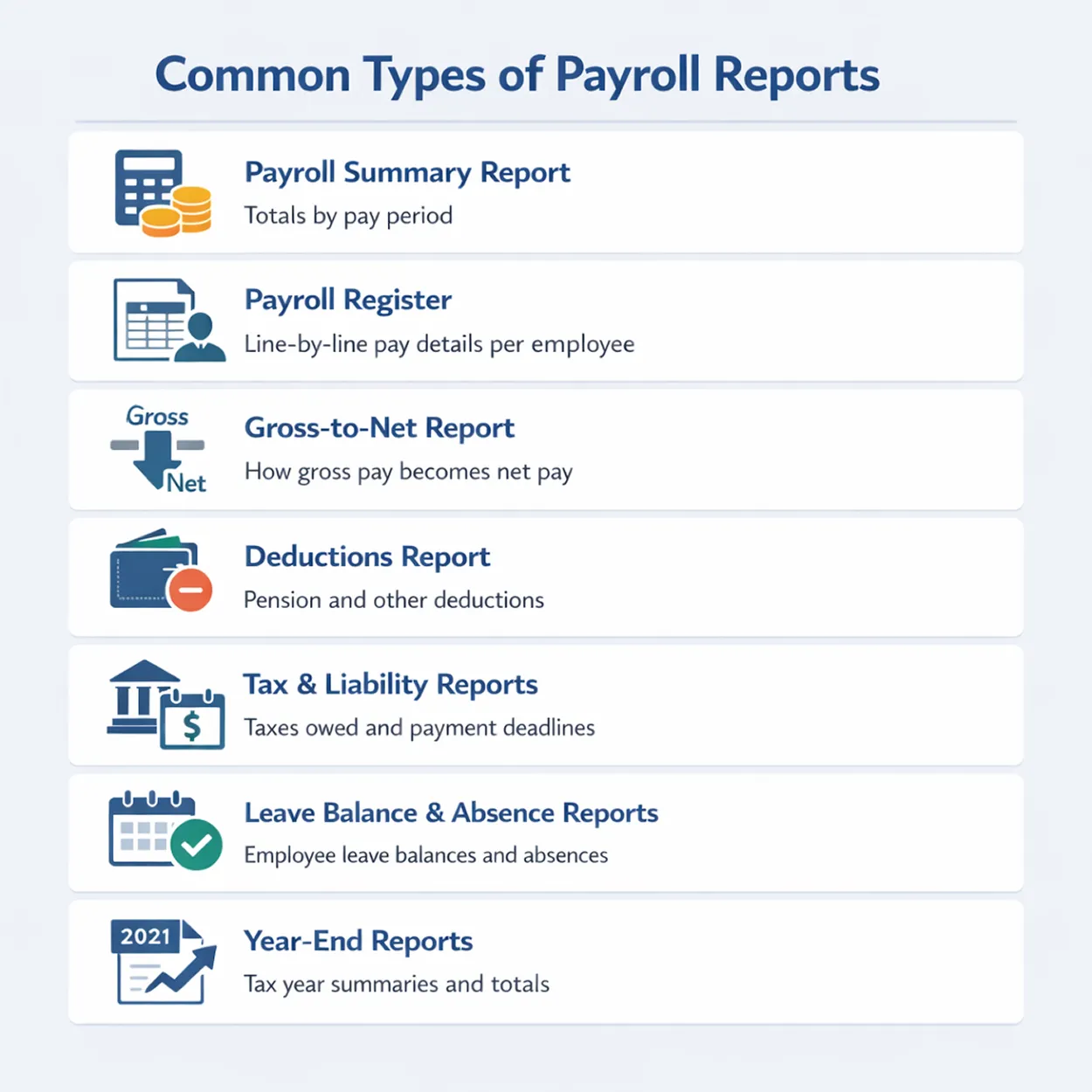
    Common Types of Payroll Reports

    Different businesses use different payroll reporting types, but these are the ones you will see most often:

    • Payroll summary report (totals by period).
    • Payroll register (line-by-line pay details per employee).
    • Gross-to-net report (how gross pay becomes net pay).
    • Deductions report (pension and other deductions).
    • Tax and liability reports (what you owe and when).
    • Leave balance and absence reports.
    • Year-end reports (tax year summaries and totals).

    Common Types of Payroll Reports

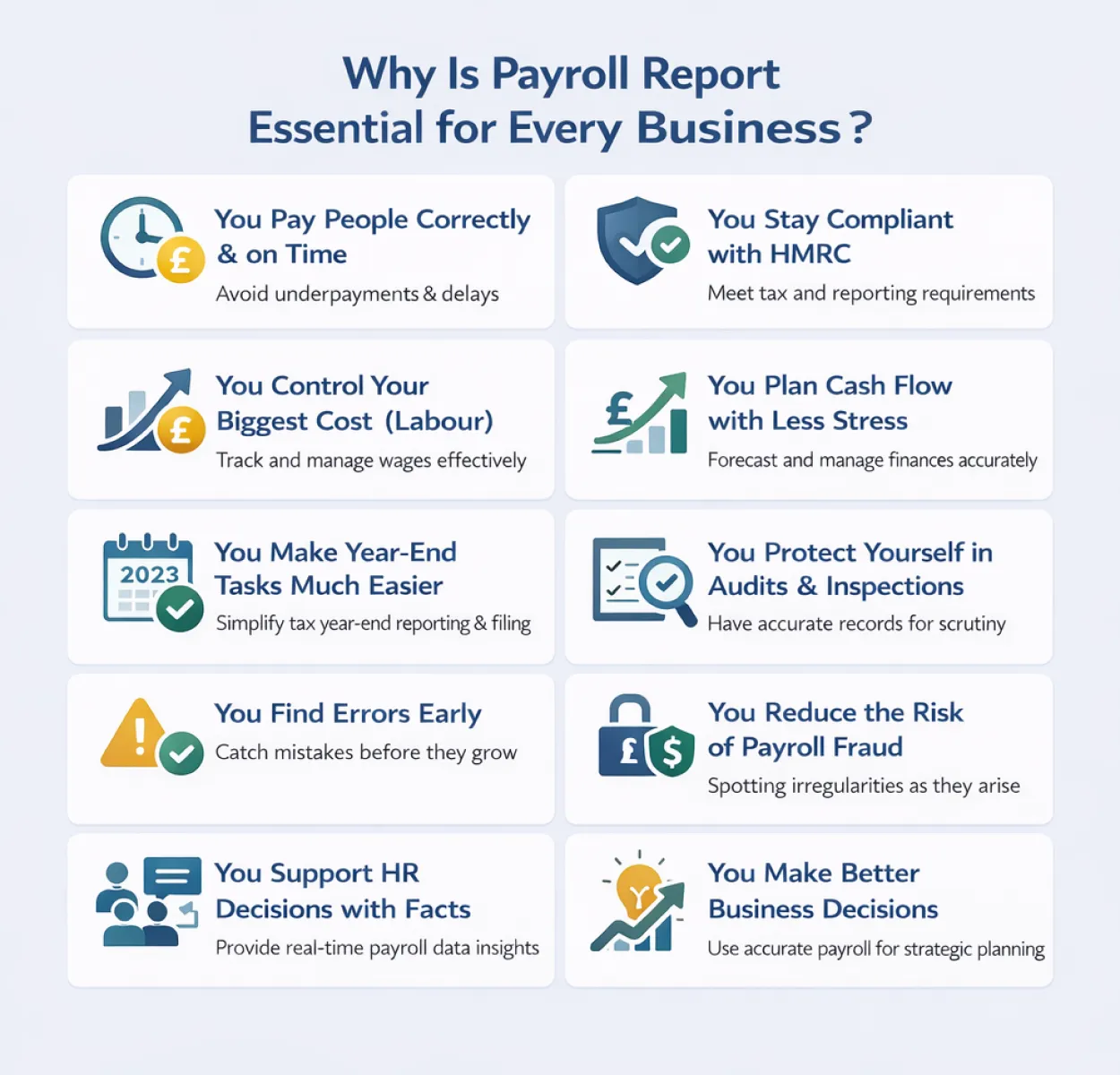
    Why Is Payroll Report Essential for Every Business?

    Below are 10 clear reasons payroll reports matter for UK businesses:

    1. You Pay People Correctly & on Time

    The first thing payroll reports do is easy. They help you pay individuals the correct amount.

    Common payroll mistakes include:

    • Unpaid overtime.
    • Missing hours.
    • Wrong rate (overtime rate).
    • Duplicated payments.
    • Wrong deductions.

    Why Is Payroll Report Essential for Every Business

    A payroll register or gross-to-net report. It makes it easy to see each employee’s numbers. You can spot unexpected drops in net pay or unusual differences. That gives you time to fix issues before payroll is processed. That also helps with cash flow. One wrong payroll can mean having to make emergency bank transfers, make changes quickly, and waste time on paperwork.

    2. You Stay Compliant with HMRC

    ‘Doing payroll’ is not the same as compliance. Compliance shows that payroll has been done correctly.

    In the UK, RTI reporting means that firms have to provide payroll information through FPS on or before payday. They also have to use EPS when necessary, such as when they don’t pay anyone in a tax month.

    This is where payroll reports come in handy. They back up your RTI numbers. They also help you answer questions like these:

    • What taxable pay did we report this period?
    • How much tax did we deduct?
    • What student loan amounts were taken?

    HMRC provides examples of the data reported for each pay period, such as taxable wages, tax that was taken out or returned, and student loan deductions. You are less likely to need last-minute corrections or send in the wrong reports if you keep your reports neat.

    3. You Control Your Biggest Cost (Labour)

    For many firms, payroll is the most expensive thing they do every month.

    A clear payroll summary shows you exactly where your payroll money is going, including:

    • Total wages.
    • Total employer costs.
    • Overtime spend.
    • Department or location totals (if your system supports it).

    This helps you make smart choices, like:

    • Do we need more staff, or better rota planning?
    • Are overtime costs climbing for one team?
    • Are we paying too much in one role compared to output?

    This is where payroll reports become more than basic administration. They turn into tools for business.

    4. You Plan Cash Flow with Less Stress

    There is a set date for payroll. It doesn’t wait.

    A payroll summary report or payroll liabilities report might assist you figure out when and how much money you need to take out of your bank account. It also helps you separate:

    • What goes to employees?
    • What do you owe as deductions?
    • What do you owe as employer contributions? (where applicable)

    This is particularly more important when money is limited or when your income changes with the seasons.

    Your management accounts and budget should reflect real payroll costs, so planning stays accurate. This is one reason some businesses use payroll support or outsource payroll.

    5. You Make Year-End Tasks Much Easier

    When records are sloppy, the end of the year is hard. You often need to know the exact amount of payroll for:

    • Annual accounts.
    • Benefits and expenses reporting.
    • Pensions records and checks.
    • Audit trails.

    For instance, HMRC sets deadlines for expenses and benefits reporting and warns about penalties for late submissions. Dates can change, so confirm the current deadlines for your reporting duties before year end.

    When you keep your payroll reporting in order every month, the end of the year is a time to check and confirm, not to worry and start over.

    6. You Protect Yourself in Audits & Inspections

    Not every ‘audit’ is a real audit. Sometimes it’s just:

    • An HMRC check.
    • A pension provider query.
    • An employee dispute.
    • A bank asking for proof of payroll costs.

    This is when payroll reports come in handy as proof.

    In the UK, employers must keep PAYE records for the required period. Poor records can lead to penalties and extra HMRC questions, so keeping reports organised is a practical safeguard. It also warns that poor record keeping can lead to penalties, and HMRC may assess what is due based on the information available. So, reports are more than just ‘nice to have.’ They help protect your business.

    7. You Find Errors Early (Before They Get Expensive)

    People generally don’t notice payroll mistakes until they happen again. That means that one mistake can affect a lot of pay runs.

    Some such examples are:

    • Wrong tax code carried forward.
    • Pension not applied correctly.
    • A deduction continuing after it should stop.
    • Wrong leaver date causing overpayment.

    A simple check routine goes a long way:

    • Run a payroll summary report.
    • Compare it to last period.
    • Review the biggest changes.
    • Review exceptions (new starters, leavers, sick pay).

    Many payroll systems also recommend reconciling payroll totals with your accounts and budgets.

    8. You Reduce the Risk of Payroll Fraud

    Payroll fraud does exist and can come from both internal and external sources. Some examples are:

    • Fake employees.
    • Inflated hours.
    • Changed bank details.
    • Unauthorised bonuses.
    • Payroll diversion scams.

    Use payroll reports in a controlled way to reduce risk:

    • Restrict access.
    • Use approval steps.
    • Run ‘change reports’ (bank detail changes, new employees).
    • Check overtime spikes.
    • Match headcount to HR records.

    The Government of the UK has an official way to report tax fraud (both an online payroll report facility and a phone line) if you think someone is cheating on their taxes or not paying their payroll taxes. If an employee has concerns, Acas (the Advisory, Conciliation and Arbitration Service) explains whistleblowing as the disclosure of wrongdoing in the public interest and provides guidance on the relevant legal framework.

    9. You Support HR Decisions with Facts (Not Guesses)

    Payroll data is strongly related to HR. It depicts what is really going on, not what people think.

    Reports can assist you answer questions like:

    • Who is doing repeated overtime?
    • Which role has the highest turnover cost?
    • Are absences affecting payroll costs?
    • Are allowances and deductions consistent?

    Your payroll system might also let you see how much leave you have left. For instance, QuickBooks Advanced Payroll has a report option for leave balances. This makes it easier for HR and finance to work together. It also helps you make rules about equitable pay.

    For people growing into finance roles, it also helps to understand the basics of bookkeeping and record keeping. If that is you, our guide on becoming a bookkeeper is a useful next read. 

    10. You Make Better Business Decisions (Pricing, Hiring, Growth)

    Lastly, payroll reports provide you the confidence to make major choices.

    Here are some basic business decisions that payroll data can help with:

    • Pricing: ‘If labour costs go up, can we still afford this contract?’
    • Hiring: ‘Is it cheaper to hire someone full-time than to work overtime all the time?’
    • Hours of Operation: ‘Are we overstaffed when it’s quiet?’
    • Raises and Bonuses: ‘How much does it all cost, including what the employer has to pay?’
    • Planning for Growth: ‘How much does payroll go up with 10 more workers?’

    You don’t have to be a data pro. You only need numbers that are accurate and reliable. That’s why companies use payroll services and experienced help when things get hard. A structured payroll management service can help make sure that reports are correct, consistent, and ready for an audit.

    Case Study of HMG Paints (UK)

    HMG Paints in the UK shared a big win. Payroll that once took three days was reduced to around three hours.

    What Happened?

    They moved to an all-in-one HR + payroll system and said their monthly payroll run dropped from a three-day process to a three-hour process (over 80% faster). They also said reports became easy to access and they were no longer hunting for them.

    Why Does It Support Payroll Reports?

    It shows that easier access to reports can save time and reduce back-and-forth during payroll.

    What’s the Key Takeaway?

    HMG Paints shared that their monthly payroll used to take around three days. After changing their payroll setup, they said it dropped to around three hours. They also said payslips and reports became easy to access, so they stopped wasting time searching for information. This shows how payroll reports help you work faster and spot problems sooner.

    Conclusion

    A payroll report is more than a spreadsheet or a software download. It gives you a clear record of pay, deductions, and employer costs. It also helps you check payroll, stay organised for HMRC reporting, and reduce avoidable errors.

    When your payroll reports are clear, you pay people right, meet HMRC requirements, manage cash better, and reduce risk. You also make smarter business decisions using real data, not assumptions. If you want a calmer payroll process, start with the reports. Then build a simple routine around them.

    Want payroll to feel simpler and safer?

    Sterling Cooper Consultants can take payroll off your plate and keep your reporting accurate and compliant through our Payroll Management service.
    If you are ready, contact us today and tell us what you need help with.

    +443300102526
    Book an Appointment

    FAQs


    What Is a Payroll Report?

    A payroll report is a record of employee pay for a time period. It normally shows earnings, deductions, taxes, and net pay. In the UK, payroll records also support RTI submissions like FPS and EPS.

    If you use QuickBooks Online Payroll, QuickBooks explains a simple route:

    i. Go to the Payroll section in Reports

    ii. Select Payroll Summary

    iii. Set the date range and apply

    iv. Customise if needed, then run the report

    If you use QuickBooks Online Advanced Payroll (UK), QuickBooks shows steps like:

    i. Go to Payroll → Reports tab

    ii. Pick the report (for example Gross to Net, Employee payment history, Deductions)

    iii. Set filters (date range, employees, pay schedule)

    iv. Run and download the report


    Start with your internal process first (manager, HR, finance, or whistleblowing policy). Acas explains whistleblowing as reporting wrongdoing that affects others and is in the public interest. If you believe it involves tax fraud or evasion, GOV.UK provides an official way to report tax fraud to HMRC, including an online service and a hotline option.


    Accuracy and timing. People must be paid correctly and on time. Then your reporting must match what happened, so you can prove it later.

    The core calculation and reporting flow:

    i. Correct pay inputs (hours, salary, overtime)

    ii. Correct deductions and tax treatment

    iii. Clean reports that match what was paid and what is owed

    In the UK, that also means RTI-ready reporting (FPS and EPS).

    A detailed payroll report usually means a payroll register or a gross-to-net report. It shows line-by-line detail per employee, like:

    i. Gross pay

    ii. Taxable pay

    iii. Tax deducted

    iv. Deductions (pension, loans, other items)

    v. Net pay

    For UK payroll reporting fields like taxable pay and tax deducted, HMRC gives examples of ‘pay and deductions’ data reported per period.

    Share This Article!

    Recent Posts

  • What Is Workforce Analytics and Why Is It Essential for Modern HR?

    What Is Workforce Analytics and Why Is It Essential for Modern HR?

    What Is Workforce Analytics and Why Is It Essential for Modern HR

    Posted by:

    Admin

    Date:

    February 11, 2026

    Category:

    blogs

    Error: Contact form not found.

    What Is Workforce Analytics and Why Is It Essential for Modern HR?

    HR teams have access to more workforce data than ever, from recruitment and turnover to employee performance and engagement. This data can reveal what is happening across an organisation, but collecting it is only the first step. The real value comes from understanding what the data means and using it to make better decisions.

    This is where workforce analytics comes in. Workforce analytics helps HR teams turn employee data into useful insights, identify trends and make more informed decisions about people and planning. As businesses face changing skills needs, shifting employee expectations and evolving workforce demands, data can provide a stronger basis for HR decisions.

    So, what is workforce analytics and why is it essential to modern HR? This guide explains how it works, where it can support HR teams and how organisations can use workforce data more effectively.


    Key Takeaways

    • Workforce analytics turns workforce data into insights that support HR and business decisions.
    • Descriptive, diagnostic, predictive and prescriptive analytics answer different workforce questions.
    • Analytics can support recruitment, retention, workforce planning and employee development.
    • Reliable and consistent data is essential for producing useful workforce insights.
    • Clear business goals help HR focus analytics on meaningful questions and measurable outcomes.
    • Privacy, data quality and potential bias should be considered when using workforce analytics.

    What Is Workforce Analytics?

    Workforce analytics is the process of collecting and analysing workforce data to understand how people, teams and workforce processes perform. It uses information from areas such as recruitment, attendance, performance, engagement, retention, skills, and workforce costs to give HR teams a clearer view of their workforce.

    Rather than simply reporting figures such as turnover, absence or time to hire, workforce analytics helps HR explore what those figures may indicate. By identifying patterns and trends, HR teams can use data to investigate workforce issues, support planning and make more informed decisions.

    The type of analysis used depends on the question HR needs to answer. This is where the different types of workforce analytics come in. 

    Types of Workforce Analytics

    Workforce analytics can be categorised into four main types, each providing a different level of insight. Together, they help HR teams understand what has happened, why it happened, what may happen next and which actions they can take. These insights come from a wider process of collecting, analysing and applying workforce data:

    Types of workforce analytics

    How Workforce Analytics Works

    Workforce analytics starts with a clear HR or business question, such as why employee turnover is increasing or whether the organisation will have the skills it needs in the future. HR then gathers relevant information from sources such as HR systems, payroll, recruitment platforms, performance reviews and employee surveys.

    The data may need to be cleaned, combined and analysed to identify relevant patterns and trends. HR can then interpret the findings, use them to inform decisions and monitor whether the actions taken produce the intended results.

    The process can therefore be viewed as a continuous cycle:

    Define the question → collect and prepare data → analyse patterns → interpret insights → take action → review results.

    Quick Tip: 

    Workforce analytics is most valuable when HR connects data to a clear business question. Tracking more metrics does not necessarily lead to better decisions.


    Why Is Workforce Analytics Essential for Modern HR?

    Workforce analytics gives HR teams a clearer view of workforce trends and helps connect people data with business decisions. It can support decisions across the employee lifecycle, from recruitment and retention to workforce planning and development. The following points show why workforce analytics is important for modern HR teams. 

    Improve Recruitment and Hiring Decisions

    Workforce analytics can help HR assess recruitment channels, time-to-hire, candidate trends and hiring outcomes. These insights can show which parts of the recruitment process are working well and where changes may improve efficiency or help attract suitable candidates.

    Strengthen Employee Retention and Engagement

    Keeping the right people is just as important as hiring them. Analysing turnover, engagement, absence and other workforce data can help HR identify patterns associated with higher employee turnover. This allows teams to investigate potential causes and address issues before they contribute to further employee retention problems.

    Support Strategic Workforce Planning

    Workforce analytics can help organisations understand current workforce capacity, identify potential skills gaps and estimate future staffing requirements. These insights can support workforce planning as business priorities and skills needs change.

    Improve Employee Performance

    Workforce data can help HR identify development needs and understand patterns in employee performance. These insights can inform training, development programmes and other forms of employee support.

    Support Fair and Data-Driven HR Decisions

    Analytics can give HR a stronger basis for consistent, evidence-based decisions. It can also highlight patterns in areas such as pay, progression and representation, helping organisations identify potential gaps and respond to them.

    However, analytics does not automatically remove bias. HR teams should consider data quality, methodology and potential sources of bias when using workforce insights to inform people decisions.

    How to Use Workforce Analytics Effectively

    Using workforce analytics effectively requires more than collecting data. HR needs clear objectives, reliable information and a process for turning findings into action. A practical approach is to build analytics into the way HR sets priorities, makes decisions and evaluates results. 

    Align Analytics With Business Goals

    Start with a clear business or HR objective. This could include reducing employee turnover, improving recruitment efficiency or identifying future skills gaps. Then select the data and metrics that can help measure progress towards that objective. This keeps the analysis focused on decisions that matter to the organisation. 

    ‘People should make people decisions, and analytics merely exists to arm decision-makers with the most reliable insights.’
    — Vibhas Ratanjee, Gallup

    Use Reliable Workforce Data

    Accurate and consistent data is essential for useful workforce insights. Information from HR systems, payroll, recruitment platforms and employee surveys should be reviewed for errors, duplicate records and missing information. Organisations should also use consistent definitions for metrics such as turnover, absence and time to hire so that results can be compared reliably.

    Sensitive employee information should be handled securely and in line with applicable privacy and data protection requirements.

    Turn Insights Into Action

    Insights only create value when they lead to action. Use findings to address issues such as high turnover, skills gaps or recruitment delays. Keep complex findings simple so managers can understand them and respond effectively. Track the results to see whether changes are working.

    Review and Improve Results

    Regular reviews can show whether HR initiatives are achieving their intended outcomes. Compare results with the original objectives, identify areas for improvement and adjust the approach when necessary. This creates a continuous cycle of analysis, action and review.

    Case Study: How Landmark Improved HR Visibility With Better Data 

    Landmark, a UK commercial real estate business with 30 centres in London and 10 more across the UK, relied on disconnected HR systems and manual spreadsheets. Payroll processing could take up to three weeks of a team member’s time each month, with the process also contributing to payroll errors.

    After moving to an integrated HR and payroll system, Landmark reduced payroll processing from three weeks to three days and gave managers better access to workforce information through dashboards. The HR team could then spend more time on areas such as learning, development and career planning. 

    The example highlights the importance of connected workforce data. When HR information is accurate, accessible and available through appropriate reporting tools, teams can spend less time managing data manually and more time using it to support workforce decisions.

    Make Better Decisions With Better Workforce Insights

    Effective workforce analytics is not about collecting more data. It is about having reliable information, asking the right questions and turning workforce insights into informed action. With the right approach, organisations can better understand workforce trends, address current challenges and plan for future needs.

    Ready to Make Better Use of Your Workforce Data?

    Give your HR strategy the expert guidance it needs. Speak to Sterling Cooper Consultants to explore how workforce insights can support smarter planning, stronger people management and more informed HR decisions.


    +443300102526
    Book an Appointment

    FAQs


    What is workforce analysis in simple words?

    Workforce analysis means examining data about an organisation’s workforce to understand what is happening across areas such as employee turnover, recruitment, absence, performance and workforce costs. It can help HR identify trends and support workforce planning and decision-making.


    The terms are often used interchangeably, but they can have slightly different focuses. HR analytics commonly involves analysing HR activities and outcomes such as recruitment, retention and employee performance. Workforce analytics can take a broader view of workforce composition, skills, capacity, costs and future workforce needs.


    Common examples include analysing employee turnover, absence rates, hiring times, workforce costs, engagement levels, skills gaps and employee performance. These insights can help businesses identify trends and plan their workforce more effectively.


    Workforce analytics can help businesses understand workforce trends, identify potential problems and plan for future needs. For example, HR teams can analyse turnover patterns, recruitment data and skills information to identify areas that may require attention and support better workforce decisions.


    Businesses should consider data quality, privacy, security and how workforce information will be interpreted and used. Clear objectives are also important so that analytics focuses on meaningful HR or business questions rather than simply collecting more data.


    Share This Article!

    Recent Posts

  • How Capital Gains Tax Is Changing in April 2026?

    How Capital Gains Tax Is Changing in April 2026?

    capital gains tax changes

    Posted by:

    Admin

    Date:

    February 10, 2026
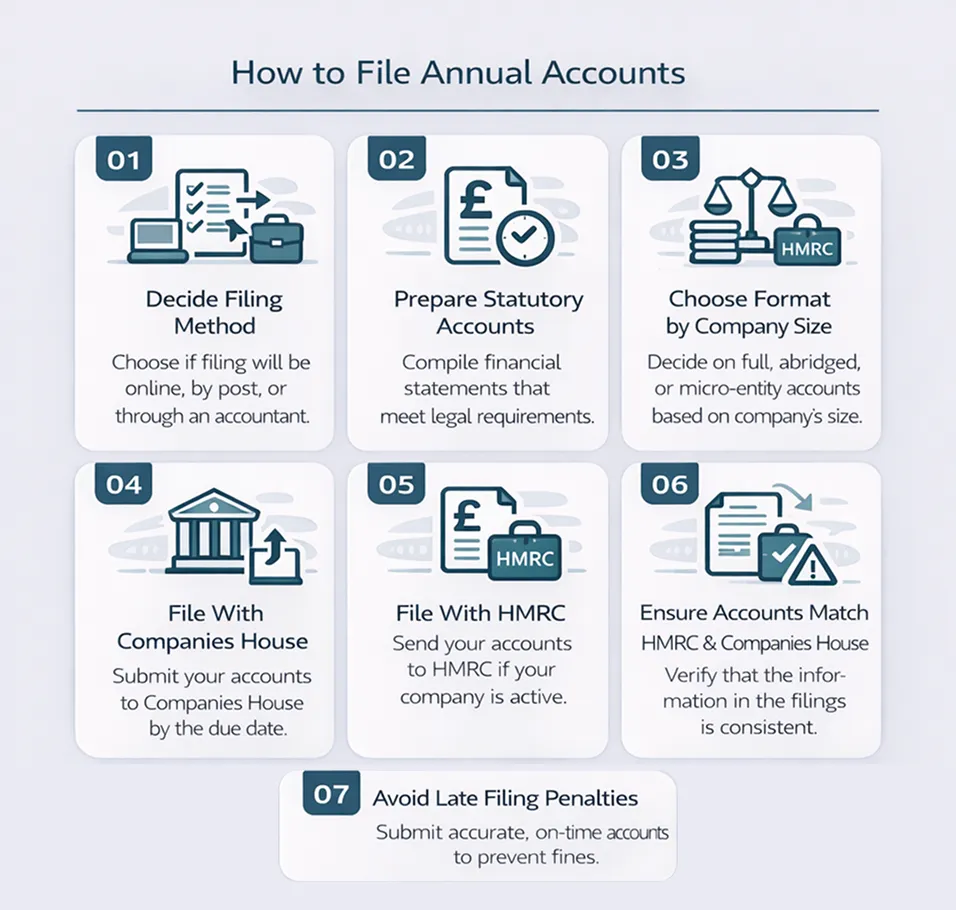
    Category:

    blogs

    Error: Contact form not found.

    How Capital Gains Tax Is Changing in April 2026?

    On 30 October 2024, the Budget introduced major CGT updates. Autumn 2025 brought further rule changes and relief updates. Since then, future CGT direction has remained a key focus for taxpayers and advisers. 

    While April 2026 does not introduce an entirely new CGT regime, it locks in and normalises several major reforms introduced earlier. Most notably during the capital gains tax changes 2025 period. The main expected capital gains tax changes in the UK are a scheduled increase in the rate for Business Asset Disposal Relief (BADR) and the full alignment of carried interest taxation with income tax.

    These changes alter how much tax individuals pay and who now falls within the CGT net.

    In this guide, we will explore all that and more. Understanding these tax changes is crucial for anyone looking to manage their tax liabilities.

    Key Takeaways:

    • Reduced allowance: £3,000 exemption means more taxpayers are affected.
    • Property impact: Buy-to-let and second home gains are particularly affected.
    • Planning is key: Timing, reliefs and allowable losses can save thousands.
    • Higher rates: 18% and 24% apply to many chargeable gains and these rates continue into April 2026.
    • Even if gains seem small, good records can prevent surprise tax bills after April 2026.

    What Changes From 6 April 2026

    • BADR rate increases from 14% to 18% for qualifying disposals.
    • Carried interest is taxed using income tax rules rather than CGT rules.
    • Most other CGT rates and the £3,000 allowance stay the same.

    What Is Capital Gains Tax?

    Capital Gains Tax is charged on the gain made when an asset increases in value and is disposed of. Assets can include:

    • Most personal possessions, excluding the main vehicle. Valued at a minimum of £6,000.
    • Property excluding your main home. Your main home is liable if it’s used as a business or let out.
    • Shares that are not in ISA or PEP.
    • Cryptoassets like Ethereum and Bitcoin.
    • Business assets.

    A disposal can include:

    • Sell an asset for cash.
    • Exchange for another asset.
    • Gift it to someone other than your spouse.
    • Transfer it to a trust.

    Private Residence Relief allows your private residence to be exempt from CGT. Exceptions include if the residence is being used as a business or being rented out.

    Capital Gains Tax Changes Leading Up to April 2026

    Capital gains tax changes in the UK have been on Labour’s agenda for some time now. The biggest reasons for these changes are:

    • To promote economic parity between working class and wealthy individuals.
    • Tax Equity.
    • Increased Revenue.
    • Limit tax planning opportunities.

    This rationale has led to sharp changes in capital gains tax rates. These include:

    1. Reduced Annual Allowance

    The annual CGT allowance has been reduced sharply.

    Table 01

    This amount is to remain unchanged at £3,000. This brings more people into the CGT net.

    2. Main Rate Changes

    The main rates for some assets were raised from 10% to 18% for basic rate taxpayers and from 20% to 24% for higher rate taxpayers. These rates remain the same going into April 2026.

    Higher rates: 18% and 24% apply to many chargeable gains and these rates continue into April 2026.

    For many disposals, the main CGT rates moved to 18% for basic rate taxpayers and 24% for higher rate taxpayers and these rates continue into April 2026.

    3. Other Changes

    The rate for Business Asset Disposal Relief (BADR) and Investors’ Relief (IR) increased from 10% to 14% from 6 April 2025.

    The CGT rate on carried interest rose to a flat rate of 32% from 6 April 2025.

    Key Changes in Capital Gains Tax in April 2026

    There are several key changes expected as of April 2026. This is part of the CGT reforms aimed at generating revenue and creating tax equity. The 2024 changes raised the main CGT rates, while the 2025 changes aimed at lowering the CGT exempt allowances. The April 2026 changes will primarily affect Business Asset Disposal Relief (BADR) and carried interests. 

    To get more taxation forecasts, check out our guide on 2026 tax updates.

    Here are some key capital gains tax changes in April 2026

    Key Changes in Capital Gains Tax in April 2026

    1. Business Asset Disposal Relief (BADR) Rate Increase

    Business asset disposal relief is a reduction relief offered under conditions to businesses that qualify. This relief results in lower tax than CGT on the disposal of assets. Previously, the lifetime limit for BADR was set at £1 million. This will remain the same. The CGT rate on disposals qualifying for BADR will increase from 14% to 18%.

    Table 02

    BADR Rate Timeline

    • On or before 5 April 2025: 10% on qualifying disposals.
    • From 6 April 2025 to 5 April 2026: 14% on qualifying disposals.
    • From 6 April 2026: BADR rate is 18% on qualifying disposals.

    This means that selling a qualifying business or investment after 6 April 2026 will usually attract more CGT than before.

    Review your exit timing carefully. Selling before April 2026 may result in a lower tax rate (14%) compared to later (18%).

    2. Carried Interest Taxation

    One of the biggest capital gains tax changes is that from April 2026 carried interest will no longer be considered as capital gains. From 6 April 2026, carried interest is taxed using income tax rules rather than CGT rules. The final tax outcome depends on the individual’s income position and how the return is treated under the carried interest rules.

    This is a major shift for fund managers and partners who previously gained from CGT treatment.

    3. Interaction With Income Tax

    CGT is calculated alongside your taxable income. Your position in the income tax bands determines which portion of your gain is taxed at the basic or higher rate.

    Example:

    • Salary: £45,000
    • Capital gain: £15,000
    • Allowance: £3,000
    • Taxable gain: £12,000

    The gain is split between basic and higher rate bands, creating a blended CGT liability.

    4. Inheritance Tax (IHT) Relief Caps

    This is an IHT update that may matter for business and farm planning, but it is separate from CGT rates. Business Property Relief (BPR) and Agricultural Property Relief (APR) will be restructured. Here are the changes.

    • The 100% relief cap is fixed at £2.5 million per individual.
    • The value of qualifying assets above the £2.5 million allowance will still be eligible for a 50% relief, resulting in an effective IHT charge of 20% on the excess amount.
    • Any unused portion of the allowance is passable to the surviving spouse. This means a couple can potentially pass on up to £5 million in qualifying assets free of IHT.

    Capital Gains Tax Changes Impact on Property Owners

    CGT changes have shaken up the property world. The impact on property owners is most observable. 

    1. Lower Allowances

    Lower allowances mean that property owners now have to pay more taxes. With the limit being reduced to £3,000, landlords selling property often face CGT bills far higher than they would have paid just a few years ago.

    2. 60 Day Reporting Rule

    You must report and pay CGT on residential property sales within 60 days of completion. This rule remains unchanged in April 2026, but penalties for late reporting are strictly enforced.

    3. No Relief Expansion

    Despite calls for reform, no new reliefs for landlords are planned. This confirms the government’s direction under ongoing capital gains tax changes in UK policy.

    Capital Gains Tax Changes for Shares and Crypto

    Investors in shares and cryptocurrency are also impacted.

    1. Smaller Gains Now Taxed

    Previously, many small investors stayed under the CGT allowance. With the allowance reduced to £3,000, even modest profits may now be taxable.

    2. Crypto Remains Fully Taxable

    HMRC treats cryptocurrency as an asset, not currency. All disposals, including swaps and gifting (excluding spouses), may trigger CGT.

    The capital gains tax changes 2025 significantly increased reporting requirements for crypto investors and these rules remain in force for April 2026.

    Strategic Planning to Minimise CGT Exposure

    With the ongoing changes being part of long term reforms, it is crucial to plan ahead. Strategic planning can help mitigate CGT impact and allow financial adjustments.

    1. Transfers Between Spouses

    Spouses and civil partners can transfer assets tax free:

    • Allows both CGT allowances to be used
    • Gains may fall into lower-rate bands

    2. Timing Disposals

    Selling assets gradually over multiple tax years:

    • Maximises allowances
    • Reduces the portion taxed at higher rates

    3. Utilising Trusts and Reliefs

    Careful use of trusts or BADR can further reduce tax liabilities, although professional advice is essential due to complex rules and anti-forestalling provisions.

    4. Allowable Losses

    Losses are now an integral part of planning CGT mitigation. Due to reduced allowances and higher rates, capital losses can be used in a number of ways to minimise the impact of CGT. These include,

    • Offset gains against losses in the same tax year.
    • Carry losses forward.
    • Utilise exclusions such as losses involving spouses, connected persons or non chargeable assets.

    To get more tax saving strategies, check out our blog on tax saving tips.

    Strategic Planning to Minimise CGT Exposure

    Will CGT Increase Further After 2026?

    Although rates and allowances are fixed as of April 2026, CGT is under ongoing review:

    • The Office of Tax Simplification has recommended further alignment with income tax rates.
    • Potential changes could affect reliefs, lifetime limits and reporting requirements.

    Investors and property owners should stay informed, as future capital gains tax budget changes may further alter the landscape.

    Conclusion

    Capital gains tax changes in the UK have been significant in recent years. April 2026 marks the consolidation of the capital gains tax changes taking place in recent years. While there are no changes to the main CGT rates or allowances, the cumulative effect of recent changes has been solidified into a broader capital gains tax net with tighter anti-avoidance rules. 

    Smart planning is key in this changing landscape. At Sterling Cooper Consultants, we are all about smart planning and strategic thinking. Whether it is selling property, shares, crypto or business assets, staying informed and planning ahead is the only way forward. Contact us now to get strategic financial and taxation planning.

    Unsure how the Capital Gains Tax changes affect you?

    With CGT rules becoming more complex from April 2026, getting the timing and structure right matters more than ever. Our taxation services can help you understand your exposure, plan disposals efficiently, and avoid unnecessary tax.
    +443300102526
    Book an Appointment

    FAQs


    What Are The Capital Gains Tax Changes Taking Effect In April 2026?


    From 6 April 2026, Capital Gains Tax (CGT) rates for gains qualifying for Business Asset Disposal Relief (BADR) and Investors’ Relief will rise to 18%, up from 14% in 2025/26 and 10% historically. Standard CGT rates introduced in October 2024 (18% and 24%) will remain unchanged.


    Yes. As part of the Autumn Budget 2024, CGT rates increased immediately from 30 October 2024. The basic rate rose from 10% to 18%, and the higher rate rose from 20% to 24% for most assets. Residential property rates were already aligned at 18% and 24%.

    For most assets:

    • 18% for gains within the basic rate band.
    • 24% for gains above the basic rate band.

    For BADR and Investors’ Relief qualifying disposals:

    • 18% flat rate, subject to lifetime limits and qualifying conditions.


    Second homes and buy-to-let properties remain taxed at 18% or 24%, depending on your income level. There are no new property-specific CGT rate increases in April 2026, but the reduced annual CGT allowance means more of the gain is now taxable.


    No further reductions are currently planned. However, the allowance is already at a historic low of £3,000 per individual, down from £12,300 in 2022/23. This lower allowance continues into the 2026/27 tax year.


    Yes. Gains on shares, funds, cryptoassets, and other chargeable investments are subject to the 18% or 24% CGT rates. With the reduced allowance and higher rates, investors holding assets outside ISAs or pensions face a higher effective tax burden.


    Yes. Cryptocurrencies are treated as chargeable assets for CGT purposes. Disposals of cryptoassets after using the £3,000 allowance are taxed at 18% or 24%, depending on income level.


    BADR remains available, but the CGT rate applied to qualifying gains increases to 18% from 6 April 2026. The lifetime limit remains capped at £1 million, significantly reducing the overall tax benefit compared to previous years.

    Yes. The timing of a disposal can determine:

    • Which CGT rate applies.
    • Whether BADR or Investors’ Relief is available.


    In some cases, completing a disposal before or after 6 April can materially change the tax outcome.


    Yes. Anti-forestalling rules apply where arrangements were entered into mainly to secure a lower CGT rate ahead of announced increases. These rules can override normal contract-date rules and apply CGT based on completion date instead.


    No. Assets held within ISAs and pensions remain fully sheltered from Capital Gains Tax and income tax. This makes tax-efficient wrappers increasingly valuable following the CGT changes in 2025 and 2026.

    No. You generally do not pay CGT on:

    • Your main home (subject to Private Residence Relief).
    • Assets sold at a loss.
    • Gains within the £3,000 annual allowance.

    However, most other asset disposals may now trigger CGT due to the reduced allowance.


    There is no confirmed increase beyond April 2026, but future Budgets could introduce further changes. CGT remains an area of ongoing political and fiscal focus, particularly for high-value asset holders.


    Yes. With higher rates, lower allowances, and complex relief rules, professional advice can help ensure disposals are structured and timed tax-efficiently under the current Capital Gains Tax rules.

    Share This Article!

    Recent Posts

  • What Are Annual Accounts? Everything You Need to Know

    What Are Annual Accounts? Everything You Need to Know

    Annual Accounts Explained

    Posted by:

    Admin

    Date:

    February 9, 2026

    Category:

    blogs

    Error: Contact form not found.

    What Are Annual Accounts? Everything You Need to Know

    Did you know that in the UK, about 98.5% companies filed their annual accounts on time. That shows how important this job is for companies. 

    Annual accounts show a business’s finances for one year. They show profit or loss, plus what the business owns and what it owes. They also help calculate how much Corporation Tax is due. Limited companies must file annual accounts with Companies House and send accounts to HMRC as part of the Company Tax Return process. This is a legal duty.

    What Are Annual Accounts?

    At the end of your business’s financial year, you make annual accounts, which are a set of financial statements. Your bookkeeping records, such as invoices, bank transactions, payroll, and expenses, are what they are based on. Companies in the UK usually have to send their statutory accounts to Companies House and HMRC as part of the process of filing their Company Tax Return.

    Think of your annual accounts as a ‘financial story’ for that year. They answer simple questions like:

    • Whether the business made money or lost money.
    • How much cash it had at key points.
    • What it owned, like stocks or tools.
    • What it owed, such as bills that weren’t paid or loans.

    They also help you figure out how much Corporation Tax you owe. The UK Government official webpage on accounts and tax responsibilities for private limited companies lists annual accounts and the Company Tax Return as two important things that must be done at the end of the year.

    Why Do Annual Accounts Matter?

    You don’t just file yearly accounts. They also give you an idea of how well your business is doing. The following points explain why they are important.

    1. Financial Transparency and Insight

    You can see the business clearly with good annual accounts. You can see patterns, not just guesses.

    You might see, for instance:

    • Costs went up faster than sales.
    • One line of products makes more money.
    • Customers are paying late, which is bad for cash flow.

    You cannot judge profit just by checking the bank balance. A business can show a profit on paper even when cash is tight. That’s why accounts are important.

    2. Legal and Tax Compliance

    If you file your accounts late in the UK, you could be fined anywhere from £150 to £1,500, depending on how late you are. Not filing on time can lead to legal action. Directors or LLP designated members may face penalties in serious cases.

    3. Informed Decision-Making

    When your yearly accounts are correct, it is easier to make choices.

    You can choose:

    • If you can hire someone.
    • If you can afford a new van.
    • If you should raise prices.
    • If you need to save money.

    Without solid accounts, decisions are mostly guesswork.

    4. Stakeholder Confidence

    People depend on your numbers.

    This could include:

    • Lenders and banks.
    • People who invest.
    • Credit from suppliers.
    • People who might want to buy the business.

    They can trust what they see because of clear yearly financial accounts.

    5. Strategic Planning

    When planning is based on real data, it works best.

    Strong annual accounts help you to:

    • Make a budget that you can stick to.
    • Make a guess about how much money you’ll need.
    • Make plans for tax bills sooner.
    • Find risks before they turn into problems.

    Why Annual Accounts Matter

    What Are the Components of Annual Accounts?

    There are a few important papers that make up annual accounts. Some are main financial statements, while others are annual accounts reports and accounts that back them up. Let’s make them easier to understand.

    1. Core Financial Components

    A few main statements make up most sets of annual accounts.

    i. Income Statement

    The income statement is often called the profit and loss account.

    It shows:

    • Sales (money made).
    • Costs that come directly from things like materials.
    • Costs that aren’t directly related to the business, like rent and software.
    • The year’s profit or loss.

    A simple thought can help here:

    • What is left after costs is profit.
    • When costs are higher than income, you lose money.

    ii. Balance Sheet

    The balance sheet shows what the company looked like on the last day of the financial year.

    It includes:

    • Assets are things that the company owns.
    • Liabilities (what the company owes).
    • Equity (the value left for owners).

    The balance sheet in UK statutory accounts must have a director’s name on it and be signed by a director.

    iii. Cash Flow Statement

    A cash flow statement shows how money came in and went out.

    It usually divides cash flow into:

    • Day-to-day trading is an example of operating activities.
    • Investing activities, like buying equipment.
    • Activities that involve cash movement (loans, repayments).

    This is worth noting: UK rules say that a lot of small and micro businesses don’t have to file as many forms. The size of your business and the reporting framework you use will determine the exact annual statements you need to include.

    2. Other Key Components

    Extra annual accounts reports may also be included in yearly accounts, depending on the size and type of the company.

    i. Director’s Report

    This is a brief annual accounts report from the directors about the year.

    It could have:

    • A review of business performance.
    • Main risks.
    • Plans for the future.

    Companies House lets small businesses choose whether or not to send in the director’s annual accounts report and profit and loss account.

    ii. Auditor’s Report

    There is an auditor’s annual accounts report with your company’s audit if it needs one.

    Many private limited companies do not need an audit, unless they meet audit rules or an audit is required by their governing documents or shareholders.

    iii. Letter to Shareholders

    Some businesses send a short letter to their shareholders. It’s more common in bigger companies or those that get money from investors.

    It often explains results in simple terms, such as:

    • What worked out well.
    • What changed?
    • What comes next?

    iv. Management Discussion and Analysis (MD&A)

    This is a more in-depth ‘plain-language’ explanation of the results.

    It often includes:

    • Why revenue changed.
    • What caused the costs to change?
    • What are the main risks?
    • What management intends to do next?

    Most small private companies do not include MD&A as a formal section, but a clear plain-language summary of results can still help.

    v. Corporate Governance

    Corporate governance is the system that tells a company what to do and how to do it.

    In bigger companies, governance annual accounts reporting might include:

    • The structure of the board.
    • Rules and policies.
    • Managing risk.

    Smaller businesses may be able to keep this lighter, but good governance still helps cut down on mistakes and fraud.

    How Do Account Types Vary by Company Size?

    Not all businesses file the same kinds of accounts. The rules in the UK let you use different formats depending on the size and type of activity. These are the most common types of accounts you will see.

    1. Full Statutory Accounts

    The most detailed version is the full statutory accounts.

    They are usually needed when a business doesn’t qualify for small or micro rules or when it decides to file full accounts.

    Full accounts usually have:

    • Account of profit and loss with more information.
    • A balance sheet with all the information.
    • Notes that explain the rules of accounting and important numbers.
    • It might be a cash flow statement, depending on the framework.

    2. Small Company Accounts

    A company that meets the UK small company criteria is treated as small for reporting. The test is based on turnover, balance sheet total, and employee numbers. Check the current thresholds before filing, as they can change. 

    You can do the following if your business is small:

    • Use the exemption so that your company’s books don’t have to be checked.
    • You can choose whether or not to send Companies House a copy of the director’s annual accounts report and the profit and loss account.
    • Send Companies House your shortened accounts.

    So, for many small companies, what the public sees on Companies House can be less detailed than what you prepare internally.

    3. Micro-Entity Accounts

    Micro-entities are even smaller than small businesses. UK Government official website says that a micro-entity must meet at least two of the following conditions:

    • A turnover of less than £1 million.
    • £500,000 or less on its balance sheet.
    • Fewer than 10 people work there.

    Micro-entities can make simpler accounts and may only send a simpler balance sheet to Companies House.

    4. Dormant Accounts

    A dormant company is one that doesn’t do any ‘significant’ business during the financial year. Dormant companies still have filing duties. Many people send Companies House dormant company accounts, which are easier to read. It’s better to ask an accountant if you’re not sure. Filing incorrectly can still lead to penalties.

    How Do Account Types Vary by Company Size

    Who Must Prepare and Receive Annual Accounts?

    Not just accountants need yearly accounts. A lot of people and businesses depend on them to make decisions, check things, and follow the rules. These are the main groups that are involved.

    1. Anyone with a Business Entity

    This depends on the type of business.

    • Most of the time, limited companies have to make and file statutory accounts.
    • Sole traders don’t have to send their company accounts to Companies House, but they still have to keep records and annual accounts report to HMRC in other ways.

    So, ‘business entity’ is important. The rules don’t work for everyone.

    2. Directors

    It is the job of directors to make sure that yearly accounts are made and filed on time. Directors are still legally responsible for the work, even if an accountant does it.

    3. Chief Executive and One Director

    In smaller businesses, the CEO and a board member are often the same person. The CEO of a large company may not be on the finance team, but they still use accounts to make decisions.

    4. Chief Financial Officer (CFO)

    A finance manager or CFO often:

    • Reviews performance results.
    • Checks for risks.
    • Helps with forecasting.
    • Works with accountants to get ready for the end of the year.

    5. Shareholders

    Shareholders get statutory accounts. According to the UK Government official website, you have to send copies of your statutory accounts to all of your shareholders.

    6. Regulators

    Companies House is the main place where UK businesses register and send in their accounts. As part of filing taxes, HMRC gets accounts.

    7. Stock Exchanges

    If a company is listed, it has to follow more rules about annual accounts reporting. This is mostly about filing for UK companies in general, but listed companies usually have more rules and shorter deadlines.

    8. Other Stakeholders

    Other people who have a stake can be:

    • Lenders.
    • Vendors.
    • Possible investors.
    • People who might buy.
    • Agencies that check credit.

    A lot of financial information before trusting a business. 

    If you are improving your finance skills, you may like this guide on how to become a bookkeeper. It helps you understand the basics that sit behind annual accounts.

    When to File Annual Accounts?

    Deadlines can be confusing because Companies House and HMRC use different timelines. The key is to track them separately.

    When to File Annual Accounts

    1. First-Year Accounts

    In some cases, your first year has different rules and longer timeframes. You still have to keep track of two different deadlines. This is how it works for each body.

    First Year Accounts

    i. Companies House (UK)

    UK Government official website says this about a private limited company:

    • You have 21 months from the date you registered with Companies House to file your first accounts.

    It’s also helpful to know your accounting reference date (ARD). The annual accounts filing guide from Companies House tells you how to figure out the filing deadline from the ARD and how new companies get their ARD. On its first accounts guidance page, the UK Government official website also gives clear examples of how first accounts cover an unusual first period.

    ii. HMRC (UK)

    There are two important deadlines for HMRC:

    • Pay Corporation Tax (or tell HMRC you owe none): usually 9 months and 1 day after the end of your accounting period.
    • File the Company Tax Return: 12 months after the end of the accounting period to file the Company Tax Return.

    People get confused because of this. The deadlines for Companies House and HMRC are not the same.

    2. Subsequent Accounts

    After the first year, the deadlines happen more often. But you still have to meet the deadlines set by both Companies House and HMRC. Here are the usual timelines.

    Subsequent Accounts

    i. Companies House (UK)

    A private company usually files 9 months after the end of your company’s financial year, which is after the first year.

    Also, if your deadline is on a Sunday or a bank holiday, you still have to file by that date. The Companies House accounts guidance makes this very clear.

    ii. HMRC (UK)

    The deadlines for HMRC stay the same:

    • Corporation Tax Payment: 9 months and 1 day after the end of the accounting period.
    • Company Tax Return: One year after the end of the accounting period.

    How to File Annual Accounts?

    Filing may seem hard, but if you follow the steps in the right order, it’s not too hard. The process usually starts with making sure the records are clean and ends with sending them to the right places. Here is the easy-to-follow flow.

    1. Decide Filing Method

    There are a few ways you can file:

    • You can file directly with Companies House using software or the internet.
    • As part of the Company Tax Return process, send this to HMRC.
    • Use the joint filing service to file your accounts and tax return at the same time.

    The best way depends on how your business is set up and what tools your accountant has.

    2. Prepare Statutory Accounts

    You need to get the accounts ready before you file.

    That means:

    • Balance your bank accounts.
    • Make sure that all sales and expenses are in order.
    • Check your payroll and VAT if you are registered.
    • Check on debtors and creditors.
    • Make note of year end accounts changes, such as depreciation.

    This is the part where a lot of small businesses need professional help.

    3. Choose Format by Company Size

    Use the right size for your format:

    • All accounts.
    • Accounts for small businesses.
    • Accounts for micro-entities.
    • Accounts that are not active.

    4. File With Companies House

    Companies House keeps track of when it gets acceptable accounts. You don’t get more time if you file close to the deadline and your accounts are turned down. The Companies House accounts guide on the UK Government official website makes this very clear.

    5. File With HMRC

    When you file with HMRC, how you format it is important. According to HMRC, most companies’ accounts that are part of an online Company Tax Return must be in iXBRL format, but there are some exceptions. If you use the government’s joint filing service, it says that the service will change your accounts to the right iXBRL format.

    6. Ensure Accounts Match HMRC and Companies House

    Try to keep one ‘source of truth’ clean.

    Some common reasons for mismatches are:

    • Used the wrong year-end dates by accident.
    • Changes made late after one filing.
    • Different ways of depreciating are used.
    • Missing changes to the director’s loan.
    • Matching your numbers lowers risk and saves time later.

    7. Avoid Late Filing Penalties

    Late filing fees can add up fast. Companies House charges private companies:

    • £150 for being less than a month late.
    • £375 for being late more than a month but less than three months.
    • Late by more than three months but less than six months: £750.
    • £1,500 if you’re more than six months late.

    If you file late in two consecutive financial years, the fees double in all cases.

    How to File Annual Accounts

    What Are the Benefits of Proper Annual Accounts?

    Keeping proper accounts does more than keep you legal. They can help you run your business better and lower your risk. The benefits below are divided into two groups: business benefits and compliance benefits.

    1. Business And Financial Benefits

    These benefits are about making the business work better every day. They concentrate on planning, doing things well, and making better choices. Let’s look at each one.

    i. Informed Decision-Making

    Clean annual accounts help the companies show:

    • What is profitable.
    • Where costs are high.
    • Where cash gets stuck.

    ii. Budgeting And Planning

    It’s easier to make a budget once you know the real numbers from last year.

    You can make plans:

    • Spending each month.
    • Getting hired.
    • Tax savings.
    • Goals for growth.

    iii. Improved Financial Performance

    You can make things better by measuring them.

    You could, for instance:

    • Stop wasting things.
    • Talk to your suppliers again about prices.
    • If your margins are too low, raise your prices.

    iv. Increased Access To Funding

    Banks and lenders often want to see recent accounts.

    Strong yearly accounts can help:

    • Applications for loans.
    • Overdrafts go up.
    • Talks with investors.

    v. Enhanced Operational Efficiency

    Accounts show where money and time are being wasted. For instance, if the cost of running the business keeps going up, you might want to automate invoicing or collect debts faster.

    vi. Fraud Detection And Prevention

    Fraud often hides in messy records. Regular checks and reconciliations make it less likely that mistakes or fraud will go unnoticed.

    2. Legal And Compliance Benefits

    These benefits help you follow the rules. They also make doing taxes and annual accounts reporting less stressful. Here are the main benefits.

    i. Regulatory Compliance

    Filing correctly is important for following Companies House rules and staying in good standing. You could be charged with a crime if you don’t file.

    ii. Simplified Tax Preparation

    Filing taxes is easier when your books are clean. You don’t have to worry about missing receipts, panicking at the last minute, or rushing to get numbers.

    iii. Proof Of Active Status

    Filing on time shows that your business is still open and following the rules.

    That can be important when:

    • Putting in bids for contracts.
    • Getting money.
    • Trusting your suppliers.

    iv. Legal Evidence

    Your annual accounts can show what the business did and when. This can help with business sales, due diligence, and disagreements.

    Conclusion

    Annual accounts are more than just paperwork. They show how much money your business makes each year. They help you file your taxes, make sure you follow the rules, and run your business clearly. Knowing what goes into them makes the whole thing less stressful. You can also find problems sooner, make better plans, and talk to lenders, investors, and partners with confidence. The easiest way to make the process feel easy is to keep it simple. Keep good records all year, then get ready and file on time.

    Worried your annual accounts might be late or incorrect?

    That is exactly where we can help. Sterling Cooper Consultants can support you with tidy bookkeeping, accurate year-end reporting, and smooth filing. Explore our accounting and bookkeeping services for ongoing support.
    Ready to get started? Contact us and we will talk you through the next steps.

    +443300102526
    Book an Appointment

    FAQs


    What Are the Annual Accounts?


    They are the yearly statutory financial statements for a company. They are prepared after the financial year ends. In the UK, you send statutory accounts to Companies House, and also to HMRC as part of the Company Tax Return process.


    A simple way to think about it is:
    1. Collect records, like sales, bills, and bank statements.
    2. Record transactions in your books.
    3. Reconcile bank accounts.
    4. Review and adjust entries.
    5. Produce a trial balance.
    6. Prepare financial statements.
    7. File and store records safely.


    For most small businesses, the ‘big five’ are:
    1. Income (sales).
    2. Expenses (costs).
    3. Assets (things you own).
    4. Liabilities (things you owe).
    5. Equity (value left for owners).


    It means ‘once each year’. In practice, it usually means covering one full financial year, then preparing annual accounts at the end of that period.


    Most annual accounts include a profit and loss account (income statement), a balance sheet, and notes. Many sets also include a director’s report and, if required, an auditor’s report.

    Share This Article!

    Recent Posts

  • How Do You Register a Business the Right Way?

    How Do You Register a Business the Right Way?

    Register a business

    Posted by:

    Admin

    Date:

    February 5, 2026

    Category:

    blogs

    Error: Contact form not found.

    How Do You Register a Business the Right Way?

    Registering a business in the UK depends on the structure you choose. The process also includes some important changes introduced in 2025 and 2026. From 1 February 2026, the standard digital incorporation fee for a company increased from £50 to £100. Mandatory identity verification for new directors and other individuals in scope also began on 18 November 2025. This means older business registration guides may not reflect the current process or fees.
    This guide explains how to register a business in the UK based on the structure you choose, including the main registration steps, tax requirements and checks to complete before you apply.

    Key Takeaways

    • Sole traders generally register with HMRC for Self Assessment rather than Companies House, while a private limited company costs £100 to incorporate digitally.
    • Identity verification is now part of the Companies House process for new directors, with separate verification requirements for PSCs.
    • Your business structure determines where you register, what filings you need to make and how liability is treated.
    • Checking the company name, registered office address, directors, PSCs and SIC code before applying can help avoid delays.
    • Registering a company name does not guarantee that it cannot later be challenged under company-name rules.

    Choose the Right Structure First

    Your business structure affects where you register, what tax responsibilities you have and how liability is treated. For many new UK businesses, the main options are sole trader, private limited company and limited liability partnership (LLP):
    business registeration structure
    A sole trader is usually the simplest structure. You register for Self Assessment with HMRC when required. If your gross trading income is more than £1,000 in a tax year, you generally need to register for Self Assessment.
    A limited company is a separate legal entity from its owners. It can provide limited liability, but it also brings additional reporting, accounting and filing responsibilities.
    An LLP combines elements of a partnership with limited liability. It must have at least two members and at least two designated members. The LLP is registered with Companies House, while its members generally pay tax on their share of the profits through Self Assessment.
    Choose the structure before starting the registration process because the requirements differ between them.

    How to Register a Business Step by Step?

    Once you have picked a structure, the actual registration process runs through a fairly fixed sequence as follows:

    Step 1: Pick a Name

    For a limited company or LLP, check that your proposed name complies with Companies House rules and is not too similar to an existing company name. Also check relevant trademarks before building your brand around it.

    Step 2: Verify Your Identity

    New company directors must complete the required identity verification, while PSCs have separate verification requirements. You can verify your identity through GOV.UK One Login or an Authorised Corporate Service Provider.

    Step 3: Register Your Business

    To register a business, sole traders generally register with HMRC for Self Assessment when required, while limited companies and LLPs register with Companies House. For a company, you will need information such as the registered office address, directors, PSCs and SIC code. A standard digital company incorporation costs £100, while paper and same-day options have different fees.

    Step 4: Check Your Tax Obligations

    After registration, check which taxes apply to your business. Depending on your structure and circumstances, this may include Corporation Tax, Self Assessment, VAT and PAYE.

    Step 5: Set Up Your Business Finances

    Once your company is incorporated, consider opening a separate business bank account and keeping business and personal finances separate. This can make it easier to maintain clear financial records and manage your accounts.
    business resgisteration steps

    Business Registration Checklist

    Before and after registering your business, check that you have:

    • Chosen the appropriate business structure
    • Checked the proposed company name against Companies House records
    • Considered relevant trademark and brand-name conflicts
    • Confirmed the registered office address
    • Identified the directors and PSCs, where applicable
    • Completed the required identity verification
    • Selected the appropriate SIC code
    • Prepared the required incorporation information and documents
    • Checked the current Companies House fee
    • Considered Corporation Tax, Self Assessment, VAT and PAYE requirements
    • Registered for the relevant taxes within the required deadlines
    • Opened a separate business bank account where appropriate
    • Kept the Certificate of Incorporation and other registration records safely

    Pro Tip:
    Complete the required identity verification before submitting your incorporation application. This can help prevent delays caused by missing verification information.

    Case Study: What Happens When You Do Not Check a Company Name Properly?

    Alpha Intel Advisory Ltd was registered on 18 July 2025. Intel Corporation later applied to the Company Names Tribunal, arguing that the company name breached the Companies Act 2006. The case was undefended.

    On 26 May 2026, the adjudicator ordered Alpha Intel Advisory Ltd to change its name within one month. The order also awarded Intel Corporation £800 in costs. The company did not change its name within the required period. On 13 August 2026, the adjudicator therefore changed the registered name to 16592971 LTD.

    The case involved specific allegations about the use of the Intel name, so it should not be treated as an example of every company-name dispute. However, it demonstrates an important point: Companies House registration does not guarantee that a company name is protected from later challenge.

    Checking the name and considering relevant existing brands before registration can reduce the risk of having to change your company name later.

    Conclusion

    Registering a business is not difficult, but the process has more moving parts than it did even a year ago. Start by choosing the right structure, then verify your identity, check your business name and register for the relevant taxes on time. Following these steps in the right order can help you avoid unnecessary delays and problems later. You can also benefit from a professional business advisory consultancy when making key decisions during the setup process.

    Not sure which business structure or registration step applies to you?

    Get in touch with Sterling Cooper Consultants for guidance on setting up your business correctly from the start.

    FAQs


    What is the business registration process in the UK?

    The process depends on your structure. Sole traders generally register with HMRC for Self Assessment when required. Limited companies and LLPs are incorporated through Companies House, with relevant tax registrations handled according to the business’s circumstances.

    A sole trader structure is generally simpler and has no Companies House incorporation fee, but the owner has unlimited personal liability. A limited company is a separate legal entity and generally provides limited liability, but it has additional reporting and filing responsibilities.

    If your gross trading income is more than £1,000 in a tax year, you generally need to register for Self Assessment with HMRC. You may also need to register in other circumstances, such as if you want to claim certain reliefs or benefits.

    Standard digital incorporation costs £100. A paper application costs £124, while the eligible same-day software service costs £156.

    New directors must verify their identity as part of the Companies House incorporation or appointment process. PSCs also have identity-verification requirements, with the timing depending on their circumstances. Verification can be completed through GOV.UK One Login or an Authorised Corporate Service Provider.

    Registering a name with Companies House does not guarantee that it is free from later challenge. In certain circumstances, another party can apply to the Company Names Tribunal, which can order a company to change its name. The 2026 Alpha Intel Advisory Ltd decision demonstrates how this can happen.
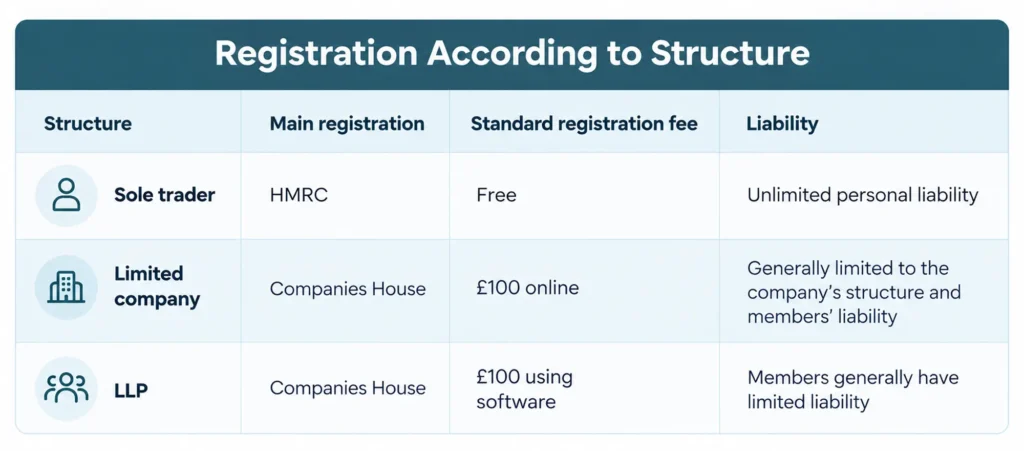
    Share This Article!

    Recent Posts