Author: admin

  • New HMRC Interest Rates Explained

    New HMRC Interest Rates Explained

    New HMRC Interest Rates Explained

    Posted by:

    Admin

    Date:

    February 4, 2026

    Category:

    blogs

    Error: Contact form not found.

    New HMRC Interest Rates Explained

    HMRC has announced changes to interest rates for tax payments this April, i.e., April 2025. These significant changes to the interest rate regime have tightened the financial consequences of late tax payments. Previously, the late payment interest rate was calculated by the Bank of England (BoE) at a base rate plus 2.5%. Now it has been increased to base rate plus 4%. Due to this, the effective interest rate to 8.5% when the BoE base is 4.5%. This is among the highest rates in more than ten years. It marks a more aggressive stance of the HMRC on compliance. HMRC interest rate changes are going to impact businesses as well as individuals significantly. This blog contains everything that you need to know about it.       

    What Are HMRC Interest Rates and Why Do They Change?

    HMRC charges interest on unpaid and or overdue taxes. The purpose of these interest rates is to encourage you to pay taxes on time. They also make things fair for everyone who does. Here are the three main types of interest rates that you need to know about:

    1. Late-Payment Interest

    If you don’t pay your tax bill on time, this is the extra cost you have to pay. This interest is charged by the HMRC from the day after your payment was due. It continues until the day it’s paid in full. Late payment interest discourages late payments. It also covers the extra time HMRC had to wait for your payment. 

    2. Repayment Interest

    This is what HMRC pays you when they owe you money. For instance, you paid much more tax than you were supposed to, or you were due a refund you didn’t get. This interest is usually less than late-payment interest. It is supposed to be fair, but it stops people from using HMRC as a savings account. 

    3. Corporation Tax Instalment Interest

    Corporation Tax is often paid by large companies in advance in the form of instalments. If HMRC does not get these instalments on time, they charge interest. This is just like the main late-payment rate. The rate, however, is slightly lower than that, though it still adds up. 

    How Are These Rates Set?

    The base rate of the Bank of England (BoE) is the basis for all HMRC interest rates. This is the primary interest rate in the UK, and it fluctuates according to the state of the overall economy. HMRC uses the following fixed formulae: 

    • Late-payment interest = BoE base rate + 4% (as of April 2025)
    • Repayment interest = BoE base rate – 1% (with a minimum of 0.5%)
    • Corporation Tax instalment interest = BoE base rate + 2.5%

    As the BoE rates change, HMRC updates itself as well. It is done within a few weeks. 

    Why Do HMRC Interest Rates Change?

    The change in interest rates serves a few purposes; it is not done randomly. They are meant to discourage late payments. Since they make it more expensive to delay, taxpayers are more likely to pay on time. Secondly, the interest helps preserve the value of the money. This is done by keeping the amount owed to HMRC from depreciating due to inflation. The system is also built to promote fairness and discipline. It makes sure that people who are paying on time do not get penalised, while those who delay their payments get penalties. 

    HMRC Interest Rate Changes Effective from 6 April 2025

    HMRC made significant adjustments to its interest charging and payment procedures in April 2025. Here is everything you need to know about these changes. 

    1. Late Payment Interest Rate

    The formula used to calculate the late payment interest rate has been adjusted. It is the Bank of England base rate plus 4%. So what does this mean? Well, in simple words, now small delays can be costly for you. The late payment rate, for instance, increased to 8.5% while the base rate was 4.5%. The interest rate on late payments was adjusted to 8.25% in May 2025, following a minor decline in the base rate to 4.25%. These changes are applied to the following taxes: 

    • Income Tax
    • Capital Gains Tax
    • National Insurance
    • PAYE
    • VAT
    • Corporation Tax (non-instalment)
    • Outstanding penalties

    Interest on late payments is calculated daily. It keeps accumulating until the debt is paid off, putting further strain on finances every day.

    2. Repayment Interest Rate

    There has been no change in the rate that HMRC pays when it owes you money,  such as for overpaid tax. It remains tied to the base rate but calculated as the BoE rate minus 1%, with a minimum of 0.5%. This means taxpayers are receiving 3.5% interest when the base rate is 4.5%. When it drops to 4.25%, you will get 3.25%. Depending on which party owes money, there is a growing disparity in how interest is handled. This is evidenced by the unchanged repayment rate and the higher rate applied to late payments. 

    3. Corporation Tax Instalment Interest

    For larger companies paying Corporation Tax in quarterly instalments, the interest charged on late payments has risen from base rate plus 1% to base rate plus 2.5%. At a base rate of 4.5%, this means a 7% interest rate on missed instalments. This applies to businesses with taxable profits typically over £1.5 million. This is because these businesses are required to follow the quarterly instalment regime. Any delay in scheduled payments now carries a noticeably heavier cost.

    How Much Could HMRC Interest Rate Changes Actually Cost You?

     Currently, even a small payment delay might result in observable additional expenses. Let’s examine a simple example to give you a general notion. The interest payable at an annual rate of 8.5% on a £10,000 tax debt would be approximately £210 if the payment were made 90 days after the due date. This continues for three months, and it is only for one bill. As delays become longer or amounts become larger, the amount increases. The average interest rate for late payments was closer to 6.75% last year. Accordingly, interest on the same £10,000 that was 90 days past due would have been roughly £165. Here are rounded estimates using simple interest. Actual amounts may vary, subject to compounding, exact timing, and HMRC calculations.

    Amount Owed Delay Interest Rate (2024) Interest Cost (2024) Interest Rate (2025) Interest Cost (2025)
    £10,000 90 days 6.75% (est.) ~£165 8.5% ~£210
    £25,000 90 days 6.75% (est.) ~£412 8.5% ~£525
    £10,000 180 days 6.75% (est.) ~£330 8.5% ~£420
    £50,000 30 days 6.75% (est.) ~£281 8.5% ~£354

    Why did HMRC Interest Rate Changes happen?

    The Autumn Budget 2024 officially announced the 1.5 percentage point increase. It is a component of a larger strategy to boost public budgets and enhance tax compliance. Here are four major reasons behind this decision: 

    • To stop people from delaying payments: The HMRC interest rate changes deter people from taking up short-term borrowing from HMRC.
    • To get cash in the door faster: HMRC interest rate changes push more taxpayers to pay on time, which helps HMRC improve its day-to-day cash flow.
    • To tackle the tax gap: For the 2023–2024 period, HMRC is attempting to bridge a reported £32 billion discrepancy. This gap is between the tax it should be collecting and what is actually paid.
    • To match rising government costs: In order to maintain financial equilibrium, the government expects to charge more when others owe it. This is because it pays more to borrow money.

    Impact of HMRC Interest Rate Changes on Individuals

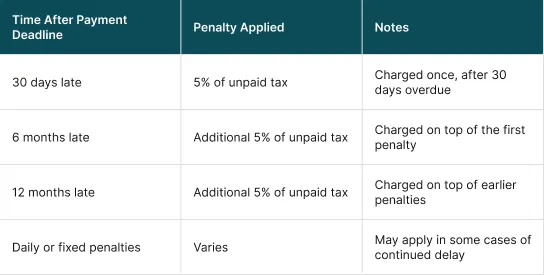
    If you pay income tax or file Self Assessment, you will be affected by HMRC interest rate changes. You will pay 8.25% to 8.5% interest to the HMRC, depending on the Bank of England base rate, if you miss your tax payment deadline. This implies that it gets more costly the longer you put it off. Interests are not the only extra cost that HMRC takes. They have penalties for late payments as well, which are as follows:
    Impact of HMRC Interest Rate Changes on Individuals

    You have to pay these penalties on top of the interest. All these amounts added up can cost a lot more than you expect. 

    Impact of HMRC Interest Rate Changes on Businesses

    The recent rise in HMRC interest rates can seriously affect businesses. Paying Corporation Tax by instalments is specifically impacted by it. Interest is now assessed at a rate of 7% for late payments. It quickly mounts up and raises overall expenses. It can put extra pressure on cash flow for small and medium enterprises (SMEs). Since they are already dealing with higher borrowing costs and tighter margins, they may feel the impact more. Businesses can face extra penalties and charges apart from Corporation Tax when they fall behind. Here are the ones that they will have to pay additional costs for:

    • PAYE (Pay As You Earn) for employee wages
    • VAT (Value Added Tax)
    • National Insurance contributions

    Most business owners fail to account for these taxes. They do not have a clear picture of how fast interest and penalties pile up. This can cause the penalties and interest amounts to go far beyond their expectations. 

    HMRC’s Tougher Crackdown on Late Payers

    Lately, HMRC has been more proactive in collecting unpaid taxes. The HMRC interest rate changes are a small part of this larger shift. 500 new staff members were added to their debt recovery team in April 2025. By April 2026, a further 600 staff members are expected to join the team. This additional staff will be dedicated to locating and collecting tax debts owed by both individuals and corporations. HMRC has also been using tools. One of their most powerful ones is called Direct Recovery of Debt (DRD). This tool allows them to take money directly from your account. They use it for covering your unpaid taxes, and they don’t even need a court order for this. With increased enforcement, DRD is becoming more popular and can be utilised for both personal and business tax debts. HMRC is also making better use of banking and credit data, giving it a clearer picture of a taxpayer’s finances. This helps them act more quickly when they suspect that someone is not paying what they owe.

    Do HMRC Interest Rate Changes Still Apply if You can’t Pay?

    Yes, you still have to pay interest with HMRC interest rate changes, even if you can’t pay your tax bill. Generally, when you can’t pay your bill, HMRC offers you a solution. It is called a Time to Pay (TTP) arrangement. Instead of paying the full amount at once, you can pay over several months in 6-12 months, through this plan. Interest will still be charged at the full rate from you. This will help you avoid penalties and legal action. Your total cost will still go up over time. To qualify for Time to Pay, you must do a few things:

    • Prioritise filing all of your tax returns because HMRC won’t accept anything if any of your documentation is missing.
    • Make early contact with HMRC, preferably before the payment deadline.
    • Even if you are unable to pay everything at once, demonstrate that you can afford the monthly instalments.

    This method may allow you some breathing room, but it will only be effective if you act promptly and maintain communication with HMRC. Usually, ignoring the issue results in increased expenses and more stringent enforcement.

    Summary Table of New HMRC Interest Rates (2025)

    Here is a quick summary of the HMRC interest rate changes:
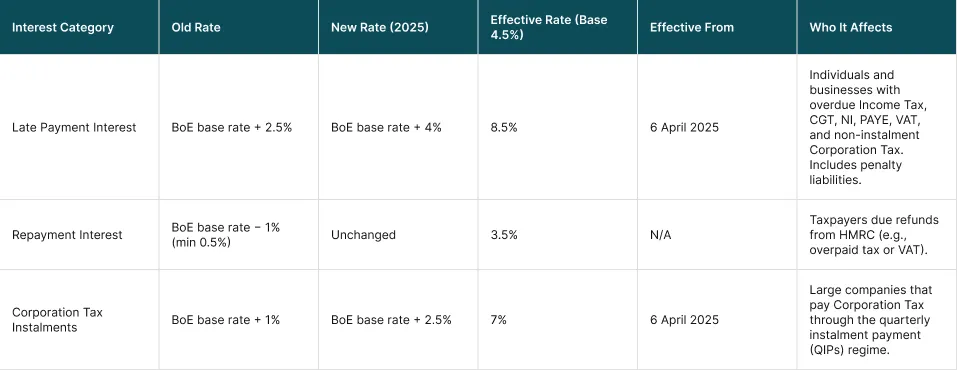
    Summary Table of New HMRC Interest Rates 2025

    Final Thoughts 

    HMRC is now tightening its grip on compliance with HMRC interest rate changes and stricter enforcement. You can no longer take compliance as an afterthought. Interest costs are now seen by both individuals and corporations as a significant and increasing financial burden. At Sterling Cooper Consultants, we help you stay ahead of all of this. We set up smart tax alerts and forecast cash flow impacts. We always ensure that you make timely tax submissions. We offer you support in navigating all kinds of taxes, from Self Assessment to planning Corporation Tax instalments. We help you avoid unnecessary costs and stay in full control. To get help, contact us now.

    Ready to avoid costly HMRC surprises?

    Let Sterling Cooper help you stay compliant, minimise interest charges, and protect your cash flow.
    +443300102526
    Book an Appointment

    FAQs


    When did HMRC increase its interest rates in 2025?


    HMRC raised its interest rates starting from 6 April 2025, in line with a policy change announced in the 2024 Autumn Budget. A further adjustment was made on 28 May 2025, following a reduction in the Bank of England base rate.


    Yes. HMRC reviews its rates shortly after any change in the Bank of England’s base rate. Interest rates are typically updated within 13 to 15 days to reflect the new base, both for late payment and repayment interest.


    Unfortunately, yes. Interest is charged automatically from the due date of payment, even if the underpayment happened due to a genuine error. Even if no tax is ultimately owed, HMRC interest can still apply until the issue is corrected.


    No, HMRC interest charges cannot be appealed, because they are calculated automatically based on the amount owed and the length of delay. However, you may appeal any related penalties, especially if you have a reasonable excuse.


    To steer clear of interest, it’s best to file your returns and make payments on time. If you’re struggling to pay, you should set up a Time to Pay (TTP) arrangement with HMRC in advance. You can also stay informed by tracking base rate updates to anticipate changes in interest costs.

    Share This Article!

    Recent Posts

  • Common Errors on VAT Returns and How to Avoid Them?

    Common Errors on VAT Returns and How to Avoid Them?

    Common Errors on VAT Returns and How to Avoid Them

    Posted by:

    Admin

    Date:

    February 3, 2026

    Category:

    blogs

    Error: Contact form not found.

    Common Errors on VAT Returns and How to Avoid Them?

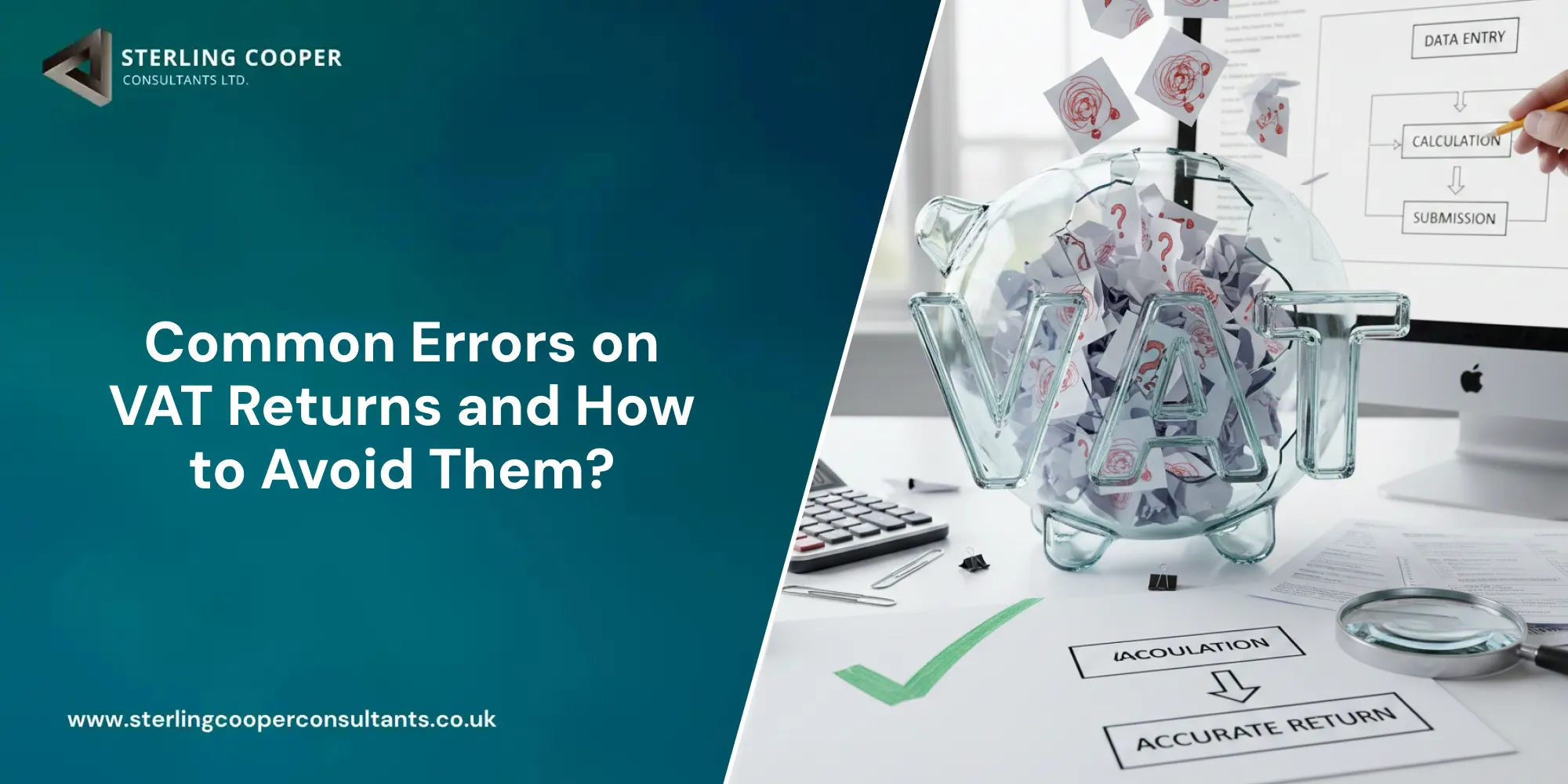
    Did you know that 24% of UK businesses have faced a VAT audit for mistakes? Even small slip-ups can cost hundreds or thousands in fines! VAT return errors are mistakes businesses make when calculating, reporting, or claiming VAT to HMRC.

    VAT may look simple, but it involves a lot of regulations, rates, and plans for imports, exports, and expenses. People often make blunders like utilising the wrong VAT rate, registering too late, or claiming VAT incorrectly. These VAT errors waste time and make you feel stressed. 

    The good news is that you can prevent most VAT errors. Make sure your records are organised, utilise software that works with MTD, and check every bill. Learn the VAT rules and train the people who handle your invoices and returns. That simple habit can cut mistakes, reduce risk, and help you avoid penalties.

    This guide explains common VAT return errors in the UK. It also shows what to check, what to fix, and how to stay compliant with fewer surprises.

    Introduction to VAT

    Introduction to VAT

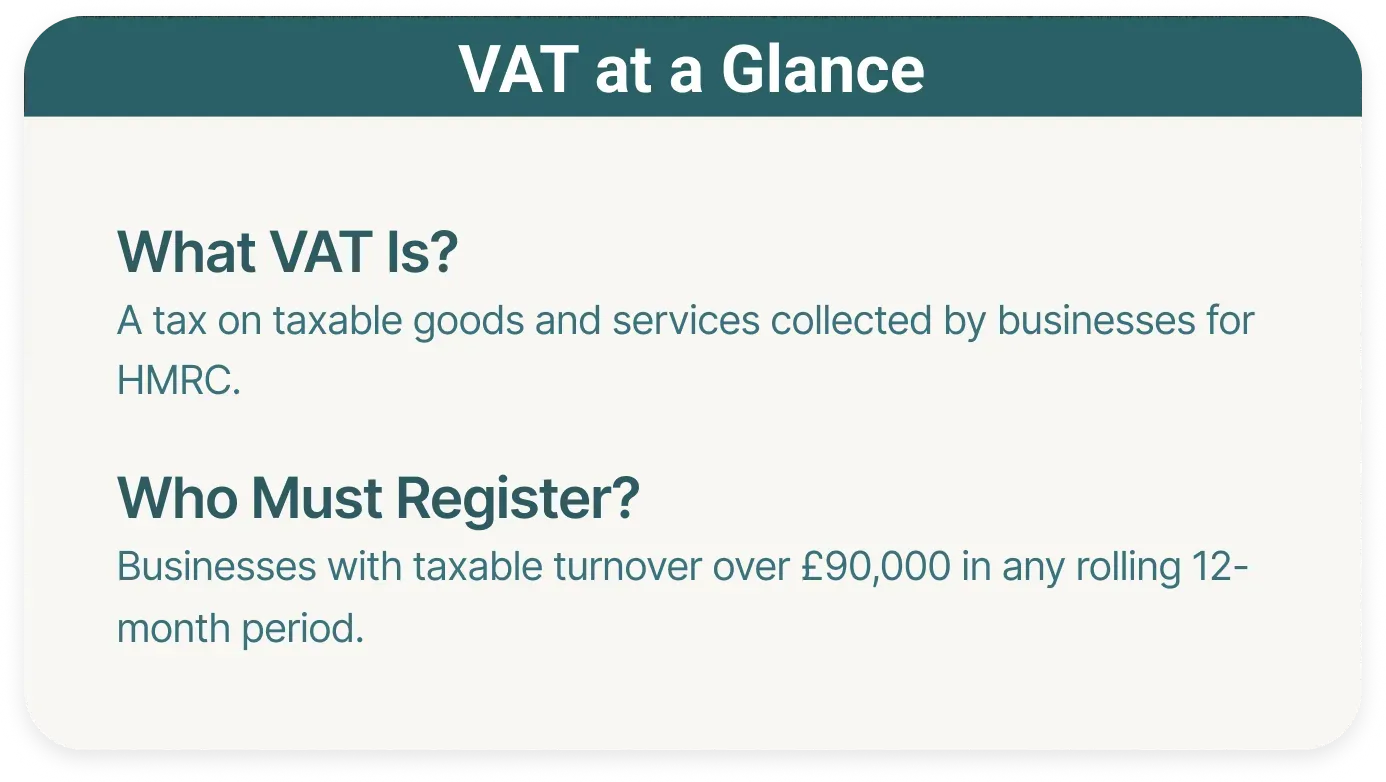
    Value Added Tax (VAT) is a UK tax charged on many goods and services. If a business is VAT-registered, it usually adds VAT to sales and pays that VAT to HMRC.

    VAT applies to taxable supplies, but not everything is treated the same. Some supplies are:

    • Standard-rated (20%)
    • Reduced-rated (5%)
    • Zero-rated (0%)
    • Exempt (for example, some financial and postal services)

    Zero-rated and exempt can look similar because both can show “no VAT charged,” but they are not the same in VAT terms.

    A business must register for VAT if its taxable turnover goes over £90,000 in any rolling 12-month period. This is not based on a calendar year. If the threshold is crossed, the business must register within 30 days of the end of the month in which it went over the limit. Smaller businesses can register voluntarily if it suits their situation.

    Note: This is general UK guidance. VAT rules can change, and some cases are tricky, so check HMRC guidance for edge cases.

    VAT Penalties for Errors

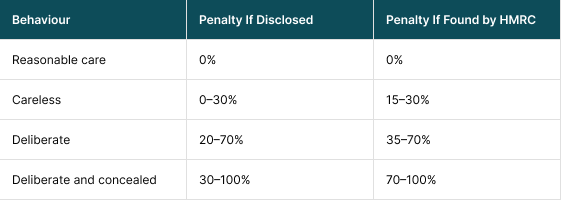
    VAT mistakes can be expensive if HMRC finds them. The penalty depends on what caused the error and whether you tell HMRC before they contact you. In some cases, penalties can range from 0% up to 100% of the VAT due. HMRC looks at the type of mistake and how it was handled before setting a penalty. The main types of VAT penalties for errors are:

    HMRC Penalties by Behaviour

    What Are the Top 11 Common Errors on VAT Returns & Ways to Avoid Them?

    VAT returns can be tough, and even small mistakes can lead to delays, interest, or penalties. Many businesses make VAT errors without noticing at the time. Spotting the common issues early can save time and money later. Below are 11 frequent VAT return errors in the UK, plus simple ways to avoid them.

    1. Misclassifying Goods or Services

    Many businesses charge the wrong VAT rate. This is called misclassification. Here is why it happens:

    • Some items have multiple possible rates.
    • Staff are confused by catering and lodging packages.
    • Hot and cold foods have different rates.

    For instance:

    • Hot takeaway food is charged at a normal rate of 20%.
    • Takeaway cold food may be 0%.
    • Medical supplies and child car seats are charged at the reduced VAT rate of 5%.

    Using the wrong VAT rate can lead to VAT being overpaid or underpaid. HMRC may investigate, especially for food and catering, where rules differ for hot takeaway food, cold takeaway food, and eat-in sales under HMRC guidance.

    How to Avoid?

    Here is how you can correct VAT error:

    • Review HMRC VAT guidelines regularly.
    • List all items and services with valid rates.
    • Changing products? Update your list.
    • Consider accounting software for rate tracking.
    • Ask a VAT expert if unsure.

    2. Incorrect Invoicing

    Valid VAT invoices have particular details. Their absence poses problems. Here are some common mistakes:

    • No invoice or VAT number.
    • Missing VAT rate.
    • Incorrect total VAT amount.
    • Missing company name or place.

    VAT claims and payments might be delayed by errors.

    How to Avoid?

    Here is how you can avoid such mistake:

    • Create VAT-compliant invoices with software.
    • Teach staff invoice requirements.
    • Check invoices before shipping.
    • Hold templates for all goods/services.

    3. Late or Missed VAT Registration

    VAT registration is necessary for businesses over £90,000 in 12 months. Here’s why such VAT errors occur:

    • Businesses rarely track turnover.
    • Registration is optional until turnover develops.
    • No defined financial year, 12-month barrier.
    • Late registration incurs VAT backdates and penalties.

    How to Avoid?

    Here is how you can correct VAT error:

    • Keep track of monthly turnover.
    • Alert when VAT threshold approaches.
    • Consider voluntary registration for growth.
    • Consult an accountant if uncertain.

    4. Overclaiming VAT on Expenses

    Companies overclaim VAT on costs. This is hazardous and fineable. Here are some common mistakes:

    • Client entertainment.
    • Items for personal use.
    • Uninvoiced VAT items.
    • Full business claim for mixed-use commodities.

    How to Avoid?

    Here is how you can correct VAT error:

    • Save VAT invoices and receipts.
    • Track VAT on each purchase with software.
    • VAT should only be claimed for business.
    • Double-check gift and entertainment guidelines.

    5. Errors on Imports and Exports

    International trade complicates VAT. Post-Brexit mistakes are widespread. Here are some common VAT errors:

    • Import VAT accounting delayed due to misunderstanding.
    • Missing export zero-rating.
    • Incorrect EU sales documentation.

    How to Avoid?

    Here is how you can avoid such mistake:

    • Learn export and import VAT rules.
    • Maintain proper import/export records.
    • Need help? Ask a VAT or customs specialist.
    • Use cross-border VAT software.

    6. Failing to Comply With MTD

    Making Tax Digital (MTD) requires digital records. Non-compliance leads to fines. Here is why such VAT errors happen:

    • Some businesses employ paper methods.
    • Staff may not know digital submission rules.

    How to Avoid?

    Here is how you can correct VAT error:

    • Accounting software that supports MTD.
    • Teach staff the software.
    • Make digital copies of invoices.
    • Regularly reconcile records.

    7. Late VAT Returns or Payments

    Missing VAT deadlines can lead to fines and extra charges.Late submission can build penalty points, while late payment leads to interest and payment penalties.

    These issues often happen because:

    • Forgetting deadlines.
    • Miscalculating payment dates.
    • Manual bookkeeping errors.

    How to Avoid?

    Here is how you can avoid such mistake:

    • Mark deadlines in a calendar.
    • Use reminders or software notifications.
    • Automate payments where possible.
    • Submit returns early if you can.

    8. Missing VAT Rule Updates

    VAT rates and restrictions vary often. Not updating can result in fines and VAT problems. For instance:

    • Rate reductions.
    • New late submission penalty.
    • Export/import rules.

    How to Avoid?

    Here is how you can avoid such mistake:

    • Get HMRC updates.
    • Participate in VAT seminars.
    • Rules should be reviewed quarterly.
    • Ask your accountant for updates.

    9. Using the Wrong VAT Scheme

    VAT schemes affect VAT reporting. Using the wrong one creates VAT issues. Here are some common schemes:

    • Flat-rate plan.
    • Accounting for Cash.
    • VAT standard accounting.

    How to Avoid?

    Here is how you can avoid such mistake:

    • Review all VAT schemes routinely.
    • Quarterly scheme comparisons.
    • An accountant can recommend the best VAT scheme or option for the business.
    • If cashflow improves, switch plans.

    10. Incorrect VAT Calculations

    VAT errors are common with manual calculations. Minor mistakes result in large fines. Here are some common mistakes:

    • Incorrect totals
    • Incorrect VAT amounts
    • Rates misapplied

    How to Avoid?

    Here is how you can avoid such mistake:

    • All VAT calculations should use MTD-compatible software.
    • Monthly reconcile sales and purchases.
    • Check totals before making returns.

    11. Claiming VAT Without Proper Evidence

    HMRC demands VAT evidence. Missing evidence can defeat your claim. Here are some common VAT errors:

    • Lacking invoices.
    • Personal cost claims.
    • Bad recordkeeping.

    How to Avoid?

    Here is how you can correct VAT errors:

    • Keep paper and digital invoices.
    • Use your company name on invoices.
    • Sort records by date and vendor.
    • Securely back up VAT paperwork.

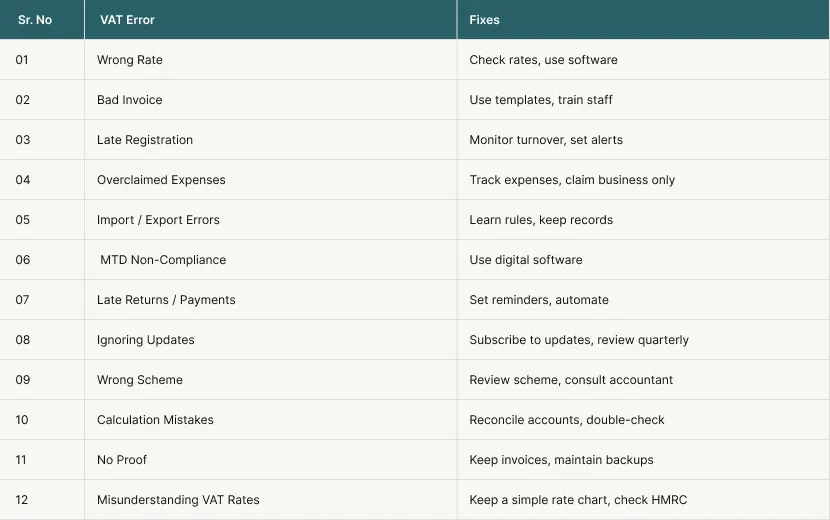
    VAT Error Vs Fix Overview Table

    Here is the VAT errors and solutions to overview table:

    VAT Error Vs Fix Overview

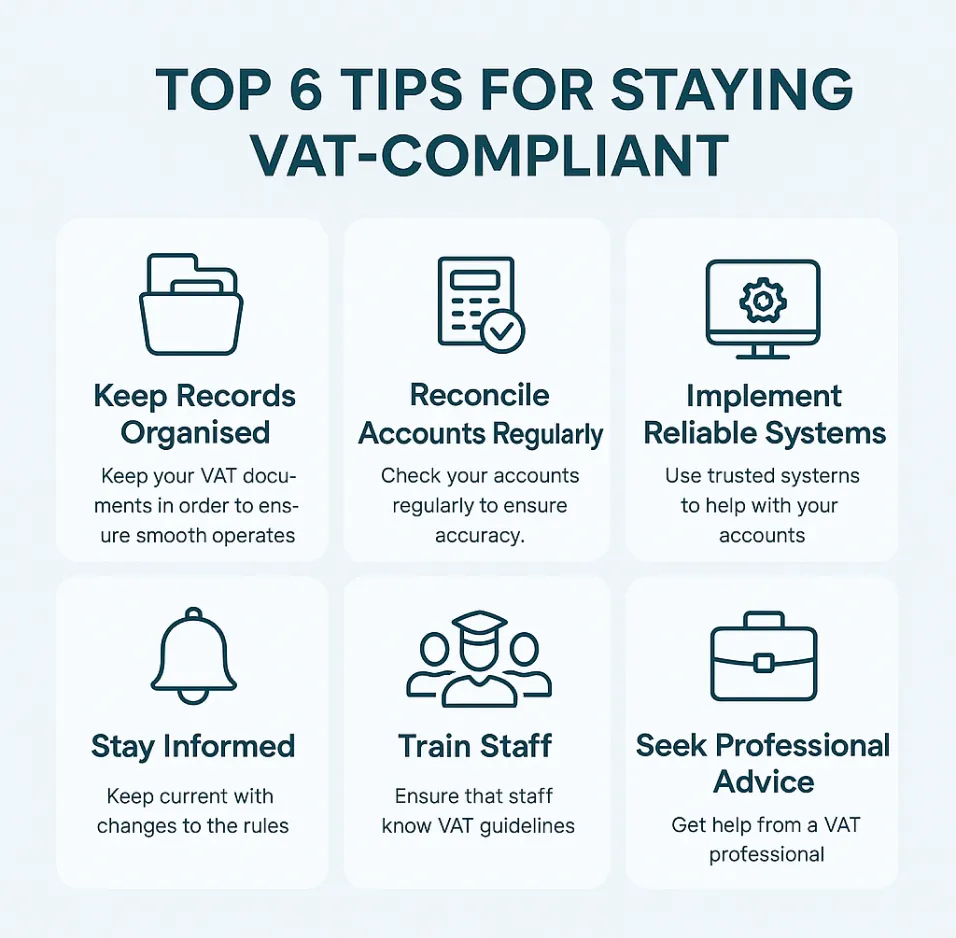
    Top 6 Tips for Staying VAT-Compliant

    Following the appropriate steps makes it easier to follow VAT rules. These ideas can help you keep your records clear, reduce stress, and easily obey HMRC laws. Here are the six best methods to keep on track.

    1. Keep Records Organised

    Keeping your VAT documents in order helps your business work smoothly. Clear files help you stay calm during checks. You need to maintain all of your VAT papers for six years. This includes receipts, bills, sales notes, bank slips, and VAT forms. Keep VAT records in labeled, safe files. Avoid losing or destroying important papers by scanning and backing up.

    2. Reconcile Accounts Regularly

    Every month, check your accounts. Make sure your VAT account matches your sales and purchases. Check for strange amounts or inappropriate dates. Look at the tax rates on each bill. Make sure the VAT code is correct. Little mistakes can add up quickly. A simple scan lets you correct VAT errors before they get worse. This also keeps you from getting large fines.

    3. Implement Reliable Systems

    Use systems that you can trust to help with your accounts. Choose accounting software that is compatible with Making Tax Digital (MTD). HMRC publishes guidance and a list of software that works with MTD for VAT, which businesses should check before choosing a system. These apps get information from your accounts. They do the maths for you on VAT. They also leave a clean digital trail. You can find out who made each adjustment. This makes it easier for you to believe your numbers. It also lowers the chance of making mistakes.

    4. Stay Informed

    Keep current with changes to the rules. Every year, the rules for VAT can change. You may get HMRC alerts or read short tax guidelines online. This helps you plan ahead and not be surprised at the last minute.

    5. Train Staff

    Make sure that the people who record sales or deliver bills know the regulations about VAT. Show them what you do and how you check things. Many VAT errors can be avoided with good training. Your overall VAT process stays seamless and safe when your team knows what to do.

    6. Seek Professional Advice

    Sometimes, VAT requirements can be hard to follow. When you need help, a VAT pro can help. They can help you with sales across borders. They can find out if you need to utilise the reverse charge. They can aid when the rules change. A pro keeps you safe and on the right path.

    You can read our blog to learn how to get a VAT certificate.

    Top 6 Tips for Staying VAT Compliant

    Conclusion

    Mistakes with VAT happen a lot, but they can be avoided. Businesses may avoid VAT error and fines by keeping good records, using software that works with MTD, checking invoices, and following HMRC rules. Simple things like reviewing VAT schemes and educating staff can help. Being careful and consistent saves you time, money, and stress. These recommendations will help your business stay legal and run effectively. 

    This guide is general UK VAT information and may not fit every business. For complex cases like cross-border sales or partial exemption, check HMRC guidance or speak to a VAT adviser.

    Are you worried about making costly VAT errors on your returns? Sterling Cooper Consultants can help.

    Our expert Taxation Services ensure your returns are accurate, compliant with HMRC, and submitted on time. Let our specialists take care of your VAT compliance so you can focus on growing your business.
    +443300102526
    Book an Appointment

    FAQs


    How to Correct Errors on VAT Return?


    You can correct mistakes on your next VAT return if the total net error is under £10,000, or if it is between £10,000 and £50,000 and less than 1% of your turnover for that period. Errors above these limits, or those that do not qualify for adjustment, must be reported directly to HMRC.


    A careless error happens when a taxpayer does not take reasonable care, such as failing to inform HMRC within 30 days that an assessment is too low. For example, if a VAT return is late and HMRC issues an estimate that understates what is owed, not notifying HMRC within 30 days may result in a penalty.


    Check that the totals for your sales and purchases match the figures shown on your VAT return. Review the underlying data to confirm that all transactions have been categorised correctly and that the VAT amounts agree with your accounting records.


    If you believed your VAT return was correct but later discovered an error, HMRC may apply a penalty of 0% to 30% of the tax involved, provided you inform them. The penalty depends on how the error occurred and how promptly you disclose it.


    You can correct VAT errors for up to four years from the filing deadline of the VAT return in which the mistake was originally made, including cases of under-claimed input tax.


    If you discover a mistake on a submitted VAT return, small errors under HMRC thresholds can often be corrected on your next return. For larger errors, you must notify HMRC directly. Using accounting software or consulting a VAT expert ensures accurate amendments.


    To correct VAT errors, first identify the mistake and determine its value. Minor errors may be adjusted in your next VAT return, while significant errors must be reported to HMRC. Keeping detailed records and seeking professional advice helps prevent penalties and ensures compliance.

    Share This Article!

    Recent Posts

  • A Complete Guide to the 0T Tax Code

    A Complete Guide to the 0T Tax Code

    0T Tax Code Explained

    Posted by:

    Admin

    Date:

    February 2, 2026

    Category:

    blogs

    Error: Contact form not found.

    A Complete Guide to the 0T Tax Code

    Being on the 0T tax code can mean more tax is taken from your pay than expected. Even a short period on 0T can cost you hundreds of pounds. Many people only notice when their take-home pay drops, which can feel confusing and frustrating.

    The tax code 0T means you won’t get any pay that isn’t taxed. So, all your income is taxed from the first pound. There are a few reasons why this might happen. It could happen when you get a new job. If you have more than one job, it can also happen. This could also happen if you make a lot of money.

    The good news is that this usually doesn’t last long. You can easily check it by following these steps. If it’s wrong, you can also fix it. You might get your money back if you paid too much in taxes.

    What is a 0T Tax Code?

    A 0T tax code means you have to pay taxes on your pay. This could be for a job or a pension. This code is usually only temporary. It might be used by HM Revenue and Customs (HMRC). HMRC may use it until your details are updated. It helps collect the right tax.

    Why Do You Get a 0T Tax Code?

    In some cases, HMRC uses the tax code 0T. It can happen when you start a new job, have multiple sources of income, make a lot of money, or don’t have all the information you need. If you know why it happens, you can plan for it and avoid surprises.

    1. Starting A New Job Without A P45

    Start a new job without a P45 from your former work and you may obtain the 0T tax code. P45s reveal what you’ve paid in taxes. Your employer may request a Starter Checklist if you don’t have one. Your employer will use 0T tax code until HMRC updates your code. Every pound earned is taxed immediately.

    2. Multiple Sources Of Income

    In multi-job or pension situations, only your principal income gets the tax-free allowance. Many second jobs and pensions use 0T tax code. To ensure accurate total tax across all incomes, HMRC does this. You may pay too little tax on your combined earnings without this.

    3. High Income

    Your Personal Allowance starts to go down if you make more than £125,140 a year. If your income is higher than this, the allowance will eventually go down to zero. The 0T tax code is right when this happens. This makes sure that people who make a lot of money pay taxes on all of it, with no exceptions.

    4. Missing Or Delayed Information

    HMRC sometimes uses 0T tax code because they don’t have enough information. This could be because the forms were late, missing, or the information about your job or pension isn’t clear. The 0T tax code is only a temporary fix until the right code is found.

    5. Administrative Errors

    A tax code 0T can also happen because of mistakes. When HMRC and employers talk to each other, enter data, or process it, mistakes can happen. If your code suddenly changes to 0T, get in touch with HMRC. If necessary, they can look at your record and change your tax code.

    How 0T Tax Differs From Other Tax Codes?

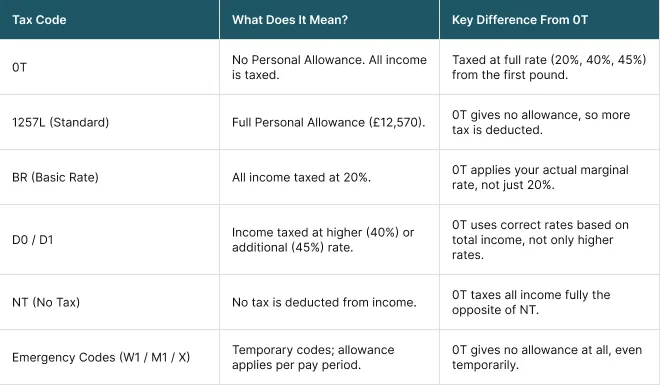
    The 0T tax code is not like most other tax codes in the UK. You don’t get a tax-free Personal Allowance with 0T tax code. This means that you have to pay taxes on every pound you make. Other codes usually give some allowance or use flat rates. They lower taxes at the beginning or treat all income the same. The tax code 0T is very strict: you pay taxes on your income according to the full tax rate. If you know the difference, you can read your payslip and avoid surprises.

    Comparison Table

    Here’s a quick comparison:

    Comparison Table

    If you want to learn about BR tax code read our blog What Is Tax Code BR and How Does It Impact Your Pay?

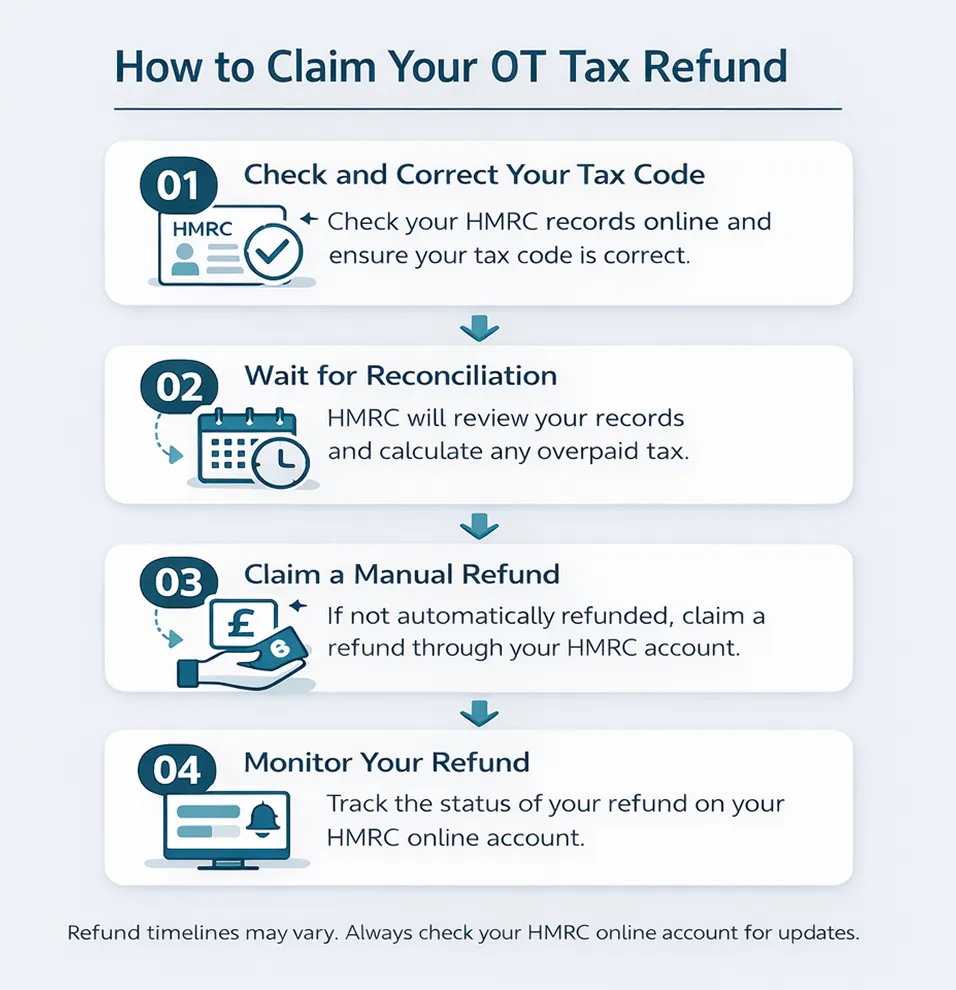
    How to Claim Your 0T Tax Refund?

    If you have a 0T tax code, you don’t get a tax-free Personal Allowance. From the first pound you make, you have to pay taxes on it. This can lead to overpayment. You can get your money back by following these steps:

    1. Check and Correct Your Tax Code

    First, check your tax code on your payslips or by going to the GOV.UK Personal Tax Account. The HMRC app displays tax payments and code. If unsure, call HMRC’s Income Tax helpline at 0300 200 3300. Prepare your P45 (or Starter Checklist), National Insurance number, and pay stubs. Update your information and HMRC will use the right code.

    2. Wait for Reconciliation

    After the tax year ends on April 5, HMRC (a tax code checker) usually checks for overpayments. If you paid too much in taxes, they might send you a P800 tax calculation letter that shows how much you can get back. If your information is on file, refunds may sometimes be sent automatically through direct bank transfer.

    3. Claim a Manual Refund (If Needed)

    You can ask for a manual refund if you need your money back sooner or haven’t gotten a P800 yet:

    • P50 Form: If you stopped working during the year and didn’t claim taxable benefits, use P50 form. This makes it possible to make a claim during the year.
    • Online Claim: Use your National Insurance number and P800 reference to quickly send money to your bank by following the P800 letter’s instructions.
    • Cheque: HMRC may send a cheque, but after 31 May 2024, most refunds must be claimed online or requested. 
    • Written Claim: You can also write to HMRC and give them your personal information, work history, and the reason you overpaid.

    4. Monitor Your Refund

    Your next payslip should show the right tax code and any refund once your 0T tax code has been updated. If not, you can claim it through your Personal Tax Account or the HMRC app.

    How to claim your OT Tax Refund

    When Is the 0T Code Correct?

    If you don’t get any tax-free Personal Allowance in the UK, the 0T tax code is right. There are a few situations where 0T is the right code.

    1. Personal Allowance Is Used Up

    One reason 0T is right is because your personal allowance has already been spent. This can happen if:

    • You have another employment that uses up all of your allowance.
    • You get a private pension where the allowance is applied first.
    • Your overall income is substantial, more than £125,140 in the tax year 2024/25. In this instance, your Personal Allowance slowly goes down to zero.

    0T makes sure you pay the proper amount of tax in these cases.

    2. Have A New Or Second Job

    0T is also correct when you get a new job or a second job. This frequently happens if:

    • You didn’t provide your new employer your old P45.
    • You didn’t finish the Starter Checklist.

    HMRC can’t issue a full tax code without these forms. Using 0T for a while makes sure that taxes are collected correctly until HMRC updates the code.

    3. HMRC Lacks Sufficient Information

    Sometimes 0T is used because HMRC doesn’t have enough information about your income. This can happen if:

    • You just got a new job.
    • You get a termination payout even though you already have a P45.
    • Your tax data are not completely up to date.

    In these situations, 0T is a holding code until HMRC gets all the information.

    What Should You Do If You’re on the 0T Tax Code?

    If you see 0T on your pay cheque, act right away. This code says you won’t get a tax-free allowance. So you might be paying more taxes than you should. Look at your tax code and make sure your information is up to date. This helps make sure that you get the right amount of money. If you paid too much you might get your money back.

    1. Gather Your Documents

    Get the relevant papers together before you call HMRC or your employer:

    • Your National Insurance (NI) number
    • Recent pay stubs that demonstrate how much money you made 
    • P45 from your last job or a filled-out Starter Checklist (P46)

    Getting them ready speeds up and smooths out the process.

    2. Check Your Tax Code Online

    You can log in to your HMRC Personal Tax Account or use the HMRC app. Look at the tax code that HMRC has on file for you. Check to see if it says 0T and if it fits your job position.

    3. Update Your Details

    If you just started a new job and didn’t give your P45 to your employer, act right away. Fill out a Starter Checklist if you don’t have P45. Make sure that HMRC has the correct information about all of your jobs and pensions if you have more than one. This makes sure that the right code is used for each source of income.

    4. Contact HMRC by Phone

    Call HMRC if changing your information doesn’t fix the problem. Call the Income Tax hotline at 0300 200 3300. Get your NI number, PAYE reference, and income information ready. Staff can help you fix your code and let your boss know.

    5. Submit a Starter Checklist

    The Starter Checklist (P46) has all the information that HMRC needs to give your employer the right tax code. If you don’t have your P45, always send it in.

    6. Receive Your Refund

    The revised code should be on your next payslip after HMRC updates it. Most of the time, you will instantly get back any extra taxes you paid. If it is after the tax year, HMRC may give you a P800 tax calculation that tells you how to get your refund.

    Conclusion

    In short, tax code 0T can seem scary. The code is usually temporary. It is used by HMRC for safety. It can happen when you get a new job. Having two jobs can set it off. It might also happen if you get paid more.

    Quickly check your 0T tax code. Use your HMRC Personal Tax Account. The HMRC app can also help. If you need to, fill out the Starter Checklist. You can get back money if you paid too much tax. You might see refunds on your payslips. Or come after the checks at the end of the year.

    When work changes, update your information. This helps you avoid making mistakes on your taxes. If it looks wrong, call HMRC. Quick action stops surprises on payday.

    Are you paying more tax than necessary because of the 0T tax code?

    Sterling Cooper Consultants can review your tax position, correct your tax code, and help you reclaim any overpaid tax. Explore our taxation services or learn more about how we support individuals and businesses.
    +443300102526
    Book an Appointment

    FAQs


    How to Calculate Tax on a 0T Tax Code?


    The 0T tax code is applied when your personal allowance cannot be used or has not been determined by HMRC. Unlike the BR tax code, which only applies a basic tax rate of 20%, the 0T tax code taxes your income progressively. Income falling within the basic rate band is taxed at 20%, earnings within the higher rate band are taxed at 40%, and any income above the additional rate threshold is taxed at 45%. This means your income is assessed at the standard UK rates but without any tax-free allowance.


    If you find yourself on a 0T tax code, it is important to ensure your details with HMRC are correct. You should first check your tax code using HMRC’s online tax code checker to confirm your personal allowance and the status of your income. If your tax code appears incorrect, contact HMRC promptly to provide updated information. Keeping your personal and employment details current and reviewing your tax code regularly can help prevent overpayment of tax and ensure you are on the correct code.


    The 0T tax code, which uses the numeral zero followed by the letter T, is assigned by HM Revenue & Customs when you are not entitled to any tax-free personal allowance for a particular source of income. It may also be used if HMRC does not have enough information to assign your proper tax code. This ensures that tax is deducted correctly while your allowances are being confirmed.


    Yes, being on a 0T tax code often results in higher tax deductions in the short term because you are not granted any tax-free personal allowance. Consequently, every pound you earn is subject to tax at the applicable rates, which can lead to larger deductions from your pay compared to a standard tax code where allowances are applied.


    HMRC commonly applies the tax code 0T when they do not have complete or up-to-date information about your earnings. This can occur if you start a new job without providing your previous P45 or completing a Starter Checklist (formerly P46), or if you change employment partway through the tax year while still on your previous tax code.


    Although 0T is a temporary measure, it is not classified as an emergency tax code. It acts as a holding code until HMRC can confirm your correct tax position and assign the appropriate code. Once the information is updated, your tax deductions will be adjusted accordingly.


    Yes, you can get a refund if you overpaid tax while on a tax code 0T. The 0T tax code means no tax-free Personal Allowance. This often leads to paying too much tax if it is applied temporarily or incorrectly.

    Share This Article!

    Recent Posts

  • How Labour Could Reshape Capital Gains Tax in the UK?

    How Labour Could Reshape Capital Gains Tax in the UK?

    labour capital gains tax

    Posted by:

    Admin

    Date:

    January 29, 2026

    Category:

    blogs

    Error: Contact form not found.

    How Labour Could Reshape Capital Gains Tax in the UK?

    Are you an investor, business founder or property owner? Do you have second homes, shares or assets that you are meaning to dispose of? Then the Labour capital gains tax changes are of great importance to you. The talk around tax reforms is nothing new in the UK. This time, however, it’s different. The current Labour government has decided to sharply reduce the annual tax-free allowance and increase the main rates of most assets. This is done to target wealthy individuals to raise revenue and the longstanding Labour promise of bringing parity between CGT and income tax. Starting from Autumn Budget 2024 and with further legislation, the question will Labour raise capital gains tax has been answered with a yes. The only question now is how far they will go.

    While the most directly affected are individuals who own capital assets. As with most UK legislation, some caveats and angles must be explored before a final verdict can be made. In this blog, we will cover all you need to know about capital gains tax and how capital gains tax labour proposals affect individuals and businesses.

    Key Changes At A Glance (UK CGT)

    Labour capital gains tax policy resulted in the following changes.

    • Tax-free allowance: £3,000 (or £1,500 for trusts).
    • Most asset sales (shares, funds, business assets): 18% for basic rate taxpayers, 24% for higher rate taxpayers.
    • Residential property and second homes: Often 18% or 24%, and it usually must be reported and paid within 60 days of completion.
    • Carried interest: 32% (mainly for fund managers).
    • Business Asset Disposal Relief (BADR): Lifetime limit is £1 million, and the relief rate has increased (with more change already scheduled).

    What Is Capital Gains Tax?

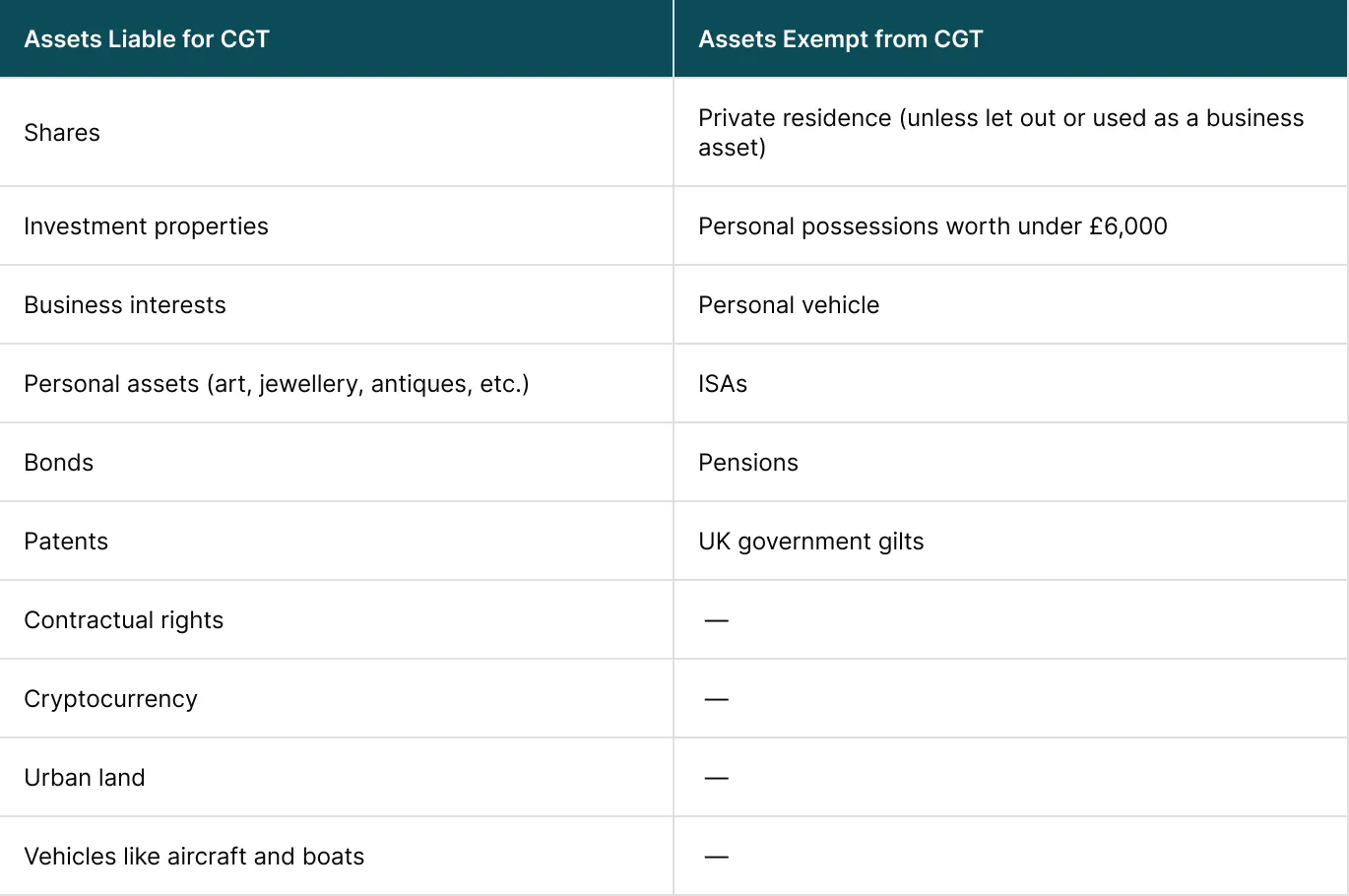
    Capital Gains Tax or CGT, is charged when you sell an asset with increased value. The tax is calculated on the gains made from the sale. The assets generally liable for CGT are:

    • Shares
    • Investment properties
    • Business interests
    • Certain personal assets ( art, jewellery and antiques, etc.)
    • Bonds
    • Patents
    • Contractual rights
    • Cryptocurrency
    • Urban land
    • Vehicles like aircraft and boats

    The CGT does not apply to all assets. Certain assets are exempt from CGT under labour capital gains tax legislation. These include.

    • Private residence (unless let out or used as a business asset)
    • Personal possessions worth under £6,000
    • Personal vehicle
    • ISAs and pensions
    • UK government gilts.

    As of now, the rate for CGT is adjusted based on income level and the type of asset involved. The CGT has lower rates than income taxes. The lower rates encourage investment and entrepreneurship. Critics have argued that CGT is too lower than the income tax rate and that it is unfair to workers. Recent labour capital gains tax policy aims to change that fact.

    What Is Capital Gains Tax

    How Much Is Capital Gains Tax in the UK?

    The tax-free annual allowance is £3,000 and £1,500 for trusts. This was reduced from £12,300 in 2022-2023 for the 2024-2025 tax year. If you have sold an asset, you are entitled to the given tax-free allowance. You are charged CGT for any gains made above the allowance limit.

    How much CGT you have to pay depends on the gains you have made and whether you are a basic rate or a higher rate taxpayer.

    Higher Rate Taxpayer:

    As of April 2025, the CGT for higher-rate taxpayers is:

    • 24% of gains made from the sale of an asset.
    • 32% of your gains on carried interest in case you manage a fund (private or public).

    Basic Rate Taxpayer: 

    As of April 2025, the CGT for basic rate taxpayers is: 

    • 18% of gains made from the sale of an asset.
    • 32% of your gains on carried interest in case you manage a fund (private or public).

    Labour and Capital Tax Gains

    Labour capital gains tax policy has a long history. Labour has viewed capital gains as benefiting wealthy owners at the expense of the working class. This view has largely steered the capital tax gain labour policy. For a long time the question of will Labour raise capital tax gain has been directed at the core of Labour’s financial decision-making. It has come to be now that labour has increased CGT and it’s expected to rise in the future.

    The goal seems to be parity between the income tax rate and CGT rates. While not fully aligned to that goal, Labour capital gains tax policy seems to move in that direction. The full alignment to the universal tax rate has gained support, but it is considered politically risky. This would mean raising the current main rate of 24% to 40%. Such a sharp rise can result in significant blowback from the investor community.

    A more incremental approach with modest increases seems more likely. The increase from 10% to 18% for basic rate and from 20% to 24% for higher rate taxpayers, supports this indication. This also seems like the more politically viable option. Historically, more incremental raises have gained more revenue. As taxpayers have more incentive to pay quickly rather than delay disposals.

    Under this plan, the Labour capital gains tax policy seems more like a gradual reform than a radical shift. 

    Now that we have covered the basics, we will discuss in greater detail how Labour capital tax policy could reshape CGT in the UK. 

    To learn more about taxation forecasting, check out our guide on 2025-26 tax year updates.

    Residential Property and Second Homes

    Residential property has already been affected by the Labour capital gains tax policy. As of 2025, the CGT on residential property stands at 24%. This rate is higher than that on most assets. Although the main home exemption remains in place. However Labour has targeted second home owners and landlords of investment properties.

    Affordability has been a key concern in the UK for quite some time. Recent CGT increases on non-primary residencies and properties are an attempt to tackle this problem. This measure is seen as both fiscally important and socially beneficial. There is much speculation going on as to what the future holds for CGT in regards to residential property; however, two very common observations seem to be.

    • Likely rate increase: In line with the ongoing trend and labour capital gains tax policy, the CGT for residential property and second homes are expected to increase.
    • Property tax reforms: There have been indications of a shift towards a different form of property tax, such as a national property tax.

    As of now, the CGT on the sale of a property must be reported and paid within 60 days of its completion.

    To learn more about taxation on rental income, check out our guide for reducing taxes on rental income.

    Business Asset Disposal Relief

    Business asset disposal relief is a reduction relief offered under conditions to businesses that qualify. This relief results in lower tax than CGT on disposal of assets. BADR has been scaled back a lot under the labour capital gains tax policy. The lifetime limit has fallen from £10 million to £1 million and the qualifying gains have increased from 10% to 14%,  as of 6 April 2025. This rate is set to increase to 18% as of April 2026. 

    If Labour capital gains tax policy further decreases the lifetime limit it can generate more revenue. This would allow it to still claim its support for businesses. However the limit has been greatly reduced already. Even though it may allow a person a saving of up to £100,000, the optics may look worse for any further change. 

    Alternatively, Labour could increase the relief rate itself. This would fill the gap between business disposals and other asset sales. Either approach would affect businesses and form a key component of any capital gains tax labour reform agenda.

    The approach is driven by a revenue generation agenda. Expect relief rates to go up further in the future.

    CGT and Inheritance

    One of the most complex areas involves what happens at death. At present, many assets receive a tax-free uplift for CGT purposes. This means that historic gains are effectively wiped out, and heirs inherit assets at their current market value. This can be very lucrative.

    Business assets may also qualify for inheritance tax relief, creating a situation where no CGT or IHT is paid at all. This is viewed as a loophole rather than a policy choice.

    Labour has not committed to specific changes here, but reviews of this area are widely expected. Removing or limiting the CGT uplift on death would be a significant reform, though politically sensitive.

    If addressed, it would mark one of the most structural changes under any future capital gains tax labour agenda.

    Labour capital gains tax policy may result in limiting or removing the CGT uplift where inheritance tax relief applies, particularly for shares in trading companies. While politically sensitive, such a change would align with Labour’s broader narrative around fairness and closing perceived loopholes in wealth taxation.

    Timing of Potential Changes

    Changes to CGT rates announced in the Budget would take effect from the following 6 April. However, recent years have shown a shift away from this trend.

    This matters because advance notice can trigger a surge in disposals. If Labour announces a CGT increase, many asset owners may rush to sell.

    As a result, recent budgets have introduced measures that have immediate effect. If Labour announces a significant CGT increase, there is a big chance that changes could apply from budget day itself.

    Anyone asking will labour raise capital gains tax must also consider the risk that advance planning opportunities could be limited.

    Administration and Compliance 

    Changes to CGT rates mean complexity increases often when different rates apply within the same tax year. Taxpayers may need to apportion gains by date, apply multiple rate bands, and deal with transitional rules.

    From HMRC’s perspective, implementing labour capital gains tax reforms would likely require system updates, revised guidance, and additional support for digitally excluded taxpayers. For individuals, especially those with diverse portfolios, compliance costs could rise even if headline rates increase only modestly.

    Economy and Behaviour

    While CGT reform will have a direct impact on behaviour. Higher rates may discourage disposals and encourage people to hold on to assets.

    Labour will need to balance revenue goals with the risk of dampening investment or entrepreneurial activity. This is why many analysts expect capital gains tax labour changes to focus on small reforms rather than radical change. Labour capital gains tax seems to align with that direction

    Who Is Most Likely to Be Affected?

    Labour raises CGT as it affects a small but wealthy subset of the population. The results of labour capital gains tax policy could be far-reaching.

    Any changes to labour capital gains tax policy would primarily affect:

    • Investors with shared portfolios.
    • Owners of second homes or rental properties.
    • Business founders looking for an exit.
    • Trustees and personal reps.
    • Individuals engaged in succession planning.

    While CGT is paid by a small subset of taxpayers, the amounts involved can be huge. Even small amounts can translate into tens of thousands of pounds in additional tax.

    Knowing where you sit is critical when assessing the impact of capital gains tax labour reforms.

    Who is most likely to be affected

    What Can Taxpayers Do?

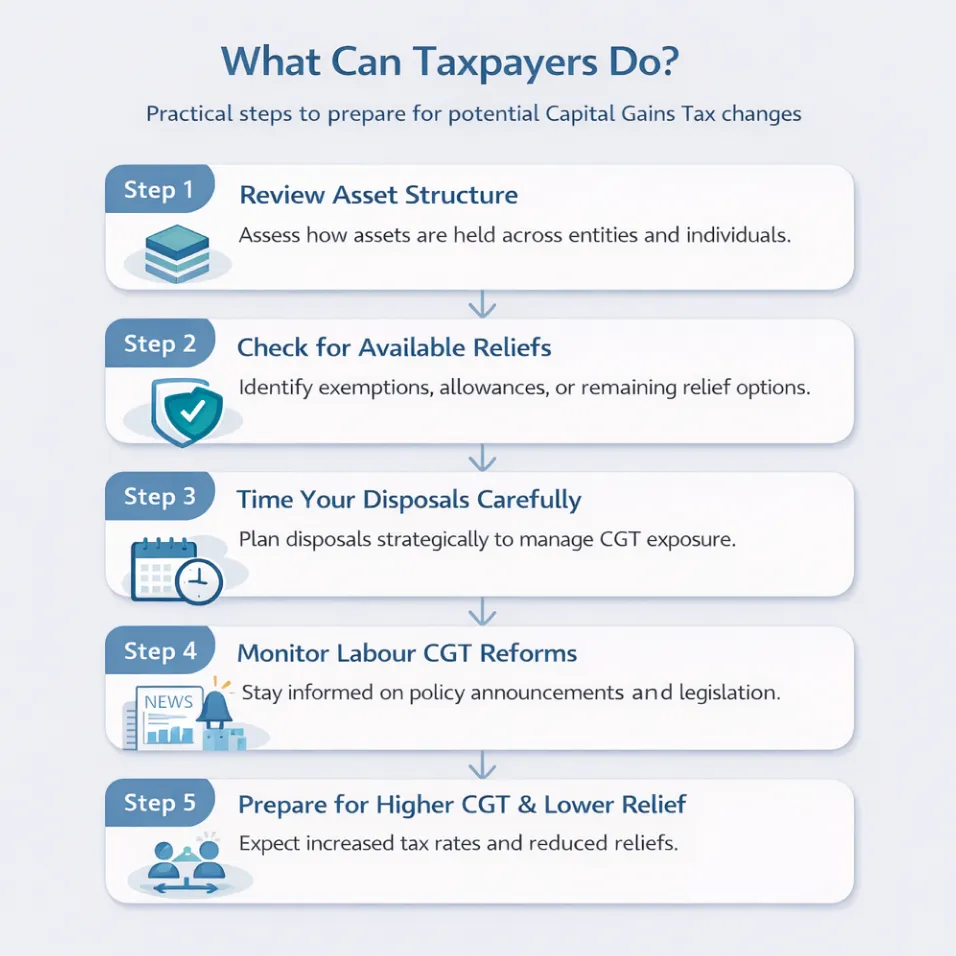
    Inaction is the worst approach. There is much uncertainty, but waiting does not make it any better. A right approach would be:

    • Review asset structure.
    • Check for relief.
    • Time your disposals.
    • Monitor labour capital tax gains reforms.
    • Expect high CGT and low relief.

    While no policy is final, the current trend does seem to result in increased CGT. So the taxpayer should plan ahead for that.

    What can taxpayers do

    Conclusion

    The labour capital gains tax reforms aim to create revenue and fairness. The role of wealth taxation for equity has been clear in the capital gains tax labour policy. While the road remains certain, a direction can be mapped out. Rather than asking will labour raise capital gains tax, a better question is how quickly raises will come. Inaction serves no one. One must prepare for the capital gains tax in the UK. That’s where we come in. At Sterling Cooper Consultants, we provide the most relevant and comprehensive financial advice. Be it taxation or asset management, we specialise in knowing and acting out your financial will. Contact us now to get started today.

    If you are considering selling assets, exiting a business, or reviewing succession plans, now may be the right time to act. Potential changes to Capital Gains Tax could materially affect your tax position.

    Speaking with a qualified tax adviser before any reforms are announced can help you identify opportunities, manage risk, and plan with confidence. Check out our taxation services today to get you started.
    +443300102526
    Book an Appointment

    FAQs


    What Is Labour Proposing To Change About Capital Gains Tax?


    Labour has indicated that it wants to reform Capital Gains Tax to raise revenue while keeping the UK competitive. Rather than immediately aligning CGT with income tax rates, current proposals and policy signals suggest moderate rate increases, particularly for non residential assets, alongside changes to reliefs such as Business Asset Disposal Relief.


    Under the measures announced in the Autumn Budget 2024, the main CGT rate for basic rate taxpayers has already increased from 10% to 18% for disposals made on or after 30 October 2024. While further increases are not confirmed, future Budgets could introduce additional changes depending on fiscal pressures.


    Yes, higher rate taxpayers have already been affected. The main higher rate of CGT has increased from 20% to 24% for most assets other than residential property and carried interest. Whether Labour goes further remains uncertain, but aligning CGT more closely with income tax remains part of the wider debate.


    For residential property, CGT rates remain 18% for basic rate taxpayers and 24% for higher rate taxpayers. However, property investors are particularly exposed to future reforms, especially those with second homes or buy to let portfolios. Any further rate increases could materially affect post tax returns.


    Business Asset Disposal Relief is being phased down. The CGT rate on qualifying gains will rise from 10% to 14% from April 2025, and then to 18% from April 2026. While the relief is not being abolished, its value to entrepreneurs is being significantly reduced.


    Yes. Trustees and personal representatives are now subject to a 24% CGT rate on most chargeable gains, increased from 20%. This change applies to disposals made on or after 30 October 2024 and increases the importance of careful estate and trust planning.


    Most of the main CGT rate increases took effect from 30 October 2024, partway through the tax year. Changes to Business Asset Disposal Relief and Investors’ Relief take effect from 6 April 2025, with further increases planned from April 2026.


    If you are considering selling assets, exiting a business, or undertaking succession planning, it may be sensible to review your position sooner rather than later. Changes to CGT often trigger rushed decisions, and proactive planning can help manage exposure under both current and future rules.

    Share This Article!

    Recent Posts

  • Business Asset Disposal Relief: Key Changes Coming in 2025 and 2026

    Business Asset Disposal Relief: Key Changes Coming in 2025 and 2026

    Business Asset Disposal Relief

    Posted by:

    Admin

    Date:

    January 28, 2026

    Category:

    blogs

    Error: Contact form not found.

    Business Asset Disposal Relief: Key Changes Coming in 2025 and 2026

    You might have heard about Entrepreneurs’ Relief, but do you know what business asset disposal relief is? To your surprise, it’s the same thing. 

    The latest changes to this policy have got the attention of business owners across the UK. Also the government continues to revise tax policy in response to economic pressures. In this lieu, many believe that business asset disposal relief 2025/26 will reshape the way investors leave businesses. Knowing these shifts is not just important for compliance. It is also needed for financial planning.

    What is Business Asset Disposal Relief?

    Formerly known as Entrepreneurs’ Relief, it is a UK tax relief scheme. It allows people to pay a reduced rate of Capital Gains Tax (CGT) when selling all or part of their business. The primary aim is to support startups by rewarding those who build and grow businesses.

    In place of the standard CGT rate, qualifying disposals are taxed at a lower rate. In most cases, this can offer huge savings, mainly for those planning a business exit.

    BADR applies to those selling:

    • All or part of their business
    • Shares in a personal company
    • Assets used in the business

    The current relief limit allows for up to £1 million of lifetime gains to be taxed at the reduced rate.

    Who can Qualify for Business Asset Disposal Relief?

    Not every business can get this relief. A criteria is set to be met for this. A person must:

    • Be a sole trader, partner, or shareholder
    • Have owned the business or shares for at least two years
    • Hold at least 5% of shares and voting rights if disposing of company shares
    • Be an officer or employee of the company 

    Some conditions still vary based on the type of disposal. For instance, selling company shares requires the business to be trading and not mainly involved in investments.

    For example, there is a marketing consultant operating as a limited company for five years. They decide to retire and sell their shares would likely qualify for business asset disposal relief 2025. That too in case all conditions are met.

    Get expert financial advisory services from Sterling Cooper Consultants. 

    Confirmed Changes to Business Asset Disposal Relief

    More updates are officially set to take effect in 2025 and 2026. These changes will reduce the tax benefits offered by the scheme and make timing more crucial than ever.

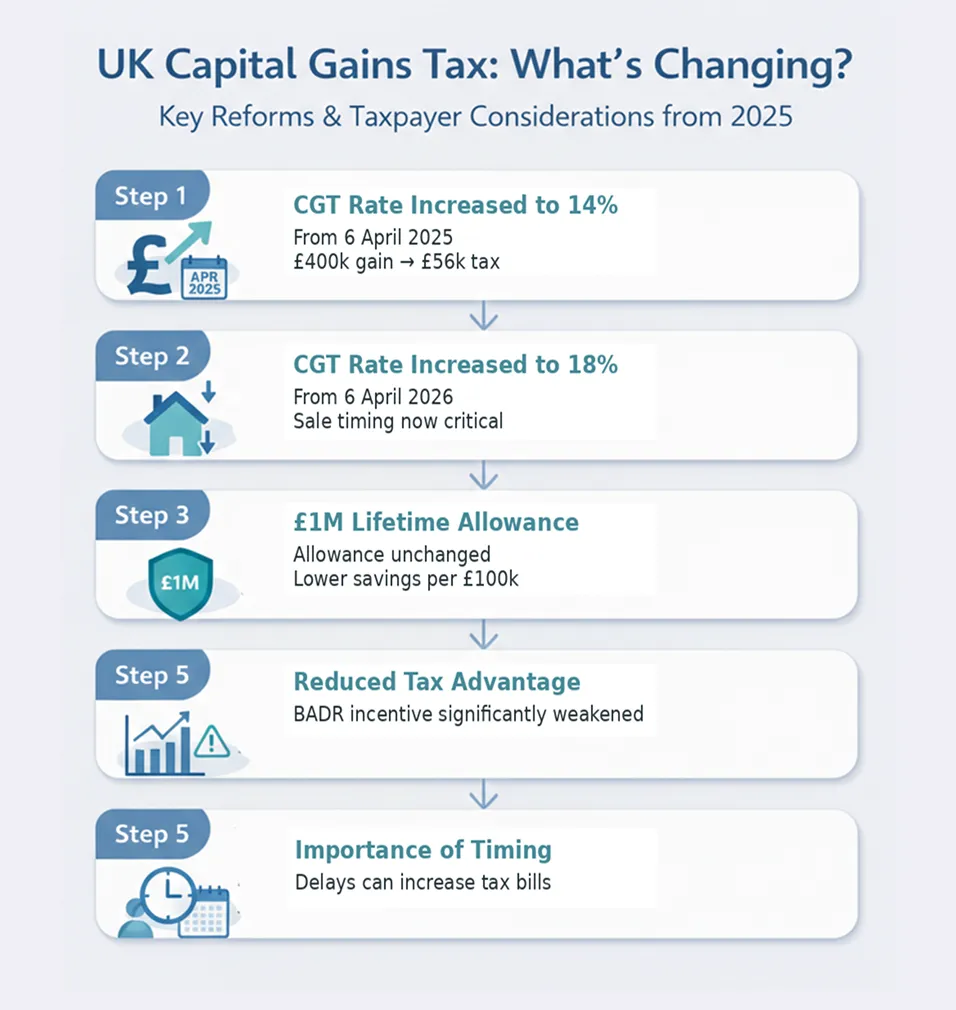
    1. CGT Rate Increased to 14% From 6 April 2025

    The business asset disposal relief 2025 update increased the CGT rate on qualifying gains from 10% to 14%. This represents a 40% rise in tax liability for sellers. For example, selling a business with a £400,000 gain resulted  in a tax bill of £56,000 instead of £40,000 under the current rules.

    2. Again, CGT Rate Increase to 18% From 6 April 2026

    Another confirmed update is a second rise to 18% from April 2026. This continues the trend towards narrowing the gap between reduced and standard CGT rates. Business owners must have assessed if it is better to sell before April 2025 to benefit from the lower rate.

    3. Lifetime Allowance at £1 Million

    Even with an increase in the rate, the business asset disposal relief limit will remain at £1 million. But the value of this allowance is reduced as tax savings per £100,000 in gains decline. This could change the appeal of the scheme for those considering larger disposals.

    4. Reduced Tax Advantage 

    As seen previously, BADR provided a strong incentive with CGT at just 10%. With upcoming increases to 14% and then 18%, the relative benefit diminishes. Those who relied on BADR to exit with minimal tax burdens must re-evaluate financial plans.

    5. Increased Importance of Timing for Business Disposals

    Given the rising rates, business owners planning to exit must think carefully about timing. Delaying until after April 2026 may result in a higher tax bill. Expert advice will be needed in evaluating when and how to proceed with disposals.

    Get insights on 2025–26 Tax Year Updates.

    UK capital gains tax

    Potential Changes to Business Asset Disposal Relief

    As these changes are confirmed more drastic revisions or even abolition of the scheme is expected. It is the need of the hour to stay informed about the upcoming tax policies.

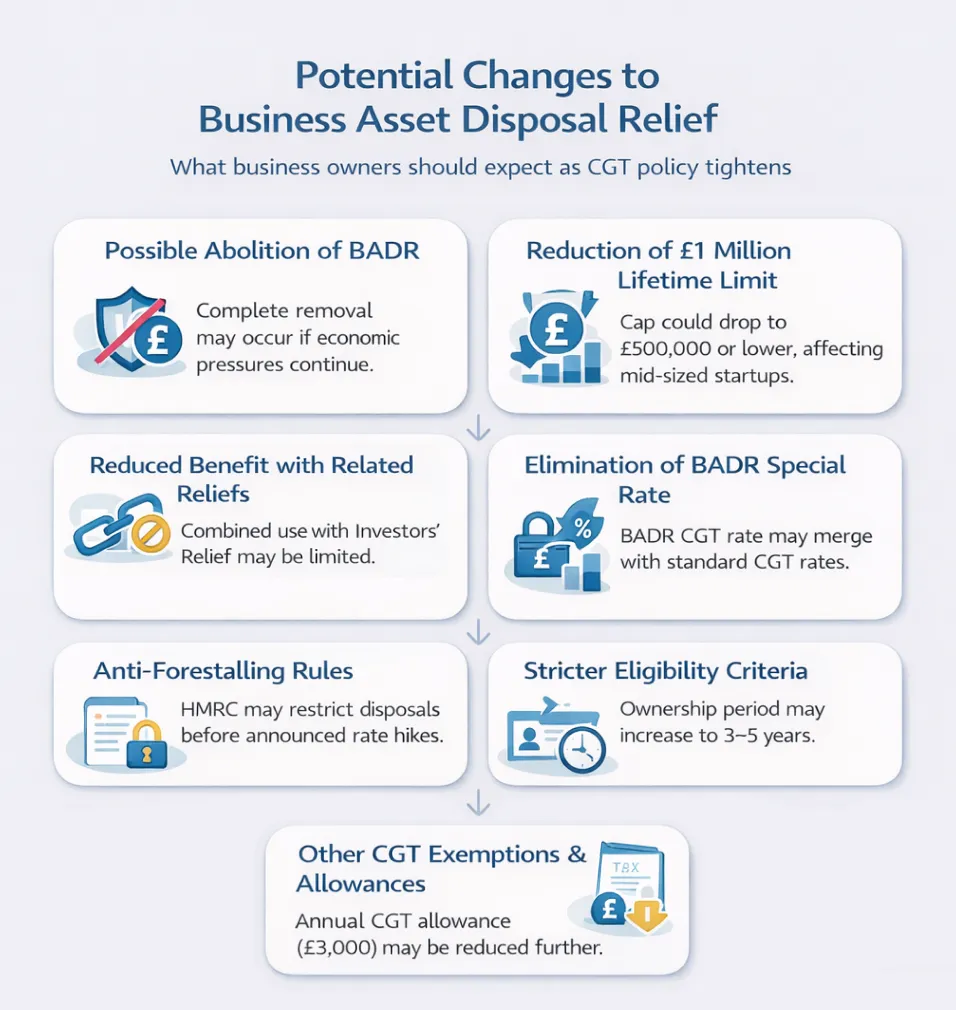
    1. Possible Abolition of BADR

    Some economists and political groups argue that the relief benefits high earners. As a result, complete removal of the scheme in future budgets is a possibility mainly in case economic pressures continue.

    2. Reduction of £1 Million Lifetime Limit

    The business asset disposal relief budget 2024 included discussions about possibly lowering the £1 million cap. A cut to £500,000 or lower would impact mid sized start ups the most.

    3. Elimination of BADR Special Rate

    The distinct CGT rate under BADR could be merged with the standard CGT system, mainly as rates rise. This would eliminate the special rate and remove incentives for qualifying sellers.

    4. Anti Forestalling Rules 

    HMRC might tighten rules to prevent gaining tax advantage. This keeps the taxpayers from rushing disposals before rate hikes. It could include more scrutiny on transaction timing and intent.  It’s mainly for sales close to the end of year.

    5. Strict Eligibility Criteria

    Policymakers may revisit the conditions which make business owners eligible. Possibly raising ownership length to 3 or 5 years. This would impact younger or part time business owners in a bad way. 

    6. Reduced Benefit With Related Reliefs

    BADR is sometimes used alongside Investors’ Relief and other exemptions. Future changes may restrict combined usage, mainly where it leads to massive tax avoidance.

    7. Other CGT Exemptions and Allowances

    More broadly, the government may lower the CGT annual exempt amount, currently £3,000, to align with general tax tightening. This would increase effective tax across the board and not just for business disposal relief.

    Boost growth with expert business advisory consultancy from Sterling Cooper Consultants.

    Potential Changes to business asset disposal relief

    Conclusion

    How business exits will be taxed in future? Business asset disposal relief 2025/26 is going through major changes. Rising Capital Gains Tax Rates signals towards a shift. The benefits that once made this relief a cornerstone of exit strategy planning are shrinking, and timing now plays a critical role. 

    Our experts at Sterling Cooper Consultants, help clients assess financial positions. We also guide them to evaluate tax options, and develop exit strategies. This provides a long-term value.

    We make sure that your disposal plan is on the same page with business asset disposal relief changes. That’s going to save you money and avoid mistakes. Do not wait until the new rules are made. Reach out to us today for expert advice while planning your business exit.

    Need help navigating the 2025 and 2026 changes to Business Asset Disposal Relief?

    Our experienced tax advisors are here to guide you through complex updates, ensuring you get the most from your business exit. Reach out to Sterling Cooper Consultants for personalised support and expert advice tailored to your unique situation.
    Contact us now to schedule a strategy session.

    +443300102526
    Book an Appointment

    FAQs


    What are the changes to BADR in 2025?


    From April 2025, the CGT rate for qualifying disposals under business asset disposal relief 2025 will rise from 10% to 14%.


    Yes, in addition to confirmed CGT rate increases, there are several potential reforms being discussed including limits and eligibility tightening.

    Entrepreneur Relief is the former name of business asset disposal relief. From April 2026, the CGT rate under this relief will increase to 18%.


    Yes, the CGT rate for business disposals is scheduled to increase under the business asset disposal relief 2025 updates.


    The business asset disposal relief limit remains £1 million in lifetime gains, though future reductions have been rumoured.


    The business asset disposal relief budget 2024 did not confirm cuts to the allowance but included discussions around potential cap reductions and eligibility changes.


    Confirmed business asset disposal relief changes include CGT rate hikes in 2025 and 2026. Additional revisions may follow in future budgets.

    Share This Article!

    Recent Posts

  • Landlord Tax Returns Made Simple: A Step-by-Step Guide

    Landlord Tax Returns Made Simple: A Step-by-Step Guide

    landlord tax return

    Posted by:

    Admin

    Date:

    January 27, 2026

    Category:

    blogs

    Error: Contact form not found.

    Landlord Tax Returns Made Simple: A Step-by-Step Guide

    Are you a landlord having issues with your tax returns? Do you find self-assessment to be hectic? Rental property can be a very lucrative asset. But being a landlord comes with certain responsibilities. For instance, timely HMRC landlord tax returns are a must. However, taxes can be confusing, therefore, knowing how to file your landlord self-assessment tax return is very important. As a landlord in the UK, you must declare your income from rent to HMRC and pay the following taxes.

    • Income tax on rental profits.
    • Stamp duty land tax on the purchase of property.
    • Capital gains tax on the sale of an asset.
    • Voluntary Class 2 national insurance if being a landlord is your main occupation.

    For many landlords, tax matters can be difficult. With a step-by-step guide, landlord taxation can be easily managed. 

    This guide will explain all you need to know about landlord tax returns. We will cover everything from rental income, allowable expenses, deadlines and much more to make the process of filing returns simpler. We will clear the difference between the landlord self-assessment tax return and HMRC landlord tax return, so that all things are made clear for you to understand. Let us begin.

    At a Glance: Landlord Tax Returns UK (Self Assessment)

    This step-by-step guide explains how UK landlords file a landlord self-assessment tax return. It covers:

    Who it’s for: UK landlords who earn more than £1,000 a year from renting out property (the £1,000 is the property allowance). 

    What you’ll achieve: Learn if you should contact HMRC (£1,000 to £2,500) or file a Self Assessment tax return (over £2,500 after allowable expenses / over £10,000 before allowable expenses), then follow the steps to file on time and avoid penalties.

    • When a landlord must file a tax return (including the £1,000 property allowance).
    • How to register for Self Assessment and get a UTR.
    • What rental income to declare to HMRC?
    • Which allowable expenses can be claimed?
    • How to calculate rental profits and tax.
    • Key deadlines for paper and online returns.
    • Digital tax returns (Making Tax Digital) and who they apply to.
    • Common mistakes that lead to penalties.

    What Is a Landlord Tax Return?

    The landlord tax return is the process through which landlords file self-assessment reports about their rental income and expenses to HMRC. This report is submitted to HMRC through the main SA100 form and the supplementary SA105 pages for property income. In case you file online, HMRC will calculate the tax. For paper filing you or an accountant will have to work out the tax. The landlord has to file that tax within the time limit. Failure to do so may result in penalties.

    This process ensures that:

    • All income from your rental properties is declared.
    • Deduct expenses to lessen your tax.
    • You pay the right amount of tax.
    • Make sure that your tax returns are in compliance with HMRC regulations.

    Landlords have to report their income and expenses manually. As part of this process, you complete a landlord self-assessment tax return. 

    To learn more about taxation on rental income, check out our guide on paying tax on rental income.

    Who Needs to File a Landlord Self-Assessment Tax Return?

    You are eligible to file landlord self-assessment tax return if your rental income exceeds £1,000. The first £1,000 of your rental income is tax-free. This is the tax-free allowance. If your income is anywhere between £1,000 to £2,500, you should report to HMRC. If it’s more than £2,500, you must report landlord tax return on a self-assessment tax return after allowable expenses and £10,000 before allowable expenses. 

    Other than basic limits, you are eligible for a landlord taxation return if any of the following conditions are met:

    • You own furnished holiday lettings (FHL) or overseas property.
    • You jointly own a property and receive rent from it.
    • The total income from all your rental sources exceeds the personal allowance.
    • You have sold a rental asset.
    • HMRC has issued a notice to file a return.

    Even if your income is below the allowance limit, it is good to file a return to claim tax relief.

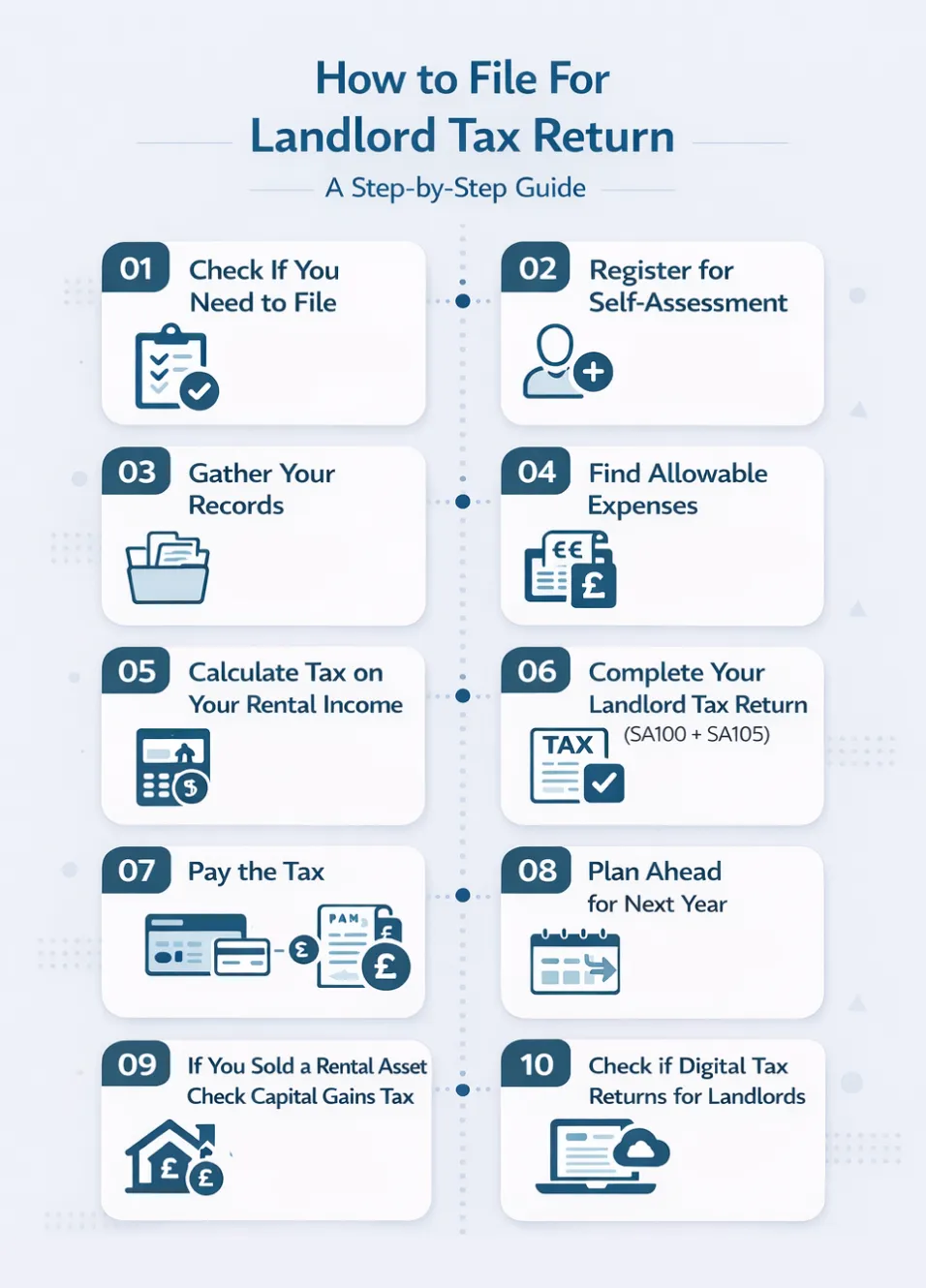
    How to File For Landlord Tax Return: A Step-by-Step Guide

    Now we will go through each step of the process of filling out the landlord self-assessment tax return. Before laying out the process, we should understand what a landlord tax return is and what is the eligibility criteria for it.

    Step 1: Check If You Need to File

    Before even starting to file, you must make sure that you are eligible to file for the tax return. The conditions for filing have already been provided. Work out your income and expenses to see if it is above the taxation threshold. If your income from rental property is above £1,000, then you may need to register for self-assessment.

    Step 2: Register for Self-Assessment

    Before filing for your first landlord tax return, you need to register with HMRC. Registration can be done online or via form SA1. For landlords, you have to fill form SA-105. This is a document that discloses your earnings from rent. If you are filling online you may not have to fill SA-105.

    Here is how you register online:

    1. Visit the HMRC online registration portal.
    2. Complete form SA1 (if you already have a tax record), or the self‑employed registration if applicable.
    3. You need to enter your National Insurance number, address, and letting start date.
    4. Receive your Unique Taxpayer Reference (UTR).

    This UTR must be kept safe. It is needed every time you complete an HMRC landlord tax return.

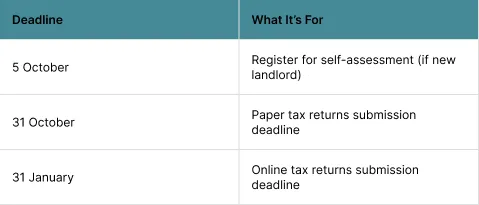
    Important Deadlines

    Here are some important deadlines. Missing these deadlines may result in penalties and interest.

    Table

    Step 3: Gather Your Records

    The most important thing in maintaining a smooth tax return is keeping clean records. Records include:

    • Rental income received.
    • Allowable expenses paid.
    • Mortgage interest statements.
    • Receipts for repairs and maintenance.
    • Tenancy agreements and deposits.

    HMRC requires that you keep these records for at least five years after the 31 January filing deadline for the relevant tax year.

    Step 4: Find Allowable Expenses

    Allowable expenses are the expenses you can deduct from your income before calculating your taxable profit. 

    Quick rule: repairs and maintenance are usually allowable, but improvements (upgrades that add value) are not treated the same way.

    There is a wide range of costs you can deduct before calculating tax.

    Common Allowable Expenses:

    • Letting agent fees.
    • Property insurance.
    • Maintenance and repairs (not improvements).
    • Utility bills (if the landlord pays).
    • Council tax (if landlord is responsible).
    • Legal and accounting fees.
    • Advertising for tenants.
    • Inventory and tenancy setup costs.

    All these expenses must be deducted from your net income before calculating HMRC landlord tax return.

    Reminder:

    Mortgage interest is no longer deducted from rental income. You receive a 20% tax credit based on your finance costs. This change can change your tax position, at this rate, even some basic taxpayers can be pushed into a higher-rate taxpayer category. 

    The impact is strongest on higher-rate taxpayers. As the 20% credit increases their tax liability. 

    Step 5: Calculate Tax on Your Rental Income

    Your taxable profit is calculated as:

    Net rental income = Rental income – Allowable expenses

    For instance, 

    If your rental income = £24,000 per year 

    Your allowable expenses = £6,000 

    Your net rental income = £24,000-£6,000 = £18,000. 

    This is the figure that will be taxed through your landlord self-assessment tax return.

    If you own multiple properties, you must combine all rental income and expenses to calculate total profit. HMRC treats your rental business as a single entity even if you have many properties.

    Step 6: Complete Your Landlord Tax Return (SA100 + SA105)

    Use form SA100, with supplementary pages SA105 for property income.

    You’ll need to:

    • Enter rental income.
    • Deduct allowable expenses.
    • Include mortgage interest as a tax credit.
    • Report other property income (holiday lets, overseas rentals).
    • Online submission is recommended. It’s quicker, reduces errors, and gives instant confirmation.

    Step 7: Pay the Tax

    After submitting your landlord self-assessment tax return, HMRC calculates your tax liability. Payment options include:

    1. Bank transfer.
    2. Direct debit.
    3. Debit/credit card.

    If your tax bill exceeds £1,000, HMRC may require payments on account, which are advance payments toward next year’s tax. These are due:

    • 31 January – First payment.
    • 31 July – Second payment.

    If you cannot pay in full, you can request a payment plan. HMRC allows for that.

    Step 8: Plan Ahead for Next Year

    Effective tax planning allows landlords to:

    • Keep accurate records.
    • Utilise allowable expenses.
    • Plan for Capital Gains Tax on future property sales.
    • Consider alternative ownership structures, such as limited companies, for tax efficiency.

    Keeping on top of these steps ensures your HMRC landlord tax return is straightforward in subsequent years.

    To get more planning and tips for saving on tax, check out our top tax saving tips.

    Step 9: If You Sold a Rental Asset Check Capital Gains Tax

    Capital Gains Tax or CGT is applied when you sell a rental asset. It is the tax on gains made from the proceeds. It is calculated as:

    Gains =  Sales price – purchase price – costs

    Note: “Costs” can include certain buying/selling fees and some improvement costs, and special rules/reliefs can apply. Always check what HMRC treats as allowable for your situation.

    The amount of tax depends on a number of factors such as the gains made, the type of asset and whether you are a basic taxpayer or a higher taxpayer. 

    Capital gains tax does not apply if the asset in question was your main home. There are also letting reliefs in limited cases.

    Step 10: Check if Digital Tax Returns for Landlords Apply

    HMRC requires landlords with income above £50,000 to use digital records and submit updates quarterly. This has been in effect since 6 April 2026. By 6 April 2027, the threshold will lower to £30,000. Benefits of digital tax returns for landlords include:

    • Reduced risk of errors
    • Easier end-of-year filing
    • Less paperwork and faster updates
    • Investing in compatible software early can save significant time

    How to file for landlord tax return

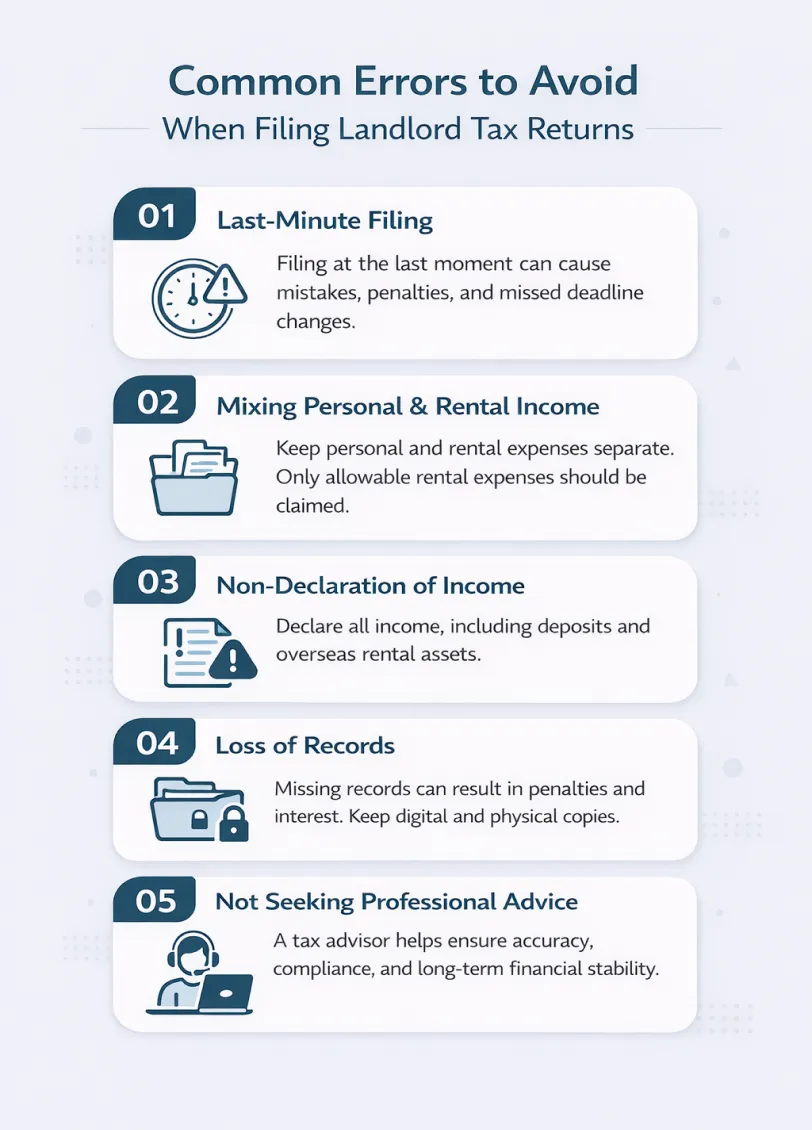
    Some Errors to Avoid

    Even with proper guide taxes can be tricky. There are some pitfalls you need to be aware of as a landlord, when filling landlord tax returns. 

    • Avoid last-minute filing. Delays can be messy and deadlines are subject to change.
    • Mixing of incomes. Don’t mix personal and rental expenses. A list of rental expenses has been provided in this guide.
    • Non-declaration of income. Make sure that all income, including deposits and overseas assets are declared.
    • Loss of records. Loss of records can lead to penalties and extra interest. Make sure to keep digital and physical copies of all records. 
    • Not getting an advisor. An advisor can help a lot when dealing with taxation. Proper calculation and accounting of assets are key for stable finances. Getting expert help is always the right move.

    Common Errors to avoid when filing landlord tax returns

    Conclusion

    So there you have it. A comprehensive guide for landlords on tax returns. Taxation is often seen as hectic. It doesn’t have to be provided you:

    • Maintain accurate records
    • Don’t mix your expenses
    • Do the right calculations
    • Stay ahead of deadlines

    By doing these steps, you can save money and make the process smoother for you.

    Getting professional advice can be of great value in working multiple properties and complex tax situations. That’s where we come in, at Sterling Cooper Consultants we can help you optimise your HMRC landlord tax return. No more missed deadlines or wrong calculations. With us, your taxes are done accurately and timely. Contact us now to start a stress-free financial journey today.

    Take control of your landlord tax return today.

    Whether you’re filing for the first time or managing multiple properties, expert advice can help you reduce errors and avoid penalties. With our taxation services, get personalised support for your HMRC landlord tax return and file with confidence.
    +443300102526
    Book an Appointment

    FAQs


    What If My Rental Property Is Abroad?


    If you own a rental property overseas, you must declare the income on your UK Self Assessment tax return. This income is subject to UK tax, although you may also be eligible for tax relief under a double taxation agreement between the UK and the country where the property is located.


    If you realise you’ve made a mistake on your tax return after submitting it, you can amend your return within 12 months of the filing deadline. Log in to your HMRC online account, select the tax year you wish to amend, and make the necessary corrections. If the return is older than this, you will need to contact HMRC directly.


    Missing the filing deadline can result in penalties. If you’re up to three months late, you’ll receive an automatic £100 fine, with further penalties if the delay continues. If you know you will miss the deadline, contact HMRC as soon as possible to discuss your situation.


    Yes, you can still claim certain expenses while your rental property is temporarily vacant, such as insurance, mortgage interest tax relief, and maintenance costs, provided the property is actively available for rent.


    You do not pay tax on deposits unless you retain part or all of the deposit to cover damages or unpaid rent. Any retained amount must be declared as income on your landlord tax return.


    You should keep records of all rental income and expenses, including receipts, invoices, bank statements, tenancy agreements, and mortgage statements. HMRC requires landlords to retain these records for at least five years after the 31st January submission deadline.


    You can reduce your tax liability by claiming all allowable expenses, understanding mortgage interest tax relief, considering ownership structures such as limited companies, and reviewing your tax position regularly with a professional adviser.


    o fill in a landlord tax return, you must complete a Self Assessment tax return through HMRC. This includes entering rental income, allowable expenses, and mortgage interest details in the property income section (SA105). Filing online is recommended, as HMRC’s system guides you step by step.


    A landlord can ask for tax returns only in limited situations, such as during business arrangements or financial assessments. Tenants are not legally required to provide tax returns to landlords. HMRC, however, can request a landlord’s tax return and supporting documents during compliance checks.


    Landlords need tax returns to declare rental income, claim allowable expenses, and pay the correct amount of tax. A landlord self assessment tax return ensures compliance with HMRC rules, helps avoid penalties, and provides proof of income for mortgages, refinancing, or property sales.

    Share This Article!

    Recent Posts

  • What Is Double Taxation Relief? A Complete Guide for Individuals & Businesses

    What Is Double Taxation Relief? A Complete Guide for Individuals & Businesses

    double taxation relief

    Posted by:

    Admin

    Date:

    January 26, 2026

    Category:

    blogs

    Error: Contact form not found.

    What Is Double Taxation Relief? A Complete Guide for Individuals & Businesses

    Individuals and businesses with cross-border income or gains may sometimes be taxed in more than one country. For example, a UK resident may pay foreign tax on overseas income and also be liable to UK tax on the same income.
    This is known as double taxation. To reduce the impact of being taxed twice, the UK provides Double Taxation Relief (DTR) through tax treaties and domestic rules. Depending on the circumstances, relief may be available through a foreign tax credit, an exemption, a reduced tax rate or another treaty provision.
    This guide explains how Double Taxation Relief works in the UK, who may qualify and how to claim it.

    Key Takeaways

    • Double taxation can occur when the same income or gain is taxed in two countries.
    • UK Double Taxation Relief can reduce the UK tax arising on qualifying foreign income or gains.
    • Relief may be available under a Double Taxation Agreement (DTA) or UK domestic rules.
    • Foreign Tax Credit Relief (FTCR) can provide a credit for qualifying foreign tax already paid.
    • The available relief depends on the type of income or gain, tax residence, foreign tax paid and applicable rules.
    • Individuals and businesses may be subject to different rules and relief mechanisms.

    What Is Double Taxation and How Does It Happen?

    Double taxation occurs when two countries tax the same income or gain. This can happen when one country taxes income based on where it arises, while another taxes it because the individual or company is resident there.

    For example, a UK resident may receive rental income from an overseas property. The country where the property is located may tax the rental income, while the UK may also tax it under its rules for UK residents. Double taxation can arise in several situations:

    double taxattion relief
    However, the actual tax treatment depends on the domestic rules of the countries involved and, where applicable, the relevant Double Taxation Agreement (DTA).

    What Is Double Taxation Relief?

    Double Taxation Relief (DTR) refers to rules that can reduce or eliminate the effects of the same income or gain being taxed in two countries. For UK taxpayers, relief may be available when foreign income or gains have also been subject to foreign tax. The method of relief depends on the relevant Double Taxation Agreement, UK domestic rules, the type of income or gain and the taxpayer’s circumstances.
    For example, Foreign Tax Credit Relief (FTCR) may allow qualifying foreign tax already paid to be credited against the UK tax due on the same income or gain. However, the credit is subject to limits and does not necessarily refund all foreign tax paid.
    double taxattion relief

    A DTA does not simply provide a tax refund. It can allocate or limit taxing rights between the countries involved and may provide for exemption, reduced taxation or credit relief.

    The UK may also provide unilateral relief under domestic rules where the relevant conditions are met, even where there is no applicable DTA.

    How Does Double Taxation Relief Work?

    The way Double Taxation Relief works depends on the countries involved, the type of income or gain, the amount of foreign tax paid and the applicable UK rules or tax treaty.

    Credit Relief

    Foreign Tax Credit Relief (FTCR) can allow qualifying foreign tax paid on income or gains to be credited against UK tax charged on the same income or gain.

    The credit is generally limited to the lower of:

    • the qualifying foreign tax paid; or
    • the UK tax attributable to the same income or gain.

    This means that paying more foreign tax than the UK tax attributable to the same income or gain does not normally create an equivalent UK tax credit. The excess cannot simply be refunded by HMRC.

    Exemption Relief

    Some tax treaties provide for certain income or gains to be exempt from tax in one of the countries. Where an exemption applies, the relevant income or gain may be taxed in only one country, subject to the conditions of the treaty.

    Whether exemption relief applies depends on the specific DTA and the type of income or gain involved.

    Partial or Reduced Relief

    A DTA may limit the amount of tax that a country can charge rather than remove the tax completely. For example, a treaty may reduce the withholding tax rate on certain dividends, interest or royalties. The applicable rate depends on the relevant treaty and the conditions that must be met.

    Unilateral Relief

    The UK may provide unilateral relief under domestic legislation where qualifying foreign tax has been paid, but there is no applicable DTA or where the domestic rules otherwise provide for relief. However, foreign tax does not automatically qualify for unilateral relief. The relevant conditions and limits must be met.

    What Types of Income and Gains Can Be Subject to Double Taxation?

    Different types of foreign income and gains can be taxed differently depending on the countries involved and the relevant tax treaty. Common examples include:

    double taxation relief taxation

    Not every type of income or gain receives the same form of relief. The relevant UK rules and DTA should therefore be checked for the specific income or gain.

    Double Taxation Relief for Individuals

    For individuals, Double Taxation Relief depends on tax residence, the country where the income or gain arises, the type of income or gain and whether foreign tax has been paid.

    UK Residents With Foreign Income

    UK residents may be liable to UK tax on foreign income, although the treatment depends on the individual’s circumstances and any applicable special regime.

    Where foreign income is also subject to foreign tax, Foreign Tax Credit Relief may be available if the relevant conditions are met. The credit can reduce the UK tax charged on the same income, subject to the applicable limits.

    UK Residents With Foreign Capital Gains

    Foreign capital gains may be subject to tax in both the UK and the country where the gain arises. If both countries tax the same gain, relief may be available under a DTA or UK domestic rules. The available relief depends on factors such as the type and location of the asset, the individual’s tax residence and the provisions of the relevant treaty.

    The Foreign Income and Gains Regime

    Since 6 April 2025, the UK’s Foreign Income and Gains (FIG) regime has provided a separate form of relief for qualifying new UK residents. An individual may qualify if they become a UK tax resident after at least 10 consecutive tax years of non-UK residence. A qualifying individual can claim relief on eligible foreign income and gains for their first four years of UK tax residence.

    The FIG regime is separate from ordinary Foreign Tax Credit Relief. An individual cannot generally claim both FIG relief and FTCR on the same foreign income or gain, so the correct treatment should be established before making a claim.

    Non-UK Residents With UK Income

    Non-UK residents may still be liable to UK tax on certain UK-source income. If the same income is also taxed in their country of residence, the relevant DTA may provide full, partial or credit relief. The treatment depends on the type of income, the individual’s tax residence and the specific provisions of the treaty between the UK and the other country.

    Some treaty claims require supporting documentation or specific claim forms, so the relevant treaty and HMRC requirements should be checked before making a claim.

    Double Taxation Relief for Businesses

    Businesses operating across borders may face tax in more than one country on foreign profits, gains or cross-border payments. UK companies may be able to obtain relief through foreign tax credits, treaty provisions or specific UK exemptions, depending on their circumstances.

    Foreign Business Profits

    A UK-resident company is generally subject to UK Corporation Tax on its UK and overseas profits. If the same profits are also taxed overseas, foreign tax credit relief may be available where the relevant conditions are met.

    The amount of relief depends on the foreign tax that qualifies for credit and the UK tax attributable to the same profits.

    Dividends, Interest and Royalties

    Cross-border payments such as dividends, interest and royalties may be subject to withholding tax in the country from which the payment is made. A DTA may reduce the withholding tax rate or, in some circumstances, allocate taxing rights between the countries. UK domestic rules may also affect how foreign income is treated.

    The exact treatment depends on the type of payment, the countries involved and the applicable treaty provisions.

    Overseas Branches and Permanent Establishments

    A UK company operating through an overseas permanent establishment may be subject to tax in both jurisdictions.

    The UK has a foreign branch exemption regime that can allow qualifying profits and losses attributable to an overseas permanent establishment to be excluded from UK Corporation Tax, provided the relevant conditions and election requirements are met.

    Businesses should consider the longer-term consequences before making an election because the choice can affect the treatment of future profits and losses.

    How Do You Claim Double Taxation Relief in the UK?

    The process for claiming Double Taxation Relief depends on the type of income or gain and the relevant treaty or UK domestic rules. However, the following steps provide a useful starting point:

    claim double taxation relief

    Bonus: Double Taxation Relief Checklist

    Use this checklist to prepare for a potential Double Taxation Relief claim:

    • Identify the country where the income or gain arose
    • Confirm your UK tax residence status
    • Check whether a UK Double Taxation Agreement applies
    • Identify the relevant type of income or gain
    • Confirm how much foreign tax was paid or deducted
    • Check whether the foreign tax qualifies for relief
    • Calculate the available relief
    • Report the foreign income or gain correctly
    • Make the appropriate relief claim
    • Keep evidence of the foreign tax paid and supporting documents

    Conclusion

    Double Taxation Relief can help reduce the UK tax impact when the same income or gain is taxed in more than one country. However, the relief available depends on factors such as tax residence, the type of income or gain, the foreign tax paid and the relevant Double Taxation Agreement or UK domestic rules.
    Before making a claim, check which rules apply, report the foreign income or gain correctly and keep evidence of any foreign tax paid. Where the circumstances are complex, professional tax advice can help determine which relief is available and how it should be claimed.

    Need Help With Cross-Border Tax?

    Double Taxation Relief depends on your circumstances and the countries involved. Sterling Cooper Consultants can help you understand your tax position and navigate the relief available to you.

    FAQs


    What Is a Double Taxation Agreement?

    A Double Taxation Agreement (DTA) is an agreement between two countries that sets out how certain types of income and gains are taxed and how double taxation can be relieved.

    Individuals and businesses with qualifying cross-border income or gains may be able to claim relief. Eligibility depends on factors such as tax residence, the type of income or gain, foreign tax paid and the applicable UK rules or tax treaty.

    Potentially. If the same capital gain is taxable in both the UK and another country, relief may be available under the relevant DTA or UK domestic rules. The treatment depends on the asset, tax residence and applicable treaty provisions.

    Yes. A business may be able to claim relief where qualifying foreign tax has been paid on income or gains that are also subject to UK tax. However, some income may instead be covered by specific exemptions or treaty provisions.

    Not necessarily. Foreign Tax Credit Relief is generally limited to the lower of the qualifying foreign tax paid and the UK tax attributable to the same income or gain. Therefore, paying more foreign tax does not automatically result in a full UK tax credit.

    Share This Article!

    Recent Posts


  • Payroll Compliance: What Every Business Needs to Know

    Payroll Compliance: What Every Business Needs to Know

    payroll compliance

    Posted by:

    Admin

    Date:

    January 23, 2026

    Category:

    blogs

    Error: Contact form not found.

    Payroll Compliance: What Every Business Needs to Know

    Payroll compliance is the process of ensuring that your employees are paid on time and properly. It also means being compliant with all the UK laws pertaining to this matter. It includes calculations of tax, National Insurance, statutory payments, pensions, and accurate record-keeping. You might think, “Why does it matter?” Well, for one, mistakes can be costly. HMRC expects you to reasonably care in the payroll matters. If you fail to do so, you will get penalties. These can go to 30% of the underpaid amount. The other reason is that if you consistently keep making such mistakes, employees’ trust will actually erode. Thus, complying with payroll is very important. This payroll compliance guide covers everything that you need to know about it. 

    What is Payroll Compliance?

    Payroll compliance means following UK laws when paying employees. It includes registering as an employer with HMRC and reporting wages on time. It also includes paying at least the minimum wage and enrolling eligible staff into workplace pensions. Keeping accurate records and providing payslips along with statutory pay are also part of payroll compliance. Staying compliant is beneficial in multiple ways. You can avoid fines and ensure employees are paid correctly.

    Quick legal checklist: What every employer MUST do (short list / TL;DR) 

    Here is a brief outlook on what a payroll compliance guide may contain:

    • Register as an employer with HMRC and set up PAYE.
    • Report wages on time using RTI (send an FPS on or before payday).
    • Pay at least the correct National Minimum or Living Wage.
    • Enrol eligible staff into a workplace pension (employees are 22+ and earn over the threshold)
    • Keep accurate employee records.
    • Keep payroll records the right way
    • Provide payslips 
    • Pay statutory entitlements (like sick pay and maternity pay).

     PAYE & RTI: the reporting backbone 

    In the UK, PAYE (Pay As You Earn) is the main reporting system. Through this, the employers take tax and National Insurance (NI) from employees’ wages before paying them. The second main system is the RTI (Real Time Information). This is how you report these payments to HMRC. On making a payment to your staff, you have to send a Full Payment Submission (FPS) to HMRC. This is to be done on the payday. For a safety buffer, try sending FPS the day before payroll. These steps are important for payroll compliance.

    What an FPS needs to show

     At a high level, your FPS must include the following:

    • The payroll period (when you paid your staff)
    • Employee identifiers (like names and National Insurance numbers)
    • Pay amounts
    • Tax, NI, and other deductions from Pay
    • Any statutory pay (sick pay, maternity/paternity pay, etc.) 

    Why getting it right matters

    It is crucial to get FPS right. If you send it late or with mistakes, you will be in trouble. There are monthly penalties and interest on unpaid tax by the HMRC. Also, you must keep proof of your submitted FPS. This way, you can protect yourself even if there is a question about payment. 

    How to test your RTI feed

    To steer clear, do a test run of your RTI feed. For this, run a test submission to HMRC before your first payroll. Many payroll systems allow this “dry run.” Ensure your software transmits the data accurately.  Also, make sure that your employees’ details align with HMRC records.

    Common FPS mistakes and how to avoid them

    Here are some of the common FPS mistakes that can get you in trouble with the HMRC:

    • Wrong employee details 
    • Incorrect National Insurance numbers
    • Missing pay information
    • Issues with statutory pay
    • Forgetting deductions like student loans or pension contributions

    To avoid errors, perform dry runs before actual submissions. Also, check vendor confirmations before you report to the HMRC. Also, perform a very careful review of your employees’ information. For complex RTI issues or tricky payroll situations, it’s wise to speak with a payroll compliance practitioner. They can guide you in detail about your payroll issues. They can also check your submissions and help keep your payroll fully legal.

    National Minimum Wage 

    Paying staff the correct National Minimum Wage (NMW) is a key part of payroll compliance. When applicable, national living wage payment is also a must. The exact rate depends on a worker’s age. It also depends on the fact if they are an apprentice. The NLW applies to adults aged 21 and over. On the other hand, younger staff and apprentices have lower minimum rates. These rates usually change every April. For the latest updates,  check the figures on GOV.UK.

    Common payroll traps

    Payroll compliance can be tricky. Even well-meaning businesses can fall foul of the rules. They break the rules without meaning to. Common problems include:

    • Taking money from pay for uniforms
    • Using pay for equipment costs
    • Staff losing pay because of unpaid breaks
    • Salary sacrifice schemes reducing take-home pay (e.g.,  childcare vouchers)
    • Tips not being handled correctly in sectors like hospitality

    Common payroll traps

    The basic rate may be fine, but these conditions can cause the pay to fall below the minimum level. 

    How to stay on track

     The safest way is to run regular reports. They are supposed to calculate staff pay against hours worked. They can also factor in deductions. It’s also a good idea to do regular NMW checks. Paying the right wage is a vital part of payroll compliance. Getting it wrong can lead to fines and bad publicity. Ultimately, it can damage your business. 

    Statutory pay and family/carer rights

    UK law gives employees certain rights to paid or unpaid time off. Some of the conditions are that they are sick, having a baby, adopting, or caring for family members. Payroll compliance includes handling these payments the right way. 

    Statutory Sick Pay (SSP)

     Employees who are off work due to illness may qualify for SSP. This is if they earn at least the lower earnings limit. They also meet the sickness rules. The rate of SSP is reviewed every April. Therefore,  employers have to check the GOV.UK “Rates and thresholds for employers” page. Using this information, they have to update payroll before the new tax year begins.

    Statutory Parental Pay

    Current rates are set by HMRC and also reviewed each April. Usually, employees receive 90% of their average weekly earnings for the first few weeks. It is followed by a fixed weekly rate or 90% of pay (whichever is lower). Here are the two types of parental pay. 

    • Statutory Maternity Pay (SMP) helps new mothers take time off after the birth or adoption of a child.
    • Statutory Paternity Pay (SPP) helps new fathers take time off after the birth or adoption of a child.

    Carer’s Leave

    This has been in effect from April 2024, under the Carer’s Leave Act 2023. Employees are to get one week of unpaid leave each year to look after dependents with long-term care needs. This is day-one right. This means that there is no minimum service needed.

    Practical steps for employers

    So, how can employers ensure payroll compliance in these cases? Well, as an employer, you can take the following steps:

    • You must set a reminder for April for new updates
    • You must test payroll calculations (mainly for SSP, SMP, and SPP).
    • You have to update employee handbooks to include family and carer rights.

    Workplace pensions: Auto-enrolment duties 

    In the UK, every employer must follow the auto-enrolment rules for workplace pensions. This means you must put certain staff into a pension scheme and pay money into it. Employees must be auto-enrolled if they are aged 22 up to state pension age and earn at least the set earnings level (for example, around £192 a week, always check the latest figures on The Pensions Regulator website).

    Employer contributions and records

    Employers must pay at least the legal minimum into the pension, and staff also pay a part. You must keep clear records showing who has been enrolled, how much was paid, and any staff who chose to opt out. Every three years, you must re-enrol staff who are still eligible, even if they previously left the scheme. In case you ignore any rules, you will get penalties.

    How to stay on track

    To ensure payroll compliance, run a pension-eligibility report. This should be done every time you process payroll. This makes sure no one is missed and that contributions are correct. 

    Data & record-keeping obligations 

    Every employer must keep certain records to prove that staff are paid correctly. These records also show that legal rules are followed. This includes:

    • Employee personal details
    • Records for pay and tax
    • Records for National Insurance
    • Pension assessments
    • Contributions to pension
    • Any other payroll-related information

    According to HMRC, the records should be kept for at least 3 years. However, most employers keep records longer than this just to be on the safe side. 

    Protecting payroll data

    There is sensitive information stored in payroll, i.e., personal data of the employees. Employees, thus, must take care of payroll’s security, complying with laws such as GDPR. Here are some of the steps they should take: 

    • The access should be limited so that only the concerned staff can see it
    • Systems should be secured, preferably with encryption
    • Keep audit logs that track who accessed or changed records

    This protects both the business and employees.

    Why records matter
    Records are not just about doing payroll calculations. They are a major chunk of payroll compliance meaning. They are proof that you acted with reasonable care if HMRC or The Pensions Regulator checks your business. Basically, they depict that you followed the law. You have evidence to prove that. As a result, you are ready for inspection every time. 

    Controls, processes and tools 

    Payroll needs to be kept safe and accurate. There are certain controls and processes that can help businesses in this regard. Using these, fraud and mistakes can be prevented. These tools and processes also prove to HMRC that payroll is being managed properly. 

    Core internal controls

    • Duties should be segregated. This means that different people should handle data entry, approvals, and payments.
    • There should be reconciliation at the end of every month. For this, check payroll totals against bank payments and HMRC reports.
    • Do a sample check. Review a few payslips, each run to confirm pay is correct.
    • Keep a clear log of who did what in the system.
    • Keep approval gates at every checkpoint. For instance, payroll should not move forward until managers approve.

    Control, Processes & Tools

    Technology support

    Modern payroll software can make this easier. Useful tools include:

    Technology What it Does Examples of Software
    Automated RTI / FPS Submissions Sends payroll data (wages, tax, NI) directly to HMRC in real time. Sage Payroll, BrightPay, Xero Payroll, QuickBooks Payroll
    Automatic Pension Feeds Connects payroll software to workplace pension providers so contributions are sent automatically. NEST integration tools, Smart Pension API, The People’s Pension link, Sage Pensions Module
    Employee Self-Service (ESS) Portals Lets employees update details, download payslips, and request leave, reducing admin errors. Sage HR, BambooHR, Fourth Hospitality ESS, HiBob
    Audit Trail & Reporting Tools Tracks changes in payroll data, shows who approved, and produces compliance reports. Fourth, ADP Workforce Now, IRIS Payroll, PayFit
    Data Security (Encryption & Access Control) Protects sensitive payroll and employee data; controls who can access it. Microsoft Azure AD, Okta, Sage Payroll with 2FA, KeyPay

    Training and updates

    Payroll rules change often. Staff should stay updated with HMRC bulletins, software release notes, and regular training. Many payroll teams follow CPD (Continuing Professional Development) to keep skills current.

    Standard process template
    A simple “payroll run SOP” might look like this:

    1. Data intake (collect hours/salary info)
    2. Validation (check accuracy)
    3. Approvals (manager sign-off)
    4. FPS submission to HMRC
    5. Payment to staff
    6. Reconciliation (compare payroll vs. bank/HMRC)
    7. Archiving records

    Practical Payroll Compliance Checklist

    Use this payroll compliance guide checklist to stay on track with UK payroll rules. You can copy and keep it as a quick reference:

    Immediate actions

    The following actions are crucial for payroll compliance. They are your first priority. 

    • Register for PAYE with HMRC 
    • Set up RTI reporting.
    • Check all employee details (NI number, date of birth, bank details, tax code).

    Recurring process items

    These steps have to be taken recurrently for successful payroll compliance. 

    • Create a yearly payroll calendar. This has to include FPS deadlines, P60s, and HMRC year-end dates. 
    • Set up payroll software for automatic FPS submissions. Do the same for pension feeds. 
    • Do a monthly payroll reconciliation.
    • Check payroll totals vs. bank payments. 
    • Keep an error log.
    • Run quarterly checks on National Minimum Wage (NMW) 
    • Check pension eligibility quarterly as well.
    • Keep payroll records and audit trails safely.

    Escalation & governance

    For better governance, take the following steps:

    • Keep separate duties, i.e., one person enters data, another approves, and so on.
    • Set a clear sign-off process for payroll.
    • Subscribe to HMRC and The Pensions Regulator updates.
    • Test payroll software updates.
    • Test vendor patches at least once a year.

    Practical pyroll compliance checklist

    Following this checklist reduces mistakes. Your business will be protected from penalties as well. These steps keep your payroll fully legal.

    Sector Special Notes for Payroll Compliance

    Hospitality & tips

    In the hotel industry, tips and service charges are widespread. These must be taxed via payroll. They cannot be used to calculate the National Minimum Wage (NMW). If employees are paid too little in basic pay, the business risks violating the law. This holds even with the tips being paid.

    Zero-hours contracts

    For zero-hours and casual staff, holiday pay must still be given. Since 1 April 2024, new rules allow “rolled-up holiday pay” for some workers.  This means holiday pay is added to each payslip instead of being taken later. Employers must check the GOV.UK guidance to apply this correctly.

    International payroll

    When paying staff in more than one country, each country has its own tax and employment laws. This can be very complex. Many businesses use Employer of Record (EOR) services. They can also use specialist global payroll providers to manage compliance across borders.

    Risks, Penalties, and Enforcement

    HMRC wants all employers to exercise “reasonable care” while processing payroll. This means that your records should be up-to-date. You should also be following all laws, and your calculations must be correct. If there are errors due to you being careless, there will be penalties from the HMRC. The penalties are majorly severe if the errors are intentional or hidden.

    Penalties and public action

    Employers who break payroll rules can face fines. There can also be back payments to staff and interest charges. In serious cases, HMRC publishes a list of businesses that underpaid staff. This is sometimes called “naming and shaming.” For instance, millions have been returned to workers in hundreds of companies. This was a result of enforcement actions over the National Minimum Wage (NMW). Employers who neglect worker pensions may also be subject to fines from the Pensions Regulator. They either have not set up or paid pensions. 

    Payroll Penalty Table

    Here are the rates of penalties that you can get from the HMRC.

    Type of Error Penalty Rate
    Careless Inaccuracy (HMRC) 0%–30% of extra tax due (if unprompted); up to 15%–30% if HMRC prompts you
    Deliberate Inaccuracy (HMRC) 20%–70% of extra tax due (unprompted reduces slightly)
    Deliberate & Concealed (HMRC) 30%–100% of extra tax due (penalty max if hidden errors)
    NMW Underpayment Penalty Up to 200% of the underpaid amount; minimum £100 per notice; capped at £20,000 per worker
    NMW Penalty Reduction Reduced by 50% if the unpaid wages and penalty paid within 14 days
    Naming & Shaming (NMW) Employers may be publicly listed if arrears exceed £500; significant reputational damage

    How to reduce risk

    Employers can protect themselves by keeping strong documentation. They should also have audit trails. They must be testing payroll each month and fixing errors quickly. Some businesses also use payroll insurance to reduce financial risk. Indemnity covers are also an option. Acting early and proving “reasonable care” often reduces penalties.

    Where to Get Help: Payroll Compliance Practitioner & Services

    Payroll can become complex very quickly. If you manage staff across multiple locations, deal with frequent law changes, the situation might be particularly tricky for you. In these cases, outsourcing to experts can save time and reduce risk. It is best that you speak to a specialist. At Sterling Cooper Consultants, we understand this. Our experienced payroll compliance services experts deal with RTI reporting, automated pension feeds, and keep strong audit trails. We offer you the right setup, checks, and ongoing support.

    Struggling With Payroll Compliance?

    Sterling Cooper Limited offers expert payroll compliance services to help you meet every HMRC requirement, avoid penalties, and keep your payroll running smoothly. Contact us now and make sure that you never have to worry about requirements or penalties again.
    +443300102526
    Book an Appointment

    FAQs


    What is payroll compliance?


    Payroll compliance means following all UK laws when paying employees — including tax, pensions, minimum wage, and record-keeping rules.


    Yes. Even if you have just one employee, you must register with HMRC, run PAYE, and follow payroll rules.


    HMRC may charge a penalty and interest. Always file on or before payday.


    Most modern payroll software helps with RTI, pensions, and records, but you must still check settings and updates.


    If payroll feels too complex or you risk errors and penalties, a payroll compliance practitioner can handle everything for you.

    Share This Article!

    Recent Posts

  • How to Start and Manage a Business from Home?

    How to Start and Manage a Business from Home?

    running a business from home

    Posted by:

    Admin

    Date:

    January 22, 2026

    Category:

    blogs

    Error: Contact form not found.

    How to Start and Manage a Business from Home?

    Approximately 70% of new businesses start at home, contributing £300 billion to the economy. At present, there are around 2.9 million home-based businesses that are playing a significant role in uplifting the economy of the UK..The increasing popularity of a home-based business can be explained by flexible work patterns, online technologies, and the need to improve a work-life balance. Running a business from home may therefore be lucrative to you and your company. Here is all you need to know about starting a business from home.

    Is it possible to run a business from your home? All the important information you need

    Running a business from home is not against the law many small businesses, sole traders and freelancers are making it big in this situation. However, there are legal compliances that you have to follow to ensure that you are running your business within the law.

    When are you a Home-based business?

    You are considered to be running a business from home in the following conditions:

    • Your work involves selling goods or services to make a profit (this can be online, app-based or face-to-face work).
    • You handle several customers or clients.
    • You have set prices of what you offer.
    • You supply your own equipment or tools.
    • You have employed people or partners to help you.
    • You are assuming major functions of the business.

    Even if your business is small, like selling things on social media, you can still fall under this category. You just have to meet these conditions. 

    Running a Business from Home Council Rules

    There are some cases in which running a business from home does not require any permissions. This is mainly when your business is quiet and does not involve visitors. It implies that the residential nature of your property is not changing; hence, you don’t need permissions. 

    You might, however, be required to obtain the approval of different parties in certain cases.  It will depend on the impacts that your business will have on your home and neighbouring areas. Here are some of the permissions that you might need to seek:

    1. Local council or planning office

    You have to seek their permission if your business is causing any of the following:

    • An observable and increased volume of people (e.g. clients or staff foot traffic).
    • Putting up of signs to market your business.
    • Stockpiling of business-related goods away from the property.
    • Making physical alterations to the house.

    2. Landlord

    You need to take permission from your landlord. This is because sometimes your agreement of tenancy prohibits any kind of commercial activity on the property. 

    3. Mortgage provider

    Your mortgage terms might restrict the use of the property for running a business from home. In this case, you have to seek permission from your mortgage provider. 

    Common types of home businesses allowed

    Here are some of the common examples of businesses that are permitted to be run from home:

    1. Web-based-services

    This includes consulting, content creation, virtual assistance, and digital marketing. 

    2. Home-based services

    Childminding, personal training, therapy and tutoring fall under these services. 

    3. Online retail

    These services include dropshipping, print-on-demand, and selling handmade goods. 

    4. On-call services

    If you are a plumber, electrician or IT support and you operate from home but service your clients externally, then you fall under these services.

    5. Creative professions

    These professions include artists, graphic designers, writers, and photographers. 

    6. Entertainment and media

    This sector includes influencers, streamers, YouTubers and podcasters. 

    “While  manufacturing  firms  are  often  found  on  a  specific  business  site  owing  to  space requirements, service firms are relatively more often home-based. Services firms also move less often from a non-business site to a business site, and move from a business site to a non-business site more often than manufacturing firms do”

    Veronique Schutjens et al. 

    Key Steps for Running a Business from Home

    Following are the main steps of opening a business at home:

    Step 1: Select your business idea.

    Among the ones that can be implemented at home, find the one that suitss your abilities. More so, think about your lifestyle and objectives.

    Step 2: Do your market research

    You have to research on your market before committing your money and time. These are some of the aspects you can look into:

    • Does anybody need your service or product?
    • Who is your competitor?
    • What are the issues that your business is addressing?
    • Check interest either by speaking to some potential customers or executing small test campaigns.

    Step 3: Assess the needs of your business

    Before running a business from home, assess if your business is suitable to be run from this environment. Asking yourself the following questions is a good place to start: 

    • Is my space sufficient?
    • Will my living areas be intruded by business activities?
    • Does it need any special equipment, storage or safety measures?
    • Will it cause harm to others in the house (e.g. children or pets)?
    • How do I go about expanding or hiring employees in the future?

    Step 4: Prepare your working space.

    To maintain a long term productivity, make sure that you organise your working environment adequately. The following are some of the essential tips that can be embraced:

    • Find a particular corner in your house so that you can work with less interruptions.
    • Purchase required furniture and equipment, a good desk, an ergonomic chair, light, etc.
    • Separation between work and home life will prevent burnout and make work professional.

    Step 5: Ensure the fitness of IT and infrastructure

    Since your work will mostly be remote or online, make sure that your tech and connectivity are efficient. Here are some tips for this step:

    • Ensure that your computer, printer and internet connection are stable and at speed.
    • Sign up for a cloud-based storage to backup files safely (e.g., Google Drive, Dropbox).
    • Do not count on your hard disk alone; it is always good to back up important files frequently.

    Step 6: Consider practical needs

    Consider the following practical needs if they are applicable for business:

    • Find out whether your business will bring inconveniences to the neighbours (e.g. traffic of clients, noise, deliveries, etc.).
    • In case you use a vehicle, is it good to carry goods or equipment?
    • Do you have a nearby postal service when shipping products regularly?

    Step 7: Register your business

    Depending on the structure of your business, register with the appropriate registration bodies. Make sure that you know your tax obligations. Moreover, educate yourself on National Insurance and VAT. 

    Here are the registration bodies based on your status:

    • Sole trader: Register for self-assessment with the HMRC
    • Limited Company:  Register with the Companies House. Inform HMRC. 

    Step 8: Set up a business account

    To manage your finances better, open a separate bank account while running a business from home. Other than this, consider the following tips:

    • To keep a record of incomes and expenditures, use accounting software (such as QuickBooks or FreeAgent).
    • It may be helpful to seek prior advice from an accountant, particularly about permissible expenditure and recordkeeping.

    Gross Pay vs Net Pay Why It Matters More Than You Think

    Managing Your Business from Home: Key Aspects

    Here are some things you should have in mind when you are running a business from home.

    1. Managing Time And Adhering To Routines

    When you are running a business from home, you need to ensure that you are making good use of your time. Here are some things you can do:

    • Set clear goals

    Break your goals down into steps that you can take, and focus on the tasks that will have the biggest impact to get the most out of them.

    • Avoid multitasking

    Concentrate on one thing at a time to reduce stress and increase quality.

    • Practice efficiency techniques

    Using strategies such as Pomodoro (in 25 min work and make short breaks). This makes you more productive. 

    2. Marketing your business 

    To make your business visible, invest in its effective marketing. Here are some of the tips:

    • Social media presence

    Put good content on your site regularly to foster a relationship, as well as brand recognition.

    • Local listings

    Hook the local customers with Google My Business and local directories.

    • Batch content creation

    Assign group tasks, such as photo shoots or email drafts, in time blocks in order to increase efficiency. 

    3. Keeping financial records

    Keep your records transparent and ready for taxes. Use bookkeeping services to maintain your finances. Here are a few tips for this:

    • Record every payment 
    • Choose the right accounting method 
    • Keep detailed receipts and invoices
    • Use appropriate software
    • Know when to outsource
    • Understand double-entry basics

    The effects of running a business from home on tax

    Running a business from home may save you some costs, but there are important tax considerations that you need to pay attention to. Here are some of the key aspects of your tax responsibility. 

    1. Council Tax vs Business Rates

    While running a business from home, you’ll have to pay council tax because your home is a residential property. You may be liable for business rates if you use a specific part, such as a garage or shed, as a shop. To describe clearly, you may have to pay business rates under the following conditions:

    • You hire workers who work in your house
    • Customers come regularly to your business
    • You have significantly changed your land to conduct business on it

    Find out with your local council if you are unsure. In other instances, you might be entitled to the Small Business Rate Relief. More info: GOV.UK Business Rates

    2. Capital gains tax on home sales

    By the Private Residence Relief, you are exempt from the Capital Gains Tax. However, in case you have used a section of your residence for any business purposes (e.g., a room turned permanently into an office or stores), then you may have to pay a CGT on that percentage upon the sale of the house. For instance, assuming that one-fifth of your residence was in exclusive use of business, CGT can be applicable on the gain of 20 per cent when one sells the property.

    In order to benefit financially by not paying CGT, it is advisable to use rooms as both business as well as domestic premises.

    3. Claiming Allowable Expenses

    Having a business at home allows you to offset allowable expenses, thereby lowering your net taxable profit. These are:

    • Heating and electricity
    • Council tax
    • Internet and phone bills
    • Rent or mortgage interest

    You can either:

    • Determine the exact proportion of each bill that is used for business purposes

    If you work from home for 25 or more hours per month, use HMRC’s simplified expenditure flat rate.

    Table Sheet1

    4. Impact on Self-Assessment Tax Returns

    This is applicable to you if you are a sole trader or in partnership running a business from home. You’ll have to report your expenses and income on a Self-Assessment tax return. You can claim working expenses in this case as well to lower your taxable income. Take the following steps:

    • Keep proper records and receipts.
    • Maintain records of permissible expenses.

    Advantages and disadvantages of home based business.

    The advantages and difficulties of operating home based like a business are as follows:

    Advantages of having a home-based business.

    The advantages of conducting business at home are very numerous. Here are some of them. 

    1. You don’t have to rent a separate space and pay extra bills. 
    2. You can be in charge of your own schedule, i.e, flexible working hours. 
    3. You can spend more time with your family since you are not only at home, but you also save additional commute time. 
    4. You have everything you need in the reach of your hand. 

    Challenges of running a home-based business

    A major challenge in running a business from home in the UK is that residential properties are zoned for domestic living. So, you must ensure that you take the following steps:

    • Keep the residential character of your home the same. 
    • Be mindful of your neighbours.
    • Stick to regulations of your local authority.

    Can any business be conducted at home in UK?

    No, it is not. But, in case your business in any way affects the neighbourhood, then you should apply to plan permission. The planning department of your local council will help you out provided that you are joining a commercial area.

    Conclusion

    Running a business from home offers flexibility, savings and healthy work life. Nevertheless, you should adhere to legal regulations, manage your workspace, and be aware of your tax liability. Your home-based business can be successful with the right planning and strategy.

    Ready to take your home business to the next level?

    Sterling Cooper Consultants offers expert Business Advisory & Consultancy to help you navigate regulations, optimize your operations, and ensure success. Get expert advice today!
    +443300102526
    Book an Appointment

    FAQs


    Is it illegal to run a business from home in the UK?


    No, just make sure to seek appropriate permissions from the local council where applicable.


    If your business has any impact on the neighbourhood, or your business is changing the residential status of your home, then you must make them aware.


    Yes, there are certain expenses such as internet bill, mortgage interest, or council tax that you can claim.


    You need public liability insurance if customers are entering and leaving your home. If there are employees on premises, you also need employer’s liability insurance.


    It depends on the type of your business. For instance, you need a license for childcare, dog breeding, ear piercing, etc.

    Share This Article!

    Recent Posts

  • Accounting Terms Made Easy: A Simple Guide for Non-Financial People

    Accounting Terms Made Easy: A Simple Guide for Non-Financial People

    accounting terms

    Posted by:

    Admin

    Date:

    January 20, 2026
    Category:

    blogs

    Error: Contact form not found.

    Accounting Terms Made Easy: A Simple Guide for Non-Financial People

    Have you heard about ‘assets’ and ‘liabilities’? We often hear such terms in the world of finance. On a surface level they sound simple. They take deeper meaning, when it comes to finance. It is important to understand basic accounting terms, even if you are not an accountant. Knowing these terms gives you a clearer view of your company’s finances. It also helps you make better and more informed decisions. This blog explains the key accounting and finance terms you should know.

    If you want to learn more about bookkeeping and managing your money, read our guide for bookkeeping.

    What Are Accounting Terms?

    Accounting means keeping track of the money your business makes. It involves keeping track of and recording all cash transactions. It also means telling people about them. Accounting help companies stay on the legal side of the law. It also shows how much money they have. You need to know some simple accounting terms if you want to learn about it. If you are a small business owner or an individual worker, this is very helpful. You’ll understand how to make budgets and decisions about money a lot better.

    “The role of accounting education in mastering technical  terms  has  gained  attention  in  the global  arena.  According  to  Bochkay  et  al. (2023),  Kermis  &  Kermis  (2010),  accounting education  plays  a  crucial  role  in  preparing individuals  for  careers  in the  Þ nancial  sector. It involves a comprehensive understanding of technical  terms  that  are essential  for  effective  financial reporting  and  analysis.”

    Djuwari et al. 

    Here is some basic terminology of accounting that you need to know:

    1. General terms:

    These are the general accounting terms that you might need to know about.

    • Accounting Period

    It is the length of time that a financial statement for operations covers. For instance, fiscal years, quarters, calendar years, etc. are all accounting periods. Each period covers one accounting cycle (8-step process that accountants do).

    • Double-Entry Bookkeeping

    Every financial transaction is recorded two times. One entry is a debit, and the other is a credit. The books are “balanced” when total debits equal total credits.

    • Single-Entry Bookkeeping

    In this system, each transaction is recorded only once. Income and costs are written as single entries in the accounts.

    • Debit

    This accounting term refers to an item that raises assets or lowers liabilities. In accounting paperwork, debits are located on the left-hand side.

    • Credit

    This accounting term refers to an item that raises obligations or lowers assets. In accounting papers, credits are located on the right-hand side. They serve as the functional opposite of debits.

    • Closing the Books

    The closing of the books means the end of an accounting cycle. This finance term refers to the approval of financial data for specific timings.

    • General Ledger

    A ledger is a system that keeps track of transactions. Businesses and organisations use ledgers, which are a system of accounting. General ledger (GL or G/L)  is the accounting term for the master account that houses all ledger accounts.

    • Trial Balance

    This accounting term means a list of all account balances at one time. After each reporting period, accountants make a trial balance. They use it to check if all numbers are correct.

    • Overhead (O/H)

    This term means the costs needed for daily work. These costs help keep the business running. They are not added to the company’s services and products. However, they are crucial for running the company.

    • Return on Investment (ROI)

    This accounting term is the profit or loss on an investment. It is usually expressed in the form of a percentage. It is calculated by dividing net profit by cost.

    • Payroll

    Payroll accounting refers to records of payments made to employees. It also consists of an analysis of these payments. Fringe benefits and income checks are included in the payroll.

    • Diversification

    Diversification is a way to lower risk. It helps you avoid putting too much money in one asset or business. For this, you may spread your capital across options.

    • Net Margin / Gross Margin

    The phrase “net margin” describes net profit as a ratio of total revenues for a business. Gross margin indicates the net sales value less the cost of products sold.

    Gross Pay vs Net Pay Why It Matters More Than You Think

    2. Terms from Balance Sheet

    A balance sheet is the most commonly used financial report. It shows what a business owns, what it owes, and what the remainder is. The following are the terms that commonly appear in a balance sheet.

    • Accounts Receivable (AR)

    This account contains the amount that is owed to the company. This amount is not yet paid back. It may include products or services given to customers on credit. It is recorded as a liability on the balance sheet.

    • Asset

    An asset is everything a company owns or manages. These assets can bring in benefits in future. Some of them include cash, inventory, property and equipment.

    • Liability

    This accounting term refers to anything that a company owes to third parties. It includes loans, overdue invoices, or taxes. It is a future payment owed to the company.

    • Equity / Owner’s Equity / Shareholders’ Equity

    Equity is an accounting term used to describe the owner’s stake in the company. It is calculated by removing liabilities from the assets. The rest of the capital is equity and represents shareholders’ value in the business.

    • Accounts Payable (AP)

    This accounting term refers to the money a company owes to its suppliers or creditors. It means that you have received the goods and services that you haven’t paid for.

    • Inventory

    Inventory is an accounting term that refers to the goods stored by a business. This makes sure that these items are available when needed. These items can include raw materials, in-progress goods and completed goods.

    • Capital

    This accounting term means funds or assets that investors or owners put into a firm. This is used to support a firm in its operations and growth.

    • Working Capital

    Working capital means the difference that exists between current assets and current liabilities. It shows that the company is able to function and fulfil its immediate responsibilities.

    • Fixed Assets

    The accounting term refers to long-term assets that a corporation uses for operations. These items cannot be sold easily. For instance, machinery, automobiles, and buildings are a few fixed assets.

    • Depreciation

    When a fixed asset wears out, is torn down or just ages over time, it is known as depreciation. This accounting term is basically used to represent the diminishing value of a fixed asset. Depreciation is an expense for a company.

    • Liquidity

    Liquidity demonstrates the capacity of a company to convert its assets to cash effortlessly. When a business has high liquidity, it will be able to settle debts quickly.

    • Retained Earnings

    Retained earnings refer to the profits that a company holds on to after paying expenses and dividends. They are reinvested to make growth.

    • Chart of Accounts

    A chart of accounts refers to a full list of names and numbers of each account that is used to record financial events in the general ledger.
    Terms from Balance Sheet

    3. Terms from the Income Statement

    It is also known as a profit and loss statement. It reflects revenues, expenses and profits within a particular period of time. Revenue is shown at the top of the report. Then different costs are subtracted from it. After all costs are removed, the amount left is Net Income.

    • Cost of Goods Sold (COGS)

    COGS is the total cost of making or buying the items a business sells during a set time. It comprises materials, labour and direct overhead.

    • Expense (Cost)

    An expense refers to any cost a business incurs as it operates. For instance, the rent, the utility, the wages, or an advertisement are all expenses. The expenses dent into the profit of the company.

    • Revenue (Sales)

    The total amount of money a company makes by selling its products or services is known as revenue. It serves as the foundation for figuring out profit.

    • Fixed Cost

    Fixed costs, such as rent, insurance, or salary, are expenses that don’t change no matter what the business activity. Sales and production do not affect them.

    • Variable Cost

    Variable costs are subject to change as a result of production volume or sales volume. Examples would be the raw materials, the packaging and wages on a commission basis.

    • Dividend

    A dividend describes part of a company’s profit that is paid to shareholders, either in cash or stock. It is a form of distributing income among investors.
    Terms from the Income Statement

    4. Terms from the Cash Flow Statement

    This is another very important accounting term. A cash flow statement constitutes a statement of finance that indicates the extent to which cash flows in and out of a business within a given period of time. Here are some of the important terms of the cash flow statement.

    • Cash Flow (CF)

    Cash flow refers to the inflow and outflow of money within and outside a business within a specified duration of time. It demonstrates the quantities of cash that can make the business run.

    • Cash Basis Accounting

    Under cash basis accounting, income and expenses are accounted for only at the point that money is received or paid. Small businesses tend to use it often.

    • Accruals

    Accruals are revenues or expenses which have been listed prior to payment or receipt of cash. Some examples would be unpaid bills or earned but uncollected income.

    • Accrual Basis Accounting

    Income and costs are recorded in accrual accounting as they happen. It is not recorded when money is transferred. It provides a more realistic view of financial well-being.

    • Present Value (PV)

    The present value is the current value of a future amount of money. It is adjusted according to such aspects as interest or inflation. It is also useful in investment decisions.

    • Receipt

    A receipt is a document that shows a payment or financial transaction was made, whether it is written or electronic. It becomes useful in tracking and reporting.

    • On Credit

    On credit refers to goods or services that are given at the time, but payment will be accepted at a later time. It either generates an account receivable or payable.
    Terms from the Cash Flow Statement

    5. Most Common Finance Terms You Should Know

    Finance terms are words we use to talk about money. They help us understand things like saving, spending, investing, and how a business is doing. These terms make it easier to talk clearly about money in daily life or at work. Here is the finance terminology that you should pay attention to:

    • Profit (Net Income)

    The amount of money a business keeps after deducting all of its costs from its total revenue is known as profit, or net income. It indicates if a business is profitable over a given time frame.

    • Budget vs Forecast

    A budget is like a financial roadmap. It gives a planned estimate for income and expenses for a future period. A forecast, which is more like a calculated guess, projects future financial results. It is based on historical data and present patterns.

    • Working Capital

    This finance term refers to the difference between a business’s current assets and its liabilities at present. It assesses a business’s capacity to fulfil immediate financial commitments.

    • Break-even Point

    When the entire revenue and total costs are equal, there is no profit or loss. This is known as the break-even point. It indicates the amount that a company must sell in order to pay its bills.
    Most Common Finance Terms You Should Know

    Conclusion

    Knowing these accounting terms helps you manage money. You will understand your money health better. You will know your tax needs clearly. You will see your business direction easily.Therefore, learning a few basic accounting concepts is the way to go. Here at Sterling Cooper Consultants, we understand this. We take care of your accounts and cash flow. We also deal with filing your taxes and avoiding penalties. We ensure that you can focus on your business by taking care of all the monetary aspects.

    Sterling Cooper Consultants offer expert Accounting and Bookkeeping Services.

    So why wait? Contact us now!
    +443300102526
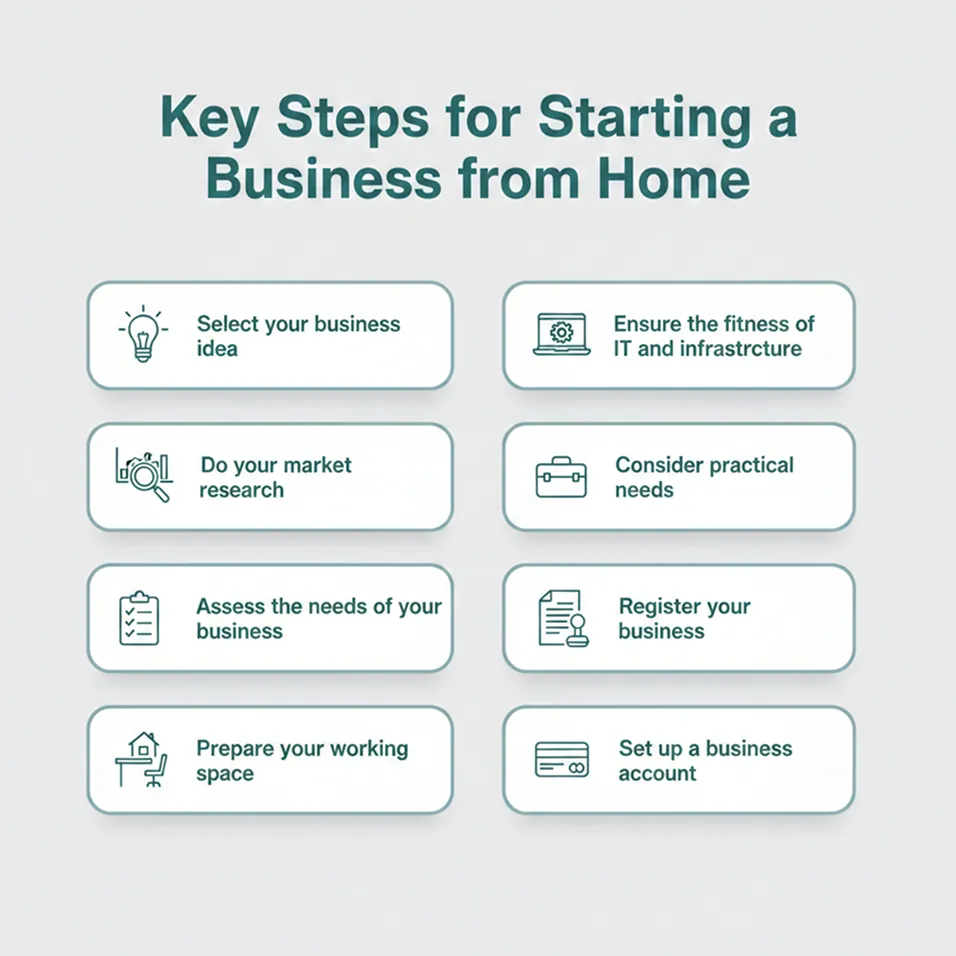
    Book an Appointment

    FAQs


    What is a Certified Public Accountant?


    In the UK, a certified public accountant is a distinguished and recognised professional who provides expert accounting services to people, companies, and organisations. They are frequently members of the Certified Public Accountants Association.


    At the conclusion of each month or year, books that are records of financial transactions are closed. An accountant reconciles and double-checks them so that the company can go into the following month. This is not a physical activity, but a procedural one.


    Fixed expenses are the costs which do not change no matter of how the business is doing. It includes fixed costs like office space rent, weekly wages, and asset and equipment depreciation. Power consumption bills, travel, transportation, and company credit card fees are examples of variable expenses that can vary depending on factors like hourly earnings, travel, and transportation.


    It means the knowledge that the credit customer (debtor) won’t be able to pay the amount that is due.


    It refers to something existing independently. For instance, a business that exists independently of its owner.

    Share This Article!

    Recent Posts