
Posted by:
Admin
Date:
January 20, 2026
Category:
blogs
Error: Contact form not found.
Accounting Terms Made Easy: A Simple Guide for Non-Financial People
Have you heard about ‘assets’ and ‘liabilities’? We often hear such terms in the world of finance. On a surface level they sound simple. They take deeper meaning, when it comes to finance. It is important to understand basic accounting terms, even if you are not an accountant. Knowing these terms gives you a clearer view of your company’s finances. It also helps you make better and more informed decisions. This blog explains the key accounting and finance terms you should know.
If you want to learn more about bookkeeping and managing your money, read our guide for bookkeeping.
What Are Accounting Terms?
Accounting means keeping track of the money your business makes. It involves keeping track of and recording all cash transactions. It also means telling people about them. Accounting help companies stay on the legal side of the law. It also shows how much money they have. You need to know some simple accounting terms if you want to learn about it. If you are a small business owner or an individual worker, this is very helpful. You’ll understand how to make budgets and decisions about money a lot better.
“The role of accounting education in mastering technical terms has gained attention in the global arena. According to Bochkay et al. (2023), Kermis & Kermis (2010), accounting education plays a crucial role in preparing individuals for careers in the Þ nancial sector. It involves a comprehensive understanding of technical terms that are essential for effective financial reporting and analysis.”
Djuwari et al.
Here is some basic terminology of accounting that you need to know:
1. General terms:
These are the general accounting terms that you might need to know about.
-
Accounting Period
It is the length of time that a financial statement for operations covers. For instance, fiscal years, quarters, calendar years, etc. are all accounting periods. Each period covers one accounting cycle (8-step process that accountants do).
-
Double-Entry Bookkeeping
Every financial transaction is recorded two times. One entry is a debit, and the other is a credit. The books are “balanced” when total debits equal total credits.
-
Single-Entry Bookkeeping
In this system, each transaction is recorded only once. Income and costs are written as single entries in the accounts.
-
Debit
This accounting term refers to an item that raises assets or lowers liabilities. In accounting paperwork, debits are located on the left-hand side.
-
Credit
This accounting term refers to an item that raises obligations or lowers assets. In accounting papers, credits are located on the right-hand side. They serve as the functional opposite of debits.
-
Closing the Books
The closing of the books means the end of an accounting cycle. This finance term refers to the approval of financial data for specific timings.
-
General Ledger
A ledger is a system that keeps track of transactions. Businesses and organisations use ledgers, which are a system of accounting. General ledger (GL or G/L) is the accounting term for the master account that houses all ledger accounts.
-
Trial Balance
This accounting term means a list of all account balances at one time. After each reporting period, accountants make a trial balance. They use it to check if all numbers are correct.
-
Overhead (O/H)
This term means the costs needed for daily work. These costs help keep the business running. They are not added to the company’s services and products. However, they are crucial for running the company.
-
Return on Investment (ROI)
This accounting term is the profit or loss on an investment. It is usually expressed in the form of a percentage. It is calculated by dividing net profit by cost.
-
Payroll
Payroll accounting refers to records of payments made to employees. It also consists of an analysis of these payments. Fringe benefits and income checks are included in the payroll.
-
Diversification
Diversification is a way to lower risk. It helps you avoid putting too much money in one asset or business. For this, you may spread your capital across options.
-
Net Margin / Gross Margin
The phrase “net margin” describes net profit as a ratio of total revenues for a business. Gross margin indicates the net sales value less the cost of products sold.
2. Terms from Balance Sheet
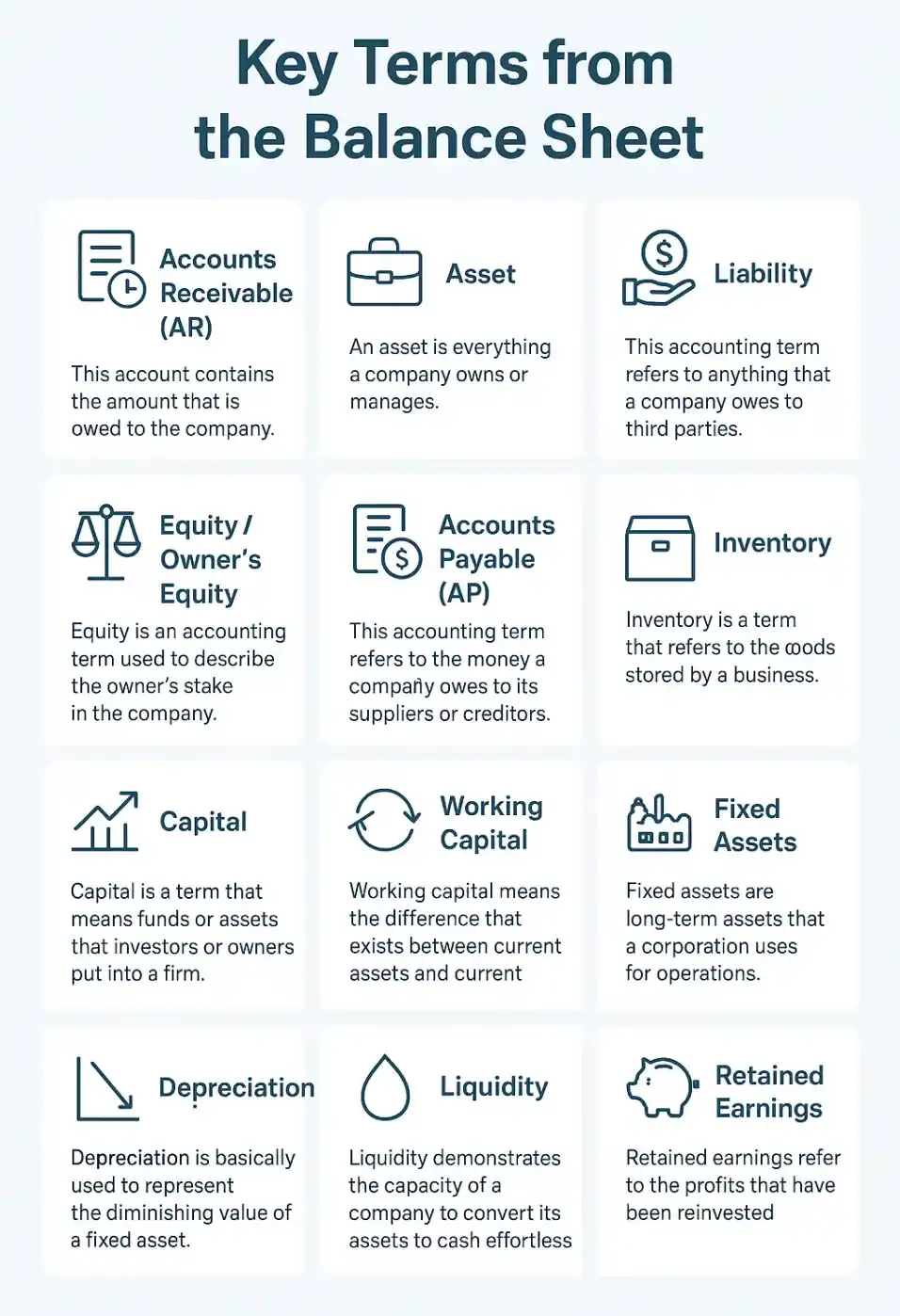
A balance sheet is the most commonly used financial report. It shows what a business owns, what it owes, and what the remainder is. The following are the terms that commonly appear in a balance sheet.
-
Accounts Receivable (AR)
This account contains the amount that is owed to the company. This amount is not yet paid back. It may include products or services given to customers on credit. It is recorded as a liability on the balance sheet.
-
Asset
An asset is everything a company owns or manages. These assets can bring in benefits in future. Some of them include cash, inventory, property and equipment.
-
Liability
This accounting term refers to anything that a company owes to third parties. It includes loans, overdue invoices, or taxes. It is a future payment owed to the company.
-
Equity / Owner’s Equity / Shareholders’ Equity
Equity is an accounting term used to describe the owner’s stake in the company. It is calculated by removing liabilities from the assets. The rest of the capital is equity and represents shareholders’ value in the business.
-
Accounts Payable (AP)
This accounting term refers to the money a company owes to its suppliers or creditors. It means that you have received the goods and services that you haven’t paid for.
-
Inventory
Inventory is an accounting term that refers to the goods stored by a business. This makes sure that these items are available when needed. These items can include raw materials, in-progress goods and completed goods.
-
Capital
This accounting term means funds or assets that investors or owners put into a firm. This is used to support a firm in its operations and growth.
-
Working Capital
Working capital means the difference that exists between current assets and current liabilities. It shows that the company is able to function and fulfil its immediate responsibilities.
-
Fixed Assets
The accounting term refers to long-term assets that a corporation uses for operations. These items cannot be sold easily. For instance, machinery, automobiles, and buildings are a few fixed assets.
-
Depreciation
When a fixed asset wears out, is torn down or just ages over time, it is known as depreciation. This accounting term is basically used to represent the diminishing value of a fixed asset. Depreciation is an expense for a company.
-
Liquidity
Liquidity demonstrates the capacity of a company to convert its assets to cash effortlessly. When a business has high liquidity, it will be able to settle debts quickly.
-
Retained Earnings
Retained earnings refer to the profits that a company holds on to after paying expenses and dividends. They are reinvested to make growth.
-
Chart of Accounts
A chart of accounts refers to a full list of names and numbers of each account that is used to record financial events in the general ledger.
3. Terms from the Income Statement
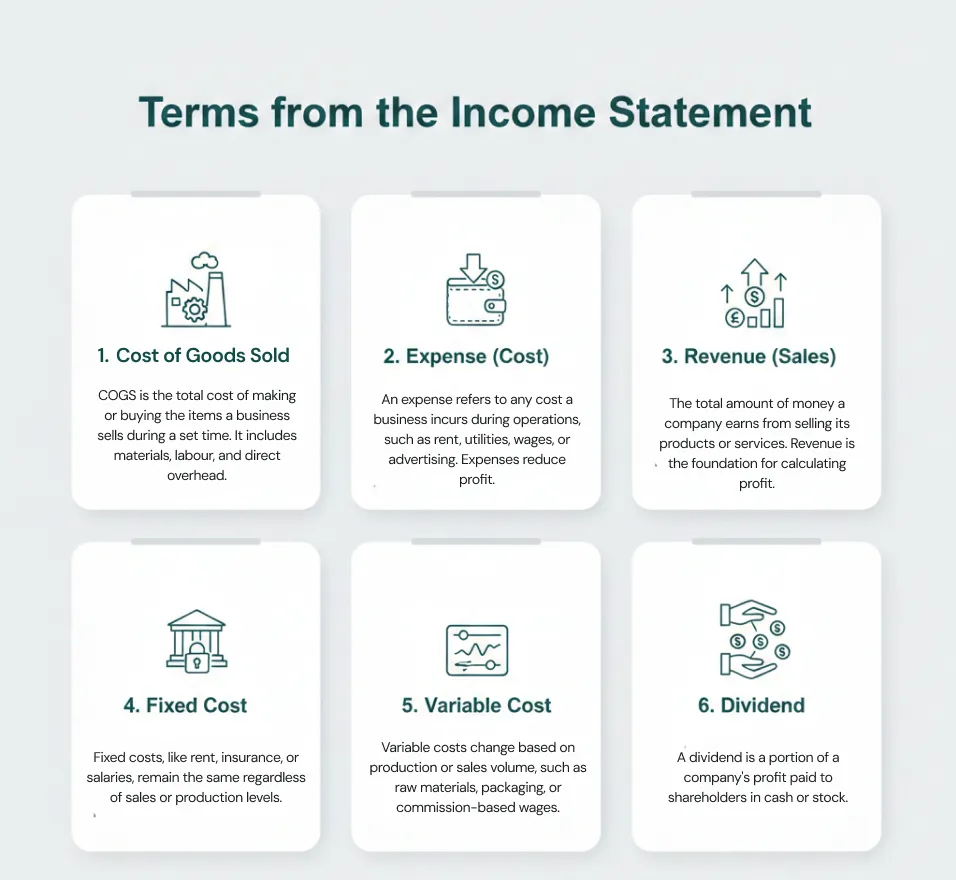
It is also known as a profit and loss statement. It reflects revenues, expenses and profits within a particular period of time. Revenue is shown at the top of the report. Then different costs are subtracted from it. After all costs are removed, the amount left is Net Income.
-
Cost of Goods Sold (COGS)
COGS is the total cost of making or buying the items a business sells during a set time. It comprises materials, labour and direct overhead.
-
Expense (Cost)
An expense refers to any cost a business incurs as it operates. For instance, the rent, the utility, the wages, or an advertisement are all expenses. The expenses dent into the profit of the company.
-
Revenue (Sales)
The total amount of money a company makes by selling its products or services is known as revenue. It serves as the foundation for figuring out profit.
-
Fixed Cost
Fixed costs, such as rent, insurance, or salary, are expenses that don’t change no matter what the business activity. Sales and production do not affect them.
-
Variable Cost
Variable costs are subject to change as a result of production volume or sales volume. Examples would be the raw materials, the packaging and wages on a commission basis.
-
Dividend
A dividend describes part of a company’s profit that is paid to shareholders, either in cash or stock. It is a form of distributing income among investors.
4. Terms from the Cash Flow Statement
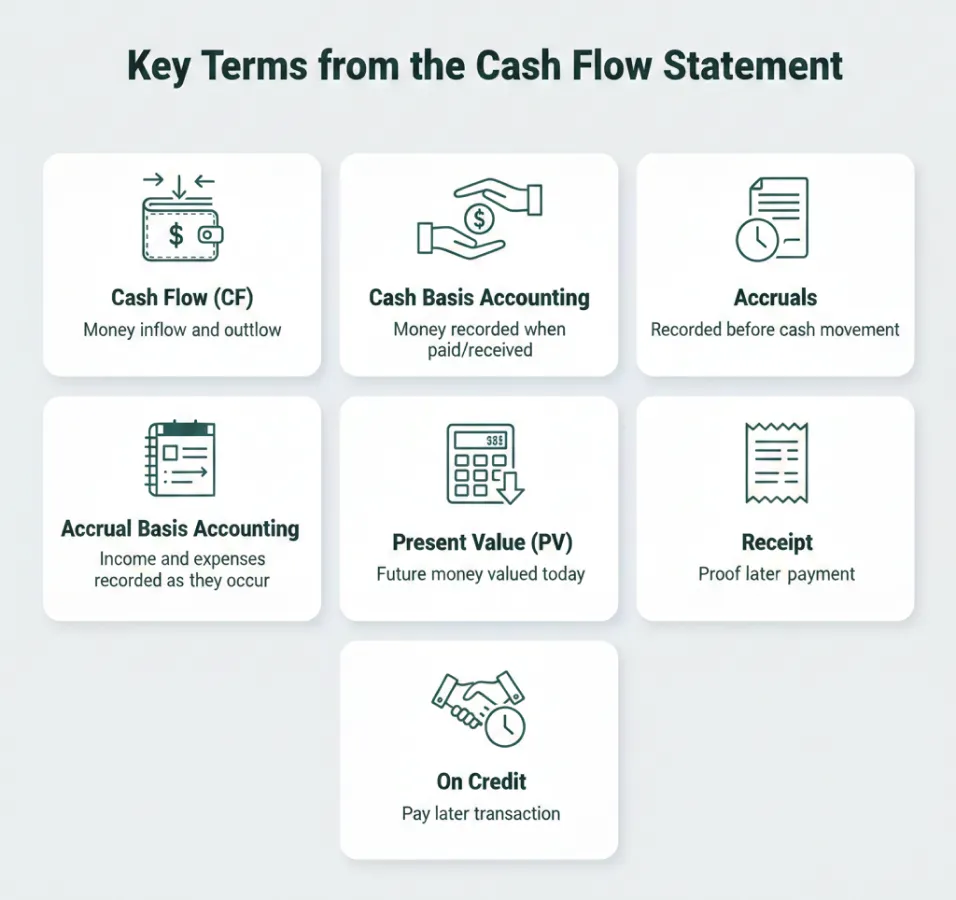
This is another very important accounting term. A cash flow statement constitutes a statement of finance that indicates the extent to which cash flows in and out of a business within a given period of time. Here are some of the important terms of the cash flow statement.
-
Cash Flow (CF)
Cash flow refers to the inflow and outflow of money within and outside a business within a specified duration of time. It demonstrates the quantities of cash that can make the business run.
-
Cash Basis Accounting
Under cash basis accounting, income and expenses are accounted for only at the point that money is received or paid. Small businesses tend to use it often.
-
Accruals
Accruals are revenues or expenses which have been listed prior to payment or receipt of cash. Some examples would be unpaid bills or earned but uncollected income.
-
Accrual Basis Accounting
Income and costs are recorded in accrual accounting as they happen. It is not recorded when money is transferred. It provides a more realistic view of financial well-being.
-
Present Value (PV)
The present value is the current value of a future amount of money. It is adjusted according to such aspects as interest or inflation. It is also useful in investment decisions.
-
Receipt
A receipt is a document that shows a payment or financial transaction was made, whether it is written or electronic. It becomes useful in tracking and reporting.
-
On Credit
On credit refers to goods or services that are given at the time, but payment will be accepted at a later time. It either generates an account receivable or payable.
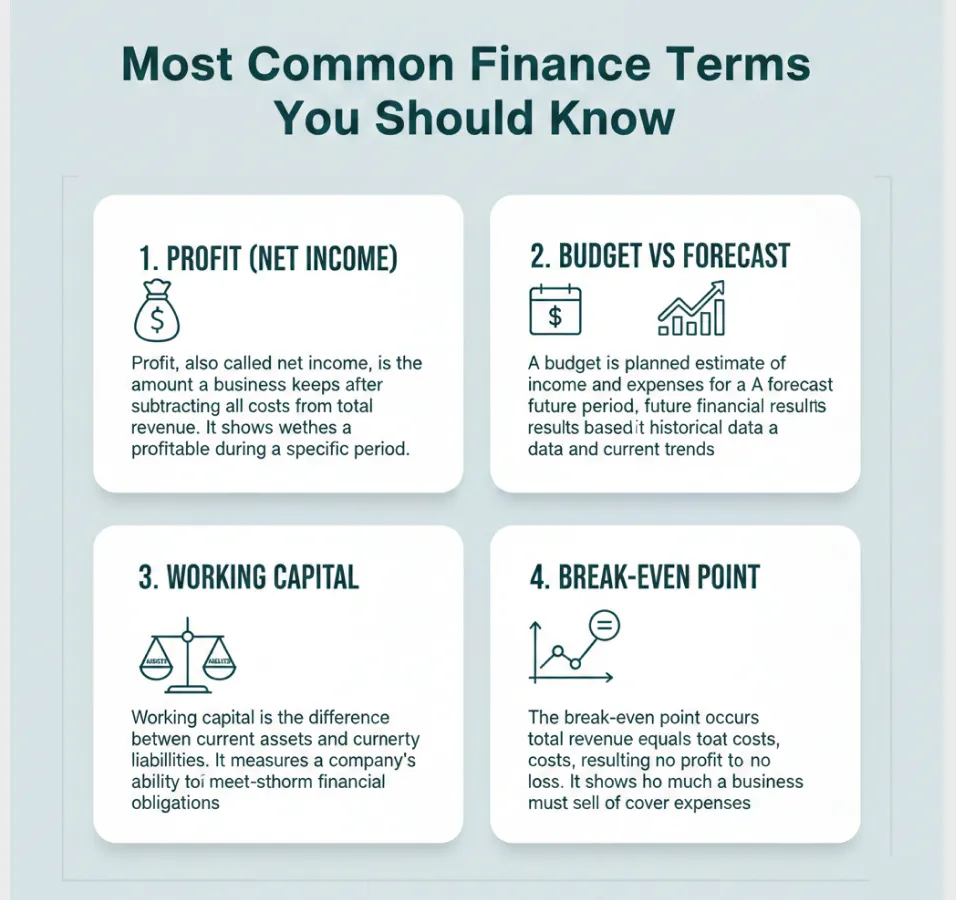
5. Most Common Finance Terms You Should Know
Finance terms are words we use to talk about money. They help us understand things like saving, spending, investing, and how a business is doing. These terms make it easier to talk clearly about money in daily life or at work. Here is the finance terminology that you should pay attention to:
-
Profit (Net Income)
The amount of money a business keeps after deducting all of its costs from its total revenue is known as profit, or net income. It indicates if a business is profitable over a given time frame.
-
Budget vs Forecast
A budget is like a financial roadmap. It gives a planned estimate for income and expenses for a future period. A forecast, which is more like a calculated guess, projects future financial results. It is based on historical data and present patterns.
-
Working Capital
This finance term refers to the difference between a business’s current assets and its liabilities at present. It assesses a business’s capacity to fulfil immediate financial commitments.
-
Break-even Point
When the entire revenue and total costs are equal, there is no profit or loss. This is known as the break-even point. It indicates the amount that a company must sell in order to pay its bills.
Conclusion
Knowing these accounting terms helps you manage money. You will understand your money health better. You will know your tax needs clearly. You will see your business direction easily.Therefore, learning a few basic accounting concepts is the way to go. Here at Sterling Cooper Consultants, we understand this. We take care of your accounts and cash flow. We also deal with filing your taxes and avoiding penalties. We ensure that you can focus on your business by taking care of all the monetary aspects.
Sterling Cooper Consultants offer expert Accounting and Bookkeeping Services.
So why wait? Contact us now!
+443300102526
Book an Appointment
FAQs
What is a Certified Public Accountant?
In the UK, a certified public accountant is a distinguished and recognised professional who provides expert accounting services to people, companies, and organisations. They are frequently members of the Certified Public Accountants Association.
What does closing the books mean?
At the conclusion of each month or year, books that are records of financial transactions are closed. An accountant reconciles and double-checks them so that the company can go into the following month. This is not a physical activity, but a procedural one.
What are fixed and variable expenses?
Fixed expenses are the costs which do not change no matter of how the business is doing. It includes fixed costs like office space rent, weekly wages, and asset and equipment depreciation. Power consumption bills, travel, transportation, and company credit card fees are examples of variable expenses that can vary depending on factors like hourly earnings, travel, and transportation.
It means the knowledge that the credit customer (debtor) won’t be able to pay the amount that is due.
It refers to something existing independently. For instance, a business that exists independently of its owner.
Share This Article!
Recent Posts
edit post

What Disabilities Qualify for VAT Exemption?
May 21, 2026
edit post

Making Tax Digital for Income Tax: A Practical Guide for UK Taxpayers
May 20, 2026
edit post

The Impact of AI on Financial Reporting and Auditing
May 19, 2026