Blog

  • How Much Do Accounting and Bookkeeping Services Cost for UK Small Businesses?

    How Much Do Accounting and Bookkeeping Services Cost for UK Small Businesses?

    How Much Do Accounting and Bookkeeping Services Cost for UK Small Businesses

    Posted by:

    Admin

    Date:

    October 15, 2026

    Category:

    blogs

    Error: Contact form not found.

    How Much Do Accounting and Bookkeeping Services Cost for UK Small Businesses?

    What would you expect to pay an accountant for your small business?

    £50 a month? £150? Or £500?

    The answer can be surprisingly different from one business to another. A sole trader who only needs help with a Self Assessment tax return has very different needs from a limited company that needs bookkeeping, VAT, payroll, annual accounts and tax advice.

    That is why there is no single price for accounting and bookkeeping services in the UK.

    The cost of managing business finances is also becoming more important as reporting requirements change. HMRC’s latest Administrative Burdens Advisory Board survey found that 11.3% of businesses surveyed employed an accountant, agent or bookkeeper to handle their day-to-day record keeping in 2026, up from 9.1% in 2025.

    This is one reason many small businesses choose to outsource some or all of their bookkeeping. But how much should you actually expect to pay?

    This blog looks at typical 2026 market prices for accounting and bookkeeping services and explains what you may need to budget for as a UK small business.

    How Much Do Accounting and Bookkeeping Services Cost?

    There is no standard UK fee for accounting or bookkeeping services. What you pay depends on the type of business you run, the services you need and the complexity of your financial records.

    As an indicative 2026 market guide, you may see prices around the following ranges:
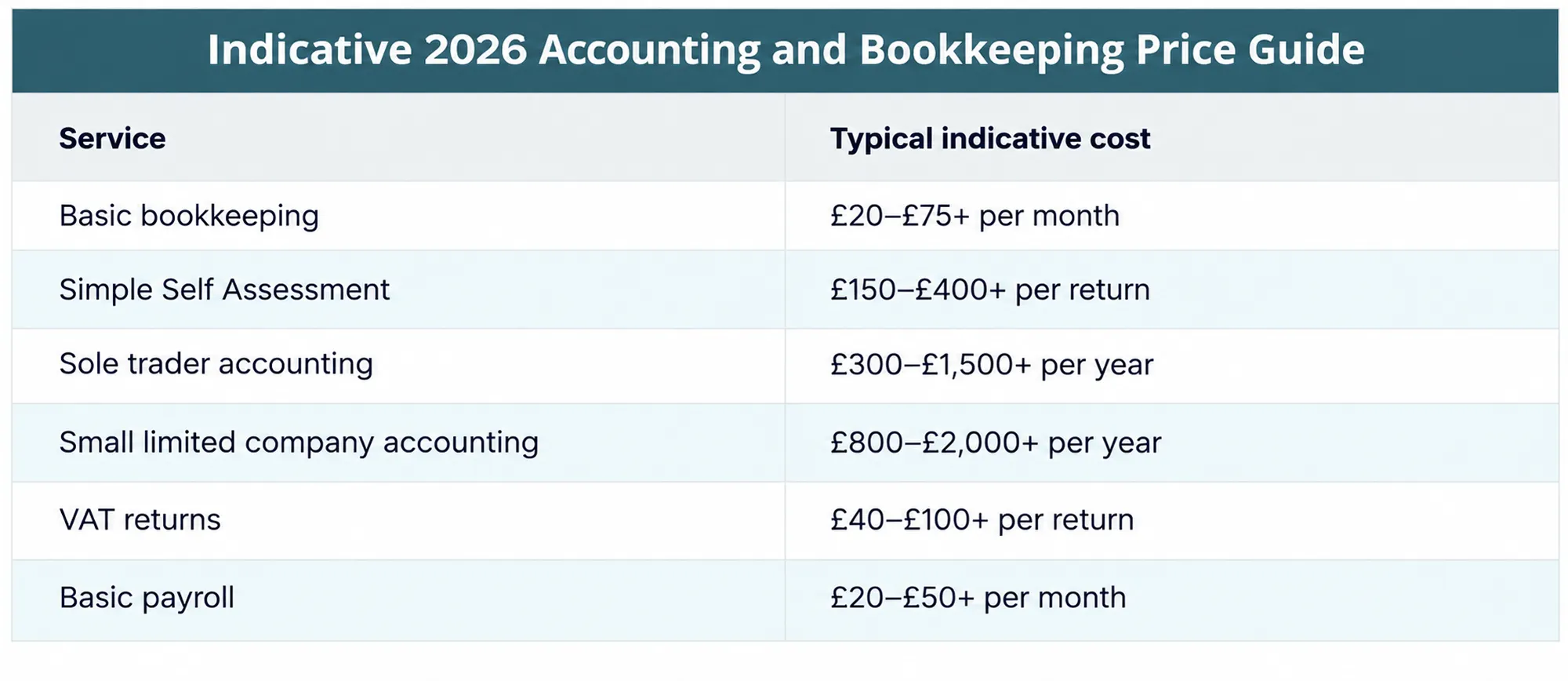
    Indicative 2026 Accounting and Bookkeeping Price Guide

    These are market ranges rather than fixed prices. The final accounting and bookkeeping services cost can be higher if your business has a large number of transactions, employees, VAT obligations, complex records or additional reporting requirements.

    When comparing accountants, look at what is included in the fee rather than comparing monthly prices alone. A £50 monthly package may look cheaper than a £100 package, but the more expensive option may include bookkeeping, VAT returns, payroll and regular advice.

    How Much Does Bookkeeping Cost for a Small Business?

    For a small business with relatively simple financial records, bookkeeping may cost around £20–£75 per month.

    A basic bookkeeping service may include recording sales and expenses, reconciling bank transactions and maintaining financial records. Some providers may also prepare information for VAT returns or provide basic financial reports.

    The amount of work involved can increase significantly when a business has:

    • A high number of monthly transactions
    • Multiple business bank accounts
    • Several payment platforms
    • Large volumes of invoices
    • Complicated expense records
    • Poorly organised financial information

    The way the bookkeeper charges can also affect the final cost. Some providers offer a fixed monthly fee while others charge according to transaction volume, hours worked or the level of support required.

    Before agreeing to a package, ask exactly how the fee is calculated and what happens if your transaction volume increases.

    How Much Does Accounting Cost for Sole Traders and Limited Companies?

    The cost of accounting can vary considerably depending on whether you operate as a sole trader or a limited company.

    Sole Trader Accounting Costs

    A straightforward Self Assessment tax return may cost around £150–£400 or more.

    However, this can increase if you need bookkeeping, tax planning, business advice or support with more complicated income and expenses.

    Some sole traders choose to pay an accountant only when their tax return is due. Others prefer a monthly package that includes ongoing bookkeeping and advice.

    The introduction of Making Tax Digital for Income Tax also means some sole traders will need to consider how they keep and submit their financial records.

    From 6 April 2026, Making Tax Digital for Income Tax applies to individuals with qualifying income above £50,000. The threshold falls to above £30,000 from 6 April 2027 and above £20,000 from 6 April 2028.

    For affected businesses, this can mean additional software costs or professional support alongside existing accounting fees.

    Limited Company Accounting Costs

    A small limited company may pay around £800–£2,000 or more per year for annual accounts and Corporation Tax services.

    However, the total cost depends heavily on what is included.

    A broader package may include:

    • Annual accounts
    • Corporation Tax return
    • Bookkeeping
    • VAT returns
    • Payroll
    • Director’s Self Assessment
    • Management accounts
    • Cash flow support
    • Regular tax and business advice

    This is why it is important to compare the overall service rather than simply looking at the monthly figure.

    For example, a £100 per month package may provide considerably more value than a £50 per month package if the additional cost covers services you would otherwise have to pay for separately.

    What Can Increase the Cost of Accounting Services?

    The advertised starting price is rarely the whole story. Several factors can increase the amount you pay for accounting and bookkeeping support.

    These can include:

    • The number of monthly transactions
    • Multiple bank accounts or payment platforms
    • VAT registration and quarterly VAT returns
    • Payroll and the number of employees
    • Complex business structures
    • Additional tax returns
    • Management accounts
    • Cash flow forecasting
    • Tax planning
    • Financial advice
    • Cleaning up incomplete or inaccurate records

    This is why two businesses in the same industry can receive very different accounting quotes.

    The more organised your financial records are, the easier it can be for an accountant or bookkeeper to complete the work efficiently. Good bookkeeping can therefore help reduce avoidable costs as well as giving you a clearer view of your business finances.
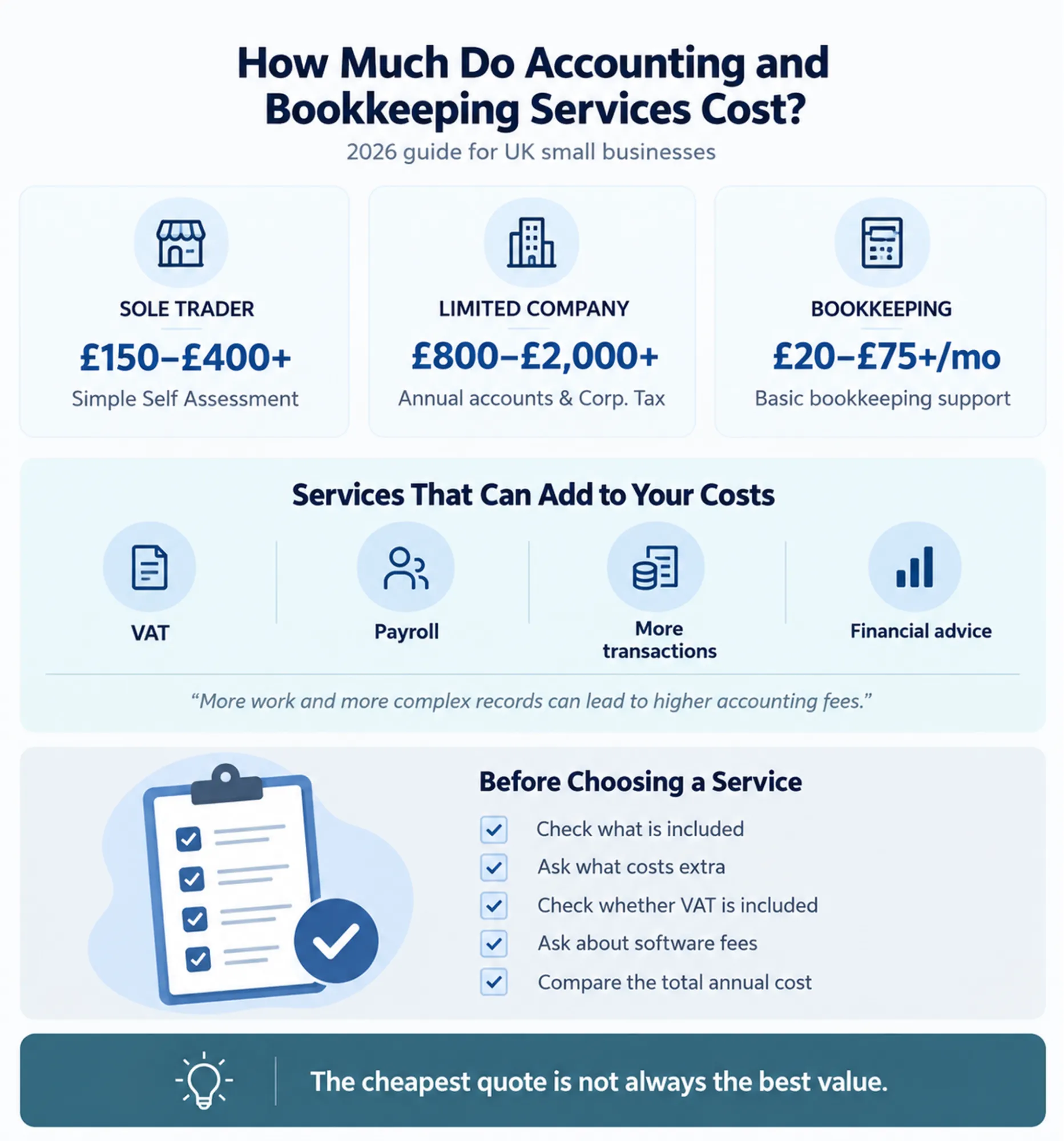
    how much do accounting and bookkeeping services cost

    Case Study: How the Right Accountant Can Add More Than Compliance

    The value of an accountant is not always reflected in the cost of preparing accounts or submitting a tax return.

    Consider the example of BrightWeb, a UK micro business. The business initially found that its accountant was not providing the level of financial support it needed. As the business developed, it moved to a chartered accountant who helped put better financial systems in place.

    The accountant supported the business with its annual budget, tax returns and cash flow statements that could also be used when dealing with the bank.

    The lesson is simple: accounting support can extend beyond compliance.

    A good accountant should not simply tell you what happened financially last year. Depending on the services you agree with, they can also help you understand your numbers and make better-informed decisions about the future.

    How Much Should Your Business Budget for Accounting?

    There is no single amount that every UK small business should budget for accounting.

    A sole trader with straightforward records may only need occasional support with their Self Assessment return. A growing limited company may need bookkeeping, VAT, payroll, annual accounts, Corporation Tax and ongoing financial advice.

    Before choosing a provider, consider:

    1. What accounting tasks do you actually need help with?
    2. How many transactions does your business handle?
    3. Are you VAT registered?
    4. Do you have employees?
    5. Do you need monthly bookkeeping?
    6. Do you need regular financial advice?
    7. Are you likely to need more support as the business grows?

    Once you understand these requirements, you can compare accounting packages more accurately.

    The cheapest accountant is not necessarily the best choice. The right service should provide the level of support your business actually needs at a fee you understand and can budget for.

    Conclusion

    The cost of accounting and bookkeeping services depends on what your business needs. A sole trader with simple records may only need occasional tax support, while a limited company with VAT, payroll and regular bookkeeping will usually need a wider service.

    The right service should give you the support your business needs at a clear and manageable cost. Comparing what each package includes can help you avoid paying for unnecessary services while ensuring important financial work is properly managed.

    This is the approach taken by Sterling Cooper Consultants, providing tailored support with accounting, bookkeeping, tax and wider financial matters based on each business’s needs.

    Need accounting and bookkeeping support?

    Get in touch with Sterling Cooper Consultants to discuss your business needs.
    +443300102526
    Book an Appointment

    FAQs


    How much does an accountant cost in the UK?


    The cost depends on the type of business and services required. A simple Self Assessment may cost around £150–£400, while a small limited company may pay £800–£2,000 or more per year for annual accounts and Corporation Tax services.


    Bookkeeping is generally less expensive than a full accounting service because it focuses mainly on maintaining financial records. However, the actual cost depends on transaction volume and the level of support required.


    Basic bookkeeping can start at around £20–£75 per month for a business with straightforward records. More complex businesses may pay considerably more.


    A small limited company may pay around £800–£2,000 or more per year for annual accounts and Corporation Tax services. The cost can increase if bookkeeping, VAT, payroll or ongoing advice is included.


    It can. VAT-registered businesses generally require additional work, such as preparing and submitting VAT returns. Some accountants include this within a monthly package while others charge separately.


    Yes. Some small businesses manage their day-to-day bookkeeping themselves and use an accountant for annual accounts, tax returns or specific advice. This can reduce professional fees, provided your records are accurate and maintained properly.


    It depends on your business. A monthly package can be useful if you need regular bookkeeping, payroll, VAT support or ongoing advice. It can also make costs more predictable compared with paying separately for different services throughout the year.

    Share This Article!

    Recent Posts

  • HMRC Agent Services Account: The Complete Guide for Accountants

    HMRC Agent Services Account: The Complete Guide for Accountants

    hmrc agent services

    Posted by:

    Admin

    Date:

    August 28, 2026

    Category:

    blogs

    Error: Contact form not found.

    HMRC Agent Services Account: The Complete Guide for Accountants

    A failed HMRC login or a missing client authorisation can bring an accounting firm’s work to a sudden stop, especially when an important tax deadline is close. The problem is not always with the account itself. Access to HMRC services depends on several parts working together, including the HMRC Agent Services Account (ASA), Online Services for Agents (OSA), client authorisations, staff permissions and compatible Making Tax Digital (MTD) software.

    Setting up an ASA is therefore only the beginning. A reliable HMRC setup requires a clear understanding of how these systems work together and how to manage them over time. This guide explains what the HMRC Agent Services Account is, who needs it, how it differs from OSA and what to check when access or client authorisation does not work as expected.

    Key Takeaways

    • ASA does not replace OSA. Many firms need both, depending on the services they use.
    • A reliable HMRC setup also requires client authorisations, staff permissions and compatible software.
    • MTD works best when accounts, authorisations and software are properly connected.
    • Never share HMRC login details. Use the correct client authorisation process.
    • Regularly review access, permissions, authorisations and software to prevent problems.
    • When access fails, check the wider HMRC setup, not just the ASA.

    What Is an HMRC Agent Services Account and Why Does It Matter?

    An HMRC Agent Services Account (ASA) gives tax agents access to a range of HMRC digital services. It allows accountants to act on behalf of clients through supported online processes and is particularly important for firms working with digital tax services and client authorisations.

    However, ASA does not replace every HMRC agent system.

    Depending on the services a firm provides, accountants may still need to use Online Services for Agents (OSA). Client authorisations, staff permissions and compatible software can also be part of the wider setup.

    This is important because creating an ASA does not automatically give a firm access to every HMRC service or every client. Before setting up or troubleshooting an account, it helps to understand what ASA does and where OSA is still needed.

    ASA vs OSA: What Is the Difference?

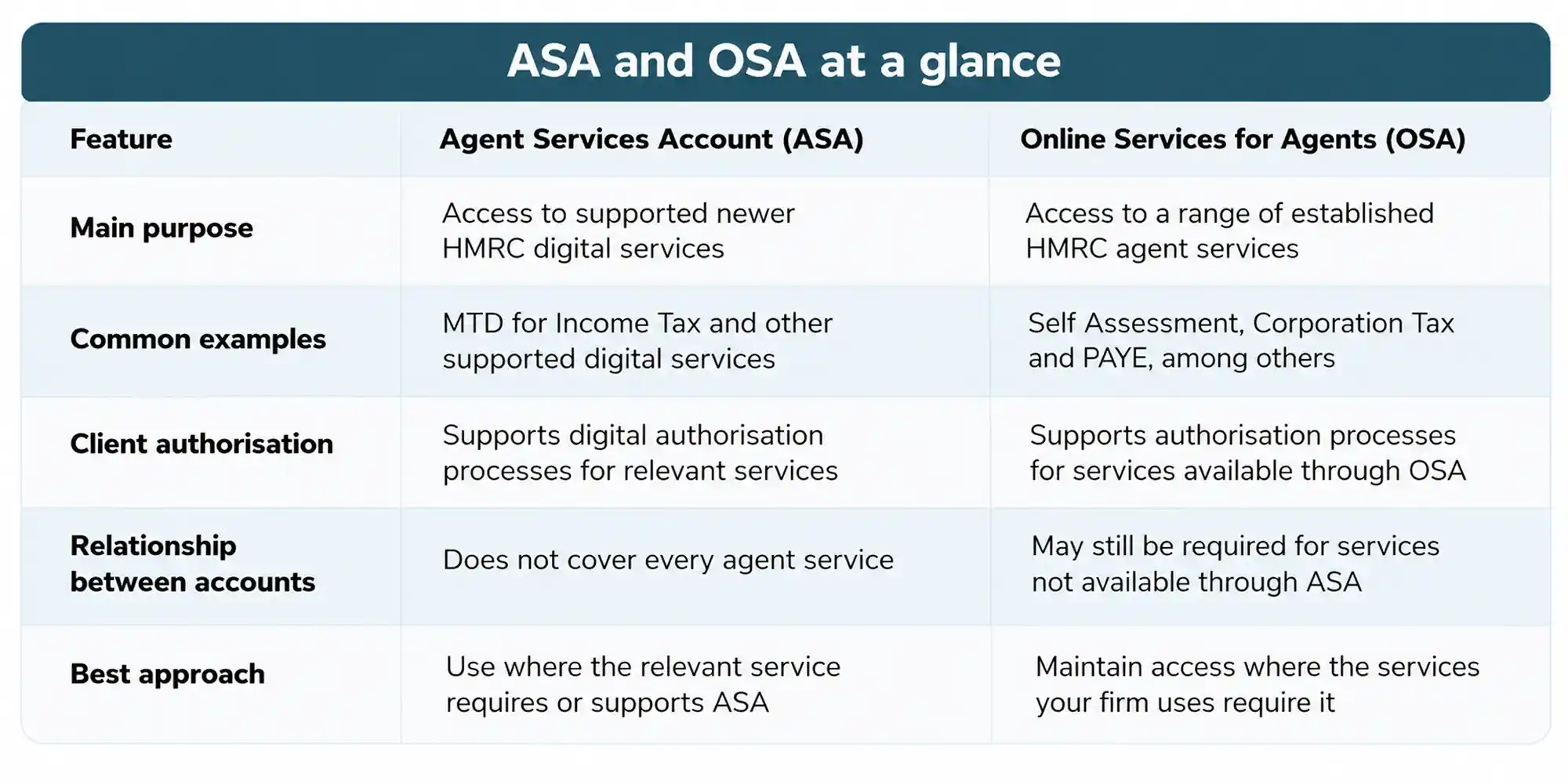
    One of the most important things for an accounting firm to understand is that ASA and OSA have different purposes.

    HMRC Agent Services Account (ASA)

    The Agent Services Account provides access to newer HMRC digital services, including services connected with Making Tax Digital. Accountants can use ASA to request client authorisations and manage access to supported digital tax services.

    HMRC Online Services for Agents (OSA)

    Online Services for Agents provides access to a range of established HMRC services. Depending on what the agent is enrolled for, these can include Self Assessment, Corporation Tax and PAYE.

    This means that setting up an ASA does not make OSA unnecessary. The account a firm needs depends on the specific HMRC service it is trying to use.

    HMRC ASA vs OSA: Which Account Does Your Practice Need?

    Knowing the difference between the two accounts is useful. But the more important question is which account your firm needs for each service.

    There is no single HMRC agent account that covers everything.

    asa and osa

    HMRC research involving 873 agents shows why this distinction matters. Seventy-five per cent of agents said they used both ASA and Online Services for Agents. This shows that many firms need to work across both systems rather than relying on one account alone.

    With this distinction clear, the next question is who actually needs an ASA.

    Who Needs an HMRC Agent Services Account?

    If you provide tax advice to clients and interact with HMRC on their behalf, you may be legally required to register with HMRC as a tax adviser and obtain an Agent Services Account. The exact requirements depend on your business and the services you provide. 

    For example, an ASA is required when acting as an agent for Making Tax Digital for Income Tax. HMRC also uses ASA for other supported digital services, so firms should always check the requirements for the specific services they provide. Depending on the services they provide, firms may also need to use OSA for services such as Corporation Tax.

    But setting up the account is only one part of the process.

    Once the account is active, your firm may also need to:

    • Obtain the correct authorisation from each client.
    • Add and manage client authorisations.
    • Set up individual staff access.
    • Give staff the right roles and permissions.
    • Make sure the required software is compatible with the relevant HMRC service.
    • Maintain access to OSA where certain services still require it.

    These parts work together. An account can be correctly registered and still not give a firm everything it needs to manage client tax affairs effectively.

    What Can Accountants Use an Agent Services Account For?

    The value of an ASA depends on how well it works with the other parts of your firm’s HMRC setup, particularly client authorisations, staff access and other HMRC systems.

    Managing Client Authorisations

    Client authorisation is at the heart of acting for clients through HMRC’s online services.

    Creating an ASA does not automatically give your firm permission to act for every client. For supported services, agents need to request authorisation through the relevant HMRC process.

    The exact method can depend on the tax service. For example, the digital handshake allows an agent to send an authorisation request to a client, who can then approve it through the relevant HMRC service.

    Keeping track of these authorisations matters. Your firm needs to know which clients have authorised you and which tax services those authorisations cover.

    Supporting Making Tax Digital

    Client authorisation is only one part of the digital tax process.

    Making Tax Digital has made it even more important for firms to have the right account access, authorisations and software connections in place.

    For Making Tax Digital for Income Tax, agents need an ASA and the appropriate client authorisation before signing clients up. Clients also need compatible software and must be correctly set up for the service.

    This is why MTD preparation should not be treated as a software issue alone. The account, authorisation and software all need to work together.

    How to Set Up an HMRC Agent Services Account Correctly

    Once you know which services require an ASA, the next step is to set up the account and manage the access around it.

    A reliable setup starts with accurate registration information and continues with proper client authorisations and controlled staff access.

    1. Prepare Your Registration Details

    Before applying, make sure the business and agent information provided to HMRC is accurate and up to date.

    HMRC may ask for additional information or carry out checks during registration. Having accurate business and contact details can help reduce unnecessary delays.

    Where relevant, firms should also make sure their anti-money laundering supervision information is correct and current.

    2. Complete HMRC’s Verification Checks

    HMRC may carry out checks before giving access to the account.

    Responding promptly to requests and providing accurate information can help keep the process moving. Once the account is active, keep your firm’s registration and contact information up to date rather than waiting until an access problem appears.

    3. Set Up Client Authorisations

    After registering as a tax agent, you need authorisation from clients before you can deal with HMRC on their behalf.

    The authorisation process depends on the tax service. Digital authorisation may be available for some services, while other services may use different routes.

    One important rule should always be followed: do not ask clients to share their HMRC login details. Use the relevant HMRC authorisation process instead.

    4. Manage Staff Access

    An accounting firm’s ASA should not rely on shared login details.

    HMRC allows administrators to create additional users and assign roles. When someone joins the firm, changes responsibilities or leaves, their access should be reviewed promptly.

    This helps make sure current employees have the access they need while reducing the risk of former employees keeping access after they leave.

    How to Maintain Your HMRC Agent Setup

    Getting your accounts set up correctly is important. Keeping them up to date is what helps prevent many avoidable access problems.

    A practical review should cover:

    • ASA and OSA access
    • Client authorisations
    • Staff roles and permissions
    • Agent registration and contact details
    • Anti-money laundering supervision details where applicable
    • MTD client status
    • Software connections and compatibility
    • Current HMRC service issues or planned downtime

    These checks become especially important when your firm takes on new clients, changes staff, introduces new software or starts using additional HMRC digital services.

    Regular reviews can help you find problems before they affect client work.

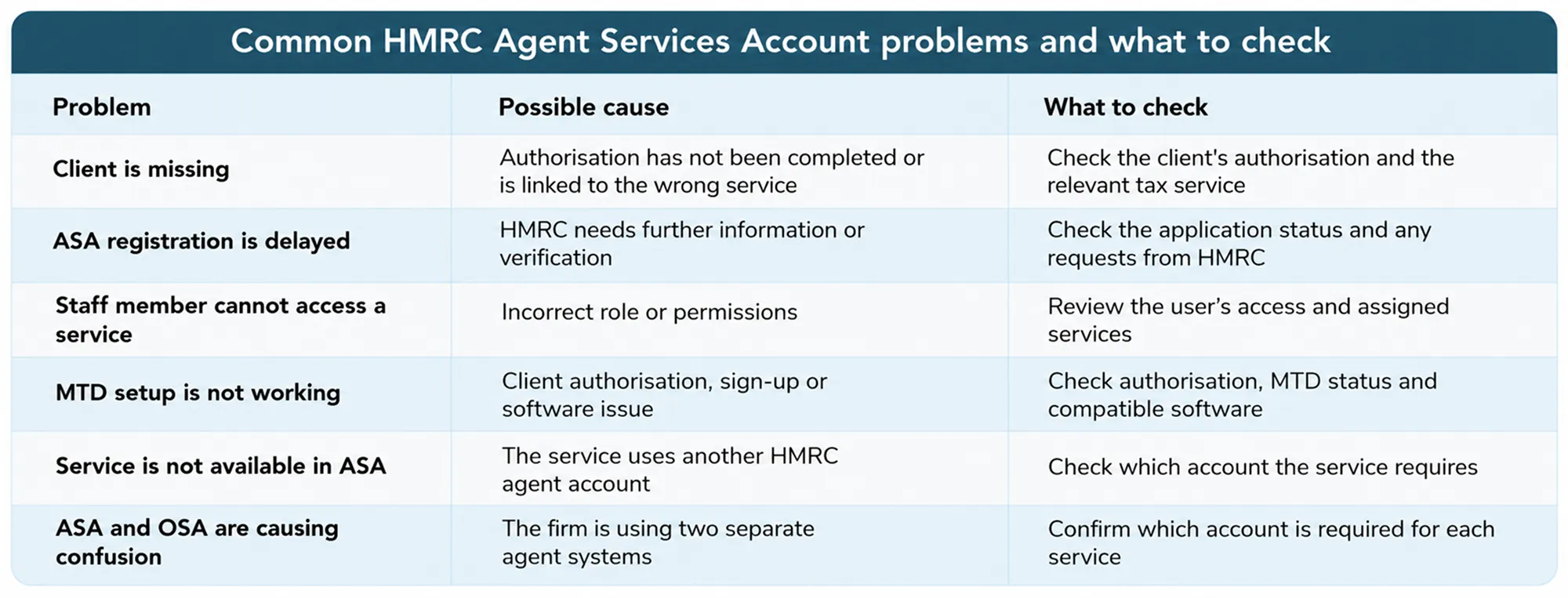
    Common HMRC Agent Services Account Problems and How to Fix Them

    Even a well-managed setup can experience access problems.

    When something goes wrong, looking only at the ASA may not reveal the real cause. The problem could be connected to a client authorisation, staff permissions, OSA access or software.

    The key is to look at the whole setup rather than assuming that the account itself is the problem.

    What HMRC Research Says About Agent Account Challenges

    HMRC research provides useful evidence of the challenges tax professionals can face when working across different agent systems.

    Among the 873 tax agents surveyed, 75% used both ASA and Online Services for Agents. At the same time, 36% said that having separate accounts with different login details had a high negative impact on their ability to deal with clients.

    Other problems were also reported. Thirty-five per cent said limited visibility of VAT returns and payments had a high negative impact, while 33% reported that differences between the information available to agents and clients caused a high negative impact.

    These findings point to an important lesson: having an ASA is not enough on its own.

    A firm also needs the right account access, client authorisations and staff permissions to work together. When these pieces are properly aligned, accountants can spend less time dealing with access problems and more time supporting their clients.

    For accounting firms, understanding HMRC’s systems is therefore about more than knowing which account to log into. It is about building a setup where the right people can access the right services at the right time.

    Keep Your HMRC Setup Working Smoothly

    An HMRC Agent Services Account is an important part of managing digital tax services, but setting up ASA is only the beginning.

    Your firm also needs to understand when OSA is required and make sure client authorisations, staff access and MTD software remain properly aligned.

    Taking time to review these areas regularly can help you find access problems before they disrupt client work or create unnecessary delays. If something does not seem right, review your HMRC accounts, authorisations and permissions together rather than looking at only one part of the system.

    Get Your HMRC Setup Back on Track

    If you are unsure whether your current setup is working as it should, Sterling can help review your HMRC accounts, authorisations and access processes. Contact us to discuss how we can help keep your client work running smoothly.
    +443300102526
    Book an Appointment

    FAQs


    What is an Agent Services Account with HMRC?


    An HMRC Agent Services Account (ASA) allows accountants and tax agents to access supported HMRC digital services and act on behalf of clients. Depending on the services they provide, firms may also need Online Services for Agents (OSA), client authorisations and compatible software.


    You need to authorise the accountant through the relevant HMRC authorisation process. The exact process depends on the tax service involved. You should never share your personal HMRC login details with an accountant. Instead, use the appropriate client authorisation process to give them permission to act on your behalf.


    To set up an ASA, you need to provide accurate business and agent information and complete any HMRC verification checks. Once the account is active, you may need to set up client authorisations, manage staff access and ensure any required software is compatible with the HMRC services you use.


    Accountants may have legal or professional obligations to report certain issues to HMRC, depending on the circumstances. However, they do not routinely report clients simply because they identify an error or disagreement. If you are concerned about a specific situation, discuss it with your accountant so you understand their obligations and your options.


    You can contact HMRC through the appropriate department or service for your tax issue. The contact method and availability of advisers vary depending on the service you need help with. If you are an accountant acting for a client, make sure you have the relevant authorisation before contacting HMRC on their behalf.


    HMRC does make mistakes, but there is no single figure that shows how often this happens across all its services. Errors can involve incorrect information, delays, missing records or problems accessing services. If you believe HMRC has made an error, check the relevant records and contact HMRC or your tax adviser to resolve the issue.

    Share This Article!

    Recent Posts

  • How Digital Bookkeeping Is Transforming UK Startups?

    How Digital Bookkeeping Is Transforming UK Startups?

    How Digital Bookkeeping Is Transforming UK Startups?

    For a growing UK startup, managing finances can become more demanding as transactions increase. Recording transactions, organising receipts, raising invoices and reconciling accounts can take time away from running the business. Digital bookkeeping can simplify these tasks by automating routine processes and keeping financial records organised in one place. Regularly updated records can also give startups clearer visibility of income, expenses, outstanding payments and cash flow.

    This guide explains how digital bookkeeping is changing financial management for UK startups, its key benefits and how to implement it effectively.

    Key Takeaways

    • Digital bookkeeping can automate routine financial tasks and reduce manual work.
    • It helps keep financial records organised and can reduce some data-entry errors.
    • Startups can access financial information more quickly to monitor cash flow and performance.
    • Automated processes can support financial planning as the business grows.
    • Choosing suitable software and setting it up correctly is important for getting the most from digital bookkeeping.

    What Is Digital Bookkeeping?

    Digital bookkeeping uses accounting software and other digital tools to record, organise and manage a business’s financial transactions. Accounting software can connect to business bank accounts and import transactions. Depending on the system, it may also support invoicing, expense tracking, payment matching and financial reporting.

    OCR tools can extract information from invoices and receipts, reducing manual data entry. However, digital bookkeeping doesn’t automate every task. Transactions may still need categorisation, reconciliation, and review. Business owners, bookkeepers and accountants also need to investigate discrepancies and make financial decisions.

    For startups, digital bookkeeping provides a more efficient way to manage financial records as the business grows. Businesses can also use professional bookkeeping services to manage these processes and maintain accurate financial records as their bookkeeping needs develop.

    How Digital Bookkeeping Simplifies Financial Management for UK Startups

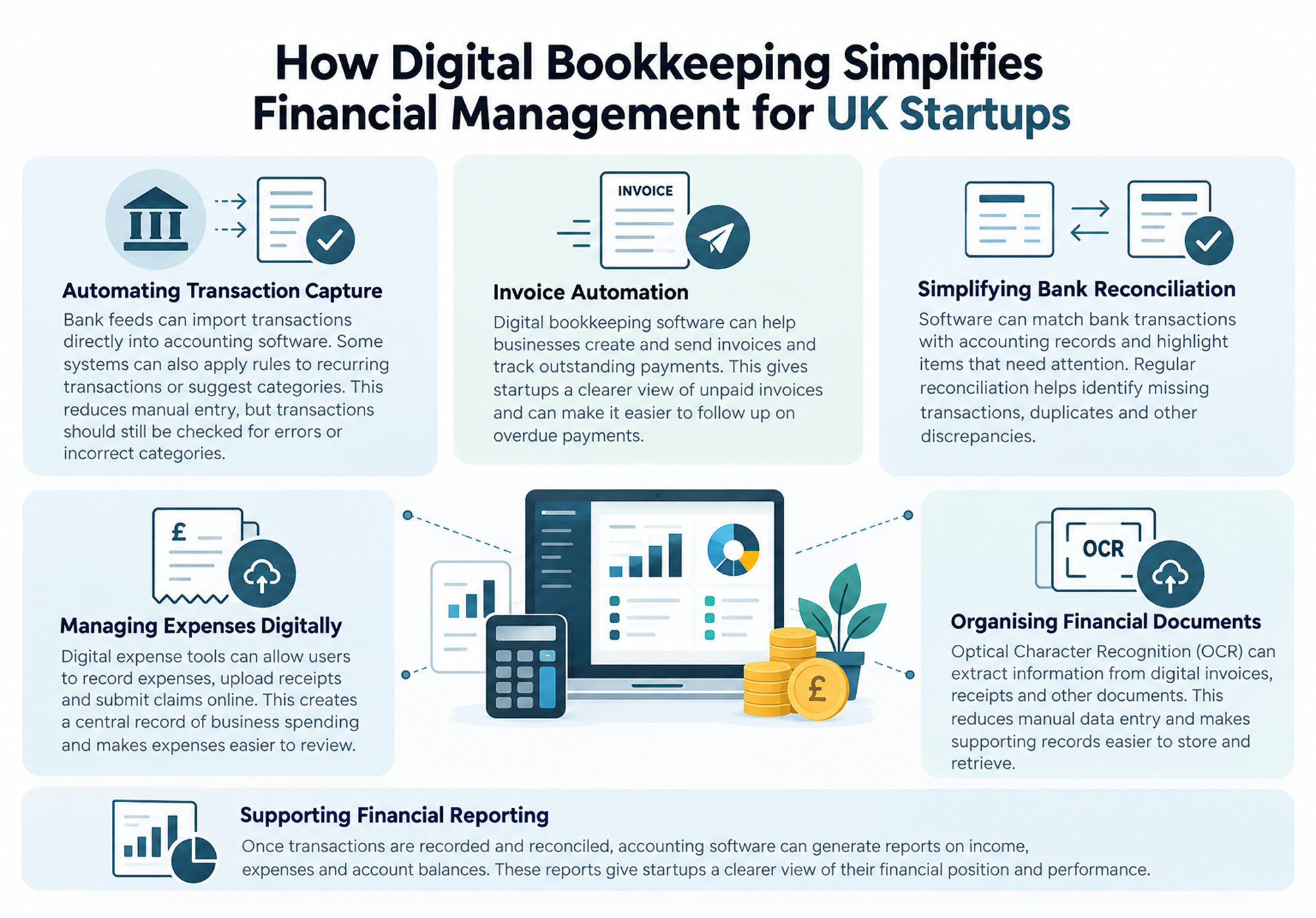
    Digital bookkeeping can facilitate several routine financial processes. This can make day-to-day bookkeeping easier to manage as transaction volumes increase:

    Automating Transaction Capture

    Bank feeds can import transactions directly into accounting software. Some systems can also apply rules to recurring transactions or suggest categories. This reduces manual entry, but transactions should still be checked for errors or incorrect categories.

    Invoice Automation

    Digital bookkeeping software can help businesses create and send invoices and track outstanding payments. This gives startups a clearer view of unpaid invoices and can make it easier to follow up on overdue payments.

    Simplifying Bank Reconciliation

    Software can match bank transactions with accounting records and highlight items that need attention. Regular reconciliation helps identify missing transactions, duplicates and other discrepancies.

    Managing Expenses Digitally

    Digital expense tools can allow users to record expenses, upload receipts and submit claims online. This creates a central record of business spending and makes expenses easier to review.

    Organising Financial Documents

    Optical Character Recognition (OCR) can extract information from digital invoices, receipts and other documents. This reduces manual data entry and makes supporting records easier to store and retrieve.

    Supporting Financial Reporting

    Once transactions are recorded and reconciled, accounting software can generate reports on income, expenses and account balances. These reports give startups a clearer view of their financial position and performance.

    Start by reviewing your current bookkeeping process and identifying areas that take the most time. Then choose suitable software, establish responsibilities, transfer relevant records and connect necessary integrations. Review the system regularly to keep financial records accurate and up to date.

    Benefits of Digital Bookkeeping for UK Startups

    The main benefits of digital bookkeeping come from reducing manual work and making financial information easier to access and manage.

    Save Time

    Manual bookkeeping can involve entering transactions, checking statements, organising receipts and updating records. Automating some of these tasks can reduce repetitive work. This can give startup teams more time to focus on operational and commercial priorities.

    Improve Accuracy

    Manual data entry can result in incorrect amounts, duplicate entries or miscategorised transactions. Automation can reduce some of these errors by transferring and matching information between connected systems. However, software does not eliminate errors. Regular reconciliation and review are still necessary.

    Improve Cash-Flow Visibility

    Cash flow is important for startups because they need enough money available to meet their financial commitments. Up-to-date bookkeeping can show income, expenses, outstanding invoices and recent transactions. This gives founders a clearer picture of their current cash position. It can also help them identify changes in spending or delayed customer payments that may require attention.

    Support Financial Decisions

    Accurate financial information can help founders make decisions about spending, costs and growth. For example, they can review income and expenses, monitor recurring costs and identify changes in financial performance.

    Support Business Growth

    Bookkeeping can become more complex as a startup gains customers, suppliers, employees and transactions. Digital systems can handle larger volumes of financial data without relying entirely on manual entry. Businesses can also add users, integrations and features as their needs change.

    How to Implement Digital Bookkeeping in Your Startup

    Moving to digital bookkeeping should be a planned process. Startups do not need to automate every financial task immediately. It is often more practical to begin with processes that take the most time or are most prone to errors:

    Evaluate Your Current Process

    Review how you currently manage bookkeeping. Identify repetitive tasks, delays, recurring errors and areas where information is difficult to access. This will help you identify which processes would benefit most from digital tools.

    Set a Realistic Budget

    Consider the full cost of digital bookkeeping. This may include software subscriptions, additional users, integrations, setup and external bookkeeping support. Choose an option that fits your current budget without creating unnecessary costs.

    Select the Right Software

    Look for software that meets your current needs and can support future growth. Consider features such as bank feeds, invoicing, expense tracking, reconciliation, reporting, document capture and integrations. UK startups should also consider relevant tax and record-keeping requirements.

    Train Your Team

    Decide who will manage key bookkeeping tasks. These may include recording expenses, reviewing transactions, reconciling accounts and following up on unpaid invoices. Clear responsibilities can help prevent important tasks from being missed.

    Import and Check Financial Data

    Transfer relevant records into the new system and connect business bank accounts where supported. Check imported transactions, opening balances and other financial information before relying on the new records.

    Set Up Relevant Integrations

    Connect the bookkeeping system with tools that support your financial processes, such as payroll, invoicing or payment platforms. Only use integrations that provide a clear benefit. Too many unnecessary connections can make the system harder to manage.

    Review the System Regularly

    Check the system for unreconciled transactions, duplicate records and incorrect categories. As the business grows, review whether the software and processes still meet its needs.

    Conclusion

    Digital bookkeeping can help UK startups manage financial administration more efficiently. It can reduce repetitive tasks, improve access to financial information and make bookkeeping easier to scale. Regularly updated records can also give founders better visibility of income, expenses and cash flow. This can support day-to-day financial decisions as the business grows. However, software alone does not guarantee accurate records. Startups still need clear processes, defined responsibilities and regular reviews.

    Need help managing your startup’s bookkeeping?

    Contact Sterling Cooper Consultants to discuss how our bookkeeping support can help you keep your financial records organised and up to date.

    FAQs


    Does digital bookkeeping replace an accountant?

    No. Digital bookkeeping software can automate many routine tasks, but accountants can still provide professional advice, review financial records, support tax compliance and assist with financial planning.

    Some UK businesses have digital record-keeping and reporting obligations under Making Tax Digital. The requirements depend on the relevant tax and the business’s circumstances.
    Businesses should check current HMRC guidance to understand which requirements apply to them.

    Costs depend on the software, features and level of support required. Startups may need to consider software subscriptions, additional users, integrations, setup and bookkeeping or accounting support.

    Consider features such as bank feeds, invoicing, expense tracking, reconciliation, reporting and document capture. Startups should also consider integrations, security, ease of use and whether the software can support their future needs.

    Start by reviewing your current bookkeeping process and identifying areas that take the most time. Then choose suitable software, establish responsibilities, transfer relevant records and connect necessary integrations. Review the system regularly to keep financial records accurate and up to date.

  • Final Accounts vs Management Accounts: What’s the Difference?

    Final Accounts vs Management Accounts: What’s the Difference?

    Posted by:

    Admin

    Date:

    August 18, 2026

    Category:

    blogs

    Error: Contact form not found.

    Final Accounts vs Management Accounts: What’s the Difference?

    What happened to your business last year? Your final accounts can tell you.

    But what is happening this month? Are costs rising? Are profit margins falling? Will you have enough cash to cover the next few months?

    For these questions, final accounts may not provide all the detail you need. This is where management accounts can help.

    Both types of accounts use financial information from your business, but they serve different purposes. Final accounts provide a formal record of your financial performance and position over a completed accounting period. Management accounts offer more regular insights to help you monitor performance, plan ahead and make informed decisions.

    Understanding the difference between final accounts and management accounts can help you decide what financial information your business needs as it operates and grows.

    Key Takeaways

    • Final accounts show a business’s financial performance and position for a completed accounting period.
    • Management accounts provide regular financial information to support internal decision-making.
    • Final accounts must follow applicable accounting rules, while management accounts can be tailored to your business needs.
    • Management accounts can include budgets, forecasts, key performance indicators (KPIs) and cash flow information.
    • Final accounts support compliance and external reporting.
    • Growing businesses can benefit from both to understand past performance and make better-informed decisions.

    What Are Final Accounts?

    Final accounts are prepared at the end of an accounting period to provide a formal record of a business’s financial performance and position. For UK limited companies, these are generally referred to as statutory accounts.

    According to GOV.UK guidance on preparing annual accounts, statutory accounts generally include a balance sheet, profit and loss account and notes to the accounts. Depending on the company’s circumstances, a directors’ report and an auditor’s report may also be required.

    Final accounts are important for meeting relevant Companies House requirements, supporting Corporation Tax reporting and helping shareholders understand the company’s financial position.

    What Do Final Accounts Include?

    The exact contents depend on the company’s size, structure and applicable accounting framework. They can include:

    • Profit and loss account: Shows the company’s income, expenses and profit or loss over an accounting period.
    • Balance sheet: Provides a snapshot of the company’s assets, liabilities and equity at a particular date.
    • Notes to the accounts: Provide additional information to help readers understand the figures.
    • Directors’ report: Provides information about the company’s business and performance where required.
    • Auditor’s report: Provides an independent audit opinion where an audit is required.

    Final accounts are prepared using accounting records for the completed financial year. They therefore provide an important historical view of the business rather than a live picture of current performance.

    What Are Management Accounts?

    Management accounts are financial reports prepared for the people responsible for running a business. Unlike statutory accounts, they do not follow one fixed format for every business. Instead, they can be tailored to the information owners and management teams need.

    They are often prepared monthly or quarterly and can help answer practical questions about profitability, spending, cash flow and future performance.

    What Do Management Accounts Include?

    Depending on your business’s needs, management accounts can cover:

    • Sales and costs: Track income and expenditure over a particular period.
    • Gross and net profit: Help assess profitability and identify changes in margins.
    • Cash flow: Show how money moves into and out of the business.
    • Budget against actual results: Highlight differences between expected and actual performance.
    • Key performance indicators (KPIs): Track financial measures relevant to business objectives.
    • Department or product performance: Help identify which areas contribute most to revenue or profit.
    • Debtors and creditors: Provide visibility of money owed to the business and amounts it needs to pay.
    • Forecast financial results: Help assess potential future performance and financial requirements.

    The Department for Education’s 2026 management accounts guidance for colleges highlights the importance of comparing actual performance against budgets and forecasting the expected financial position. Although this guidance is designed for colleges, these principles also illustrate how management accounts can support financial oversight and planning in other organisations.

    For a business owner, regular reporting can help identify changes before they become more difficult to address. For example, if sales increase but profit margins fall, management accounts can help you investigate rising costs or changes in pricing while there is still time to respond.

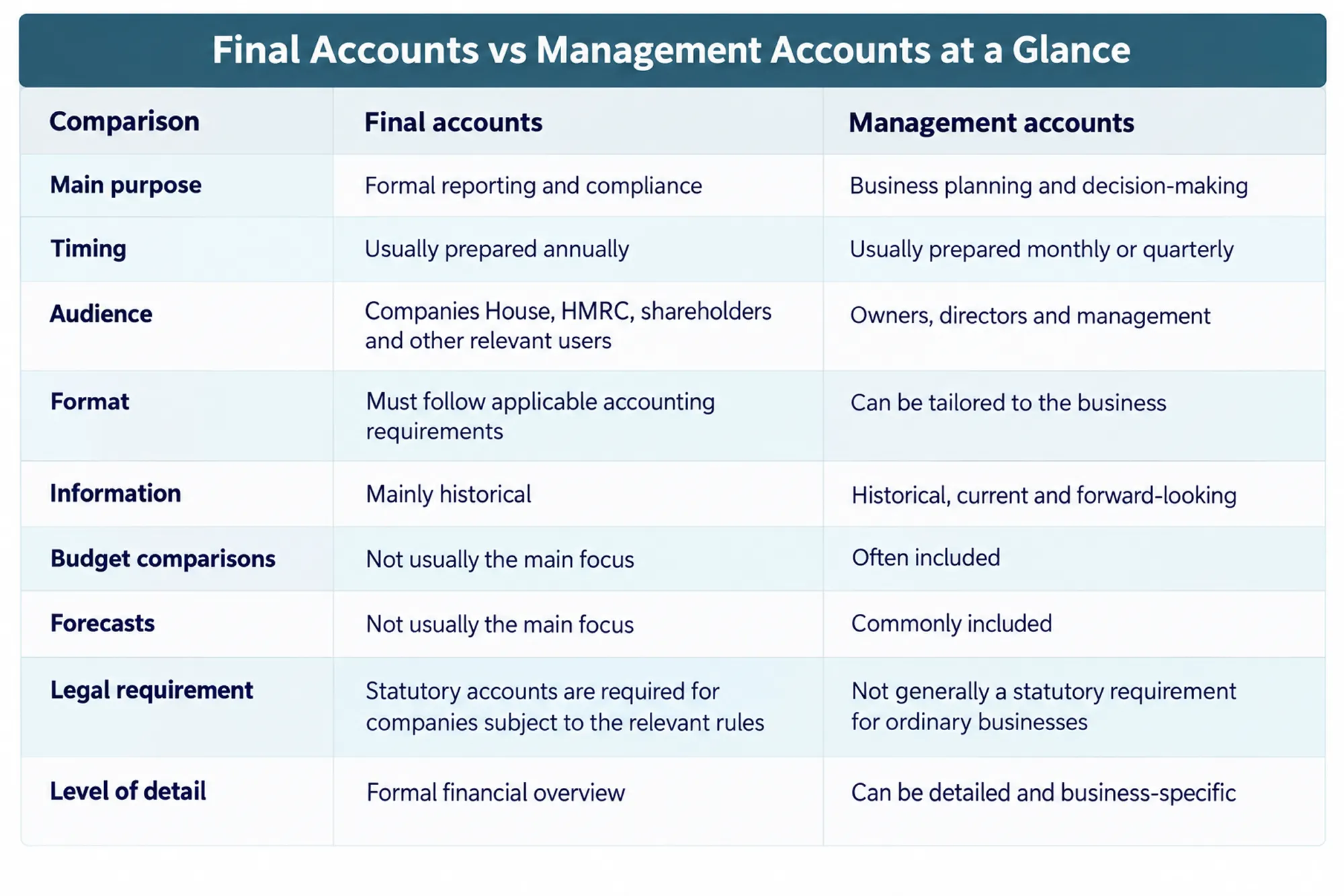
    Final Accounts vs Management Accounts: What Is the Difference?

    The main difference comes down to purpose, timing and audience. Although both use financial information from your business, each serves a different role.

    final account vs management accounts

    GOV.UK guidance on annual accounts for limited companies explains the requirement to prepare statutory accounts and meet relevant reporting obligations. Management accounts, by contrast, are designed around the information management needs to monitor performance and plan ahead.

    Can You Use Both Final Accounts and Management Accounts?

    Yes. Many businesses benefit from using both because they provide different but complementary views of the company’s finances.

    Final accounts provide the formal year-end record. Management accounts offer more regular information to help owners and directors monitor performance and make decisions during the year.

    The two are not competing sets of accounts. They answer different questions:

    • Final accounts: How did the business perform over the completed financial year?
    • Management accounts: How is the business performing now, and what might happen next?

    Using both can give business owners a clearer view of past performance, current results and future financial needs.

    Case Study: How Management Accounts Can Support Business Decisions

    An ICAEW case study involving Six Island Bay Developments Limited illustrates how management accounts can support ongoing financial assessment.

    The company’s directors reviewed the business each October using management accounts for the first nine months of the year, alongside the current-year forecast and the budget for the following year. They used this information when considering whether there were indicators of impairment in the business.

    The example demonstrates how management accounts can support more than routine financial monitoring. By reviewing current results alongside forecasts and budgets, directors can use financial information to inform wider business decisions.

    Which Accounts Does Your Business Need?

    Final accounts and management accounts both provide valuable financial information, but they serve different purposes.

    Final accounts provide a formal record of a business’s financial performance and position for a completed accounting period. Management accounts offer more regular and flexible information to help owners and directors monitor performance, control costs and plan ahead.

    For a small business, annual final accounts may be enough to meet its reporting requirements. As the business grows and financial decisions become more complex, management accounts can provide the additional detail needed to make decisions with greater confidence.

    Sterling Cooper Consultants supports businesses with accounting and financial reporting, including the preparation of accounts and management information. By understanding each business’s requirements, the aim is to provide financial information that supports both compliance and day-to-day decision-making.

    Need Help With Your Business Accounts?

    Get in touch with Sterling Cooper Consultants to discuss your accounting and management reporting needs.
    +443300102526
    Book an Appointment

    FAQs


    Are Final Accounts and Management Accounts the Same?


    No. Final accounts are formal accounts prepared at the end of an accounting period, while management accounts are internal reports prepared regularly to help with business management and decision-making.


    Management accounts are generally not a statutory requirement for ordinary businesses. They are prepared to give owners and managers useful information about financial performance and position. However, particular organisations may have additional reporting obligations.


    Management accounts are commonly prepared monthly or quarterly, but the right frequency depends on the size, complexity and needs of the business. Monthly reporting can help businesses identify changes in costs, cash flow and profitability sooner.


    Companies required to prepare statutory accounts generally prepare them for each financial year and must meet the relevant Companies House filing requirements. Specific reporting obligations depend on the company’s circumstances.


    Yes. Management accounts can compare actual performance with budgets and support forecasts of future financial performance and cash flow. This can help business owners anticipate potential shortfalls and make informed decisions about spending and growth.


    Neither is automatically more useful. Final accounts are important for formal reporting, while management accounts can be more useful for regular monitoring and business decisions. A growing business may benefit from using both.

    Share This Article!

    Recent Posts

  • Compliance Risk vs Operational Risk: What’s the Difference?

    Compliance Risk vs Operational Risk: What’s the Difference?

    compliance risk vs operational risk what's the difference

    Posted by:

    Admin

    Date:

    August 13, 2026

    Category:

    blogs

    Error: Contact form not found.

    Compliance Risk vs Operational Risk: What’s the Difference?

    What happens if a business follows every rule but still suffers a costly disruption? Or when a smooth operation leads to a serious compliance breach? This is where the difference between compliance risk and operational risk matters. But a lot of organisations continue to mix up compliance risk and operational risk. This makes it harder to spot gaps and take the right action. As per EU/EEA banks, about 3.9 million operational risk loss incidents occurred in 2025. This shows that operational errors remain a risk for regulated firms.

    There are two types of risks involved. First are the risks that disrupt daily business work. Then there are risks that break laws or rules. This blog will explain both types so you can differentiate between compliance risk and operational risk. You will learn how these risks differ, where they overlap and why this matters. It also lists the actions you can take to handle both.

    Key Information

    • Compliance risk focuses on following laws, regulations and internal rules, while operational risk relates to failures that disrupt daily business activities.
    • The difference between compliance risk and operational risk can affect how a business spots, controls and responds to threats.
    • Operational risk management helps businesses spot weaknesses in people, processes, systems and external events before they cause problems.
    • Compliance risk is often more tactical and prescriptive, while operational risk management takes a broader, more strategic and predictive approach.
    • Both risks can overlap, so businesses should manage compliance risk and operational risk together to reduce losses, meet legal duties and improve resilience.
    • Effective risk management includes clear policies, employee training, regular reviews, strong controls and collaboration across teams.

    What Is the Difference Between Compliance Risk and Operational Risk?

    Although they are not the same, operational risk and compliance risk often coexist.

    The difference between compliance risk vs operational risk is important. It helps organisations make better choices. It also helps them avoid costly mistakes and build stronger risk management plans.

    In simple terms, operational risk is about keeping the business running. Compliance risk is about following the rules.

    Consider a manufacturing corporation, for instance.

    It is at risk of noncompliance with workplace safety regulations.

    A machine is at operational risk if it malfunctions and ceases producing.

    Failing to follow legal or regulatory standards is one problem. Failures in daily operations are the source of the other. One sometimes causes the other. A compliance violation can disrupt the operations. And legal requirements may get compromised by an operational failure.

    Knowing where each risk comes from makes it easier to stop problems early.

    What is Compliance Risk?

    Compliance risk is when a company does not follow the rules it is bound by. These include the laws, regulations and internal policies. It can come from old practices, poor checks or unclear rules.

    It can show up in the real world as:

    • A construction company that is facing fines for ignoring safety standards.
    • A hospital breaking privacy laws by mishandling patient data.
    • Financial firms facing enforcement action for skipping compliance risk checks.

    In each instance, the organisation violates a rule. And then it has to face the consequences. These can include financial fines, legal action, reputational damage or even limited operations.

    Firms need good compliance risk management. It makes it easier to keep up with new rules. They can train their employees. They can also reduce compliance risks by using the right controls.

    What is Operational Risk?

    A disruption in your daily business operations is an operational risk. These happen for four main reasons: people, systems, processes and outside events. This differs from compliance risk. The problem here isn’t breaking the rules. Operational risks come from obstacles that stop operations.

    Operational risk can appear in real life as:

    • An employee slowing down operations by accidentally deleting customer data.
    • An entire production line compromised by broken machinery.
    • A supplier missing a delivery, creating delays in the supply chain.

    In each of these scenarios, the operations are being stopped. This can cost your business time, money and customer trust.

    Operational risk management means taking early action. Look for weaknesses and fix them before they spiral into real problems. You can reduce operational risk by:

    1. improving your processes
    2. keeping your equipment in good shape
    3. training your team
    4. boosting your cybersecurity
    5. planning for the unexpected

    The aim of operational risk management is to keep work moving even when things go wrong.

    Compliance Risk vs Operational Risk: A Side-by-Side Comparison

    Compliance risk and operational risk are different. But businesses manage them both together. Putting them side by side shows where each fits and why both matter.

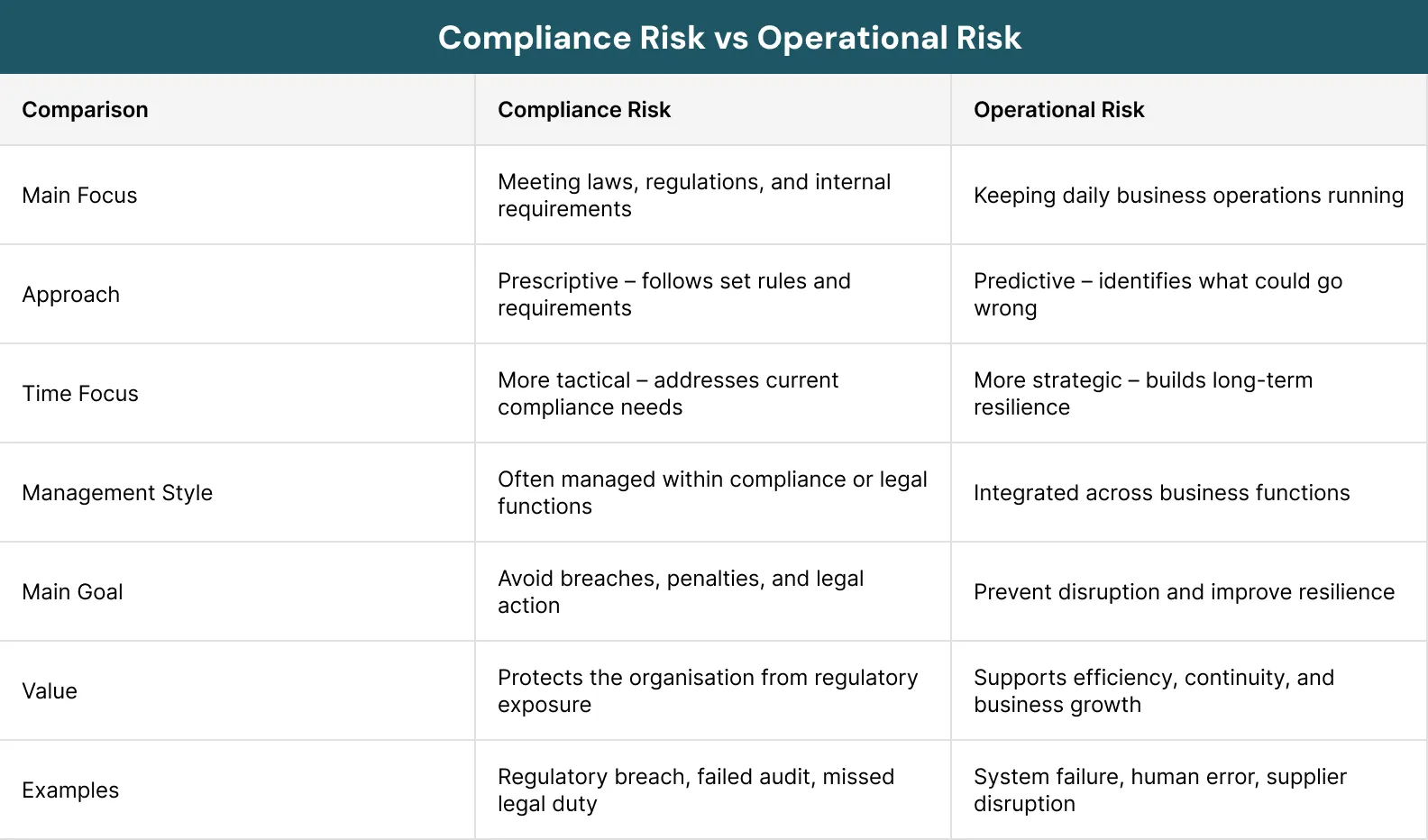
    Compliance risk focuses on following laws and regulatory rules. Operational risk focuses on keeping business work running. One asks, “Are we following the rules?” The other asks, “Can we keep work running?”

    The comparison below shows the key points.

    compliance risk vs operational risk table

    Prescriptive vs. Predictive

    Compliance risk is prescriptive. It comes from rules that organisations must follow. Laws, industry rules and company policies set clear standards. The aim is to meet these rules.

    For example, a chemical plant must train staff on safety laws. They are bound to comply. Otherwise they will face fines or court action.

    Operational risk is different. It is predictive because it looks ahead. It asks what could go wrong and how to stop it. This is a key part of operational risk management.

    For example, a manufacturer notices their equipment is getting old. It could break down and shut down production. People could get hurt too. So they replace it before that happens. Production keeps running and everyone stays safe.

    Tactical vs. Strategic

    Compliance risk management is often tactical. It focuses on following the law, passing audits, keeping records and meeting new rules.

    For example, a food company modifies its safety procedures when food rules change. This helps the company reduce compliance risk and meet its legal duties.

    Operational risk management is more strategic. It looks at how well the business works. It aims to improve daily work, prevent problems and support future growth.

    For example, the same food company may buy new quality control systems. This can reduce errors and make work faster. It also helps the company deal with operational risk before it causes a major problem.

    Siloed vs. Integrated

    In the past, teams often managed compliance risk in silos. Legal, compliance and audit teams checked new rules and reported to regulators. They often worked apart from daily operations.

    Take the example of a compliance team to understand this. The team may review documents and write reports. But it may have little contact with daily operations. This makes compliance risk harder to manage across the whole business.

    Operational risk management works best when integrated throughout the firm. Every team is important because everyone helps to find and manage risks.

    This means if a system outage happens, all teams of a corporation have to work together. Operations will stop immediately. IT will resolve the technical issue. Compliance reports the incident to regulators. Finance monitors the expense. All teams work together to get the system back up and running.

    This combined approach helps firms manage both operational risk and compliance risk.

    Thinking of operational resilience as the outcome we are seeking, and operational risk management as the means by which this is achieved gives a clear focus for investment in both.”

    Nick Strange, Bank of England

    Risk Aversion vs. Value Creation

    The main goal of compliance risk management is to avoid rule breaches. It helps firms avoid fines, legal action, money loss and damage to their reputation.

    Consider a financial institution as an example. To reduce compliance risk, it can conduct frequent financial compliance checks. This will ensure that it is in line with anti-money laundering law.

    Operational risk management aims to prevent risks and create value. It can make work faster, cut waste and improve service. It can also help a business prepare for future problems.

    For example, a shop redesigns its supply chain after spotting delivery problems. As a result, it avoids disruptions and speeds up delivery. This reduces operational risk and increases customer satisfaction.

    Strong businesses do not treat these risks as separate goals. They manage both at the same time. Compliance risk management helps them build trust and meet legal obligations. Operational risk management helps them improve work and deal with future problems.

    Why Does the Difference Between Compliance Risk and Operational Risk Matter?

    The difference between compliance risk and operational risk matters. It helps you spot problems early. It also helps you choose the right response.

    A company can either only focus on following the law and ignore the operational flaws. Or, it can improve its operations regardless of whether it meets legal standards.

    For example, a logistics company may speed up deliveries to increase efficiency. The new procedure saves delays. However, it breaches the new driving safety regulations. They improved operations but created a compliance risk. This will cause fines and legal issues.

    It can also go the opposite way. A company may have all the proper legal procedures in place. However, if employees do not understand how to follow them, work will still fall apart. On paper, they look good. But they are facing operational risk in real life.

    Knowing the difference between compliance risk vs operational risk helps you spot each one. You can then take the right steps to prevent problems. You can meet legal duties while keeping work on track. Teams can also work better together. This can cut losses, fines and work pauses.

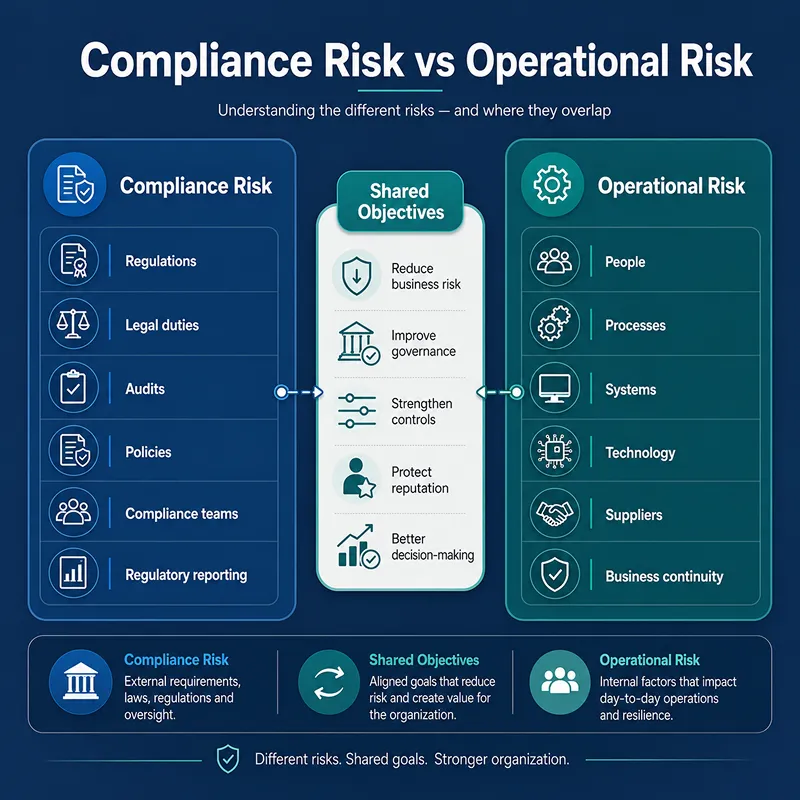
    The truth is that compliance risk and operational risk are not at odds. They work as one. Seeing their similarities and differences, you may create stronger strategies to stop them. This lets you ensure that work flows even as rules and practices change.

    compliance risk vs operational risk

    Common Pitfalls When Managing Compliance Risk vs Operational Risk and Their Solutions

    You can make mistakes even with effective risk management procedures. That is why learning to identify these common errors is essential. It allows you to avoid extra expenses, regulatory issues and operational delays.

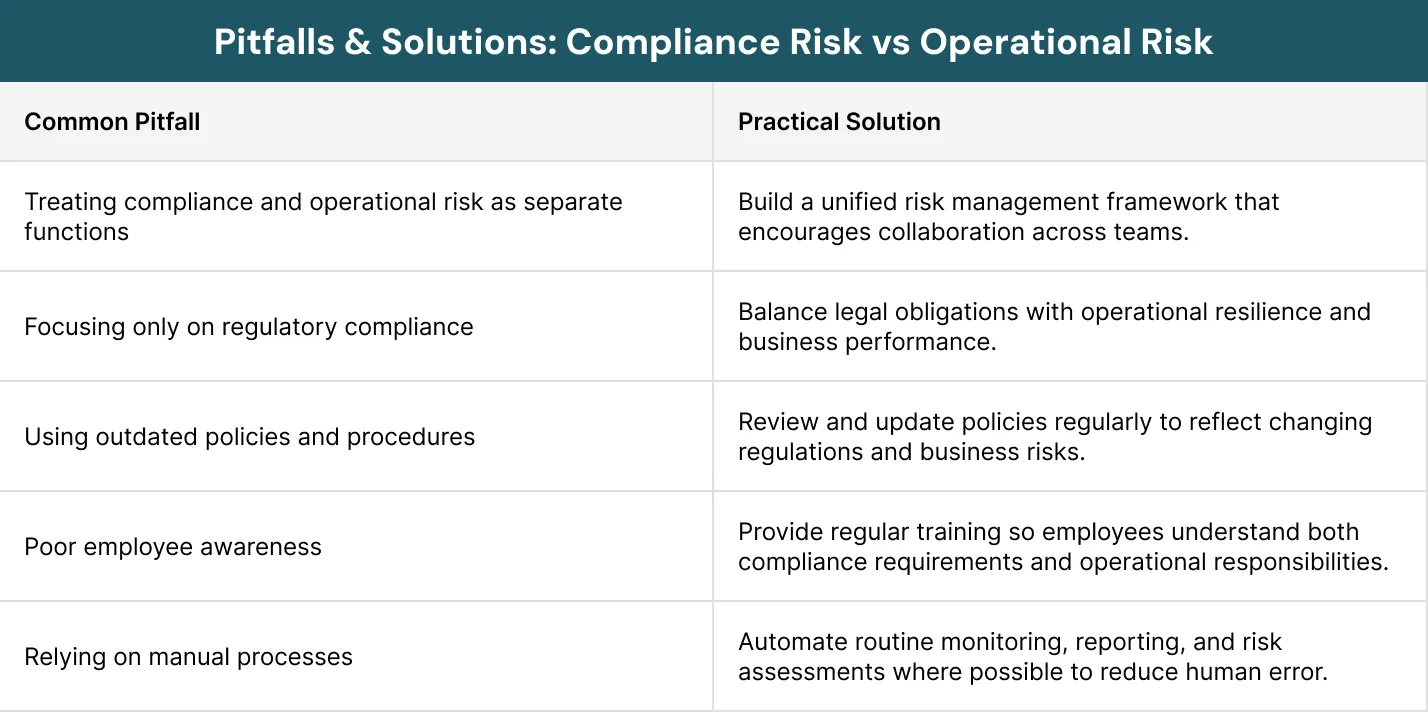
    pitfalls & solutions compliance risk vs operational risk

    The table above listed the mistakes you need to avoid when managing compliance risk vs operational risk. By doing so, your business can improve response time. This shows a shift toward proactively managing risks.

    Conclusion

    Compliance and operational risk are not alike. Compliance risk focuses on meeting legal duties. The purpose of operational risk is to avoid disruptions that harm corporate operations.

    When you know the difference between compliance risk vs operational risk, you can deal better with threats. You can take proper safeguards and build both legal and professional strength. Addressing both risks together solves your problems. As a result, your businesses reduce legal risk. They also end work breaks and make better choices.

    Good operational risk management needs regular reviews. It also needs staff training and the right tools. Good compliance risk management helps businesses follow laws and rules. Together, these steps can help your business stay strong and ready for change.

    Struggling to Manage Compliance and Operational Risks?

    Don’t wait for a compliance breach or operational failure to expose weaknesses in your business. Our experts have helped businesses identify risk gaps, improve compliance and strengthen operational resilience. Talk to Sterling Cooper Consultants today.
    +443300102526
    Book an Appointment

    FAQs


    What is the difference between compliance risk and operational risk?


    Compliance risk relates to failing to follow laws, regulations or internal requirements. Operational risk relates to failures in people, processes, systems or external events that disrupt business operations. A business can face both risks at the same time.


    Examples of compliance risk include failing to meet health and safety requirements, breaching data protection laws, missing regulatory deadlines and failing to complete required compliance checks. These issues can result in fines, legal action and reputational damage.


    Common examples of operational risk include human error, system failures, equipment breakdowns, cyber incidents and supplier disruptions. These problems can interrupt business activities, reduce productivity and cause financial losses.


    Businesses can manage compliance risk by monitoring regulatory changes, reviewing policies, training employees and carrying out regular compliance checks. Clear controls and accurate records can also help identify and address potential breaches.


    Operational risk management is the process of identifying, assessing and controlling risks that could disrupt business operations. It involves improving processes, strengthening controls, training staff and preparing for events that could affect business continuity.


    Yes. Compliance risk and operational risk can overlap when an operational failure causes a regulatory breach or when a compliance issue disrupts normal business activities. Managing both together can help businesses reduce losses, meet their legal obligations and improve resilience.

    Share This Article!

    Recent Posts

  • How to Build a Cash Reserve for Business Stability

    How to Build a Cash Reserve for Business Stability

    Posted by:

    Admin

    Date:

    August 11, 2026

    Category:

    blogs

    Error: Contact form not found.

    How to Build a Cash Reserve for Business Stability

    Have you ever wondered how many companies enter insolvency in the UK each month? In June 2026 alone, 1,845 companies were declared insolvent. This is how quickly a business can go into a financial crisis.

    Unpredictable bills, late payments or unexpected declines in sales can wipe out your budget. It’s impossible to foresee all the random costs you may encounter, but you can plan for them. You can set up cash reserves for business to avoid cash flow problems.

    In this guide, you will learn how to build cash reserves for business stability. It explains how to determine the cash reserve requirements for your company and the common mistakes to avoid. For most small businesses in the UK, maintaining a 3 to 6 months cash reserve to cover their basic operating costs is the benchmark to follow. However, the correct amount depends on your industry, cash flow and business risks.

    Key Takeaways

    • Build a cash reserve that covers 3 to 6 months of essential expenses.
    • Keep your reserve in a separate savings account.
    • Automate regular savings into your reserve.
    • Improve cash flow by reducing unnecessary spending and managing late payments.
    • Review your reserve regularly as your business grows.

    What Is a Cash Reserve Account?

    A cash reserve account is a business savings account used to save money set aside for emergencies, business stability or unexpected expenses. This reserved account works as a financial buffer and is kept separate from your regular account. It gives you the confidence to make decisions without short-term panic.

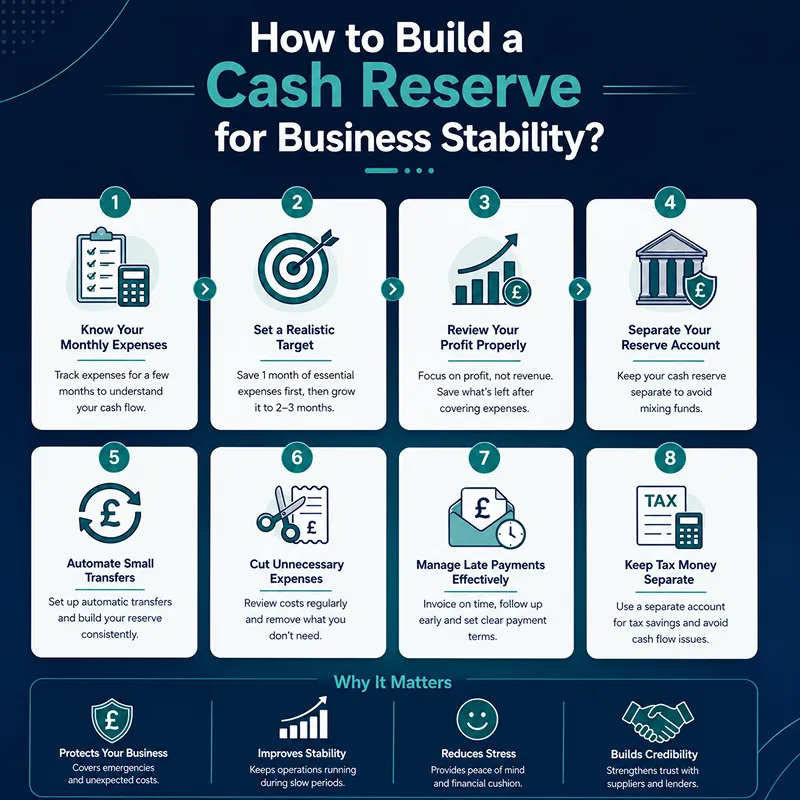
    How to Build a Cash Reserve for Business Stability?

    Here are the simple steps that you need to take in order to build a cash reserve for business stability:

    1. Record Monthly Expenses

    Record your spending for a couple of months. Where does all your money really go? After you can visualise your real cash flow in and out, you’ll have the data you need to determine how much you should save. This is the first step towards a good cash reserve.

    2. Set a Realistic Target

    Don’t try to build up a huge reserve right away. Initially, save for at least one month’s worth of necessary costs. After that, gradually increase the amount of time to two or three months and perhaps longer if you are comfortable. The crucial thing is to keep it manageable, so you don’t blow your cash flow over the board trying to save some reserves.

    3. Analyse Your Profits

    Another key factor while building a cash reserve is monitoring your profits accurately. It’s easy to get excited about “big sales numbers,” but profits are what let you save. Regularly review what’s left after you cover expenses. That’s the money you can actually put away in your reserve.

    “Revenue is vanity, profit is sanity, but cash is king.”

    — Alan Miltz

    4. Separate Your Reserve Account

    Always keep your cash reserve account separate from your regular account. This will help you avoid mixing up your funds and spending them without noticing. A separate reserve account makes sure you protect your savings and stay focused on your goal.

    5. Automate Transfers

    Make regular transfers from your regular account to the cash reserve for business accounts. Auto transfers will help to keep your reserve growing without having to monitor them from a human perspective. Always begin with a small amount that your business can easily afford. Repeated small transactions, such as a weekly or monthly transfer, add up. If you’re making more money, raise the amount and start quickly putting more into your reserve business account.

    “Do not save what is left after spending, but spend what is left after saving.”

    — Warren Buffett

    6. Reduce Unnecessary Expenses

    Make it a habit to regularly review your business expenses and identify potential cost-saving opportunities that don’t impact your day-to-day business. Subscription to tools is more expensive than it seems and it is something we hardly take a note of. Regularly check the subscriptions and cancel all unused ones.

    Additionally, renegotiate service contracts and determine the costs that have been slowly increasing over time. After you have cut your unnecessary costs, be sure to put them into your cash reserve for business accounts and NOT into other items. After a while, you will realise that even small frequent savings can help you create a greater financial cushion.

    7. Manage Late Payments Effectively

    Delayed payments often disrupt your cash flow and badly affect your cash reserve for business. To avoid this, set clear payment terms, send invoices to the customers on time and follow up before they become overdue. In addition, offer your customers convenient payment options and charge late fees when necessary to manage late payments effectively.

    8. Keep VAT and Corporation Tax Separate

    Don’t mix up your VAT or Corporation Tax funds in your cash reserve. Instead, set up a separate account to manage your taxes. Initially, this might not be a concern for you. However, as your revenue grows, setting aside money for taxes becomes increasingly important. Separate tax savings protect your cash reserve from unexpected withdrawals. It also helps you avoid cash flow problems and keeps your emergency funds available for genuine business needs.

    How to build a cash Reserve for Business Stability

    How Much Cash Should a Business Have in Reserve?

    A business must have three to six months of fundamental operating expenses in an instant-access savings account. This buffer helps you manage late payments, unexpected emergencies and gaps in your order pipeline. However, this isn’t the standard hardcore number. The right time frame varies based on the nature of your business. A well-established business with consistent demand can operate with a smaller cash reserve. However, seasonal businesses or those with unpredictable incomes should aim higher. If your revenue is unstable or clients pay late, you need a bigger buffer.

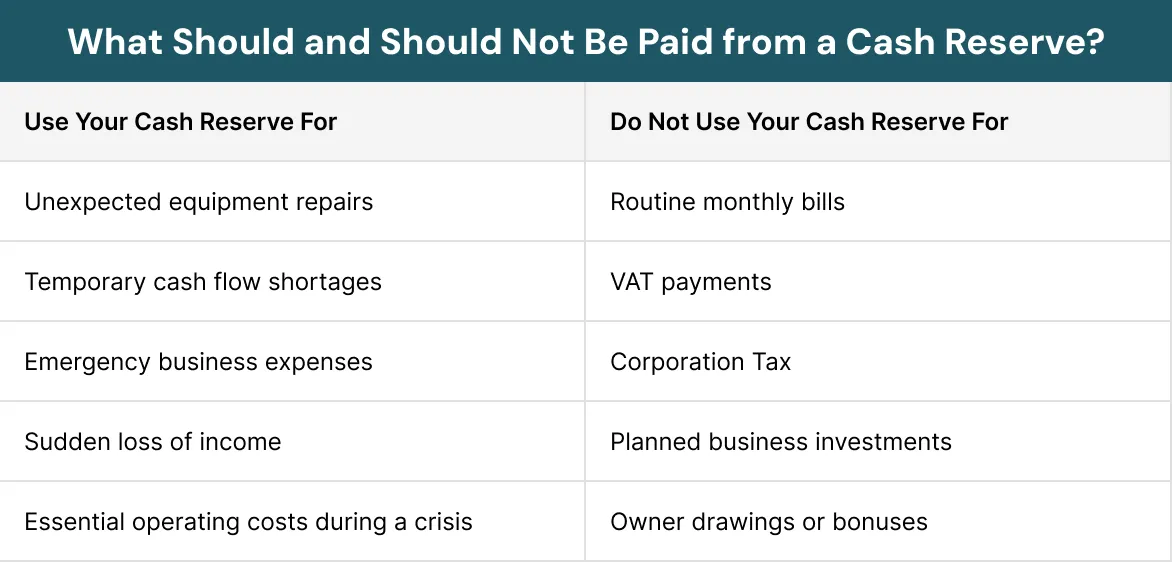
    What Should and Should Not Be Paid from a Cash Reserve

    How Do You Calculate Your Cash Reserve?

    To calculate your cash reserve, first, you need to understand your essential monthly costs, such as payroll, rent, utilities, insurance, loan repayments and subscriptions. Then, multiply your essential monthly cost by the number of months you want to cover. For example, if your essentials cost is £15,000 a month, you must target £45,000 for three months or £90,000 for six months. Here is the formula that you can use to calculate your cash reserve target:

    CashReserveTarget = EssentialMonthlyOperatingExpenses×NumberOfMonths

    Common Mistakes When Building a Cash Reserve for Business

    While creating a cash reserve for business, make sure to avoid the following common mistakes. If you overlook these mistakes, they can cause long-term financial problems.

    1. Mixing VAT or Corporation Tax with Reserves

    One of the most frequently observed mistakes is mixing up your VAT or corporation Tax with your reserve. In this case, when tax bills arrive, your reserves vanish. Therefore, it’s always recommended to use separate deposit accounts for taxes and day-to-day funds to protect the integrity of your funds.

    2. Saving Too Aggressively

    Another mistake that businesses often repeat is saving too aggressively. If you try to save too much too quickly, it can disrupt your working capital. You need to understand that consistency matters much more than the size of the initial deposits. Building your cash reserve for business accounts slowly but consistently reduces the chances of unexpected cash flow problems.

    3. Ignoring Regular Reviews

    As your business grows, your cash reserve for business targets should evolve alongside it as well. If you ignore your ongoing cash flow figures or do not update your targets, unexpected market fluctuations may affect your business badly.

    4.  Treating the Reserve as Spending Money

    If you treat your business cash reserve as spending money, you could leave your business unprepared for unexpected expenses. Remember, a cash reserve is meant to be an emergency buffer. Consider separating your funds into categories or accounts for routine operations, planned investments and emergency reserves. This helps you avoid impulse withdrawals and ensure money is available when it is needed most.

    5. Failing to Prepare for Worst-Case Scenarios

    Always be prepared for worst-case scenarios to manage extended disruptions. You must prepare a three to six-month cash reserve for essential expenses to ensure business stability.

    “Prepare for the worst; expect the best.”

    — Benjamin Disraeli

    How a Cash Reserve Improves Stability: Case Study

    John Lewis Partnership, a well-known UK retailer, planned to get a precise view of its financial strength during uncertain times. So, they carefully examined their cash flow and ran through a series of potential stress scenarios. This includes everything from sharp drops in sales to unexpected expenses. After analysing the data, they decided to keep £100 million set aside as a permanent reserve, just in case circumstances changed. They made sure this reserve was kept separate from the money they used for daily operations or long-term projects, so nothing got mixed up.

    This simple move made John Lewis more resilient. They had cash ready for emergencies, but they didn’t let extra money sit around doing nothing. The takeaway? Set cash reserves for business based on the real risks your business faces, not just arbitrary numbers.

    Did You Know?
    A cash reserve is not an investment fund. It should remain easily accessible so you can use it immediately during emergencies, unexpected expenses or temporary cash flow shortages without disrupting your business.

    Conclusion

    Building a cash reserve for business stability helps your business stay financially stable during unexpected expenses and temporary cash flow disruptions. You can start with a small but consistent amount. Also, make sure to monitor your cash flow regularly and adjust your savings as your business evolves. If you are unsure how much you should reserve, Sterling Cooper Consultants can help you improve your financial stability through expert cash flow and budget planning.

    Need expert financial guidance?

    Sterling Cooper Consultants provides professional Financial Advisory services to help your business make informed financial decisions and achieve long term stability.

    FAQs


    What is a cash reserve account?


    A cash reserve account is a separate business savings account used to set aside money for emergencies, unexpected expenses or temporary cash flow shortages. It helps businesses stay financially stable during difficult periods.


    Yes. A cash reserve and a cash buffer both refer to money set aside to protect a business from unexpected expenses, reduced income or temporary cash flow problems.


    Most financial experts recommend keeping at least 2 to 3 months of fixed business expenses in cash reserves. Businesses with seasonal or unpredictable income should aim for 3 to 6 months of expenses.


    Yes. Many business savings accounts and cash reserve accounts earn interest while keeping your funds accessible when needed. This allows your reserve to grow while remaining available for emergencies.


    Without cash reserves, unexpected expenses or delayed customer payments can quickly create cash flow problems. This may force a business to borrow money, delay payments or reduce essential business spending.

    Share This Article!

    Recent Posts

  • How to Forecast Cash Flow During Economic Uncertainty

    How to Forecast Cash Flow During Economic Uncertainty

    cash flow forecast

    Posted by:

    Admin

    Date:

    August 6, 2026

    Category:

    blogs

    Error: Contact form not found.

    How to Forecast Cash Flow During Economic Uncertainty

    Economic uncertainty can make it difficult for your business to plan ahead. Changes in customer demand, rising costs and market shifts can affect how much money comes in and goes out.  Research shows that 82% of UK SMEs have experienced cash flow problems. During these times, having a reliable cash flow forecast becomes more important for you than ever.

    A cash flow forecast helps you estimate future income and expenses. It gives you a clearer picture of your financial position and helps you make better decisions. Instead of reacting to problems after they happen, you can prepare for them in advance.

    With proper cash flow forecasting, you can identify the risks early, protect your cash reserves and maintain the stability of your business.

    “Forecasting is not about predicting the future perfectly. It is about reducing uncertainty.”

    — Peter Drucker 

    Key Takeaways

    • A cash flow forecast helps you estimate future income and expenses, allowing you to plan ahead and make informed financial decisions during uncertain economic conditions.
    • Understanding economic uncertainty and monitoring changes in customer demand, costs and market trends can help you identify risks before they affect your business.
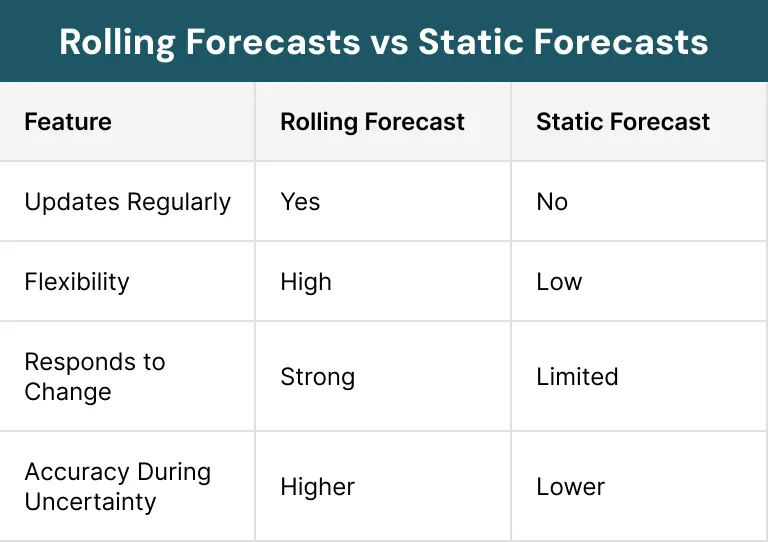
    • Regular cash flow forecasting, along with tools like rolling forecasts, scenario planning and stress testing, improves the accuracy of your financial planning.
    • Managing cash wisely by building a financial buffer, improving receivables and payables and creating multiple income sources can strengthen your business during challenging times.
    • Reviewing your cash flow forecast regularly helps you manage liquidity, plan major investments and prepare for unexpected financial challenges.

    What is Economic Uncertainty?

    Economic uncertainty happens when it becomes difficult for your business to predict what might happen in the economy in the future. During these periods, you may not know whether your sales will increase or decrease, costs will rise or customer demand will change.

    Did You Know?
    Businesses that regularly update their cash flow forecast are often better prepared to handle sudden economic changes than businesses that rely only on annual budgets.

    Why Cash Flow Matters During Economic Uncertainty?

    Cash flow matters during the economic uncertainty because it gives your business the money it needs to keep running every day. It helps you to pay costs such as staff wages, rent, supplier bills and other regular expenses, even if your income drops for a while. Good cash flow also helps your business to deal with unexpected issues. If customers pay late or sales become slower, you will still have money to cover the costs.

    “Cash is a business’s lifeblood.”

    — Richard Branson

    Pro Tip:
    Review your cash flow forecast every month. During uncertain economic periods, weekly reviews may provide even greater visibility.

    How to Forecast Cash Flow During Economic Uncertainty?

    To forecast cash flow during economic uncertainty, estimate your expected income and expenses over a specific period. It is not complicated when broken into simple steps. The goal is to estimate how much money will enter and leave your business over a specific period.

    A reliable cash flow forecast should include expected income, expected expenses and also the final balance. These details allow you to identify the cash shortages.

    The more frequently you update your cash flow forecast, the more useful it becomes. The following steps explain how to prepare a reliable cash flow forecast.

    1. Cash Flow Planning

    The time frame for your cash flow forecast may be a few weeks, a few months or even a year. It really depends on how far ahead you feel you can plan with confidence. If your business has been operating for a while, you can more accurately predict your future sales. If you are starting a new business, you might not have much data and things are more likely to change in the long term.

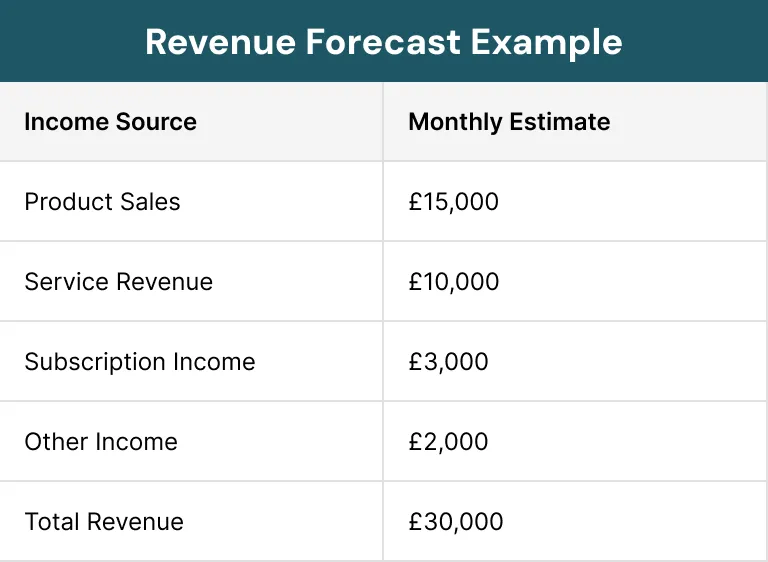
    2. Revenue – Money Coming In

    Revenue includes all money expected to enter your business. This may come from product sales, service contracts or other income sources. Past performance can provide you with useful guidance when you are estimating future income. You should remain realistic when you are estimating income.

    3. Expenses – Money Going Out

    It represents all outgoing payments. These include salaries, rent, utilities, supplier invoices, marketing costs and taxes. When you are preparing a cash flow forecast, it is important for you to include both fixed and variable costs. Fixed costs remain consistent, while variable costs may change based on the activity of your business.

    Common business expenses include the following:

    • Employee wages
    • Rent and utilities
    • Inventory purchases
    • Marketing expenses
    • Insurance costs

    4. Net Cash Flow – The Balance

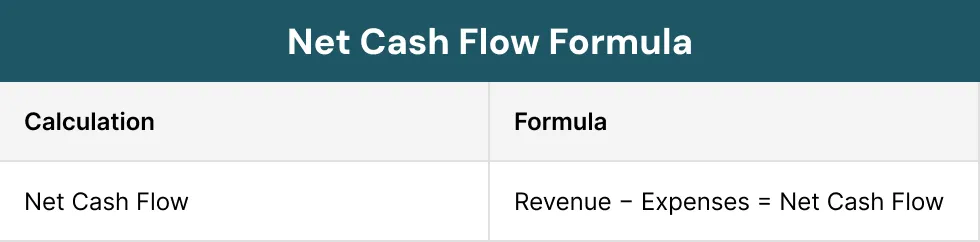
    Net cash flow is calculated by subtracting total expenses from total revenue. This figure shows whether your business is generating profit or facing loss. A positive result means more money is coming in than going out. A negative result suggests that right action may be needed to maintain the liquidity.

    Your cash flow forecast should clearly show the projected balances for each month. This helps you identify the periods where cost controls may be required.

    Net Cash Flow Formula

    5. Update Your Forecast Regularly

    During economic uncertainty, things can change quickly. Your sales may go down, customers may pay late or business costs may rise. By updating your forecast you can see these changes early and make better decisions.

    Review your cash flow forecast every week or every month. Compare it with the money that actually came in and went out. If there are any differences, update your figures so your forecast stays accurate. This gives you a clear picture of your business finances.

    Cash Flow Forecasting Strategies During Economic Uncertainty

    You can improve the accuracy of cash flow forecasting by using different forecasting methods. These techniques help you prepare for multiple outcomes instead of relying on a single prediction.

    Some methods are given below:

    1. Rolling Forecasts vs Static Forecasts

    A static forecast remains unchanged after it is created. It covers a fixed period, such as a year. While it is useful for budgeting, it may quickly become outdated. A rolling forecast is updated regularly. New details are added as economic conditions change. This makes it more flexible and responsive.

    Many businesses prefer rolling forecasts because they provide a more realistic view of future cash flow. You can combine the rolling forecasts with a detailed cash flow forecast to improve the decision-making process.

    Rolling Forecasts vs Static Forecasts

    2. Scenario Planning and Sensitivity Analysis

    Scenario planning helps you prepare for different possible outcomes. For example, management may create best-case, expected-case and worst-case scenarios. While sensitivity analysis shows how changes in key factors, such as sales or costs, affect your cash flow forecast.

    These techniques improve cash flow forecasting by helping you understand the potential risks before they occur.

    Did You Know?
    Many successful companies prepare at least three forecast scenarios to improve resilience during uncertain market conditions.

    3. Stress Testing

    ‘Stress testing’ means how your business would perform under difficult conditions. Examples include sudden revenue declines, major customer losses or cost increases. Stress testing helps you highlight those areas where financial protection may be needed. A strong cash flow forecast becomes even more valuable when combined with stress testing.

    Example: Cash Flow Forecast

    A small manufacturing company started receiving fewer orders during a difficult economic period. The business owners became worried that he might not have enough cash to cover daily expenses. To understand their financial position, they prepared a cash flow forecast for the next 12 months. The cash flow forecast showed that the company could run short of cash within four months. Because they spotted the problem early, they collected customer payments faster and also negotiated better payment terms with the suppliers. As a result, the business kept a healthy cash balance and avoided financial problems.

    This example shows how cash flow forecasting can help you prepare for challenges before they happen.

    Conclusion

    Economic uncertainty can make it harder to run a business. Sales may go up or down, costs can increase and unexpected changes can affect your finances. A well-prepared cash flow forecast helps you to understand how much money your business is likely to have in the future. It helps you to plan ahead, manage your spending and make better financial decisions.

    The more often you review and update your cash flow forecast, the better prepared your business will be for unexpected challenges. Good planning can help you stay financially stable, even during an uncertain economic time.

    At Sterling Cooper, our experts help you to create accurate cash flow forecasts, so you can make confident financial decisions.

    Want to improve your cash flow forecasting and prepare for economic uncertainty?

    Contact us today for expert guidance tailored to your business needs. Our experienced team will help you build accurate forecasts, strengthen your cash flow management and make confident financial decisions for long-term success.

    FAQs


    What is a cash flow forecast?


    A cash flow forecast is a financial tool that estimates future cash coming into and leaving a business. It helps businesses to plan ahead and avoid cash shortages.


    Cash flow forecasting helps businesses anticipate potential financial challenges. It allows management to make informed decisions before problems arise.


    To do a cash flow forecast, estimate your expected income and expenses over a set period to see how much cash your business is likely to have.


    Many businesses update their cash flow forecast monthly. During periods of uncertainty, weekly updates may provide better visibility.


    A cash flow forecast typically includes projected sales, customer payments, operating expenses, loan repayments, taxes and planned investments.

    Share This Article!

    Recent Posts

  • How AI Is Changing Bookkeeping for Small Businesses

    How AI Is Changing Bookkeeping for Small Businesses

    How AI Is Changing Bookkeeping for Small Businesses in 2026

    Posted by:

    Admin

    Date:

    August 5, 2026

    Category:

    blogs

    Error: Contact form not found.

    How AI Is Changing Bookkeeping for Small Businesses

    What if your bookkeeping took less time and required less effort, but maintained accuracy? This is no longer a dream, but a reality with AI.

    Many small businesses still spend hours entering data, tracking expenses and checking bank records. These repetitive tasks increase costs and reduce the time available to grow your business. By using AI bookkeeping bots, this automates your task and you can focus more on growing your business. That is why there is a rise in the use of AI bookkeeping. 

    According to research, 78% of small firms make use of AI for bookkeeping. AI can perform routine bookkeeping tasks easily and save time and cost for your business. It can also help keep the financial records up to date and correct. Small businesses are starting to learn how AI is changing bookkeeping for them and improving their business operations.

    In this guide, you will learn how AI is changing bookkeeping for small businesses, the tasks it can automate, its benefits and limitations.

    Key Takeaways

    • AI bookkeeping automates routine tasks such as data entry and expense tracking.
    • AI bookkeeping bots can help with bank reconciliation, invoicing and reporting.
    • Many AI bookkeeping tools offer free plans for small businesses.
    • AI bookkeeping UK adoption is growing as businesses look for faster and more accurate financial management.
    • AI supports bookkeepers by reducing manual work rather than replacing them.

    What Is AI Bookkeeping?

    AI bookkeeping involves the use of smart tools to help with bookkeeping. The system can read receipts, sort expenses and match bank records to maintain accurate financial records. This reduces the need for manual work.

    AI bookkeeping for small businesses can be seen as a digital bookkeeping helper that takes care of all your everyday financial tasks. It helps keep financial data organised, updated and ready to use. This saves time by automating bookkeeping and saves costs of labour and prevents penalties. AI makes bookkeeping simpler and more effective for you. Paul Roetzer talks about the emerging role of AI in accounting:

    ‘AI will not replace accountants, but accountants who use AI will replace those who do not.’

    Paul Roetzer

    Did You Know?
    AI bookkeeping tools can process receipts, sort transactions and update records in seconds. This helps small businesses spend less time on admin work.

    How Is AI Changing Bookkeeping for Small Businesses?

    AI bookkeeping has become an essential component for small businesses in the UK. It makes it easy for you to handle your daily bookkeeping tasks in an efficient way. It results in various bookkeeping advantages in terms of cost, time and efficiency. There are some tools where AI bookkeeping is free to some extent.

    Below are some ways in which AI can improve everyday bookkeeping tasks:

    1. Matching Bank Records

    AI can automatically match the payments in a bank account with the invoice and other related records. This reduces the time spent checking the bank records. This helps spot missing or incorrect data more easily and quickly.

    Best AI Tool

    Booke AI is an excellent option. The AI system automatically reads receipts, extracts line items and matches them to your bank feed transactions for effortless reconciliation.

    2. Expense Tracking

    AI has made it easy for users to track their expenses. Users just have to upload a receipt and the tool is able to read all the information from it. This helps keep expense records accurate and up to date.

    Best AI Tool

    Dext Prepare (formerly Receipt Bank) is the industry standard. Its AI uses Optical Character Recognition (OCR) to extract VAT, suppliers and dates from photos or PDFs, pushing perfectly categorized data straight to your ledger.

    3. Invoicing and Cash Flow

    AI can be used to prepare invoices automatically and remind people about pending and future payments. This way, you can make timely payments and also have an overview of the cash flow.

    Best AI Tool

    JAX is a newer AI assistant built specifically to work with Xero. It automates bookkeeping and keeps your records completely Making Tax Digital (MTD) compliant for HMRC.

    4. Anomaly Detection

    AI bookkeeping bots can find anomalies within your financial data in no time. It can spot duplicate payments, unexpected costs or even missing data.

    Best AI Tool

    NetSuite is excellent for UK SMEs. It features built-in AI and a financial assurance agent that continuously compares live entries against historical patterns to flag unusual outgoings or journal entries.

    5. Financial Reporting and Forecasting

    AI can create financial reports in seconds. It shows key data such as revenue, expenses and cash flow. It can also assess business trends and forecast future income and costs. This helps business owners make better decisions and plan ahead easily.

    Best AI Tool

    For built-in AI forecasting and HMRC Making Tax Digital (MTD) compliance, Xero Analytics Plus is the top choice. For deep, Excel-based financial reporting, Datarails offers superior AI-driven predictive modeling and scenario planning.

    6. Integrated Workflows

    AI tools seamlessly connect payment processors (like Stripe or PayPal) directly to popular accounting software such as QuickBooks or Xero.

    Best AI Tool

    Zapier is best for practices or high-volume businesses. It serves as a dedicated AI automation layer that codes complex transactions and connects across Xero, Sage and QuickBooks.

    Quick Tip
    Start with a free AI bookkeeping tool before investing in a paid plan. This helps you understand which features your business needs most.

    Too Much Data vs Useful Data

    Actual Growth with AI: Case Study

    Armstrong Watson, a UK accounting firm, worked with more than 2,000 bookkeeping clients. Every year, the firm received over 30,000 pages of bank statements, invoices and receipts. Staff spent many hours entering this data manually. This made bookkeeping slow and took time away from client work.

    To solve this problem, the firm started using AI bookkeeping software to automate data entry. The Ai tool scanned and captured information from invoices, receipts and bank statements. It also stored documents online, making them easier to access and manage.

    The results were impressive. Armstrong Watson increased bookkeeping productivity by almost 90%. Staff spent less time on manual data entry and more time helping clients. The AI tool also improved accuracy by reducing human errors. This shows how bookkeeping via AI can save time, reduce labour, maintain accurate records and help businesses work more efficiently.

    Conclusion

    AI bookkeeping is making things easier for small businesses. It helps them save time, avoid mistakes and automates bookkeeping for them. Moreover, it provides the owner with clear insight into their financial status.

    At Sterling Cooper, we help businesses keep their bookkeeping correct and updated. If you are facing any difficulties with your bookkeeping, reach out to us today. We can help you keep your financial matters organised.

    Ready to spend less time on bookkeeping?

    Explore AI bookkeeping tools that can automate routine tasks and improve accuracy. Reach out to us and we will give you a clearer view of your business finances.
    +443300102526
    Book an Appointment

    FAQs


    What is AI bookkeeping in the UK?


    AI bookkeeping uses smart software to handle bookkeeping tasks. It can sort expenses, read receipts, match transactions and create reports automatically.


    AI reduces manual work by automating routine tasks. This allows business owners to spend more time on running and growing their business.


    Yes. Some platforms offer free plans with basic bookkeeping features. These tools can be a good starting point for freelancers and small businesses.


    More UK businesses are using AI bookkeeping tools to save time, improve accuracy and manage financial records more efficiently. Many tools also help with tax and compliance tasks.


    No. While AI can automate routine bookkeeping work, businesses still need bookkeepers to review records, provide advice and handle complex financial decisions.

    Share This Article!

    Recent Posts

  • Audit Exemption UK: Rules Explained for Companies

    Audit Exemption UK: Rules Explained for Companies

    audit exemption uk

    Posted by:

    Admin

    Date:

    August 4, 2026

    Category:

    blogs

    Error: Contact form not found.

    VAudit Exemption UK: Rules Explained for Companies

    Research shows that audit exemption saves small businesses an average of 1,000 to 5000 pounds in 2015. This cost saving helps small business owners to invest more in growth. If you are running a small business in the UK, then understanding the audit exemption UK rules is very important for you. It helps you to know when your company needs an audit and when it does not. Many owners miss this and end up spending extra time and money.

    The rules of audit exemption in the UK are designed mainly for small and medium size companies. They allow eligible businesses to avoid full audits. This makes financial reporting simpler and also less costly. In this guide, we will explain everything in simple words. You will learn who qualifies, who does not and how the system works under audit exemption in the UK rules.

    Key Takeaways

    • Meet the two-of-three test: A company qualifies as small if it meets at least two of these conditions: turnover up to £15 million, balance sheet total up to £7.5 million and 50 or fewer employees.
    • New thresholds from April 2025: The turnover and balance sheet limits increased on 6 April 2025, while the employee limit remained unchanged at 50.
    • Two-year qualification rule: Companies must meet the small company criteria for both the current and previous financial year, although transitional rules apply for accounting periods starting on or after 6 April 2025.
    • Exemptions depend on company structure: Audit exemption may also apply to dormant companies, qualifying subsidiaries and some small groups, but group size and regulated entities can affect eligibility.
    • Not all small companies are exempt: An audit may still be required if shareholders request one, company rules or agreements require it or if the business is a public company, bank, insurer or another ineligible entity.

    What is Audit Exemption for UK Companies?

    Audit exemption in the UK is the relief from audit for small businesses under certain criteria. It helps you to focus more on the growth of a business instead of heavy compliance tasks.

    Many audit exempt companies in the UK benefit from this system. They still prepare the accounts but do not need a full audit review. Overall, audit exemption in the UK helps to make financial reporting easier and more practical for small firms.

    What Are the Audit Exemption Rules for UK Companies?

    If you want to qualify under audit exemption in the UK, you must meet the established criteria and conditions. These include turnover, assets and staff limits. Many audit exempt companies qualify by staying below these thresholds. If you cross any two of these three limits for two consecutive years, then you lose the rights of the exemption.

    The Three Criteria for Audit Exemption

    SMEs in the UK have to meet certain criteria to qualify for audit exemption. These three criteria are designed to ensure that actual small businesses get the relief for which audit exemption is designed. The three criteria are as follows:

    Annual Turnover: Gross income of your company from all business activities must not exceed £15 million.

    Assets: The value of gross assets of your company must be more than £7.5 million.

    Employee: Your business must employ 50 people or fewer on average throughout the year.

    Audit Exemption Thresholds

    The “Two-Year” Rule

    The two-year rule means a company must exceed the size limits for two years in a row before it loses its audit exemption.

    For a new company, the audit exemption applies in its first financial year if it meets the qualifying conditions. For an existing company, going over the size limits once does not automatically remove the exemption. The company normally loses its small company status only if it exceeds the limits for two consecutive financial years. This gives the business extra time to prepare for the changes and plan for the cost and process of a statutory audit.

    “Qualifying for an audit exemption does not reduce a director’s responsibility for preparing accurate financial statements. Companies must still maintain proper accounting records and comply fully with the Companies Act.”

    — Michael Izza CBE, Former Chief Executive, ICAEW

    Who Is Exempt from Audit in the UK?

    Under the rules of audit exemption in the UK, a selected few companies are exempt from audit. These include small, dormant and some group companies.

    Most audit exempt companies fall under the size-based rules. If they stay within financial limits, they qualify automatically. This helps to reduce the pressure on small business owners.

    The following audit exemption criteria are operational in the UK for different companies.

    1. Audit Exemption for Dormant Companies

    Dormant companies are usually businesses that are inactive or do not trade. Under audit exemption in the UK rules, they often qualify for exemption. These audit exempt companies have little or do not have any financial activity. This makes audits unnecessary for them.

    As long as they remain dormant, they can continue to enjoy the exemption.

    2. Audit Exemption for Individual Small Companies

    Small companies are most likely to get audit exemption under the UK rules. They qualify if they meet the limits of employee size, turnover and balance sheet. You are deemed as a small company if you meet at least two of the three criteria stated above.

    All audit exempt companies fall into this category because of their low turnover and size. This helps you to reduce the costs related to compliance.

    3. Audit Exemption for Small Members of a Small Group of Companies

    Group companies also benefit from audit exemption in the UK rules. This applies when the entire group is small. Some audit exempt companies operate within larger structures but they still qualify because they follow staff limits.

    Did you know?
    Group size plays an important role in eligibility.

    4. Audit Exemption for Subsidiary Companies

    Subsidiary companies may qualify under the UK rules of audit exemption if they are supported by a guarantee of a parent company. Many audit exempt companies use this rule in corporate groups. This helps them to reduce the duplication of audits within the same group.

    Why Some Businesses Are Not Eligible for Audit Exemption?

    Businesses are ineligible for audit exemptions if they operate in high-risk, regulated sectors (like banking or insurance), exceed size thresholds or fail to meet governance requirements.

    The following businesses are ineligible for audit exemption:

    • A public limited company, unless it is dormant
    • A subsidiary company, unless it meets the specific exemption rules
    • An authorised insurance company or involved in insurance market activities
    • A banking services company
    • An electronic money (e-money) issuer
    • A MiFID investment firm (regulated investment business)
    • A UCITS management company (fund management business)
    • A company that has exceeded the audit exemption thresholds set by law
    • A company with shares traded on a regulated stock market
    • A pension scheme trustee, especially master trust pension schemes
    • A special register body (regulated or listed organisations)

    Have the Audit Exemption Thresholds Increased?

    The rules of audit exemption in the UK have been updated over time. These changes affect the eligibility for old and new companies alike. More companies now qualify for the exemption due to higher limits. This supports the growth for small businesses.

    Case Study: Audit Exemption in the UK

    A UK based company, SwiftTech Solutions Ltd was expanding its client base and handling more contracts each year. Even though the company was still classed as small, it continued to undergo an annual statutory audit.

    This caused a few challenges:

    • Audit fees were becoming a financial burden
    • The audit process slowed down the year-end reporting
    • Staff had to spend extra time to preparing documents for auditors

    Solution

    The company reviewed the UK audit exemption rules under the Companies Act 2006. After they reviewed the rules, they found that:

    • It was a private limited company, not publicly listed.
    • It was not part of a regulated financial sector.
    • It met the small company criteria for turnover, assets and staff numbers.

    After evaluating the criteria, the company learned about its eligibility for audit exemption. ‘

    Result

    After switching to audit exemption:

    • Year-end accounts were prepared more quickly.
    • Internal teams focused more on client projects instead of audit work.
    • The business improved its overall financial efficiency.

    Conclusion

    Understanding the audit exemption in the UK rules can help you save both time and money. If your company meets the eligibility criteria, you may not need to go through a full statutory audit each year. This helps to reduce admin work and allow you to focus more on business growth.

    However, it is important to check the latest thresholds and make sure your company still qualifies for the exemption. By understanding the rules, you can stay compliant while making the most of the benefits that audit exemption offers.

    At Sterling Cooper, our experts review the eligibility of your company and guide you throughout the process of audit exemption.

    Not sure if your company qualifies for audit exemption?

    Contact us today and let our experts assess your eligibility and guide you through the process.

    FAQs


    What are the audit exemption thresholds for small companies?


    A company can usually claim audit exemption if it meets at least two of these three conditions: annual turnover of up to £15 million, a balance sheet total of up to £7.5 million, and an average of 50 or fewer employees.


    In most cases, no. A company must normally meet the qualifying conditions for both the current and the previous financial year, although transitional rules apply for accounting periods beginning on or after 6 April 2025.


    Yes. A company may still need an audit if its articles of association, shareholder agreements, or lender requirements demand one, or if shareholders holding at least 10% of the shares request an audit.


    Yes, many small companies in the UK are exempt from a statutory audit if they meet the legal eligibility criteria. Generally, a company must satisfy at least two of the three small company thresholds and comply with the relevant audit exemption rules


    Yes, some subsidiaries can qualify for audit exemption if they meet the relevant legal requirements, such as being covered by a qualifying parent company guarantee under the applicable UK regulations.

    Share This Article!

    Recent Posts