Blog

  • Driving Innovation and Long Term Growth Through Research and Development

    Driving Innovation and Long Term Growth Through Research and Development

    R&D Driving Innovation and LongTerm Growth

    Posted by:

    Admin

    Date:

    March 16, 2026

    Category:

    blogs

    Error: Contact form not found.

    Driving Innovation and Long Term Growth Through Research and Development

    Innovation is not luck or magic. It is the end result of organised work. It comes from research, testing, learning, improving and trying again. Research and development in business refers to the systematic work used to test and make new ideas or products.

    R&D turns companies’ doubts into progress. It helps companies create better products, services and methods. R&D focuses on:

    • Supports long-term progress.
    • Helps businesses stay ahead of others.
    • Reduces possible damage to business.
    • Provides financial support through research and development tax credit.

    A large number of businesses are spending money to earn more from new ideas, products and tools. The UK’s R&D budget was £55.6 billion in 2024.

    This blog will cover:

    • Definition of R&D.
    • The key features and main types of research and development.
    • Importance of research and development for long term business growth.
    • Steps involved in the R&D process with real world examples.
    • Common challenges and success factors in research and development.
    • R&D tax credits and government incentives support innovation.
    • Reduction in business risk and support for future expansion through research and development.

    What Is R&D?

    Research and development (R&D) is an efficient way through which companies introduce new products and services to the market. It also includes improving processes along with products and services within the company. 

    Companies make an effort to bring doubts into business development through R&D. Research and development is done through study and testing to achieve solutions and scientific progress.

    R&D consists of two main parts:

    1. Research

    Research is the finding of new knowledge and increasing the current technical or scientific understanding. It answers your questions like:

    • How does it work?
    • Why does it happen?
    • Can this be possible?

    Research includes the studying of new materials, procedures, equipment and methods.

    2. Development

    The real solution to the research results is called development. It is the step where ideas are turned into real results, like:

    • Minimum viable products (MVPs).
    • Early product models.
    • Tests to check if an idea will work.
    • New digital tools.
    • Better ways of working.

    R&D fills the gap between theory and real solutions. It helps the businesses to work on the idea and turn it into earnings.

    The Role of R&D in Science or Tech

    Science is the organised study of the physical and natural world through observation and trying ideas. Whereas the actual results of this knowledge are called technology.

    Did You Know?

    From 1 April 2023, mathematical advances can also be treated as science, even if they are not directly related to the physical universe. This is an important update because it expands what qualifies as scientific work.

    The focus of R&D must be on improving the areas related to science or technology. The updates must be recognised as seen by an expert in that field.

    The changes in scientific or technical approach in such a way that they are clearly better than before are called a noticeable update. The regular improvements or minor changes are not included in this.

    The progress in this field must be helpful to the overall industry. 

    What Are Scientific or Technological Doubts?

    A project qualifies for the research and development tax credit if it tries to fix scientific or technological doubts.

    Doubts exist when:

    • An expert is not sure if something can be done.
    • An expert does not know how to do it, even after checking all the available information.

    This means the solution must not already be known. The work must involve trying ideas and problem solving.

    Businesses must explain:

    • What was the issue?
    • What did they do to try to solve it?
    • What worked and what didn’t?
    • Why was the solution not easy to find?

    The Basic Features of Real Research and Development

    The Frascati Manual gives you the five important elements of real R&D, which are:

    1. Progress

    It involves creating something new or much better products, services or processes.

    1. Doubts

    It refers to solving problems that do not have clear answers.

    1. Trials

    Tests ideas, checks results and improves them based on the results.

    1. Expert involvement

    The work is done by skilled and capable professionals.

    1. Proofs

    It involves keeping records and showing results.

    R&D aims to solve technical problems. The problem is not technical if it relates to regular updates or testing.

    Types of Research and Development

    R&D activities fall into three main types:

    1. Basic Research

    Basic research aims to grow knowledge. It focuses on understanding main ideas. For example, studying the properties of a new material.

    2. Applied Research

    Applied research uses knowledge to solve clear technical problems. For example, improving battery performance.

    3. Real Development

    This applies test results to get return on samples, products or methods.

    These stages show the full roadmap from discovery to delivery.

    Why Research and Development Is Important for Long Term Growth

    R&D does not usually create immediate earnings. Instead, it builds long term expertise and long term success.

    The table below shows why businesses spend money on R&D:
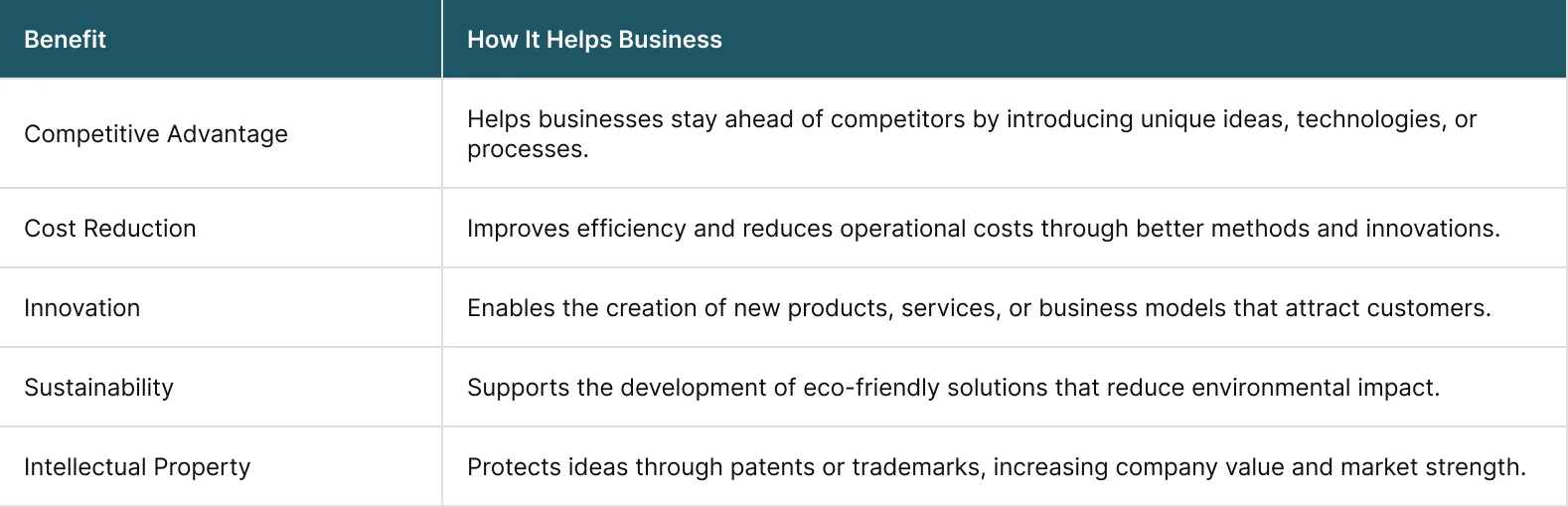
    Why Research and Development Is Important for Long Term Growth

    R&D often leads to ownership claims, trademarks and copyrights. These protect new ideas and create an improved market strength.

    Quick Insight

    Global businesses spend trillions on research and development and it reached $2.3 trillion in 2019.

    High tech, media, network services, pharmaceutical and industrial areas were among the key parts who invested money. This shows how important invention is for modern economies.

    The R&D Steps in Business

    R&D follows organised steps. This organised approach separates it from routine business improvement.

    The typical R&D steps includes:

    1. Identify a Problem or Goal

    It defines a real problem you want to solve.

    1. Research Existing Knowledge

    Study reports, patents and earlier work to understand what has already been done.

    1. Plan an Experiment

    Decide what you want to test or find out.

    1. Design Experiments or Models

    Using trial runs, samples or basic test products (MVPs) to explore solutions.

    1. Test and Check

    Test and check by collecting data and checking the results.

    1. Apply Results

    Use successful results in real products or procedures.

    This cycle repeats until a real solution is found.

    What Is R&D Life Cycle?

    The R&D life cycle includes five business stages:

    1. Creating the Idea

    Coming up with the first thought or method.

    1. Building the Design

    It means making models and solving specialised problems.

    1. Testing and Improving

    Improving the sample by using trial and error.

    1. Increasing Production

    Make more products or extend services.

    1. Selling and Making Income

    Bring the product or service to the market.

    Not all R&D succeeds. Some projects fail. But even failures create learning and knowledge.

    Real World Examples of Research and Development

    Research and development takes place in many industries. Businesses use R&D to improve products, solve technical challenges and create modern solutions. Examples can be seen in the table below:
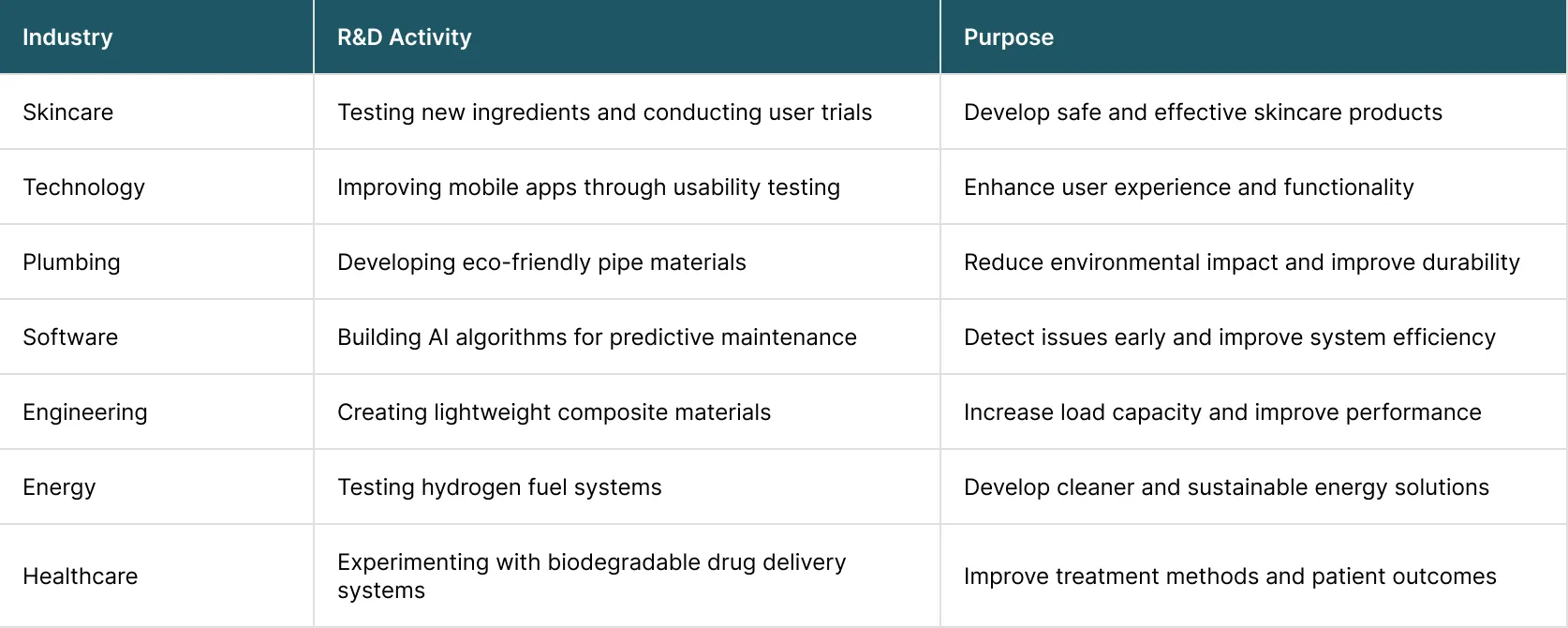
    Real World Examples of Research and Development

    The above examples show that R&D is not only for large companies. Small businesses can also create new products.

    Comparing R&D Success

    Businesses need to see whether their R&D activities are successful. R&D success can be checked in two main ways, which are:

    Quantitative Checks

    These are results that can be checked using numbers or data.

    Qualitative Checks

    These results are harder to check but are still very important.

    R&D success is not only about income or return. Even when a project does not succeed in the market, it can still provide valuable knowledge that supports future new ideas and business growth.

    Paying for Research and Development

    R&D is expensive and sometimes it is difficult to invest into it. Companies can use the below mentioned options to fund R&D:

    • Use your own savings. 
    • Apply for a government subsidy.
    • Work with universities.
    • Get money from sponsors.
    • Raise money online through fundraising platforms.

    The UK offers research and development tax credits through mixed schemes, Enhanced R&D Intensive Support (ERIS) and Research and Development Expenditure Credit (RDEC).

    In some countries, research and development tax credits provide discounts on tax to be paid. In the UK, companies must be required to pay Corporation Tax to meet the rules.

    To claim, activities must:

    • Make new or updated products, methods or software.
    • Have technical doubts and challenges.
    • Test and try different solutions.

    Proper written records are essential

    The Challenges of Research and Development

    R&D brings you many benefits. However, it also involves risk and difficulty. New developments are not easy.

    Some common challenges include:

    1. Financial Loss

    R&D projects do not always succeed. A business may spend time and money without guaranteed return. Cash flow can become unpredictable. This may be hard to manage for small businesses.

    2. Technical Limits

    Some technical problems are very hard. Systems may fail early during testing. Engineers and scientists need to try different approaches before fixing the issue.

    3. Time Pressure

    Many R&D projects take years before they create a market return. Long development plans can put stress on teams and spending plans.

    4. Lack of Skilled Staff

    R&D requires trained professionals. There may be limited access to specialist staff, scientists, engineers or better equipment.

    5. Requirements by Law

    Following rules adds cost and difficulty. Businesses must meet laws and industry rules while developing new products.

    R&D is essential to stay strong in the market. Companies that avoid new ideas may fall behind.

    Want to know more about how to save money on your business strategies? Check out this blog on Best business strategies for businesses.

    How Research and Development Tax Credit Supports Progress

    Governments understand that R&D involves temporary drops in profits. To encourage new ideas, they offer tax benefits.

    In the UK, R&D tax assistance supports companies working on modern projects in science and technology. Only companies that are liable for UK Corporation Tax can be entitled.

    About 46,950 companies in the United Kingdom claimed research and development tax credits in the tax year 2023-24. This shows thousands of companies use tax assistance to support their R&D.

    The main UK plans include:

    • RDEC.
    • ERIS.
    • Mixed R&D scheme.

    To meet the conditions for tax benefit, a project must:

    • Try to make progress in science or technology.
    • Solve technical or scientific problems.
    • Create a clear improvement.
    • Be recognised as valuable by an expert.

    The work must not be connected to the arts, history and culture subjects or social sciences.

    A company must explain:

    • What doubts or problems existed?
    • Why was it not easy to solve?
    • What tests or experiments were done?
    • What worked and what did not?

    Written evidence is the key. Records of work, testing and results must be kept carefully.

    After confirming rules, businesses must check which R&D costs can be claimed. These may include staff costs, materials, software and subcontractor fees depending on the rules.

    R&D tax credits help improve cash flow. They can reduce tax to be paid or provide financial support. This financial help can then be put into further better solutions, driving long term progress.

    If a company has worked on progress and is not announced by law, then it can still be counted for research and development tax credit.

    The Importance of Records and Proof

    R&D requires clear notes and records. Businesses must keep:

    • Records of experiments.
    • Reports of tests.
    • Notes on what failed and what was changed.
    • Technical explanations from experts.

    Experts should be in a position to show that the work done was not clear. They need to explain why the problem could not be solved by a trained professional.

    Good record keeping must be part of routine business practice. Tax refunds may fail without proper records.

    Intellectual Property and Protecting Invention

    R&D usually leads to intellectual property (IP), such as:

    • Patents
    • Trademarks
    • Copyrights

    Protecting IP is very important. Businesses should:

    • Secure ownership claims before sharing ideas openly.
    • Register logos or brand names.
    • Protect designs and copyrights.

    New ideas should be promoted by businesses. Delivering a speech at conferences or writing a blog will help to find supporters and sponsors.

    Planning is very important to protect ideas. It will get harder once ideas are public.

    Protecting IP helps businesses grow in the long term by:

    • Making it harder for competitors to copy.
    • Increase the value of the company.
    • Attracting business supporters.

    How R&D Reduces Business Risk

    At the start, results are not clear which makes R&D hard. But R&D reduces business damages in the long run.

    It helps businesses:

    • Keep up with market changes.
    • Use new systems.
    • Stay ahead of competitors.
    • Work more efficiently.
    • Reduce manufacturing costs.

    Companies that spend money on R&D are better prepared for future challenges. R&D also improves intellectual property, which protects market position. Tax credits further reduce financial waste by supporting cash flow. 

    The Future of Research and Development

    R&D is always changing. New areas include:

    • Artificial intelligence.
    • Automated workflows.
    • Data testing.
    • Nature friendly solutions.
    • Hydrogen energy systems.
    • Environment friendly materials.

    There is also a strong trend for team work. Businesses are working more with:

    • Educational institutes.
    • Research organisations.
    • Industry experts.

    Knowledge transfer between the education sector and industry supports faster solutions. There is an increase in the use of data driven methods and improved trial runs.

    The future of R&D is in teamwork, testing and following progress.

    R&D Is Not the Same as Innovation

    It is important to understand the difference between R&D and invention. Both are required for long term progress.

    The following table shows the key difference between R&D and innovation:
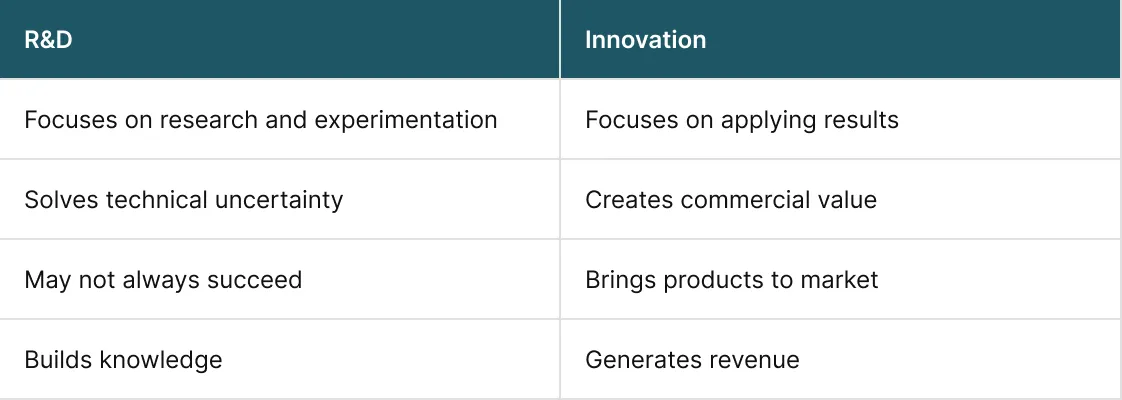
    R&D Is Not the Same as Innovation

    Small Businesses and R&D

    Small businesses can also do R&D. It helps them create new ideas and stay competitive in the market. They may:

    • Solve defined technical problems.
    • Improve internal company procedure.
    • Develop new digital tools.
    • Test new materials.

    Small and new companies need smart solutions when they invest in R&D. Even with a small amount of money, they can:

    • Use their own money carefully.
    • Apply for government help.
    • Work with universities.
    • Get funding from new projects.
    • Raise money through online money raising platforms.

    R&D tax credits for growing business are more valuable. They help reduce financial risk.

    Driving Long Term Progress Through Planned New Developments

    Creating new ideas and achieving long term progress needs more than short term thinking.

    It requires:

    • Clear goals.
    • Focus on science or systems.
    • Smart testing and experiments.
    • Skilled professionals.
    • Proper records and written proofs.
    • Good financial planning.
    • Managing challenges carefully.
    • Protecting intellectual property.

    R&D turns unknown problems into clear progress. It supports:

    • New products and services.
    • Better business efficiency.
    • Long term business development.
    • Edge over competitors.
    • Stronger market position.
    • Better financial performance.

    Governments support R&D through tax benefits because new ways help to build the economy.

    Businesses can build long term expertise by putting money into R&D. They create value for themselves as well as for industries. R&D spending needs careful tracking, and using cloud accounting can help manage costs and cash flow efficiently.

    Conclusion

    Driving better solutions and long term progress is not a single task. It is a constant flow.

    Research and development (R&D) is the organised method businesses use to explore unknown, test ideas and create scientific or tech boosts.

    Businesses achieve the following through R&D:

    • Create clear improvements.
    • Solve unknown problems.
    • Test and experiment with ideas.
    • Make scientific or systems progress.
    • Work with experts.
    • Keeping proper notes and records.

    It has a defined cycle from idea generation to bring products to market. In house capital sharing, government grants, project funding, partnerships and tax benefits are the main money sources of R&D.

    The basic challenges involved in R&D are:

    • Financial drop
    • Technical limits
    • Time stress
    • Legal problems

    The setback is reduced by RDEC and ERIS tax support programmes in the United Kingdom. 

    R&D helps in building intellectual property, better efficiency, reliability and market strength.

    R&D increases knowledge, useful know-how and strength. This helps businesses grow in the long term. Through R&D, companies move from:

    • problems to progress.
    • ideas to actions.
    • short term survival to long term success.

    The new ideas in businesses cannot be achieved by mistake. It is the result of organised research, continuing development and testing.

    Sterling Cooper understands this and puts money wisely in research and development to better prepare for the future. Contact us and start building a smarter development strategy.

    Ready to Turn Innovation Into Growth?

    Speak to our team today and discover how strategic marketing can amplify your R&D impact.
    +443300102526
    Book an Appointment

    FAQs


    Why Is Research and Development Important for Innovation?


    Research and development (R&D) is important because it helps businesses test new ideas, solve technical problems, and create improved products or processes. It reduces uncertainty through experimentation and evidence. Without R&D, innovation would lack structure, technical validation, and long-term direction for sustainable growth.


    The main function of research and development is to create scientific or technological advances. It identifies problems, carries out testing and experimentation, builds prototypes, and applies findings commercially. R&D improves efficiency, strengthens competitiveness, and supports long-term business growth through structured innovation.


    Research and development create new knowledge through testing and experimentation. Innovation applies that knowledge to deliver value in the market. In simple terms, R&D focuses on solving technical uncertainty, while innovation turns those solutions into commercial success and measurable business growth.


    The need for innovation is driven by competition, changing customer expectations, new technologies, cost pressures, and sustainability goals. Businesses must continuously improve products and processes to remain competitive, increase efficiency, and adapt to market changes.


    Innovation is important because it helps businesses stay competitive, improve efficiency, and create new revenue opportunities. It also strengthens brand positioning, reduces operational costs, and supports long-term growth in changing markets.

    Share This Article!

    Recent Posts

  • The Complete Guide to UK Dividend Tax for Beginners

    The Complete Guide to UK Dividend Tax for Beginners

    dividend tax

    Posted by:

    Admin

    Date:

    March 12, 2026

    Category:

    blogs

    Error: Contact form not found.

    The Complete Guide to UK Dividend Tax for Beginners

    Received a dividend but unsure how much tax to pay? You are not alone.

    According to the UK government, the dividend allowance is only £500 for the 2025/26 tax year. Before recent tax changes, the allowance was £5,000. In such a short time, the allowance dropped, meaning more people now have to pay dividend tax.

    From April 2026, dividend tax charges will rise for basic rate and higher rate taxpayers. Therefore, some people may have to pay more tax on dividend income. The £12,570 Personal Allowance and the £500 dividend allowance will remain the same for the 2026/27 tax year.

    This means some investors must pay dividend tax for the first time.

    If you invest in shares, you are more likely to receive dividends.

    A dividend is money you receive from a company’s profits. Tax on dividend is the tax on that money.

    Many new investors ask:

    • How is the tax on dividends calculated
    • Are UK dividends taxed

    You should understand these terms as soon as possible. Once you know about tax on dividends, updates won’t surprise you. If you are a company director, small investor or business owner, understanding it is beneficial.

    In this blog, you will explore:

    • What is the tax on dividends
    • How does the Personal Allowance of £12,570 work
    • What Is Included in the £500 Dividend Allowance
    • The current rates for dividend tax UK
    • How are dividends treated inside ISAs and pensions
    • Lower your tax bill on dividend income in legal ways
    • The right time to report dividends to HMRC

    What Are Dividends for Taxes?

    A dividend is money a company pays to its shareholders from profit. You are more likely to receive a dividend if you own shares. Moreover, this is typically paid per share.

    For example, if you own 1,000 shares and receive 5p per share, you will receive £50.

    When Are Dividends Paid?

    When a dividend is made, no tax is deducted from it. This is why paying the required tax is your responsibility. There are several ways for the company to distribute these dividends. The ways are given as follows:

    • Monthly
    • Quarterly
    • Semi-annually or twice a year
    • Annually

    What Is Dividends Tax?

    Dividend tax is the extra charge that you need to pay when you receive money from company profits. This applies if you own those shares.

    When a business makes a profit and pays part of it to shareholders, that amount is known as a dividend. The UK government taxes this income separately from the salary.

    First, you have to use your Personal Allowance and after that your £500 dividend allowance applies in the UK. If you have any income above this, the dividends are taxed according to your income band.

    Based on your total income, the rate can be 8.75%, 33.75% or 39.35%. This is also known as the tax rate for dividends UK, which depends on your overall earnings.

    For more understanding, check out our guide on 2025 to 2026 tax year updates.

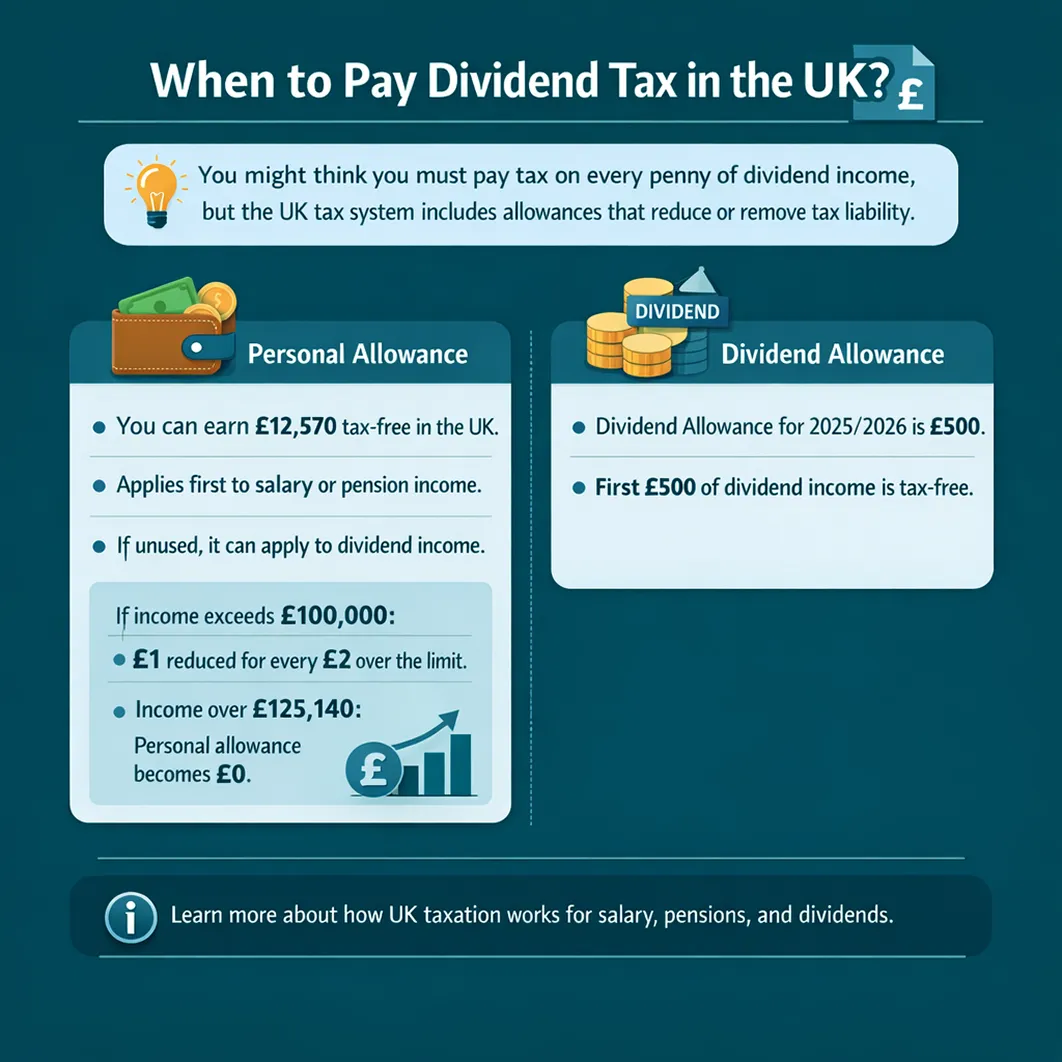
    Personal Allowance

    You are allowed to earn £12,570 without any tax in the UK. To your pension income or salary, this applies first. In case it is not used, it can apply to dividends.

    Your Personal Allowance decreases by £1 for every £2 over £100,000 when your total income goes beyond £100,000. And when income reaches £125,140, your Personal Allowance becomes zero.

    Dividend Allowance

    You can also understand this term as how much dividend is tax free? When you utilise your Personal Allowance, the dividend allowance applies. The allowance is £500 for the 2025/2026 tax year. This means that no matter what your tax band is, your dividend income’s first £500 is tax-free.

    When to Pay Dividend Tax UK
    Here’s a breakdown of how the dividend allowance has changed over the past few tax years:

    Tax Year Dividend Allowance
    6 April 2026 to 5 April 2027 £500
    6 April 2025 to 5 April 2026 £500
    6 April 2024 to 5 April 2025 £500
    6 April 2023 to 5 April 2024 £1,000
    6 April 2022 to 5 April 2023 £2,000
    6 April 2021 to 5 April 2022 £2,000

    Why Did the Dividend Allowance Drop From £5,000 to £500?

    The dividend allowance was £5,000 when it was first introduced in the 2016/17 tax year. It allowed investors to receive up to £5,000 in dividends without paying tax.

    But the government of the UK lowered this amount step by step. First, it dropped in 2018 to £2,000, then in 2023, it dropped to £1,000 and now it is £500.

    This change was made to raise tax income and improve fairness in the system. The government wants people who earn from investments to pay tax. The aim is to make it like a tax on job pay.

    Impact on Small and New Investors

    A lower allowance means more people must now pay tax on dividends. Some small investors may now exceed the tax-free limit and therefore may need to report dividends to HMRC. 

    New investors should now learn dividend tax rules early. If dividends go above £500, you may have to pay tax.

    Effect of Total Income on Your Dividend Tax Bill

    If you want to know the tax rate for dividends UK, it is your income that determines it.

    When you get a £20,000 salary from your company and receive £60,000 in dividends, it will be done as follows:

    • The dividends will be taxed at 8.75%, which is the basic rate.
    • The remainder will be taxed at 33.75%

    On the other hand, if the salary is £60,000 and you receive £20,000 in dividends:

    • Your salary uses the lower tax band first. 
    • The dividends will be taxed at a higher rate.

    How Much Tax Is on Dividends?

    The tax that you pay is decided according to your income band, which is given as follows:

    • For additional rate taxpayers, it is 39.35%
    • For higher rate taxpayers, it is 33.75%
    • For basic rate taxpayers, it is 8.75%

    These percentages represent the rate for dividends tax UK and they apply after your allowances have been used.

    The table below shows tax bands and dividend tax rates:

    Total Income Band Tax Band 2025/26 Tax Rate 2026/27 Tax Rate
    Personal Allowance £0 to £12,570 0% 0%
    Basic Rate £12,571 – £50,270 8.75% 10.75%
    Higher Rate £50,271 – £125,140 33.75% 33.75%
    Additional Rate £125,141 or more 39.35% 39.35%

    Dividend Tax Calculator

    Want to estimate your dividend tax?

    Use the official UK government calculator to check how much tax you may pay on your savings or dividend income: Calculate My Dividend Tax

    Why Is Dividend Tax Important?

    To create long-term wealth, dividend plays a key role. Some important points are given below:

    • Every year, some businesses increase dividends, which can help your income keep up with high prices
    • This will give you a stable income even in retirement
    • With reinvested dividends, your portfolio can improve over time

    However, due to cuts in the dividend allowance, more people now have to pay tax on their dividends. Due to this, small investors must also become aware of the implications of tax.

    Pros and Cons of Taking Dividends vs Salary From a Company

    People who run a company can take income as salary or dividends. Both of these options have their own limits and benefits.

    Income Type Pros Cons
    Salary
    • Regular and fixed income
    • Considered as earned income for benefits, loans and pensions
    • Convenient to report and record
    • Depends on National Insurance and income tax
    • Can raise the total tax rate for both the director and the company
    Dividends
    • Frequently taxed at a lower rate than salary
    • National Insurance is not charged
    • In some cases, it helps lower the overall tax
    • Only paid if the company makes a profit
    • Payments may not be regular

    Do Dividends Inside an ISA Affect Dividend Tax?

    In the UK, an ISA (Individual Savings Account) is a tax-free savings or investment account. Dividends earned inside an ISA are tax-free and do not need to be reported to HMRC.

    This is one of the most effective ways to reduce the amount of tax you may have to pay. The ISA allowance per year is £20,000 and dividends within an ISA do not reduce the allowance.

    For more ways to save on taxes, check the top tax saving tips. It shows how ISAs and allowances can help lower your tax.

    How UK Dividends Work for Non-Residents

    The tax rules are slightly different for people who receive dividends from UK companies but live outside the UK. Sometimes, the tax rules of the UK for non-residents are not the same as those for residents.

    Impact of Withholding Tax and Double Taxation Treaties

    In general, withholding tax is not applied to UK dividends paid to non-residents.

    This means the whole dividend is paid to you and no UK tax is deducted. However, you may have to pay tax in the country where you live. Some countries tax dividends earned from foreign companies.

    The UK has tax treaties with many countries. They help prevent investors from paying tax twice. These agreements ensure that the same dividend income is not taxed twice. Sometimes, tax paid in one country can lower the tax due in another. 

    Non-resident investors should check the tax rules in their country of residence. Also check whether a tax treaty with the UK applies.

    Is a Limited Company for Dividend Tax More Tax Efficient?

    A limited company may pay less tax on dividends than a sole trader in some cases. Here, the profits of the company are taxed first according to Corporation Tax and people are paid from post tax profits.

    People only have to pay tax if they receive dividends. It may lower the overall tax bill.

    How to Report Dividend Tax UK to HMRC?

    You must report to HMRC if your dividends are more than £500. If the dividends fall within £500 and £10,000, you can:

    • Update your tax code with HMRC
    • Add them to your self-assessment return

    You must complete a self-assessment tax return if your dividend income is more than £10,000.

    Consequences of Late or Incorrect Dividend Reporting

    HMRC may charge penalties if the dividend income is reported late or inaccurately. Interest may also be included on any unpaid tax.

    Sometimes, HMRC can review earlier tax returns or request additional information. Due to this, the total amount you may have to pay may increase.

    Therefore, keeping correct records and reporting dividend income on time is important.

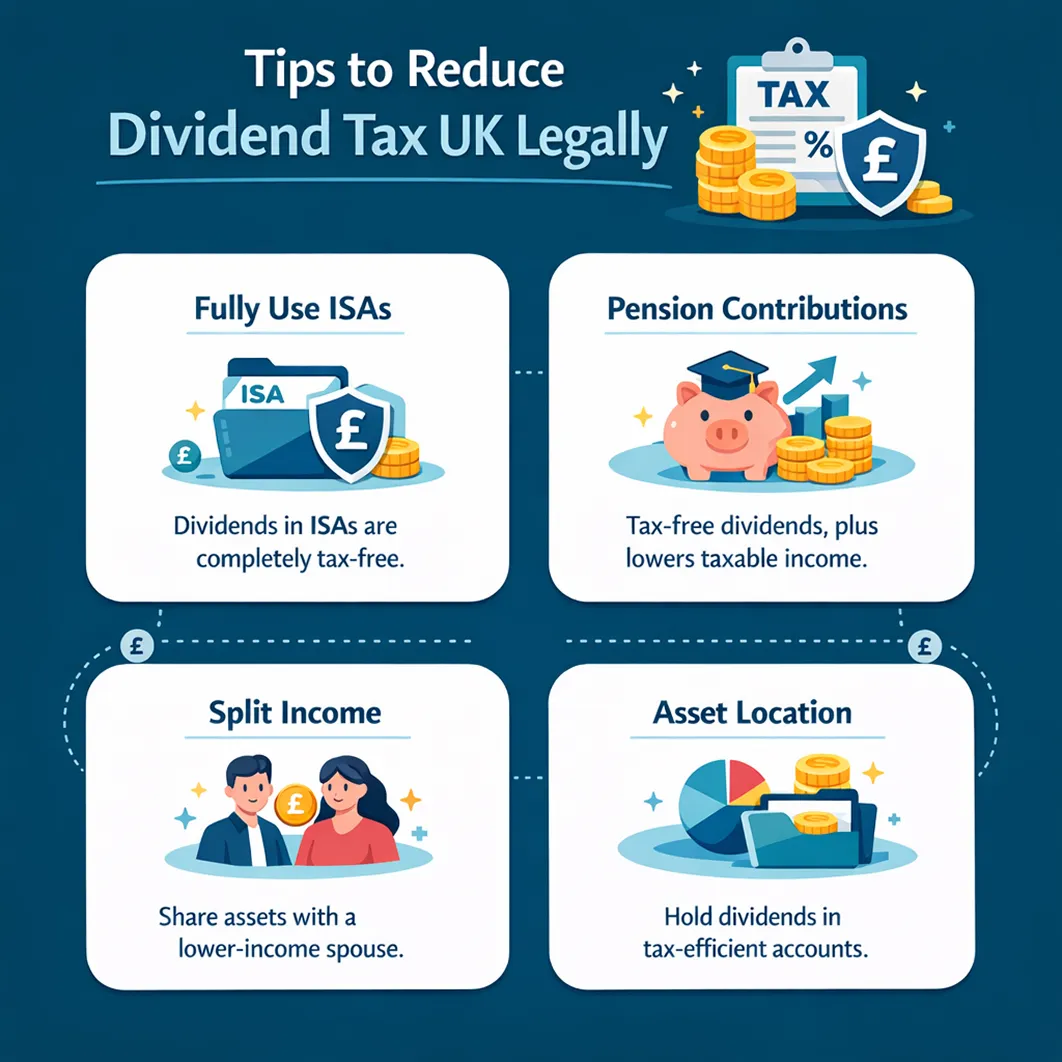
    How to Reduce Dividend Tax UK Legally?

    Here you can find some useful strategies that you can use to legally reduce the amount of tax you pay:

    Use the Dividend Allowance

    The first £500 of dividend income each tax year is tax-free. You do not pay dividend tax if your dividends stay within this limit.

    Invest Through an ISA

    Inside an ISA, any dividends are free of tax.

    Pension Contributions

    Dividends in pensions, like Self-Invested Personal Pensions (SIPPs), are tax-free. Making additional contributions to a pension can also reduce your taxable income.

    Split Income

    In case you are married, you can split your assets with your spouse under the low income condition. This helps lower your overall tax.

    Asset Location

    Give priority to dividend paying finances inside tax-free wrappers like ISAs.

    Tips to Reduce Dividend Tax UK Legally

    Final Thoughts

    Dividend tax is easy to understand. Once you know the basics, it becomes easy to manage. Every new thing takes time to understand and becomes easier if you learn in small steps. This is because they look tiny but make a big difference.

    First, you need to know your income band, as your total income determines the rate of tax you will pay. To calculate tax, dividends and salary are combined to work together.

    The next step is to utilise your allowance completely. £500 dividend allowance has the same importance as the £12,570 Personal Allowance. By using pensions and ISAs, you can manage your dividend income efficiently and reduce the amount of tax.

    It is important to keep accurate records. Track your dividend payments during the year and report them to HMRC when needed.

    Stay updated with changes in tax rules. In recent years, the dividend allowance has decreased suddenly and it has become more important. Also, these rules change with time, so it’s necessary to stay alert to the new trends.

    You stay in control if you understand how taxes on dividends work in the UK. Smart planning helps you keep more of your investment income, whether you are a company director or an investor.

    At XoomPlus, we know the importance of clear financial guidance. We assist company owners and individuals in handling it properly. 

    Contact us today to calculate your tax liability and stay compliant.

    Still unsure about how dividend tax works in the UK?

    At XoomPlus, we help investors and business owners understand and manage dividend tax correctly.
    Contact us today to make sure your dividends are reported correctly and you avoid unexpected tax bills.
    +443300102526
    Book an Appointment

    FAQs


    How to avoid paying tax on dividends in the UK?


    The rate of tax payable ranges from 8.75% to 39.35%, depending on the rate of income tax you pay. From 6 April 2026, the UK dividend tax rates will be:

    • 10.75%  basic rate
    • 35.75%  higher rate
    • 39.35%  additional rate

    Dividend tax can be avoided by keeping investments in stocks and shares, ISAs and pensions.


    There is a separate Dividend Allowance on top of the Personal Allowance, where you only pay tax on any dividend income above £500. The dividend tax rates start at 8.75% for basic rate taxpayers, 33.75% at the higher rate and 39.35% at the additional rate.


    A dividend is a payment a company can make to shareholders if it has made a profit. You cannot count dividends as business costs when you work out your Corporation Tax. Your company must not pay out more in dividends than its available profits from current and previous financial years.


    You can calculate a stock’s dividend yield by dividing its total annual dividends by the stock’s current share price. Companies can start, stop, reduce, or increase their dividend payments at any time. So it’s important to understand that dividend yield is not a guaranteed return rate.


    It’s a percentage of the current share price. For example, say it’s 6% annually per £20 share, you’d make £1.20 per year per share. If they pay that monthly, it would be 0.10 per month or quarterly, it would be 0.30 every three months. However, dividends can change depending on share price and market volatility.

    Share This Article!

    Recent Posts

  • Business Consulting Strategies, Benefits and Best Practices for Growth

    Business Consulting Strategies, Benefits and Best Practices for Growth

    business consulting

    Posted by:

    Admin

    Date:

    March 11, 2026

    Category:

    blogs

    Error: Contact form not found.

    Business Consulting Strategies, Benefits and Best Practices for Growth

    Think your business can grow without a consultant? Many UK business owners are surprised by what expert guidance can unlock. It is not easy to run a business in the UK. Business moves fast these days. Competition is high so, organisations are constantly using methods to improve production and growth. They want to stay a step ahead of their opponents and this is where business consultants step in.

    A business consultant offers proficient advice and planned guidance to support your business with market trends. The UK consulting sector has almost doubled over the past five years, recording an 11% growth in 2023 alone. This rapid rise shows how businesses increasingly rely on consultants to stay competitive and growth-centre.

    In this blog, you will learn about business consulting including:

    • Strategies
    • Benefits
    • Best practices

    What’s a Business Consultant?

    These are the skilled professionals with deep business knowledge. They have deep knowledge about how businesses and markets operate. 

    What Does a Business Consultant Do?

    They offer you with plans and strategies to help your business grow. They focus on delivering results. Identify problems and give quick solutions. You can call them a business trainer or coach. 

    What Does Business Consulting Means?

    Business consulting means hiring an expert to support your growth. The expert you hire is known as a business consultant. A business consultant’s goals include providing professional advice and identifying business problems.

    They come from different fields and can help in many areas, such as:

    • Operational
    • Strategic
    • IT
    • Finance
    • Management
    • Marketing

    The table below clearly shows the different areas where business advisors can help:

    Business Consulting Areas Description
    Operational Improves business operations and efficiency.
    Strategic Provides advice on long-term planning and business direction.
    IT Provides technology solutions to enhance business systems.
    Finance Provides financial advice including budgeting, investments and cost-saving strategies.
    Management Improves leadership and team management strategies.
    Marketing Offers advice on marketing strategies, campaigns and brand development.

    Why Do UK Businesses Hire Consultants?

    The UK business landscape is competitive. Whether you are a start-up in Manchester or a settled firm in London, you constantly face pressure to adjust.

    Many businesses use business advisors for:

    • Neutral advice
    • Specialist expertise
    • Faster decision-making
    • Support during change
    • Structured growth planning

    Business owners are too involved in daily operations, sometimes they miss problems. Business advisors provide an external, neutral view. They can quickly spot issues and give solutions that others ignore.

    Why do UK Businesses Hire Consultants

    Key Changes in Business Consulting

    Over the past few years, business consultant goals have changed. Modern consultants now rely on technology. 

    Business advice is now linked with AI technology, data and digital revolution. 

    The business consultant responsibilities have expanded to include digital planning. They are now using the following softwares: 

    • AI
    • Cloud computing. 

    By using these softwares, they can deliver faster and more efficient results. 

    Key Strategies in Business Consulting

    Here are the key strategies consultants use to help businesses grow and succeed.

    Digital Revolution 

    Moving towards technology is a huge change in the business consulting industry. Traditional business models are left behind, businesses are now becoming digital models. IT Consultants are playing a main role in helping organisations steer this shift. 

    They may advise using cloud platforms such as digital bookkeeping to improve teamwork. They may also say to use data analytics to make improved decisions.

    These digital changes are helpful in reducing the costs and also improve service delivery.

    Using Technologies for Operational Excellence

    New technologies are changing the game in business consulting. 

    They can use these tools to:

    • Difficult challenges 
    • Generate process 
    • Provide solutions

    For example, AI can figure huge amounts of figures in no time. It also helps businesses track trends and predict customer behaviour.

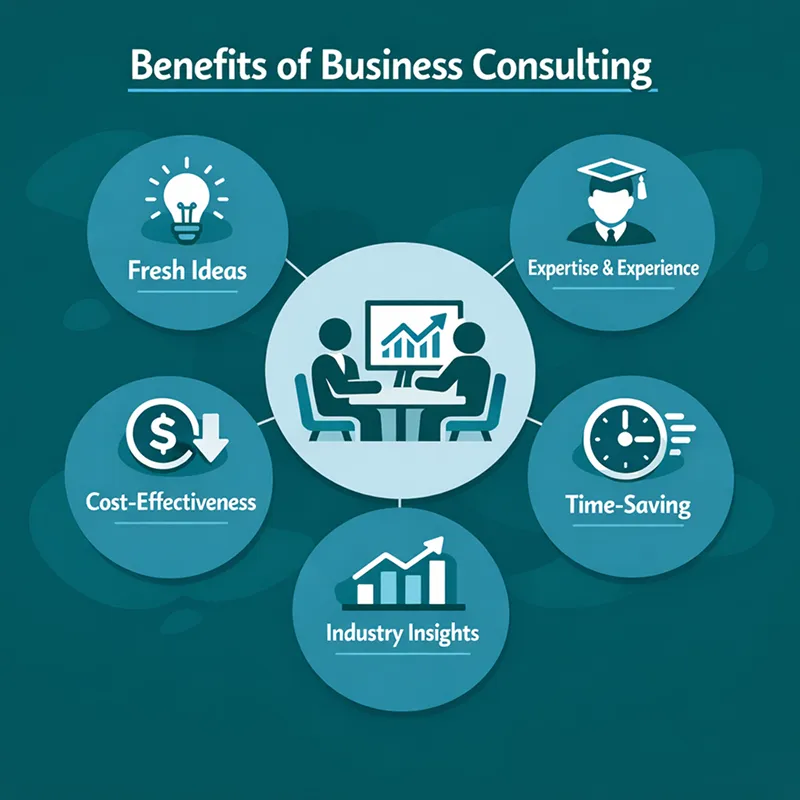
    Benefits of Business Consulting

    They bring significant gains to the businesses. Now let’s explore them:

    1. Fresh Ideas

    Consultants come with new ideas. They can find problems quickly and give solutions. They also bring ambition. 

    Notice the opportunities that you may have missed. Fresh ideas can help you make improved decisions to increase your business profit.

    2. Proficiency and Experience

    Business consultants are specialists in their field. They have worked with different businesses. They know the best plans which work out. 

    While working with them you can have access to their skills and expertise. This can save your  time and help you avoid costly mistakes. 

    3. Cost-Effectiveness

    For many organisations hiring a consultant may seem like an extra fee. Their business plans can save money.

    They help businesses to grow and adjust their operations. They help you to avoid unnecessary costs and give a proper plan to increase the profit.

    For example, if your business has tax issues and you need the help to solve the issue, they can guide you through processes like VAT certificates.

    With their experience services productions become more efficient, which leads to greater success.

    4. Time-Saving

    You can save your time by taking on a business coach. They have a deep understanding of the trades so they can quickly figure out the problems and give solutions. 

    Business consulting means no need to waste time on trial and error.  

    Working with them allows businesses to make decisions faster and focus on key priorities.

    5. Industry Insights

    Business advisors are often experts in specific trades. They have deep knowledge of market trends, customer behaviour and updated technology. 

    They can provide valuable ideas to help businesses a step ahead of their competitors. 

    While entering a new market or taking a new invention, experts can guide businesses through an informed process.

    Benefits of Business Consulting

    Best Practices for Effective Business Consulting

    Proper direction and consulting works side by side. Your business needs to follow certain practices.

    The following are the best practices for business consulting:

    • Explain Your Goals Clearly

    Outlining your goals clearly will help the advisor better understand your business needs. Before hiring a consultant, make sure you are clear about the objectives. Following questions must be clear:

    • Do you want to improve operations?
    • Do you want to increase sales?
    • Do you want to adopt new technologies to reach your objectives?
    • Regular Communication

    You can build a strong consulting relationship through good communication. So, make sure to have regular discussions with your business coach about progress, new ideas and problems. This will bring better results for your business.

    • Accept Changes

    Change mostly brings success so it is good for you to accept change. While it may be difficult to make these changes, it’s important to be open to new ideas. Consultants often advise changes to the way your business works. 

    • Team Involvement

    You can’t run your business alone. Running a successful business is not a solo task. Consultants are experts, but your team should not be ignored. Also involved them in the process. They know how businesses run on a daily basis. When teams are involved in decisions, resistance decreases and you can apply changes easily. 

    • Focus on Execution

    Execution creates growth. So, make a plan, give tasks and check progress regularly. 

    • Measure Success

    Check the results once the consulting project is complete. The following questions must be answered while measuring success:

    • Did you meet your goals? 
    • Is your business more efficient or profitable?

    Fresh ideas with the use of technology improve performance. Clear goals and good communication lead to better results. 

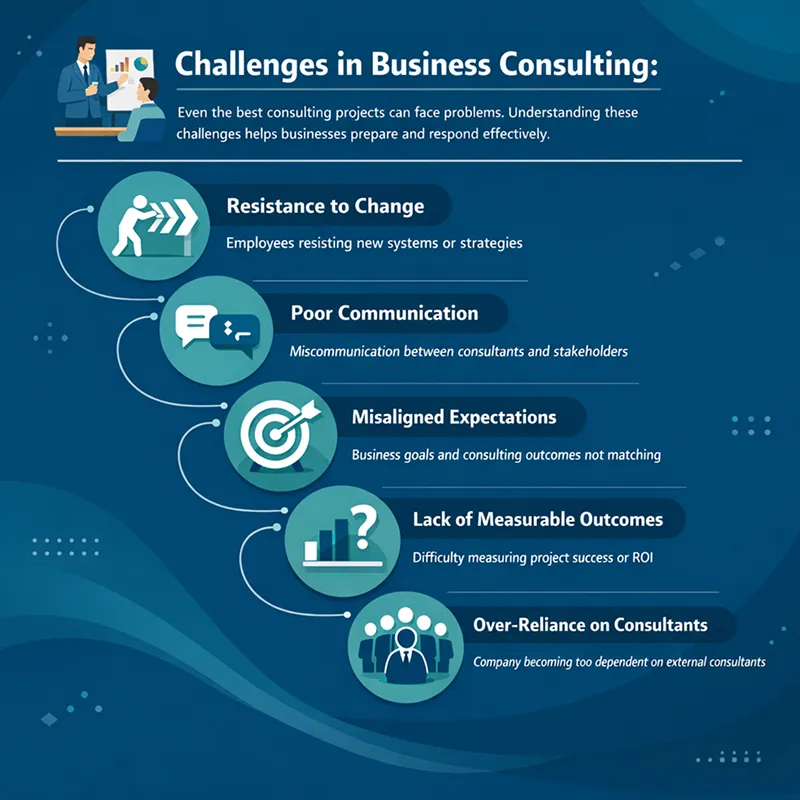
    Challenges in Business Consulting:

    Did you know that the best consulting projects can also face difficulties? To know these challenges helps businesses prepare and respond well. 

    These problems include:

    • Not accepting the change
    • Poor communication
    • Misaligned expectations
    • Lack of measurable results
    • Over-reliance on consultants

    Challenges in Business Consulting

    When Should You Consider Hiring a Consultant?

    You might need their services if:

    • Growth has stalled
    • Costs are rising without any reason
    • You are planning for an investment
    • You are growing into new markets
    • In house expertise is limited
    • You need an independent perspective

    The earlier you address problems, the easier they are to solve.

    Conclusion

    Business growth needs proper planning, discipline and adaptability. What does a business consultant do? Business consultants bring fresh ideas. They provide you with strategies that really work. 

    Being expert in their field. They help you through technology. They make smarter decisions, save time and reduce costs. 

    The business consultant goals is to prioritise productive strategies, understand the profits and follow best practices. When done wisely, this is not an expense; it becomes an investment. 

    At Sterling Cooper Consultants we know how vital business consulting is for helping your business grow.

    If you want result oriented services, contact us today.

    Ready to move from strategy to measurable growth?

    Partner with experienced consultants who know the UK market and deliver solutions that get real results.
    Book an appointment to explore how the right guidance can strengthen your performance, streamline operations and support long term success.
    +443300102526
    Book an Appointment

    FAQs


    What Does a Business Consultant Actually Do?


    A business consultant analyses your organisation’s operations, identifies problems and develops strategies to improve performance. They provide expert advice in areas such as strategy, operations, finance, marketing and digital transformation to help businesses grow efficiently.


    You may need a consultant if growth has stalled, costs are rising, internal expertise is limited, or you are planning expansion. Consultants are especially valuable during periods of change, restructuring, or digital transformation.


    Consulting fees vary depending on the consultant’s expertise, project scope and duration. Some charge hourly rates, while others offer project based pricing. Although it requires investment, consulting often delivers long term financial benefits.


    Key benefits include objective advice, specialised expertise and faster problem solving, improved operational efficiency and reduced business risks. Consultants also provide structured planning that supports sustainable growth.


    The duration depends on the complexity of the project. Short term projects may last a few weeks, while strategic or digital transformation initiatives can take several months. Clear goals and regular communication help ensure timely results.

    Share This Article!

    Recent Posts

  • What Is IR35 and Why Does it Matter?

    What Is IR35 and Why Does it Matter?

    Ir35

    Posted by:

    Admin

    Date:

    March 10, 2026

    Category:

    blogs

    Error: Contact form not found.

    What Is IR35 and Why Does it Matter?

    Are you worried about paying the right taxes? Understanding tax rules while running a business or working as a contractor can feel difficult. 

    Tax rules are known to frequently change and many guides do not clarify them thoroughly. This is why people are afraid that they’ll mess up. The issue is that most people struggle to know how IR35 impacts their tax and hiring decisions. 

    The UK government estimates that changes to IR35 rules may affect around 120,000 private and voluntary sector contractors. This affects a lot of workers and businesses across the UK. It mainly impacts day-to-day choices about:

    • Hiring
    • Contracts
    • Taxes

    This blog will help you learn:

    • What Is IR35
    • Why It Causes Confusion
    • Why These Rules Exist
    • Inside IR35 vs Outside IR35
    • How a Status Is Decided
    • Common Mistakes
    • Risks and Limits
    • How The Rules Affects Different People
    • Documents That Support Outside IR35
    • How Businesses Can Decrease Compliance Risk
    • Why Is It Important Today
    • How Professional Guidance Helps
    • UK Case Laws

    What Is IR35

    IR35 is a tax rule in the UK. It allows HMRC to check, for tax purposes, if a contractor is genuinely self-employed or working as an employee. This regulation decides if an income is taxed through PAYE or as business profits. Tax rules can change and confuse business owners and contractors.

    IR35 was designed to prevent unauthorised employment.

    These rules were enforced in 2000 with three key points:

    • Employees pay tax through PAYE
    • Businesses pay their own taxes
    • Contractors who work as employees should not pay less tax

    Why It Causes Confusion

    Uncertainty is the biggest problem with these rules. A contractor may think he is doing his own business. A business may think it hired an independent contractor. Tax laws may see the same case differently. This creates risk. It leads people to make compliance mistakes because:

    • The rule looks at both, how work is done and the contract
    • Small changes can affect tax status
    • Official guidance uses legal terms
    • Responsibility rules have changed

    These mistakes can lead to surprise tax bills for businesses. Income can change quickly. Investors and company leaders also feel the effects because they struggle to hire when status is unclear.

    Why These Rules Exist

    These rules were established with the intention of making the tax system fair. Without it, two people doing the same job might pay significantly different taxes. For example:

    • A full-time employee pays taxes through PAYE
    • A contractor carrying out the same work could have paid less tax

    The government saw this as unfair and lost tax revenue. The regulation checks how work is actually done, not just what the contract says.

    Inside IR35 vs Outside IR35

    You must know the tax rules before being able to determine the right status. There are two main status outcomes under this regulation:

    Inside IR35

    Inside IR35 means the contractor is classified as an employee for tax purposes. Even if the contractor is working through a limited company, the client deducts PAYE tax and National Insurance before payment. Key factors include:

    • The client determines how the work is done
    • Fixed working hours
    • Very little financial risk
    • No substitute allowed

    If a contractor’s status is Inside IR35, then the business payments are processed through payroll systems. They have to make sure PAYE, National Insurance and reporting obligations are being treated correctly.

    For detailed information on employer responsibilities read Payroll Compliance.

    Outside IR35

    Outside IR35 means a genuine independent business. They take care of their taxes and can be paid without PAYE deductions. This position generally follows the company tax guidelines. Key factors include:

    • Greater control over how work is done
    • Ability to send a substitute
    • Financial responsibility
    • Working for different clients

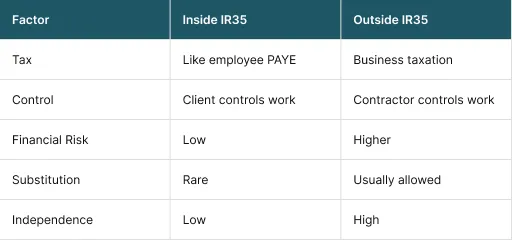
    Side-by-side comparison highlights the key differences.

    Side-by-side comparison highlights the key differences

    How a Status Is Decided

    Important features which are used to determine the status include:

    Control

    Whether a contract worker decides when and how work gets done? It is likely inside IR35 if the client has more control.

    Active Substitution

    Is someone else able to do the work? A right to send a substitute is more often outside IR35.

    Mutuality of Obligation

    Is work expected on an ongoing basis from both sides? Continuous work can often look like employment.

    Common IR35 Mistakes

    Many problems occur due to common misunderstandings. Avoiding these mistakes lowers risk. Common mistakes are:

    • Assuming limited company always equals outside IR35
    • Copying contracts from others
    • Ignoring daily working practices
    • Trusting calculators alone
    • Not reviewing contracts regularly

    Risks and Limits of IR35

    The regulation affects more than just taxes. It also covers the following:

    Financial Risk

    Financial problems are a major concern for the businesses. Wrong classification may lead to:

    • Backdated taxes
    • National insurance payments
    • Interest charges

    Business Risk

    Planning and hiring can also get affected. Companies might stop hiring contractors due to uncertainty of their status.

    Administrative Work

    The extra paperwork and checks are involved in staying compliant. They also need appropriate records. Labels on paper mean less than actions in the world. Real behaviour matters more.

    How The Rules Affects Different People

    In the UK, these rules affect contractors, companies and investors. It can change how they plan their jobs and spend money. Key groups include:

    Business Owners

    Tax responsibility may fall on them which is why businesses need to carefully check contractor status.

    Contractors and Freelancers

    Status under these rules is likely to make a difference in take-home pay.

    Investors and Directors

    Hiring plans and project costs depend on correct classification.

    The General Public

    The regulation can also impact the industries like IT, healthcare, engineering and media.

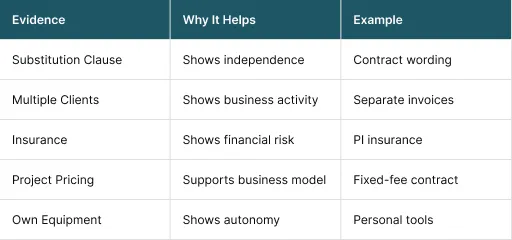
    Documents That Support Outside IR35

    How Businesses Can Lower Compliance Risk

    Simple steps help businesses to comply with the rules. Compliance lowers the risk of penalties. Steps include:

    • Create clear roles
    • Train managers
    • Review contracts regularly
    • Keep written decisions

    It is also critical for contractors and hiring managers to communicate openly. Everyone should know what they have agreed to in terms of working structure.

    Contracts should dictate whether businesses will follow suit. They help to ensure that status does not move towards Inside IR35 undetected.

    Why Is IR35 Important Today

    At first, businesses could choose if a contractor was inside or outside IR35. After the reforms, medium and large private sector businesses have to decide each contractor’s status. Many placed contractors inside the rules to reduce risk.

    This increased compliance but caused less flexibility for contractors. As UK rules change, tax systems are becoming organised and digital. Businesses now must manage their status with great care. They also need to keep track of other taxes.

    If you want to find out more about how tax will be done differently digitally, see our guide on Making Tax Digital.

    How Professional Guidance Helps

    Different businesses have different nature. As a result, most businesses require professional advice. Professional support helps to:

    • Understand working practices
    • Spot risks early
    • Improve documentation
    • Make consistent decisions

    UK Case Laws

    These examples show that the law determines if a person is a worker or a business owner.

    In Pimlico Plumbers Ltd v Smith (2018), a plumber named Gary Smith worked for Pimlico Plumbers Ltd. The company classified him as self-employed. Mr. Smith said he was in fact working as an employee.

    Mr. Smith worked mostly for one company, followed its direction and was under the company control. 

    The court examined the real working relationship. It also reviewed what the contract said. The Supreme Court of the United Kingdom ruled that Mr. Smith was not completely self-employed. 

    What mattered most was not the wording of the contract but the real working relationship. The judges said that the company exercised a high degree of control over the employee which made him qualify as a worker. 

    This case shows that contracts or titles do not decide employment status.

    In Uber BV v Aslam (2021), the Uber drivers claimed that they were workers, not independent contractors. Uber argued that the drivers were self-employed and operated their own businesses. The drivers said Uber controlled key aspects of their work through the app.

    Uber set the fares. Uber also controlled the access to riders and monitored performance ratings. Drivers had little room to negotiate prices or establish customer relationships of their own. The working arrangement made users dependent on the platform.

    The Supreme Court ruled that Uber drivers are workers with rights under UK Law. It focused on how contracts were used, not what was written.

    The judges said that Uber’s degree of control indicated an employment type relationship. Now drivers have worker rights with minimum wage and holiday pay. The decision shows how courts evaluate employment status.

    Conclusion

    IR35 is not about technical tax rules. It is about knowing the nature of a working relationship. This taxation can be tricky and getting it wrong can result in unexpected tax bills, fines, and issues for contractors and businesses altogether.

    Take the time to review contracts and examine how work is done. Also, maintaining clear records can reduce risk and ease things for all those involved. As HMRC focuses on employment rules, businesses must act early and not wait for issues to appear suddenly.

    With the help of  Sterling Cooper Consultants, handling IR35 becomes simple, organised and stress free.

    Get in touch today to get your contractor arrangements set up correctly.

    IR35 compliance protects your business from costly mistakes and unnecessary stress. Acting early ensures you stay in control and avoid future disputes.

    Speak to a specialist today to review your current position and strengthen your compliance with confidence.
    +443300102526
    Book an Appointment

    FAQs


    What is IR35 in simple terms?


    Traditional accounting software is installed on one computer and can only be accessed there. Cloud accounting works online and stores your data securely on remote servers. You can log in from any device, with internet access. This makes it more flexible and easier to manage.


    In most private-sector cases, medium and large companies decide the IR35 status. They must review the contract and the real working setup carefully.


    No, it doesn’t. Just having a limited company does not make you outside IR35. HMRC looks at how you really work, not just your business structure.


    Online tools can give a rough idea of risk. But they cannot check every detail. A full review is usually more accurate.


    Yes, it can. If the way you work changes, your IR35 status may change too. It’s important to review it regularly.

    Yes, you can give access to multiple users. Business owners, accountants and staff can log in at the same time. Everyone sees the same updated information. This improves teamwork and reduces confusion.

    Share This Article!

    Recent Posts

  • 5 Ways Cloud Accounting Can Save You Time and Money

    5 Ways Cloud Accounting Can Save You Time and Money

    cloud accounting

    Posted by:

    Admin

    Date:

    March 9, 2026

    Category:

    blogs

    Error: Contact form not found.

    5 Ways Cloud Accounting Can Save You Time and Money

    Do you feel stressed when thinking about numbers and accounts? Cloud accounting offers a simpler way to manage business finances. One of the benefits of cloud accounting is that it saves time and reduces cost. According to McKinsey, automation technologies can reduce time spent on routine administrative tasks by up to 60%.

    Many businesses are shifting towards digital accounting to run their operations. It helps with data entries, reportings, cash flows and VAT submissions.

    This digital accounting is becoming more important as UK tax rules obligate digital compliance. According to HMRC, all VAT registered UK businesses must now keep digital records. They tend to submit VAT returns using approved software under Making Tax Digital (MTD).

    In this blog, you will learn:

    • What is cloud accounting
    • How does this work
    • What are the benefits of cloud accounting
    • How cloud-based accounting saves time and money
    • Steps to switch from older accounting systems
    • Limitations of cloud systems
    • Who can benefit from cloud accounting

    What Is Cloud Accounting?

    Cloud accounting uses online software to record and manage finances. Your data is stored securely online. It is not saved on one device and you can access it from anywhere using the internet. Other people like accountants or bookkeepers can also access it with certain permissions. Everyone works from the same information.

    Many UK businesses begin shifting to digital accounting softwares with expert advisers and this helps them to avoid mistakes during setup. This also helps them to transition to the new system with ease. Working with an experienced team ensures work efficiency as well.

    How Does This Work?

    This accounting system follows a clear process. Here is the step by step process:

    1. Connect your business bank account to the accounting setup
    2. Transactions appear automatically on the ledgers
    3. The accounting system records all income and expenses
    4. Accounting reports update in real time

    You do not need to send files separately or wait for updates. Everything stays in check and works simultaneously in real time.

    Digital tax administration will make it easier for businesses to get their tax right and keep on top of their affairs.

    – Jim Harra, Chief Executive, HMRC

    Cloud Accounting Versus Traditional Accounting

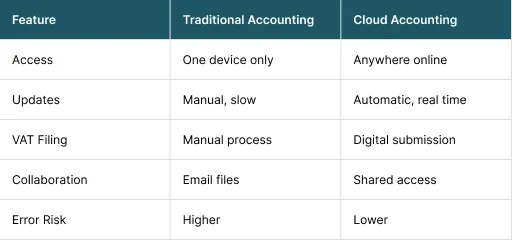
    Cloud-based accounting is ideal for remote-friendly businesses needing real-time financial data. Traditional accounting is suitable for smaller and stable offline businesses.

    Cloud Accounting Versus Traditional Accounting

    Why Traditional Accounting Cause Problems for Many Businesses

    Accounting should not feel stressful. Yet for many people, it does. The issue is often not the numbers but the system behind them. Many UK businesses still rely on:

    • Spreadsheets
    • Paper invoices
    • Desktop software
    • Manual data entry

    These tools were useful in the past. Today, they cause problems. Businesses using traditional accounting methods normally face issues including:

    • Data must be typed by hand
    • Errors go unnoticed
    • Files get lost
    • Reports take time
    • Single person can access records at one time

    Each issue costs time and adds stress. Over time, these small problems grow into bigger ones. The cloud system removes many of these above mentioned issues.

    Why Businesses Are Moving to Cloud Solutions

    The benefits of cloud accounting are practical and attractive for businesses. This is not about technology only. It is about making work easier and efficient at the same time. Below are key benefits of why businesses are moving to digital accounting systems.

    1. Less Manual Work

    The most important advantage of this accounting method is that it reduces manual bookkeeping which takes a lot of time. Manual accounting causes mistakes. Typing numbers again and again increases risk of errors.

    How Cloud Accounting Reduces Manual Work

    Automation does most of the work. This removes daily admin tasks because:

    • Bank feeds import transactions
    • Rules sort expenses
    • Invoices repeat automatically
    • Totals calculate instantly

    Why This Saves Money

    Little savings can add up over months. Cloud-based accounting can save money in ways such as:

    • Fewer errors
    • Less fixing later
    • Faster month-end work

    2. Access Your Numbers at Any Time

    Digital accounting gives instant access to financial data. You no longer wait for reports. With this system, you can do more in less time by accessing it from anywhere any time. You can:

    • Check cash before spending
    • Review invoices while travelling
    • Share data with adviser
    • Answer questions quickly

    This way you can manage your business from anywhere in real time. Your accountant can rely on live data to give accurate advice.

    3. Lower Accounting and Compliance Costs

    Digital accounting reduces total accounting costs over time. This happens through efficiency which is a major financial benefit of it. Cloud accounting can reduce costs and increase efficiency in these areas:

    • Less bookkeeping time
    • Fewer errors to correct
    • Faster year-end accounts
    • Fewer urgent fixes

    Clean data costs less to manage. HMRC explains that digital records help reduce errors and improve accuracy. Digital accounting complies with HMRC rules to make financial digital records.

    This shift toward digital systems is one of the long-term benefits for UK businesses.

    To learn more, check out our guide on making tax digital.

    4. Better Control Over Cash Flow

    Cloud accounting helps you see cash flow issues early. This is one of the strongest advantages of cloud-based accounting. In the manual accounting methods, cash flow problems appear suddenly because they grow slowly. Keeping an eye on your cash flow is easier with cloud software. You can have:

    • Dashboards show income and costs
    • Automatic reminders chase late invoices
    • Spending trends become visible
    • Forecasts show future gaps

    5. Easier Work With Accountants and Teams

    Cloud accounting improves communication. Older systems rely on emails and attachments causing confusion. Teamwork and collaboration improve because:

    • Everyone sees the same data
    • All updates appear instantly
    • Fewer emails are needed
    • No file version problems

    This works well with payrolls as well. To learn more, check out our guide on payroll automation.

    What Are Risks and Limits of Cloud Systems

    Cloud accounting is very useful but at the same time it also has potential drawbacks. Few of the risks and limits include:

    • Internet access is required
    • Learning takes time
    • Monthly fees apply
    • Data security worries

    How These Risks Are Managed

    Most of these risks can be managed effectively through simple measures such as:

    • A backup internet provider
    • Simple training solves confusion
    • Monthly fees recover by replacing different resources
    • HMRC recognised systems meet UK security standards

    Real Life Example: MMQ’s Move to Cloud Accounting

    MMQ is a food distribution company with several branches across Iran. Each branch used the same accounting software, but the systems were not connected. 

    Reports were sent to the head office only at the end of each month, which delayed decisions. Main problems included:

    • No integrated system between branches
    • Delayed monthly reporting
    • High IT travel and maintenance costs
    • No centralised backup

    After reviewing cost, security and IT capacity, MMQ chose a public cloud deployment setup. 

    After adopting cloud accounting, MMQ achieved the following benefits:

    • Real-time financial access
    • Integrated branch data
    • Lower IT and infrastructure costs
    • Faster and better decision-making

    The shift to digital accounting helped the company save time, reduce costs and improve overall efficiency. This case study shows the real advantages of cloud accounting.

    The longer you delay switching to cloud accounting, the more time and money you can lose.

    How to Move to Cloud Accounting Step by Step

    A clear plan helps to change the running system with ease. Here’s how to move to cloud software step by step.

    Step 1: Review Your Current System

    Start by understanding what is your current system and what causes stress. Your business may be using the following:

    • Software
    • Spreadsheets
    • Paper files

    Step 2: Select Suitable Software

    Price of the cloud accounting software should not be the only deciding factor. When selecting cloud software, look for these important features:

    • HMRC approval
    • Bank connections
    • Simple reports
    • UK support

    Step 3: Data Required for the Initial Setup

    You must have all the important information for the setup before moving to the cloud including:

    • Bank statements
    • Supplier invoices
    • Customer lists
    • Opening balances

    Step 4: Transfer and Check Records

    Once your data is ready, transfer it carefully and check for errors. When you move data also check totals and VAT settings.

    Step 5: Know the Basics of Accounting

    Before shifting to cloud accounting, you must have the basic knowledge of accounting which includes:

    • Invoices
    • Expenses
    • Reports

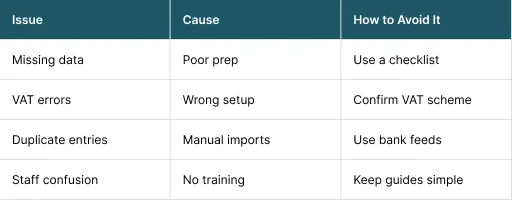
    How to Avoid Normal Delays During Setup

    How to Avoid Normal Delays During Setup

    Who Benefits Most From Cloud Accounting

    Cloud accounting works well for small businesses, growing companies, VAT registered firms, businesses using advisers and owners wanting clarity. 

    Some businesses gain more from this accounting than others. It is about the needs of the business and not its size.

    Conclusion

    Cloud accounting is not just about keeping records online. It is also about managing the business in a smart way. It reduces manual tasks, avoids the risk of mistakes and gives you clear, real-time financial insight and overview. As a result, these long term benefits of cloud-based accounting help you save both time and money.

    As UK tax rules continue to move toward digital systems, switching to cloud accounting is becoming essential. With Sterling Cooper Consultants, the shift can be smooth and highly beneficial for your business growth.

    Get in touch today to simplify your business finances by having better control, strong cash flow and less stress.

    Cloud accounting saves you time, reduces stress and cuts unnecessary costs. The sooner you switch, the sooner your business benefits.

    Book an appointment to move to cloud accounting with expert guidance.
    +443300102526
    Book an Appointment

    FAQs


    How Is Cloud Accounting Different From Traditional Accounting Software?

    Traditional accounting software is installed on one computer and can only be accessed there. Cloud accounting works online and stores your data securely on remote servers. You can log in from any device, with internet access. This makes it more flexible and easier to manage.

    Yes, you need internet access to use cloud accounting in real time. It allows you to view, update and share financial data instantly. Most systems are secure and protect your data during short outages. Once the connection returns, everything remains updated.

    No, cloud accounting is suitable for businesses of all sizes. Many small businesses and sole traders use it daily. It helps growing companies stay organised and compliant. The benefits apply whether your business is small or expanding.

    Yes, most cloud accounting systems connect securely to your bank. Transactions are imported automatically into your records. This reduces manual data entry and errors. It also saves time on bookkeeping tasks.

    Yes, cloud accounting keeps digital VAT records automatically. It supports Making Tax Digital requirements in the UK. This makes VAT submissions easier and more accurate. It also reduces the risk of mistakes.

    Yes, you can give access to multiple users. Business owners, accountants and staff can log in at the same time. Everyone sees the same updated information. This improves teamwork and reduces confusion.

    Share This Article!

    Recent Posts

  • What Is a Leave of Absence and When Should Employees Take One?

    What Is a Leave of Absence and When Should Employees Take One?

    leave of absence

    Posted by:

    Admin

    Date:

    March 6, 2026

    Category:

    blogs

    Error: Contact form not found.

    What Is a Leave of Absence and When Should Employees Take One?

    Ever find yourself swamped with workload? Ever feel low, but work starts at 9 am? An employee might feel that he cannot carry on. If you are ill or under stress. Whether you are dealing with family troubles or facing something unexpected. There are moments when you cannot go on. That’s exactly when a leave of absence gives you time to take a break.

    A leave of absence gives you approved time away from work for a serious reason. It is not the same as a holiday. It is usually longer. It may be paid or unpaid depending on the situation.

    In the UK, employees are entitled to 5.6 paid weeks of holiday per year. This leave is called statutory leave entitlement or annual leave. A number of emergencies and other reasons allow for such leaves. This is done for the sake of the employee’s well being.

    Understanding how a leave works can protect your job and reduce stress. In this guide, we explain your rights, when to take one and how to request it properly in the UK.

    What Is a Leave of Absence?

    A good place to start is by explaining what does leave of absence mean? 

    It is time off from work. The employee is allowed to take it for a certain period. Your job remains intact and you can be paid or not depending on the type of leave.

    This leave does not mean you can just miss work. Not showing up without prior discourse can be considered as a misconduct. Therefore, it is very important to submit an absence of leave letter for work.

    There are different types of leave of absence. These types depend on conditions and circumstances attached. They can be:

    • Paid
    • Unpaid
    • Required by law
    • Agreed by company policy

    It is an approved time off. An absence without permission is not counted as leave.

    What Does Leave of Absence Mean in the UK?

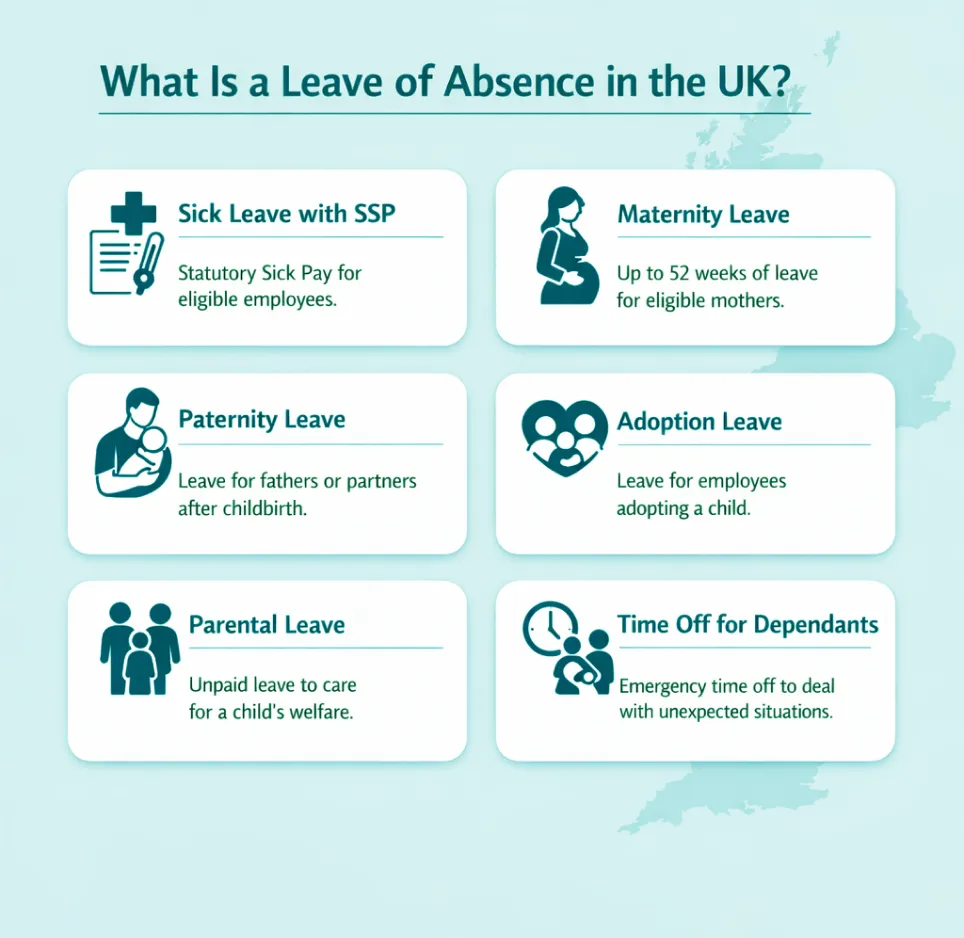
    You have statutory rights to take time off for approved reasons under UK law. In the leave of absence UK system, some types of leave are protected by employment law. Statutory leaves in the UK are:

    Sick Leave With Statutory Sick Pay (SSP)

    In case you are too ill to work, you can get a leave of absence. You can apply for SSP if you earn £123 per week or more. Employers must pay at least £118.75 per week (2025/26). This is paid for up to 28 weeks under SSP.

    Maternity Leave

    You can have 52 weeks of statutory maternity leave in the UK. At least 2 weeks leave is a must. The leave starts 11 weeks before the due date. The pay is 90% of the regular earnings for at least the first 6 weeks. Next 33 weeks at 90% or £187.18 per week whichever amount is lower. The last 13 weeks are unpaid.

    You can return sooner but must give at least 8-week notice.

    Paternity Leave

    As per law, paternity leave is a 2 week leave for husbands and spouses. This leave is to support your partner after childbirth. The leave must be taken within 52 weeks of the child’s birth.

    Adoption Leave

    Adoption leave is similar to maternity leave where 52 weeks are granted to the main adopter in order to bond with the child. It is given in case of adoption or surrogate birth. It involves 39 weeks of paid leave.

    Parental Leave

    A statutory leave of 18 weeks is granted to the working parents to care off their child before they turn 18. It is limited to 4 weeks per child per year. It is usually unpaid but certain employers do pay as well. 

    Time off for Dependants

    You can take time off in case of emergencies that involve a family member or a dependent. Such leaves are unpaid. These are not planned leaves and usually last for a short period of time.

    Employers must follow these laws. They cannot refuse certain types of protected leave of absence if the employee qualifies.

    However, all leaves are not automatic. For example, unpaid personal leave or a sabbatical depends on your company’s policy. Always check your employment contract and leave policy before making plans.

    What is a leave of absence in the UK

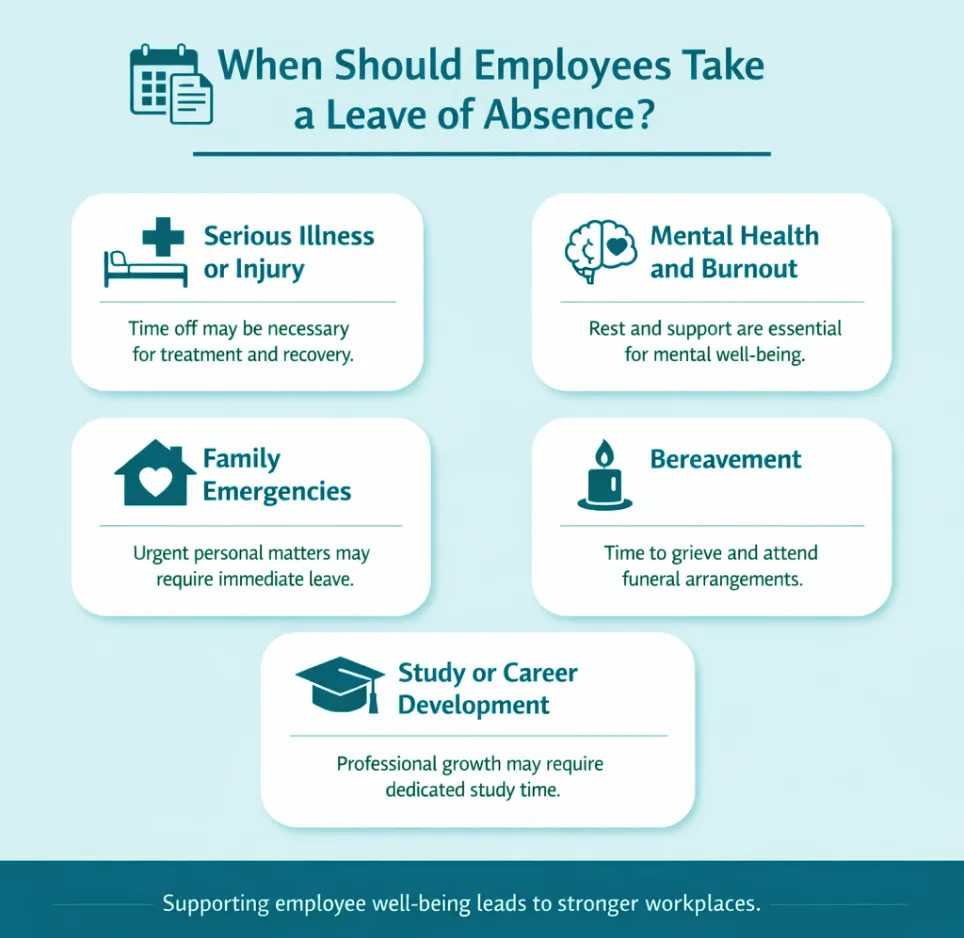
    When Should Employees Take a Leave of Absence?

    This leave should be taken when continuing to work would harm your:

    • Health
    • Family life
    • Long term well-being

    Common situations where leave may be necessary include:

    1. Serious Illness or Injury

    You can take a leave if:

    • You are physically unwell
    • Cannot safely perform your duties

    For example, someone is recovering from a surgery. He may need several weeks off. Also a warehouse worker having a broken leg cannot perform labor.

    As per UK system, you may need a GP fit note if you are ill for more than seven days. This supports your request for leave. This also protects your position.

    2. Mental Health and Burnout

    Mental health is just as important as physical health. Ongoing stress can cause 

    • Anxiety
    • Depression
    • Severe exhaustion

    A leave may help you recover If you struggle to:

    • Sleep
    • Feel constantly overwhelmed
    • Lose focus at work

    In the UK, employers must take mental health seriously. A medically supported leave can prevent long term damage to your well-being.

    3. Family Emergencies

    Life can change suddenly. A child may fall seriously ill. A parent may need urgent care.

    In all these situations, employees may request a leave to manage responsibilities at home.

    The UK rules allow reasonable unpaid time off. It is for dependents in emergencies. Longer leave may require agreement with your employer.

    4. Bereavement

    Losing a loved one is very hard. Focusing at work may be impossible.

    Many employers offer compassionate leave. In some cases, it is paid. A short leave of absence allows time to grieve and organise practical matters.

    Returning too soon can affect performance and mental health.

    5. Study or Career Development

    Some employees request a leave to complete a qualification or training course.

    For example, a teacher may take a year to complete a master’s degree. This type of leave is usually unpaid and depends on employer approval.

    Although not always guaranteed under UK law, some organisations encourage development through career breaks.

    When Should Employees take a leave of absence

    What Happens If You Do Not Inform Your Employer?

    Failing to communicate properly can cause serious problems. Stopping work without approval may be treated as misconduct. This is why sending an absence of leave letter for work is essential.

    Even in emergencies, contact your manager as soon as possible. Follow up in writing. Clear documentation protects you and your employer.

    Paid vs Unpaid Leave of Absence

    Not all leaves of absence are paid. Some leaves are paid by certain employers but not statutory under UK law. 

    Paid Leaves

    Paid leaves are statutory leaves generally under law. Such leaves make sure that pay and employment continues unaffected. Some examples are:

    • Annual Leaves
    • Sick Leaves
    • Maternity Leaves
    • Public Duties

    Some companies have their own criteria for paid leaves. Such leaves are reserved at the discretion of the employer.

    Unpaid Leaves

    Unpaid leaves are discretionary and case dependent. They are generally reserved for personal reasons. Some examples are:

    • Extended travel
    • Career breaks
    • Long term personal projects
    • Carer’s leave

    Under leave of absence UK guidelines, unpaid leave depends on agreement between employer and employee.

    Unauthorised absence is unpaid and often considered a misconduct. Therefore, it is essential to write a leave of absence request before going on leaves.

    How to Write Leave of Absence Request

    Your request is how you convey your need for absence to the employer. Write your request clearly and directly. Explain your reasons in a professional way. You must use polite language and make your case under the light of relevant rules and guidelines.

    Process:

    1. Start with a clear subject stating the intent and purpose
    2. Clearly state the end dates of your requested leave
    3. State the reasons in a brief manner. Avoid unnecessary personal details
    4. Attach any supporting documents such as medical reports etc
    5. Offer a handover plan for how your absence can be covered
    6. End with a note thanking the employer

    You do not need to share private details unless legally required. Professional communication increases your chances of approval.

    Case Study: Steve’s Burnout Recovery

    Steve was a content creator at a marketing firm in Manchester. He worked long hours creating repetitious content day in and out. His long hours at work diminished his capacity to spend time for his hobbies. This caused him to be anxious and irritable. Soon his performance levels dropped.

    Initially, he tried to ignore the signs and ‘push through’ the condition. Instead of getting better he seems to be plummeting into bad performance and lethargy. Eventually he checked in with a psychiatrist and was diagnosed with overwork and generalised anxiety disorder. The doctor advised a 4 week leave.

    Steve requested a formal leave of absence supported by a medical report. His employer approved it under sick leave policy.

    During this time, Steve:

    • Attended therapy
    • Improved his sleep routine
    • Reduced stress triggers

    This recovery worked. Steve returned 

    • Happier
    • Healthier

    Also, Steve was able to:

    • Outperform his previous work 
    • Confidently face work challenges 
    • Avoid burnout

    Employer Responsibilities in Leave of Absence UK

    Employers also have legal duties. Under leave of absence UK employment law, employers must:

    • Follow statutory leave rules
    • Avoid discrimination
    • Protect employee confidentiality
    • Allow return to the same or similar job (for protected leave)

    The employee may seek legal action, if an employer rejects a legally protected leave.

    Can an Employer Refuse a Leave of Absence?

    Yes, but only in certain situations. If the request is not legally protected, the employer may refuse based on business needs. For example, a small shop may not manage without a key staff member during peak season.

    However, refusal must not be discriminatory or unfair. If you believe your leave was rejected unfairly, speak to HR or seek professional advice.

    How Long Can a Leave of Absence Last?

    The length depends on the type.

    • Sick leave can last weeks or months
    • Maternity leave can last up to 52 weeks in the UK
    • Career breaks may last longer if agreed

    Under UK rules, statutory leave periods are clearly defined. Always confirm with HR.

    Preparing Before You Take Leave

    Before your leave begins:

    • Finish urgent tasks
    • Inform colleagues and clients
    • Set an email auto reply
    • Document project details

    Planning ahead makes your return smoother

    Conclusion

    A leave of absence is more often a need rather than desire. It is a formal way to protect your employment while dealing with life situations. 

    In the leave of absence UK system, employees have rights and employers have responsibilities. But communication is always essential.

    In cases where a leave is linked to injury, medical recovery, or a workplace dispute, professional support can make a real difference. Sterling Cooper Consultants provides specialist employment law support, helping employees and employers handle complex absence matters with confidence and clarity. Contact us to move forward with clarity and confidence.

    Need clarity around medical evidence linked to a leave of absence?

    Contact our payroll and HR services today for clear, reliable expert medical reporting you can trust.
    Get professional support that strengthens your case and protects your position at work.
    +443300102526
    Book an Appointment

    FAQs


    What Is A Leave Of Absence?


    A leave of absence is approved time away from work for a specific reason, such as illness, family emergencies, or personal matters. It is formally agreed between the employee and employer and may be paid or unpaid.


    In the leave of absence UK system, it refers to authorised time off that may be protected by employment law, such as maternity, sick, or parental leave. Other types depend on company policy.


    Some types are paid, such as statutory sick pay or maternity leave. Others, like career breaks, are usually unpaid unless your employer agrees otherwise.


    Keep your request clear and polite. Include your reason, dates and any supporting documents. A short, formal letter or email is usually enough.


    Failing to notify your employer properly may result in disciplinary action. Always send written confirmation to protect your job.


    Yes, if the leave is not legally protected. However, they cannot refuse statutory leave unfairly or discriminate against you.

    Share This Article!

    Recent Posts

  • A Complete Guide to GPSR Labelling Requirements in 2026

    A Complete Guide to GPSR Labelling Requirements in 2026

    GPSR Labelling Requirements 2026

    Posted by:

    Admin

    Date:

    March 5, 2026

    Category:

    blogs

    Error: Contact form not found.

    A Complete Guide to GPSR Labelling Requirements in 2026

    The General Product Safety Regulation (GPSR) is actively enforced across the European Union (EU). It replaced the older General Product Safety Directive in December 2024. The enforcement is much stricter today. 

    The online platforms are also checked. Did you know that a total of 15,608 recalls are recorded in 2025? It surpassed the record of 14,484 recalls in 2024.

    This fact ensures that no business can sell products to the EU or Northern Ireland without GPSR. It applies for both the businesses inside or outside the EU.

    The system has changed after Brexit. UK businesses face different GPSR labelling requirements today. Especially when they export to the EU and NI.

    In this blog, you will learn:

    • What is GPSR
    • GPSR labelling requirements in 2026
    • Practical steps to remain compliant to GPSR
    • Where GPSR applies, and where it does not
    • Which consumer products are covered under GPSR
    • What must appear on a GPSR product label
    • How the EU Responsible Person requirement works for UK exporters
    • What risk assessment checks are expected under GPSR
    • What documents must be kept for 10 years
    • What must be displayed on online listings under GPSR
    • What happens if GPSR rules are not followed

    What Is GPSR

    GPSR stands for General Product Safety Regulation. It is an EU law that is made for the safety of consumers. GPSR regulations are placed in the EU market. They apply to non food consumer products.

    The GPSR labelling requirements were introduced because today’s supply chain is complex. Ecommerce has grown rapidly. Dropshipping has also increased. There are multiple websites selling dangerous products.

    In addition, the earlier directive was more than 20 years old. It did not fit the digital market. The GPSR labelling requirements address this gap. GPSR regulations apply directly in all EU and EEA (European Economic Area) Member States. This holds significant value.

    Now countries do not need to have their own laws. Because GPSR regulations are uniform across the EU. It helps you prevent interpretation between countries. It also helps you make the enforcement stronger.

    When Did GPSR Come Into Force

    The GPSR came into effect on 13 December 2024.

    From this date, all new products in the EU market must comply with GPSR. The existing products must also comply with the GPSR labelling requirements.

    Not following GPSR labelling requirements may result in withdrawal of your products from the market. These requirements ensure that businesses may face sanctions or fines if they don’t comply.

    In 2026, market inspection officials are active. They inspect compliance. They enforce law under Safety Gate Systems.

    Does GPSR Apply to the UK

    GPSR does not apply to goods placed on the Great Britain (GB) market. England, Scotland and Wales continue to follow the older GPSD framework.

    However, GPSR does apply to:

    • Any UK business that sells products to customers in the EU
    • Any UK business that sells products to Northern Ireland
    • Any business outside the EU Single Market that puts products on the EU market

    GPSR Applicability by Market (2026)

    Northern Ireland follows EU product safety rules. It is because of post Brexit policy. It caused regulatory divergence. This can be observed between GB and the EU.

    So, a product sold in London may follow UK rules. The same product sold in Belfast, NI must follow GPSR. Thus, cross border trade is more complex now.

    Did You Know?

    Products sold only in Great Britain do not need to follow GPSR, but the moment you sell into the EU or Northern Ireland, the rules apply.

    What Products Are Covered Under GPSR

    GPSR covers all non food consumer products including new, used and repaired goods. This also covers reconditioned goods. The digital products and CE marked goods are also included.

    Even the products already CE marked may need to follow GPSR UK. There are some exemptions though. GPSR does not apply to:

    • Medicines
    • Medical devices
    • Food and animal feed
    • Live plants and animals
    • GMOs used in controlled settings
    • Animal by-products
    • Plant protection products (like pesticides)
    • Transport equipment used by service providers
    • Low-risk aircraft
    • Antiques
    • Products clearly marked for repair before they are used
    • Products made only for professional use, not for consumers

    Some products are exempted from GPSR UK. But they still need to comply with other EU laws. Because product safety is still important.

    Some products, like toys, are covered by specific EU harmonisation laws. For them, GPSR applies to risks that are not already covered.

    However, some parts of GPSR apply to all products.

    What Is EU Responsible Person Requirement

    GPSR labelling requirements introduced EU based Responsible Person.

    An economic operator must be there in the EU. Otherwise, a product can not be placed on the EU market. That operator becomes the Responsible Person under GPSR. This applies especially to non-EU businesses.

    The Responsible Person acts as:

    • A representative who makes sure the product follows the product safety rules
    • A contact point for EU officials
    • The person who keeps the required technical documents
    • The person who checks that labels and safety information are correct

    The Responsible Person must be identifiable on the product and its packaging. The accompanying documentation should also identify them. Their name and address must appear clearly.

    What Are GPSR Labelling Requirements in 2026

    Labelling is central to GPSR compliance.

    GPSR labelling requirements ensure each product must include:

    • The product type or model name
    • A batch number, serial number, or barcode
    • The manufacturer’s name
    • The manufacturer’s postal address
    • The manufacturer’s email or online contact details
    • Details of the Responsible Person, if needed
    • Safety warnings, if required
    • Age guidance, if relevant
    • The registered brand name or trademark

    Read more about how to register business in the UK.

    Mandatory GPSR Labelling Information (2026)

    Labels must be visible, legible and easy to understand. They should be in a language used in the target EU country.

    Sometimes it is not possible to place information on the product. So it may be placed on the packaging. If not on the packaging, then it should be placed in the accompanying document.

    Example of a Compliant GPSR Label

    Below is an example of how a UK business should follow GPSR labelling requirements. This applies when they are selling in the EU or NI.

    Manufacturer: Example UK Brand Ltd, Manchester, United Kingdom
    support@exampleukbrand.co.uk

    EU Responsible Person: Example EU Rep GmbH, Berlin, Germany
    contact@exampleeurep.eu

    Product: Cotton Hoodie – Size M
    Model Number: HOOD-M-2026
    Batch Number: 542789-C

    Warning: Keep away from fire. Wash before first use.

    This example shows the key elements required under GPSR. It includes manufacturer details, traceability information and safety warnings.

    What are Risk Assessment Requirements under GPSR UK

    Under GPSR, businesses must conduct thorough risk assessments.

    Under the UK GPSR, the product’s design and the materials used are subject to checks. It also reviews the intended use. It then considers any expected misuse. Vulnerable users such as children or the elderly are also considered.

    GPSR UK also checks the environmental conditions where the product will be used. The risk assessment must be written down in the technical files.

    It shows that you have done your duty. It is the base of compliance.

    What Are Technical Documentation Requirements of GPSR Regulations

    Technical documentation must include a product description. It must also have a risk analysis. It should contain test reports and a list of the European standards used. Safety instructions, labelling and traceability details are also part of it.

    Documentation must be kept for at least 10 years after the product is placed on the market. EU market authorities can request these documents at any time.

    GPSR Technical Documentation Checklist (2026)

    What Is Traceability Under GPSR Labelling Requirements

    Traceability means tracking where a product came from and where it was sold. It ensures products are quickly removed if they are not safe.

    Businesses must be able to trace:

    • Where the product came from
    • Where the product was sent or sold
    • Who handled the product along the way

    Each product must have a batch number. If not, it must have a serial number or another clear identifier. Inspection officials have the authority to ask for these records.

    Strong traceability systems lower the risk of recalls. They help with market checks.

    What Are Online Market Obligations Under GPSR in 2026

    By 2026, online marketplaces are under strict regulatory attention. GPSR UK notes that e-commerce is a major source of unsafe products being sold.

    Online business must:

    • Set up one clear contact point for officials and customers
    • Register on the Safety Gate Portal
    • Put proper product safety checks in place
    • Work with market surveillance officials when needed
    • Report products that are unsafe
    • Remove unsafe products quickly once it is told
    • Follow Regulation (EU) 2022/2065 (Digital Services Act)
    • Clearly show all required product information on its website or app

    Marketplaces are not always seen as ‘economic operators.’ But they still have to make sure dangerous products are not sold.

    For online sales, the product listing must show:

    • The manufacturer’s name
    • The brand name or trademark
    • The postal address and email or online contact details
    • Clear product images
    • The product type
    • Product details such as SKU, barcode, or model number
    • Safety warnings and age guidance, if required

    Giving only a QR code is not enough as per GPSR labelling requirements. Digital information can help but it can not replace required visible labels.

    Who Is Responsible for GPSR Labelling Compliance in 2026

    Understanding who is responsible is important. It can be learned with the help of the following:

    1. Manufacturers

    Manufacturers have the main responsibility. They must:

    • Make sure products are safe by design
    • Carry out risk checks
    • Prepare and keep the required technical documents
    • Make sure labels are correct and complete
    • Keep documents for 10 years
    • Keep checking that products remain safe
    • Inform officials if there is a safety risk
    • Fix problems and arrange recalls if needed

    2. Importers

    Importers are a second line of safety checks. They must:

    • Make sure the manufacturer is following the regulations
    • Confirm that a risk assessment has been done
    • Check that labels and documents are correct
    • Keep copies of the technical documents
    • Work with officials if asked

    3. Distributors

    Distributors do not design products, but they still have legal duties. They must:

    • Make sure products are properly labelled
    • Check that safety instructions are included
    • Not sell products they know are unsafe
    • Help with recalls or other corrective actions

    4. Fulfilment Service Providers

    Sometimes there is no other EU-based operator. In that case, fulfilment providers can become the Responsible Person.

    This has major implications for warehouse operators and logistics centres.

    GPSR Responsibilities by Economic Operator

    Who Becomes the EU Responsible Person Under GPSR

    The GPSR provides a hierarchy:

    1. EU-based manufacturer: They automatically become the Responsible Person.
    2. EU-based importer: They become the Responsible Person if the manufacturer is outside the EU.

    If goods are also being brought into the UK, import VAT may apply at the border too. See: VAT on imports in the UK.

    1. Authorised Representative: They are chosen through a written agreement.
    2. Fulfilment Service Provider: They are automatically made the Responsible Person where no EU based manufacturer, importer or authorised representative has been appointed.

    This means that even warehouses or logistics centres in the EU can become Responsible Persons. This applies if no other party takes responsibility.

    For UK SMEs, this often means paying for an authorised representative in the EU. Many small businesses are now thinking again about whether to export. They want to ensure if it is still worth the cost.

    What Are GPSR Waste Disposal Requirements

    One often overlooked area is product disposal after recall.

    If a product is recalled, its disposal must:

    • Protect the environment
    • Support sustainability goals
    • Follow the relevant EU environmental laws

    This connects GPSR with broader EU law. Businesses must consider environmental impact when they remove goods that are not safe.

    What Businesses Are Affected by GPSR Labelling Requirement

    Many people link GPSR with electronics or toys. But it also covers clothing and textiles.

    In this sector, compliance includes:

    • Reducing choking risks from small parts, like buttons
    • Avoiding strangulation risks from drawstrings
    • Making sure chemicals are safe (such as azo dyes, formaldehyde, and heavy metals)
    • Providing clear safety information where needed
    • Keeping traceability records to show where the product came from and where it went

    Textile products must follow EU rules on fibre labelling (Regulation (EU) No 1007/2011)).

    Small fashion brands selling on sites like Etsy or their own websites must follow these rules. The regulations apply if they ship to the EU or NI.

    E-commerce compliance is especially important for fashion brands.

    How Does GPSR Labelling Requirement Benefits Consumer

    GPSR labelling requirements help consumers know more and report their problems. They make consumer rights stronger.

    Consumers now have better ways to report unsafe products. GPSR labelling requirements give more transparency and access to product information. Market inspectors can act faster. Systems like Safety Gate help share alerts across countries.

    This update means product safety is not just a legal issue. It also affects a brand’s reputation. A safety alert can harm trust. In 2026’s connected digital world, it happens even faster.

    Operational vs Product Safety Compliance

    GPSR compliance can be viewed in two ways. They are:

    1. Operational

    Businesses must assign responsibilities among economic operators. They also appoint an EU Responsible Person and ensure online disclosures are complete.

    In addition, maintaining traceability systems and implementing internal compliance processes is also important.

    2. Product Safety

    Businesses must conduct detailed risk assessments and validate product safety through testing. Mitigating identified hazards and maintaining updated technical documentation is also important. They must also ensure compliant labelling.

    Both of them are necessary. One can not replace the other.

    Trade Barrier Under GPSR Labelling Requirements

    For British businesses, GPSR adds extra complexity.

    Key points:

    • GPSR does not apply to products sold only in Great Britain.
    • It does apply to products sold in the EU and Northern Ireland.
    • UK rules still follow the older GPSD framework.
    • This means the rules are now different across markets.

    Northern Ireland follows EU rules due to post-Brexit arrangements.

    Many small UK businesses are rethinking selling to the EU because:

    • They must appoint an EU Responsible Person
    • Compliance costs are higher
    • There is more paperwork to manage

    SMEs represent around 60% of the UK workforce. Increased trade barriers may affect employment and growth.

    Consumers may also feel the effects:

    • Northern Ireland may have fewer product choices.
    • As small businesses try to recover lost export income, prices in Great Britain may increase.

    It shows why GPSR labelling requirements are not only legal. It is also political and commercial.

    Heads Up

    Online sellers must display manufacturer details, product identifiers and safety warnings directly on the product page. Hidden PDFs are not enough.

    Consequences of Not Following GPSR Labelling Requirements

    GPSR labelling requirements in 2026 are strict. Failure to comply them can lead to:

    • Product recalls
    • Products being removed from the market
    • Financial penalties
    • Fines and other sanctions
    • Legal action
    • Suspension from the market
    • Damage to your reputation
    • Loss of customer trust

    Officials now have more powers. Inspections are more effective. It improved cooperation between EU states.

    Correcting labelling later on is not always possible. Prevention is far cheaper. Non following GPSR labelling requirements is expensive. But more importantly, it damages trust.

    “An ounce of prevention is worth a pound of cure.”

    Benjamin Franklin

    GPSR Compliance Checklist for 2026

    Risk assessment requirements and technical documentation standards are updated on GPSR UK. To stay compliant with updated GPSR UK requirements, complete these steps:

    • Check your product labels
    • Fix any missing or wrong details
    • Make sure your EU Responsible Person is set up correctly
    • Update your product risk checks
    • Keep your technical documents complete and up to date
    • Store compliance records for 10 years
    • Update online listings with the required safety and business details
    • Train staff on traceability and record keeping
    • Keep clear supply chain records (batch, serial, and supplier details)
    • Check Safety Gate alerts regularly
    • Keep a clear recall plan ready in writing
    • Get expert help if needed

    Compliance is ongoing, not a one-time action.

    Why It Matters

    Non-compliant products can be withdrawn, recalled, or fined. By 2026, EU market surveillance inspections are more active than ever.

    Conclusion

    GPSR has transformed product safety across the EU. Today, there are strict checks. Enforcement is active and there is more accountability.

    GPSR regulations add complexity to UK businesses. You must follow when you are selling to the EU and Northern Ireland. GPSR labelling requirements are important. They ensure traceability and labelling clarity. 

    In addition, GPSR labelling requirements ensure that products on the EU market are safe. They also ensure that these products are supported by accountable operators.

    Sterling Cooper Consultants understand that ignoring GPSR is not an option. You should prepare early and maintain proper documentation.

    Making compliance a part of your operational culture is important. It helps you succeed in the EU market in 2026 and beyond. Not following GPSR labelling requirements can lead to:

    • Product recalls
    • Fines and financial penalties
    • Removal from online marketplaces
    • Damage to your reputation

    GPSR UK is about consumer protection. It also maintains accountability and transparency. GPSR labelling requires consumer trust and long-term market access in the EU. Contact us today to treat labelling documentation as strategic priorities.

    Worried your GPSR labels are wrong and could block EU or NI sales?

    We check your labels, sort the Responsible Person setup and organise your documents. Contact us to sell into the EU or Northern Ireland with confidence.
    +443300102526
    Book an Appointment

    FAQs


    What products are exempt from GPSR?


    GPSR does not apply to some categories, such as medicinal products, food and feed, living plants and animals (including certain GMOs in contained use), animal by-products, and plant protection products. It also excludes antiques and products clearly marked to be repaired or reconditioned before use.


    GPSR compliance mainly means: sell only safe products, carry out a risk assessment, keep technical documentation, ensure traceability, and provide clear labelling and safety warnings. If you sell online, required product and safety information must also be shown on the listing.


    You need technical documentation that shows the product is safe, including a product description, risk analysis, and other safety proof. This documentation must be kept available for authorities for 10 years after the product is placed on the market.


    A GPSR label should clearly show product identification (type/model and batch/serial or similar), and manufacturer details (name and contact info). Any warnings or safety information must be in a language consumers can understand in the country where it is sold.


    GPSR is the EU General Product Safety Regulation (EU) 2023/988, a law that updates product safety rules and replaces the older directive. It has applied since 13 December 2024.


    To be compliant, check if your product is covered, do a risk assessment, prepare and keep technical documents, add correct labels and warnings, and keep traceability (batch/serial or similar). If you sell into the EU from outside, you also need an EU-based economic operator responsible for compliance.


    GPSR applies across EU Member States (and it is also relevant to the wider EEA context in the regulation’s scope). It also applies in Northern Ireland due to post-Brexit arrangements for product safety rules there.


    GPSR is mandatory for products placed on the EU market and it also applies to Northern Ireland. It does not apply to goods placed only on the Great Britain market (England, Scotland, Wales).


    In Great Britain, product safety follows UK rules (based on the older framework). In Northern Ireland, EU GPSR rules apply from 13 December 2024 for general product safety.


    GPSR broadly covers non-food consumer products, including products sold online, and it can include new, used, repaired, or reconditioned items where no more specific EU product safety law fully covers the risks.


    Countries affected include all EU countries (and Northern Ireland for UK trade). GPSR is the EU’s updated product safety law, applying from 13 December 2024.


    It does not apply to products sold only in Great Britain, but it does apply if a UK business sells into the EU or Northern Ireland.


    GPSR compliance means meeting the rules on safety checks (risk assessment), technical documentation kept for 10 years, traceability, and clear labelling and warnings, including language rules for safety information.

    Share This Article!

    Recent Posts

  • Understanding the Accounting Cycle: Step-By-Step Breakdown

    Understanding the Accounting Cycle: Step-By-Step Breakdown

    accounting cycle

    Posted by:

    Admin

    Date:

    March 4, 2026

    Category:

    blogs

    Error: Contact form not found.

    Understanding the Accounting Cycle: Step-By-Step Breakdown

    Have you ever wondered how businesses can monitor all the pounds they make and spend without losing it? That is where the accounting cycle fits in.

    Accounting cycle is a straightforward and well-structured process that assists companies in recording, categorising and reporting their money well. Once you learn it, you will know how all financial information fits together like the pieces of a puzzle.

    Here we will explain the steps of the accounting process in a simple way. In conclusion, you will know the answer to the question: what are the steps in the accounting process?

    What Is the Accounting Cycle?

    An accounting cycle is the complete description and analysis of every activity in an accounting period. It is an 8-step process that gives accuracy to the financial process. In the absence of this cycle, businesses will not be able to:

    • Track profits and losses.
    • Know how much cash they have.
    • Pay the correct tax.
    • Make smart decisions.
    • Avoid legal trouble.

    It maintains a record of finances which is correct and well organised. This is why each company, even the small shop or global brand adheres to the steps of the accounting process attentively.

    The Accounting Cycle Steps

    The cycle has 8 steps. Let us take them separately and in simple terms.

    Detect Financial Dealings.

    Money in motion generates a transaction every time.

    Examples include:

    • Selling a product.
    • Paying wages.
    • Buying equipment.
    • Receiving a loan.

    The initial part of the cycle is the identification of the events that influence the business in a financial manner. Not every event counts. When one is hired, the operations are influenced but the payment of salary is the transaction.

    The Accounting Cycle Steps

    Enter Transactions into the Journal.

    After being identified, they are recorded in a journal.

    This is called journalising. Each entry records:

    • The date.
    • The accounts affected.
    • The amounts.
    • A short description.

    The accounting process and cycle is always based on the system of double-entry. That means:

    In all transactions, there are two sides.

    One account is debited, another account is credited. This maintains the books in balance.

    Post to the Ledger

    Upon recording of journal entries they get transferred into the ledger.

    The ledger lumps together similar transactions into such accounts as:

    • Cash
    • Sales
    • Expenses
    • Equipment
    • Wages

    The journal, in case it is a diary, is the ledger, which is a filing cabinet. This accounting process would assist the businesses in viewing sums of money in each account.

    Write Up the Unadjusted Trial Balance.

    Then accountants make a trial balance.

    This is nothing but a list of all ledger accounts and balances. It checks whether:

    • Total debits = Total credits.

    In case they do not coincide, there was some mistake in the process previously.

    The trial balance will not ensure that no mistakes are made. It merely establishes the fact that debt and credit amounts are equal.

    Make Adjusting Entries

    There are transactions that are not registered on a daily basis. These require the adjustment of entries at the end of the period.

    Common adjustments include:

    • Unpaid wages and other accrued expenses.
    • Expenses paid in advance (such as insurance in advance).
    • Depreciation of equipment.
    • Accrued income,

    This aspect of the accounting process is important in ensuring that incomes and expenses are accrued within the right period.

    It is based on the principle of accrual accounting which states:

    • Record income when earned.
    • Expenses to be recorded at the time they occur.
    • Not when cash changes hands.

    Prepare the Adjusted Trial Balance.

    A new trial balance is prepared after recalculations. In this version, the figures are updated. It ensures:

    • All accounts are accurate.
    • Debits still equal credits.

    This is a modified version required during the accounting cycle process prior to the preparation of final reports.

    Consolidated Financial Statements.

    Businesses prepare financial reports using adjusted trial balance. These usually include:

    • Income Statement

    Indicates profit or loss within a period of time.

    • Financial Position (Balance Sheet).

    Discloses assets, liabilities and equity.

    • Cash Flow Statement

    Tracks the movement of cash within and out.

    These reports assist the owners, investors, and banks to know the health of the company.

    This phase indicates the importance of the accounting process and cycle. These reports would be misguided without the preceding steps.

    Closing the Books

    Closing of temporary accounts is the last operation of the bookkeeping cycle.

    Temporary accounts include:

    • Revenue.
    • Expenses.
    • Drawings.

    Their balances are moved into retained earnings. After closing:

    • The revenue accounts are brought back to zero.
    • Expense accounts are brought back to zero.
    • The new period starts fresh
    • Then the cycle of accounting starts all over again.

    Accounting Cycle in Real Life.

    Suppose that we consider a small cupcake store.

    Step 1:

    The shop sells £200 of cupcakes.

    Step 2:

    It registers the sale in the journal.

    Step 3:

    The sale is recorded on Sales and Cash accounts.

    Step 4:

    At the end of the month, a trial balance is made.

    Step 5:

    The owner understands that electricity of £50 has been used but not paid. An adjusting entry is made.

    Step 6:

    A modified trial balance is developed.

    Step 7:

    A profit is to be seen in an income statement.

    Step 8:

    The new month is closed in terms of revenue and expenses.

    This basic illustration reveals why the bookkeeping cycle ensures everything is in order. 

    To learn more about managing small businesses, check out our guide on how to start and manage a business.

    Major Theories That Enable the Accounting Cycle to Operate.

    There are some basics to know when it comes to the accounting steps.

    Double-Entry System

    Each debit is accompanied by a credit.

    Accrual Accounting

    Recognise revenue when it is earned and not when received.

    Consistency

    The same applies with businesses every period.

    Accuracy

    The process verifies the one before it.

    These regulations render the accounting process and cycle dependable and dependable. You can learn more from our guide on accounting terms.

    Common Mistakes.

    Errors may occur even with a system.

    Here are some common issues:

    • Omission of recording transactions.
    • Posting to the wrong account.
    • Skipping adjusting entries.
    • Mathematical errors.

    Failure to close accounts in the right manner.

    These errors are minimised by examining every phase of the bookkeeping cycle carefully.

    The Influence of Technology on Changing the Financial Cycle.

    Previously, it was all hand-operated. Software today accomplishes it at a faster pace.

    The modern accounting software can:

    • Recording transactions automatically.
    • Post to ledgers instantly.
    • Generate trial balances.
    • Prepare financial reports.

    Nevertheless, the accounting cycle process is the same. Nothing more than software automates the steps.

    It is still necessary to have the bare minimum knowledge, though computers may do all the heavy lifting.

    Who Uses the Accounting Cycle?

    The accounting cycle is relied on by many people:

    • Business owners.
    • Accountants.
    • Auditors.
    • Investors.
    • Banks.
    • Government tax authorities.

    It generates credible accounting data that is trusted by all.

    Who Uses the Accounting Cycle

    Why Do You Need to Learn the Financial Cycle?

    The accounting cycle is a basic understanding in case you are studying business or finance.

    It helps you:

    • Learn the way businesses quantify success.
    • Read financial statements without fear.
    • Study for advanced accounting subjects.
    • Develop good financial consciousness.

    After having knowledge of the accounting processes, more advanced-level subjects will be very easy.

    The financial cycle may look long at first. But it is simply a clear system. It helps businesses stay organised and in control.

    Each step builds on the one before it. Nothing is random. When the cycle is followed properly, the numbers make sense and the reports can be trusted.

    Conclusion

    At Sterling Cooper, we believe accounting should feel simple, not stressful. Clear systems create strong businesses. That is why understanding the accounting cycle matters more than ever.

    If you want help setting up or improving your accounting process and cycle, we are here to guide you.

    Contact us today and let’s make your numbers easy to manage.

    Ready to simplify your accounting cycle and gain full control of your business finances?

    Contact our accounting services today and let our experts guide you every step of the way.
    +443300102526
    Book an Appointment

    FAQs


    What Is The Accounting Cycle In Simple Words?


    The accounting cycle is a step-by-step system businesses use to record and organise financial information.


    It keeps financial records accurate and helps businesses prepare correct financial statements.


    There are usually eight main accounting cycle steps followed in order.


    The steps include identifying transactions, recording them, posting to the ledger, preparing trial balances, making adjustments, preparing statements, and closing accounts.


    The journal records transactions first, while the ledger groups similar transactions into accounts.


    A trial balance checks that total debits and credits are equal.


    Adjusting entries ensure income and expenses are recorded in the correct accounting period.


    Temporary accounts are closed and the system resets for the new period.


    Yes, most businesses follow the same accounting process and cycle, even if they use software.


    No, software automates the accounting cycle process, but the steps still exist behind the scenes.


    It usually repeats every month, quarter, or financial year.

    Share This Article!

    Recent Posts

  • What is Capital Allowance? A Simple Guide for UK Businesses

    What is Capital Allowance? A Simple Guide for UK Businesses

    capital allowances

    Posted by:

    Admin

    Date:

    March 3, 2026

    Category:

    blogs

    Error: Contact form not found.

    What is Capital Allowance? A Simple Guide for UK Businesses

    Who knows better than businesses that tax decreases their profit? But many UK firms do not claim the reliefs that could lessen it.

    UK businesses claimed  £7,000 in tax relief in 2024-25. This shows the extent of capital investment claims made. But many small firms do not take advantage of it.

    Capital allowances are a kind of tax reliefs that allow businesses to deduct the cost of business assets from their taxable profit.

    In this blog, you’ll learn:

    •  How do allowances work in Uk?
    • What is the capital gains tax allowance?
    •  What can businesses claim?
    •  How do capital allowances UK rules apply for the 2025-26 tax year?
    •  How do they differ from the capital gains tax allowance 2025/26?

    What Are Capital Allowances?

    These are a type of tax relief. They allow firms to claim back some of the cost of assets they buy for business. This could include tools, kits, vans, or a plant. Instead of cutting the full cost as a normal expense, they claim it over time.

    It helps firms invest and grow. When people talk about any type of allowances in the UK, they say how the system works under tax law.

    “Our new Constitution is now established, everything seems to promise it will be durable; but, in this world, nothing is certain except death and taxes.”

    Benjamin Franklin, Founding Father of the United States

    Why Do They Matter for UK Businesses?

    Cash flow is important to run the business. It is a fact that tax reduces profit. These allowances reduce tax when a firms invest in business assets. It means they pay less tax in the claim year.

    Over time, this adds up. Many firms in the capital allowances UK system use it to buy tools. It is not only a tax rule. It is a growth tool.

    How Do These Allowances Work in the UK?

    When firms buy an asset, they cannot always deduct the full cost at once. Instead, they claim capital allowances based on set rates. Some items qualify for full relief in year one. Others go into a pool and get relief bit by bit. 

    The rate depends on asset type. The taxable profit falls by the amount they claim. The capital allowances system in the UK has set these rates.

    How do capital allowances work in the UK

    What Is the Annual Investment Allowance?

    The Annual Investment Allowance (AIA) allows firms to claim full relief on certain types of assets in the year. In this allowance, the UK government sets a limit. If they spend within that limit, they subtract the full cost from profit. This increases cash flow. 

    What Happens If Firms Spend More Than the AIA Limit?

    If companies spend above the AIA limit, the extra amount goes into a pool. They can then claim relief at a set rate each year. This is called the Writing Down Allowance. 

    The rate can be 18% or 6% depends on asset type. This means firms will not get relief all at once. The structure makes sure large spenders still get relief. It just spreads it out.

    How Are Cars Treated Differently?

    Cars have different rules. Their rate of relief depends on CO₂ emissions. Cars with low emissions may qualify for higher relief and vice versa.

    If a company has a plan to buy fleet cars, these rules matter a lot. So, always check emission bands before you buy.

    How Is This Different From Capital Gains Tax?

    Capital gains tax is different from this allowance. Capital allowances lower profit when you buy assets. Capital gains tax applies when you sell assets at a profit. They both work differently. 

    The capital gains tax shows how much gain you can make before tax is due. That rule applies to profit, not business asset relief claims. So do not confuse these allowances with their limits.

    Related: How Capital Gains Tax is Changing in April 2026

    Do Sole Traders and Limited Companies Both Qualify?

    Yes, both can claim capital allowances if they buy assets to run a business. Sole traders claim through their tax return. Limited firms claim through corporation tax. 

    The relief works similarly for both. However, rates may differ. So the real cash savings may differ. The capital allowances system in the UK covers both.

    What Can Firms Claim Under the Rules?

    Firms cannot claim all costs. The asset must not be for private use only. It must be for business use. They can claim items like:

    • Machinery and plant
    • Vehicles
    • Kits and tools
    • Office new installations
    • IT gear and software

    They cannot claim relief for:

    •  Land
    • Stocks. 
    • Homes built for sale 

     There are clear instructions for what to claim from the capital allowances system in the UK.

    You Cam Claim You Cannot claim

    What About Full Expensing?

    Full expensing is another type of relief for companies. Here’s how it works:

    •  It allows 100% relief for some plants and machinery. 
    •  It is mainly for limited companies, not sole traders.
    •  It gives firms a strong reason to invest in new tools.
    •  It works alongside standard capital allowances.

     The main purpose of this relief is to drive growth and boost spending in the UK.

    Case Study: How UK Businesses Respond to Capital Allowances

    Background

    HM Revenue and Customs examined how UK firms make investment decisions in the presence of capital allowances. The study tested whether tax relief affected the timing and spending patterns.

    What Businesses Did

    Businesses had actedin different ways according to their plans. Like:

    • Many firms invested in machinery, equipment, and IT systems.
    • Some made planned purchases to claim relief within the same year.
    • Some businesses also relied on their advisers to ensure they followed the rules correctly.

    Results

    The impact of these decisions is very clear. It shows that:

    • Capital allowances influence how firms invest.
    • Cutting the profit for tax helped businesses start new projects early.
    • These are more than tax rules.

    It helps businesses to grow faster.

    What Common Mistakes Businesses Make?

    Businesses make a lot of mistakes. They do not track assets well. Some mix up repairs with their spending. Others forget to claim on time. Some miss small items that still qualify.

    Many of them confused these allowances with the capital gains tax allowance 2025/26. They are not linked in purpose or timing. If you miss allowances, you may pay more tax than needed. The UK system works very well, but only if you apply it with care and clean records.

    How Can Firms Plan Purchases Smartly?

    The firms need to plan their purchases. If they buy assets close to year’s end, they may reduce their taxes sooner and improve cash flow quickly. If they delay the purchase, relief may move to the next year, which can affect their plans.

    Capital allowances help sort out tax bills. Many firms do high spending during high profit years. This approach reduces tax when it helps most. The systems work in their favour if they move with plans.

    Related: Using Losses to Reduce Your Corporation Tax Bill

    What Records Firms  Need to Be Kept?

    Firms must have clear proof of purchase. This includes: 

    • Invoices. 
    • Asset details. 
    • Payment dates.
    • How the asset is used. 

    They have to show that it supports trade activity. If an item has private use, the claim may be reduced.

    Firms need to have proper documentation. Poor records can cause delays or disputes in a tax check. The firm should have a strong and clean record. It protects their claims and peace of mind.

    How Do These Allowances Affect Cash Flow?

    If the firms saved Tax today, it means they have more money for investment. Capital allowances reduce profit for tax. As a result, the tax bill drops. The saved money can be used for stock and staff. It can also be used for tech or paying off debt. Over time, this improves the firm’s position. Businesses that use the relief well often grow faster. Others miss out. If firms use it within the limits, this relief becomes a lasting cash tool. It is more than a yearly saving.

    What Happens When Firms Sell an Asset?

    If businesses sell an asset, the outcome of the tax may change. They may face a balancing charge if the sale price is high. They may get extra relief if the sale price is low. This is also possible.

    This change relates to their original claim. It is separate from the capital gains tax allowance 2025/26 rules, which apply to gains above a fixed limit. So even when assets are sold, allowances still matter.

    How Do Allowances Compare With Other Reliefs?

    Capital allowances’ main focus is on spending on assets. Other reliefs may focus on staff training, research, or local growth. Each tax scheme works in a different way. 

    The system reduces taxable profit from plant and machinery. It does not depend on new ideas like R&D, but relief does. It is not about gains from selling assets. That is what the capital gains tax allowance 2025/26 covers. This is a sort of steady form of tax relief.

    When Should Firms Seek Advice?

    If firm spend is large or includes mixed-use assets, expert adviceis inevitable. The rules on pooling and rates can be complex to understand. Some firms also discover that they missed them for years.

    In some cases, backdated adjustments are allowed. This can bring unexpected savings. A clear expert review canmake sure that claims are accurate and aligned with business goals.

    How Do These Allowances Support Long-Term Growth?

    This is a matter of fact that growth needs reinvestment. When businesses reduce tax through allowances, they free up working capital. That capital can fund upgradesand tech shifts. It also leads to team expansion. Over time, this compounds. 

     It is not just a relief. Strong firms use allowances as part of their yearly planning cycles. Within the framework, it is a growth lever that supports scale and resilience.

    Final Thoughts

    Capital allowances allow firms to reduce tax when they invest in their assets. They improve cash flow and support reinvestment. It also helps firms to improve their financial stability. 

    They differ from the capital gains tax allowance 2025/26, which applies when gains arise on disposal. The system gives clear guidance, but good planning does better.

    Sterling Cooper understands how these allowances can kick in a broader tax plan. We help companies to plan investments according to the law. 

    To get specific instructions on it or clarity on how they compare with the capital gains tax. Contact us today and let our team support you.

    Don’t leave tax relief unclaimed. Tax planning decisions made today can significantly affect your future liabilities.

    Our expert team can review your position, optimise your claims, and structure your investments tax-efficiently. Speak to our specialists now and secure the relief your business deserves.
    +443300102526
    Book an Appointment

    FAQs


    What are capital allowances in simple terms?


    Capital allowances are tax reliefs that allow UK businesses to deduct the cost of qualifying assets from taxable profit. Instead of claiming the full cost as a normal expense, the relief is given under specific rules. These rules form part of the capital allowances UK framework.


    Sole traders, partnerships, and limited companies can claim capital allowances if they purchase assets for business use. The claim must relate to qualifying expenditure. Private use may reduce the amount claimed.

    Common qualifying assets include plant and machinery, vans, tools, office equipment, and certain fixtures. Land and buildings generally do not qualify. The capital allowances uk rules define which assets are eligible.


    The Annual Investment Allowance allows businesses to claim 100% tax relief on qualifying assets up to a set annual limit. If expenditure exceeds the limit, the remaining amount is added to a pool and relieved over time.


    No. Capital allowances apply when a business purchases qualifying assets. The capital gains tax allowance 2025/26 applies when an individual or business makes a gain on selling an asset. They relate to different tax events.


    Yes. By reducing taxable profit, capital allowances reduce the tax payable in a given year. This may increase available cash within the business for reinvestment or operational use.


    When an asset is sold, a balancing adjustment may apply. This could increase or decrease taxable profit depending on the sale value compared to its tax value. This adjustment is separate from the capital gains tax allowance 2025/26 rules.


    Capital allowances are claimed in the tax year in which qualifying expenditure is incurred. Ongoing claims may apply through writing down allowances in later years, depending on the type of asset and the capital allowances under UK rules.

    Share This Article!

    Recent Posts

  • VAT Notice 708: A Simple Guide to Buildings and Construction VAT Rules

    VAT Notice 708: A Simple Guide to Buildings and Construction VAT Rules

    VAT Notice 708

    Posted by:

    Admin

    Date:

    February 27, 2026

    Category:

    blogs

    Error: Contact form not found.

    VAT Notice 708: A Simple Guide to Buildings and Construction VAT Rules

    Are you paying extra VAT on your construction or renovation project? This is shocking for landlords, homeowners, and developers to realise that in UK, their construction prices include VAT up to 20%. Even projects that qualify for reduced VAT rates often pay the full 20% VAT. HMRC collects over £2 billion in construction VAT in the UK each year.

    However, by getting the proper information about the VAT rules, a significant amount can be reduced. HMRC has provided the official guide, which is known as VAT Notice 708.

    When it comes to development, renovation, or building projects, VAT can be applied at zero Rate (0%), reduced Rate (5%), and standard Rate (20%). 

    In this blog, you will learn:

    • Meaning of VAT Notice 708 and why it is important
    • Working of HMRC VAT Notice 708 for different types of construction plans
    • Who can take advantage of zero or minimum VAT rates
    • Helpful tips to minimize cost and follow the rules of construction projects

    What is VAT?

    VAT is the short form for Value Added Tax. In the UK, most of the services and goods are subject to this tax. Its normal rate is 20%. Besides this, there are other rates such as 5% reduced VAT rate and 0% zero VAT rate.

    By fulfilling certain conditions, the property and construction work can qualify for reduced VAT rates.

    What is VAT Notice 708?

    VAT Notice 708 is issued by HMRC to provide detailed instructions about the construction industry VAT. It clearly shows which projects are best for zero, minimum, or standard VAT charges.

    It describes the exemptions, certificates, and all the established rules that are required to apply the correct VAT rate.

    Importance of VAT Notice 708

    In the UK construction industry, VAT plays an important role. Its effect is directly on how much you pay the VAT and how much payment you can take back. VAT Notice 708 is essential to understand since it:

    • Explains when VAT is 0%, 5%, or 20%
    • Helps avoid costly VAT errors
    • Reduces risk of penalties from HMRC
    • Clarifies rules for builds, conversions, and repairs
    • Helps price projects accurately

    Importance of VAT Notice 708

    What are the Buildings and Construction VAT Notice 708 rules?

    Everyone who is involved in construction, property development, and renovation in the UK, it’s important for them to understand the Buildings and Construction VAT Notice 708 rules.

    Rules are described below, which are very important to know.

    1. The Three VAT Rates in Construction

    There is no fixed rate for construction work in the UK. The charges of VAT depend on the building type and work type involved, as explained in Buildings and Construction VAT Notice 708.

    20% Standard Rule

    Most of the construction services follow this rule, which includes these:

    • Work on commercial properties
    • General repairs and servicing
    • Raw materials supplier
    • Increase living space and property value

    5% Reduced Rate

    This rule applies in some special conditions, such as:

    • Modifying a building to create more units
    • Installing specific energy-saving materials
    • Reconstructing commercial buildings and turning them into residential homes
    • Renovating residential buildings empty for two years

    0% Zero Rate

    This rate applies to the category of the following buildings:

    • Installation of certain energy-saving materials
    • Construction of qualifying charitable buildings
    • Approved changes to specific listed buildings
    • Construction of new residential buildings

    The Three VAT Rates in Construction

    2. What are Considered to be Qualifying Buildings?

    Every building does not count for zero or reduced VAT. According to HMRC Buildings and Construction VAT Notice 708, the qualifying buildings are:

    • The buildings that are used only for relevant charitable purposes
    • New changes built from scratch
    • Self-contained residential units

    These buildings should fulfil the criteria of strict design and usage requirements, such as

    • Specifically, it must be for charitable or residential use.
    • It should be self-contained
    • It must not include non-qualifying features

    3. Conversions and Renovations

    The conversion renovation projects may qualify for reduced VAT; however, one should look at certain conditions.

    Empty Homes

    Renovation work qualifies for 5% VAT if any residential building has been empty for at least two years.

    Change of Use

    If a business property is changed into a residential building, this will come under the category of 5% VAT.

    Number of Residential Units Changes

    If the number of residential units is increased or decreased due to any project, the reduced VAT may apply.

    4. Energy-Efficient Materials

    Some energy-saving installations qualify for reduced or zero VAT to encourage sustainable construction. The projects must meet HMRC requirements because there are eligibility conditions and time limits.

    • Groundworks directly related to the eligible installation
    • Solar sheets
    • Heat pumps
    • Insulation

    5. Materials vs Service Rule

    One of the most important rules in buildings and construction is who provides the materials.

    • A builder who installs and supplies materials must be VAT registered to qualify for zero or reduced VAT.
    • The customers who buy materials directly pay 20% VAT.

    6. Certificates are Necessary

    Proper certifications are essential to qualify for reduced or zero VAT. HMRC can ask for unpaid VAT and extra charges if proper documentation is not provided.

    Customer must provide:

    • A valid certificate that confirms the building’s use
    • A proof that the building will be charitable or residential

    Constructors must:

    • Keep an accurate record and invoices
    • Must have copies of certificates

    Learn more with: How do I get a VAT Certificate: A Complete Guide

    7. DIY and Refund Scheme

    In certain cases, developers and self-builders may reclaim VAT.

    DIY House Builder Plan

    After completion of the project, the people who are building their own houses can refund input VAT paid on materials.

    Developers Refunds

    The developers who have constructed zero-rated buildings can take back the input VAT on materials.

    8. Compliance and HMRC Checks

    HMRC observes all the construction records and VAT returns. If mistakes occur, they result in interest, fines, and assessments.

    To be compliant, one must:

    • File correct VAT returns
    • Keep detailed invoices
    • Apply accurate VAT charges
    • Keep certificates safe

    9. Common Errors in Construction VAT

    Most people sometimes make mistakes that become so costly for them, such as:

    • Failing to collect certificates
    • Purchase materials separately and lose the chance of a reduced rate
    • Do not verify building eligibility
    • Think that all renovations come in 5%

    To learn more: Common Errors on VAT Returns and How to Avoid Them?

    Who Can Benefit from Reduced or Zero VAT Rates?

    VAT Notice 708 clearly shows that only certain people and projects are allowed to use reduced or zero VAT rates. If you understand this rule, it will save so much money and time on a construction project. Customers who want to purchase new or renovated residential buildings cannot claim VAT relief themselves.

    The people and groups below can qualify for 5% or 0% VAT if HMRC conditions are met:

    • Homeowners

    Such homeowners are eligible for 5% reduced VAT who want to renovate their houses that have been empty for two or more years.

    • Property developers

    People who want to build new residential buildings are eligible for 0% VAT.

    • Self Builders

    People who want to construct their own homes from scratch are eligible for 0% VAT on qualifying new builds

    • Landlords

    Those who want to change commercial buildings into residential ones are eligible for 5% reduced VAT on conversions.

    • Charities

    Construction of units for charity purposes is eligible for 0% VAT.

    Project Profitability

    VAT affects the profitability of a construction project. Applying the correct VAT rules under HMRC VAT Notice 708 can significantly reduce overall project costs. These rules make sure that projects are completed in accordance with all rules of VAT that are compliant with HMRC regulations.

    Net Income

    The effect of VAT is directly on the net income for investors and developers. If you pay unnecessary VAT, it will reduce profit margins. With the accurate HMRC VAT Notice 708, companies can reclaim eligible paid VAT and make sure that they are not overpaying. This helps them preserve their earnings and make overall returns better.

    Development Budget

    VAT has an important role in affecting the construction budget. Your project will become more expensive if you choose 20% VAT instead of 0% or 5%. If you study these regulations, you will know when 0 or reduced VAT applies.

    It allows homeowners and developers to plan budgets correctly and do not face unexpected VAT charges.

    Compliance Rate

    If you follow an inaccurate VAT rate, it can take you through serious issues with HMRC. If the application of VAT is incorrect, HMRC can issue fines, interest, and backdated VAT. VAT Notice 708 is very helpful for property owners, builders, and developers to apply the accurate VAT charges.

    Tips to Reduce VAT

    • Seek professional VAT advice
    • Collect and keep VAT certificates
    • Let contractors provide materials
    • Keep proper records and invoices
    • Check the eligibility of building early
    • Always use VAT-registered builders

    Final Thoughts

    The guide VAT Notice 708 has all the VAT rules for construction and buildings with simple yet powerful instructions. You can save your money on renovation and development projects if you understand them properly. The correct way to apply VAT assists you in avoiding costly charges and unexpected bills in many ways, such as building new units, developing a commercial property, or renovating a home. 

    Sterling Cooper provides expert construction VAT advice across the UK. If you need any help with construction VAT, contact us now and get a cost-effective and compliant project.

    We have assisted developers, homeowners, and builders across the UK in applying VAT Notice 708. Our team of specialists is ready to guide you every step of the way.

    Contact us if you want to ensure your construction project applies the correct VAT rate and avoid unnecessary costs.
    +443300102526
    Book an Appointment

    FAQs


    What is VAT Notice 708 in simple words?


    VAT Notice 708 is an official guide issued by HMRC that explains how VAT works for building, construction, renovation, and conversion projects in the UK. It shows when VAT is charged at 20%, reduced to 5%, or applied at 0%.


    Homeowners can benefit from reduced VAT in certain cases. For example, if a residential property has been empty for at least two years or is being converted from commercial to residential use, the work may qualify for the 5% VAT rate.


    Zero-rated VAT means VAT is charged at 0%, not that the project is exempt. Contractors can still reclaim input VAT on materials, but no VAT is added to the customer’s bill for qualifying work.


    Certificates are essential. The customer must provide a valid certificate that confirms the building’s qualifying use. Without proper certification, HMRC may reject the reduced or zero VAT rate and charge penalties.


    Self-builders can reclaim VAT on materials through the DIY Housebuilder Scheme after project completion. Developers building zero-rated properties can also reclaim input VAT if they are VAT registered.

    Share This Article!

    Recent Posts