Blog

  • VAT on Private School Fees

    VAT on Private School Fees

    VAT on private school fees

    Posted by:

    Admin

    Date:

    April 7, 2026

    Category:

    blogs

    Error: Contact form not found.

    VAT on Private School Fees

    What if one sudden policy change upends your budget and your child’s schooling?

    School fees are a big part of the monthly budget for many families. Things are changing with the new rule about VAT on private school fees.

    VAT is not just about costs. It is a decision that directly affects families. It makes budgeting harder to manage.

    Education is the soul of a society as it passes from one generation to another. – G.K. Chesterton

    From January 2025, private schools in the UK will charge 20% VAT on fees. This includes both school fees and boarding services. This data shows costs may rise quite sharply.

    In this blog, you will learn:

    • What is VAT on private school fees
    • The purpose behind UK VAT on private school fees
    • Does VAT affect military families
    • Will school fees increase because of VAT
    • VAT may still apply if fees are paid in advance
    • Does VAT apply to boarding and extra costs
    • Can families avoid VAT on private school fees UK
    • Does VAT affect demand for private schools
    • Why UK VAT on private school fees hits differently

    Not just a tax change

    It affects school costs, family budgets and children’s stability.

    What Is VAT on Private School Fees?
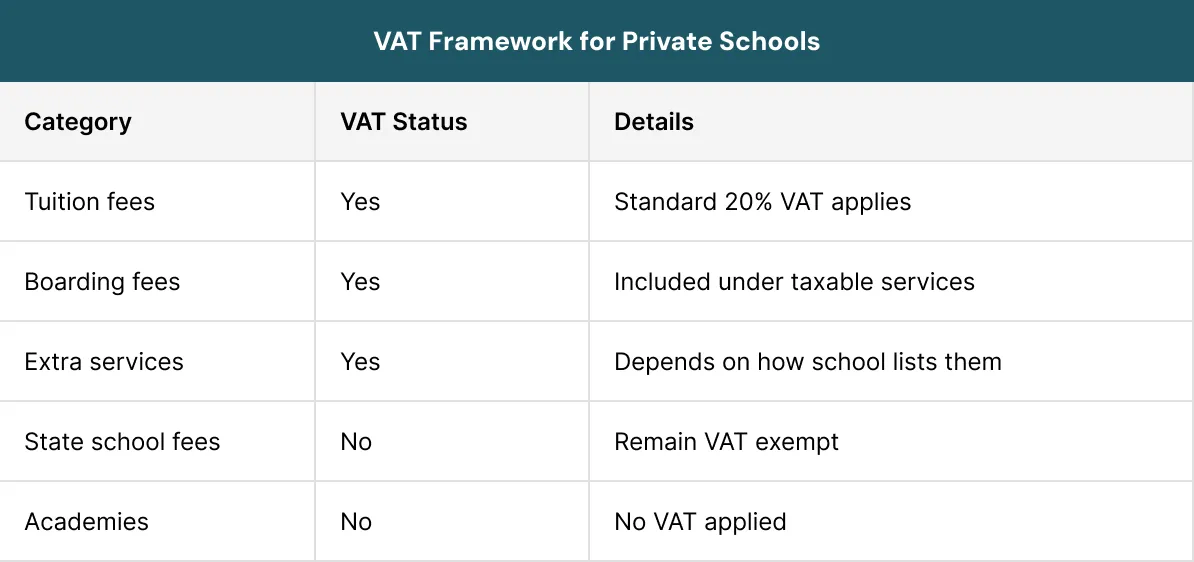
    VAT Framework for Private Schools

    This is one of the most asked questions. It needs a simple answer first. VAT on private school fees UK means the government will add extra VAT to the cost of private education.

    Most private school education was exempt from VAT before. Now it will be treated like a taxable service.

    This change applies to:

    • Tuition fees
    • Boarding fees
    • Services linked to education

    This shows why families are concerned. That is a big shift that changes the entire financial planning for many families.

    This is why VAT on private school fees UK is being discussed widely.

    Why VAT on Private School Fees Hits Differently?

    Some policy changes may not affect your daily life much. This one is very close to everyday life. Education is part of a child’s journey. So, private school fees change in the UK raises many issues.

    It can also bring stress and sometimes difficult decisions. The right approach for your family is not to rush. You should plan wisely to deal with current issues.

    What Is the Purpose of VAT on Private School Fees?

    The government wants to raise more funds. These funds are used for public services like state education.

    Private education is treated like other paid services by applying VAT.The idea is that this will bring more money to support state schools.

    Some people believe that removing VAT relief makes the system fairer. Others argue that it places an extra burden on families.

    Families already make sacrifices for education. That sparked debates around UK VAT on private school fees legal challenges.

    Some people question:

    • Whether the change is fair
    • Whether it could be challenged legally

    Does VAT Affect Everyone?

    No, VAT does not affect everyone.

    This policy includes:

    • Private schools
    • Independent schools
    • Private sixth form colleges

    State schools and academies do not have to pay VAT. This includes state boarding schools as well. This change will not affect families using state education.

    Now comes the more complex part. Military families, especially those receiving CEA (Continuity of Education Allowance) are also affected. They also have to pay VAT.

    Support is adjusted but costs still rise. This makes VAT on private school fees affect families differently.

    1. Does VAT Affect the Demand for Private Schools?

    Yes, it affects the demand for private schools. Many people are thinking about other schools they can afford.

    Some families may move to state schools due to rising fees. Others may continue with private education. They adjust their budgets to pay the fees.

    Schools will still exist but the balance may shift over time. This also affects how people view UK VAT on private school fees. It becomes part of a bigger topic about education choices in the UK.

    2. Does VAT Affect Military Families?

    Yes, VAT also affects military families. They are not exempt from VAT on private school fees. Military families often rely on the CEA. This helps cover school fees when families move to different postings.

    The government has increased CEA to help with the change in VAT. However, parents still need to spend.

    Even with increased CEA, parents’ out-of-pocket costs rise because VAT increases fees. This puts a financial burden on them.

    While the allowance has increased, it does not fully cover the rising costs for all families.

    This shows the policy changes affect families. It is not just a policy, it is about daily life decisions.
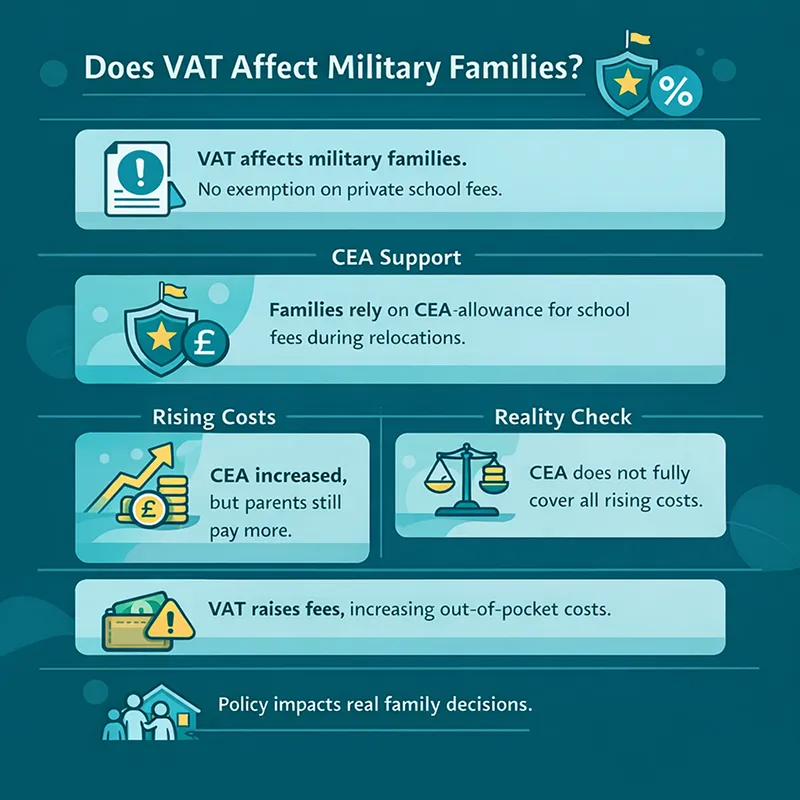
    Does VAT Affect Military Families

    How Schools Are Responding to VAT?

    Not all schools react in the same way. Some may increase fees fully to cover VAT. Some may absorb part of the cost to stay competitive. Others may change their fee structure to include VAT.

    This can be stressful for families. Fee increases may vary from school to school.

    For example, one school may increase fees by 20% while another may increase by 25%.

    This depends on financial reserves, demand for places and competition in the area. This variation makes planning harder. Families cannot assume one fixed outcome.

    1. Will School Fees Increase Because of VAT?

    Yes, school fees are increasing because of VAT. Most schools are expected to pass some or all of the VAT cost to parents. But the situation is not always equal.

    Some schools may absorb part of the cost. Others may increase fees fully. It depends on school financial strength, demand and competition.

    Data shows in the UK, private day school fees now cost about £18,000 to £22,000 a year after increases of 6–8% per year. This shows families must prepare for changes that may not be exactly the same across all schools.

    The effect of VAT on private school fees UK is not fixed but it varies by school.

    2. Does VAT Apply to Boarding and Extra Costs?

    The answer is yes. These extra costs are for some added services provided by the school. It does not only apply to tuition.

    Some things do not change like some educational materials and basic welfare services. They may still be treated in a different way. It depends on how they are listed. Now VAT calculations have become more complex.

    Schools must decide how services are grouped. This affects how VAT is applied. The point is very simple for parents.Total costs may rise, not just tuition fees.

    3. May VAT Still Apply If Fees Are Paid In Advance

    Yes, VAT still applies even if fees are paid early. Now, there is something important many people do not realise.

    VAT may still affect fees that were paid early. It depends on how early you pay the fees. Schools look at when the fees are paid.

    Some rules are applied for a short time. These rules prevent early payments from being used to avoid VAT.

    VAT may still apply even if you paid fees in advance. This is why people in the UK are look for ways to avoid VAT on private school fees. In fact, new rules make it very hard to avoid it fully.

    Can Families Avoid VAT on Private School Fees?

    No, families can not fully avoid VAT. In the UK, there is no clear legal method to avoid tax on private school fees under the current policy.

    There are some options that may reduce the effect.

    Families may consider:

    • Moving to state schools
    • Exploring scholarships or bursaries
    • Reviewing school choices

    None of these options can remove VAT directly. They only change the situation around it. Some people are also looking at ongoing debates about VAT on private school fees legal challenge. There is no confirmed outcome yet from these debates.
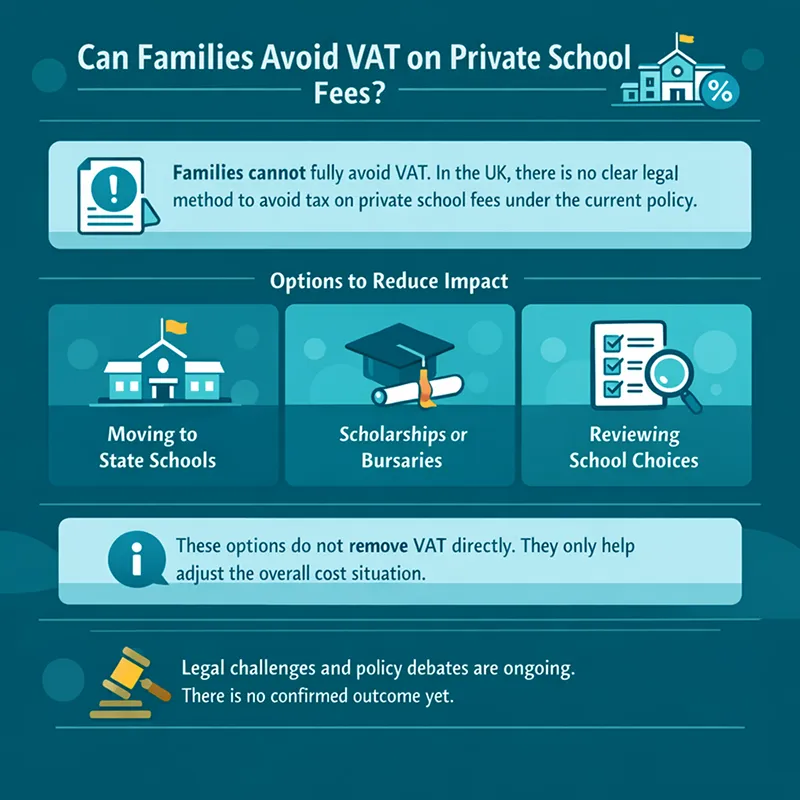
    Can Families Avoid VAT on Private School Fees

    Pause to Reflect

    At this point, the topic may feel heavy for you and that is normal. Education decisions are never just financial. They involve:

    • Your stability
    • Your future plans
    • Your emotive choices

    Policy changes may seem like numbers on paper but for families, they are decisions for life.

    What Happens Next?
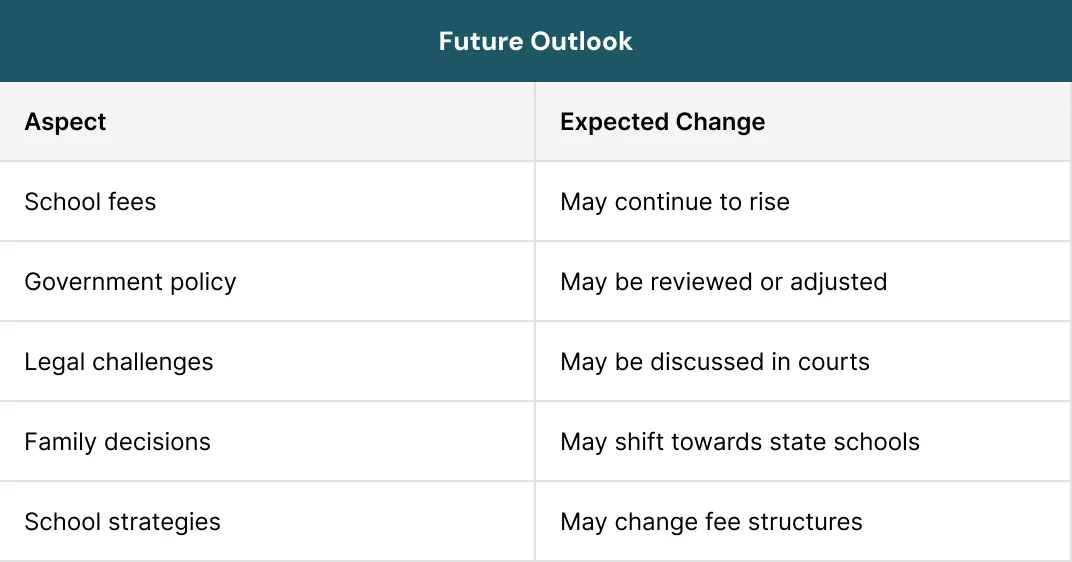
    Future Outlook

    This change has already been decided. Many families still hope the situation may improve. The government has said it will check the effects of VAT.

    Future changes may be made based on the responses of families and schools. This means the debate is not fully finished. More updates may come in the future.

    Payment Timing and Transitional Rules

    This part plays a key role in VAT. VAT applies based on when education is provided, not when payment is made, which can be unexpected.

    To understand tax requirements in more detail, read our guide on how to get a VAT certificate.

    VAT may still apply if fees are paid before the school term starts. This is because some new rules are made to stop early payments being used to avoid tax.

    These rules stop people from paying early just to skip VAT. So even a careful plan may not fully change the result.

    This is another reason people think about how to avoid VAT on private school fees UK. Some rules are made to limit those options.

    Scholarships and Bursary Support

    Expenses are growing fast. These forms of support are now more important than before. A bursary is a form of financial support given to a family in need, usually covering part or all of school fees.

    Scholarships and bursaries can help reduce the total cost. They do not remove VAT itself. 

    If a school gives financial support, VAT still applies to the value of education they provide. This means it helps but the tax still exists.

    Some schools may expand bursary schemes to support families. It depends on funds and school policy.

    Families may find some comfort at this stage. Even small support may help some families.

    Can You Challenge This Policy?

    Yes, you can challenge this policy. Many people are looking for ways to challenge this policy. Debates continue about legal challenges to VAT on private school fees.

    Some people feel this policy may not be fair for families with special needs. Others think it may affect who can access education and should be reviewed.

    So far, there is no confirmed legal decision that changes the policy. The rules of VAT still apply. So, families should plan based on the current system rather than waiting for change.

    Impact on Families

    This is where effects become more personal.

    The change in tax on private school fees may affect:

    • Your school choices
    • Your family budgets
    • Your long term planning

    Some families may continue and adjust with VAT. Others may think of other school options. It is not only about money. It also affects stability for children, especially when they are in exam years.

    Changing schools is not always simple or desirable. This is why the debate is not only about money. It is about continuity, comfort and future outcomes.

    How to Plan for VAT?

    Pro Tip

    Plan early to avoid stress later. Check full costs, support options and future affordability.

    This is the basic part because it gives direction to plan for VAT. There are some key steps to plan for this change.

    These steps include:

    1. Awareness

    The first step plays a key role. It means knowing how the tax on private school fees may affect your money.

    2. Reviewing

    The next step is reviewing finances.

    Families may need to:

    • Recalculate yearly education costs
    • Check affordability over multiple years
    • Plan for gradual increases

    3. Exploring

    The third step is exploring options.

    These options may include:

    • Speaking with schools about payment structures
    • Asking about bursaries or support
    • Reviewing alternative education paths

    You can choose an option that fits your situation and comfort level.

    Why VAT on Private School Fees Hits Differently?

    Some policy changes may not affect your daily life much. This one is very close to everyday life. Education is part of a child’s journey. So, private school fees change in the UK raises many issues.

    It can also bring stress and sometimes difficult decisions. The right approach for your family is not to rush. You should plan wisely to deal with current issues.

    Key Takeaways

    • Tax on private school fees will apply to all private schools but it can vary
    • State schools remain exempt from VAT
    • Military families are not exempt but support is adjusted by CEA
    • Costs for parents will still increase even with allowances
    • Some debates exist around tax on private school fees legal challenge
    • There is no simple way to avoid UK VAT on private school fees. Some options may reduce impact

    Case Study

    A UK military family with two children studying at a private boarding school. They faced higher costs after tax on private school fees was introduced.

    Their CEA raised but it did not fully cover the rise. So their own share in costs still increased.

    The family thought about moving one child. Exam years made that difficult for them. They cut spending in other places. They also adjusted their plans.

    This shows that in the UK VAT on private school fees affects family budgets. It also affects school stability and peace of mind.

    This policy places a heavy burden on families. Many families look for ways to reduce tax on private school fees, but there is no simple solution under current rules.

    Conclusion

    The change in VAT on private school fees is slowly changing how families think about education.

    Some people can manage this issue with small changes. On the other hand, it can cause real trouble for others.

    Every family has a unique lifestyle. One solution does not fit everyone. It matters the most when you know the change early.

    At that stage, it becomes easier to make the right decisions because things are clearer. Wasting time may lead you to stress or rushed choices.

    The debates around tax on private school fees will likely continue.

    You can expect:

    • New updates
    • Reviews
    • Further debates

    It becomes important to plan right now, as policy is moving forward. There are also ongoing debates on the tax on private school fees. It is better to be prepared for current rules until anything changes officially.

    Education decisions take time. They are financial and personal at the same time. Families move forward with more confidence with a calm and informed approach.

    Sterling Cooper helps clients understand policy changes, financial topics and educational content. This is where the right guidance makes a difference.

    Contact us today to make the right decisions for your family and plan ahead with confidence.

    Unsure how VAT on private school fees will impact your family’s finances?

    We provide clear expert guidance to help you understand financial impact and make informed decisions, trusted by professionals across the UK.
    Contact us today to get clear answers, reduce uncertainty and make confident decisions about your child’s education with expert guidance.
    +443300102526
    Book an Appointment

    FAQs


    Do private schools pay VAT in the UK?


    Yes. From 1 January 2025, private schools in the UK must charge 20% VAT on education and training services, including school and boarding fees.


    No. School fees cannot be used to reduce your tax bill. However, families may plan payments tax-efficiently, for example through regular gifts from grandparents that fall outside inheritance tax rules.


    It depends. Data from the Department for Education (2025) shows that privately educated graduates earn about 15% more on average five years after graduation, but the costs of private education are high.


    Some services are VAT exempt, such as financial services, insurance, investments and certain property-related services like land and buildings.


    Many families use scholarships, bursaries, savings plans or family support. Schools often provide financial aid based on talent or financial need.


    Some children attend for free through full bursaries or scholarships, usually awarded to highly talented students or families who cannot afford the fees.

    Share This Article!

    Recent Posts

  • The Complete Guide to Payroll Management

    The Complete Guide to Payroll Management

    payroll management guide

    Posted by:

    Admin

    Date:

    April 1, 2026

    Category:

    blogs

    Error: Contact form not found.

    The Complete Guide to Payroll Management

    For any business, payroll is a crucial part of managing employees and meeting tax and reporting obligations. Employees expect accurate, on-time pay, while employers need to calculate wages correctly, manage PAYE and National Insurance and meet HMRC requirements.
    However, payroll can become more complex as a business grows. A 2026 UK payroll efficiency report found that 9 in 10 payroll professionals had experienced payroll errors in 2025, while 68% reported payment delays. Errors and delays can affect employees and may also lead to compliance issues, including penalties where PAYE reporting requirements are not met. This makes an effective payroll management process essential for UK businesses.
    This guide explains what payroll management is, how the process works and what businesses can do to manage payroll accurately, efficiently and in line with UK requirements.

    Key Information

    • Compliance risk focuses on following laws, regulations and internal rules, while operational risk relates to failures that disrupt daily business activities.
    • The difference between compliance risk and operational risk can affect how a business spots, controls and responds to threats.
    • Operational risk management helps businesses spot weaknesses in people, processes, systems and external events before they cause problems.
    • Compliance risk is often more tactical and prescriptive, while operational risk management takes a broader, more strategic and predictive approach.
    • Both risks can overlap, so businesses should manage compliance risk and operational risk together to reduce losses, meet legal duties and improve resilience.
    • Effective risk management includes clear policies, employee training, regular reviews, strong controls and collaboration across teams.


    What Is Payroll Management?

    Payroll management is the process of calculating employees’ pay, applying the correct deductions, paying employees and reporting payroll information to HMRC. It involves more than calculating salaries. Employers also need to account for changes such as overtime and bonuses, process deductions and maintain accurate payroll records. Effective payroll management helps businesses meet their payroll and reporting obligations while keeping employee pay accurate and on time.
    The table below explains the main areas of payroll management:As HMRC states: “As an employer running payroll, you need to report your employee’s pay, any payrolled benefits and deductions in a Full Payment Submission (FPS) on or before their payday.”

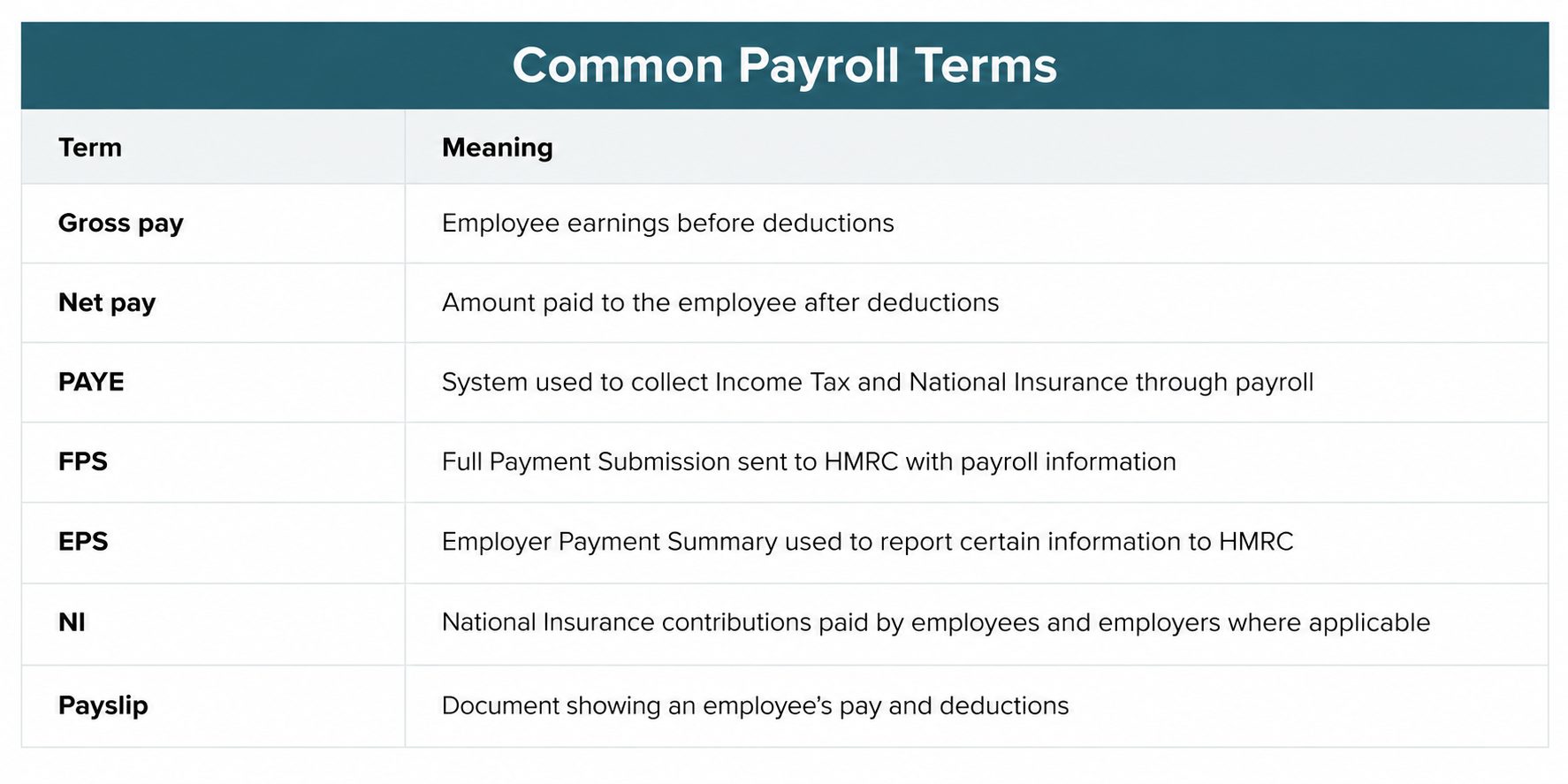
    Key Payroll Terms You Should Know

    Before exploring the payroll process, it is useful to understand the key terms commonly used in payroll management: common payroll terms

    How Does the Payroll Management Process Work? A Step-by-Step Guide

    Payroll follows a regular cycle, which may be weekly, fortnightly, four-weekly or monthly, depending on the employer. Although the exact process can vary between businesses, the main stages generally remain the same.

    Step 1: Collect Employee Information

    The payroll management process begins with collecting and verifying each employee’s information. This may include:

    • Full name and address
    • National Insurance number
    • Tax code
    • Salary or hourly rate
    • Bank details
    • Pension information
    • Relevant starter information or P45 details

    Employers should keep this information up to date and amend it when an employee’s circumstances change. Accurate records help reduce payroll errors and support compliance with reporting and tax requirements.

    Step 2: Record Hours, Salary and Additional Pay

    The next step is to determine how much each employee should receive before deductions. Depending on the employee’s pay arrangement, this may include:

    • Basic salary
    • Hourly wages
    • Overtime
    • Bonuses
    • Commission
    • Allowances
    • Applicable statutory payments

    Employers may also check attendance, working hours and approved leave before payroll is processed.

    Did You know?
    Finity’s 2026 UK Payroll Efficiency Report found that 77% of payroll professionals lose up to 11 hours per week to inefficient technology or processes, while 68% experience payment delays. 

    Step 3: Calculate Gross Pay

    Once the relevant hours, rates and additional payments have been confirmed, the employer calculates each employee’s gross pay before deductions.

    For salaried employees, gross pay is generally based on their regular salary, adjusted where necessary for factors such as unpaid leave or changes in pay. For hourly workers, it is calculated using the hours worked and the agreed rate. Overtime, bonuses and commission may also form part of gross pay where applicable.

    Step 4: Apply Tax, National Insurance, Pension and Other Deductions

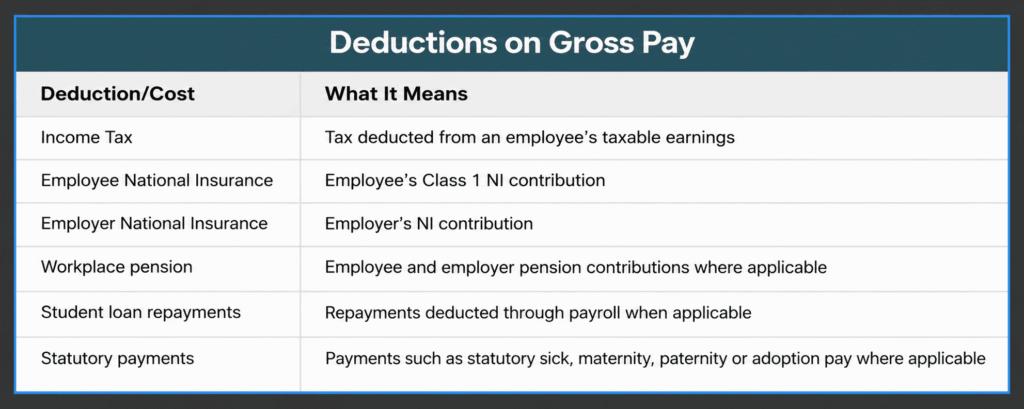
    After calculating gross pay, the employer applies the relevant deductions. The employee’s tax code and payroll information are important at this stage because errors can affect the amount deducted. The table below explains the types of deductions applied to the gross pay:


    Deductions on Gross Pay

    Step 5: Calculate and Check Net Pay

    After the applicable deductions have been calculated, the remaining amount is the employee’s net pay. This is the amount the employee receives after deductions.

    Before finalising payroll, the employer should review the results for unusual changes, missing information or calculation errors. This helps ensure employees receive the correct amount and payroll records are accurate.

    Step 6: Pay Employees

    Once the payroll has been reviewed and approved, the employer pays employees their net wages using the agreed payment method.

    Payments should be made on the agreed payday, and the payment amounts should match the finalised payroll records. This helps maintain accurate payment records and supports a reliable payroll process.

    Step 7: Issue Payslips

    Employers must provide employees and eligible workers with a payslip on or before payday. A payslip helps employees understand how their pay was calculated and what deductions have been made. A payslip may include:

    • Gross pay
    • Net pay
    • Income Tax
    • National Insurance
    • Other deductions
    • Pay period
    • Hours worked, where pay varies according to hours

    Step 8: Submit Required Reports to HMRC

    Employers operating PAYE must report payroll information to HMRC through Real Time Information (RTI). The Full Payment Submission (FPS) is normally sent on or before payday. An FPS includes information such as:

    • Employee pay
    • Income Tax
    • National Insurance
    • Other relevant deductions
    • Payrolled benefits, where applicable

    Late or inaccurate payroll reporting can result in HMRC penalties, depending on the circumstances.

    Step 9: Pay HMRC and Other Relevant Bodies

    After payroll has been processed, the employer must pay amounts owed to HMRC and other relevant recipients. This may include:

    • PAYE and National Insurance to HMRC
    • Employee and employer pension contributions to the relevant pension provider
    • Other applicable deductions or payments to the relevant recipient

    Payroll management monitors every deadline closely to avoid penalties or compliance problems.

    Step 10: Review and Reconcile Payroll Records

    The final stage is to review and reconcile payroll records to make sure the figures are complete and accurate. Often, these records are compared with:

    • Bank payments
    • HMRC liabilities
    • Pension contributions
    • Accounting records
    • Previous payroll periods

    Regular reconciliation helps employers identify discrepancies and correct errors before they become more costly problems.


    Did You know?
    Employers must keep PAYE records for at least three years from the end of the tax year they relate to. These records can include details of employee pay, deductions, payroll reports submitted to HMRC and payments made to HMRC.

    How Can Outsourcing Improve Payroll Management?

    As businesses grow, managing payroll can become more complex. Hiring more employees, introducing different pay arrangements and keeping up with changing compliance requirements can increase the workload for internal teams. This can also increase the risk of payroll errors and missed deadlines.
    Payroll outsourcing can help businesses manage this complexity by giving them access to specialist payroll professionals. Depending on their needs, a company can outsource part or all of its payroll management process while retaining oversight of key decisions.
    For example, Sterling Cooper Consultants provides payroll management services that include:

    • Payroll processing
    • Tax and pension calculations and submissions
    • Payslips
    • Payroll reporting and compliance support

    Businesses can also choose from fully managed, partially managed or payroll processing-only options, depending on the level of support they require.

    Payroll Management Checklist

    Use this checklist to make sure each key stage of the payroll management process is completed accurately and on time: 

    Conclusion

    Payroll management involves much more than paying employees. It involves maintaining accurate employee information, calculating pay and deductions, issuing payslips, reporting to HMRC and keeping payroll records up to date. A well-managed payroll process helps businesses pay employees accurately and on time while reducing the risk of errors, compliance issues and avoidable penalties.
    As payroll requirements become more complex, businesses can use payroll software or outsource some or all of their payroll activities to specialist providers. The right approach depends on the size of the business, the complexity of its payroll and the level of support available internally.

    Need Payroll Support?

    Keep your payroll accurate and compliant with specialist support from Sterling Cooper Consultants, covering payroll processing, payslips, tax, pensions and reporting. Get in touch to discuss your payroll needs.


    +443300102526
    Get In Touch

    FAQs


    What is payroll management?

    Payroll management is the process of calculating employee pay, applying deductions, paying employees and completing the required payroll reporting and record-keeping.


    Payroll management can include maintaining employee information, calculating wages and salaries, managing PAYE and National Insurance, processing pension contributions, issuing payslips, submitting reports to HMRC and reconciling payroll records.


    Payroll can be processed weekly, fortnightly, four-weekly or monthly, depending on the employer’s chosen pay schedule.


    A Full Payment Submission (FPS) is a report sent to HMRC containing information about employees’ pay, deductions and other required details. Employers generally submit an FPS on or before payday.


    Yes. Businesses can outsource some or all of their payroll activities to a specialist provider. Services can range from payroll processing and payslips to fully managed payroll, depending on the provider and the business’s requirements.


    Outsourcing payroll can reduce administrative workload and give businesses access to specialist support for payroll calculations, payslips, deductions, pension administration, reporting and compliance.


    HMRC can apply penalties for late or missing PAYE reports, depending on the type of submission and the circumstances. Businesses should follow the relevant reporting deadlines to reduce the risk of penalties and compliance issues.


    Share This Article!

    Recent Posts

  • What Is Business Advisory Service and Why Does It Matter?

    What Is Business Advisory Service and Why Does It Matter?

    business advisory

    Posted by:

    Admin

    Date:

    March 31, 2026

    Category:

    blogs

    Error: Contact form not found.

    What Is Business Advisory Service and Why Does It Matter?

    Why do some businesses grow fast? Others fall behind, even with the same tools. Strong business advisory is what sets a business apart. It guides businesses to make stronger decisions and stay ahead.

    Most small businesses struggle with money because they don’t know how to manage it well. Without good advice, many businesses miss ways to save money and work better.

    The UK management consulting market was worth about £15 billion in the previous years. This shows how much companies rely on consulting services. These services help with planning, technology and business advice.

    Business advisory services go beyond just working with numbers. From startups to large firms, these services help businesses of all sizes. They also help businesses handle challenges and optimise resources.

    In this blog, you will find out:

    • What is business advisory
    • Why does it matter
    • Its main services for profitability, growth and efficiency
    • Important types of advisory services
    • How it enables businesses to make smarter operational and financial decisions

    What Is Business Advisory?

    Business advisory provides expert help in managing and developing your business. These services provide more than basic accounting or one-time advice.

    An advisor supports your business for the long term. They help you understand your accounting records and organise them clearly.

    The key objective is simple. These services utilise data to grow, earn more and stay in control.

    Many people think business advisory is only about reports, but its real goal is much more.

    It helps you in many ways, such as:

    • Make better choices
    • Run your business better
    • Handle risks and cash flow
    • Plan your strategy

    Good advice helps you throughout your business journey. It covers your market, systems, team and objectives.

    Many small businesses struggle with their finances. Nearly 60% of small and medium businesses say they don’t have enough money or the know-how. Advisors help businesses focus on the main things and take the right steps.

    In 2025, UK consulting and business advisory services made about £15.7 billion. This was a growth of around 5 % from the previous year. Companies used these services for help with growth, technology and business changes.

    Levels of Business Advisory Services

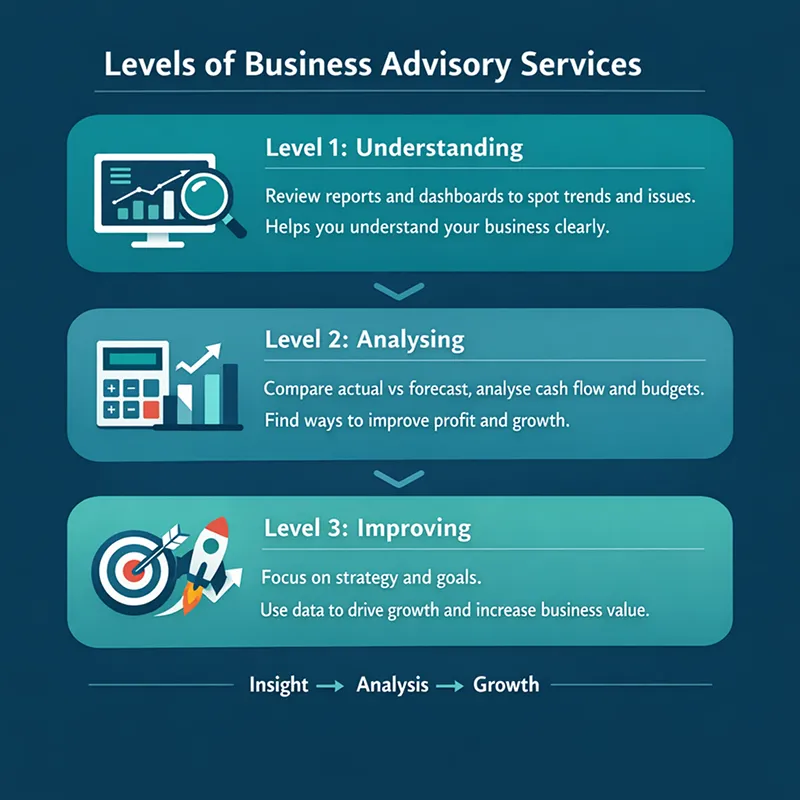
    Business advice functions in different ways for different businesses. It has three levels, each one guiding you to learn, take action and improve.

    Level 1 – Understanding the Numbers

    At this stage, advisors look at your reports, numbers and dashboards to show key points. They ask questions to find trends or problems you might have missed. This helps you see what’s really happening in your business.

    Level 2 – Analysing the Numbers

    Here, advisors consider budgets, forecasts and cash flow. They compare actual results with plans side by side. They search for ways to improve profit and growth. This level uses forecasting to help you make smart changes instead of just reacting.

    Level 3 – Improving the Numbers

    The main focus of this level is on strategy and how the business is operating overall. Advisors work like a money coach. They guide you on your business, goals and plans. They use historical and projected data to design growth. They help increase value and plan for the future.

    Levels of Business Advisory Services

    Case Study: How Allen’s Catering Made It Through Lockdown

    When the lockdown was going on, many hospitality businesses tried hard to stay open. Here’s the story of a catering firm that remained resilient and kept growing.

    Lockdown hit hospitality businesses hard. Kevin McGuiness, the CEO of Allen’s Catering, faced high bills and uncertainty. His old cash flow details did not inspire the bank’s confidence.

    Kevin asked Mercer and Hole for assistance. They built a 24-month forecast with multiple scenarios. The forecast helped Kevin. He got an extra £200,000 to keep the business open during the lockdown.

    When the lockdown ended, Kevin teamed up with small businesses to expand into new areas.

    Expert advice helped the business survive and grow.

    The Importance of Business Advisory

    In this competitive era, running a business is tougher than ever. With markets changing instantly, every decision can be a challenge. Many people don’t fully understand their money, whereas most small businesses don’t know their accounts clearly.

    Without clear information, you might make bad choices. You could also miss chances to grow or have money problems. Furthermore, this will lead you to waste time and resources.

    Here, you will understand the importance of business advisory. It helps you grasp your business requirements. It gives clear advice and guidance based on actual information. It helps you set clear objectives and make simple plans to achieve them. You can find faults, cut costs, make better use of resources and fix problems before they get worse.

    It points out opportunities to grow your business in a smart and consistent way. Advisory helps your teams, processes and tasks work together toward one goal.

    Without a plan, businesses often react to problems. They make quick fixes and miss long-term growth. Advisory services change this approach. They help you go from guessing to planning and from doubt to a clear path.

    It helps you know your business. You can make better choices and grow step by step. Finally, business consultants turn confusion into clear plans. They also make your accounts easy to understand.

    Advisory services can also guide you on funding options, including loans.

    What Main Services Does Business Advisory Provide?

    Business advisors do not just give advice about businesses. They work with you to help your business grow, run smoothly and make better choices. Some of the areas where business advisors can help you are given below:

    1. Business Strategy

    Business advisory helps you set a clear path, goals and a practical plan. Advisors also track key performance indicators (KPIs). This makes sure each step fits your goals.

    2. Money Management

    Business coaching helps with spending plans, estimates and handling cash flow. They also advise on investments to help your business make more profits. They identify potential risks and suggest ways to protect your business.

    3. Running Your Business

    Advisory services check your business operations. They look for slow points, problems or weak areas. Their advice helps your team perform better, reduce expenses and get more done.

    4. Protecting Your Business

    Business advisors help show you the risks. Advisors help you deal with them. They make plans to protect your business by preparing for problems in advance.

    5. Technology Support for Business

    Advisors help businesses use tools, automation and information technology to work smarter. They assist with cybersecurity to safeguard your business. This helps you work more easily and stay ahead of competitors.

    6. Growing Your Business

    Advisors observe the market and customers. They help your business improve and enter new areas. Growth happens through planning, not by chance.

    7. Building Leaders and Teams

    These advisors give training to owners, managers and teams to become better leaders. They help improve decision-making and create a team that pays attention to results.

    8. Watching Business Performance

    Corporate advisors track results, see how you’re doing and help make better plans. Using records helps keep your business on track. They help you make choices from facts.

    9. Boosting Sales and Income

    Business success coaching watches sales, marketing and customer data. They search for best-selling products, worthy clients and techniques to earn more money.

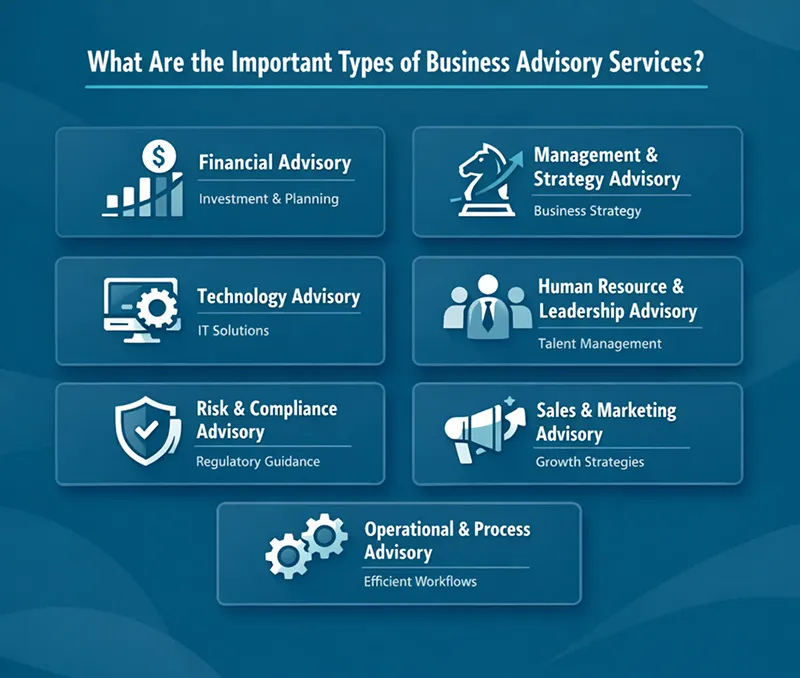
    What Are the Important Types of Business Advisory Services?

    The importance of business advisory is evident in many areas. They offer services that fit your business needs. Knowing these types helps you pick the right help to grow, improve and manage risks.

    1. Financial Advisory

    Financial advisory handles money, investments, budgets and profits. It provides financial planning, budgets, investment guidance and tax help. These advisors help corporations stay healthy, reduce risks and grow safely.

    2. Management and Strategy Advisory

    Management and strategy advisory helps businesses plan and stay on track. It provides strategy plans, market checks, takeover advice and team system help. With this help, your business gets a clear plan. It can also help adjust to market changes.

    3. Technology Advisory

    Technology advisory helps businesses use digital tools, automation and stay safe online. Technology advice helps keep your business efficient and competitive.

    4. Human Resource and Leadership Advisory

    Human resources and leadership advisory helps build strong teams. It also guides leaders and manages talent. Effective leaders and motivated teams enhance productivity and growth.

    5. Risk and Compliance Advisory

    Risk and compliance advisory helps businesses search for, manage and reduce risks. Its services check for risks and follow rules. They also offer insurance and help in emergencies.

    6. Sales and Marketing Advisory

    Sales and marketing advisory focuses on successful sales and marketing strategies. Services include sales plans, marketing, brand building and keeping clients.

    7. Operational and Process Advisory

    Operational and process advisory helps improve business operations. It also boosts sales plans. It helps make work easier and cut waste. It also cuts costs, speeds up work and helps the business grow.

    What Are the Important Types of Business Advisory Services

    Top Benefits of Business Advisory Services

    Business advisors give owners real benefits. They go beyond accounts to help make smart decisions and grow with confidence.

    Related: Business Consulting Strategies

    Benefit Description
    Expertise and knowledge Access specialised skills and industry insights not available internally.
    Objective perspective External advisors give unbiased advice, spotting blind spots and new opportunities.
    Time and resource savings Make processes easier and let your team focus on core work.
    Building lasting value Align daily tasks with objectives to grow and remain profitable.
    Wiser decisions Make smarter choices by using data.
    Business growth and competitive advantage Map out ways to grow, increase revenue and scale your business.
    Better risk management Find and lower financial, functional and market risks in advance.
    Stronger leadership and team Training helps leaders and teams run better.

    Challenges in Business Advisory Services

    Advisory has many benefits, but some problems can make it hard for businesses to use it fully.

    Challenge Description
    Cost concerns Advisory fees can be high, so small businesses and startups may find them hard to pay.
    Misalignment of goals If the advisor’s approach doesn’t match your business priorities, results may be limited.
    Resistance to change Internal teams may resist new suggestions or changes to established processes.
    Data and reporting gaps Without accurate and current financial or operational data, advisory services are less effective.
    Choosing the right advisor Check an advisor’s experience, fame, team and culture before selecting.

    What to Look for When Choosing a Business Advisory Firm?

    It is key to pick the right advisory firm. They add value and help your business grow. Important things to keep in mind when picking an advisory are:

    1. Related Experience

    Pick a firm that knows your industry and offers the services your business needs. If they know your problems, it will make their advice useful and easy to follow.

    2. Trusted Reputation

    Look at references, customer reviews and experience. A firm that delivers results shows that it can help the growth of your business.

    3. Skilled Team

    Be aware of what the advisors can do and the expertise they possess. A strong team with diverse skills delivers new ideas and practical solutions.

    4. Matching Culture

    Make sure the advisory’s values and work style align with your business. A strong cultural fit helps teams work better and get outstanding results.

    5. Clear Communication and Support

    Evaluate how the firm communicates progress and provides support. Systematic updates and timely support keep your business on track.

    6. Complete Set of Services

    Check the services they deliver, such as strategy, finance, operations and technology. The right advisory firm covers your main requirements and supports your business growth.

    Closing Thoughts

    Running a business today is fast-paced and challenging. If the insights aren’t clear, you could miss growth opportunities or make bad calls. A business advisor helps you understand your numbers and make future plans.

    It gives a clear plan for your business. It helps your business run well and grow steadily. It helps you move from guesswork to control, improve cash flow and set clear objectives.

    At Sterling Cooper, we know the importance of business advisory. We deliver business advice that helps you grow your business. Also, we enable you to make informed decisions.

    Contact us today to secure a sustainable future for your business.

    Struggling to make sense of your business finances and growth plans?

    We’ve helped dozens of businesses boost profits and streamline operations. We provide expert guidance to make smarter decisions and drive steady growth.
    Reach out today to take control of your business’s future.
    +443300102526
    Book an Appointment

    FAQs


    How to grow financial advisory business?

    To grow your financial advisory business, focus on building trust with clients, offering personalised solutions and showcasing your expertise. Use digital marketing, networking and referrals to reach new clients. Continuously improve your services, stay updated on industry trends and provide clear, easy-to-understand financial guidance. Strong client relationships and consistent results drive long-term growth.


    Advisory in business means providing expert guidance to help companies make better decisions, improve operations, manage risks and grow. Advisors offer support in areas like strategy, finance, technology and leadership to ensure businesses run efficiently and achieve their goals.


    Businesses need advisory services to make smarter decisions, manage risks, improve operations and plan for growth. Advisors help turn data into clear actions and long-term strategies.


    Common types include financial advisory, strategy and management advisory, technology guidance, HR and leadership support, risk and compliance advice, sales and marketing help and operational improvement.


    Advisors analyse numbers, processes and strategies to find cost savings, boost productivity and identify growth opportunities, helping businesses earn more while working smarter.

    Share This Article!

    Recent Posts

  • How to Assess Your Risk Tolerance Before Investing

    How to Assess Your Risk Tolerance Before Investing

    risk tolerance

    Posted by:

    Admin

    Date:

    March 30, 2026

    Category:

    blogs

    Error: Contact form not found.

    How to Assess Your Risk Tolerance Before Investing

    Do you fear losing money when thinking of investing? Investing always comes with risk. There is always a chance that your investment could lose value, whether you buy:

    • Stocks
    • Mutual funds
    • Bonds

    The higher the risks, more rewards can be obtained. But nothing is guaranteed. Risk tolerance will help you choose the right investment plan and make better decisions based on your finances.

    It is a matter of your peace of mind and your goals if you assess your risk tolerance. A study in the UK shows that 21% of adults are likely to make small investments in 2026. The idea of small regular investments looks good. It helps you to build long term wealth without stress. These kinds of investments are more affordable, especially for beginners.

    In this blog, you will learn:

    • What is risk tolerance in investing
    • Why understanding risk tolerance comes first
    • Why risk tolerance matters before you invest
    • What factors influence your risk capacity
    • How your investment time frame affects risk
    • How to measure your risk profile

    What Is Risk Tolerance in Investing

    The degree of financial loss and uncertainty that an investor can take is called risk tolerance. It shows how much loss you can handle and how calmly you can tolerate market changes. This involves both the financial and emotional losses. It is shaped by your:

    • Financial situation
    • Personality and goals
    • Time frame and life experiences

    Some investors enjoy taking risks, while others prefer low risk investments. Most people sit somewhere in the middle. Your investment choice depends on your comfort level. Measuring risk tolerance is not easy.

    Before building a portfolio, you should be careful about your emotions, your money and your long term goals. With the right strategy, low risk investments can help you grow your money over time. It can help you in:

    • Retirement
    • Buying a home
    • Savings for the future
    • Paying for education

    You should consider these questions before you choose anything to make an investment. 

    • Are you ready to tolerate risk?
    • How much risk can you handle?

    The answers depend on you, your time and money situation. It also depends on your investment plan. It is important to consider if you feel comfortable with market fluctuations.

    Why Understanding Risk Tolerance Comes First

    Recent data shows that around 68% of UK investors now choose a careful approach while investing. This shows the importance of understanding your level of risk comfort. It helps you shape real investment decisions in 2026.

    Risk comfort level is the most important factor which shapes:

    • How do you react when markets move
    • What results do you get over time

    If you invest too aggressively, you may panic in downturns. If you sell at the wrong time, you miss the recovery from loss. If you invest too conservatively, you may not reach long term goals. Your returns may not match with inflation. When your risk level is properly aligned, you feel more confident and stay stable. You need to make careful decisions when the market is changing.

    Why Risk Tolerance Matters Before You Invest

    You must understand your risk capacity before investing. It helps you make right decisions during market ups and downs. The right risk level helps match investments to your goals, time frame and real financial needs. So choices feel calmer, more stable and easier to stick with over time.

    Risk Capacity vs Risk Comfort

    Risk tolerance includes two main parts:

    1. Risk Capacity (Financial Ability)

    Risk capacity is about what you can afford financially. It shows how much you can lose easily. If you need your investment money for daily costs like rent, food or medical bills. then your risk capacity is lower. If the money is extra and losing some would be upsetting, not stressful, then your risk capacity is higher.

    2. Risk Comfort (Emotional Ability)

    Risk comfort involves emotions. It shows how much uncertainty you can tolerate without panic. Some people stay calm during market drops. Others panic as soon as they see losses.

    If market changes make you lose sleep, you may be taking too much risk by investing aggressively. There is a difference in willing to take risks and being able to afford them.

    your finances may not support that risk level even if you show some guts. You may be able to afford the risk but still worry about prices swinging.

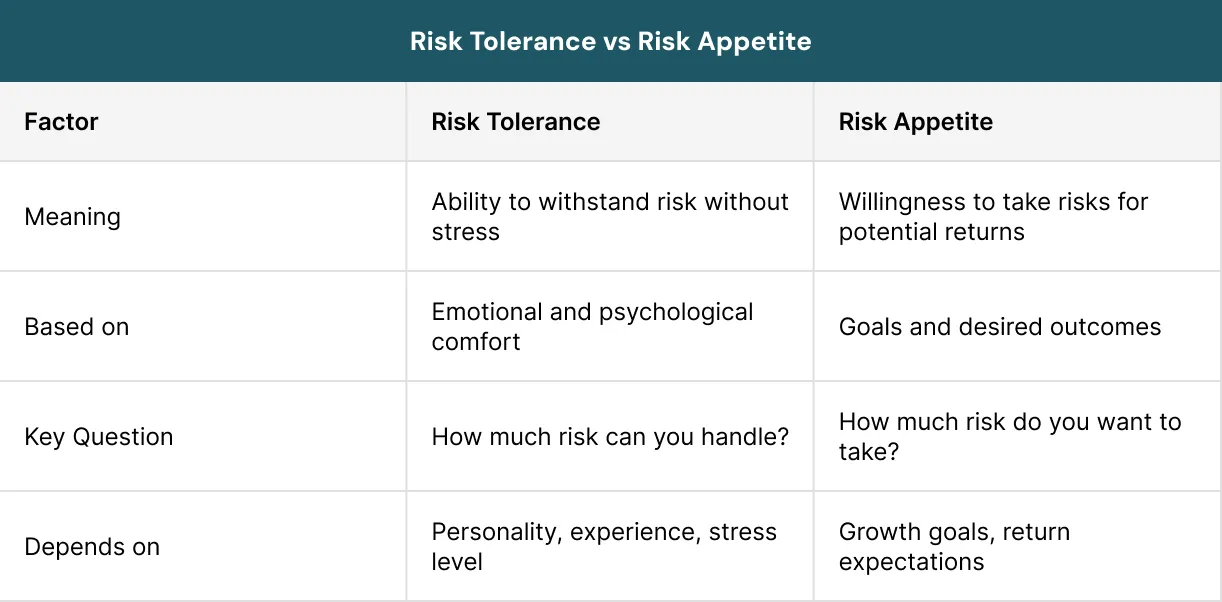
    Risk Tolerance vs Risk Appetite

    Risk tolerance is how much risk can be taken for a specific situation. It sets the limits and rules to handle that risk.

    Risk appetite means the overall risk an organisation is willing to handle. In simple words, appetite is the bigger picture and tolerance is the boundary for each risk.

    Risk Tolerance vs Risk Appetite

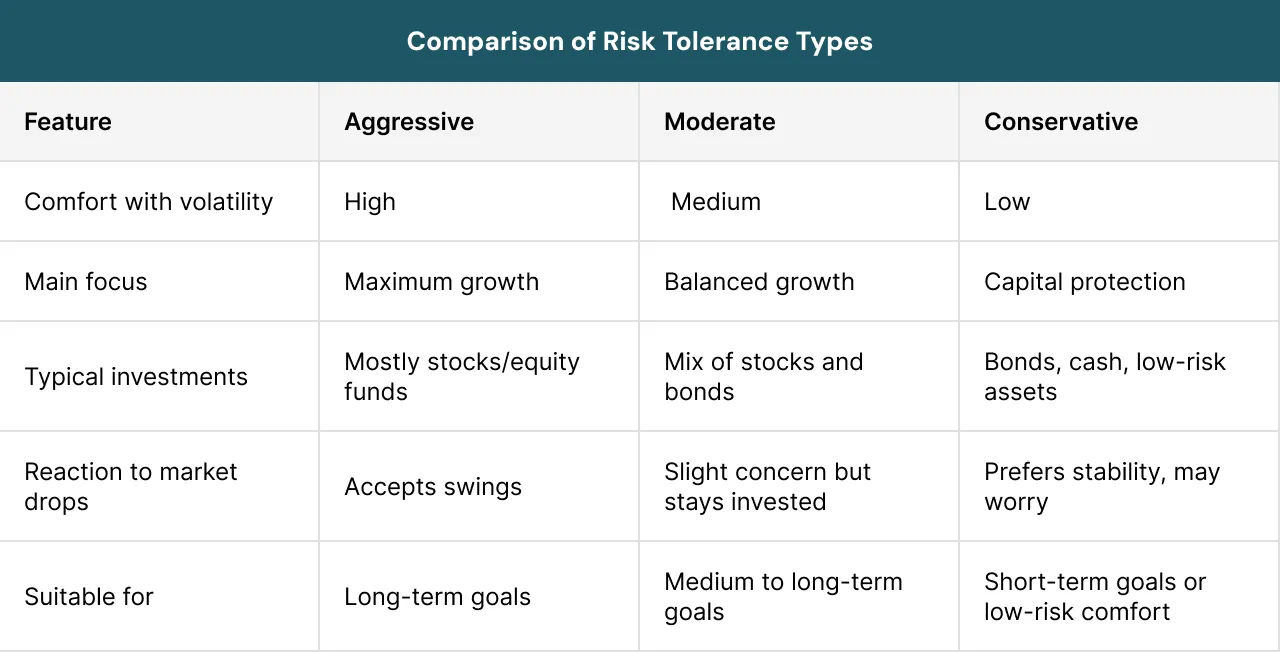
    Types of Risk Tolerance in Investors

    The approach to investments and risk tolerance varies for different people and organisations. Typical approaches of risk tolerance include:

    Aggressive

    • Comfortable with high volatility
    • Willing to risk losses for higher returns
    • Often invest heavily in stocks
    • Aim for maximum growth
    • Accept market swings

    Moderate

    • Prefer balance
    • Mix of stocks and bonds
    • Accept some risk but want stability
    • Seek steady growth with controlled volatility

    Conservative

    • Prefer low volatility
    • Focus on money preservation
    • Choose safe investments
    • Choose easy to access investments
    • Avoid big changes in portfolio value

    Comparison of Risk Tolerance Types

    What Factors Influence Your Risk Tolerance

    Risk tolerance involves some other factors as well. The factors that shape this are:

    1. Investment Objectives

    If your objective is high growth, you may need higher risk investments. If your objective is protecting assets, low risk investments may be better. Even if returns are smaller, they may be more suitable.

    Your objectives must reflect your needs and your goals. They also reflect the risks you are willing to take.

    2. Time Frame

    Time frame means how long you plan to stay invested. In the long term goal (20–30 years), you can usually afford more risk. You also have time to recover from losses.

    In the short term goal (1–5 years), lower risk may be right for you. This is important if you do not want large losses right before withdrawal.

    Consider liquidity, that means how easily you can access your money when needed. Risk tolerance changes with time.

    3. Reliance on Funds

    Ask yourself if you depend on this money. Risk tolerance may need to be lower, if you depend on it. The important things such as:

    • Retirement
    • Buying a house
    • Child’s education

    Risk capacity should match your real financial needs too. Also consider your expenses like:

    • Routine: housing, food, utilities
    • Emergency: repairs, medical bills
    • Long term: college, health care

    4. Personality and Experience

    Risk comfort level is deeply personal. It reflects:

    • Your life stage
    • Your investing knowledge
    • Your past experiences
    • Your personality traits

    Some people easily handle uncertainty, while others prefer to avoid it. Your risk comfort level is shaped by your life experiences. It may change slowly over time due to:

    • Family changes
    • Economic shifts
    • Personal events

    How Your Investment Time Frame Affects Risk

    Your time frame is very important for your risk tolerance. It simply means how long you can invest. If retirement is 30 years away, you have time to recover from losses. So short term drops may not affect your long term plan. You may be able to tolerate more risk.

    If you need the money in two years for a home down payment, a big market fall could hit your goal. So, you may need more stability and lower risk. Cash options can make more sense.

    In general, longer timelines can allow more risk. Shorter timelines often need more caution. This is not automatic. Your financial needs and your comfort should be the deciders.

    Understanding Volatility and Investment Risk

    There is uncertainty in investing. You might earn less than you expected or lose some or all your money. Market prices may change quickly. These ups and downs in prices are called volatility.

    Successful investing is about managing risk, not avoiding it. – Benjamin Graham

    Higher volatility generally comes with higher risk. It can bring higher returns, but it can also bring bigger losses. This relationship is called the risk return tradeoff.

    Risk Return Trade Off

    The risk return tradeoff means higher risk can bring higher returns. It can also lead to bigger losses. Higher risk investments like stocks or equity funds may grow more over time. Their prices can swing up and down.

    Low risk investments like cash or some bonds usually move less. They may protect you from big losses. They often give smaller rewards. There are no high returns with zero risk. So, promises of guaranteed high returns with no risk should be a warning sign.

    When assessing your risk capacity, the risk level should fit your goals and timeline. You cannot avoid risk because it always exists. It also fits your financial capacity and emotional comfort. It is important to understand how you tolerate risk.

    Types of Risk Assessment Tools

    Following are two main types of risk assessment tools:

    1. Revealed Preference Exercises

    They use made up choices to see how you react under risk. For example, they may ask if you want a guaranteed amount or a 50/50 chance to win more.

    These tests can show decision patterns. They often do not feel real and do not always match how people invest in real markets.

    2. Stated Preference Questionnaires

    They ask how you think and feel about risk. For example, how do you react when markets fall?

    Advantages:

    • Easy to use
    • Good for discussion
    • They help people think about their feelings toward risk

    Types of Investment Risk You Should Know

    There are many types of risk that can affect your portfolio. Every investment comes with the following:

    • Company or Issuer Risk 

    This risk is linked to one specific company or organisation.

    • Asset Class Risk

    The risk which is connected to types of investment like stocks, bonds or real estate.

    • General Market Risk

    The risk which is associated with the overall market movement.

    • Industry Risk

    The risk that affects a whole sector, like technology or healthcare.

    Diversification and Low Risk Investments

    Diversification is one of the best ways to manage investment risk. It does not guarantee profit and it cannot stop losses. But it helps to reduce the impact of bad investment. A simple way to diversify is to spread money across different asset classes like stocks and bonds.

    Broad index funds can help with wider exposure too. Your investment portfolio should reflect the ease of risk involved.

    Aggressive investors usually keep more stocks, while conservative investors prefer bonds or cash. Moderate investors choose a mix of both.

    The guide on annual accounts will help you better understand plans and investments.

    How to Measure Your Risk Tolerance

    Measuring risk tolerance means looking at your emotions and your finances. How much can you lose before it gets stressful? A lot of people overestimate their toughness when things are calm. Online questionnaires are handy but can miss the mark. The better tools ask lots of detailed questions which can be handy.

    Why Measuring Risk Tolerance Is Difficult

    Risk tolerance is not just one type. It ranges from very careful to very risk taking. It also cannot be measured with a simple yes or no. Many websites offer free risk tolerance questionnaires. Some even suggest a portfolio mix based on your responses.

    They can be helpful when you start, but they are not perfect. Some may promote the company’s own products. Many are not tested and quick quizzes can miss real emotions about risk. A more reliable result requires many detailed questions. So, it is not a quick process if done seriously.

    Investing Is Not Gambling

    Gambling style questions can feel off. Real investing affects your family, your future and your peace of mind which is totally emotional.

    That is why good risk tools should feel relatable and reliable. They should also support meaningful conversations. They should help investors explain how comfortable they are with uncertainty. The goal is real understanding.

    Aligning Risk Tolerance With Your Investment Plan

    Your risk tolerance shapes your entire plan. It guides what assets you pick, how you diversify, how often you rebalance. High risk capacity is more stocks and low risk capacity equates to more protection.

    Comfort is not enough. You also need risk capacity, which is what you can afford to lose. The right strategy matches your real life situation and supports your long term goals.

    To learn more about managing your goals and income, check out our guide on budgeting strategies.

    Important:

    Your risk tolerance is not fixed. It evolves with your income, responsibilities, life stage and financial goals.

    UK Case Study

    The collapse of the café chain Patisserie Valerie highlights the importance of correct reporting. For years, the business appeared stable on the surface. Its financial reports showed the company was performing well and meeting its obligations.

    However, a gap of around £40 million was later discovered in the company’s accounts. This gap had not been visible in earlier reports. It later became clear that the financial records were not accurate and the true level of debt had not been properly shown.

    As a result, the published accounts created a misleading picture. Once the issue became public, the impact was immediate including:

    • Investor confidence dropped sharply
    • Banks became more cautious in their support
    • The company faced severe cash flow pressure

    The business eventually went into administration. This led to store closures and job losses across the UK.

    Financial reports must be both accurate and honest. Filing on time is not enough if the information itself is not correct. For directors, the risks go beyond financial loss. Poor reporting can lead to:

    • Loss of trust from lenders and investors
    • Damage to the company’s reputation
    • Impact on more business opportunities

    Conclusion

    Your annual report in 2026 is more than an item on your list. It’s about creating your company’s reputation and knowing where you’re headed. A good, plain-language report builds trust, keeps you on the right side of the law and gives you a better sense of where your business stands.

    But don’t stop there and get to the bottom of things. Understand and see what the numbers mean. Figuring out what’s working and what needs to change to make your future plans solid. Your report speaks for your business, showing others how you’re doing and what you stand for.

    If you start early, everything will be easier. You won’t be scrambling at the last minute and things will be neater overall. Over time, it will become a routine that can give your business stability and set it up for growth. Once reporting is a second nature, you’ll build a company that people can trust, one that is clear and trustworthy.

    Sterling Cooper helps you understand what annual reporting data is and how to present it in the best possible light.

    Get in touch today to improve your annual reports and stay compliant with ever evolving standards.

    Take control of your investment decisions by understanding your true risk tolerance.

    A well aligned strategy can help you stay consistent, reduce emotional stress and work steadily toward your financial goals.
    Speak to a specialist today to invest with confidence and make balanced decisions.

    +443300102526
    Book an Appointment

    FAQs


    Can risk tolerance change over time?


    Yes, risk tolerance can change due to life events, income changes or financial responsibilities. As your situation evolves, your comfort with risk may also increase or decrease, so regular review is important.


    It is generally recommended to review your risk tolerance at least once a year. You should also reassess it after major life events such as a job change, marriage or significant financial change.


    Yes, age often influences risk tolerance. Younger investors usually take more risk due to longer time horizons, while older investors prefer lower risk to protect accumulated wealth.


    Investing beyond your comfort level can lead to stress and emotional decisions. You may panic during market drops and sell at the wrong time, which can negatively impact returns.


    No, risk tolerance should be considered along with goals, time horizon, income stability and liquidity needs. A balanced approach helps build a more effective and sustainable investment strategy.

    Share This Article!

    Recent Posts

  • Why Annual Reports Still Matter for Businesses in 2026

    Why Annual Reports Still Matter for Businesses in 2026

    annual report

    Posted by:

    Admin

    Date:

    March 27, 2026

    Category:

    blogs

    Error: Contact form not found.

    Why Annual Reports Still Matter for Businesses in 2026

    Do business owners feel anxious because of annual reporting? Business owners normally feel stressed at the year end due to reporting concerns. They need to check multiple documents and invoices. The directors of a company try to keep everything in order. Given all this hassle, you might wonder whether this reporting still matters. Or is it just a waste of time.

    The registration of 5.2 million limited companies at the start of 2024 suggests a boost in business activity. They all need to file their accounts on time to avoid penalties. 

    Failing to meet a deadline incurs a penalty of £150. Delaying the submission of reports every quarter adds to that penalty. That is why annual reports must be submitted in time.

    In this blog, you’ll learn:

    • What is an annual report
    • Performance reports vs. basic accounts
    • Why annual monitoring reports matter
    • Importance of annual confidential reports
    • Why annual reports build business trust
    • Using annual reports to plan for growth
    • Common filing mistakes
    • Filing your report without the stress
    • UK case study

    What Is Annual Performance Report

    The annual report lays out everything your company did last year, both financially and otherwise. It’s not just a formality or a tax requirement. It shows the performance of your business to everyone, from the government to clients.

    Many people think an annual report is just paperwork for taxes. That is not completely true. It shows your numbers with the story behind them, summing up what you accomplished over the past year. This includes:

    • A balance sheet  
    • A profit and loss account  
    • A director’s report  

    Using Annual Reports to Plan Growth

    The annual report gives you an idea of the current position of a business. This also helps you understand its future. The report allows you to look at profit margins. You will be able to see what is making the most money in your business. Without this information, you are just guessing when to make decisions for the future.

    You can spot patterns by looking at annual reports from previous years. It shows if you have been spending in the wrong direction or if a certain service is not popular anymore. This allows you to move your resources to areas that offer the best returns. 

    This is why it is often suggested to use a clear payroll report to track your staff costs within these larger records. You just make growth planning much easier when you have hard facts backing up your ideas.

    Performance Reports vs Basic Accounts

    It is easy to mix up different reports businesses put out. Annual accounts stick to the numbers, which usually are:

    • Income
    • Expenses
    • Assets

    A performance report digs deeper. It looks at why your company performed the way it did and how you got those results. These reports turn complex data into something your whole team can actually use and understand. These reports go beyond money to:

    • Track team targets
    • Show product success
    • Highlight efficiency trends
    • Reveal non-financial wins
    • Simplify data for teams

    Why Annual Monitoring Reports Matter

    Whether you’re in construction or healthcare, annual monitoring reports are essential. You could face legal inspections or temporary shutdowns if you are not complying.

    Keeping these reports up to date all year saves you from unnecessary hassle. Typical areas they cover:

    • Safety standards
    • Environmental compliance
    • Data protection

    If your records aren’t in order, inspections get stressful fast and you risk fines or delays. Maintaining thorough reports isn’t just about avoiding trouble. It shows everyone from regulators to your customers that you care about doing things right.

    In this world, nothing can be said to be certain, except death and taxes.

    – Benjamin Franklin

    Importance of Annual Confidential Report

    In some sectors, the annual confidential report is used to keep track of internal growth and staff quality. While this is not a public document, it is a vital part of your business’s health.

    It ensures that your most valuable people are being looked after and given the right training. These reports help you:

    • Identify who is ready for a promotion
    • See where your team might need more help or better tools
    • Keep a record of professional conduct over several years
    • Ensure that your company culture stays strong as you grow

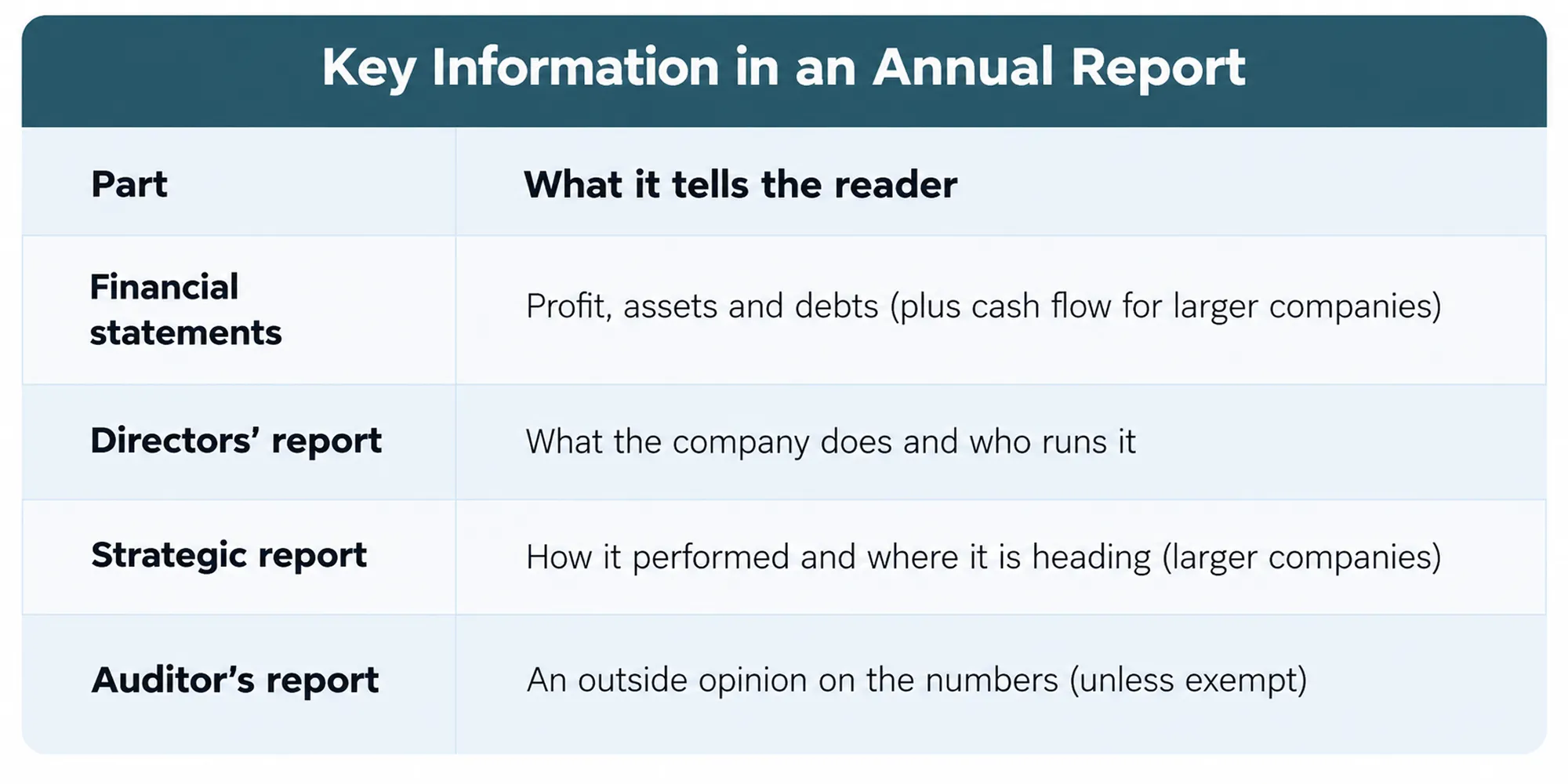
    The table below explains the purpose and use of each reporting type.

    Key Information in an Annual Report

    Why Reports Build Business Trust

    Trust is the base of every sale and every partnership in today’s business world. An annual report gives your customers, staff and investors a reason to believe in your brand. It shows that you are not afraid to be open about how you manage your money and your duties.

    By sharing your achievements and challenges, you can establish trust with people. That trust sets you apart in a world where people worry about hidden fees or bad management. If a bank or a supplier wants to work with you, they will often check:

    • Whether you file reports on time
    • If your numbers are clear and easy to follow
    • How stable your business looks on paper

    If they see strong and clear reports, they are more likely to trust you with a loan or a credit line.

    Why Investors Focus on Annual Reports in 2026

    If you look at where things are heading by 2026, investors want more than just quick returns. They want to see a stable and lasting business model. They use annual reports to look deeply into how your business really works. They check if your cash flow is strong enough to handle a slow month or a change in the market. They focus on areas such as:

    • Cash flow strength and stability
    • Clear income and expense records
    • Ability to handle market changes
    • Long-term growth potential

    If you cannot provide a clear annual report, investors will likely walk away. They see poor reporting as a sign of weak management and lack of control.

    On the other hand, a clean report acts as a strong sales tool. They want to know you run a safe, solid business where their money is protected. With so much data available, being open and honest in your reports lets everyone know you are someone they can rely on.

    Common Filing Mistakes

    It takes 20 years to build a reputation and five minutes to ruin it. If you think about that, you’ll do things differently. – Warren Buffett
    This applies perfectly to your annual report. One dishonest report or a missed deadline can destroy years of hard work. It also badly affects trust with your clients. 

    When the business is legal, then you are protected from fines and mistrust of customers. However, if you are not complying, more drastic issues can happen. In some serious cases, it can even get closed.

    Beyond large fraud cases, the “strike-off” process is often used by Companies House. The Registrar can dissolve a company from the register if it is inactive under the Companies Act 2006. This usually happens when required filings are missed or delayed.

    When a company is struck off, it is not considered as a legal entity. This can cause serious issues such as:

    • Directors can lose their limited liability protection  
    • The Crown could claim your business assets  
    • Banks might freeze or close your accounts  

    A lot of businesses run into trouble just because they mess up their reports. Sometimes it’s something very small. It may be an overlooked detail, a box not ticked or something minute. But that tiny slip up can cause big headaches. Lost paperwork leads to delays or even outright rejection. All for something you could’ve dodged if you had caught it early. The issues are usually the same, such as:  

    • Missed filing deadlines  
    • Wrong or incomplete financial information  
    • Mistakes in company details or records

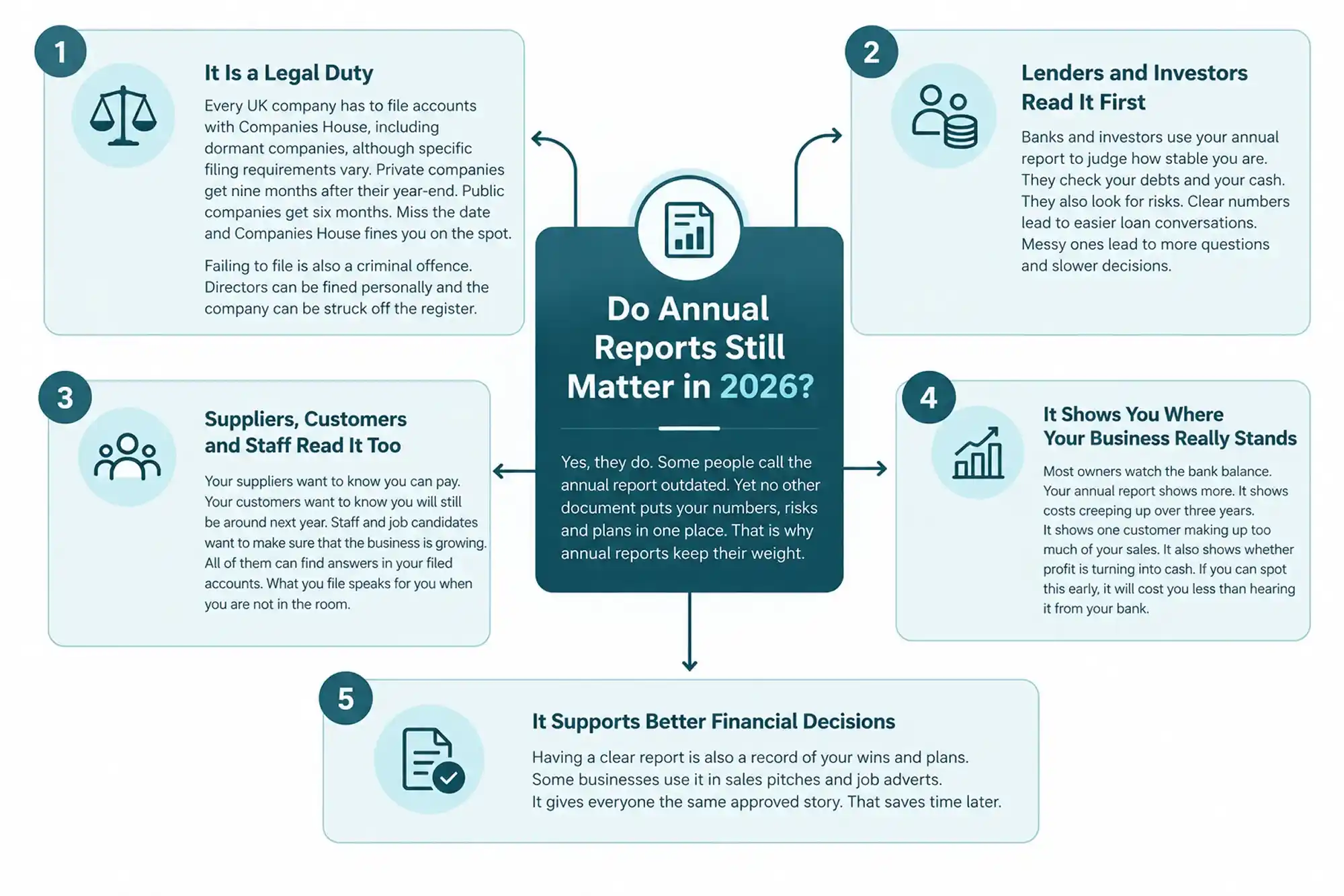
    Annual Reports Still Matter in 2026

    Filing Your Report Without Stress

    It does not have to be a race against the ticking clock to get your annual reports ready. With a simple plan, you can turn a stressful month into a smooth task. Many owners have found that working a little bit each week can make the task much easier. 

    This is much better than doing it all in one go. To remove the hassle, businesses should try to follow the steps listed below:

    Keep Digital Copies of Every Receipt

    Use an app to scan your bills as soon as you get them.

    Set a Monthly Review Date

    Spend one hour every month checking your bank balance against your records.

    Define Your Performance Goals

    Write down the things you want to achieve this year to help explain success for your business.

    Speak to a Professional Early

    Do not wait till the last moments to ask for professional help. Discussing with professionals early provides enough time to cater to potential problems.

    Related: Outsourcing Accounting Services

    Check Your Filing Dates

    Mark your Companies House and HMRC deadlines on your calendar clearly. Missing those dates means losing a chunk of your profit in fines.

    Gather All Required Evidence

    Having your paperwork ready before you start will save you a lot of headaches. Make sure you have all the documents listed in the table below before you start filing.

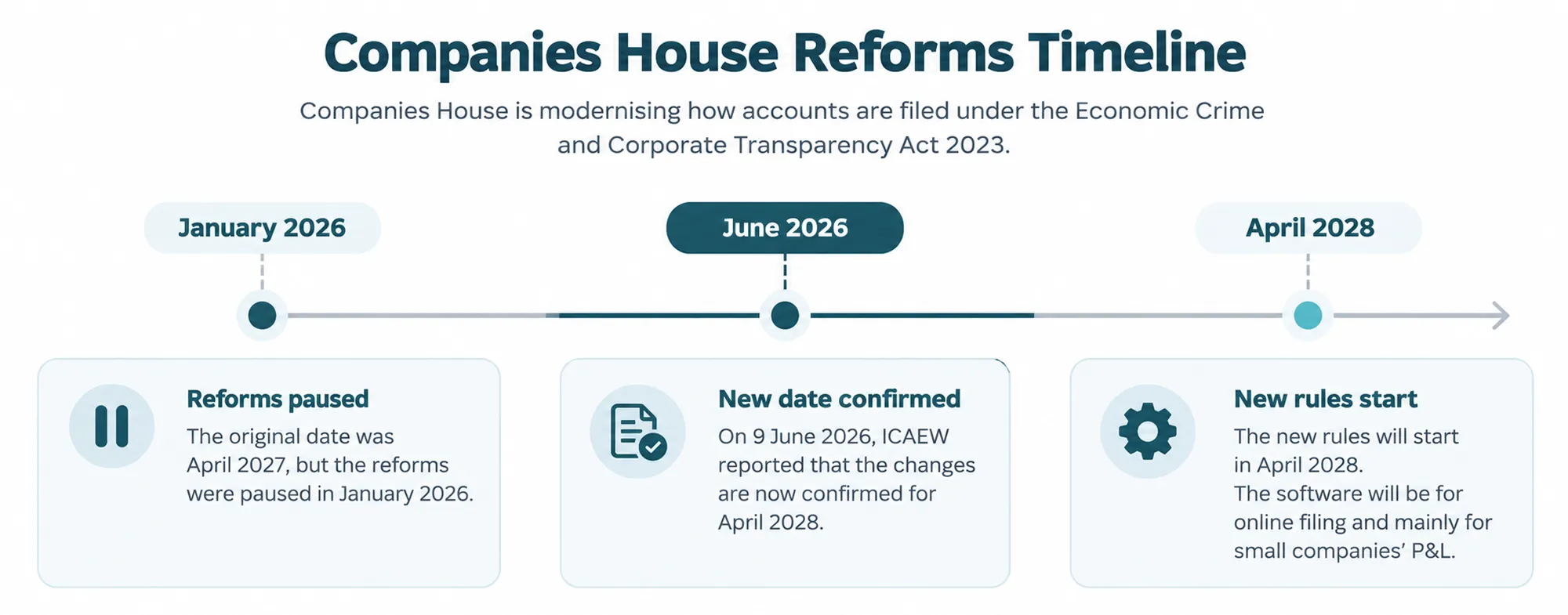
    Companies House Reforms Timelin

    Key Point:

    Small errors in filing can lead to significant fines from HMRC.

    UK Case Study

    The collapse of the café chain Patisserie Valerie highlights the importance of correct reporting. For years, the business appeared stable on the surface. Its financial reports showed the company was performing well and meeting its obligations.

    However, a gap of around £40 million was later discovered in the company’s accounts. This gap had not been visible in earlier reports. It later became clear that the financial records were not accurate and the true level of debt had not been properly shown.

    As a result, the published accounts created a misleading picture. Once the issue became public, the impact was immediate including:

    • Investor confidence dropped sharply
    • Banks became more cautious in their support
    • The company faced severe cash flow pressure

    The business eventually went into administration. This led to store closures and job losses across the UK.

    Financial reports must be both accurate and honest. Filing on time is not enough if the information itself is not correct. For directors, the risks go beyond financial loss. Poor reporting can lead to:

    • Loss of trust from lenders and investors
    • Damage to the company’s reputation
    • Impact on more business opportunities

    Conclusion

    Your annual report in 2026 is more than an item on your list. It’s about creating your company’s reputation and knowing where you’re headed. A good, plain-language report builds trust, keeps you on the right side of the law and gives you a better sense of where your business stands.

    But don’t stop there and get to the bottom of things. Understand and see what the numbers mean. Figuring out what’s working and what needs to change to make your future plans solid. Your report speaks for your business, showing others how you’re doing and what you stand for.

    If you start early, everything will be easier. You won’t be scrambling at the last minute and things will be neater overall. Over time, it will become a routine that can give your business stability and set it up for growth. Once reporting is a second nature, you’ll build a company that people can trust, one that is clear and trustworthy.

    Sterling Cooper helps you understand what annual reporting data is and how to present it in the best possible light.

    Get in touch today to improve your annual reports and stay compliant with ever evolving standards.

    When you have a clear picture of your finances and performance, the fear goes away.

    You can make plans with confidence because you know exactly where you stand.
    Book an appointment to handle your annual report in the best way possible and start seeing it as a tool instead of a problem.
    +443300102526
    Book an Appointment

    FAQs


    How long should a typical annual report be for a small business?


    There is no set length, but for a small UK firm, it is usually between 10 and 20 pages. This includes your balance sheet, profit and loss, and a short director’s report. The goal is to be clear and helpful rather than long and boring. Quality is always more important than the number of pages.


    Yes, you can write the narrative and the director’s report yourself. However, it is wise to have a professional check your financial figures. This ensures you are following the UK GAAP rules and that your math is perfect before you send it to Companies House.


    An annual report is a public document sent to Companies House to show the general health of your business. A tax return is a private document sent to HMRC to calculate how much tax you owe. While they use the same data, they serve two very different purposes.


    It is not a legal requirement for very small “micro-entities” to have a separate performance report. However, many successful directors choose to create one anyway. It helps them track their internal goals and show their progress to potential partners or lenders.


    If you find a mistake after you have filed, do not panic. You can file amended accounts with Companies House. This replaces the old report with the correct one. It is always better to fix the error as soon as you see it to maintain your reputation for honesty.

    Share This Article!

    Recent Posts

  • What Is the Employment Rights Bill 2025 and How Will It Affect Workers?

    What Is the Employment Rights Bill 2025 and How Will It Affect Workers?

    employment rights bill

    Posted by:

    Admin

    Date:

    March 26, 2026

    Category:

    blogs

    Error: Contact form not found.

    What Is the Employment Rights Bill 2025 and How Will It Affect Workers?

    Have you ever felt uncertain about your work? Some people worry about job safety from time to time. Others feel unsure about their rights at work. Business owners also struggle to keep up with changing working rules. This is why the Employment Rights Bill 2025 has been introduced.

    Polling by Opinium for IPPR, the TUC and Persuasion UK shows that around 70% of business leaders believe stronger employment rights will improve productivity.

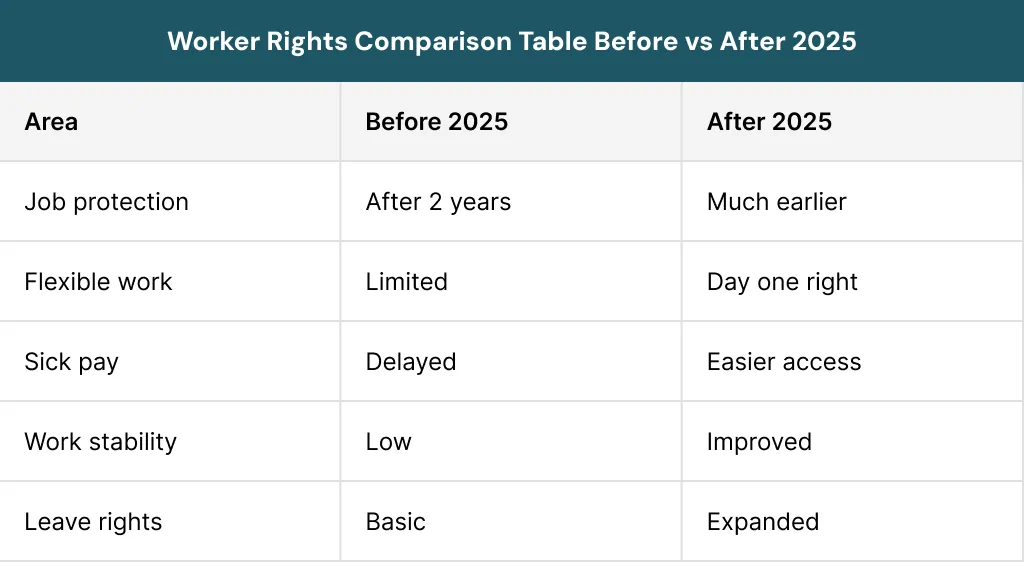
    According to the UK Government, most employees must currently complete 2 years of continuous service before they can claim unfair dismissal protection. This leaves many workers without full protection in the early stage of their job. This gap is one of the main reasons behind the Employment Rights Bill UK.

    In this blog, you’ll learn:

    • What is the Employment Rights Bill
    • How the Employment Rights Bill 2025 changes existing laws
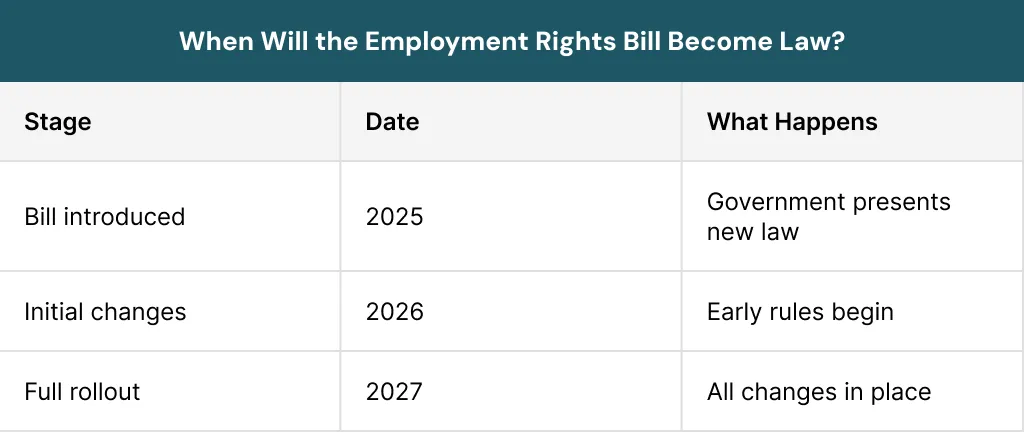
    • When the Employment Rights Bill will become law
    • How it affects workers and businesses
    • Key risks, limits and real UK context

    What Is the Employment Rights Bill 2025?

    The 2025 Bill is a major update. It improves worker protection. It also makes rules easier to understand. 

    This bill is one of the most important employment law changes in recent years. This Bill focuses on:

    • Fairness
    • Clarity
    • Modern work needs

    It aims to:

    • Give workers rights earlier
    • Improve job security
    • Support fair pay and leave
    • Protect flexible and gig workers

    What Changed in 2025

    Earlier laws were based on older patterns of work. Many rights depended on how long someone had worked in a job. The previous rules worked in the past, but they created gaps in modern jobs such as:

    • Unfair dismissal rights
    • Flexible working rights were limited
    • Zero hours workers had less protection
    • Sick pay rules were strict
    • Parental leave access was limited

    Later, the Employment Rights Bill 2025 introduces key changes. These updates reflect how work has changed in recent years. These include:

    • Shorter wait time for dismissal protection
    • Day one right to request flexible work
    • Better sick pay access
    • More stable hours for workers
    • Stronger family leave rights

    Key Changes in the Employment Rights Bill UK

    Now let us look at what the Employment Rights Bill UK actually changes. The aim is to close existing gaps. It also aims to improve fairness. The new law will affect employers and workers. The key changes include:

    • Earlier access to unfair dismissal rights
    • Flexible working from day one
    • Improved sick pay rules
    • Better protection for zero hours workers
    • Stronger parental leave rights

    Why the Employment Rights Bill 2025 Matters

    Work is no longer the same as it was a few years ago. Many people now work in flexible roles, part time jobs or gig work. A new approach was needed due to these changing working conditions. This shift has created gaps in protection. Key issues included:

    • Workers lacked early protection
    • Rules were hard to follow
    • Some roles were not fully covered
    • Disputes increased over time

    Labour is not a commodity.   Franklin D. Roosevelt

    This simple idea highlights why fair work rules matter. It reflects the core principle behind worker protection.

    How Will the Employment Rights Bill Affect Workers?

    Employers are focused on how workers will be affected. The Employment Rights Bill 2025 brings both benefits and changes. Overall, the aim is to create a fair system. The positive effects include:

    • Better job security
    • Faster access to rights
    • More stable working hours
    • Improved work life balance

    Possible Challenges

    This shift will also bring some changes, which are:

    • Some rules may take time to apply
    • Workers may need to understand new rights
    • Not all roles will change at once

    UK Case Law

    In Uber BV v Aslam, few Uber drivers challenged the status of their employment. They argued that they should be treated as workers. 

    Uber maintained that they were self employed individuals operating their own businesses. The drivers argued that their work was tightly shaped by the platform.

    The Court found that Uber controlled key aspects of the work. Prices were set by the company, not the drivers. Access to customers was controlled through the app and performance was closely tracked using a rating system.

     This setup gave drivers very little control over how they worked or how they built relationships with passengers. Over time, many drivers became financially dependent on the platform.

    The UK Supreme Court held that the drivers qualified as “workers” under the law. The Court looked at how the working arrangement operated in practice.

    It found that the degree of control exercised by Uber indicated a worker relationship rather than self employment. As a result, drivers became entitled to basic employment protections, including:

    • Minimum wage 
    • Paid annual leave

    This decision highlights that courts assess real working relationships instead of relying only on contractual wording.

    This case also shows gaps in old laws. The Employment Rights Bill 2025 aims to prevent such issues.

    How Will the Employment Rights Bill Affect Employers?

    The 2025 Bill doesn’t only give rights to the workers. It creates a balanced relationship between employers and workers. The changes may take time but improve clarity. Employers will need to adjust their systems. They will also need to reconsider processes. The responsibilities of a business are:

    • Update contracts
    • Train staff
    • Improve record keeping
    • Respond to flexible work requests

    Day One Rights Explained

    One of the biggest updates in the Employment Rights Bill 2025 is called day one rights. Workers now get key protections from their first day of the job. They will not have to wait long periods. These new protections include structured setups and could leave a real mark. The key changes are:

    • Flexible work requests
    • Basic job protection
    • Clear contract terms

    Worker Rights Comparison Table Before vs After 2025

    Impact on Different Types of Workers

    Each group of workers will experience changes in a different way.

    Full Time Workers

    Their work setup is often more structured. The impact can be seen in ways such as:

    • More protection
    • Better leave rights
    • Clearer contracts

    Part Time Workers

    Their rights have often been limited in the past, making these updates more relevant. Some key impacts are:

    • Fairer treatment
    • Equal access to benefits
    • More stability

    Gig Workers

    This is where gig workers really sit in the middle of all of this. They have suffered and this Bill is attempting to give them an even chance.

    Updates are more even for them as their work was always a little unorganized. This Bill does for them:

    • Better clarity of where they stand legally
    • Improved pay protection
    • Less uncertainty

    Employer Responsibilities Under the New Bill

    Employers need to keep up too. Their systems must comply with the new standards, or they risk getting in trouble. 

    Following the right duties is not about the law. It will also help them avoid arguments later on. The key duties include:

    • Provide clear contracts
    • Keep accurate records
    • Follow fair pay rules
    • Handle worker requests properly

    Technology and Systems

    A lot of companies now use digital tools to track work stuff. These tools make it easier to manage everything from employee schedules to compliance. These tools help to:

    Common Mistakes to Avoid

    Mistakes can still happen in any business. If businesses do not keep up, it can turn into a compliance mess. So noticing these errors early helps avoid the problems. Here is what they need to watch for:

    • Ignoring updates
    • Not training staff
    • Poor documentation
    • Delayed changes

    Risks and Limitations of the Bill

    The Bill brings benefits but it is not perfect. You have got to balance the benefits and drawbacks. The risks that can affect businesses are:

    • Slow rollout
    • Early confusion
    • Pressure on small firms

    How to Reduce Risk

    The risks can be avoided if businesses:

    • Stay updated
    • Keep records clear
    • Use expert help

    Key Point:

    Early preparation reduces risks and keeps your business compliant.

    When Will the Employment Rights Bill Become Law?

    The Bill will not kick in all at once. It is going to roll out bit by bit. Spreading the changes in over several stages allows businesses to catch their breath and figure things out as they go. There is a timeline given that shows what is coming out and when.

    When Will the Employment Rights Bill Become Law

    How Businesses Can Prepare

    Businesses should devise a straightforward process to tackle the changes smoothly. Organizing things properly keeps stress and confusion low.

    1. Review Current Policies

    First go through your contract and terms.

    2. Update Employment Terms

     Look if they are in line with new rules and updates.

    3. Train Your Team

    Make sure everyone understands what is different.

    4. Monitor Legal Updates

    Keep yourself updated with the changes down the line.

    5. Documents Businesses May Need

    • Employment contracts
    • Staff records
    • Payroll data
    • Leave records

    Many firms rely on payroll reports to stay compliant with regulations. 

    Conclusion

    The Employment Rights Bill 2025 focuses on:

    • Fairness
    • Clarity
    • Early access to work rights.

    For workers, this means better protection from the very start of their job. It also reflects changes over time such as flexible and gig based roles.

    For businesses, the changes may require updates in:

    • Systems
    • Contracts
    • Processes

    The Bill will result in clearer rules and fewer disputes in the future. Businesses that prepare early are more likely to handle these changes smoothly and avoid unnecessary risks.

    The success of the Bill will depend on how well workers and employers adapt to changes. With the right approach, the Bill can support a more stable and fair working environment.

    With the help of Sterling Cooper Consultants, handling changes in UK employment law becomes simpler, more organised and stress free.

    Get in touch today to stay prepared and manage these changes with confidence.

    Employment Rights Bill 2025 compliance protects your business from costly mistakes and unnecessary stress. Acting early helps you stay in control and avoid future disputes.

    Speak to a specialist today to review your current position and strengthen your compliance framework.
    +443300102526
    Book an Appointment

    FAQs


    Will the Employment Rights Bill 2025 apply to all sectors?


    Yes, the Bill is expected to apply across most sectors. However, some industries may see changes at different stages depending on the implementation schedule.


    Employers may still refuse requests; however, they must provide valid business reasons. The process will be more structured, transparent and fair under the new framework.


    In many cases, yes. Employers may need to update employment contracts to reflect new rights and ensure compliance with updated legal standards.


    Probation periods may still exist; however, workers are expected to gain stronger protections during this period, reducing gaps in early stage employment protection.


    Workers should review their employment contract and stay informed about legal updates. Seeking professional guidance can also help them better understand their rights and position.

    Share This Article!

    Recent Posts

  • Outsourcing Accounting Services: Benefits, Costs & What to Expect

    Outsourcing Accounting Services: Benefits, Costs & What to Expect

    outsourced accounting services

    Posted by:

    Admin

    Date:

    March 23, 2026

    Category:

    blogs

    Error: Contact form not found.

    Outsourcing Accounting Services: Benefits, Costs & What to Expect

    Have you paid the extra fines lately due to late filings? Running a business can feel tough. Bills stack up with immediate deadlines. This is where outsourced accounting services often come into the picture. This approach gives you access to skilled professionals without long term staff costs.

    Late tax submissions and reporting errors remain a common issue for small businesses. The penalties are increasing every year under the HMRC rules.

    A £100 fixed penalty is charged initially for late self assessment tax returns. Additional penalties also apply after 3, 6 and 12 months. This shows how easy it is to fall behind when finances are not handled well.

    In this blog, you’ll learn:

    • What are outsourced accounting services
    • In-house vs outsourced accounting
    • Why many businesses struggle with accounting
    • Benefits of outsourcing accounting
    • How outsourced accounting services work
    • Limitations of outsourced accounting services
    • Case study

    What Are Outsourced Accounting Services?

    Outsourced accounting services mean handing over your financial tasks to an external firm. You work with experts who handle your accounts remotely instead of hiring an in-house team. These services often include:

    • Bookkeeping
    • Payroll
    • VAT returns
    • Financial reporting
    • Tax preparation

    Bookkeeping is often the first task that takes time and needs accuracy. Outsourced bookkeeping services save you a lot of time and resources.

    Important:

    Accounting is the language of business.

    In-house vs Outsourced Accounting

    In-house accounting means hiring dedicated staff to manage your accounts. Both in-house and outsourced accounting options have their own place. The following comparison table helps you decide what suits your business best.

    In-House vs Outsourced Accounting Key Differences at a Glance

    Why Many Businesses Struggle With Accounting

    Many businesses struggle because accounting takes time, skill and focus. Most owners start by handling finances themselves. At first, it feels manageable but becomes stressful with time. These issues can slow growth. The risk of mistakes increases. Common problems include:

    • Missing deadlines
    • Poor record keeping
    • Confusion over tax rules
    • Lack of financial insight
    • Cost of hiring full time staff

    Benefits of Outsourcing Accounting

    Businesses choose to outsource their tasks to save time and reduce errors. It helps owners to focus on running the business instead of handling numbers. Key benefits are:

    • Lower costs
    • Access to skilled accountants
    • Better compliance with UK rules
    • Real time financial data
    • Flexible service options

    The benefits of outsourcing accounting go beyond cost. Clear financial data helps you make better business choices. You also gain:

    • Better support for decisions
    • Lower risk of errors
    • Faster reports
    • Easy to scale as your business grows

    Don’t ever let your business get ahead of the financial side of your business. Accounting, accounting, accounting. Know your numbers.

    — Tilman J Fertitta

    How Outsourced Accounting Supports Growth

    Outsourced accounting helps in growing businesses by giving clear financial insight. This support becomes more useful as your business grows. With better data, you can:

    • Track results
    • Plan budgets
    • Manage cash flow
    • Make better decisions

    How Outsourced Accounting Services Work

    Outsourced accounting services follow a simple process. The provider collects your financial data and manages it on your behalf. The steps usually involve:

    1. Assess Your Current Needs

    First, identify the tasks you are looking to outsource. This could be basic bookkeeping or full finance support.

    2. Choose a Provider

    Look for a firm which has prior experience and knowledge of the HMRC rules.

    3. Share Financial Data

    Provide access to invoices, receipts and bank records.

    4. Set Reporting Frequency

    Set how often you would like to receive updates, whether weekly or monthly.

    5. Check Reports on a Regular Basis

    Go through the reports to keep track of your finances.

    6. Documents You May Need

    Missing documents can delay reporting and cause errors. When you outsource accounting services, you must share key documents.

    • Bank statements
    • Sales invoices
    • Purchase receipts
    • Payroll records
    • Tax filings

    Many businesses find it difficult to understand payroll records. These are very important documents in this process.

    Many outsourced accounting services use tools which are cloud based. This makes the process faster and reduces manual errors. These tools help:

    • Store financial data securely
    • Provide real time access to reports
    • Automate tasks like invoicing and payroll

    When Should You Consider Outsourcing?

    It may be worth outsourcing when your current accounting process no longer works well. These signs often mean you may need outside help. Important signs include:

    • You spend too much time on finances
    • Reports are often delayed
    • You feel unsure about tax rules
    • Your business is growing quickly

    Which Businesses Can Benefit From Outsourced Accounting?

    Many different types of businesses can benefit from outsourced accounting. This works best when your internal team is small or under pressure. It is a good fit for:

    • Startups with small budgets
    • Small firms without in-house teams
    • Growing firms that need better reports
    • Businesses facing tax or rule pressure

    How to Outsource Accounting Services Correctly

    It is important to have a clear plan before you outsource your accounting. Make sure you: 

    • Define Your Goals

    Be clear about your goals, whether it is saving time or getting better reports.

    • Check Credentials

    Make sure the provider understands UK regulations.

    • Compare Services

    Look at what each firm offers and how flexible they are.

    • Review Data Security

    Ensure your financial data is protected.

    • Start With a Trial Period

    Test the service before committing long term.

    • Transition Process

    The move is usually simple and well planned. A smooth start helps avoid any break in your work. It may include:

    • Reviewing your current setup
    • Moving data to new systems
    • Setting report formats
    • Fixing timelines and clear plans

    Outsourcing Accounting Services Cost in the UK

    The cost of outsourcing accounting depends on your business size and needs. Small firms often pay less than large ones. The cost usually depends on:

    • Number of transactions
    • Services you need
    • Business size and setup
    • How often reports are needed

    Estimated Cost Comparison for Outsourced Accounting Services

    Note: The costs shown in the table are not final. They depend on the services offered by different providers.

    Outsourcing is not only about cutting costs. It is also about getting more value in return. It helps you cut hiring costs, reduce mistakes and keep your finances clear. In the long run, this can help you make better decisions and support business growth.

    Common Mistakes You Should Avoid

    Many businesses run into issues when they move too quickly. These mistakes can lower the benefits of outsourcing. Try to avoid the following mistakes:

    • Choosing only on price
    • Not checking past work
    • Poor communication with the provider
    • Not reviewing reports
    • Sharing missing or wrong data

    Limitations of Outsourced Accounting Services

    Outsourced accounting is useful, but it is not perfect. It also has some limits. These include:

    • Less direct control
    • Delay in communication
    • Data safety concerns
    • Dependence on outside firms

    How to Reduce Limitations

    Even with these limits, you can reduce the risks by:

    • Setting clear goals
    • Using safe systems
    • Planning regular check ins
    • Keeping some control in-house

    UK Case Study

    A UK travel business, Gowing, faced serious financial pressure during a downturn. The company had rising debt and struggled to manage its large scale accounting operations efficiently.

    To control costs and improve money management, the company outsourced about 90% of its accounting work. They chose an external provider through a proper process to ensure skill and trust.

    After outsourcing, the following results were achieved:

    • Lower costs during a tough time
    • Better control over finances and reports
    • Support in business recovery and long term growth
    • Allowed the team to focus on key business plans

    This case shows how outsourcing accounting can help a business manage pressure and improve stability.

    Conclusion

    Managing finances does not have to be stressful or time consuming. Outsourced accounting services take the responsibility of daily hectic tasks leaving you enough working time .

    With the rules changing every other day, it is very difficult to keep the track of the accounts if your business is expanding. This leads to a lot of mistakes which could have been avoided.

    Having external support keeps your records sharp and up to date. It also allows you to not worry about the delayed filings or missed accounts. Over time, this gives you much more confidence in your own data.

    One of the best things is the time you save. Instead of spending hours buried in spreadsheets, you can actually concentrate on running your business and helping it grow. You’re also relying on folks who know what they’re doing and have all the latest tools. Your reports end up clearer and a lot easier to wrap your head around. 

    When your numbers make sense, deciding what to do next doesn’t feel so overwhelming anymore.

    Honestly, the right choice really comes down to what your business needs at this moment. Maybe you need someone to handle everything, or maybe just a boost with a few tough jobs. Take a close look at how things are running now — it’ll show you what fits best. Keeping things steady and straightforward makes it easier to manage as your business grows.

    Sterling Cooper ensures your financial data is handled correctly, helping you stay compliant and organised.

    Get in touch today to simplify your accounting and stay ahead of compliance requirements.

    With the right support, you can stay compliant, improve accuracy and focus more on growing your business.

    Speak to a specialist today to check how we can support your business and make your accounting process simple and efficient.
    +443300102526
    Book an Appointment

    FAQs


    Can outsourced accounting help reduce business costs?


    Yes, it can lower costs by removing the need for full time staff. You only pay for the services you need. It also reduces costs linked to training and software.


    Most providers use secure cloud systems and follow UK data rules. They apply strict controls to protect sensitive data. It is still important to check their security standards before starting.


    Yes, services are flexible and can match your business needs. You can choose only bookkeeping or full finance support. This makes it easier to scale as your business grows.


    Small businesses, startups and even large firms use it. It works well for businesses that want to save time and improve accuracy. Growing companies often benefit the most.


    Yes, it often leads to clearer and more accurate reports. Experts use proper systems and tools to manage data. This helps you understand your financial position better.

    Share This Article!

    Recent Posts

  • What Is FRS 102? A Simple Guide for UK Businesses

    What Is FRS 102? A Simple Guide for UK Businesses

    What Is FRS 102

    Posted by:

    Admin

    Date:

    March 18, 2026

    Category:

    blogs

    Error: Contact form not found.

    What Is FRS 102? A Simple Guide for UK Businesses

    To prepare an accurate financial statement, every company needs first to understand the accounting standards that apply to it. For many, FRS 102 is the foundation for their financial reporting. However, this standard has undergone significant changes. 

    Most of the changes from FRC’s Period Review 2024 now apply to fiscal periods that begin on or after 1 January 2026. The major changes include lease accounting and revenue recognition. But what exactly is FRS 102, who does it apply to and what do the 2026 amendments mean for your company?

    This guide explains FRS 102 in simple terms. It also explains who uses it, what it covers and the practical steps you can take to prepare for it.

    Key Takeaways

    • FRS 102 is the main UK and Ireland financial reporting standard for entities outside the adopted IFRS, FRS 101 and FRS 105 frameworks.
    • It covers areas such as financial statement presentation, revenue, leases, financial instruments, assets, liabilities and disclosures.
    • Eligible small entities can use Section 1A, which provides reduced disclosure requirements.
    • Major FRS 102 changes took effect for accounting periods beginning on or after 1 January 2026, including new requirements for leases and revenue recognition.
    • Businesses should review their reporting framework, accounting policies, contracts and disclosure requirements to check that they are ready for the current FRS 102 requirements.


    What Is FRS 102?

    Financial Reporting Standard (FRS) 102 is the main UK and Ireland accounting standard for companies that do not apply IFRS, FRS 101 or FRS 105. FRS 102 is a set of standards to recognise, measure, present and disclose financial information in financial statements.  It covers a wide range of accounting areas, from revenue to leases, assets, liabilities and disclosures. 

    Originally, FRS 102 was based on the IFRS for SMEs Accounting Standard. However, it has been adapted for the UK and Ireland, and applies to a wider range of companies. It is issued and maintained by the Financial Reporting Council (FRC) in both countries. 

    Hence, you must identify the right reporting framework for your company to comply with the financial regulations. Often, companies assume that FRS 102 applies to them simply because they are small or medium-sized businesses. 

    ‘FRS 102 modernises and simplifies financial reporting for unlisted companies.’ Roger Marshall, Financial Reporting Council


    FRS 102 vs FRS 105: What Is the Difference?

    FRS 102 and FRS 105 are both accounting standards followed in the UK. However, they are both designed for distinct purposes and reporting needs. The table below explains the difference between the two standards.

    FRS 102 vs. FRS 105: Key Differences

    Area

    FRS 102

    FRS 105

    Who it is for

    A broad range of entities outside other applicable reporting frameworks

    Eligible micro-entities

    Accounting requirements

    More comprehensive requirements

    More simplified requirements

    Recognition and measurement

    Generally more detailed

    Includes specific simplifications

    Disclosures

    Full FRS 102 disclosures, or reduced disclosures where applicable

    Significantly reduced disclosures

    Small entities

    Section 1A provides reduced presentation and disclosure requirements

    Not applicable

    2026 lease changes

    Most lessee leases move to an on-balance-sheet model

    FRS 102 lease changes were not carried across to FRS 105

    Flexibility

    Available to a wider range of entities

    Only available where the micro-entity regime a

    To put it simply, FRS 105 is mainly for entities that qualify for the micro-entities regime. On the other hand, FRS 102 is the main standard within UK and Ireland GAAP. It covers a wider range of reporting entities.


    Who Does FRS 102 Apply To?

    FRS 102 applies to companies that prepare their financial statement under UK and Ireland GAAP. It is applied when another reporting framework does not apply to a company. However, the right framework depends on factors like the type and size of the company. It also depends on whether the company is part of a group and whether it qualifies for a specific reporting framework. The table below explains different frameworks and their applications.

    Types of Financial Reporting Frameworks and Their Application

    Reporting Framework

    General Application

    Adopted IFRS

    Used by entities required or permitted to prepare financial statements under adopted IFRS

    FRS 101

    Available to qualifying entities using IFRS recognition and measurement with reduced disclosures in individual financial statements

    FRS 102

    Main UK and Ireland GAAP framework for entities outside the other applicable regimes

    FRS 105

    Available to eligible entities that qualify for and choose to use the micro-entities regime

    The right choice is not based solely on the size of your company. Rather, you should consider the relevant legal and accounting needs before you choose a reporting framework. 

    FRS 102 for Small Business

    Small companies that are eligible can apply Section 1A of FRS 102. The section has reduced presentation and disclosure requirements. However, Section 1A does not mean that you use a completely different accounting rule. The recognition and measurement requirements of FRS 102 are still applicable to your financial reports. What it actually means is that you can benefit from simpler financial statement presentation and fewer disclosures, while maintaining relevant FRS 102 accounting requirements. 

    What Does FRS 102 Cover?

    FRS 102 clarifies how companies should account for and report various financial transactions and balances. This covers aspects like revenue, leases, financial instruments, assets, liabilities and disclosures. The table below explains what each area means and how it is relevant to your financial reporting. 

    What Does FRS 102 Cover?

    Area

    What FRS 102 Covers

    Financial statement presentation

    How financial information is presented in financial statements

    Revenue

    How and when revenue from customer contracts is recognised

    Leases

    How leases are accounted for by lessees and lessors

    Financial instruments

    Recognition, measurement and presentation of financial assets and liabilities

    Assets

    Accounting for property, plant and equipment, intangible assets and other assets

    Liabilities

    Recognition and measurement of liabilities, obligations and provisions

    Fair value

    How certain assets and liabilities are measured at fair value

    Disclosures

    Information that businesses must provide alongside their financial statement

    The exact requirements depend on your company’s transactions and circumstances. It also depends on the reporting framework that is being applied.


    What Changed in FRS 102 in 2026?

    The FRC’s Periodic Review 2024 introduced various amendments to FRS 102. Most of these changes have become applicable to accounting periods on or after 1 January 2026. The most apparent of these changes relate to lease accounting, revenue recognition and fair value assessment. 

    Lease Accounting

    One of the most apparent amendments in FRS 102 is the lessee accounting. The revised version removes the distinction between operating and finance leases for lessees. Now, most leases are recognised on the balance sheet through:

    • A right-of-use asset
    • A lease liability

    Although there are certain exemptions for short-term leases and low-value asset leases, it has largely changed how lease-related amounts appear in financial statements. Before, companies treated lease payments as an expense. Now, they need to recognise them as additional assets and liabilities, while depreciation and interest have replaced the previous rental expense. 

    Revenue Recognition

    FRS 102 now uses a five-step model to recognise revenue from contracts with customers. To put it simply, companies now need to:

    • Identify the contracts with customers
    • Identify the performance obligations in the contract
    • Determine the exact transaction price
    • Allocate the transaction price to the performance obligations
    • Recognise revenue when or as the obligation is met

    This change may affect the timing or amount of revenue that is recognised in the financial statements. However, it depends on the nature of the company and its customer contracts. 

    Other Important Changes

    Recent FRS 102 updates also include changes other than leases and revenue. These changes cover areas like fair value measurement, financial instruments, disclosures and uncertain tax treatments. While not every change would apply to your company, you should review the table below to check whether your policies and reporting needs require updating. 

    Other FRS 102 Important Changes

    Area

    What Changed?

    What Does It Mean for Businesses?

    Fair value measurement

    FRS 102 introduced a new framework for measuring fair value.

    Businesses may need to review how certain assets and liabilities are valued and reported.

    Financial instruments

    Requirements for recognising and measuring financial instruments have been updated.

    Businesses should review how they account for financial assets, liabilities and related transactions.

    Disclosures

    Some disclosure requirements have been updated or clarified.

    Financial statements may need additional or revised information.

    Uncertain tax treatments

    The standard provides requirements for accounting for uncertain tax positions.

    Businesses may need to assess how uncertain tax treatments are recognised and disclosed.

    Other amendments

    Various sections have been updated to improve or clarify existing requirements.

    Businesses should review their accounting policies to identify changes relevant to their circumstances.

    What Does FRS 102 Mean for Your Business?

    FRC’s 2024 amendments to FRS 102 are not just technical accounting updates. They can affect how you record, present and interpret financial information. The actual impact of these changes will depend on your company’s size and activities. Even then, there are several areas which require your attention.

    1. Financial Statements

    Changes to accounting requirements can change the figures and disclosures in your financial statements. For example, leases on the balance sheet can increase reported assets and liabilities of a company. Changes to revenue recognition can also affect when revenue and related amounts are recognised in the accounts. 

    Hence, you should understand how the revised requirements could affect your financial statements. This will ensure your financial statements comply with the new rules. 

    2. Accounting Process

    You would need to review your accounting policies, systems and internal processes against the updated FRS 102. This will require you to check:

    • How lease contracts are recorded
    • How customer contracts are assessed
    • How revenue is recognised
    • How fair value measurements are supported
    • What information is collected for disclosures

    You may also need to update your accounting software and existing processes to support the revised requirements. 

    3. Leases and Revenue

    The recent amendments should be of particular importance for companies with significant lease arrangements or complex customer contracts. For leases, you need to check the arrangements that fall within the revised requirements and decide whether an exemption applies. For revenue, you need to review contracts to check when their performance obligations are satisfied. 

    These reviews will help clarify whether the changes could affect reported revenue, assets, liabilities and profit. 

    4. Financial Ratios and Covenants

    Even a slight change in accounting treatment can affect financial ratios and the figures used for lending and financing arrangements. For example, the recent amendment of the lease model can affect measures like:

    • Gearing
    • Interest cover
    • Current ratio
    • EBITDA

    If you have borrowing arrangements, these accounting changes could affect covenant calculations. Hence, you must discuss the potential impact of these changes with your lenders when needed.


    How to Check If Your Business Is Ready for FRS 102?

    The six steps below will help you review your accounting readiness to comply with the current FRS 102 requirements. 

    1. Identify Your Reporting Framework

    The first step is to confirm which accounting framework applies to your company. This could be FRS 102, FRS 105, FRS 101 or adopted IFRS.

    2. Check Whether Section 1A Applies

    Second, assess if your business qualifies as a small entity. For this, you need to check whether FRS 102 Section 1A applies to you. 

    3. Review Your Accounting Policies

    Next, check that your accounting policies are updated to the latest requirements. Pay close attention to areas that are affected by the 2026 amendments.

    4. Review Leases and Revenue

    Review leases and customer contracts that are affected by the updated requirements. Here, should review how they are recognised and reported in your financial statements.

    5. Check Disclosures and Records

    Then, review your financial statement disclosures and ensure you have the records to support the information you have reported.

    6. Check the Latest FRC Requirements

    Lastly, check the latest FRC guidance, amendments and effective dates to ensure your reporting is up to date.


    Quick FRS 102 Readiness Checklist

    • ☐ Correct reporting framework identified
    • ☐ Section 1A eligibility checked
    • ☐ Accounting policies reviewed
    • ☐ Lease agreements reviewed
    • ☐ Revenue contracts reviewed
    • ☐ Disclosure requirements checked
    • ☐ Supporting records complete
    • ☐ Latest FRC requirements checked

    Need Help With FRS 102?

    The 2026 FRS 102 changes can affect your leases, revenue recognition and financial reporting. Sterling Cooper Consultants can help you understand the changes and keep your accounts compliant with UK accounting standards.

    +443300102526
    Book an Appointment

    Conclusion

    FRS 102 is the primary UK and Ireland GAAP framework that applies to a broad range of entities. The framework covers key areas of financial reporting that also include revenue, leases, financial instruments, assets, liabilities, fair value and disclosures.

    The recent amendments by FRC have made FRS 102 crucial for companies to review their accounting policies and processes. The new lease and revenue requirements can affect financial statements, while other changes may affect disclosures and accounting treatments. Hence, companies should be clear on which reporting framework applies to them and assess how the current FRS 102 affects their financial reporting. 

    You may find some of the rules to be complex, or some changes to have a critical impact on your financial reporting. In such cases, professional accounting advice can ensure you apply the right practices and policies to your financial statements.


    FAQs


    Who needs to use FRS 102?

    FRS 102 applies to entities preparing financial statements under UK and Ireland GAAP where another applicable reporting framework does not apply. The appropriate framework depends on the entity’s circumstances and eligibility.


    No. FRS 102 applies to a broad range of entities. Eligible small entities can use Section 1A, which provides reduced presentation and disclosure requirements while generally retaining FRS 102’s recognition and measurement requirements.


    Yes. The revised Section 23 introduces a five-step model for recognising revenue from contracts with customers. The model focuses on recognising revenue when, or as, control of promised goods or services transfers to the customer.


    Yes. Changes in accounting treatment can affect reported assets, liabilities, expenses and other financial figures. For example, the revised lease requirements may affect gearing, interest cover, current ratio and EBITDA, and could have implications for loan covenants.


    Start by confirming your reporting framework, checking whether Section 1A applies, reviewing accounting policies, assessing leases and revenue contracts, checking disclosure requirements and reviewing the latest FRC guidance and effective dates.


    Not every business will need the same level of professional support. However, FRS 102 can involve complex accounting judgements, particularly where a business has significant leases or complex revenue contracts. Professional accounting advice can help businesses assess their requirements and apply the appropriate framework.


    Share This Article!

    Recent Posts

  • Why ESG Reporting Is Now Part of Financial Audits?

    Why ESG Reporting Is Now Part of Financial Audits?

    ESG reporting

    Posted by:

    Admin

    Date:

    March 17, 2026

    Category:

    blogs

    Error: Contact form not found.

    Why ESG Reporting Is Now Part of Financial Audits?

    Environmental, social and governance (ESG) issues are increasingly connected to business finances. Climate risks, energy costs, regulatory changes and other sustainability matters can affect a company’s assets, costs, cash flows and future plans. As ESG reporting becomes more important and subject to external assurance in many markets, it is also becoming increasingly relevant to finance teams, auditors and assurance providers.

    In this guide, we explain why ESG reporting is becoming part of the wider audit and assurance landscape. We also cover regulatory changes, greenwashing, investor demands and how businesses can prepare reliable ESG information.

    Key Takeaways

    • ESG issues can affect a company’s finances and financial reporting.
    • Auditors may consider ESG-related risks when they affect financial statements.
    • Sustainability assurance may involve testing ESG data, calculations, controls and supporting evidence.
    • Reliable ESG reporting can help reduce the risk of unsupported or misleading sustainability claims.
    • ESG reporting and assurance requirements vary by company, country and applicable rules.

    Role of ESG Reporting in Financial Audits

    ESG reporting in financial audits is becoming more important as sustainability matters can affect a company’s financial position, performance and future cash flows. Climate risks, regulatory changes, resource costs and other ESG factors may affect assets, operating costs, liabilities and business plans.

    For example, a company operating in an area at risk of flooding may face damage to buildings and equipment, higher insurance costs or additional spending to adapt its operations. Similarly, a company moving away from high-carbon products may need to reassess certain assets or incur costs related to changing its operations.

    When ESG-related factors could affect financial reporting, auditors may need to consider how those risks are reflected in the financial statements and whether the relevant accounting estimates and disclosures are appropriate.

    This does not mean that ESG reporting is automatically part of every financial statement audit. Financial statement audits and ESG or sustainability assurance are separate activities. However, they can overlap where sustainability matters have financial implications or ESG information is subject to specific assurance requirements.

    Why Is ESG Reporting Now Part of Financial Audits?

    There is no single global rule that makes every ESG report part of every financial audit. Instead, laws, stock-market rules and reporting standards are creating new sustainability reporting and assurance requirements in many markets.

    For example, the IFRS Sustainability Disclosure Standards include two key standards. IFRS S1 covers sustainability-related risks and opportunities that could reasonably be expected to affect a company’s cash flows, access to finance or cost of capital. IFRS S2 focuses specifically on climate-related risks and opportunities.

    As these requirements develop, finance teams and auditors increasingly need to understand how material sustainability matters connect with financial reporting.

    Changing Regulatory Requirements

    Regulation is one of the main reasons ESG reporting requirements and sustainability assurance are becoming more important. In the European Union, the Corporate Sustainability Reporting Directive (CSRD) introduced sustainability reporting requirements for companies within its scope, based on the European Sustainability Reporting Standards (ESRS).

    However, the scope, timing and detail of these ESG reporting requirements have been subject to regulatory changes. Companies should therefore check the rules that apply to their specific circumstances and reporting period rather than relying on earlier requirements.

    These developments also affect assurance providers, because sustainability information may be subject to assurance requirements. Businesses need to understand which information their ESG reporting requirements cover, which standards apply and what evidence is needed to support their disclosures.

    Combating Greenwashing

    Greenwashing occurs when a company presents its environmental performance or claims in a misleading way. For example, a business may describe a product as “green” or “eco-friendly” without sufficient evidence to support the claim.

    Reliable ESG reporting and appropriate assurance can help reduce this risk by improving the quality and traceability of sustainability information. Depending on the engagement, assurance providers may examine data sources, calculations, controls and supporting documentation.

    Businesses should therefore maintain clear records for reported ESG metrics and environmental claims. Consistent calculation methods and documented evidence can make sustainability information easier for investors, customers and other stakeholders to assess.

    Investor Demands

    Investors increasingly use sustainability information alongside financial information when assessing companies and their risks. They may want to understand how a business manages climate-related risks, regulatory changes, resource use, workforce matters and other sustainability issues that could affect long-term performance.

    Reliable ESG information can give investors greater visibility into these risks and how the company manages them. Consistent reporting can also improve confidence in the information provided.

    For finance teams, this means ESG data cannot always be treated as a separate sustainability exercise. Where it is relevant to business or financial reporting, it should be accurate, traceable and consistent with the company’s wider reporting processes.

    ESG Reporting in Business Relationships

    ESG information can also influence relationships with customers, suppliers, lenders and business partners. Some organisations may ask suppliers to provide sustainability information to support their own reporting, procurement or risk-management requirements.

    This can affect small and medium-sized businesses as well as larger organisations. A smaller supplier may not be directly subject to the same reporting requirements as a large customer but may still be asked to provide emissions, workforce or other ESG data.

    As these requests become more common, businesses may need clear processes for collecting, documenting and supporting the information they provide.

    How to Prepare ESG Reporting for Audit and Assurance

    A structured process can help finance teams produce reliable ESG information and respond more effectively to audit or assurance requirements.

    Assess Current Reporting Practices

    Review the company’s existing financial and ESG reporting processes. Identify missing information, duplicate data, inconsistent calculations and areas where supporting evidence may be weak.

    This can help identify where ESG information connects with financial reporting and where improvements are needed before an audit or assurance engagement.

    Check the Rules and Reporting Standards

    Identify the laws, regulations and esg reporting standards that apply based on the company’s location, size, listing status and reporting period. These may include applicable sustainability reporting requirements, ESRS or ISSB Standards, depending on the jurisdiction.

    Do not assume that the same requirements apply to every business. Confirm the current rules before preparing disclosures for the relevant reporting period.

    Identify ESG Risks and Financial Links

    Identify ESG matters that could have a significant effect on the company’s finances. Climate-related risks, for example, may increase operating costs, affect asset values, disrupt operations or influence future sales and investment decisions.

    Document how significant ESG risks could affect financial assumptions, estimates, cash flows, assets, liabilities or business plans. This helps finance and audit teams identify where sustainability-related matters may be relevant to financial reporting.

    Strengthen Data and Controls

    Use clear processes to collect, review and store ESG data. Define who is responsible for collecting each metric, checking calculations and approving the information before it is reported.

    Keep records of data sources, calculation methods, review procedures and significant changes. Strong controls can reduce errors and make ESG information easier to trace during an audit or assurance engagement.

    Pro Tip: Keep a clear record of each ESG metric, including its data source, calculation method and supporting evidence. A well-organised audit trail makes it easier to respond to audit and assurance requests.

    Prepare Evidence for Audit and Assurance

    Keep supporting documents for important ESG figures and disclosures. These may include energy records, invoices, emissions calculations, employee data, supplier information and other source documents.

    Organise the evidence so reported figures can be traced back to their underlying data. This gives auditors or assurance providers a clearer basis for reviewing the information.

    Review and Improve Each Reporting Cycle

    Treat ESG reporting as an ongoing process rather than a one-time exercise. After each reporting cycle, review data gaps, control weaknesses, calculation issues and audit or assurance findings.

    Use these findings to improve data collection and controls and maintain a stronger reporting process for the next cycle.

    how to implement ecg reporting in financial reporting

    Conclusion

    ESG reporting is becoming more closely connected to financial audits and sustainability assurance. Environmental, social and governance matters can have financial consequences. Climate risks, regulatory changes, operating costs and shifts in customer demand may affect a company’s assets, cash flows, liabilities and business plans.

    Businesses should therefore assign clear ownership to ESG information and maintain appropriate controls and supporting evidence. Understanding reporting and assurance requirements early can help finance teams prepare reliable information and respond to audit and assurance requests.

    Need Help With ESG Reporting?

    Prepare your ESG information with greater confidence. Our team can help you strengthen reporting processes, improve supporting evidence and prepare for audit or assurance requirements.

    FAQs


    Is ESG reporting part of every financial audit?

    No. ESG information is not automatically part of every financial statement audit. Requirements depend on the company’s jurisdiction, reporting framework, circumstances and applicable regulations. Sustainability information may also be subject to separate assurance requirements.

    ESG-related risks can affect a company’s financial position and performance. Climate risks, regulatory changes, energy costs and other sustainability matters may affect assets, liabilities, expenses, cash flows and business plans.

    ESG reporting involves preparing and disclosing sustainability information. ESG assurance involves an independent assurance provider evaluating specified sustainability information against applicable criteria. The scope and level of assurance depend on the relevant requirements.

    Finance teams should use reliable data sources, document calculation methods, maintain supporting evidence and establish clear controls over ESG information. They should also confirm which reporting and assurance requirements apply to the business.

    Climate-related risks can affect assets, costs, cash flows, liabilities and future business plans. Where these matters could materially affect financial reporting, auditors may need to consider their implications when auditing the financial statements.

    Share This Article!

    Recent Posts