Blog

  • The Ultimate Guide to Small Business Taxes

    The Ultimate Guide to Small Business Taxes

    small business tax

    Posted by:

    Admin

    Date:

    May 12, 2026

    Category:

    blogs

    Error: Contact form not found.

    The Ultimate Guide to Small Business Taxes

    Are you excited to run a small business in the UK but don’t know the details of its tax system? Most small businesses focus on daily operations, clients and progress. However, it is important not to overlook tax duties.

    Small business taxes in the UK are the various costs imposed by the government. These fees apply to profits, earnings, sales and jobs. In general, this consists of business rates, national insurance, VAT, income tax and corporation tax.

    In 2025, the UK private industry had about 5.7 million businesses. 5.64 million of them were small enterprises with 0–49 workers. This means that nearly 99% of UK businesses are classified as small. This detail also clarifies that for the UK economy, small business and taxes are so important.

    For instance, when sole traders earn profits, they have to pay income tax on them. However, limited companies have to pay corporation tax on the revenue of the company. This points out the vital role of business tax for small business in the UK economy.

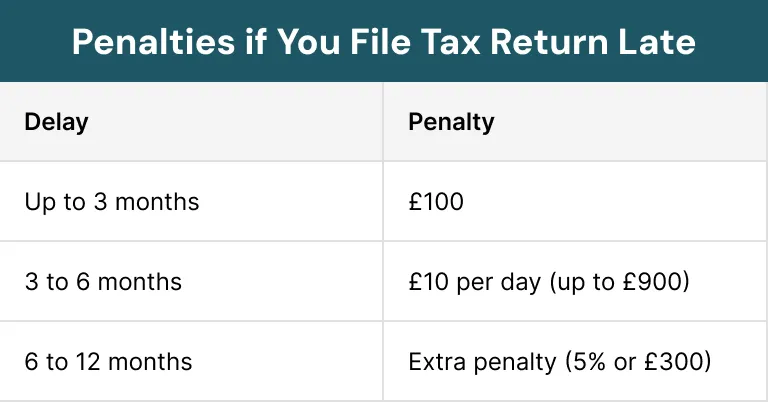
    According to HMRC policies, all businesses must keep correct records and file their taxes on time. If you do not pay all the taxes on time, this will result in cash flow pressure, interest charges and penalties.

    Learning about your tax obligations early allows you to plan more wisely. Also, you will sell your services in a more effective way and will avoid hassle later.

    In this blog, you will explore the workings of small business and taxes in the UK. You will also know what you have to pay and how to keep yourself in compliance.

    Key Takeaways

    • Small business tax rules depend on your business structure, profit level, and HMRC filing duties
    • Business tax for small business owners may include VAT, Income Tax, National Insurance, and Business Rates
    • Small business corporation tax applies to limited company profits after allowable expenses and reliefs are deducted
    • Small business company tax becomes easier to manage with good record keeping and digital accounting software
    • Small business and taxes are easier to handle when you understand deadlines, compliance rules, and tax-saving options

    What Is Small Business Tax in the UK?

    Business tax for small businesses involves HMRC collecting payments on the income, profits and sales. The aim of this policy is to make contributions to the public services like pensions, facilities and healthcare.

    No matter how small a business is, it is impacted by tax laws. The primary concern is that the tax is neither flexible nor optional. It follows exact deadlines and structured reporting systems.

    You must remember it; otherwise, you will get penalties promptly. Thus, it is not just compliance that makes you understand your tax responsibility.

    Therefore, knowing your tax duties is more than just compliance. It means that you have to protect your business from financial risk and keep it stable for a long time.

    Knowing small business and taxes is vital to staying compliant and preventing unneeded economic fines.

    Small business taxes are not only about staying compliant. They are about building a business that can grow with confidence, manage cash flow wisely, and stay prepared for change.

    Sarah Mitchell, UK Small Business Tax Adviser

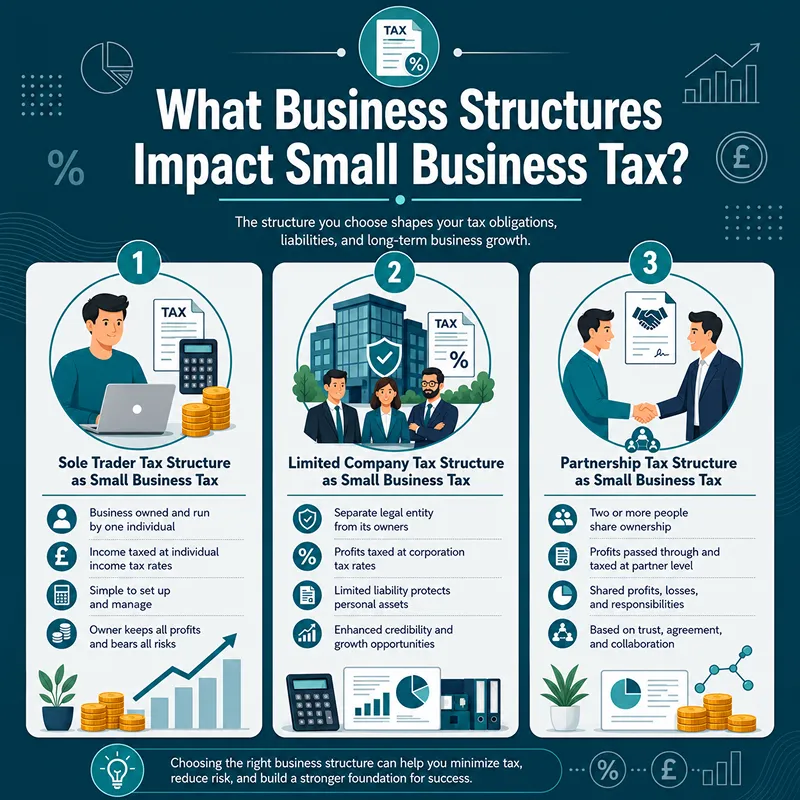
    What Business Structures Impact Small Business Tax?

    For the system of your tax, a business structure is the basis for it. This framework must decide which form to submit and how to pay taxes. Also, it tells how profits are handled.

    Each business structure has different levels of difficulty and duties. You should select one that greatly affects your workload and compliance obligations. These rules are explained below:

    1. Sole Trader Tax Structure as Small Business Tax

    Most of the small business tax examples are sole traders. Legally, you and your business are the same entity.

    In other words, you use self assessment to pay tax on your business profits. On the basis of those points, you also pay national insurance.

    Between business and personal financial affairs, there is no separation. Although this provides full authority, this also means that you must be responsible for any tax that is due.

    When your earnings become more than your personal allowance, tax becomes payable. This is why it is so important to keep records from the very beginning.

    2. Limited Company Tax Structure as Small Business Tax

    In legal terms, a limited company is separate from its owner. This setup results in a distinct tax structure.

    The company has to pay the corporation tax on its earnings. Directors usually receive income through a mix of salary and dividends.

    Dividends are taxed through self-assessment, while salaries are taxed via PAYE. In many cases, this structure offers more tax planning choices.

    However, in comparison to sole traders, it also needs compliance work, accounts setup and more reporting.

    Learn more about dividends: The complete guide to UK dividend tax

    3. Partnership Tax Structure as Small Business Tax

    Two or more individuals share ownership of the company in a partnership. The earnings are divided among all the partners.

    Each member is liable for national insurance and income tax on their portion of profits. All this is carried out by means of self assessment.

    The partnership itself also registers separately with HMRC. To prevent conflicts concerning profit distribution and tax responsibility, it is important to have clear contracts.
    What Business Structures Impact Small Business Tax

    What Is Small Business Corporation Tax?

    Whatever expenses limited companies incur, they pay corporation tax on their profits. Profits are determined by taking out salaries, costs and allowances from income.

    On the other hand, sole traders do not have to pay corporation tax. They self assess this tax and give their report to HMRC.

    Corporation Tax Rates and Thresholds

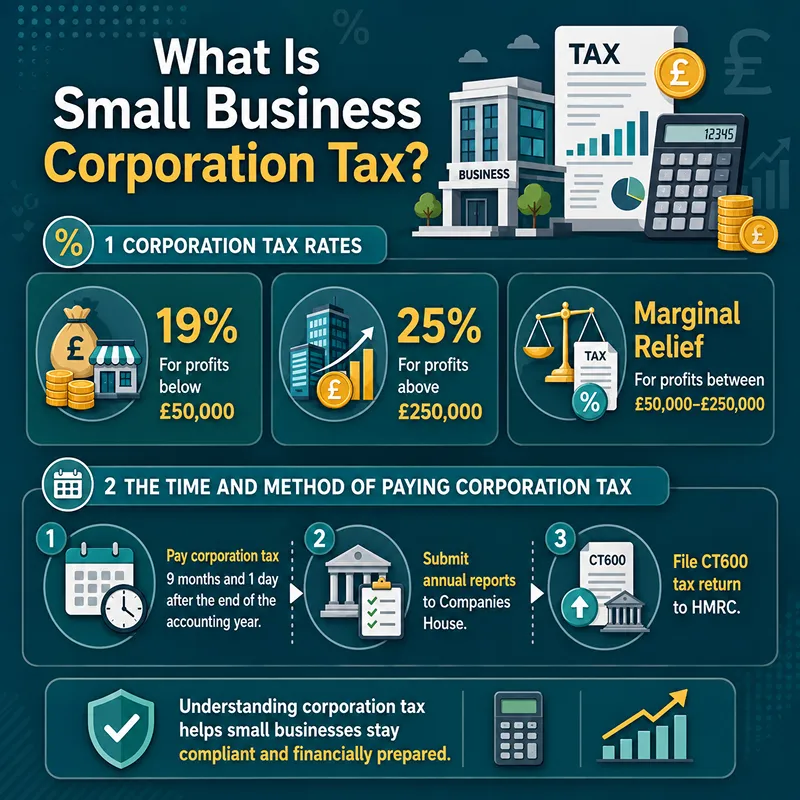
    The rate of corporation tax relies on the profit levels. For small business tax, it includes:

    • 19% for little profits (lower than £50,000)
    • 25% for profits more than £250,000
    • A range of £50,000–£250,000 utilises marginal relief

    This system ensures that the fair tax increases as profit increases.

    The Time and Method of Paying Corporation Tax

    Corporation tax is paid 9 months and 1 day after the end of the accounting year. Companies need to file:

    • Annual reports to Companies House
    • Tax return to HMRC (CT600)

    You can use the online platform of HMRC accounts to make payments. You must not wait for a bill; you need to calculate and pay taxes on time.
    What Is Small Business Corporation Tax

    Important Detail

    Even if your limited company makes no profit, you may still need to file a company tax return unless HMRC confirms your business is dormant.

    What Counts as Taxable Profit?

    Taxable profit is the profit on which tax is calculated. It is found by subtracting allowable expenses, salaries and tax reliefs from total income. 

    It may include many expenses, such as:

    • Workers pay
    • Rent
    • Equipment
    • Marketing expenses

    This decreases the overall amount of taxes due.

    What Is Small Business Income Tax?

    Profits derived from dividends, salaries and business profits are subject to income tax. It only comes into play if you earn more than £12,570 a year. Also, income tax is payable by sole traders and company directors similarly.

    Personal Allowance and Tax Bands for Small Business Tax

    A tax-free personal allowance of £12,570 is permissible in the UK. After that, income is taxed according to bands.

    Moreover, higher income means more costly rates of tax. This process is applicable to workers, sole traders and directors.

    Self Assessment System for Small Business Tax

    Income is reported and taxes are figured out using self-assessment.

    You must do the following:

    • Sign up with HMRC
    • Obtain a Unique Taxpayer Reference (UTR)
    • File tax return annually

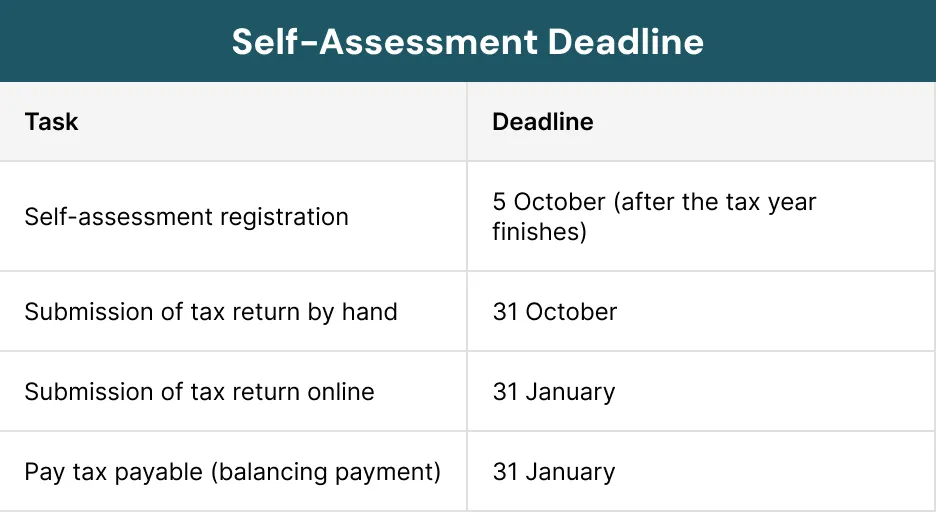
    The due date is 31 January each year. Thus, if you did not submit on time, it will result in penalties.

    Income Tax for Directors vs Sole Traders

    Sole traders must pay tax on profits. On the other hand, directors must pay tax on:

    • Salary through PAYE
    • Dividends through self assessment

    However, both should report their earnings every year to HMRC.

    What Are NICs for Small Business Tax?

    With the help of national insurance, public services and pensions are funded. This rule is the same for self-working people, employers and employees. The amount that they should have to pay depends on their status and earnings.

    Employee NICs for Small Business Tax

    Class 1 NICs are paid for by employees.

    They must make payment for the following:

    • 12% on income below the lower limit
    • 2% on earnings above

    It’s taken out by default through PAYE.

    Employer NICs for Small Business Tax

    Employers must also pay NICs on the salaries of the staff. They pay about 13.8%-15% more than the lowest possible earnings. For recruiting staff, this is an added expense.

    Self-Employed NICs for Small Business Tax

    The people who are self-employed must pay:

    • Class 2 NIC (if eligible, flat rate)
    • Class 4 NIC (according to the profit)

    Self-employed workers use self assessment to calculate and submit NICs.

    What Is VAT for Small Business Tax?

    Value added tax (VAT) is a UK consumption tax applied to goods and services, which businesses collect from customers. Firms then pay this VAT to HMRC, while reclaiming VAT on their own business transactions. 

    VAT is a tax added to most products and services in the UK. Companies pay VAT to HMRC after collecting it from clients. On business transactions, they can also claim back VAT.

    VAT Threshold and Registration Rules

    In the following cases, you must sign up for VAT:

    • When turnover goes above £90,000 in 1 year
    • Or if it is expected within 1 month

    To reclaim VAT, you can also sign up free of charge.

    VAT Rates in the UK

    The rates of VAT consist of:

    • 0% no rate
    • 5% lower rate
    • 20% standard rate

    VAT Returns and Making Tax Digital (MTD)

    VAT is paid to HMRC on a three-month basis. You must file your taxes online through approved software. Paying taxes in this way is called making tax digital (MTD). If you did not pay VAT on time, you will have to pay fines ahead.

    Related: Complete guide to VAT accounting schemes

    What Are the Business Rates for Small Business Tax?

    The taxes made on commercial properties are business rates. They are applicable to:

    • Factories
    • Warehouses
    • Offices
    • Shops

    Home businesses might not always pay them.

    When Business Rates Apply

    If you have to use other than residential property, you have to pay business rates. You can be exempted if you work from home. However, in some cases exceptions apply, such as:

    • Clients visit regularly
    • Property is designed specifically for business
    • Employees work from home

    Business Rates Relief for Small Business Taxes

    The business tax for small business relief is accessible to companies. However, this relies on usage and property value. Some businesses have to pay lower charges or nothing at all.

    What Are Other Small Business Taxes?

    There are also some extra charges that small businesses might have to pay, depending on the activity.

    Capital Gains Tax

    Small businesses may have to pay capital gains tax if they sell business assets for profit. The things involved in it are equipment, shares and real estate. Tax relies on the earnings, after expenses are taken out.

    Stamp Duty Land Tax

    This is another form of business tax for small business which is paid when purchasing land or property. This amount depends on the type of property and value.

    Industry-Specific Taxes

    There are many industries that pay additional taxes, such as:

    • Gambling tax
    • Tobacco tax
    • Alcohol tax

    All these taxes are imposed through controlled sectors.

    What Are Small Business Tax Registration and Deadlines?

    The due dates for your small business and taxes are according to the type of your business.

    Self Assessment Registration

    Once you start trading, register the self assessment by 5 October. Each year, you must file your tax return by 31 January.

    Corporation Tax Registration

    Within 3 months of trading, limited companies must register for corporation tax.

    VAT Registration

    When turnover increases above £90,000 or is voluntarily reported sooner, you must register for VAT.

    What Is Making Tax Digital (MTD) in Small Business Tax?

    The digital tax system of HMRC is called MTD. With the help of this, businesses can keep online information safe. Use its software to submit the tax returns.

    What MTD Means

    This system has replaced the paper details with online systems. With the help of this updated system, accuracy has improved a lot and errors have been reduced.

    Who Must Follow MTD

    The businesses that are already registered with VAT must already follow it. Over time, an income tax MTD is set up.

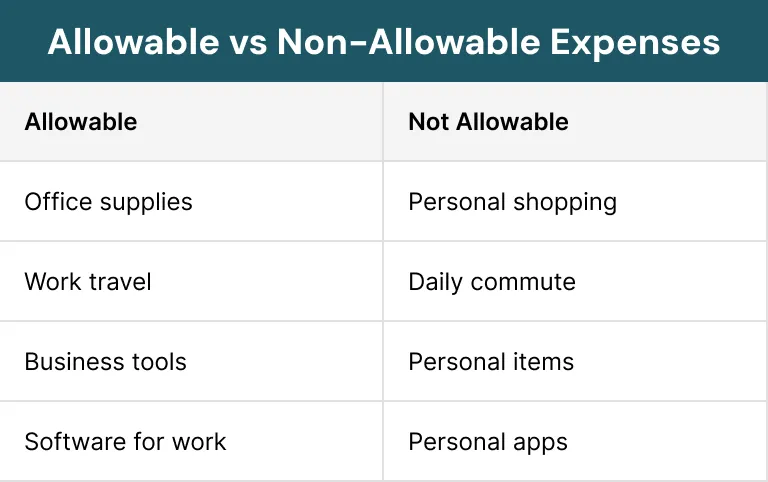
    Allowable Business Expenses for Small Business Tax

    With the help of allowable expenses, businesses can lower their taxes.

    Common Allowable Expenses

    Some of the common allowable expenses are as follows:

    • Equipment
    • Supplies
    • Staff salaries
    • Marketing
    • Travel
    • Office costs

    These costs decrease the taxable profit.

    Tax Reliefs and Allowances

    Businesses might claim the following:

    • Investment allowances
    • R&D relief
    • Pension contributions

    These allowances minimise corporation tax.

    Importance of Record Keeping

    It is vital to keep records and receipts safe. The reason is that you can take help from these invoices in case of need. All the crucial information is written over it.

    Compliance and Penalties for Small Business Tax

    Compliance with all legal regulations is referred to as HMRC. With the help of this, you can lower the risk of penalties and legal issues.

    Common Compliance Areas

    Its main areas are as follows:

    • Health & safety
    • AML regulations
    • Data safety
    • Employment law
    • Tax laws

    Results of Missing Deadlines

    It’s important to file on time because, in case of delay, you may face the following:

    • Legal action
    • Fines
    • Interest charges

    What Are the Tips for Managing Small Business Tax?

    You can make your tax system easy if you plan properly. Some effective tips are given below:

    Budgeting for Tax Payments

    For tax bills, keep some money safe and don’t spend it on other expenses. With the help of this strategy, you will not encounter cash flow problems.

    Quick Tip

    Set aside money for taxes every month instead of waiting for deadlines. This helps you avoid cash flow problems when VAT, self-assessment, or corporation tax payments are due.

    Using Accounting Software

    You can use some accounting software, such as QuickBooks and Xero. These tools are very helpful in lowering mistakes and they are time-saving too.

    Hiring an Accountant.

    If you hire an accountant for your tax-related matters, it will reduce risk and stress a lot. An accountant is very helpful in:

    • Compliance
    • Filing returns
    • Tax saving

    Case Study: An Improved Tax Management Helped a Rising Small Business

    A developing hospitality business in the UK had roughly 50 workers. They had difficulty with tax management and VAT reports after low assistance from their prior accountant.

    The company had ignored many VAT claims and did not know much about financial education. Also, they did not understand the relief of available taxes.

    The business introduced an improved financial organisation and regular reporting to enhance the situation. Also, it set up a more structured VAT process.

    This way, the company paid VAT returns on time and reclaimed overlooked tax reliefs. In addition, got a clearer and more open awareness of its finances.

    As a result, the company lowered its tax burden and improved compliance. The business becomes able to manage cash flow and economic planning.

    This real-life example reveals that when the tax management is organised and the record keeping is correct, it can support lasting business growth.

    Final Thoughts

    Once you understand the basics of UK small business tax, they become easier to manage. However, at the start, they seem to be complicated. Business rates, national insurance, VAT, corporation tax and income tax all rely on your business income and structure.

    For instance, limited companies and sole traders follow different due dates and tax rules. Also, HMRC wants businesses to keep up-to-date online details and stay compliant all year.

    However, if you plan properly and record correctly, businesses can avoid fines and handle cash flow more smoothly.

    Paying HMRC does not mean that you are aware of taxes; rather, it is all about managing a stable and profitable business.

    At Sterling Cooper, we know the worth of practical and clear business instructions. Contact us today if you want to learn more about enhancing your business skills and staying up to date.

    Struggling to keep up with small business taxes and HMRC deadlines?

    We help businesses understand complex topics with clear, practical guidance and reliable support. We have helped many businesses stay informed and organised.
    +443300102526
    Book an Appointment

    FAQs


    What is small business corporation tax in the UK?


    Small business corporation tax is the tax limited companies pay on their taxable profits. In the UK, the rate depends on profit levels, with smaller businesses often qualifying for the lower Corporation Tax rate.


    Small business company tax usually includes Corporation Tax, VAT, PAYE, and National Insurance responsibilities. Limited companies must report profits to HMRC and file tax returns within the required deadlines.


    Self-employed people can reduce higher-rate tax by claiming allowable expenses and making pension contributions.
    Keeping profits below the higher-rate threshold may also help reduce tax liability. However, tax planning should always follow HMRC rules and reporting requirements.


    The 60% tax trap happens when people earning over £100,000 start losing their personal allowance.
    This creates a much higher effective tax rate on income between £100,000 and £125,140. Pension contributions and salary planning may help reduce the impact.


    Small business tax is usually calculated based on profits after allowable expenses are deducted.
    The type of tax depends on your business structure, such as a sole trader or a limited company. You must also consider VAT, National Insurance, and any applicable reliefs or allowances.

    Share This Article!

    Recent Posts

  • Why Every Growing Retail Business Needs a CFO

    Why Every Growing Retail Business Needs a CFO

    Cfo​

    Posted by:

    Admin

    Date:

    May 8, 2026
    Category:

    blogs

    Error: Contact form not found.

    Why Every Growing Retail Business Needs a CFO

    Why do retail businesses with higher sales still struggle? Because sales alone does not ensure profit. Proper financial control, cost management, cash flows and strong CFO leadership are required to make a business successful.

    Retail businesses often start with energy, drive and a strong focus on sales. Owners spend most of their time bringing in customers, managing stock and giving a good shopping experience. These things matter, but they can take focus away from something just as important, good financial leadership.

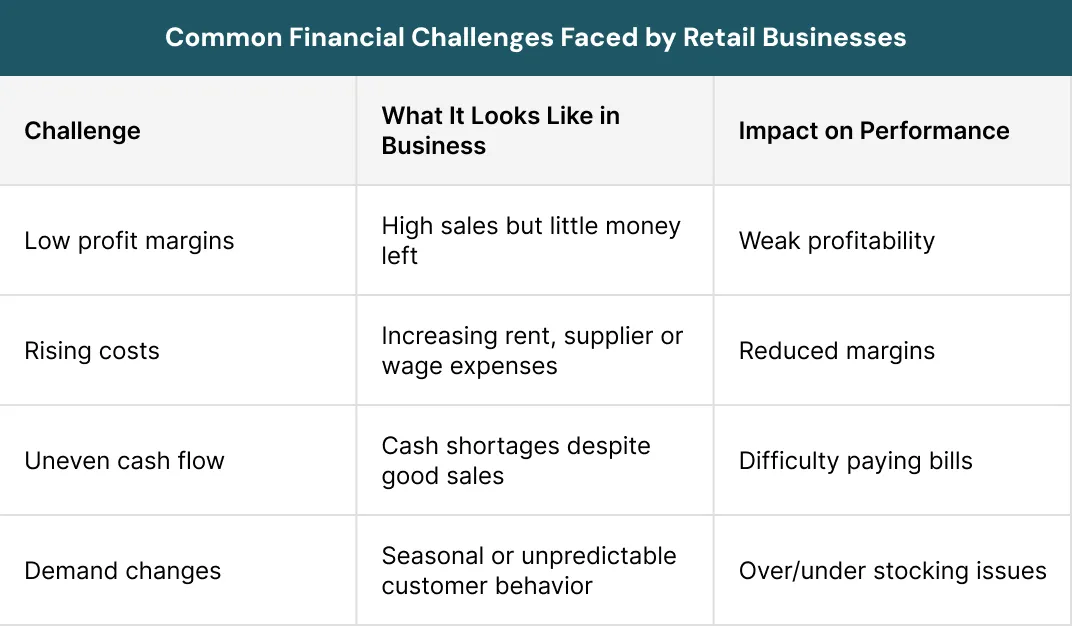
    When you look at businesses, you see that they have a lot of financial problems that are hidden. These problems include:

    • Changes in demand
    • Low profit margins
    • Rising costs
    • Uneven cash flows

    Common Financial Challenges Faced by Retail Businesses

    A business can look like it is doing well from the outside. It can still have big problems on the inside if it does not manage its finances well.

    A lot of people think that making a lot of sales means a business is successful. This is not always true. Sales growth does not mean it is doing well. The average profit margin for a business in the United Kingdom is about 8.8% in 2025. This shows how small businesses retain their revenue.

    Retail businesses can make a lot of money from sales and still have problems if they do not control costs or lack proper financial planning. Many retail businesses fail because they do not understand how to manage their finances, not because they do not have customers.

    This is why financial management is very important for businesses. Having a plan helps retail businesses turn sales into real profits, keeps costs low and helps them grow steadily. The chief financial officer is an important person in this process. They help retail businesses think clearly, get organised, manage finances and make long term financial plans.

    Key Takeaways

    • A chief financial officer is not just a finance manager; they guide strategy, improve cash flow and turn sales into real profit. Understanding what is a CFO helps business owners see the value beyond basic accounting
    • The CFO meaning in business is focused on future growth, not just past data. They use financial insights to support better decisions on pricing, stock, hiring and expansion
    • Retail businesses should not rely on sales alone. Strong financial planning, cost control and forecasting led by a chief financial officer are key to long term success and stability
    • A virtual CFO small business solution can give growing companies access to expert financial leadership without the cost of a full time hire, making it a practical option for scaling businesses
    • Knowing when a company needs a CFO is critical. Warning signs include falling profit margins, cash flow issues, weak financial reporting and rapid growth without proper systems
    • A chief financial officer helps manage risk, improve efficiency and build clear financial systems. This ensures the business can handle uncertainty and continue to grow in a controlled way
    • Investing in the services of a chief financial officer is not just a cost but a strategic step. It helps avoid costly mistakes, improves profitability and supports sustainable business growth

    Understanding the Role of a CFO in Modern Business

    A chief financial officer does much more than manage numbers. To answer, what is a CFO, you need to look at their wider responsibilities.

    They look after the financial health of a business and guide it towards steady growth. Their work includes planning, making forecasts, studying financial data and turning that data into clear business actions. It is important to look beyond numbers to understand the CFO meaning in business. 

    Unlike traditional finance roles, a chief financial officer focuses on the future rather than just the past. They help a business see where it is going, not only where it has been. This shows the true CFO meaning in business.

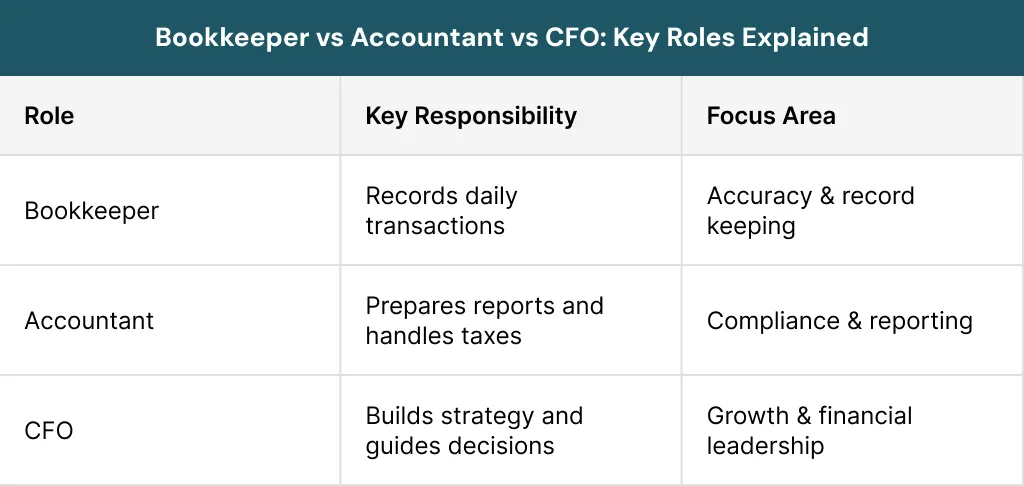
    Understanding what is a CFO becomes easier when compared with other roles:

    • A bookkeeper records daily transactions and keeps financial records up to date
    • An accountant prepares financial statements and handles tax related tasks
    • A chief financial officer interprets financial data, builds strategies and supports decision making

    Bookkeeper vs Accountant vs CFO Key Roles Explained

    This difference matters. Bookkeepers and accountants are more concerned about accuracy and compliance. However, the chief financial officer focuses on direction and growth.

    Retail businesses gain a lot from strong financial leadership early. As operations grow, financial decisions become more complex. Pricing, stock, growth plans and hiring all affect finances. Without expert help, these decisions are often based on guesswork instead of clear data.

    The Evolution of the CFO Role in Today’s Market

    The job of the chief financial officer has changed a lot over time. In the past, they mainly took care of reporting and making sure the company followed the rules. Today, they have a much wider role as key leaders in a business.

    1. From Financial Reporting to Strategic Leadership

    Modern chief financial officers help shape business growth strategies. They work with leaders to guide growth, evaluate opportunities and manage risks. Their role now goes beyond finance into:

    • Daily operations
    • Planning
    • Improving results

    2. Digital Transformation and Business Growth

    The use of digital tools is another big change. A chief financial officer now helps bring in new systems, automate tasks and use data to improve how a business runs and makes decisions.

    3. Fractional and Outsourced CFO Models

    Businesses also have more flexible ways to hire financial leaders. Instead of a full time chief financial officer, many choose:

    • Fractional (part time support)
    • Outsourced services

    These models help small or growing retail businesses get expert help without the cost of a full time senior role. This makes strong financial leadership easier to access than before.

    The Role of Technology and Data in Growth

    Modern retail businesses create a lot of data every day, from sales to customer behaviour. But data on its own is not useful unless it is studied and used well. This is where a chief financial officer plays a key role.

    1. AI and Automation in Finance

    A chief financial officer uses AI and automation tools to analyse data. The aim is to get insights from this data and use them in decision making. These tools are helpful to get the work done faster. They also improve the accuracy of the work.

    2. Cloud Based Forecasts and Real Time Dashboards

    Cloud systems are really helpful for businesses. They can look at their data at any moment. Business owners do not have to wait for monthly reports. They can simply use these dashboards to monitor performance anytime. It helps them in making faster and better decisions.

    3. ERP and CRM Integration

    They also integrate systems such as:

    • Enterprise Resource Planning (ERP)
    • Customer Relationship Management (CRM)

    By linking these systems, they create one clear view of the business. This helps track sales, stock, finance and daily operations more easily.

    4. Data Driven Decisions

    With clear data, decisions are not based on assumptions. They are based on facts. This leads to better pricing, smarter inventory management and stronger business results overall.

    Core Functions of a CFO in a Retail Business

    A chief financial officer in retail has many duties, but they all support one aim building a stable and profitable business. This clearly reflects the CFO meaning in business in practice.

    1. Financial Planning, Budgeting and Forecasting

    A key role is financial planning. This includes setting budgets, forecasting future results and making long term plans. These help the business grow while avoiding risk.

    2. Cash Flow and Financial Control

    It is crucial for any business to manage cash flows. For retail businesses, it can be very tough because they have to deal with sales that go up and down with the seasons. This can cause problems when customers pay late and create gaps in cash flow. A chief financial officer makes sure there is enough money to run daily operations.

    Interesting Fact:

    Retail businesses often lose money through slow moving inventory.

    3. Cost Management

    A chief financial officer also manages costs. They review unnecessary spending and cut those extra costs. This helps improve profit and use resources well.

    4. Financial Reporting and Compliance

    The chief financial officer handles financial reports and ensures compliance. Clear reports build trust and keep the business in line with legal needs.

    5. Risk Management

    A chief financial officer also manages risk. They spot possible problems, such as market changes or supply issues and plan how to deal with them. This helps the business stay stable in tough times.

    Support in Retail Business Growth

    A CFO plays a key role in helping retail businesses grow in a clear and steady way. When a company grows without a plan, it can put a lot of stress on finances. The company can achieve long term success with the right support.

    1. Planning for Growth and Scale

    A chief financial officer helps create clear plans for growth. They set goals that are achievable and figure out how to achieve them. Whether it is opening new shops or adding new products, they make sure each step is based on good financial analysis.

    2. Identifying Profitable Growth Opportunities

    They also find the best ways to grow. Not all growth is good. Expanding in the wrong way can lead to loss. A CFO checks each option to make sure it fits the business’s financial goals.

    3. Supporting Product, Pricing and Market Decisions

    A chief financial officer helps with key decisions like what to sell, how to price it and which markets to target. They use data to implement these decisions and minimise risk.

    4. Improving Operational Efficiency

    A chief financial officer also helps improve daily operations and find ways to cut waste. They also improve processes and make better use of resources. This helps the business to operate smoothly and gain more profit.

    Role of CFO in Cash Flow and Profitability Management

    Cash flow is commonly referred to as the lifeblood of a retail business. Even a profitable business can fail if it runs out of cash. This makes cash flow one of the most important areas a chief financial officer manages.

    1. Preventing Liquidity Gaps

    Retail businesses can have high sales but still face low cash. This may happen due to late payments, high stock costs or weak planning. A CFO helps prevent this by planning cash flow and managing working capital.

    Did you know?

    Many profitable businesses still fail due to cash flow issues.

    2. Improving Working Capital and Collections Cycles

    A chief financial officer also works to improve how cash moves in and out. They may be able to negotiate better prices with suppliers and handle incoming payments properly. This assists in keeping smooth cash flow.

    3. Strengthening Profit Margins

    Profit is another key focus. A CFO looks at the financial performance of the company and makes sure the company growth brings more revenues, not just more sales.

    They do not just reduce expenses, but make sure that every pound they spend is really valuable for their business. This helps improve the company results. It also supports steady and long term growth.

    Revenue is vanity, profit is sanity but cash is reality. – Alan Miltz, Managing Director of Pearl Business Improvement.

    Strategic Decision Making

    A key role of a chief financial officer within a retail business is to transform financial data into clear and useful insights. This is a practical example of what is a CFO in action. Many owners have access to numbers, but without clear meaning, those numbers do not help much. A chief financial officer fills this gap.

    Instead of relying on guesswork or short term thinking, decisions are based on financial data. They look at reports, identify trends and see what must be done to produce the best results.

    1. Supporting Pricing, Staffing and Inventory Decisions

    This helps with the areas like setting prices, hiring staff and managing stock. For example, a chief financial officer can see if a product is really making a profit after considering all the costs. They can also decide if hiring more staff will help or just add extra cost.

    Quick Tip:

    Focus on profit per product, not just total sales.

    2. Tracking Performance

    A chief financial officer also tracks performance. They set key measures (KPIs) that match business goals. These help owners see what is working, spot problems and adjust plans when needed.

    3. Real Time Data for Faster Decisions

    When you have updated information, you can make decisions fast and you will feel more confident about them. This is very important in the retail business because customer demands and market trends can change very quickly.

    Managing Risk and Uncertainty in Retail Operations

    Retail businesses are always dealing with things that can change at any time. You do not know what might happen. There are a lot of things that can affect the results of the business. Without good planning, these risks can cause serious money problems.

    The failure in retail business has increased by more than 5% in 2025 due to financial pressure. This will also continue in 2026.

    1. Identifying Risks Early

    A CFO helps find risks early. They can spot problems before they grow by looking at market trends and business data. This helps the business take action before things get worse.

    2. Economic Uncertainty and Scenario Planning

    A chief financial officer does scenario planning. For example, the company will see what happens if the sales of the company drop or the costs rise. This helps the company to prepare plans for situations and make sure the company can handle tough times.

    3. Supply Chain and Inventory Risk Management

    The major risk in a retail business is supply chain issues. Sales can be affected by delays, shortages or higher prices. A chief financial officer works with other teams to reduce these risks. They can minimise these risks by having multiple suppliers or managing inventory better.

    4. Planning for Crises and Continuity

    When things get tough, a simple financial plan is really important. A chief financial officer makes sure the business is ready to deal with problems while staying stable.

    Strengthening Financial Systems and Controls

    Financial systems need to improve with business growth. Without a system, it is hard to manage your finances. Mistakes start to happen all the time.

    1. Building Scalable Financial Systems for Growth

    A chief financial officer sets up systems that can grow with the business. These systems can handle sales and more complex processes as the business gets bigger.

    2. Improving Internal Controls and Financial Accuracy

    A chief financial officer also improves internal controls. These make sure financial processes are correct, consistent and safe. They help reduce errors, fraud and poor handling of finances.

    3. Making Reports and Workflows Simple

    They make reporting easier and more efficient. Instead of using old reports that are hard to understand, they set up simple systems that provide financial data on time.

    Clear information and better accuracy are key to making decisions and building trust. Good financial data helps investors, lenders and partners to be confident in the business.

    Supporting Funding and Investor Relations

    Outside funding is often required for growth, such as loans or investors. It is not just a good idea to get this funding, rather it needs strong financial planning.

    1. Preparing Financials Data for Funding

    A chief financial officer ensures the business is ready to get funding. They do this by preparing financial reports, plans and forecasts. They do this to show the strength of the business. This builds trust with lenders and investors.

    2. Improving Credit and Funding Readiness

    They also improve the business’s financial position to get funding easily. This may include:

    • Managing debt
    • Improving cash flow
    • Strengthening overall performance

    3. Managing Investor Communication

    A chief financial officer communicates honestly with investors. They share information and provide regular updates to build trust and long term support with investors.

    4. Structuring Capital for Growth

    A chief financial officer also figures out how to use funds in a smart way. They do this by ensuring that a business has a mix of debt and investment. This supports growth without putting too much pressure on the company.

    Support in Retail Growth and Scaling

    When a retail business is growing, it is an exciting time. It also means the business will have to deal with some financial problems.

    The retail business needs careful planning for things like opening new shops or adding new products or even entering new markets.

    A CFO helps make sure this growth makes financial sense. They review costs, expected returns and risks for each option. This helps stop the business from taking on too much.

    1. Funding Growth without Debt

    A chief financial officer finds the best ways to fund growth. They make sure the business does not borrow much money. This helps keep its finances strong.

    2. Tracking Profit

    During growth, it is important to track profit for each shop, product or sales channel. A CFO checks this closely to make sure growth is steady. If something is not working well, they suggest changes.

    3. Maintaining Profitability

    Most importantly, a CFO helps keep profit steady during growth. When a company grows fast without any control, it can lead to big losses. The company needs the right guidance to stay under control and be profitable.

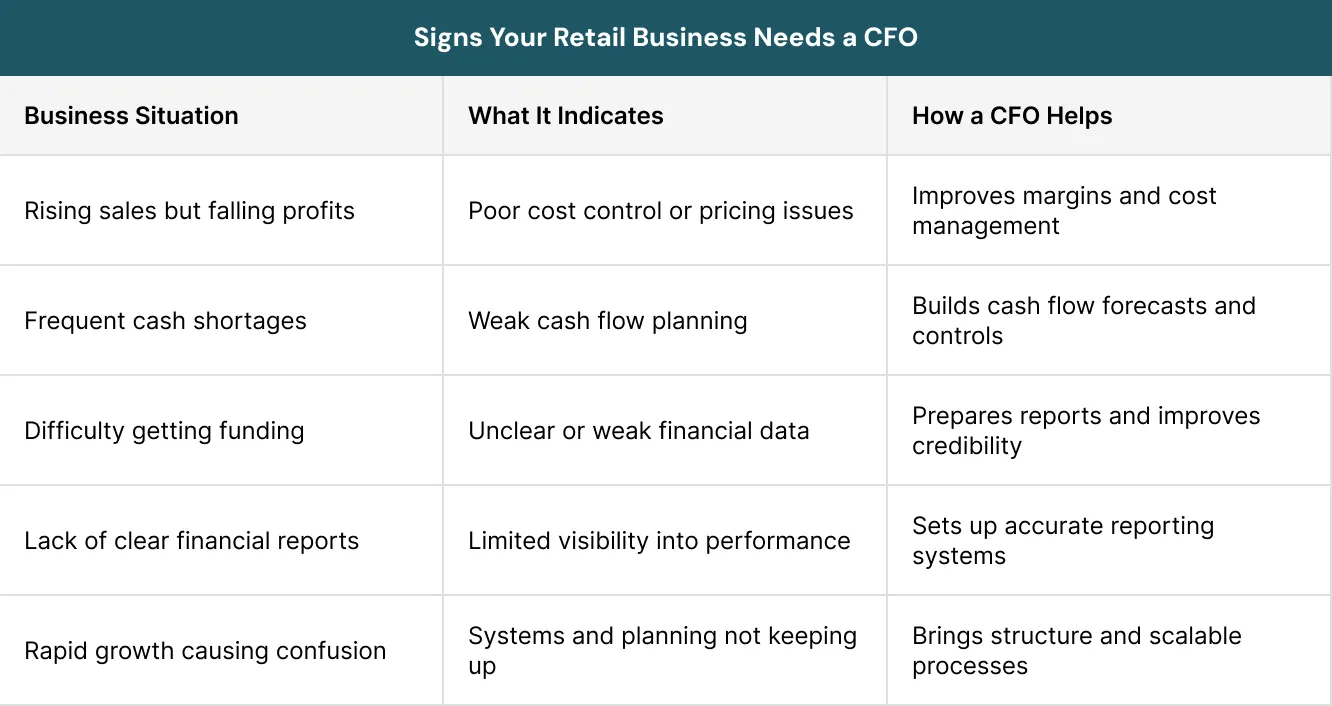
    Signs Your Retail Business Needs a CFO

    Most companies wait a long time to hire a chief financial officer. This section also answers what is a CFO and when a company needs a CFO. They think they are not ready for a chief financial officer. There are clear signs that tell you that it is time for financial leadership.

    1. Inconsistent or Declining Profit Margins

    If the sales of a company are going up but the profit is not, then something is wrong. It means that the company has some problems with costs or the processes. This needs to be fixed so that the company can make profits.

    2. Cash Flow Issues

    It is a warning sign for a company when it has strong sales but low cash. This usually means weak financial planning or poor cash control, which is not good for the company’s future.

    3. Difficulty Securing Funding

    If you are finding it hard to get loans or attract investors, it probably means your business does not have strong financial data.

    4. Lack of Reliable Financial Reporting

    If you do not have reliable reports, it is really hard to know what is going on with your business. This makes it difficult to choose wisely.

    5. Rapid Growth Outpacing Financial Systems

    Fast growth can make things complex. If systems and processes cannot keep up, a chief financial officer can bring the structure and skills needed to manage it well.

    Signs Your Retail Business Needs a CFO

    Choosing the Right CFO Services Provider

    Choosing the right chief financial officer is an important step. The first step is to understand your business’ needs. Every business is different and so are their needs. It depends on the size of business, nature of work and goals.

    1. Assessing Skills and Experience

    Experience is very important while choosing a chief financial officer. A chief financial officer with retail experience will understand key issues like stock control, pricing and seasonal sales.

    2. Outsourced, In House or Fractional Chief Financial Officer

    Businesses can choose between:

    • In house chief financial officer
    • Outsourced chief financial officer services
    • Fractional chief financial officer (part time)

    Each has its own benefits. Outsourced and part time options are more flexible and cost efficient, while an in house CFO offers full time support.

    3. Transparent Pricing and Deliverables

    It is important to have clear pricing and a clear list of tasks. This helps you know what you are paying for and how much value you are getting.

    4. Aligning CFO Services with Long Term Goals

    In the end, the chief financial officer services should match your long term goals and help your business grow in a steady and sustainable way.

    Cost, ROI and Value of CFO Services

    Many business owners worry about the cost of hiring a chief financial officer. But looking only at cost can be misleading. What matters more is the value they bring.

    1. Common Pricing Options

    A chief financial officer’s services come in different pricing options. These include full time roles, part time support or outsourced services. This gives businesses the choice to choose what fits their budget.

    2. Improve Profitability and Efficiency

    A CFO can deliver strong returns on investment (ROI). They help increase profit by improving efficiency, cutting costs and finding new opportunities.

    3. Measuring ROI

    They also help avoid costly mistakes. Poor decisions, inefficient spending and weak planning can lead to losses. A chief financial officer helps reduce these risks.

    4. Why CFO Services are Worth the Cost

    In many cases, the gains from better planning and control are greater than the cost of hiring a chief financial officer. This makes it an investment that supports growth, not just an expense.

    How to Get Started with CFO Services

    Bringing a chief financial officer into a business starts with checking if you are ready. This means looking at your financial issues, growth plans and where expert help is needed.

    1. Steps To Hire a CFO

    Once the need is clear, the next step is choosing the right type of support. Many businesses begin with a part time or outsourced chief financial officer for more flexibility.

    2. What To Expect in the First 90 Days

    The early stage includes reviewing financial data, learning how the business works and setting key goals. In the first 90 days, they build a clear view of the finances and deal with urgent issues.

    3. Setting Financial Priorities and KPIs

    It is important to set clear financial goals. These may include better cash flow, higher profit or plans for growth. Setting key measures (KPIs) helps track progress.

    With the right approach, adding a chief financial officer can be smooth and very useful for the business.

    Real Life Example

    Tesco is one of the largest retail businesses in the UK. Back in 2014 Tesco had some serious problems. The profits were falling and costs were high. There were also issues with its financial reports. From the outside, business looked strong but there was a problem in managing finances.

    During this time, a chief financial officer, Alan Stewart, helped get the company on track. They worked on fixing cash flow and cutting extra costs. They make sure financial reports are clear and accurate. This helped Tesco understand its real position.

    Tesco made some important changes. It stopped wasting money, kept a track of its stock and focused on the parts of the business that were making profit. These changes were made after financial planning, not just guessing.

    Tesco became a stable company over time. It started making profits again and people began to trust it once more. This shows that having strong financial leadership is very important for a retail business. This can turn a struggling business into strong and successful again. 

    Conclusion

    As retail businesses grow, they need to move from reacting to problems to planning ahead. Relying on intuition or basic finance methods is no longer enough for success.

    A chief financial officer brings structure, clear insight and strong leadership. They help businesses move beyond just making sales to building solid and profitable operations.

    By managing cash flow, improving how the business runs, supporting decisions and reducing risk, a CFO plays a key role in long term success. They make sure growth is not only achievable but also sustainable.

    In the end, building a stable and growing retail business needs more than ambition; it needs clear financial planning. A chief financial officer provides this highlighting a CFO meaning in business.

    The key point is simple, a chief financial officer’s services are not just for large companies. They are important for any growing retail business that wants to succeed, stay competitive and grow over time.

    Sterling Cooper understands the challenges of turning retail sales into real and lasting profit. With expert CFO support, we help businesses improve cash flow, control costs and make smarter financial decisions for sustainable growth. Contact us today for expert services.

    Ready to take your retail business to the next level?

    Contact us today to discover tailored CFO solutions designed to help your business grow smarter and faster.
    +443300102526
    Book an Appointment

    FAQs


    What does CFO mean?


    CFO stands for Chief Financial Officer. They are responsible for managing a company’s financial health, including planning, budgeting and reporting. A CFO also helps guide business strategy using financial data.


    No, the CEO holds the highest executive position in a company. A CFO is responsible for managing the company’s finances and financial strategy, but they usually report directly to the CEO.


    Yes, a CFO role can be stressful. They handle financial risks, cash flow, compliance and major decisions. However, strong systems and planning can help reduce pressure.


    A CFO typically has a degree in finance, accounting or business. Many also hold professional certifications like ACCA, CIMA or CPA. Experience in financial management and leadership is essential.


    A CFO helps turn sales into profit through strong financial planning. They manage cash flow, control costs and support decision making. This ensures stable growth and long term business success.


    A retail CFO manages finances specific to retail operations. They handle cash flow, pricing, inventory costs and profit margins. They also support growth decisions using financial data.


    A CFO brings structure and clarity to business finances. They reduce risk, improve efficiency and support strategic growth. This helps businesses stay profitable and competitive.


    CFOs face challenges like managing cash flow, rising costs and economic uncertainty. They must also ensure accurate reporting and handle financial risks. Balancing growth with financial stability is a key challenge.

    Share This Article!

    Recent Posts

  • How to Read Financial Statements: A Simple Guide for Non-Accountants

    How to Read Financial Statements: A Simple Guide for Non-Accountants

    financial statements

    Posted by:

    Admin

    Date:

    May 6, 2026
    Category:

    blogs

    Error: Contact form not found.

    How to Read Financial Statements: A Simple Guide for Non-Accountants

    Have you ever wondered how to check your business’s financial health?

    Knowing financial statements is vital. However, many people don’t grasp what financial statements mean.

    In the FinWell Index 2025, young adults aged 18‑24 secured an 87.7 score in financial health. This score is lower than that of older age groups. This shows that younger UK adults may find it harder to know basic financial management and information.

    There are three main financial statements to read. You will explore them here in detail, one by one.

    These financial statements give key insight into your company’s financial position, production and cash flow.

    For instance, a balance sheet tells what a company owns and owes. On the other hand, the income statement shows how much profit the firm produces over time. In addition, the cash flow statement tells whether the company has enough money to pay its bills.

    In this blog, you will learn how to read financial statements. Also, you will be able to make smart business or investment choices.

    Key Takeaways:

    • How to read financial statements is essential for understanding your business’s financial health
    • Start with how to read a financial statement of a company, focusing on assets, liabilities, and equity
    • Reading financial statements helps you assess a company’s profitability and cash flow
    • Use the balance sheet to track what a company owns and owes, and how do I read a balance sheet to understand its financial position
    • The income statement shows how much profit or loss a company has made
    • The cash flow statement reveals if the company has enough money to cover its bills
    • Regular reading of financial statements is key to making informed business decisions
    • Understanding financial statements is crucial for making smarter business and investment choices

    What Are Financial Statements?

    Financial statements are official data of a business’s or a person’s economic position and activities. They provide a review of the money dealings and goings-on of a company over a period of time.
    For firms, financial statements assist in getting loans, tracking performance and attracting investors. Its main types include:

    1. Balance sheet
    2. Income statement
    3. Cash flow statement

    With the help of these documents, you can know your business’s financial health. This helps both internal and external parties to make wise selections.

    Did You Know?

    Financial statements are not just for accountants. Business owners and investors use them to make crucial decisions about growth, investment, and financial planning. Knowing how to read these statements can save you time and money in the long run.

    Why Are Financial Statements Important?

    Business owners, employees, managers and investors see the progress of a company with the help of financial statements. They use these details to make better decisions. They give crucial data about cash flow, profit, debt and how smoothly the business runs.

    Consider an example, if an investor wants to buy stock, they will study the balance sheet. The purpose of this is to check the firm’s financial position. They will also look over the income statement to analyse profit trends.

    On the other side, a business owner might also check the cash flow statement. With the help of this, they will know that the business has enough money to pay its bills.

    In addition, knowing financial statements is also good for handling accounts.

    Knowing how to read financial statements is one of the most valuable skills an investor can possess. They provide essential insights into a company’s financial health, helping to make informed decisions about the future.

    Warren Buffett

    How to Read Financial Statements?

    To understand financial statements, each document should be reviewed separately. All these statements are important for assessing your business’s financial position. Let’s begin:

    How Do I Read a Balance Sheet?

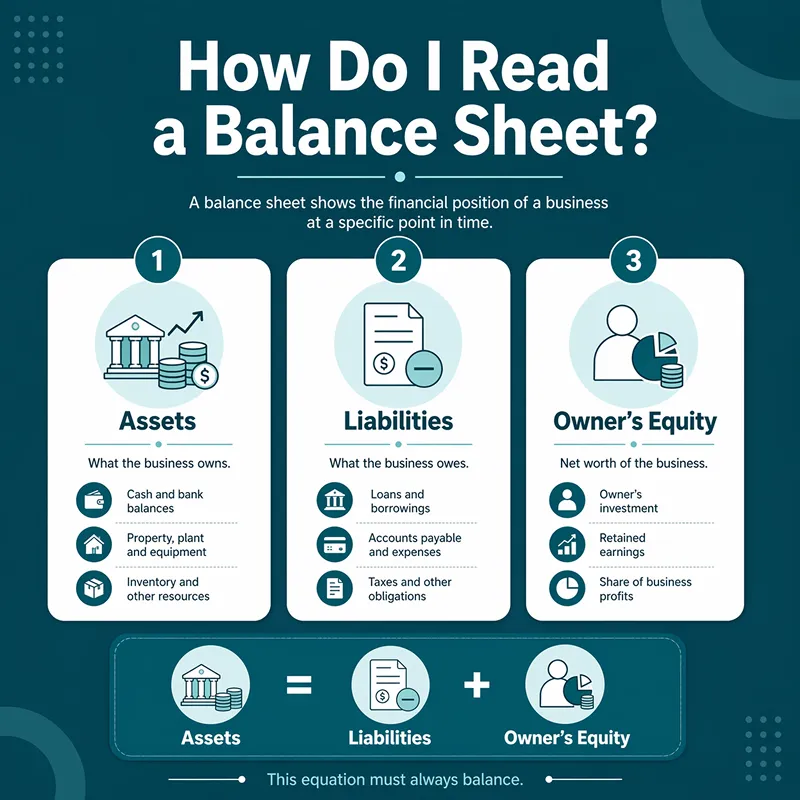
    If you want to know the firm’s financial position at a certain time, the balance sheet needs to be read. It explains to you what the company owns (assets) and what it owes (liabilities). Besides this, it also shows shareholders’ equity (the difference between liabilities and assets).

    If you want to know how do i read a balance sheet, the given formula will help you:

    Assets = Liabilities + Owner’s Equity

    The main parts of a balance sheet are given below:

    1. Assets

    The valuable things a company owns are called assets. They are divided into:

    Current Assets

    The assets of a company that can be transformed into cash in one year. Their examples are cash, inventory and accounts receivable.

    Non-Current Assets

    The long-term assets are called non-current, such as property, equipment and patents.

    2. Liabilities

    The debts that the company has to pay are called liabilities. They are divided into two groups:

    Current Liabilities

    These are the short-term debts, such as short-term loans and accounts payable.

    Non-Current Liabilities

    Mortgages or long-term loans are examples of long-term debts.

    3. Owner’s Equity

    This term is called the net worth, too. It represents the value left for shareholders when all the debts are paid. It is worked out as:
    Owner’s equity is found by subtracting debts from assets.

    You can know its financial stability by comparing its assets, debts and equity.

    If a business has £500,000 in assets and £200,000 in debts, its value is £300,000 (£500,000 – £200,000). This tells that the company’s value is £300,000 after submitting all its debts.

    How do I read a balanace sheet

    Pro Tip

    When reading a balance sheet, always compare current assets with current liabilities to assess the company’s short-term financial health. A current ratio above 2 is generally considered a good sign of financial stability.

    How Do I Read an Income Statement?

    The other name of the income statement is also the profit and loss statement. It shows, at a certain time, how much profit or loss the business made. This can be a month, quarter or year. You can find out the net income by taking out expenses from revenue.

    The income statement includes:

    Revenue

    The total money the company receives from sales or services is called revenue. 

    Cost of Goods Sold

    It is the direct cost involved in creating the products or services the business offers.

    Gross Profit

    You can find the gross profit by subtracting the cost of goods sold from sales.

    Operating Expenses

    These are the expenses needed to run the business, such as utilities, salaries and rent.

    Operating Income

    You can find out operating income by subtracting operating expenses from gross profit.

    Net Income

    Net income tells the final profit or loss after all expenses, including taxes and interest, are subtracted.

    If a firm makes £1 million and spends £600,000, the profit is £400,000. This is the business’s profit after all values are subtracted.

    How Do I Read a Cash Flow Statement?

    The cash flow statement shows how money comes in and goes out of a firm. It helps you review whether the firm has enough cash to pay its bills and progress.

    Key components of the cash flow statement are given below:

    Operating Activities

    It is the cash flow from the company’s main business activities, such as payments and sales to suppliers.

    Funding Activities

    Cash flow from buying and selling lasting assets, like property or equipment.

    Financing Activities

    Cash flow from raising money (like selling stock) or paying off debts (like loans).

    A firm would have £150,000 in cash if it makes £200,000 from operations and spends £50,000 on equipment.

    Mistakes to Avoid When Reading Financial Statements

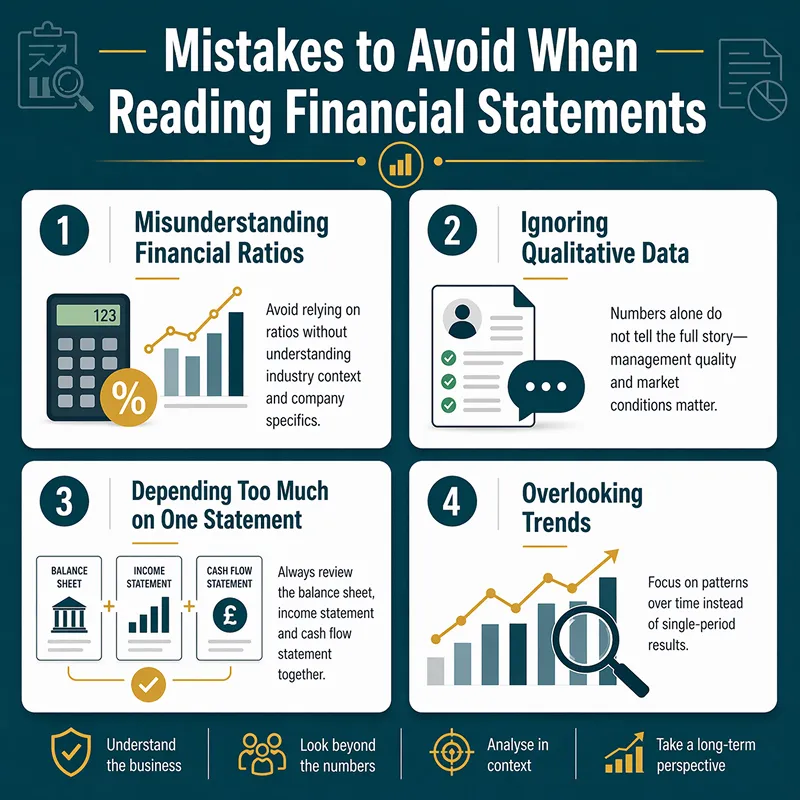
    When reading financial statements, avoid the following mistakes:

    Misunderstanding Financial Ratios

    Ratios like the current ratio are helpful, which is current assets divided by current liabilities. However, you should not look at them only. If a ratio is low, it could mean liquidity issues. On the other hand, it might also indicate that a firm is investing in growth.

    Ignoring Qualitative Data

    You will not understand the full story from financial statements only. Market situation or management changes can have a huge impact on the company’s performance. These may not be visible in the numbers.

    Depending Too Much on One Statement

    Among these three major financial statements, each one provides different details. If you rely on just one, it will result in a misguided understanding of the company’s financial health.

    Overlooking Trends

    One-time events might not tell the complete performance of the company. Therefore, you should also look at trends over time. This is helpful in understanding if the firm is improving or getting worse.

    Mistakes to Avoid When Reading Financial Statements

    How to Analyse Financial Statements Effectively?

    To know the finances is one thing, but interpreting them is another. I have explained below how to get the most from your financial statements.

    How to Analyse a Balance Sheet?

    The balance sheet shows a company’s financial state at some time. Focus on areas:

    Current Ratio

    You can achieve this ratio by dividing current assets by current liabilities. It will explain if the firm has enough assets to cover temporary debts. If a ratio is above 2, it is considered good. It means the business has twice as many assets as liabilities.
    The current ratio can be calculated by dividing current assets by current liabilities.
    For example, the ratio will be 2 if a firm has £500,000 in assets and £250,000 in debts. This tells a good position.

    Debt-to-Value Ratio

    This ratio compares a company’s total debts to its owners’ value. This represents how much the business depends on debt compared to its own equity.
    Its formula is given below:

    Debt-to-value ratio = total liabilities ÷ shareholder equity
    For instance, if a business has £1 in debt for every £1 in value, the ratio is 1. If the ratio is over 1, it means the company depends more on debt.

    Quick Ratio

    You can also call the quick ratio the acid-test ratio. It checks if a firm can pay temporary debts without selling inventory.

    The quick ratio can be calculated by first subtracting inventory from current assets. After this, divide it by current debts.
    For example, if a business has a quick ratio of 1 or more, it means the firm can pay its temporary debts without selling inventory.

    How to Analyse an Income Statement?

    The income statement tells us how much profit a company is delivering. It focuses on:

    Gross Profit Margin

    This shows how much money is left after subtracting the expense of goods sold (COGS). This will tell you how efficiently the firm makes its goods or services.

    Gross profit margin = (revenue – COGS) ÷ revenue × 100
    The margin is 60% if sales are £500,000 and COGS is £200,000. This means the business keeps 60% of its sales after production costs.

    Net Profit Margin

    This margin will tell you the percentage of revenue left after all expenses. This includes taxes and interest and shows the company’s overall profitability.
    Its formula is as follows:

    Net profit margin = profit ÷ sales × 100
    For instance, the margin will be 10% if profit is £50,000 and sales are £500,000. This means the business keeps 10% as profit.

    Operating Income

    With this income, we become aware of how well the company is working in its core operations. It keeps out income and expenses from things like taxes or interest.

    Operating income = gross profit – expenses
    Consider an example, operating income is £150,000 if gross profit is £300,000 and expenses are £150,000.

    How to Analyse a Cash Flow Statement

    You can read the cash flow statement to know how cash is being generated and used. It’s key to know a company’s ability to grow, invest and pay bills.

    Operating Cash Flow

    This tells about how much cash the firm makes from regular business activities. A positive number shows the business can cover its costs.
    Calculate it by:

    Operating cash flow = cash from business – cash from working capital changes

    The cash flow will be £150,000 if a firm makes £200,000 but has a £50,000 increase in working capital.

    Free Cash Flow

    Free cash flow is the cash left after a business has paid for capital expenditures like equipment or property. It’s vital for investing again or returning money to shareholders.
    You can find it by:

    Free cash flow = operating cash flow – money spent on assets
    Free cash flow will be £150,000 if operating cash flow is £200,000 and asset spending is £50,000.

    Cash Flow from Financing Tasks

    This represents cash increased through debt or equity or cash used to settle debts and dividends. It helps you check how the firm is financing itself.
    For example, if a company issues stock and increases £100,000, this will be indicated as a cash inflow in financing activities.

    Vodafone Annual Report: Case Study

    Vodafone is amongst the biggest phone companies in the United Kingdom. Every year, Vodafone publishes a report with all its financial information.

    This report shows how much money Vodafone earned, spent, and the profit it made. In addition, there is also some information about the firm’s debts and cash flow.

    This report includes:

    Revenue

    How much income Vodafone earned from its clients.

    Profit

    After paying for the costs, the amount left.

    Cash Flow

    This tells how payments are moving in and out of the firm.

    Debt

    The cost that the company owes to others.

    You can see if the company is progressing or losing money by looking at these records. This is helpful for investors and managers to make smart decisions about the future.

    You can understand real financial statements in a simple way through this case study.

    Read more: Why annual reports still matter for businesses?

    Final Thoughts

    In conclusion, financial statements provide key tools for grasping a company’s financial health. You can make better decisions for your business by reading balance sheets, income statements and cash flow statements. For instance, the balance sheet tells your firm’s assets and liabilities. On the other hand, the income statement shows profitability.

    However, reading these statements should not be a single task. Reviewing these statements often will help you find trends and make good choices. Also, knowing these documents allows you to handle cash flow and plan for progress.

    At Sterling Cooper, we know the value of financial literacy. Our team is available to help you navigate these core tools. They give insights to improve your decision-making. For more help or information, contact us today.

    Struggling to understand your financial statements?

    We help businesses interpret balance sheets, income statements, and cash flow for smarter decisions. Contact us today to get started!
    +443300102526
    Book an Appointment

    FAQs


    What is the purpose of reading a financial statement of a company?


    Reading a financial statement of a company helps you understand its financial health, including profits, losses, assets, liabilities, and cash flow. It allows business owners and investors to make informed decisions about the company’s performance.


    The main components include the balance sheet, income statement, and cash flow statement. Each provides insights into different aspects of the company’s financial position, such as assets, liabilities, revenue, expenses, and cash flow.


    To read a financial statement of a company, start with the balance sheet to check assets and liabilities, then review the income statement for profits or losses. Finally, analyse the cash flow statement to understand how cash moves in and out of the business.


    The balance sheet shows what a company owns (assets), what it owes (liabilities), and the value left for shareholders (equity). It gives you a snapshot of the company’s financial position at a specific point in time.


    For investors, reading a financial statement of a company helps evaluate its financial stability, profitability, and potential for growth. It provides critical data to make investment decisions.

    Share This Article!

    Recent Posts

  • What Is Umbrella Payroll? A Complete Guide for Contractors in 2026
    What Is Umbrella Payroll? A Complete Guide for Contractors in 2026
    umbrella companies

    Posted by:

    Admin

    Date:

    May 5, 2026
    Category:

    blogs

    Error: Contact form not found.

    What Is Umbrella Payroll? A Complete Guide for Contractors in 2025

    Temporary contracts are often valued for their flexibility, which lets you move between jobs and employers with ease. However, when you are hired for such roles, an umbrella company acts as a liaison between you and the recruitment agency. So, instead of being hired directly by the end company, you are employed and paid through an umbrella company.

    With an umbrella company handling your pay, it is important to understand how your assignment rate translates into your gross and take-home pay. The amount you receive can be affected by the way the umbrella company processes your pay and deductions. From 6 April 2026, changes to PAYE rules also affect who is responsible for ensuring PAYE is correctly operated when an umbrella company is part of the labour supply chain. This makes it important to understand how umbrella payroll works and how your pay is calculated.

    This guide explains what umbrella payroll is, how the process works, how your pay is calculated and what to check before choosing an umbrella company.

    Key Takeaways

    • An umbrella company usually employs contractors and pays them through PAYE.
    • The assignment rate is not the same as your take-home pay.
    • Employer costs, the umbrella margin and employee deductions affect your final pay.
    • Your Key Information Document (KID) shows important information about rates, deductions and expected pay.
    • Before choosing an umbrella company, check its PAYE arrangements, margin, employment terms and expected pay.

    What Is Umbrella Payroll?

    Umbrella payroll is a way of employing and paying temporary or contract-based workers through a third-party (umbrella company). Often, this umbrella company becomes your employer and pays you through PAYE (Pay As You Earn). While you work for an end-company, you are not directly hired by them.

    There are four main parties in this system:

    • Contractor (You): The one who carries out the work for the end client.
    • Recruitment agency: The one who finds the assignment and manages the hiring process.
    • End Client: The one for whom the work is done.
    • Umbrella company: The one who employs you directly, processes your payroll and pays your wages.

    In this arrangement, you are employed by the umbrella company while carrying out your assignment for the end client.

    How Does Umbrella Payroll Work?

    The umbrella payroll process may seem confusing, especially because there are several parties involved. However, the process would be clear once you understand the role each party plays. To put it simply, the recruitment agency finds the assignment, the contractor completes the work and the umbrella company manages employment and payroll.

    Step 1: The Agency Finds You a Contract

    The recruitment agency aligns you with a temporary or contract role with an end client. It then provides you with details about the job, assignment rate, location and working arrangements. Before accepting the role, check the KID provided by the agency. It should explain the assignment rate, relevant deductions and the expected or minimum gross pay so you can understand how the proposed pay structure works.

    Step 2: You Join an Umbrella Company

    Since you are not hired directly by the recruitment agency or the end client, you join an umbrella company. The agency may provide you with one or more umbrella companies to choose from, or you may be allowed to find one yourself.

    The umbrella company you choose becomes your employer and enters into the relevant contractual agreement with the agency or other parties in the labour supply chain.

    Step 3: You Submit Your Timesheet

    The next step is to complete the work you are hired for and submit your timesheet that records the time you have worked. Depending on the arrangement, you may need to submit your approved timesheet to the recruitment agency, umbrella company or both. The approved timesheet is used to confirm the work completed and the amount payable within the labour supply chain.

    Step 4: The Agency Pays the Umbrella Company

    Once the work and timesheet have been approved, payment moves through the relevant parties in the labour supply chain. The umbrella company receives the agreed amount from the relevant party and uses it to calculate the worker’s pay.

    Step 5: The Umbrella Company Processes Your Pay

    Then the umbrella company processes your wage as your employer. Here, the company accounts for applicable employer costs and operates PAYE on your earnings. At this stage, you should get a payslip that clearly mentions what you are paid and the deductions applied.

    Step 6: You Receive Your Payslip and Take-Home Pay

    Once your umbrella payroll is processed, you receive your wages into your stated account. Your focus here should be on the payslip you receive. It should clearly tell you how your pay has been calculated and the deductions applied to it.

    Use HMRC’s umbrella pay calculator to estimate your gross and net pay and compare the result with your payslip.

    How Is Umbrella Pay Calculated?

    As a temporary or contract worker, know that your assignment rate is not what you actually get paid. The assignment rate is paid to the umbrella company rather than directly to you. The umbrella company accounts for applicable employment costs and its margins before calculating your gross pay. Once your gross pay is calculated, PAYE deductions are taken from it before you receive the take-home pay.

    The table below explains all the deductions and costs that are applied to the assigned rate before you get your final pay.

    Deductions Applied in an Umbrella Payroll

    Cost / Deduction

    Where It Is Applied

    What It Means

    Employer National Insurance (NI) Assignment rate NI that the umbrella company is responsible for paying as your employer. It is normally accounted for before your gross pay is calculated.
    Employer pension contribution Assignment rate The employer’s workplace pension contribution where applicable. This is separate from your own employee pension contribution.
    Apprenticeship Levy Assignment rate An employer cost that may apply to the umbrella company. Where applicable, it is accounted for before your gross pay is calculated.
    Holiday pay Assignment rate/pay calculation Money allocated for your statutory paid holiday entitlement. Depending on the arrangement, it may be paid with your wages or retained until you take holiday.
    Umbrella company margin Assignment rate The fee charged by the umbrella company for employing you and providing payroll and related services.
    Income Tax (PAYE) Gross pay Income Tax deducted from your taxable earnings and paid to HMRC through PAYE.
    Employee National Insurance Gross pay Your employee Class 1 NI contribution, deducted from your pay according to the applicable NI rules.
    Employee pension contribution Gross pay Your contribution to a workplace pension if you are enrolled and required to contribute.
    Student loan repayment Gross pay A repayment deducted through payroll if you have a student loan and your earnings meet the applicable repayment threshold.

    What Are the Benefits of Umbrella Payroll for Contractors?

    Umbrella payroll simplifies contractual work by placing employment, payroll and obligations on a single employer. This ensures you have employment rights and improves tax collection by HMRC. Key benefits of umbrella payroll include:

    • Simple PAYE Tax and National Insurance: Tax and employee National Insurance are easily collected through PAYE before you receive your wages.
    • Employment Rights and Statutory Entitlements: As an employee of an umbrella company, you get rights such as National Minimum Wage, paid holidays and other relevant statutory protections.
    • Easier Administration: The umbrella company handles your payroll, insurance and tax filing; you are free from administrative work.
    • Greater Flexibility: You can move between assignments while staying employed by the umbrella company.
    • Workplace Pension and Other Benefits: Employees who are eligible get automatically enrolled in the workplace pension scheme. Additional benefits may apply depending on contract.

    How to Choose an Umbrella Company?

    Often, recruitment agencies have a list of umbrella companies for you to select from. However, if you have to choose the right umbrella company, compare the actual pay structure and employment terms. Don’t just look at the advertised take-home wage. The table below tells you what to check and why it matters.

    How to Choose the Right Umbrella Company?

    What to Check

    Why It Matters

    Check That It Uses PAYE Your employment income should be processed through PAYE. Be cautious of arrangements that claim part of your income is tax-free or does not need to be taxed.
    Understand the Umbrella Margin The margin is the umbrella company’s fee for its services. Check how much it is and whether it matches the amount shown in your documents.
    Check Your Key Information Document Your KID should show the umbrella company, assignment rate, deductions and minimum gross pay, helping you understand the proposed arrangement before agreeing to it.
    Compare the Assignment Rate and Expected Take-Home Pay Look at the full calculation rather than comparing headline rates alone. Employer costs, tax, NI, pension and other deductions can affect your final pay.
    Check Employment Rights and Insurance Confirm who your employer is, what employment rights apply and what insurance cover the umbrella company provides for the assignment.
    Avoid Unusually High Take-Home-Pay Promises Be cautious if a company promises an unusually high percentage of your assignment rate or claims its tax arrangement is approved by HMRC. HMRC does not approve or endorse umbrella companies or tax avoidance schemes.

    Useful Example: Understanding an Umbrella Pay Calculation

    The example is taken from HMRC’s Key Information Document guidance that shows how the advertised assignment rate can differ from take-home pay. To explain how umbrella payroll works, the example states:

    • Assignment rate: £750 per week
    • Employer NI: £65.61
    • Employer pension: £15.76
    • Apprenticeship Levy: £3.23
    • Holiday pay: £69.51
    • Umbrella margin: £20
    • Gross pay: £575.89
    • Income Tax: £75.48
    • Employee NI: £55.37
    • Employee pension: £26.27
    • Example take-home pay: £418.77

    The example is merely to show why contractors should look beyond the advertised assignment rate. This will help them understand each deduction before they accept any assignment.

    Conclusion

    Umbrella payroll gives you a clear way to work on temporary contracts while getting paid through PAYE. To make the most of your contract, understand who employs you, how your assignment rate is used and what deductions are applied to the pay.

    Before you start an assignment, review your KID, understand the umbrella margin and check your payslip against the agreed terms of the contract. If it confuses you, seek professional guidance from payroll specialists. These aspects ensure your wages reflect your work, while the umbrella company handles your benefits and tax filings

    Need help understanding your contractor payroll options?

    The right payroll option can affect how much you take home. Speak to our team to discuss your circumstances and find a suitable option for your needs.

    FAQs


    Is an umbrella company my employer?

    In most umbrella arrangements, yes. The umbrella company employs you and is responsible for paying your wages and operating PAYE.

    No. A recruitment agency usually finds the assignment, while the umbrella company normally employs the worker and handles payroll.

    No. The assignment or umbrella rate is the amount paid to the umbrella company. Employer costs and the umbrella margin are accounted for before your gross pay is calculated.

    The assignment rate can include employer costs and the umbrella margin. Income Tax, employee National Insurance, pension contributions and other applicable deductions are then taken from your gross pay.

    You may be able to choose your own umbrella company, depending on the recruitment agency and the arrangements for the assignment.

    Yes. Employees working through an umbrella company are entitled to paid holiday. Depending on the arrangement, holiday pay may be paid through rolled-up holiday pay or calculated using a 52-week reference period and paid when leave is taken.

    HMRC is responsible for tax and PAYE rules, but it does not approve or endorse individual umbrella companies. Contractors should be cautious of companies claiming that their tax arrangements are HMRC-approved.

    Share This Article!

    Recent Posts


  • What Is The Role of a Company Secretary In Modern Businesses?

    What Is The Role of a Company Secretary In Modern Businesses?

    role of company secretary

    Posted by:

    Admin

    Date:

    April 20, 2026

    Category:

    blogs

    Error: Contact form not found.

    What Is The Role of a Company Secretary In Modern Businesses?

    Do you know who helps a company stay legally compliant, well governed and run smoothly? The answer is often a company secretary. They help a company run its functions in a legal and smooth way. That’s why most firms invest in them.

    What Is a Company Secretary

    The company secretary (CoSec) is a senior personnel. They make sure the company follows laws and regulations and helps its governance. They play a key role in the firm and help directors work in an effective way.

    CoSecs are very important in corporate governance. Corporate governance refers to how a company is run and controlled. The CoSec makes sure decisions are transparent, fair and within the law.

    82% of UK boards see the company secretary role as a key partner in governance and business decisions.

    They also act as a link between key groups, including:

    • The board of directors
    • Share holders
    • Regulators
    • External advisers

    This puts them at the centre of the company’s functions.

    Key Takeaways

    • The role of company secretary is essential for ensuring legal compliance, strong governance and smooth business operations, acting as a key link between directors, shareholders and regulators
    • Understanding what a company secretary does highlights their dual responsibilities in administration and advisory work, including meetings, filings and board level guidance
    • The duties of a company secretary include maintaining statutory records, ensuring regulatory compliance and supporting corporate decision-making to reduce legal and operational risks
    • The company secretary role has evolved from basic administrative work into a strategic governance position that supports transparency, accountability and long term business success
    • For businesses, a strong role of company secretary helps improve efficiency, ensure compliance with regulations and strengthen overall corporate governance frameworks

    What Does a Company Secretary Do

    A CoSec can do both admin tasks and advisory functions. The duties of a company secretary on the admin side are:

    • Filing forms
    • Maintaining the records
    • Arranging the meetings

    On the advisory side, they guide directors on: 

    • Governance
    • Compliance
    • Legal matters

    They also help the company run smoothly and make sure rules are followed. Their work helps the business run in a clear and safe way. They also help avoid legal problems.

    Key Responsibilities of a Company Secretary

    Evolution of the Company Secretary Role

    The position of CoSec has changed a lot over time.

    The role of company secretary used to focus on admin work like keeping records and taking notes. Today, it is much more strategic. They help in the major company decisions.

    The CoSec gives advice to the directors. The company secretary role makes sure all rules are followed. They also make sure the internal processes are smooth.

    About 70% of companies combine the secretary role with other senior jobs. It shows how crucial the role has become.

    Key Duties of a Company Secretary

    The duties of the CoSec are extensive and essential for a business.

    The role of company secretary is to guide the board on how to manage the company. They help directors know their duties. They also make sure the firm follows the law, which keeps its legal standing.

    They help with decisions. They provide clear and accurate information. They also:

    • Make sure the legal compliance
    • Help in good governance
    • Communicate with stake holder

    Benefits of a Company Secretary for Businesses

    The role of company secretary gives many benefits to a business.

    They make sure legal compliance and help avoid fines. They look into governance work. The company secretary role enables directors to focus on strategy.

    They efficiency by:

    • Managing processes
    • Record keeping
    • Completing tasks on time

    The role of company secretary helps a firm stay well organised and compliant.

    How a Company Secretary Adds Value to Your Business

    Legal and Regulatory Requirements

    This part explains the legal requirements for the role of company secretary.

    Legal Requirements for a Company Secretary

    The need for a CoSec depends on the company. A secretary or chief is crucial for public firms. But by law, private firms do not need one.

    However, these duties still exist. If there is no secretary of the firm, the directors usually do this work.

    Did You Know?

    A company secretary can sign official legal documents on behalf of the company.

    Under the Companies Act 2006, public companies must choose a person who is fit for the role. This means the person must have:

    • Proper qualification
    • Relevant experience
    • Association with an expert body

    The role of company secretary also has legal duties. If they fail to meet these duties, they may face fines or deal with legal problems.

    Legal and Governance Duties at a Glance

    Appointment and Removal of a Company Secretary

    The CoSec is usually appointed or removed by the board of directors. Companies must inform Companies House within a set time when a change happens.

    There are also some rules on eligibility for the role. For example, the company’s auditor cannot be the CoSec. In some cases, a company can hire a corporate body instead of one person.

    Corporate Governance

    This section explains the duties of a company secretary in corporate governance.

    Corporate Governance Responsibilities

    Corporate governance is a key part of the company secretary’s role. They suggest how the company should run and follow best practices.

    This includes the following:

    • They manage conflicts of interest
    • They make sure processes are clear and open
    • They make sure rules are followed

    They also help the board and its committees do their work well.

    The company secretary helps build trust and responsibility in the company. They do this by maintaining good command.

    The standard of governance determines the success of a company. – Sir Adrian Cadbury, UK corporate governance pioneer and chair of the Cadbury Committee

    Fiduciary Duties and Legal Obligations

    The role of company secretary, as a company officer, has fiduciary duties.

    These include the following:

    • They act in the interests of the company
    • They use care and skill in their work
    • They avoid conflicts of interest

    These things make sure they act in a fair and honest way at all times.

    Compliance and Regulatory Monitoring

    Checking compliance is an ongoing duty.

    The CoSec monitors changes in rules and law. They make sure the company updates its policies and ways of working when needed. They also help keep systems in place so the whole company follows the rules.

    Administrative Functions

    This section discusses the administrative duties for the role of company secretary.

    Organising Board and Share Holder Meetings

    Organising meetings is a crucial role of a company secretary. This includes:

    • Board meetings
    • Group meetings
    • Share holder meetings such as Annual General Meetings (AGMs)

    The CoSec plans and schedules these meetings. They set the agenda and prepare all the needed documents. During the meeting, they record all details.

    They also make sure the meetings follow all the legal rules. They send notices timely to keep  everyone informed. After the meeting, they check they have completed the tasks and keep proper records.

    Maintaining Statutory Registers

    The CoSec must keep statutory registers. These are legal records, which include:

    • Register of members
    • Register of directors and secretaries
    • Register of persons with significant control (PSC)
    • Register of charges

    All these records must be precise and up to date. Errors can lead to serious legal consequences.

    Companies House Filings and Compliance

    The CoSec sends all required documents to Companies House.

    Annual Filings

    Event Driven Filings

    • Changes in directors or company secretaries
    • Share capital changes
    • Updates to the registered office address
    • Company name changes

    If these forms are not sent on time, the company may face fines. This makes the role crucial for the company.

    Record Keeping and Documentation

    The CoSec also keeps other records, not only legal registers.

    These include:

    • Financial and tax records
    • Work contracts
    • Legal papers
    • Data protection and legal records

    Good record keeping makes sure there is transparency, accountability and smooth operations.

    Admin Duties

    The CoSec often deals with day to day admin tasks to help the business run well.

    These may include:

    • Managing pay, VAT and PAYE
    • Handling pension plans and staff share plans
    • Keeping company documents organised

    These tasks help the company run in a smooth and efficient way.

    Maintaining the Registered Office

    Every company must have a registered office and the CoSec manages it.

    This means to make sure:

    • The address is a real and valid physical location
    • They manage the official post in the right way
    • Company details are shown, when needed

    The registered office is the main contact point for authorities.

    Communication and Stakeholder Management

    The CoSec plays a key role in communication inside and outside the company.

    They deal with share holders, investors and directors. This keeps communication clear and accurate. They also act as a bridge between the board and other stakeholders.

    This builds strong connections. It keeps everyone informed about what the company is doing. This helps everyone understand.

    Corporate Operations Support

    This section describes the role of company secretary in corporate operations support.

    Role in Corporate Actions

    The CoSec assists in many company actions, such as:

    • Allotments and transfers of shares
    • Payments of dividends
    • Change of company name
    • Restructuring of capital

    They make sure all these actions follow the law.

    Governance in Listed and Fund Structures

    In listed companies and fund setups, the CoSec has extra duties.

    Their duties include the following:

    • They make sure the rules of stock market are followed
    • They manage disclosure and transparency requirements
    • They maintain partner lists and reporting obligations

    These duties help people trust the market and make sure everyone follows the rules.

    Board Support and Development

    The role of company secretary helps the board work in a more efficient way.

    This includes:

    • They arrange board assessments
    • They give training and support to new directors
    • They prepare governance reports

    They also help the board to maintain strong oversight and strategic direction.

    Interesting Fact

    Company secretaries often sit in every board meeting – but rarely get the spotlight.

    Authority and Legal Position

    This part highlights the powers and rights for the role of company secretary.

    Powers of a Company Secretary

    The role of company secretary is not to  manage the firm directly. But they do have some legal power in the company.

    They can sign official papers and legal forms needed under company law. This includes sending forms to Companies House and signing some legal documents. These are usually signed with a director or on behalf of the company.

    They may also sign forms to change the company, such as from private to public or the other way round. These powers are limited but they help the company to meet its legal duties.

    Rights of a Company Secretary

    The rights of a CoSec comes from their job contract rather than company law.

    They have normal work rights, such as:

    • Fair pay
    • Safe working conditions
    • Fair treatment

    They do not have special legal rights like directors under the Companies Act 2006.

    The CoSec still has a lot of responsibility. They have a strong impact in law and compliance for the company.

    Skills and Career Development

    The section covers the qualification and career paths for company secretary.

    Qualifications and Skills Required

    A role of company secretary needs qualifications based on the company and its work.

    Private companies: Formal qualifications are not needed. It is still crucial to understand company law, rules and good practice.

    Public companies: Rules are strict. The CoSec must have good knowledge and experience. This may include:

    • Being part of a professional group
    • Having a degree in law, accounting or finance
    • Having work experience in a similar role

    The Company Secretary role needs skills such as:

    • Good communication
    • Careful attention to small details
    • Good organisation and time use
    • Ability to understand complex rules
    • Good problem solving and decision making

    The CoSec uses these skills every day, which helps them to do their job well.

    Career Path and Opportunities

    A job as a CoSec gives many career options.

    Many people begin in junior jobs, such as an assistant or trainee. From there, they can move up to senior roles like deputy or group secretary.

    They can work in many fields, like:

    • Private firms
    • Government organisations
    • NGOs
    • Financial institutions

    Some work on their own  while others join firms. These firms provide secretarial services to different clients. This gives more choice and experience in different fields.

    Business Engagement Models

    This part discusses business engagement models for the company secretary role.

    Outsourcing Company Secretary Services

    Many businesses choose to outsource company secretary services. They do this instead of employing someone full time.

    This has many benefits:

    • Access to skilled and experienced people
    • Lower cost than a full time worker
    • Work keeps going if staff are away
    • Easy to adjust as the business changes

    Outsourced services have a team of experts. They understand the company work. They share the tasks among them. This lowers risk and helps the business run well.

    Choosing the Right Company Secretary

    Selecting the CoSec is a major decision for any business.

    Key things to look for in a Company Secretary role:

    • Right skills and work experience
    • Clear communication and good teamwork
    • Strong focus on detail
    • Able to handle urgent and time based work

    A good CoSec must be proactive. This means they can see issues and address them early.

    Special Duties and Liabilities

    The CoSec has legal duties and can face penalties if they do not meet them.

    The company can blame the secretary if they are unable to follow rules. This can cause the company to pay fines or, in serious cases, legal action.

    In special cases like bankruptcy or liquidation, the secretary may have extra duties. For example, they may need to prepare a report on the company’s affairs.

    These duties show why the role needs attention and accuracy.

    Real Life Example

    The Post Office Horizon scandal is a real life example. It affected hundreds of small business owners in the UK. They used a Post Office system to run their day to day tasks. Everything seems fine at the start. However, issues began to appear soon.

    Sub postmasters found missing money in their accounts. They reported this but instead of checking the system, they were blamed. This affected many people between 1999 and 2015. More than 900 sub postmasters were wrongly accused. Their lives and business were seriously harmed.

    This case shows the importance of good governance. Red flags were ignored and issues were not checked properly. There was not enough control at the top. 

    With improved governance, they could identify these issues early and may challenge the decisions. This could lower the risks as well. 

    A CoSec document, distribute and fix issues on time. Good governance does not only mean adhering to rules. It is also about trust, protecting people and helping a business stay strong.

    Conclusion

    In modern businesses, the role of company secretary is very crucial. It includes:

    • Legal work
    • Governance of a company
    • Admin tasks
    • Strategic functions
    • Advisory functions

    They handle company records, set meetings and assist the board. The role of company secretary makes sure the rules and regulations are followed. This simplifies the operations of the business.

    They also act as a bridge between the board, share holder and directors. This keeps communication clear and strong. CoSecs are in favour of:

    • Transparency
    • Responsibility
    • Good control

    The role of company secretary is essential for long term success.

    In today’s complex business world, there is a growing need for a company secretary, even if it is not required by law. Their skills help lower risk, solve problems and help the business grow.

    Sterling Cooper makes sure your business stays compliant, well governed and smoothly managed. Contact us today to speak with our team for tailored support.

    Need help keeping your business compliant and well governed?

    Sterling Cooper delivers expert company secretarial services to ensure smooth governance and regulatory compliance. Contact us today for reliable corporate support.
    +443300102526
    Book an Appointment

    FAQs


    What is the role of a company secretary in a business?


    A company secretary ensures a business stays compliant with laws, regulations and governance standards. They support the board by managing meetings, maintaining records and advising on corporate decisions. Their role also acts as a bridge between directors, share holders and regulators. Overall, they help ensure smooth and legally sound business operations.


    The salary of a company secretary in the UK varies based on experience, company size and industry. On average, junior roles may start around £30,000–£50,000 per year. Experienced or senior company secretaries can earn £70,000–£120,000+, with higher packages in listed companies. Executive level roles may earn even more with bonuses.


    A degree in law, finance, accounting or business administration is most commonly preferred. These subjects build strong foundations in governance, compliance and corporate law. Many professionals also pursue specialised qualifications like ICSA/CGI certification. Practical experience is equally important for career growth.


    Company secretaries need strong knowledge of corporate law, governance and compliance frameworks. Key skills include attention to detail, communication organisation and time management. They must also handle regulatory filings and board level coordination effectively. Problem solving and decision making abilities are highly valuable in this role.


    A company secretary can face legal or financial liabilities if compliance duties are not properly fulfilled. This may include penalties for missed filings, incorrect records or breaches of statutory obligations. In serious cases, they may be held accountable for corporate governance failures. Their role requires high accuracy and legal responsibility.

    Share This Article!

    Recent Posts

  • How to File Your Tax Return: A Step-by-Step Guide

    How to File Your Tax Return: A Step-by-Step Guide

    file tax return

    Posted by:

    Admin

    Date:

    April 17, 2026

    Category:

    blogs

    Error: Contact form not found.

    How to File Your Tax Return: A Step-by-Step Guide

    Are you thinking about whether to file tax return online in the UK? Are you unsure about what HMRC requires from you? Most people initially find UK tax laws perplexing, but you are not the only one.

    For the tax year 2024/25 in the UK, more than 11.48 million people completed self-assessment tax returns. This is the HMRC report, which tells us how common it is to file tax return online.

    It is important to understand how to file tax return if your earnings are untaxed in the UK.

    If you are self-employed or running a company, it is important as well. It may seem confusing but when you break this process into simple steps, it is not hard.

    In this blog, you will find a step-by-step guide on how to file tax return online in the UK.

    Key Takeaways

    • Ensure you understand when to file tax return, especially if you are self-employed, earn income from property or have untaxed income
    • It’s quicker and less error-prone to file tax return online through the HMRC portal, where you can complete and submit your forms with ease
    • If you’re wondering how do I file income tax return, you need to register for self-assessment, gather necessary documents and enter your details into the HMRC system before submission
    • Not everyone needs to do I need to file a tax return; generally, only those with untaxed income, self-employment or other specific situations require filing
    • Do pensioners need to file a tax return? Pensioners may need to file if they have additional untaxed income, such as rental income or dividends
    • Avoid penalties by correctly filing a tax return on time and keep in mind the specific deadlines for submission and payments to stay compliant with HMRC
    • Be aware of the deadline to file tax return, which for online submissions is January 31st after the tax year ends and make sure you meet it to avoid unnecessary fines

    What Is Tax Return in the UK?

    The paperwork you submit to HMRC to record your income is called a tax return. It aids in determining your tax obligation. In the UK, this is typically accomplished with the use of a self-assessment system.

    It includes all of your income information, such as rent and self-employment revenues. It also includes dividends, savings and other untaxed income. You can also claim costs and deductions to minimise your tax bill.

    When you file tax return, HMRC tells you how much you must pay by working it out. In some cases, you may even receive a refund instead.

    With the help of the tax return, HMRC checks your total earnings for the tax year. The purpose of this is to ensure you pay the accurate amount of tax.

    Who Needs to File Tax Return in the UK?

    When you hear the term ‘file tax return’, your first thought is, ‘Do I need to file tax return?’. It is not necessary for everyone living in the UK to file tax return. The majority of people use PAYE to make their payments. Under this system, taxes are automatically subtracted from wages or pensions.

    However, you must file tax return if you have earnings that are not taxed at source. For this reason, most people need to complete a self-assessment tax return.

    Generally, you will need to file tax return in the following cases:

    Self-Employed (The £1,000 Rule)

    If you make more than £1,000 from self-employment in a tax year, you must file tax return. This includes freelancing, side employment and owning a small business.

    If your income is under £1,000, you may not need to file due to the trading allowance.

    Landlords and Property Income

    If you make money by renting out property, you must report it. This includes:

    • Renting a house or flat
    • Renting a room
    • Holiday rentals

    Even small rental income must be declared to HMRC.

    Company Directors (PAYE + Dividends)

    You may have to file tax return if you are a director of a company. This occurs when you:

    • Take a salary through PAYE
    • Take dividends from the company

    Dividends are taxed differently from income, so they need to be reported.

    Large Income Earners (£100,000+)

    If your yearly income is above £100,000, you must file tax return. This holds even if you have already used PAYE to clear your taxes.

    Foreign Income or Overseas Residents

    You must file tax return if you:

    • Earn income from outside the UK
    • Live abroad but have UK income

    This includes foreign salary, rent or investments.

    Capital Profits (Shares, Crypto, Real Estate)

    You might have to report it if your source of income is from the sale of assets. This covers:

    • Shares
    • Cryptocurrency
    • Second property

    This is called Capital Gains Tax and must be included in your return.

    • You make more than £1,000 from self-employment
    • Your property provides rental income
    • Your investments, dividends and savings generate income
    • You receive income from another country
    • You have more than one income source, for which tax has not been fully paid

    Also, if your income is not taxed through PAYE, you may need to file. To illustrate, HMRC may need a return if your income is higher than £100,000.

    You may also be required to file in certain situations and roles. These cover:

    • If you are a business partner
    • If you are the director of a company and are taking dividends
    • If you are handling a trust or are a trustee
    • If you are part of certain organisations, such as Lloyd’s

    There are situations where HMRC can ask you directly to file a return. Even if you think you don’t need to, you must complete it upon receiving one.

    You might be asked to file a tax return even if you think you don’t need to. The purpose of this is often to claim a tax refund.

    You might be eligible to claim money back in the following circumstances:

    • If you paid too much tax through PAYE
    • You incurred costs related to your work
    • You made pension contributions
    • You contributed to welfare schemes

    To have specific benefits, HMRC may also ask you to file tax return.

    If you are not sure, it is good to have an early check. Failing to meet the requirement can lead to charges and additional stress later.

    If you want tax‑saving, you can follow top tax saving tips.

    HMRC Tools and Resources to File Tax Return

    These tools are helpful:

    • HMRC Self Assessment portal
    • Tax calculator
    • UTR recovery tool
    • Eligibility checker

    Using these tools makes filing easier and faster.

    Step-by-Step Guide on How to File Tax Return in the UK

    When you are going to file tax return, it may seem hard. If you follow all the steps given here, it will get easier. I have listed the key steps after careful research. Following them will make filing smoother:

    Step 1: Identifying if You Need to File Tax Return

    You must first decide if you need to file tax return online. If in doubt, check as soon as possible to prevent further fees. The following circumstances must be met for you to file a tax return:

    • If you run your own business and your income is over £1,000
    • If your income comes from rent or investments
    • Your income is not taxed directly
    • Have a notice from HMRC

    Step 2: Registering for Self Assessment

    Registering for self-assessment is for those who need to file tax return online for the first time. After the tax year ends, make sure to register by 5 October.

    Follow these steps to register with HMRC:

    1. Go to the HMRC website
    2. Choose “Register for Self Assessment”
    3. Create a Government Gateway account
    4. Fill in your personal details
    5. Submit your registration

    What Is a Government Gateway Account?

    This is your HMRC account online. You use it to:

    • File your tax return
    • Check your tax bill
    • Send messages to HMRC

    When you make an account, you will receive a user ID and password.

    UTR Number

    Unique Taxpayer Reference is referred to as UTR. You are identified by this ten-digit number.

    After you register, it will be sent to you by post. It often arrives in ten to fourteen days.

    Already Registered Before

    If you already filed, you do not need registration again. In simple words, for signing in, use the previous login details.

    You can retrieve your UTR or log in on the HMRC website if you have forgotten it.

    Once you have registered, you will be given a unique taxpayer reference (UTR). You will also get access to your online account. In order to file your tax return online, you must also create a Government Gateway account.

    Step 3: Collecting Your Documents

    Collect all required documents before going to the next step. This stage is essential because it saves time if everything is organised. This is also helpful to avoid mistakes, which could lead to major issues. The table below shows the documents you need to file tax return.

    Essential Documents You Need to File a Tax Return
    Keeping a clear record of all your expenses and payments is important. This is helpful for reporting correct figures and avoiding errors in your tax return.

    Step 4: Signing in and Accessing Your Tax Return

    Use your Government Gateway details to log in to the HMRC service. In case of signing in for the first time, verify your identity. Once logged in, open your self-assessment form.

    How to File Your Tax Return on HMRC Portal:

    Follow these simple steps:

    1. Log in to your Government Gateway account
    2. Go to “Self Assessment”
    3. Open the tax return (SA100 form)
    4. Choose the salary types (job, self-employment, rent, etc.)
    5. Fill in each section carefully
    6. Save your progress as you go
    7. Check for errors before submitting

    Step 5: Completing the Relevant Sections

    The main form is SA100. It includes:

    • Dividend and savings earnings
    • Pension money
    • Student loans
    • Tax allowances and reliefs

    After reviewing all the sections, you will identify which one applies to you. After this, you may have to fill in the extra sections for:

    • SA102: employment
    • SA103: self-employment
    • SA105: property income
    • SA106: foreign income
    • SA108: capital gains

    While filling in the forms, ensure you include all your earnings. You must mention it, regardless of the amount.

    Step 6: Mention Details of your Income and Expenses

    Enter the correct details in the income sections. First, report your total earnings (turnover) if self-employed. After that, add any allowable expenses.

    To avoid complications later, only claim valid business expenses.

    Allowable vs Non-Allowable Expenses

    You can reduce your tax bill by claiming valid expenses. You can claim the following expenses: 

    Home Office Expenses

    You can claim the following things if you work from home:

    • Electricity
    • Internet
    • Work space use

    HMRC also allows a simple flat rate method.

    Mileage vs Fuel Costs

    You can choose one method:

    • Mileage rate (fixed rate per mile)
    • Actual fuel cost

    Using both at the same time is not recommended.

    Simplified Expenses

    HMRC allows fixed rates for:

    • Working from home
    • Vehicle use

    This makes filing easier.

    £1,000 Trading Allowance

    You may not have to report your business revenue if it is less than £1,000. If you are above income wise, you may still use this allowance to cover expenses. It includes:

    • Professional charges
    • Business tools
    • Travel related to work
    • Office expenses

    Step 7: Final Check

    Make sure you go over your return in detail before submitting it. Pay close attention to the details because mistakes can lead to fines or delays. Check for:

    • Inaccurate figures
    • Expense claims that are not valid
    • Incomplete details

    Step 8: Submitting Your Tax Return Online

    Your form will be able to be submitted when you double-check your information. Online form filling is a quick way and there are fewer chances of mistakes. After submission, you will receive:

    • Your tax bill summary
    • Confirmation of submission instantly

    Step 9: Reviewing Your Tax Bill

    After submission, HMRC will compute your tax. Be sure you are aware of the deadline for payment. This may include:

    • Payments on account
    • Income tax
    • National Insurance

    Step 10: Paying Your Taxes on Time

    Your tax payment is due on 31 January. You may split your payments between 31 January and 31 July. 

    You will avoid additional penalties and interest if you pay on time. You can pay using the following:

    • Direct debit
    • Credit or debit card
    • Bank transfer

    Step 11: Keeping Your Records

    After filing your tax return, you must maintain all records for a minimum of five years. This is because HMRC may ask to see these documents later. These records contain:

    • Bank statements
    • Expense records and receipts
    • Your tax return

    Step 12: After You Submit Your Tax Return

    Once you submit your tax return, HMRC will evaluate it. The process is as follows:

    HMRC Review Process

    HMRC computes your tax bill and confirms all of your information. They might get in touch with you if they need further information.

    Tax Refunds

    HMRC delivers tax calculation letters, commonly known as P800s, to those who are owed an income tax refund.

    If you paid too much tax, you may be eligible for a refund. This is often sent within a few weeks.

    HMRC delivered over 4 million income tax refund letters between June and August of 2025.

    How to Amend Your Return

    If you made a mistake, you can correct your return. You can make changes for maximum of 12 months.

    Records Should Be Maintained

    Documents should be kept for a minimum of five years. This includes:

    • Receipts
    • Bank statements
    • Tax returns

    Common Issues While Filing Tax Return Online

    While filing the form regarding tax return, you may encounter these issues:

    • Session timeout if you stay inactive
    • Missing income sections
    • Wrong figures entered

    When you complete your work, always save it and check it carefully before final submission.

    Benefits of Filing Your Taxes Early

    There may be problems if you wait until the last minute to file your taxes. To make the procedure easier and less complex, use a more structured approach.  File early and enjoy the following benefits:

    • Correct errors promptly
    • Plan your payments effectively
    • Avoid stress

    Deadline to File Tax Return

    Understanding your tax dates helps avoid penalties and manage finances better. If you ever miss the deadline to file tax return, it will result in charges, extra stress and interest. Some important dates are mentioned here:

    UK Tax Year

    The tax year in the UK is from April 6 to April 5. Your return must include all earnings within this period.

    Self-Assessment Due Date

    It is essential to remember the due date to avoid any further difficulties. If you complete the forms online, you will get extra time and quicker confirmation. The key dates are given in the following table that you must remember:

    Self-Assessment Deadline

    Payments on Account

    You might have to pay in advance for the next year if your tax bill exceeds £1,000. These amounts are as per your last tax bill. If you are unable to pay in full at once, it may also be beneficial to make two installment payments. The following table contains the details:

    Payments on Account

    Balancing Payment

    After paying tax on account, if any tax remains to be paid, this is called a balancing payment. It includes:

    • The previous tax year
    • The 31 January deadline to file tax return

    Penalties on Late File Tax Return

    If you don’t pay the tax on time, it will result in fines and penalties by HMRC. There is also a greater likelihood that HMRC will inspect your return more thoroughly.

    Penalties if You File Tax Return Late

    Interest on Late Payments

    HMRC charges interest on unpaid tax. The longer you delay, the more you pay.

    Time to Pay Option

    If you cannot pay, you can contact HMRC. They may allow you to pay in installments.

    Claim a Penalty Relief

    In case you have a valid reason, you can appeal, such as:

    • Serious illness
    • System issues
    • Family emergency

    Key Reminders:

    • Pay early if the deadline falls on a weekend or bank holiday
    • Give bank payments time to clear
    • File early to fix errors and plan your payments

    Why Do Business Owners Consider Hiring an Accountant to File Tax Return?

    Most of the business owners hire a professional to file tax returns to save time and avoid errors. Managing income and working solo can be tough. An accountant can help you understand tax rules and ensure accuracy. Tax rules change over time. Without the help of an expert, keeping up with all of this becomes difficult.

    Another great advantage of hiring a professional is their accuracy. They help significantly in reducing fines, missed deadlines or the chance of errors. In addition, they also ensure that you have included all allowable reliefs and expenses. These are essential to include because they help reduce your tax bill.

    They are also helpful in saving you time. You can focus on running your business instead of spending more time handling these taxes. Most business owners find hiring an accountant to be highly beneficial.

    These experts support you in many other ways as well. For example:

    • Guide you in planning your taxes
    • Provide advice on your expenses and income
    • Manage communication with the HMRC
    • Assist if there is a tax enquiry or issue

    The cost of hiring a professional to file a tax return depends on its complexity and the size of the firm.

    In the UK, typical fees are as follows:

    • For small to medium firms, the fee is typically £100 to £200 per hour
    • For a simple tax return, it’s near £250 to £300

    In most cases, self-employed individuals might be able to claim an expert’s fees as a business cost. This applies if the work is completely related to their own business revenue.

    While there is an additional cost to hire an expert, it has many perks. With the help of this strategy, you can save time, avoid mistakes and ensure all the details are correct. Many people choose an accountant for peace of mind.

    Common Mistakes to Avoid When You File Tax Return

    Be aware and avoid mistakes for a smooth filing. Some of the most frequent errors are:

    Incomplete Income

    Most people ignore all sources of income like interest from savings, rental income, dividends and freelance work. To avoid any fines, it is important to mention every type of income source.

    Inaccurate Claims for Expenses

    Differentiate between business expenses and personal expenses. If you claim personal costs as business expenses, it will lead to complications. Only business-related costs should be included. Examples include work travel costs and office supplies.

    Ignoring Small Income Sources

    While working on a tax return, include even the smallest amounts of income. Such earnings could be from any side jobs or interest on savings. They may be so minor that they could be ignored but all of them must be reported to HMRC.

    Not Reporting All Benefits

    You must include all benefits when you file tax return. For example, some employer-provided bonuses are also taxable and must be added. Don’t forget to declare all the taxable perks to ensure you pay the correct amount of tax.

    Incorrect Figures or Calculations

    Calculation or data entry errors can cause mistakes or delays in your tax bill. Recheck all sections for accuracy and make corrections to reduce the risk of audits or penalties.

    Overpayments Can Happen If You:

    • Are on the wrong tax code (due to incorrect HMRC data)
    • Switch jobs and get paid twice in the same month
    • Start receiving a workplace pension
    • Receive Employment and Support or Jobseeker’s Allowance

    Missing Deadlines

    Late filing leads to fines and stress. Always track key dates.

    Not Keeping Records

    Without records, you may face problems if HMRC checks your return.

    Wrong Tax Code Assumptions

    Do not assume your tax code is correct. Always check it.

    Criticism of UK Income Tax

    The UK income tax system has been critiqued for a variety of reasons. While it generates significant money, many experts and taxpayers see fundamental faults. Few are discussed below:

    Complex and difficult to understand

    Many people find the tax system overly confusing. It features multiple tax bands, laws and terms that are difficult to understand. This often causes uncertainty and concern, particularly among first-time taxpayers.

    The 60% Tax Trap (£100,000–£125,000)

    One of the most significant worries is the so-called “60% tax trap.” When income exceeds £100,000, the personal allowance is lowered. For every £2 earned, £1 in allowance is lost. This results in an extremely high effective tax rate, which can approach 60% (or even more with National Insurance).

    Unexpected Tax Cliffs

    The system has abrupt cut-offs. For instance, losing tax-free allowances or child benefits may result from exceeding specific income thresholds. This implies that people may occasionally become worse off after earning a little bit more money.

    High Earners’ Tax Pressure

    The top tax rate, according to some detractors, impacts more people than it was intended to. More taxpayers are forced into higher tax bands when salaries rise in tandem with inflation. Working professionals are burdened more as a result.

    Unequal Income Treatment

    The system is unfair, according to organisations like Tax Justice UK. Work-related income is frequently subject to higher taxes than wealth-related income, such as dividends or capital gains. Rich people may benefit more from this than average workers.

    Rising Overall Tax Burden

    According to recent reports, the UK tax burden is rapidly increasing. A higher share of national income is now taxed, putting pressure on people and businesses.

    The power to tax is the power to destroy.

    – John Marshall, Jurist

    Weak Growth Incentives

    Some experts argue that the system does not strongly inspire people to work more, invest more money or expand their firms. High marginal tax rates might diminish motivation to earn extra money.

    Challenges for High-Earners with Shares

    People who earn income from shares or stock options may confront difficulties. They may be required to pay taxes on profits they have not yet earned in cash, particularly if they are unable to sell the shares quickly.

    Final Words

    It is not a difficult process to file a tax return. A simple process makes it easy.

    First, check if you need to file. After this, collect your documents and register with HMRC if required. Then, enter your data in the appropriate fields and file tax return online.

    Before submitting your data, ensure it is thoroughly checked. Once you have completed this step, review your tax bill and make your payment before the deadline to file tax return. Your records must be kept for at least five years and include all your income.

    Avoid common errors and check if you’re eligible for a refund. Small mistakes can lead to fines or lower refunds, so check in time if unsure.

    Sterling Cooper understands that filing taxes can be tough for some people. We provide services to make the process clear, simple and manageable.

    Contact us today if you need assistance with filing a tax return.

    Confused about whether you need to file a tax return or how to avoid mistakes with HMRC?

    We have successfully assisted individuals and business owners in understanding and filing tax returns accurately. We guide you through checking your tax status, preparing your return, and avoiding penalties with clear, actionable steps.
    Reach out today for clear support and hassle-free filing.

    +443300102526
    Book an Appointment

    FAQs


    How do I file income tax return?


    Check if you need to file a self-assessment with HMRC, then register if required.
    Gather all income details and submit your tax return online through HMRC, making sure to check and pay any tax due before the deadline.


    You need to file a tax return if you have untaxed income such as self-employment earnings over £1,000, rental income, dividends, savings interest or foreign income.
    You may also need to file if HMRC asks you to or if you are a company director, partner, trustee or claiming certain tax refunds or benefits.


    Most pensioners do not need to file a tax return in the UK if their income is only the State Pension and taxed through PAYE.
    However, they may need to file if they have extra untaxed income, such as private pensions, rental income, savings interest or if HMRC asks them to complete a self-assessment.

    Preparing early helps you meet deadlines and avoid penalties, interest charges, underpaying or overpaying tax. For the 2024/25 tax year, submit paper or online tax returns by 31 October 2025 or 31 January 2026, respectively.

    Understand typical self-assessment tax return cost across the UK, with most accountants charging £150 to £350 for a standard return and higher costs where income sources or structures are more complex.

    Share This Article!

    Recent Posts

  • What Is a Business Growth Strategy? A Beginner’s Guide with Real Examples

    What Is a Business Growth Strategy? A Beginner’s Guide with Real Examples

    business growth strategy

    Posted by:

    Admin

    Date:

    April 15, 2026

    Category:

    blogs

    Error: Contact form not found.

    What Is a Business Growth Strategy? A Beginner’s Guide with Real Examples

    A business needs a clear plan to reach new markets, improve its products and make better use of its resources. A business growth strategy provides this direction. It helps owners decide where to allocate their time, money and efforts to support sustainable expansion. For a small business, choosing the right growth approach can make expansion more organised and easier to manage.

    In this guide, we’ll explain what a business growth strategy is, explore the core strategies businesses use to grow and look at real examples to show how these approaches work in practice.

    Key Takeaways

    • Growth can come from existing products, new products, existing markets or new markets.
    • Market penetration focuses on selling more existing products to existing customers.
    • Product development means creating new products for an existing market.
    • Market development means taking existing products or services into new markets.
    • Diversification combines a new product with a new market.
    • Businesses should review their results and change their approach when needed.


    What Is a Business Growth Strategy?

    A business growth strategy is a plan that explains how a company wants to grow. It sets out the actions a business can take to increase its revenue, attract customers, enter new markets or improve its position.

    A useful way to understand growth is through the Ansoff Matrix. It looks at products and markets and identifies four core business growth strategies. This includes market penetration, market development, product development and diversification.

    ‘Strategy is the creation of a unique and valuable position.’ — Michael E. Porter

    Core Business Growth Strategies

    A core business growth strategy relies on four fundamental expansion paths that are mentioned below.

    Market Penetration

    Market penetration means selling more of your products or services to your current market. For example, a local gym could encourage existing members to sign up for personal training sessions. This allows the business to increase sales within its existing customer base.

    Market Development

    Market development means taking an existing product or service to a new market. The new market could be a different customer group, location, industry or country. For example, a UK software company that mainly serves small businesses could start offering its software to larger companies as well. This example shows that the product stays the same, but the target market changes, which directly relates to market development.

    Product Development

    Product development means creating new products or services for an existing market. A company may notice that its customers need something that it does not currently offer. It can then create a new product to meet that need. For example, a coffee brand could add ready-to-drink coffee to its product range for customers who have no time to wait for preparation.


    Pro Tip:
    Before launching, the business should research customer needs, costs and demand.

    Diversification

    Diversification means selling a new product or service in a new market. For example, a clothing brand could develop sports equipment for customers outside its existing clothing market. This can help a business create a new source of revenue. However, this approach can take more time and money.
    Within the Ansoff Matrix, diversification is generally considered the highest-risk growth strategy because both the product and the market are new.
    core business growth strategies

    How to Choose the Right Growth Strategy

    Businesses should consider their existing products, target markets, resources, customer demand and growth goals before choosing any growth strategy. A business with a strong existing customer base may focus on market penetration, while one with opportunities in a new location or customer segment may consider market development. Product development may suit businesses with established customers, while diversification generally requires greater resources and investments because both the product and market are new.

    In simple words, the right growth strategy should match your business goals, resources and opportunities.


    Case Study: How Gymshark Used Different Growth Strategies?

    Gymshark, a fitness clothing company founded in Birmingham in 2012, provides a useful example of how it uses core business growth strategies over time.

    Market Penetration: Gymshark strengthened its position in the fitness market by using athletes, community building and social media to promote its existing products and connect with its target customers.

    Market Development: Gymshark expanded beyond the UK into international markets. It now serves customers in more than 200 countries.

    Product Development: Gymshark expanded its product range within the fitness market, including women’s collections such as Flex, Vital and Adapt.

    Diversification: In its early days, Gymshark sold fitness supplements alongside clothing, entering a different product area within the wider fitness market.

    This case study shows how a business can use different strategies together to strengthen its existing market, develop new products and reach new customers in a new market.

    Conclusion

    A business growth strategy gives a company a clear way to move from its current position towards its future growth goals. A business can grow by selling more existing products, creating new ones, entering new markets or moving into new areas. As Michael E. Porter explains, strategy involves making clear choices about where a company will compete and how it will create value.

    Ready to implement effective business growth strategies that deliver real results?

    Need a clear strategy to grow your business? Contact business growth experts at Sterling Cooper to discuss your goals and find the right path forward.


    +443300102526
    Book an Appointment

    FAQs


    What is a business growth strategy?

    A business growth strategy is a plan for increasing a company’s sales, customers, market reach or other areas of performance.


    Common strategies include market penetration, product development, market development and diversification.


    Planning a business strategy involves setting clear goals, understanding your target market, reviewing your resources, identifying growth opportunities and creating practical steps to achieve your goals.


    There is no single best option for every small business. The right choice depends on its customers, products, resources, competition and goals.


    Yes. A company can combine different approaches over time. For example, it may first increase sales in its current market, then develop new products and later enter new markets.


    Share This Article!

    Recent Posts

  • How Financial Planning Helps You Achieve Financial Freedom

    How Financial Planning Helps You Achieve Financial Freedom

    financial planning

    Posted by:

    Admin

    Date:

    April 14, 2026

    Category:

    blogs

    Error: Contact form not found.

    How Financial Planning Helps You Achieve Financial Freedom

    Does it feel overwhelming when you don’t save anything by the end of each month?

    Paying bills month after month takes a toll on your earning. It also affects your long term goals and financial freedom. This is where financial planning plays a vital role. It allows you to understand the current financial conditions and how to fulfil your plans.

    The UK Office for National Statistics published a report in 2023, stating about 16% of adults could not save at all. This shows how financial pressure keeps on increasing with time.

    Key Takeaways

    • Financial planning gives structure and direction to your money
    • Financial freedom is about control, not just wealth
    • Small and consistent actions lead to long term results
    • Managing risk and debt is key to protecting your progress
    • Reviewing your plan regularly keeps it effective
    • A clear plan reduces stress and improves decision making

    Financial Planning Explained

    Financial planning means using your money to get to your life objectives. Earning enough money is one thing and managing it wisely is another. Picture it as a roadmap, which will lead you to financial freedom more efficiently. It includes:

    • Budgeting
    • Saving
    • Investing
    • Preparing for risks

    What Financial Freedom Looks Like

    Financial freedom is different for different people. The key point is control. Financial planning advice helps you gain that control step by step. For some, it means:

    • No debt
    • Stable savings
    • Flexible work choices

    For others, it may mean:

    • Early retirement
    • Business independence
    • Vacation trips

    Financial Freedom Feeling Difficult

    Lack of a financial framework for financial management causes the financial freedom out of reach. Many rely on income alone and others save without a goal. Some invest without understanding risk.

    These issues build over time. Even a good income may not result in financial stability without direction. These gaps cause misunderstanding and postpone progress. Common challenges include:

    • Irregular saving habits
    • Poor budgeting
    • Lack of long term goals
    • Unknown expenses
    • Limited understanding
    • Poor planning and analysis

    Financial Planning for Life Goals

    Planning works best when it lines up with what you actually want out of life, not just your bank account. It comes down to your values and what matters most to you. It is not all about making more money. It involves creating a life that feels meaningful and balanced. You can focus freely on what truly matters, like:

    • Spending more time with family
    • Having flexibility in your career
    • Enjoying life experiences rather than just collecting assets

    The Key Elements of a Financial Plan

    A strong financial plan is built on a few simple parts.

    1. Budgeting

    Budgeting helps you stay on top of your spending. It shows you exactly what you make and how you are spending it. If you do not have clear budgeting procedures, it is easy to overspend.

    2. Saving

    If you save  money it helps you with unexpected expenses such as car repairs and medical problems. It is like making a safety net for oneself. Even small savings might add up over time.

    Do not save what is left after spending, but spend what is left after saving.

    – Warren Buffett, Chairman and Former CEO of the Conglomerate Berkshire Hathaway

    3. Investing

    Investing carries some risk, but it can also provide significantly higher returns than simply conserving your money. Understanding risk is an important aspect of planning which helps to grow savings.

    4. Risk Management

    Risk management ensures that one setback does not undo your progress and protects your finances. Risk management includes:

    • Life insurance to support your family financially
    • Health insurance to manage medical costs
    • Income protection to cover loss of earnings
    • Disability cover for long term financial security

    5. Tax Planning

    Tax planning helps you use more of your income for yourself. Applying UK tax rules correctly can help avoid unwanted payments.

    Comparison Financial Planning vs No Planning

    Financial Plan Review

    Regular reviews keep your financial plan effective. If a financial plan is not checked regularly, it may become a mess. A good approach is to review:

    • Monthly: Check spending and budget
    • Quarterly: Review savings and investments
    • Yearly: Adjust long term goals

    Major life events require changes as well, such as:

    • Starting a business
    • Buying a home
    • Changes in income

    Inflation and Financial Plan

    Inflation eats away at your money’s value as time goes on. If you do not pay attention to it, reaching financial freedom gets harder. It is one of the biggest reasons why investing is part of planning. To manage inflation, one must:

    • Review savings regularly
    • Consider long term investments
    • Adjust your budget as costs rise

    Managing Debt

    Having debt is not always a bad thing, but you really need to handle it carefully. Paying off your debts sooner will generally put you in a better financial spot in the long run.

    High interest debt can slow financial progress. It reduces your ability to save and invest. Good planning helps you to:

    • Prioritise debt repayment
    • Avoid unnecessary borrowing
    • Balance debt with savings

    Staying Consistent

    Small habits create long term results. Missing one step is not a failure but stopping completely is one. Many people put off financial planning advice because they are waiting to create the perfect plan.

    But in reality, just sticking with it is way more important than trying to make it perfect. Simple actions can lead you to financial freedom like:

    • Saving monthly
    • Reviewing expenses
    • Adjusting goals

    Finances Affecting Mental Health

    Not knowing what to do with your money can really cause worry and financial stress can affect your everyday life. If you do not have a plan, even little costs can feel huge. Financial planning gets better when you:

    • Create clarity
    • Reduce uncertainty
    • Build confidence in decisions

    When your finances are organised, your stress levels often reduce. Research from the Money and Pensions Service UK shows that financial wellbeing is closely linked to mental wellbeing.

    Life Stage and Financial Planning

    In your early career, the focus is usually on budgeting and saving. Later, investing and asset growth become more important. As retirement approaches, protecting wealth becomes the priority. 

    Your planning approach changes as your life evolves. Understanding this helps you apply your plan more effectively. Each stage requires a different strategy such as:

    Initial Stage

    One should build the habits early in life. These small steps lay the foundation of a better future. This includes:

    • Budgeting
    • Avoiding unnecessary debt
    • Persistently saving little sums

    Mid Stage

    Your financial responsibilities expand in tandem with your work advancement. This stage frequently includes:

    •  Family planning
    • Property ownership
    • Increased investment

    Asset growth, risk management, and long-term financial stability are now the primary focus.

    Later Stage

    In the later stages, the focus changes to protecting what you have created. This includes:

    • Protecting wealth
    • Planning for retirement
    • Controlling medical expenses. 

    The goal is to maintain financial security while generating a continuous revenue stream.

    Financial Planning Helps to Stay in Control

    Good planning gives you a clear structure. When you do it right, you do not have to guess where your money is going. You start making decisions with purpose instead of pressure and it helps you to:

    • Track where your money goes
    • Set your financial goals
    • Reduce unnecessary spending
    • Build savings steadily
    • Prepare for future risks

    This approach improves decision making and you start planning ahead. Financial planning and analysis help you understand your financial data. It involves:

    • Tracking income trends
    • Analysing expenses
    • Forecasting future outcomes

    When to Get Financial Planning Advice

    Grave mistakes can be avoided if you take the advice early on. You might want to think about getting financial planning advice help when:

    • You feel unsure about managing money
    • Your income increases
    • You start a business
    • You plan for retirement
    • You face complex financial decisions

    How to Start

    The first step in any planning is always difficult. Dividing your idea into smaller steps makes it much easier to execute. You can follow these steps such as:

    1. Assess Your Current Situation

    You can begin by reviewing your finances, which provides a clear beginning point. Look at your:

    • Income sources
    • Monthly expenses
    • Existing savings
    • Debts

    2. Setting Your Financial Goals

    Clear goals make financial planning more effective. You should understand what financial freedom is to you. Your goals may include:

    • Buying a home
    • Building retirement savings
    • Starting a business
    • Becoming debt free

    3. Create a Smart Budget.

    Create a simple budget based on your income and avoid the unnecessary spendings. Focus on:

    • Essential expenses
    • Savings allocation
    • Discretionary spending

    4. Keep an Emergency Fund

    This really cuts down on money worries and keeps your plan safe. You should put aside money for things that pop up unexpectedly. Ideally, enough to cover three to six months of your living costs.

    5. Start Investing Slowly

    Learning slowly improves long term outcomes. Avoid rushing and begin with small investments. Understand:

    • Risk levels
    • Investment timelines
    • Expected returns

    6. Review and Change on a Regular Basis

    Financial planning is not a one time effort. It requires regular reviews and adjustments every 3 to 6 months. It should also be updated after a big life event as well.

    Key Financial Planning Steps

    Mistakes to Avoid

    Progress towards financial freedom is affected by common mistakes. Avoid issues such as:

    • Ignoring budgeting completely
    • Saving without clear goals
    • Taking high risks without understanding them
    • Delaying financial decisions
    • Relying only on income growth

    Limitations to Planning

    Planning reduces risk, but it cannot remove it completely. Some limitations include:

    • Market risks affecting investments
    • Unexpected life events
    • Changes in income
    • Economic conditions

    Signs Your Plan Works

    Things might appear to go slowly at first. But if you stick with it, you will start to see actual effects. You will know your strategy is effective when:

    • You are saving regularly
    • Your debt is reducing
    • Your investments are growing steadily
    • You feel more in control of your finances

    Digital Tools That Help

    Thanks to technology, financial planning has gotten a lot simpler. These tools help you be more accurate and save a ton of time. They also make financial planning and analysis more accessible for beginners.

    You can now track, save and invest using simple tools. Common tools include:

    • Budgeting apps
    • Investment platforms
    • Expense trackers
    • Tax calculators

    Case Study

    In 2008, Ford Motor Company showed its recovery from financial challenges during the crisis.

    Before the crisis hit fully, Ford was already facing serious financial pressure. The costs were high and the company was at risk of running out of cash due to low sales. Many expected Ford to follow other car manufacturers into collapse.

    However, Ford took a different approach. Under the leadership of Alan Mulally, the company focused heavily on structured financials. They introduced clear financial strategies such as:

    • Strict cost control across operations
    • Selling non core brands like Jaguar and Land Rover
    • Focusing on fewer, more profitable car models
    • Improving cash flow management
    • Building strong financial reserves early

    One of their smartest moves was getting secure by funding before the crisis got worse. That gave Ford a financial safety net when the market took a dive. As a result Ford:

    • Avoided bankruptcy
    • Did not require a government bailout unlike competitors
    • Returned to profitability within a few years
    • Improved investor confidence significantly

    This situation clearly shows that planning is not just for individuals. The essential ideas remain the same whether it is a large organization or a single person.

    A shaky financial spot might start feeling steadier when steps are laid out ahead of time. Good moves follow once timing improves.

    Financial Freedom in a Nutshell

    Financial planning helps lay the groundwork for becoming financially independent. As time goes on, taking these steps gives you independence. 

    Being financially free does not mean you are super rich. It just means you have control over your money and the choices you make with it. It allows you to:

    • Live within your means
    • Save consistently
    • Invest wisely
    • Handle financial risks

    Key Point:

    Financial freedom starts with small, consistent financial decisions.

    Conclusion

    Financial planning is not only about managing the numbers. It helps you to take better control of:

    • Your money
    • Future goals
    • Better choices
    • Ease of mind

    A path laid out ahead keeps steps steady when everything else shifts. Staying at the helm grows simpler with direction in sight. Though money independence might need years, moving forward steadily through planning brings it closer without force.

    Finding your way toward financial freedom grows easier when persistence meets knowledge, minus the weight of constant pressure.

    Sterling Cooper helps both individuals and businesses manage their money clearly. Their services focus on:

    • Structured planning
    • Tax efficiency
    • Business growth strategies
    • Practical financial advice

    Contact us today to make practical financial decisions.

    If managing your finances feels confusing or overwhelming, it may be time to take a structured approach.

    Get in touch today to build a financial plan that helps you stay organised, reduce stress and move closer to financial freedom.
    +443300102526
    Book an Appointment

    FAQs


    Is financial planning only for high earners?


    No, financial planning is useful for everyone. It helps manage money better regardless of income level and supports both small and large financial goals.


    It is a good idea to review your plan every few months or when your income or expenses change. Regular reviews help keep your plan relevant.


    Yes, many people start on their own using simple methods. However, professional guidance can help if your finances become more complex.


    The first step is understanding your current financial situation. This includes your income, expenses, debts and savings.


    Results depend on consistency. Some changes can be seen within a few months, while long-term goals may take years.

    Share This Article!

    Recent Posts

  • Essential Bookkeeping Tips Every Small Business Should Follow

    Essential Bookkeeping Tips Every Small Business Should Follow

    small business bookkeeping

    Posted by:

    Admin

    Date:

    April 9, 2026

    Category:

    blogs

    Error: Contact form not found.

    Essential Bookkeeping Tips Every Small Business Should Follow

    Struggling to track your business finances? Good bookkeeping brings clarity and control.

    It is exciting yet challenging to run a small business. You may deal with customers or offer products or services. There is always work to do. Bookkeeping needs your attention.

    Accounting is key to business stability and success. However, it often feels like a routine admin task. Small business bookkeeping practices are helpful in managing your finances. 

    Good bookkeeping is more than recording numbers. Understanding small business bookkeeping tips early can help you avoid costly mistakes. It helps you:

    • Stay clear about your money
    • Make better decisions
    • Keep your business healthy

    It turns confusion into clarity when done properly. This guide is all about practical bookkeeping for small business owners. It helps you feel confident now and plan ahead.

    In the United Kingdom, more than 99% of all businesses are small businesses. This means millions of owners rely on good money management.

    These tips help you manage your money. If you are wondering how to do accounting for a small business, this guide covers the essentials.

    Key Takeaways

    • Build consistent small business bookkeeping habits by recording transactions daily, reviewing weekly and generating monthly reports to stay accurate and stress free.
    • Separate business and personal finances and record every transaction to maintain clear, reliable financial data for better decision making.
    • Use accounting software to streamline small business bookkeeping, automate tasks and reduce errors while keeping real time visibility of your finances.
    • Track cash flow, expenses and invoices closely to ensure steady income, avoid missed payments and maintain financial stability.
    • Prepare for taxes early and review reports regularly to stay compliant, avoid penalties and use financial insights to grow your business.

    Understanding the Role of Bookkeeping

    Bookkeeping means recording and organising your money. This includes tracking:

    • Money coming in
    • Money going out
    • Accurate records for reporting

    Bookkeeping stores your financial data. Accounting uses this data to make decisions. You cannot have accurate accounts without good bookkeeping.

    It gives you a clear view of your finances. Small business bookkeeping ensures accuracy and control. You can see how much you earn and spend. It also tells whether you make a profit or a loss.

    This helps you make better decisions. That is why bookkeeping for small businesses is more than just record keeping.

    Why Bookkeeping Matters for Small Businesses

    Bookkeeping is key to financial health. A business runs in the dark without it. Effective small business bookkeeping keeps your business financially visible.

    Good bookkeeping helps you to:

    • Monitor cash flow
    • Make sure you have enough cash
    • Track profits and losses over time
    • Prepare for taxes and meet legal requirements
    • Identify trends and opportunities for growth
    • Find errors or fraud

    Following basic bookkeeping tips for small businesses helps avoid these risks. If you ignore your books, problems can grow quickly. You might miss bills or understate expenses. This could lead to an unforeseen tax liability. You may face fines for failing to file taxes.

    Good record keeping brings you relaxation. It lets you focus on your business. It keeps your records accurate and up to date.

    Keep Records Regularly and Consistently

    Consistency is one of the most important small business bookkeeping tips. If you delay entries, the work becomes harder. This leads to more errors.

    A better approach is to form a routine:

    1. Daily tasks

    Record or upload receipts as they happen.

    2. Weekly tasks

    Review and reconcile bank transactions.

    3. Monthly tasks

    Generate reports and review financial performance.

    Spending a little time each week improves your bookkeeping. Give it the same attention as your clients.

    This keeps your records accurate and avoids last minute stress. Good bookkeeping for small businesses relies on regular updates.

    Simple Bookkeeping Routine for Small Businesses

    Record Every Transaction

    Record every transaction, no matter how small. This includes income, costs and transfers. Accuracy in small business bookkeeping depends on recording every detail.

    Each record should include:

    • The date of the transaction
    • The amount
    • The purpose or description

    Accurate records help you track your money and check past transactions. They also provide proof for tax claims and compliance.

    Small transactions may seem unimportant, but they add up over time. These can affect your overall financial position. Recording everything in detail will help avoid errors.

    Separate Business and Personal Finances

    Many small business owners make the mistake of using personal funds for business. It can cause confusion, errors and problems when you prepare financial reports or tax returns.

    Keep your accounts like your conscience: clear and honest

    – Benjamin Disraeli, former prime minister of the UK

    Open a dedicated business bank account. This is a basic rule of small business bookkeeping. This allows you to:

    • Clearly track business transactions
    • Make reconciliation easier
    • Keep accurate records
    • Present a more professional image

    If you use personal money, record it properly and pay yourself back. You should separate your personal and business finances to stay organised.

    Choose the Right Accounting Method

    The small business bookkeeping system depends on the method you choose. The two main methods are:

    1. Cash Based Accounting

    This approach involves recording income and expenses when they happen. This system is simple and shows your cash flow clearly. It suits small businesses.

    2. Accrual Based Accounting

    This method records income when you issue an invoice. It records expenses when they occur, even if you have not paid yet. It gives a complete picture of your finances but is more complex.

    The business size, structure and goals help in choosing the right accounting method. Choose early, as switching later may be challenging. This decision directly affects how well you manage bookkeeping for small businesses.

    Read more on accounting and bookkeeping: What is the difference between bookkeeping and accounting?

    Cash vs Accrual Accounting Key Differences Explained

    Use Accounting Software and Technology

    Technology makes modern bookkeeping much easier. Modern tools are transforming small business bookkeeping. Accounting software can automate tasks and reduce mistakes.

    The main benefits of using software include:

    • Automatic bank feeds
    • Real time financial updates
    • Invoice tracking
    • Expense classification
    • Financial reporting

    Cloud based systems let you access your data at any time. They also keep your records up to date.

    Software makes the process simple and even with tools, you still need to review your records. You should regularly review your records to make sure everything is correct.

    Stay on Top of Expenses and Invoices

    Managing invoices and expenses helps you maintain healthy cash flow. This is one of the most practical small business bookkeeping tips.

    1. Expense Tracking

    • Record all expenses as they occur
    • Keep receipts as proof for tax purposes
    • Sort expenses clearly
    • Track mileage and other claimable costs

    2. Invoice Management

    • Send invoices promptly
    • Include clear payment terms
    • Monitor due dates
    • Follow up on late payments

    Sending out invoices on time ensures that payments come in quickly. Timely follow ups save you from long delays in payment.

    Quick Fact:

    Small costs add up. Track every penny or lose profit.

    Reconcile Your Accounts Regularly

    Reconciliation means matching your records with your bank statements. Regular checks are essential in small business bookkeeping.

    Reconciliation should be done regularly; weekly or monthly is best. It helps you:

    • Identify errors or missing transactions
    • Detect duplicate entries
    • Ensure accuracy in your records

    Skipping reconciliation can cause errors and financial issues.

    Create Financial Reports

    Regular reports show how your business is doing. These are key outcomes of effective bookkeeping for small businesses. You need to have at least:

    • Profit and loss statement: Shows income, expenses and profit
    • Balance sheet: Shows assets, liabilities and overall financial position

    These reports help you understand how well your business is doing. They help identify areas that require improvement. Regular review of these reports helps you make good decisions for the future.

    Manage Cash Flow Effectively

    Cash flow is the lifeblood of any business. Poor cash flow can hurt even profitable companies.

    To maintain good cash flow:

    • Monitor incoming and outgoing payments
    • Chase overdue invoices promptly
    • Pay bills on time
    • Plan for upcoming expenses

    Understanding your cash flow helps you cover your expenses.

    Quick Tip:

    Cash flow matters more than profit. Your business needs cash to survive day to day.

    Prepare for Tax Obligations Early

    The most critical part of bookkeeping is tax compliance. Good small business bookkeeping makes tax work easier. There can be stress, errors and penalties if you leave tax preparation to the last minute.

    To stay prepared, you should:

    • Keep all records organised and up to date
    • Estimate your tax liabilities regularly
    • Set aside funds for tax payments
    • Be aware of deadlines

    UK small businesses spend about £25 billion per year on tax compliance. Each firm spends about 44 hours every year on tax related matters.

    Good bookkeeping makes it easier to fill out your tax forms and reduce errors. It also ensures that all available reliefs are claimed.

    Avoid Common Bookkeeping Mistakes

    The books may be inaccurate due to the following common errors:

    • Ignoring small transactions
    • Failing to reconcile accounts
    • Entering data incorrectly or twice
    • Mixing personal and business finances
    • Relying entirely on software without review

    Fix these errors early to keep your records accurate.

    Common Bookkeeping Mistakes and How to Avoid Them

    Build a Routine That Works for You

    Set up small business bookkeeping processes that suit you.

    Pro Tip

    Review your numbers weekly, not yearly. Small checks prevent big problems.

    A good routine should:

    • Fit into your schedule
    • Be easy to maintain
    • Cover all essential tasks

    Consistency is better than complexity. The record keeping process can remain simple even if a small amount of time is allocated weekly.

    Know When to Outsource

    Bookkeeping can become complex as your business grows. You may need to outsource at this point.

    A professional can:

    • Save time
    • Reduce errors
    • Provide expert insights
    • Ensure compliance

    Outsourcing allows you to focus on your work while experts manage your finances.

    Use Financial Data to Make Decisions

    Small business bookkeeping is not just about recording transactions. It is about using that information to improve your business.

    Your data helps you:

    • Identify profitable areas
    • Spot underperforming activities
    • Plan investments
    • Set realistic goals

    Study your records to make better decisions. This supports growth and long term success.

    Real Life Example

    A small retail business in the United Kingdom struggled to manage its money. The business had several credit cards and one bank account. It also used PayPal. The company’s books were mixed up. 

    Some invoices were missing or entered incorrectly. This made VAT returns inaccurate. Supplier files had many duplicate entries. Poor organisation made the data unreliable.

    The business hired a bookkeeping service for the daily management of accounting tasks. All bank accounts were reconciled and the team corrected supplier mistakes. They also properly added PayPal into the system.

    They also developed an automatic tool that captures supplier invoices and expenses. This greatly reduces errors and saves time. This means the firm can now:

    • Regain proper financial visibility
    • Prepare VAT returns accurately
    • Make better decisions based on accurate data

    This enables the business owner to focus on growth, instead of searching for invoices or fixing errors.

    Conclusion

    Small business bookkeeping may not be exciting, but it is essential for long term success. It supports stability and growth.

    You can make bookkeeping a powerful asset by ensuring that:

    • You keep proper records
    • You have a regular schedule
    • You have appropriate tools
    • You audit your records periodically

    Good bookkeeping gives you control, less stress and more time to grow your business.

    Good bookkeeping is more than a task. It supports your decisions and helps your business grow with confidence. 

    Using these small business bookkeeping tips will help you stay organised and ready to grow.

    At Sterling Cooper Consultants, we know it can be hard for small firms to manage their accounts. Get in touch with us for advice.

    Struggling to manage your bookkeeping?

    Sterling Cooper Consultants help you stay organised, compliant and in control with expert support. Contact us today for reliable and accurate financial management.
    +443300102526
    Book an Appointment

    FAQs


    What is the best way to do bookkeeping for a small business?


    The best way is to stay organised and consistent, using cloud accounting software like Xero or QuickBooks. Keep personal and business finances separate, reconcile regularly and track income and expenses in real time. This ensures accurate records and informed business decisions.


    Common mistakes include mixing personal and business finances, failing to record every transaction, missing tax deadlines and neglecting regular reconciliations. These errors can lead to cash flow issues and inaccurate financial reporting.


    The golden rule of bookkeeping is to always record every transaction accurately and on time, ensuring your books reflect the true financial position of your business. This helps in making informed decisions and staying compliant with tax regulations.


    For small business bookkeeping, keep personal and business accounts separate, track every transaction and reconcile accounts regularly. Use suitable accounting software and set a weekly routine. Outsource or consult an accountant when needed to ensure accuracy and make informed financial decisions.


    To do accounting for a small business, start by recording all income and expenses accurately using accounting software or spreadsheets. Choose a suitable accounting method, cash or accrual and reconcile your accounts regularly. Generate monthly reports to track cash flow, profits and liabilities and seek professional advice when needed to ensure compliance and informed decision making.

    Share This Article!

    Recent Posts