Category: blogs

  • How To Avoid Capital Gains Tax In The UK?

    How To Avoid Capital Gains Tax In The UK?

    avoid capital gains tax

    Posted by:

    Admin

    Date:

    June 10, 2026

    Category:

    blogs

    Error: Contact form not found.

    How To Avoid Capital Gains Tax In The UK?

    Capital Gains Tax (CGT) is one of the most important taxes for investors, landlords, business owners and anyone selling valuable assets in the UK. Whether you are selling shares, cryptocurrency, property or a business, understanding how avoiding Capital Gains Tax works can save you thousands of pounds legally.

    Many people only think about taxes after selling an asset. It is often too late to reduce the tax bill properly. With smart planning and the right methods, you can significantly reduce, and sometimes completely avoid, Capital Gains Tax in the UK.

    Higher-rate taxpayers in the UK may now face Capital Gains Tax rates of up to 24% on qualifying gains. This increases the importance of effective tax planning for investors, property owners and business sellers.

    In recent years, CGT has become a bigger issue because the annual tax free allowance has been reduced dramatically. The Annual Exempt Amount fell from £12,300 to just £3,000, meaning many more people now face larger tax bills when selling a property. 

    The good news is that UK tax law still offers many completely legal ways to invest to avoid capital gains. These include using ISAs and pensions, transferring assets to spouses, offsetting losses, timing disposals carefully and using special HMRC reliefs.

    Key Takeaways

    • Capital Gains Tax is charged on the profit made when selling valuable assets.
    • The current annual CGT allowance is £3,000 per person.
    • ISAs and pensions can help protect investments from Capital Gains Tax.
    • Spouse transfers may help reduce overall tax liability.
    • Capital losses can be offset against gains to lower taxable profits.
    • Private Residence Relief may reduce or remove CGT on your main home.
    • Careful timing of asset sales can help lower CGT rates.
    • Business owners may benefit from reliefs such as BADR and Rollover Relief.
    • Proper record keeping is essential for accurate CGT reporting.
    • Early tax planning can help investors, landlords and business owners save thousands legally.

    What Is Capital Gains Tax?

    The Capital Gains Tax is a tax on the profit you make when selling or disposing of an asset that has increased in value. You only pay tax on the gain, not on the total sale amount.

    For example, if you buy shares for £15,000 and later sell them for £40,000, your capital gain is £25,000. After deducting any allowances or reliefs, the remaining gain may be taxable.

    CGT commonly applies to:

    • Buy-to-let property
    • Second homes
    • Shares and Capital
    • Cryptocurrency
    • Business assets

    Some assets are usually exempt including:

    • Your main home (in many cases)
    • ISAs
    • Pension investments
    • Personal cars

    What are the Current Capital Gains Tax Rates in the UK?

    The amount of avoiding Capital Gains Tax you pay depends on your income tax band and the type of asset you sell. In the UK, basic rate taxpayers generally pay 18% CGT, while higher and additional rate taxpayers usually pay 24% on qualifying gains.

    Each individual also receives an annual tax-free CGT allowance of £3,000. This means you only pay Capital Gains Tax on gains above this threshold after applying for any available reliefs or exemptions.

    Use Your Annual Capital Gains Tax Allowance

    One of the easiest ways to avoid Capital Gains Tax is to use your annual CGT allowance. Every UK taxpayer receives a tax-free allowance each year but it operates on a “use it or lose it” basis. If unused, it usually cannot be carried forward, so careful planning can help reduce your tax liability.

    Spread Asset Sales Across Multiple Tax Years

    Instead of selling all investments or assets at once, many of the investors spread disposals across different tax years to avoid Capital Gains Tax.

    For example:

    • Sell part of an investment portfolio before 6 April
    • Sell the remaining assets after 6 April

    This strategy allows you to use two separate annual CGT allowances, helping to reduce your overall tax bill. Careful timing alone can save thousands in taxes.

    Transfer Assets Between Spouses or Civil Partners

    One of the most effective legal ways to avoid Capital Gains Tax is by transferring assets between spouses or civil partners. HMRC generally allows these transfers without causing an immediate CGT charge. This strategy offers several benefits:

    • Use both CGT allowances.
    • Benefit from lower tax rates.
    • Reduce overall tax liability.

    Careful planning between partners can help maximise tax savings on future asset sales.

    Example

    Imagine a higher rate taxpayer owns shares with significant gains. By transferring some of the shares to their spouse before selling, both partners can use their £3,000 CGT allowance, and the lower income partner may pay tax at a lower rate. This strategy is commonly used for:

    • Buy-to-let properties
    • Share portfolios
    • Business assets
    • Family Funds 

    Many couples reduce their overall tax liability each year through careful ownership planning.

    How Do ISAs Help You Avoid Capital Gains Tax?

    Individual savings accounts, or ISAs, are savings accounts that allow you to save up to £20,000 from capital gains tax per year. It is one of the best ways to avoid capital gains tax in the UK.

    A Stocks and Shares ISA allows you to invest in shares, ETFs, funds and bonds while keeping all growth protected from CGT.

    Many investors also use a Bed and ISA strategy. This involves selling investments held outside an ISA using the annual CGT allowance and then buying them back inside the ISA. Over time, this may help to move Assets into a tax-free environment.
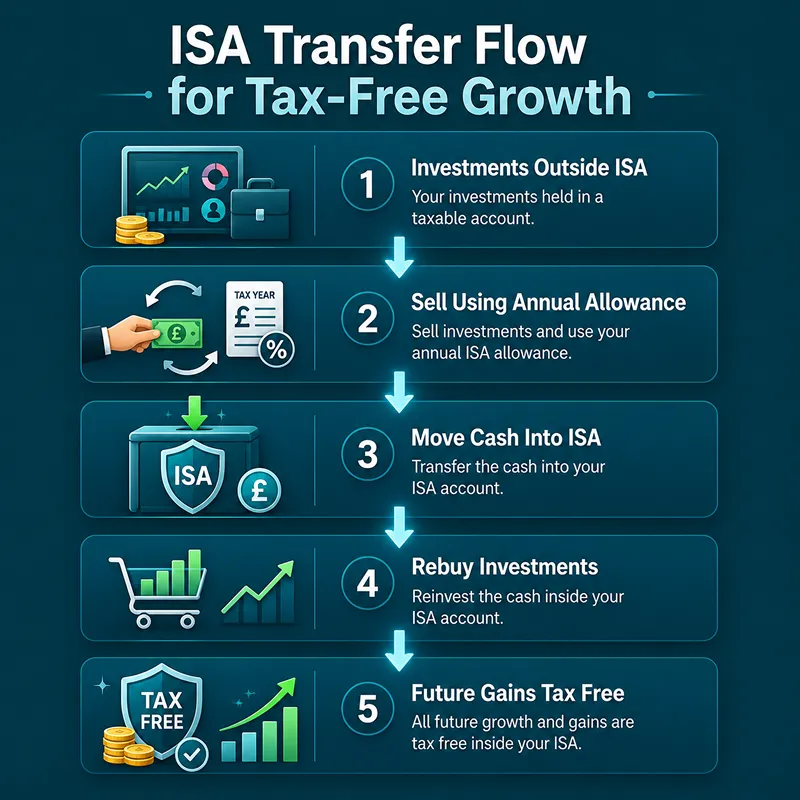
    ISA Transfer Flow for Tax-Free Growth

    How Pensions Help Reduce Capital Gains Tax

    Pensions are one of the most tax-saving ways to grow Assets in the UK. Any Funds held within a pension are free from avoiding Capital Gains Tax allowing your money to grow without being taxed on gains. This may apply to:

    • Systematic investment plan
    • Workplace pensions
    • Personal pensions

    Pensions also offer additional benefits including income tax relief on Deposits and long-term tax-efficient growth. For the higher earners, the pension contributions may also help reduce taxable income and improve overall tax efficiency.

    Helpful Hint

    Pensions can provide both Capital Gains Tax benefits and income tax relief on contributions.

    Claim Private Residence Relief

    The Private Residence Relief (PRR) is one of the biggest CGT exemptions available. In many cases, you do not pay Capital Gains Tax when selling your main home.

    Usually You Can Qualify If:

    • The property was your main residence
    • You did not mainly use it for business
    • You did not rent large parts of it
    • The property falls within HMRC rules

    If the property qualifies fully, the entire gain may be exempt from CGT.

    Offset Capital Losses Against Gains

    Using losses correctly is one of the CGT methods that is most frequently overlooked. Gains from other assets can typically be used to offset a loss on the sale of an asset. Your taxable profit is greatly decreased as a result.

    For Example

    Increase in shares: £25,000, £10,000 was lost on the cryptocurrency investment. Before allowances the taxable gain is £15,000. Typically, unused losses can also be carried over to subsequent tax years. Maintaining accurate records is crucial for making loss claims.

    Time Your Asset Sales Carefully

    Timing plays a major role in CGT planning. Selling assets during lower income years can reduce the tax rate applied to gains.

    Good Times To Sell May Include:

    • Retirement
    • Career breaks
    • Maternity leave
    • Business restructuring

    Careful timing can reduce your CGT rate from 24% to 18%. Many investors and landlords plan disposals years in advance for this reason.

    Use Business Asset Disposal Relief

    The Enterprise Investment Scheme (EIS) and Seed Enterprise Investment Scheme (SEIS) give tax benefits to people who invest in small growing businesses.

    Some possible benefits include:

    • Income tax relief
    • Capital Gains Tax deferral
    • Tax-free profits in some cases

    These investments can be higher on risk because smaller businesses may fail. Many investors use EIS and SEIS as part of their long term tax and money planning.

    Consider Enterprise Investment Plans (EIS)

    Enterprise Assets Plans (EIS) and Seed Enterprise Investment Plans (SEIS) offer valuable tax benefits for investors. These government-backed schemes are designed to encourage funding in smaller growing companies.

    Potential benefits may include:

    • Income tax relief
    • Capital Gains Tax deferral
    • Tax-free gains in certain cases

    EIS investments are generally higher risk because they involve smaller businesses. Many experienced investors use these Plans as part of long-term tax and wealth planning strategies.

    How to Use Rollover Relief

    Rollover Relief lets business owners delay paying Capital Gains Tax when they sell certain business assets. The tax can be delayed if the money is used to buy new business assets. This can help businesses grow, buy property or replace equipment.

    Incorporation Relief For Businesses And Landlords

    Some of the Property owners and business owners move operations into limited companies. The Incorporation Relief may allow Capital Gains Tax to be deferred when transferring qualifying business assets into a company structure. This strategy can help the:

    • Property investors
    • Growing businesses
    • Long term tax planning

    However, incorporation also creates other tax considerations including:

    • Corporation tax
    • Dividend tax
    • Stamp Duty Land Tax
    • Additional compliance costs

    Gift Assets to Charity

    Donating the assets to charity can reduce or eliminate Capital Gains Tax (CGT). If you give qualifying assets to a registered charity, the CGT may not apply and Income Tax relief may also be available.

    Common gifted assets include:

    • Shares
    • Property
    • Land
    • Artwork

    How to Avoid Common Property Transfer Mistakes

    Many people incorrectly assume that family property transfers are always tax-free. In reality, gifting the property can trigger avoidance of Capital Gains Tax (CGT) because HM Revenue and Customs often treats the transfer as a disposal at market value.

    Property Transfers That May Trigger CGT

    Certain property transfers can trigger avoided Capital Gains Tax, even if the property is not sold for profit.

    • Gifting buy-to-let properties
    • Adding co-owners
    • Removing co-owners
    • Transferring second homes

    Why Record-Keeping Matters for Avoiding Capital Gains Tax

    Good record-keeping is essential for effectively avoiding Capital Gains Tax planning(CGT). You should keep records of:

    • Purchase pricesLegal fees
    • Improvement costs
    • Estate agent fees
    • Transaction expenses
    • Previous tax returns

    Report Property Gains on Time

    If you sell UK residential property and owe CGT, HM Revenue and Customs normally requires reporting and payment within 60 days of completion. Many landlords face penalties because they miss this deadline. Even if little or no tax is due, reporting obligations may still apply.

    Should You Use a Limited Company?

    Holding property or assets through a limited company can offer tax benefits such as corporation tax treatment and flexible profit extraction. However, most companies can also create additional costs, tax obligations and compliance requirements. The right structure depends on your income investment goals and long-term plans, so professional advice is often recommended.

    Cryptocurrency And Capital Gains Tax

    Cryptocurrency is also subject to Capital Gains Tax in the UK. HMRC treats crypto assets similarly to investments. Avoided capital gain tax may apply when:

    • Selling cryptocurrency
    • Swapping coins
    • Using crypto to buy goods
    • Gifting crypto assets

    Many investors wrongly assume crypto profits are tax-free. Careful record keeping is essential because HMRC increasingly monitors digital asset transactions.

    How Wealthy Investors avoid Capital Gains Tax

    Investors rarely focus only on investment returns. They focus on after-tax returns. According to investor discussions and financial planning communities, some common plans include:

    • Using ISAs regularly
    • Using spouse allowances
    • Holding assets longer
    • Using tax-efficient accounts

    Mistakes That Increase Capital Gains Tax

    Many people accidentally increase their CGT bill through poor planning.

    Common Mistakes Include:

    • Selling assets in one tax year
    • Ignoring spouse exemptions
    • Missing loss claims
    • Missing reporting deadlines
    • Not using ISAs or pensions.
    • Assuming family transfers are tax free
    • Keeping poor records

    When Should You Speak To A Tax Adviser?

    Some CGT situations are straightforward but professional advice becomes important when dealing with:

    • Property portfolios
    • Business sales
    • Trusts
    • International assets
    • Cryptocurrency
    • Large investment gains
    • Inheritance planning

    A qualified tax adviser can help structure transactions legally and efficiently. In many cases, the tax savings achieved far exceed the adviser’s fee.

    Final Thoughts

    Capital Gains Tax can reduce a large part of your profits if you do not plan ahead. In many cases, UK tax rules provide several legal and effective ways to reduce or avoid capital gain tax. Careful planning before selling assets can help lower your overall tax liability and protect more of your wealth. Some of the most effective ways to avoid Capital Gains Tax include:

    • Using annual CGT allowances
    • Investing through ISAs and pensions
    • Transferring assets to spouses
    • Claiming Private Residence Relief
    • Offsetting capital losses
    • Timing asset sales carefully
    • Keeping accurate records
    • Seeking professional tax advice

    As HMRC continues increasing compliance checks and CGT allowances remain lower. Tax-efficient planning is becoming more important for investors, landlords and business owners. At Sterling Cooper, we help individuals and businesses to avoid Capital Gains Tax through smart and compliant tax planning strategies. Contact us today to discuss the right solution for your situation.

    Worried about paying too much Capital Gains Tax on your investment property or business sale?

    We have helped individuals, investors and business owners reduce CGT through smart tax planning and compliant strategies. For Capital Gains Tax planning, reach out to us today to discuss the right solution for your situation and learn more about our professional tax planning services.
    +443300102526
    Book an Appointment

    FAQs


    How to legally avoid Capital Gains Tax in the UK?


    You can reduce CGT legally through ISAs pensions annual allowances, spouse transfers and capital loss offsets. Early tax planning can significantly lower your tax bill.


    Leaving the UK does not always remove CGT obligations because HMRC temporary non residence rules may still apply if you return.


    The “Bed and ISA” strategy involves selling investments using your CGT allowance and rebuying them inside an ISA for future tax free growth.


    Private Residence Relief spouse transfers annual allowances and careful sale timing can help reduce property related CGT.


    The 6 year rule may allow some homeowners to keep Private Residence Relief after moving out of their property in certain situations.

    Share This Article!

    Recent Posts

  • What Is Employee Retention and Why Does It Matter in 2026?

    What Is Employee Retention and Why Does It Matter in 2026?

    empolyee retention

    Posted by:

    Admin

    Date:

    June 9, 2026
    Category:

    blogs

    Error: Contact form not found.

    What Is Employee Retention and Why Does It Matter in 2025?

    Hiring good people takes time and resources, but their value grows as they gain experience. When they leave, businesses must manage recruitment costs, knowledge gaps and the disruption of replacing skilled employees. This is why employee retention remains an important consideration for UK businesses in 2026.
    Meeting these expectations requires more than offering competitive salaries. Businesses also need to understand what influences employees’ decisions to stay and address the factors that shape their experience at work.
    This guide explains what employee retention means, why it matters and the strategies UK businesses can use to create a workplace where people want to stay.


    Key Takeaways

    • Employee retention measures how well a business keeps its employees over time.
    • High employee turnover can increase recruitment costs.
    • Career growth, flexibility and fair rewards can influence employees to stay.
    • Effective retention strategies can improve employee loyalty.
    • Regular feedback can help identify retention issues early.

    What Is Employee Retention?

    Employee retention is a business’s ability to keep its employees and limit unnecessary staff turnover. It reflects how effectively a company creates a workplace where people feel valued and want to stay.

    Keeping every employee is not the goal. People leave jobs for all sorts of reasons and some staff turnover is natural. The real focus is understanding why good employees leave and what a business can do to give them reasons to stay. This is where employee retention and turnover become closely linked.

    Employee Retention vs Employee Turnover

    Employee retention and employee turnover look at the workforce from different angles. Retention focuses on who stays, while turnover focuses on who leaves. Looking at both gives businesses a clearer view of workforce stability.

    People leave jobs for many reasons, including retirement, relocation and career changes. Some turnover is natural, but preventable turnover is more concerning. This can happen when issues such as poor job satisfaction, limited career growth or workplace problems are left unresolved.

    Tracking retention and turnover together can help businesses spot these patterns. When combined with employee feedback, the figures can show why people leave and where action may be needed. But before businesses can track retention, they need to know how to measure it.

    How Is Employee Retention Rate Calculated?

    An employee retention rate shows how many employees stay with a business over a set period. It only considers employees who were with the business at the start of that period, so new hires are excluded.

    The formula is:

    Employee retention rate = (Number of employees retained ÷ Number of employees at the start of the period) × 100

    For example, if a business starts the year with 100 employees and 10 leave, 90 of the original employees remain. The retention rate is therefore 90%.

    Businesses can measure retention monthly, quarterly or annually. Using a consistent timeframe makes it easier to track changes and see whether retention is improving over time.

    Why Does Employee Retention Matter in 2026?

    Losing good employees can leave gaps that are hard to fill, from lost knowledge to heavier workloads for the people who stay. In 2026, retention is also about understanding what employees value and giving them good reasons to stay.

    UK Labour Market Conditions in 2026
    Labour market conditions can also affect how easily businesses replace employees. ONS data shows that economic inactivity varies across the UK, giving employers different workforce conditions to consider when planning recruitment and retention.

    Financial and Productivity Costs

    Employee turnover can increase recruitment, onboarding and training costs while reducing productivity during the transition. When experienced employees leave, businesses may also lose valuable skills, knowledge and client relationships.

    Vacancies and the time needed for new employees to become fully productive can slow output, while existing employees may take on additional work. Reducing avoidable turnover can help businesses control costs, protect productivity and maintain stable teams.

    Changing Employee Expectations

    A good salary can attract employees, but it may not be enough to keep them. Recent data found that career growth was the leading reason for voluntary exits, followed by work-life balance and compensation and benefits.

    These findings highlight the importance of understanding employees’ longer-term expectations. Career development, flexible working, wellbeing and workplace culture can all influence retention.

    Technology and the Employee Experience

    Technology is an important part of the employee experience. AI, automation and digital tools can reduce repetitive tasks, improve access to information and make collaboration easier.

    The aim is not to add more tools, but to reduce unnecessary friction and give employees more time to focus on work that requires their skills.

    Understanding why retention is important is only the starting point. Here’s how you can turn those insights into practical ways to retain your employees.

    Employee Retention Strategies That Work in 2026
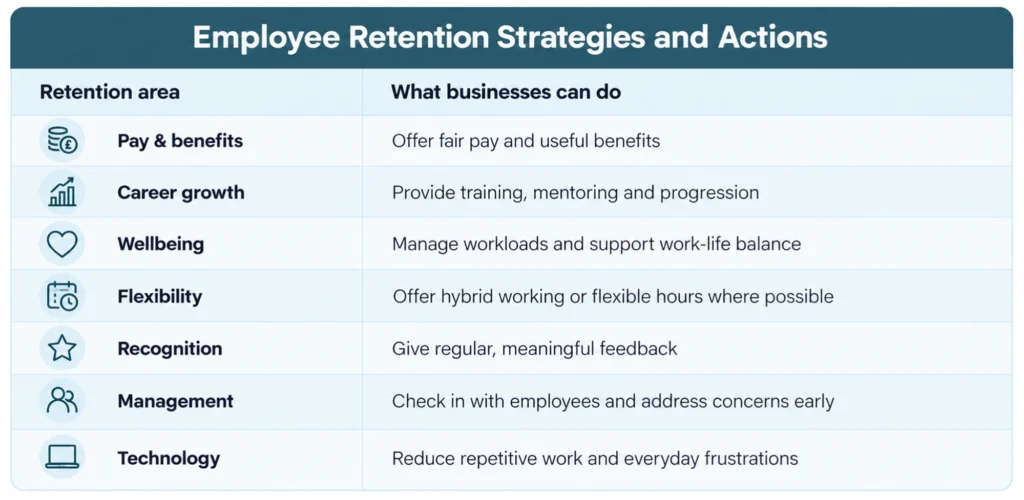
    Keeping employees rarely comes down to one perk or policy. People are more likely to stay when they are paid fairly, supported by their managers, given room to grow and able to maintain a healthy work-life balance.

    Did You Know?

    44% of UK employers say talent has become harder to retain in 2026. At the same time, 48% have increased efforts to develop talent in-house.

    Hire and Onboard Effectively

    Retention starts before an employee settles into the role. Set clear expectations, make onboarding straightforward and check in regularly during those first few months.

    One practical approach is to give new employees a clear 30-, 60- and 90-day plan, followed by regular check-ins to help them adjust and feel part of the team.

    Offer Competitive Pay and Benefits

    Salary matters, but employees also consider the wider employment package. Fair pay, relevant benefits and meaningful rewards can strengthen the overall employee experience and reduce incentives to look elsewhere.

    Support Wellbeing and Work-Life Balance

    A workplace that constantly leaves people exhausted is difficult to sustain. Keep workloads realistic, give employees some control over how they work and make it easy to raise concerns before they become bigger problems.

    Provide Career Growth Opportunities

    Employees are less likely to stay when they cannot see where their role is heading. Training, mentoring, new responsibilities and internal opportunities can give people a reason to build their future within the business.

    Build a Flexible and Inclusive Workplace

    Flexible working can make it easier for employees to balance work with their personal lives. Depending on the role, this could mean hybrid working, flexible hours or compressed schedules.

    Make flexibility practical by clearly communicating available options and applying them consistently across eligible employees.

    Recognise Employees and Encourage Feedback

    Regular feedback and genuine recognition can help employees feel that their work is valued. Managers can also use stay interviews and short employee surveys to understand concerns before they contribute to turnover.

    Rather than waiting for employees to resign, use regular check-ins to identify issues and address them early.


    empolyee retention strategies

    Case Study: How Burger King UK Improved Retention

    Burger King UK wanted to improve communication and onboarding for its largely frontline workforce. It introduced BK Hub, a mobile platform that gave employees easier access to company information, benefits and support.

    The results were clear. Burger King UK reported a 32% drop in turnover among hourly-paid crew at new sites within three months and a 40% drop in new-starter drop-out rates over six months.

    The results show how improving the day-to-day employee experience can support retention. Making information and support easier to access may help reduce some of the frustrations employees face during onboarding and throughout their time with the business.

    Build a Workplace People Want to Stay In

    Employee retention depends on more than salary. Fair rewards, career growth, flexibility, wellbeing and effective HR support can all influence whether employees choose to stay. Businesses that understand these factors can take practical steps to reduce avoidable turnover and build more stable teams.

    Sterling Cooper Consultants provides Payroll and HR services to help businesses manage their people and payroll needs effectively.

    Looking to Build a More Stable Workforce?

    Get practical payroll and HR support from Sterling Cooper Consultants to improve employee management and support long-term business growth. Get in touch to discuss your needs.


    +443300102526
    Book an Appointment

    FAQs


    What Is Employee Retention?

    Employee retention is a business’s ability to keep its employees over a set period. Retention strategies can include fair pay, career growth, wellbeing, flexibility and a positive employee experience.


    Employee retention matters because high turnover can increase recruitment and training costs, reduce productivity and lead to the loss of valuable knowledge. Retaining employees can also help businesses maintain stable teams and stronger workplace relationships.


    To calculate employee retention rate, divide the number of employees who remain at the end of a period by the number of employees at the start of the period, then multiply the result by 100. New hires during the period are not included.

    Employee retention rate = (Employees retained ÷ Employees at the start of the period) × 100


    Employee retention measures how many employees stay with a business, while employee turnover measures how many employees leave. Tracking both can help businesses understand workforce stability and identify potential retention issues.


    Employees can leave for several reasons, including limited career growth, poor work-life balance, inadequate compensation, lack of recognition and management issues. Culture Amp’s 2026 global data found that career growth was the leading reason for voluntary exits, followed by work-life balance and compensation and benefits.
     

    Effective retention strategies include competitive pay and benefits, wellbeing support, career development, effective onboarding, employee recognition, regular feedback and flexible working where appropriate. Technology can also support retention by reducing repetitive tasks and everyday workplace frustrations.


    Yes. The tools employees use can affect how easily they complete everyday tasks and communicate with colleagues. Well-designed technology can reduce repetitive work, improve access to information and create a smoother employee experience, while inefficient systems can add frustration and unnecessary administrative work.


    Share This Article!

    Recent Posts

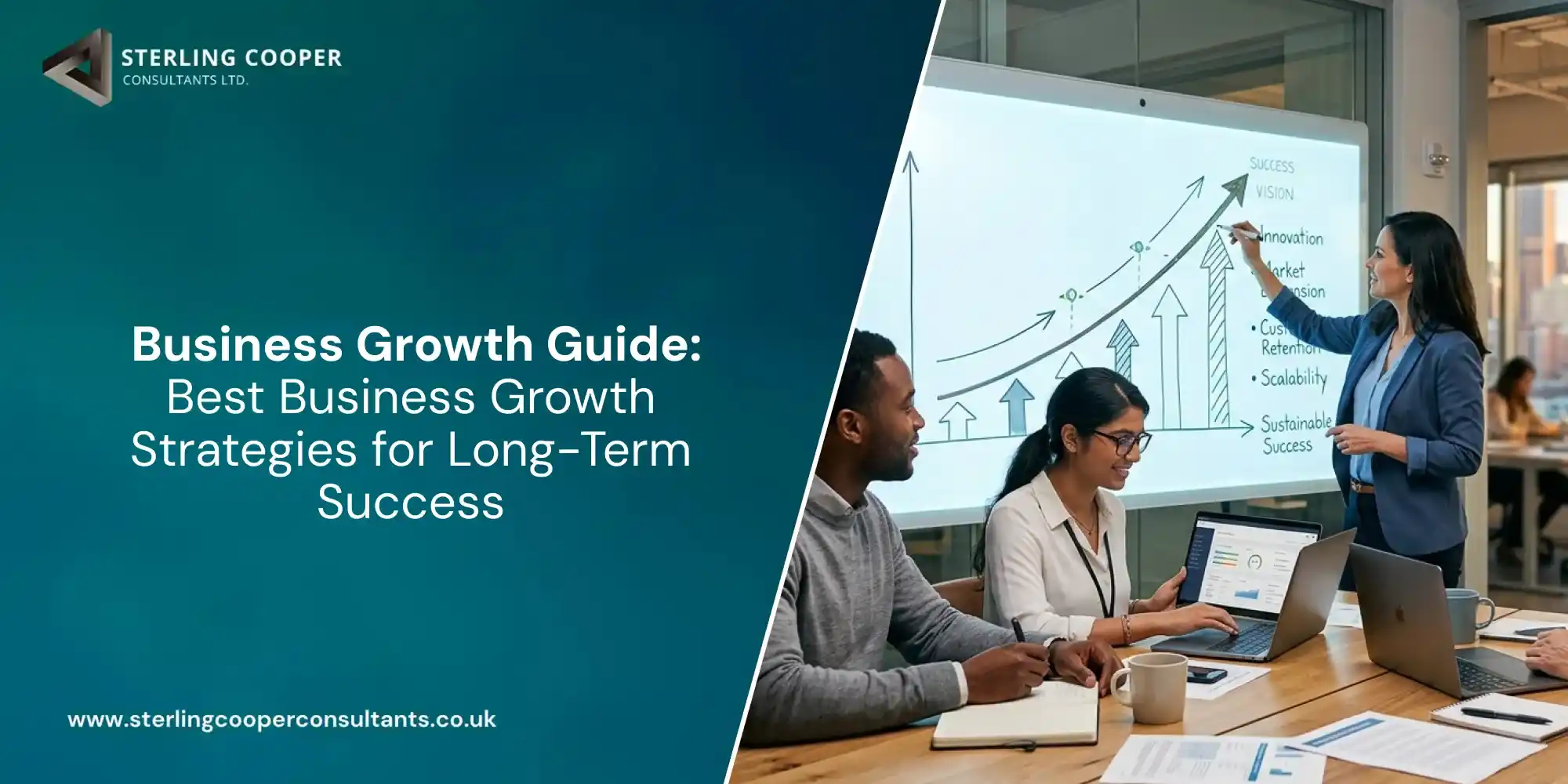
  • Business Growth Guide That Drives Long-Term Success

    Business Growth Guide That Drives Long-Term Success

    Business Growth Guide

    Posted by:

    Admin

    Date:

    June 4, 2026
    Category:

    blogs

    Error: Contact form not found.

    Business Growth Guide That Drives Long-Term Success

    If you run a business in the UK, you may have seen that growth is getting harder.

    The UK Government said that 99% of businesses fall under Small and Medium-sized Enterprises (SMEs) in the UK. This shows that business expansion is a must for survival and success.

    This clearly shows that SMEs power the economy. However, many SMEs find it hard to grow because they lack clear direction. Business growth is not about speed. It is about control, planning and steady progress.

    Business owners either rush the process of growing their businesses or defer it. They may lose opportunities along the way. So, these strategies are important.

    Key Takeaways

    • Business growth needs planning, stable cash flow and strong systems.
    • The best business growth strategies focus on steady and sustainable scaling.
    • Business development growth strategies help improve market reach and customer growth.
    • Strong customer demand and clear goals are important before expansion.
    • A business growth consultant can help reduce risks and improve planning.
    • A business growth service supports businesses with structure, strategy and financial control.
    • Cash flow management is essential during business growth.
    • Technology and digital tools can improve efficiency and customer retention.
    • Businesses should track revenue, profit margins and customer retention regularly.
    • Long-term business growth comes from consistent improvement, not quick win.

    What Is Business Growth and Why Does Business Growth Matter?

    It means that your business will grow bigger over time.

    This may be:

    • Increase in sales
    • More customers
    • Increase in profit margins
    • Increased workforce
    • Entering new markets

    However, true growth of a business does not include only growth. Growth must include stability and control.

    UK businesses tend to focus only on sales. However, good business expansion includes balance, cash flow and systems.

    Quick Insight:

    Business growth is not about doing more. It is about doing things better and smarter.

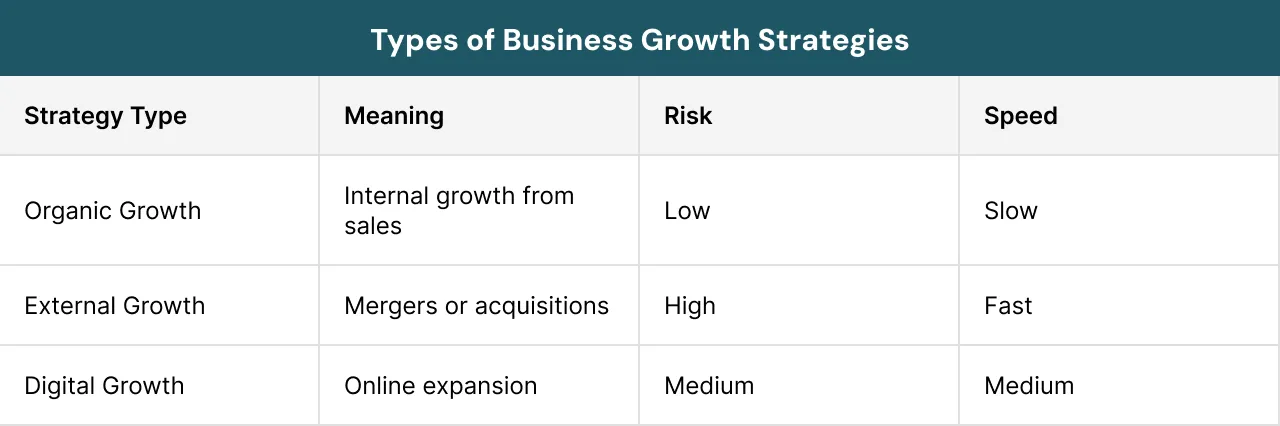
    What Are the Types of Business Growth Strategies in the UK?

    There are various strategies that you can consider based on how they work.

    1. Organic Growth

    Organic growth means using your existing customer base. It also includes reinvesting your profits. This type of growth is steady but usually slow.

    2. External Growth

    External growth includes mergers between companies. It also includes acquisitions where one company buys another. Partnerships are also part of this type.

    3. Digital Growth

    Digital growth focuses on online channels. It includes online marketing to reach more people. It also uses SEO to improve search visibility. Social media marketing is also a key part of it.

    A business consultant is normally helpful in choosing the right strategy.

    Read More: Business Growth Strategies: A Complete Guide to Planning, Execution and Long-Term Success

    Types of Business Growth Strategies

    How Can You Prepare Your Business for Long-Term Business Growth?

    Make sure your business is ready before focusing on growth. Many businesses expand too early and later face financial problems.

    1. Stable Customer Demand

    Your business should have a steady demand before you expand.

    Positive signs would be:

    • Loyal customers
    • Steady inquiries
    • Monthly sales

    Inconsistent sales each month can make business expansion difficult.

    2. Strong Cash Flow

    Cash flow plays a crucial role in business expansion.

    Your business needs to be able to handle:

    • Salaries of employees
    • Costs related to marketing
    • Overhead costs
    • Capital expenditure

    Most business owners grow sales yet have cash flow issues. Business consultants will help you check your finances before expanding your business.

    3. A Reliable Team

    Expanding a business needs strong backing from employees and management.

    Before expansion, make sure that:

    • Your employees can handle their present workload
    • Employee roles are clear
    • There is basic infrastructure in place

    Without support from the team, expanding your business will be challenging.

    4. Clear Goals

    Setting goals helps the firm expand with purpose.

    Goals you can have:

    • Increase earnings
    • Enter new markets
    • Improve customer loyalty
    • Offer new services

    Many business development growth strategies work better when businesses set real goals.

    5. Good Systems

    Better systems make daily activities simpler when the company is growing.

    Systems such as:

    • Customer relations management
    • Financial management
    • Sales system
    • Communication system

    It can be added by a professional business expansion service before expanding.

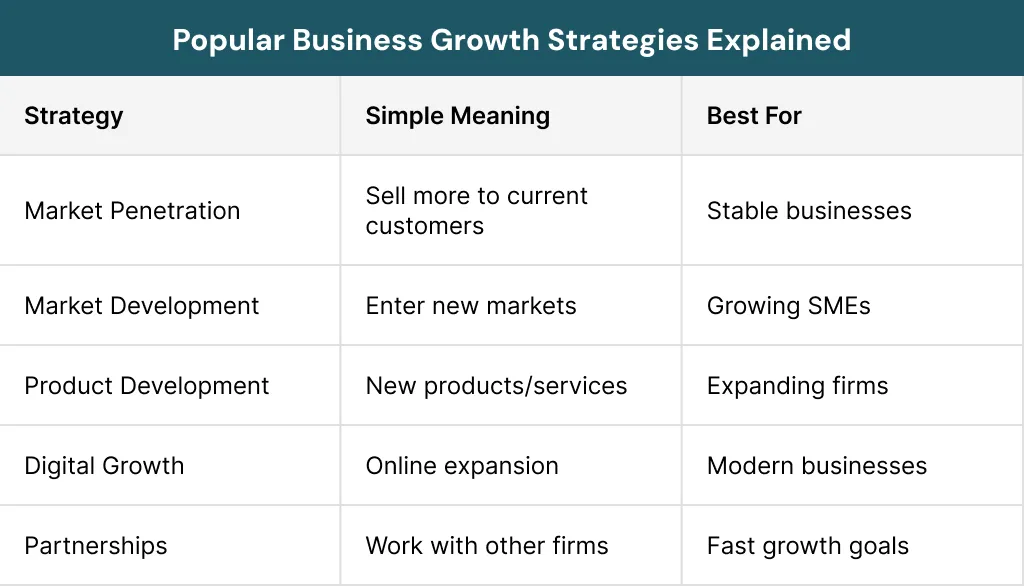
    What Are the Best Business Growth Strategies for SMEs?

    Best growth strategies for businesses are:

    • Generating sales from current customers
    • Expanding into new markets
    • Enhancing products
    • Retaining customers

    Growth strategies for the business help you to decrease risks and ensure stability. Several organisations also adopt firm growth strategies.

    Popular Business Growth Strategies Explained

    Helpful Tip:

    Start with one business growth strategy. Do not try to do everything at once.

    What Are Business Development Growth Strategies and Why Do They Matter?

    Strategies for expanding businesses include long-term expansion plans.

    Examples include:

    • Networking
    • Partnerships
    • Referrals
    • Branding

    These strategies help your business grow and build a strong position in the market. Most UK companies use business expansion services to develop these strategies.

    When Should You Use a Business Consultant?

    Consulting helps in the expansion of businesses.

    The services provided include:

    • Planning
    • Market entry
    • Control of finances
    • Reducing risks

    The need for business expansion services occurs where:

    • There is no growth
    • Unstable cash flows
    • Lack of planning
    • Business expansion plans exist

    Read more: Business Consulting Strategies, Benefits and Best Practices for Growth

    Important Note:

    If your business is growing without structure, it is risky and can fail fast.

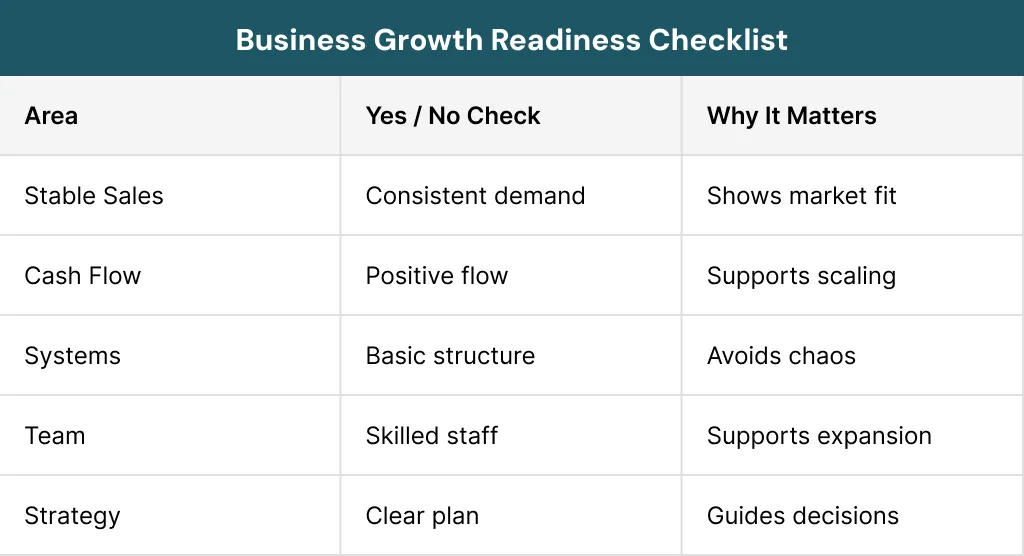
    How Do You Know Your Business Is Ready for Business Growth?

    Before using these strategies, consider the business’s preparation for this step. You should check for:

    1. Stability of Demand

    There are regular clients who bring in consistent business. Revenue stays steady over time without big changes. This helps the business plan ahead with confidence. It also reduces the risk of sudden income loss.

    2. Good Cash Flow

    Earnings remain stable throughout the business cycle. Incoming and outgoing money is easy to track and control. This helps the business meet daily expenses on time. It also reduces financial pressure during slow periods.

    3. Strength

    Services are clearly defined and easy to deliver. The business focuses on a specific niche market. This makes it easier to attract the right customers. It also helps build a strong brand identity.

    4. Business Team

    Basic systems and processes are already in place. Employees are available to support daily operations. This improves efficiency and reduces workload pressure. It also helps the business run smoothly.

    5. Vision

    Goals are clear, specific, and well understood. There is a proper plan to achieve future growth. This helps guide business decisions in the right direction. It also keeps the team focused and motivated.

    A business expansion consultant will help in this.

    Business Growth Readiness Checklist

    Quick Reminder:

    Small changes in strategy can create big long-term business growth.

    How Can You Create a Business Growth Plan That Works?

    Business expansion requires a good strategy. Without a good strategy, growth can be very risky and costly. The right strategy helps businesses grow in the right direction with less confusion. Simple goals should be set first.

    Ask yourself:

    • What should be done?
    • How much growth is right for my firm?
    • What resources are available?

    Many firms choose a business consultant to develop realistic strategies.

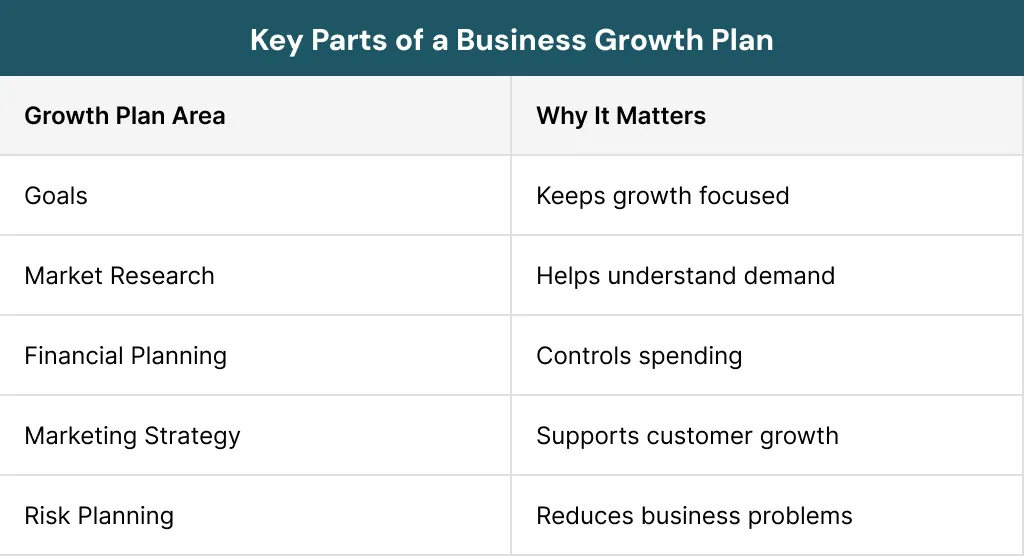
    What Should a Business Growth Plan Include?

    Planning should remain as simple and practical as possible.

    1. Business Goals

    State goals for:

    • Income
    • Clients
    • Number of staff
    • Market reach

    2. Market Research

    Get information on:

    • Competitors
    • Client needs
    • Trends

    3. Financial Plan

    Monitor:

    • Costs
    • Profit margin
    • Cash flow
    • Growth budget

    4. Sales and Marketing Plan

    Effective growth plans usually focus on:

    • SEO
    • Content marketing
    • Referrals
    • Partnerships

    5. Risk Plan

    Anticipate:

    • Poor sales results
    • Increasing costs
    • Market shifts

    Key Parts of a Business Growth Plan

    Why Is Cash Flow Important for Business Growth?

    Most firms fail due to poor cash flow rather than low sales. It’s a crucial problem for any firm that is growing.

    As the business expands:

    • Costs rise
    • Salaries go up
    • Marketing budgets increase
    • Work becomes bigger

    Ways to improve cash flow:

    • Invoicing quickly
    • Reducing late payments
    • Avoid unnecessary cost
    • Monitor the cost per month

    Quick Tip:

    Revenue looks good on paper. Cash flow keeps the business alive.

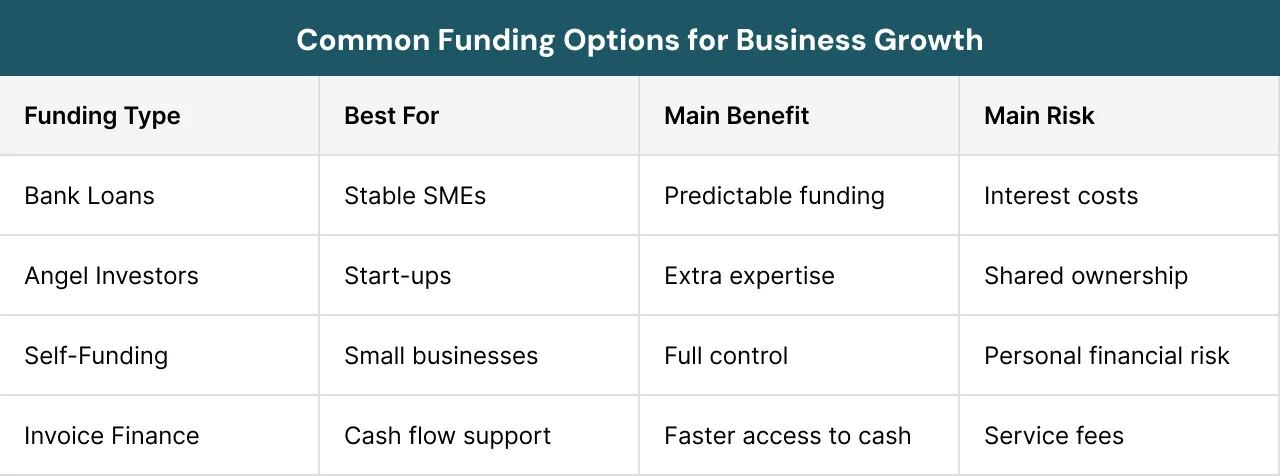
    What Funding Options Support Business Growth?

    Various business expansion strategies demand different types of funding.

    1. Business Loans

    Business loans are money borrowed from a bank or lender. They must be paid back with interest over time. They are useful for expansion, equity needs, and working capital.

    2. Angel Investors

    Angel investors are individuals who invest their own money in a business. They usually support new and growing start-ups. They often help businesses that have strong growth potential.

    3. Self-Funding

    Self-funding means using your own savings or profit. It gives you full control of your business. It is best for small and low-risk businesses.

    4. Invoice Financing

    Invoice financing helps you get money from unpaid invoices early. A finance company pays you based on your pending bills. It improves cash flow and helps manage short-term expenses.

    Common Funding Options for Business Growth

    What Mistakes Can Slow Business Growth?

    Many firms harm themselves unintentionally as they expand their businesses.

    1. Expanding Too Quickly

    Expanding too quickly may harm quality and overwhelm staff. It can also cause cash flow problems.

    2. Not Adding Systems

    Failure to add proper systems will lead to disorganised teams. It can also lead to poor customer service.

    3. Poor Leadership

    The owners are trying to control everything and limit growth.

    4. Lack of Strategy

    This leads to uncontrolled decision-making and poor investing. It can cause budget wastage, too.

    Business development growth strategies avoid these problems.

    “Growth is never by mere chance. It is the result of forces working together.”

    – James Cash Penney.

    How Does a Business Growth Consultant Help Long-Term Success?

    The consultant offers external support.

    They help firms in:

    • Creating structure
    • Improving planning
    • Constructing better systems
    • Minimising risk

    Businesses take help from consultants when:

    • Growth is unstable
    • Firms are being stretched
    • Income is not growing

    Excellent consultants focus on long-term growth.

    What Is the Guide to Working With a Business Growth Consultant?

    The guideline for collaborating with a consultant begins by establishing expectations.

    When taking help, be sure to ask about:

    The issues that need to be addressed

    • Your growth goals
    • Your budget

    Your ideal business consultant would be able to:

    • Know your market
    • Explain ideas effectively
    • Be result-oriented

    You also have to assess:

    • Experience
    • Case studies
    • Communication Style 

    All this will help in choosing the proper business expansion service.

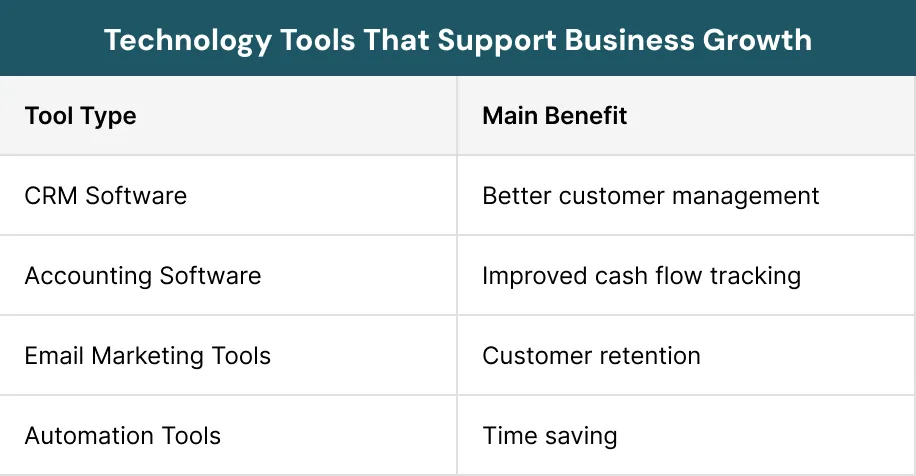
    How Can Technology Support Business Growth?

    Technology today is a vital part of business expansion.

    It can help firms by:

    • Saving time
    • Improving customer support
    • Tracking progress
    • Reducing paperwork

    Some useful technologies to be used include:

    • Customer relationship management tools
    • Accounting software
    • Email marketing applications
    • Automation technology

    Many of today’s strategies for business expansion use digital systems.

    Technology Tools That Support Business Growth

    How Can Businesses Measure Business Growth?

    Tracking progress is necessary. Progress cannot be achieved without measuring progress.

    Some useful metrics include:

    1. Revenue Increase

    It tracks how sales are growing. It shows if business income is rising. It helps measure overall performance. It supports better future planning.

    2. Profit Margins

    It shows how much profit is made. It compares income and costs. It tells real business profitability. It helps in pricing decisions. 

    3. Customer Retention Rate

    It tracks repeat customers. It shows customer loyalty. It helps understand customer satisfaction. It improves long-term business growth. 

    4. Cash Flow Monitoring

    It tracks money coming in and going out. It shows financial stability. It helps manage daily business needs. It reduces the risk of cash shortages. 

    5. Customer Acquisition Cost

    It shows the cost of getting new customers. It measures marketing effectiveness. It helps control spending on ads.

    These metrics can help in improving business expansion strategies.

    Case Study: Simple Business Growth Through Better Systems

    A small UK retail company faced challenges such as slow growth and increasing costs.

    They focused on:

    • Improved stock management
    • Effective communication with clients
    • Online sales platforms

    And enhanced their firm’s growth strategies by forming local partnerships.

    Within one year, the following was observed:

    • Increased sales
    • Decreased costs
    • Improved customer retention

    Thus, showing how an effective system helps business expansion.

    How Can Businesses Build Long-Term Business?

    Long-term business expansion requires both patience and planning.

    Focus on:

    • System balance
    • Cash flow management
    • Customers retention 
    • Training of employees
    • Effective planning

    Forget quick fixes. The best business expansion strategies include constant improvement.

    Conclusion

    Business success comes from planning, structure and smart decisions.

    Clear business growth strategies help businesses manage risks better. They also support steady growth. Strong business development growth strategies help businesses reach more customers. It also helps them build long-term stability.

    Sterling Cooper Consultants understands the challenges businesses face during growth and expansion. Need help with planning, strategy or growth? Contact us today to discuss your business goals.

    Struggling to manage business growth without a clear direction?

    Our team supports UK businesses with practical strategies, financial planning and structured growth support. We have helped firms improve stability and scale with confidence. Explore our business advisory services today.
    +443300102526
    Book an Appointment

    FAQs


    What Is Business Growth?


    Business growth means increasing sales, customers, profits or market reach over time.


    Popular business growth strategies include market expansion, digital marketing, partnerships and customer retention.


    A business growth service is useful when your business faces slow growth, weak planning or operational pressure. It can help improve structure, strategy and financial control.


    The guide to working with a business growth consultant starts with setting clear goals and understanding your business challenges. You should also review the consultant’s experience, communication style and approach to business growth.


    Yes. Small businesses can achieve steady business growth by using clear systems, realistic planning and strong customer relationships.

    Share This Article!

    Recent Posts

  • Business Strategy in 2026: How Companies Stay Competitive

    Business Strategy in 2026: How Companies Stay Competitive

    business strategy

    Posted by:

    Admin

    Date:

    June 3, 2026

    Category:

    blogs

    Error: Contact form not found.

    Business Strategy in 2026: How Companies Stay Competitive

    Why do some businesses grow fast in 2026 while others struggle to keep up?

    The answer lies in the usage of a modern business strategy built on adaptability, data and strong business growth strategies.

    In 2026, business growth strategy is not a one time thing. It helps you in making decisions and setting priorities. It ties every part of your business together. Business strategy is now the central part of how organisations work. Markets keep shifting, customers have choices and technology keeps changing. The business strategy helps businesses navigate all this.

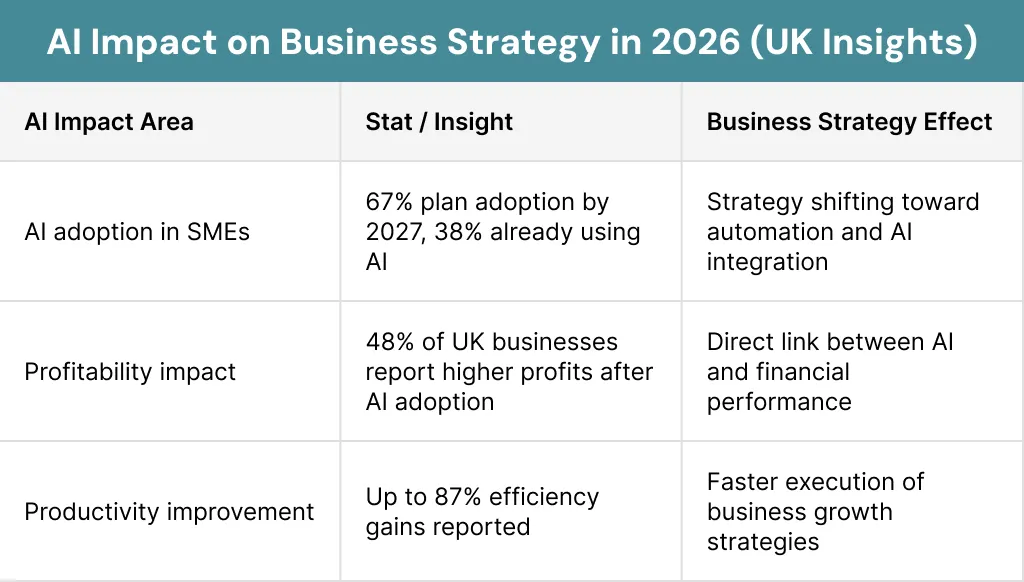
    In the UK, 67% of small and medium sized businesses are going to start using AI by 2027 and 38% are already using it every day to get work done. This shows how fast Artificial Intelligence is becoming a big part of the modern business growth strategies.

    A business strategy goes beyond planning. It means knowing what you want to achieve, keeping your team on the same page and following through. The companies thriving in 2026 are not necessarily those with the brightest ideas – they are the ones that turn ideas into actionable growth plans and pivot when circumstances demand it.

    Key Takeaways

    • Modern business strategy is no longer a static document but a continuous system that guides decisions, execution, and adaptation in real time
    • A strong business strategy for business success focuses on clarity, alignment, and turning plans into measurable action rather than just ideas
    • Effective business growth strategies are built on customer insight, competitive positioning, and the ability to respond quickly to market change
    • Sustainable business growth comes from consistent improvements, strong execution, and data-driven decision-making rather than one-off breakthroughs
    • Businesses that integrate AI and digital tools into their strategy gain faster insights, improved efficiency, and stronger competitive advantage
    • Clear alignment between teams, leadership, and operations is essential for executing business development growth strategies effectively at scale
    • The most successful organisations treat strategy as a living cycle, constantly refining their business growth strategies based on performance and feedback

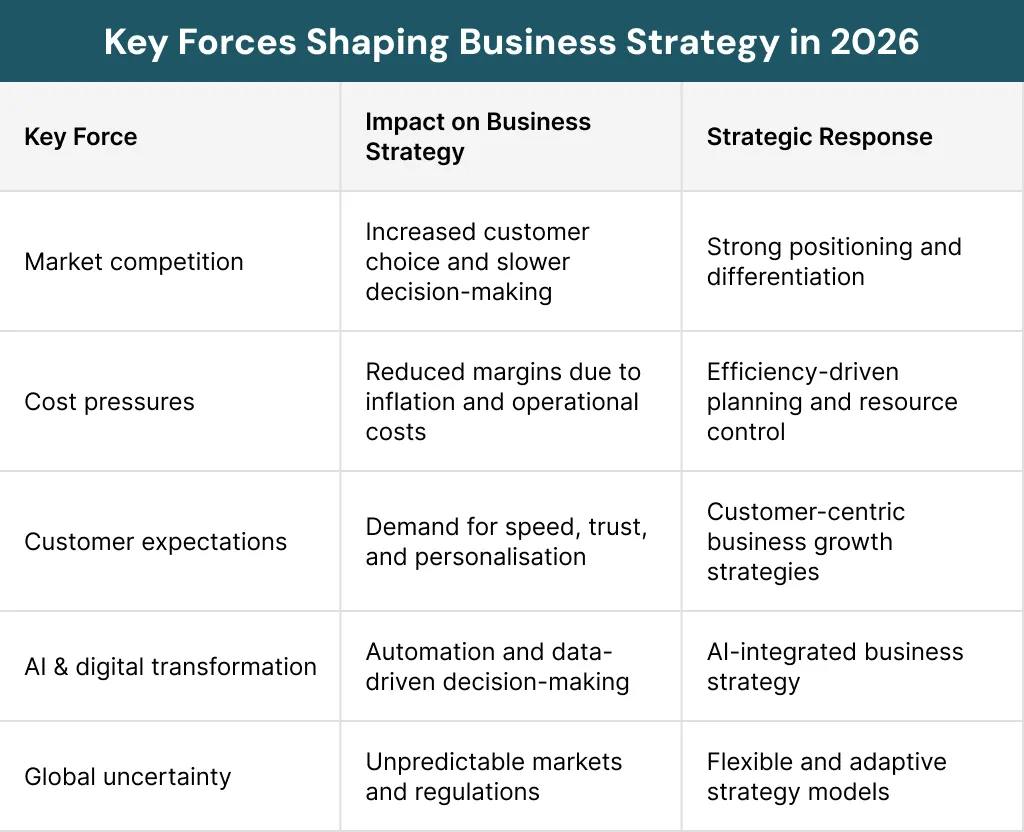
    What Is the Business Environment in 2026?

    Understanding how businesses operate on a global scale has never been more important. Conditions shift quickly and that makes having effective business growth strategies essential for keeping pace with ongoing.

    Key Forces Shaping Business Strategy in 2027 new

    1. Competitive Markets and Customer Confusion

    One of the biggest changes in business strategy is that most markets are really crowded now. Many industries now have lots of businesses offering much the same thing. That makes it harder to stand out and more important to have strong business growth strategies.

    Nowadays, it is not enough to just have a good product. Businesses should know what they are selling and why it matters to customers.

    2. High Costs and Low Profit Margins

    Inflation has slowed down in some places but the pressure to pay more is still there. Things like wages, energy, raw materials and logistics are still making it hard for your business to make money.

    Every decision matters for small and medium sized businesses. You have to reduce costs as well as investment in business growth strategies. Business strategy and financial discipline now go hand in hand.

    3. Changing Customer Expectations

    The behaviour of customers has changed a lot. People now care more about the experience they have with your business. They trust the company and feel like they are getting good value for their money. It is not about the price of something anymore. Customer behaviour is really about ethics and sustainability too.

    So businesses need to think beyond what they charge. How customers feel about your brand and whether they trust you, plays a big role in long term customer relationships.

    4. AI and Digital Transformation

    AI is now part of day to day business strategy. It is used for marketing, customer support, forecasting and automation.

    It helps businesses move faster and make better decisions as part of core business growth strategies. Data and AI are no longer nice to have, they are central to how modern businesses grow.

    In the United Kingdom, 48% of businesses say they make profits after using Artificial Intelligence. A lot of these businesses see their money grow double or more.

    5. Global and Economic Uncertainty

    In today’s world, businesses have to deal with a lot of changes. One day everything is fine, other days it is not. Rules can change suddenly. Supply chains stop working. The economic conditions can change fast. This means being flexible is very important and a core part of a good strategy in 2026.

    What Is a Business Strategy in 2026?

    Now after understanding the world businesses are working in, you can look at what business strategy actually means today.

    Modern business strategy is the set of decisions and actions that guide how a company competes. It is not a one-off plan, it is ongoing and adapts as things change. It also links closely to business growth strategies that help build long term value.

    Strategy without tactics is the slowest route to victory. Tactics without strategy is the noise before defeat. – Sir Winston Churchill, British Prime Minister

    1. Strategy Beyond Planning

    Strategy is more like a roadmap that shows where a business is going and how it will achieve its goals. But it also has to flex when conditions shift.

    2. Strategic Value Creation

    At the core, business strategy is about making things valuable for your customers, staff, suppliers and the business itself. Without that, even the best execution will not lead to long term success.

    3. Strategy as an Ongoing Process

    In 2026, a good business strategy works best when you think of it like a system, not a written document. It links your actions, goals, feedback and changes into one cycle. You decide on a direction, take action, learn from the results and then make adjustments as needed to your strategy and goals.

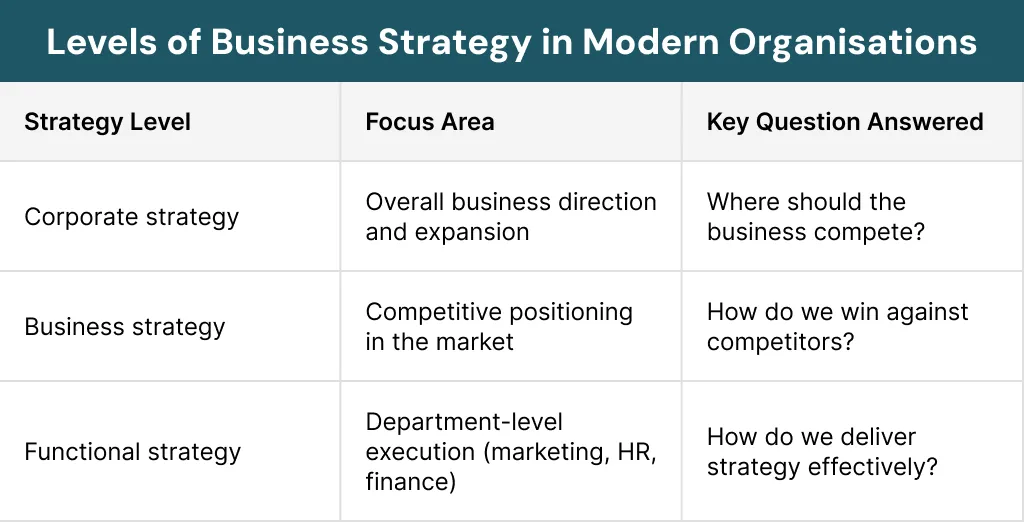
    What Are the Levels of Business Strategy in Modern Organisations?

    The business strategy needs to break down into levels to understand how it works inside a company. Each level has a different role to play and all of these need to work together.

    Levels of Business Strategy in Modern Organisations new

    1. Corporate Level Strategy

    This is the top level. It looks at the big picture; which markets to be in, whether to grow, merge or pull back and where the business is headed long term.

    It answers questions like:

    • Which markets should we enter?
    • Do we diversify, expand or merge?

    2. Business Level Strategy

    This level is about how your company competes in a specific market. It includes:

    • How do you position your company?
    • How does your company set prices?
    • What makes your company different from others?

    It answers questions like:

    • Why do customers choose us over others?
    • How do we stay ahead against competitors?

    3. Functional Level Strategy

    This is where each department plays its part; marketing, finance, HR, operations and so on. Every function supports the wider business strategy through day to day actions.

    For example:

    • Marketing creates awareness and demand
    • Finance manages costs and investment
    • Operations keeps delivery running smoothly

    4. How All Levels Connect Together

    Businesses run better when all three levels are working together. Corporate strategy decides the direction. Business strategy defines how you compete. Functional strategy makes everything work at the ground level.

    How to Build a Strong Strategic Foundation?

    A clear direction is required to start a good business strategy. Many organisations tie this to their business growth strategies right from the start.

    1. Vision, Mission and Core Values

    A vision shows you direction or where you want to go. A mission explains what the business does. Values help people understand how to behave and make decisions.

    These three things keep everyone working towards the same goal, across teams and over time.

    2. Setting Strategic Goals

    Successful businesses do not try to do everything. They prioritise important things and try to achieve them. When you try to do too much at once, you usually end up doing none of it well.

    3. Clear and Measurable Goals

    Every plan needs goals that you can track. You need to focus on goals, like:

    • Revenue growth
    • New customer
    • Keep existing customer

    If you cannot measure something, it is tough to control it.

    4. Use KPIs to Track Progress

    Key performance indicators tell you whether the business strategy is working or not. These indicators are:

    • Conversion rates
    • Customer acquisition cost
    • Retention

    You should check them often. Then act on what they show.

    5. Current Market Position Analysis

    Before you decide where to go, you need to know where you are now. That means being honest about your performance, your customers and your place in the market.

    What Is Market and Customers?

    A good business strategy is built on knowing your customers well. And to do that, you need business growth strategies for data and real research not guesswork. 

    1. Customer Behaviour in 2026

    Customers take time to make a purchase. They do research, compare different options and read reviews. They often involve people in their decision making process. The path to buying something has become longer and harder to predict than before.

    2. PESTLE Market Analysis

    Businesses use a tool called PESTLE to understand what is happening around them. PESTLE helps them look at six areas:

    • Political conditions
    • Economic trends
    • Social changes
    • Technology shifts
    • Legal requirements
    • Environmental pressures

    3. Gathering Customer Insights

    Surveys, interviews and customer behaviour data help your business understand what customers really want. The more you listen to customers, the better your strategy becomes.

    4. Customer Journey Mapping

    The customer journey starts when they first hear about you. It ends when they make a purchase. Sometimes it ends without a purchase. That is where they drop off. You need to track this to improve the customer journey.

    5. Insight Driven Decision Making

    When businesses use data to make decisions, they are able to target their customers better, waste less money and convert more people into buyers. Data without action is simply information that adds no value. The main goal of using data is to make smarter decisions.

    What Is Competitive Positioning and Value Creation?

    You really need to know your customers and your market. Then you can figure out where you stand against your competitors. This is important because if you do not have an idea of where you stand, your business growth strategies will be expensive and not very effective.

    1. Value Proposition

    A value proposition tells customers why they should choose you over others. When it is clear and strong, customers see your value quickly. This makes marketing easier and more consistent because you can repeat what makes you special.

    2. Risks of Weak Positioning

    When your business positioning is unclear, customers get confused. They take a long time to make a decision. This means you will end up spending more money on marketing. You have to explain your value repeatedly, which is not good for business. Your positioning is key so you need to get it right.

    3. Define your Competitive Advantage

    Your competitive advantage is what makes you stand out from others. It can be: 

    • Price
    • Quality
    • Speed
    • Service
    • Innovation

    When you figure out what your competitive advantage is, you can make a plan that is more focused on that. You can build a business strategy around your competitive advantage.

    4. Market Gap Analysis

    Gaps appear when customer needs are not being met or when rivals are falling short. These are your best chances to move into new areas and grow faster than the competition.

    5. Competing in a Saturated Market

    It is crucial to stand out in a busy marketplace. You need to show what sets you apart. This is important because it helps customers understand why they should choose you. When you focus on results customers start to trust you. As trust grows, customers are more likely to return.

    What Is the Role of Digital Transformation and AI in Strategy?

    The core part of business strategy in 2026 is technology. It shapes how companies plan, run and compete in real time. AI-driven business growth strategies are no longer nice to have. It is a basic requirement for staying competitive.

    AI Impact on Business Strategy in 2026 UK Insights

    1. AI in Business Operations

    AI is taking over tasks like reporting, forecasting and customer support. This helps teams to do jobs that actually need ideas and thinking. Decisions get faster and more data driven.

    2. Improve Efficiency with AI

    Artificial intelligence is turning large amounts of data into useful insights. It helps businesses see trends, track how they are doing and make decisions quickly. This means less guesswork and more confidence.

    3. Digital Tools as Core Infrastructure

    Systems like CRM, analytics and finance tools are now the backbone of how businesses run. They connect departments and help improve visibility. It also helps companies grow in a structured way without losing control.

    4. Grow your Online Presence

    Most customers usually start their shopping online. That means your website, search visibility and social media are not optional extras – they are the primary ways people find you and decide whether to trust you.

    5. Smart use of Automation in Business

    Technology should support people in making decisions, not replace them. AI is good for speed and analysis. But context, creativity and big strategic calls still need a human touch.

    What Is Marketing as a Connected Growth System?

    In 2026, marketing and sales teams should work together not apart. When they are joined up, everything works better. And consistency matters far more than short term efforts in business strategy, improving long term business growth strategies.

    1. Marketing Beyond Campaigns

    Modern marketing is not about doing one campaign and expecting it to work. It is about creating a system where your strategy, content, sales and data all work together. When these parts work together, marketing becomes more structured and the gap between planning and execution gets much smaller.

    2. Data Driven Marketing and Sales Alignment

    The best results happen when marketing and sales teams work together. Shared data helps both teams see what works and what does not. This helps them reduce miscommunication and move quickly when a good chance comes up.

    3. Data Driven Marketing Decisions

    Marketing decisions should be based on facts, not on gut feeling. When you understand how customers act and what gets results, you can spend money wisely and avoid wasting it. Having data makes you more sure about every decision you make.

    4. Long Term Consistency

    Showing up regularly is very important. It is better than doing a lot of work and then stopping. When you stay consistent, people start to trust you. You also become more visible to people. This gives you better insights over time. Short campaigns can give quick results but they do not usually create lasting momentum.

    5. Improving Team Alignment

    When teams work in isolation, things slow down. You get mixed messages, delays and patchy results. Clear systems and shared goals fix this. When everyone works together, things get done faster and better.

    What Is Innovation and Continuous Improvement?

    Innovation is important for every business strategy. It is not just about making new products but also about services, systems and how customers experience your business. The companies that do well are the ones that try out new ideas. They listen to what people think of these ideas and make small changes over time.

    Did You Know?

    Most business growth doesn’t come from big breakthroughs – it comes from small, consistent improvements made over time.

    1. Innovation Beyond Products

    Innovation is not about coming up with something new. It also means improving:

    • How you deliver a service
    • How your internal systems work
    • How customers interact with your business

    This bigger picture helps companies stay relevant when the market changes.

    2. Test and Learn Strategy

    The best way to grow is to try things in steps. Then you can learn from what happens. Feedback loops are very helpful. They show you what is working and what is not. This process of testing and then refining things really helps you in making decisions.

    3. Adapting Business to Customer Values

    Customer values are shifting especially around trust, ethics and sustainability. Businesses that ignore this risk falling behind. Those that adapt stay relevant and keep the trust of their customers.

    4. Market Expansion and New Audience

    Growth is not about doing the same things over and over. When you reach new people or move into new markets, you are not relying on just one group of people anymore. This means you can get fresh income streams. It also spreads risk.

    5. Turn Limits Into Strengths

    Budget cuts, tough competition and limited resources can feel like problems. They often make businesses think more carefully and come up with better ideas. The best ideas often show up when you are working with limited resources, not when you have everything you need.

    What Are People, Skills and Company Culture?

    A good business strategy is not enough on its own. You need to have the right people to make it work. Strong business growth strategies depend on capable teams. If you do not have the right team and culture, then even the best business strategy will not be successful.

    1. People First Strategy

    People are what make strategy real. Their skills, choices and day to day actions decide whether goals are hit or missed. You can have a brilliant plan but without the right people behind it, it goes nowhere.

    2. Competing for Skilled Talent

    Most companies are having a hard time finding the right people with the skills they need. The competition for people is really tough especially in fast moving industries. This is not going away any time soon.

    3. Invest in Your Workforce

    Businesses that train and develop their teams build strength from within. Upskilling staff improves performance and means you rely less on outside hiring over time. It also sends a clear message that you value the people you already have.

    4. Flexibility in the Workplace

    Work has changed. Most people now expect some level of flexibility or hybrid working. Businesses that offer this find it easier to bring in good people and hold on to them.

    5. Culture Driven by Leadership

    Strong leaders create a culture where people feel trusted to make decisions and take ownership. Teams that are empowered move faster and handle challenges better. Culture is not a soft extra, it is a core part of how a business performs. 

    What Is Financial Planning?

    Financial discipline is a core part of business strategy. It helps businesses manage money, reduce risk and stay stable when market conditions change. Without tight financial control, even a profitable business can run into serious trouble.

    1. Budgeting for Future Growth

    Careful spending plans help make sure money goes where it is needed most. Budgeting and forecasting keep growth on track and stop resources being wasted in the wrong areas.

    2. Cash Flow Management

    Cash flow is the lifeblood of any business. Poor cash flow control is one of the main reasons small businesses fail. The issue is not lack of profit, but lack of cash at the right time.

    3. External Funding Options

    Loans, investment and other forms of finance can help businesses grow when internal funds are not enough. Knowing what is available and when to use it is an important part of financial planning.

    4. Financial Risk Management

    Every business faces financial uncertainty. Having a plan for unexpected changes helps reduce the impact when things do not go as expected. The goal is to stay stable, not just survive.

    5. Causes of Financial Failure in SMEs

    Weak financial planning and poor cash flow control are behind many SME failures. Without financial discipline, long term instability is almost inevitable.

    What Is Risk Management in Modern Business Strategy?

    A good business strategy includes planning for things that could go wrong. Businesses that develop business growth strategies are far better placed to handle disruption when it comes.

    1. Market and Competitive Risk

    Markets can shift fast when new rivals arrive or existing ones change their game. These moves can reduce demand or change what customers expect, sometimes overnight. 

    2. Operational and Supply Chain Risk

    Delays, system failures and internal inefficiencies all carry risk. Supply chain problems can hit product availability and knock overall performance off course.

    3. Regulatory and Compliance Risk

    Laws and rules change. Businesses that fail to keep up can face fines, restrictions or worse. Staying on top of compliance is not optional, it is part of running a responsible business.

    4. Strategic Scenario Planning

    Scenario planning helps businesses think through what could happen and how they would respond. Having a backup plan means you can respond quickly when things take an unexpected turn.

    5. Diversification for Business Resilience

    It is helpful to spread your income across different products or markets. It reduces your reliance on one source of income. If one product does not do well, other products help keep the business stable.

    How to Measure Performance and Adapt Strategy?

    Business strategy is not something you set once and leave alone. It needs to be measured and improved on a regular basis. The more you evaluate, the more flexible and effective your strategy becomes over time.

    1. Key performance indicators (KPIs)

    KPIs are the key numbers that tell you how the business is doing. Common KPIs include:

    • Customer retention
    • Conversion rates
    • Cost of acquiring new customers

    Pick the ones that matter most and track them closely.

    2. Smart Data Management

    Decisions can become harder because of too much data. You should focus only on the metrics that give useful insights. Keep it simple and stay clear.

    3. Strategy as an Ongoing Process

    Strategy should shift based on real results, not stay fixed because that is how it was written. Businesses that keep improving based on what they learn stay relevant far longer.

    4. Strategic Pivoting

    If performance keeps falling, it might be time to change direction. The decision should be based on clear data and honest analysis, not panic or guesswork.

    What Is the Strategic Planning Cycle in 2026?

    Strategy in 2026 is not a once-a-year exercise, it is an ongoing cycle that shifts with the market. Businesses refine business growth strategies based on feedback and results. It also keeps getting sharper over time.

    Smart Insight:

    Companies that treat strategy as a weekly conversation, not a yearly document, adapt faster and make fewer costly mistakes.

    1. Continuous Strategy System

    Strategy is not a fixed document, it is something that evolves. As markets, customers and technology change, your direction needs to change with them.

    2. Regular Strategy Reviews

    Regular check-ins help you understand what is working and what is not. Feedback from customers and performance data make your decisions sharper and your learning faster.

    3. Annual vs Ongoing Strategic Planning

    A once a year planning cycle is no longer enough. Businesses that treat planning as an ongoing process can respond to change as it happens, not months later.

    4. Result Driven Improvement

    The best strategies get better over time because businesses learn directly from what happens. Use your results to sharpen your goals and adjust your direction. Keep learning, keep improving.

    What Is Strategy Implementation?

    Having a great plan means nothing if it is not carried out well. Many businesses fail not because their strategy is wrong, but because execution is weak or patchy. Clear business growth strategies ensure alignment.

    Quick Tip:

    If your team cannot explain your business strategy in one sentence, it’s already too complicated to execute effectively.

    1. Accountability and Role Clarity

    Everyone needs to know what they are responsible for. Clear roles reduce confusion and make sure nothing slips through the cracks.

    2. Goal Driven Team Alignment

    When everyone knows where the business is headed, their daily work supports the goals. The team’s efforts work together towards the goals. Everyone’s work adds up to make progress. The team work becomes more effective.

    3. Resource Allocation and Prioritisation

    Time, money and people are limited. Direct them to the priorities that will have the biggest impact. Poor allocation slows everything down.

    4. Monitor Progress and Adjust Strategy

    Check in regularly to see whether things are on course. When performance changes, act quickly, do not wait for the next review cycle.

    5. Reducing Planning and Delivery Gaps

    The most common strategy problem is the gap between what was planned and what actually gets done. Strong execution means your strategy lives in the real world, not just on a slide deck.

    Case Study

    Amazon is an example of a modern business strategy that really works. It began as a bookstore and then grew into a huge business that does e-commerce, cloud computing, logistics and AI.

    The reason Amazon is so successful is that it thinks about the customer first and wants to help them in the run. The company makes decisions that make things faster, easier and more valuable for the customer.

    This way of thinking helped create things like Amazon Prime, AWS and same day delivery. Amazon does not stick to one plan. Instead it keeps putting money into technology, automation and innovation.

    This shows how a clear and flexible plan can turn an idea into a huge business all around the world. Amazon is an example of this. It keeps changing and growing.

    Final Thoughts

    A good business strategy in 2026 is built on three things:

    • Being clear
    • Staying aligned
    • Adapting fast

    Businesses need to know their customers well, use technology wisely and make sure their teams pull in the same direction.

    Some companies do really well and they do not always make a lot of plans. The best way to run a business is not fixed. Business strategy gets better over time and it is supported by good business growth strategies.

    In the end, modern business strategy is about execution, staying focused and learning as you go. Business growth comes down to how well organisations put their plans into action in real time, not on paper.

    Sterling Cooper understands the value of clear, consistent and actionable business strategy. We help businesses turn strategy into practical and results driven business growth strategies that deliver actual outcomes. Contact us today for digital marketing and strategic support.

    Struggling with cash flow, reporting, or financial planning?

    Sterling Cooper Consultants helps businesses improve treasury management, financial reporting and work efficiency with practical support.
    Ready to strengthen your financial processes? Reach out today if you want to manage your accounting reports flawlessly.

    +443300102526
    Book an Appointment

    FAQs


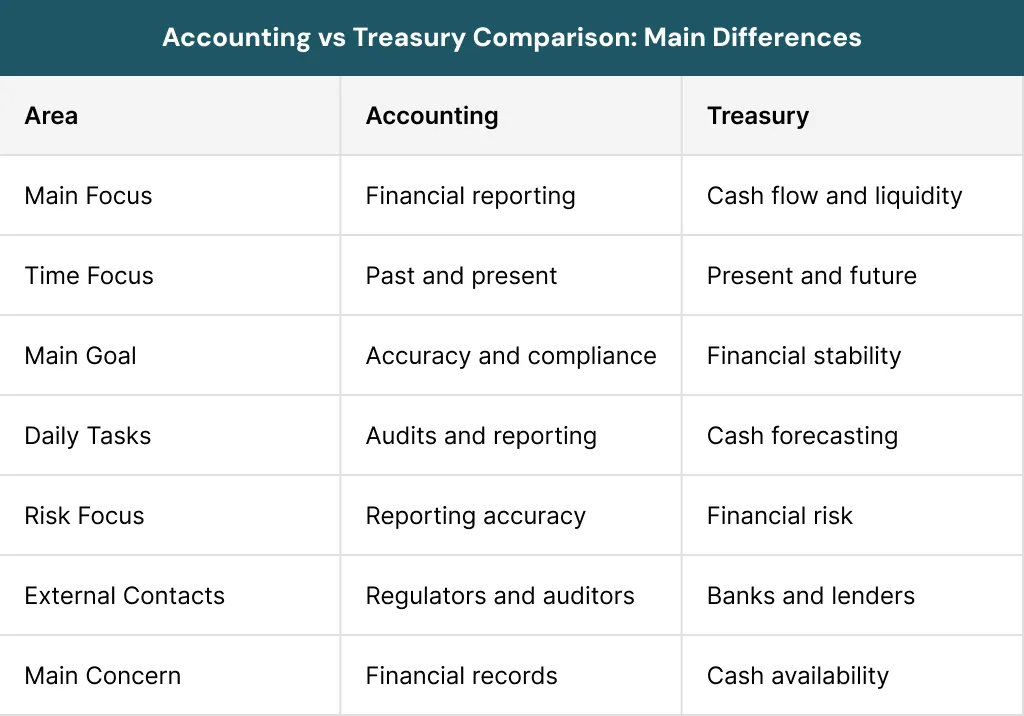
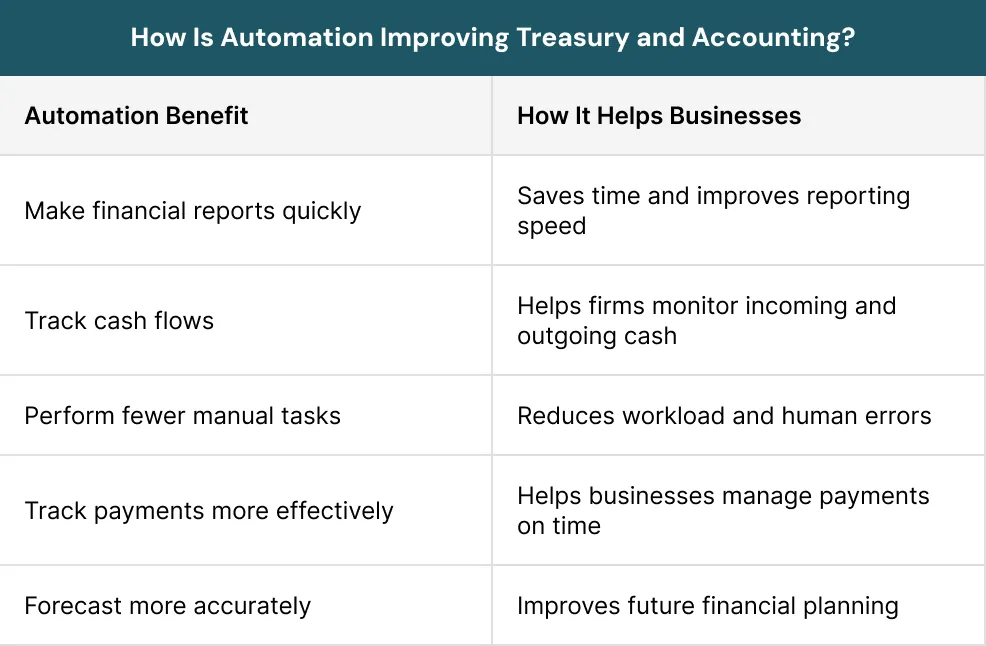
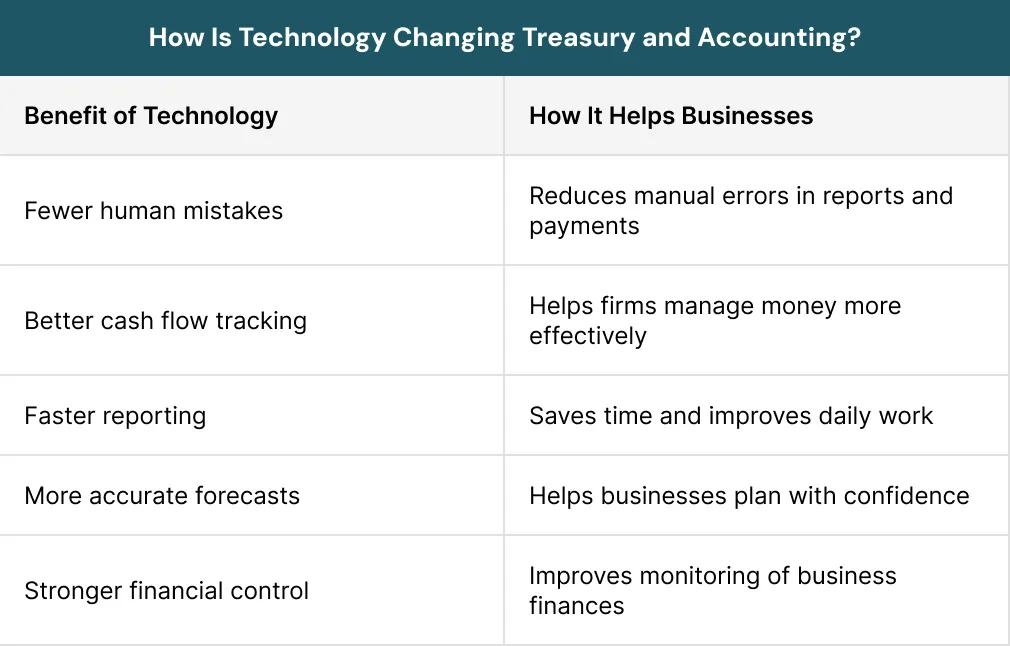
    What Is the Difference Between Treasury and Accounting?


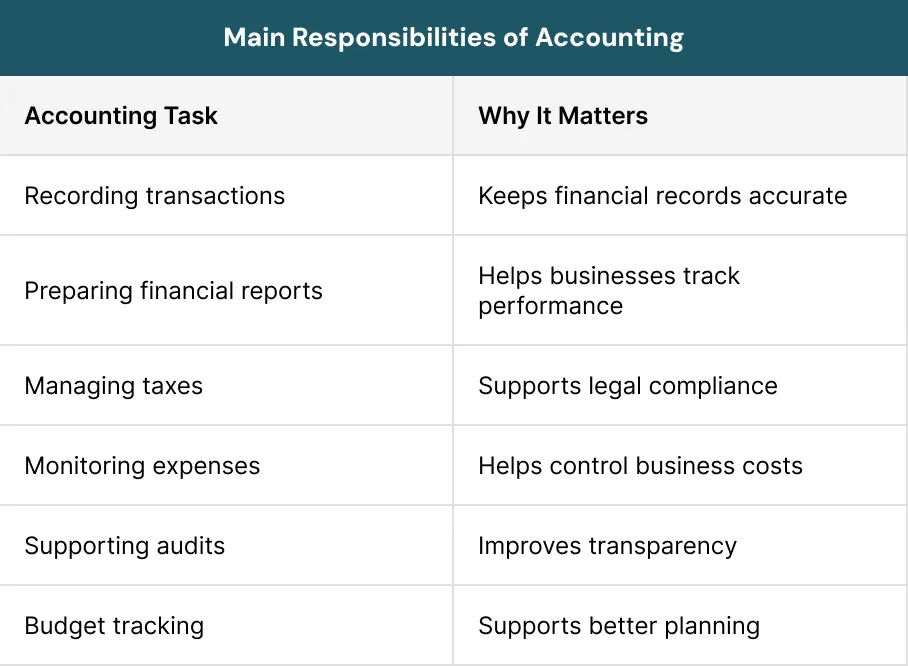
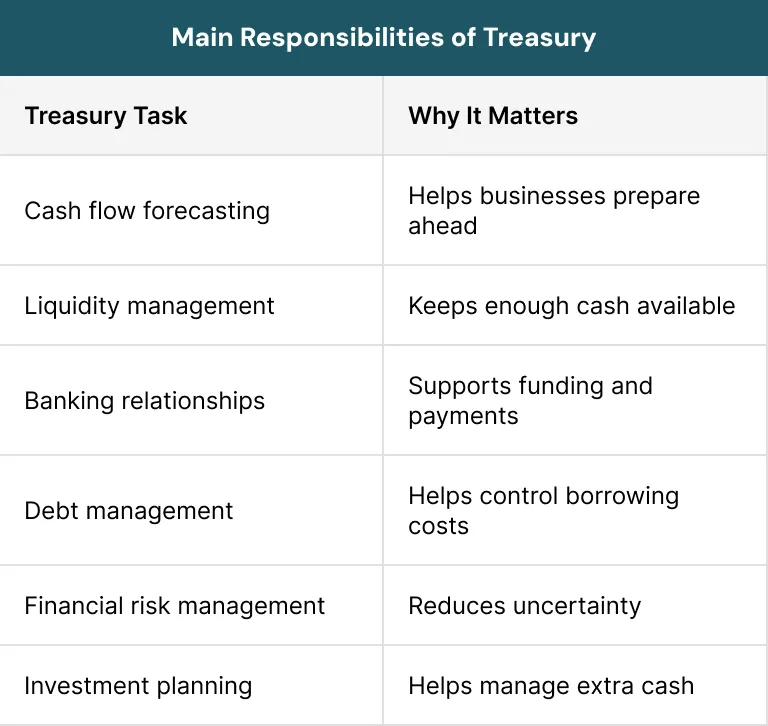
    The difference between treasury and accounting is their financial focus. Accounting manages reporting and compliance, while treasury focuses on cash flow, liquidity, and financial risk.


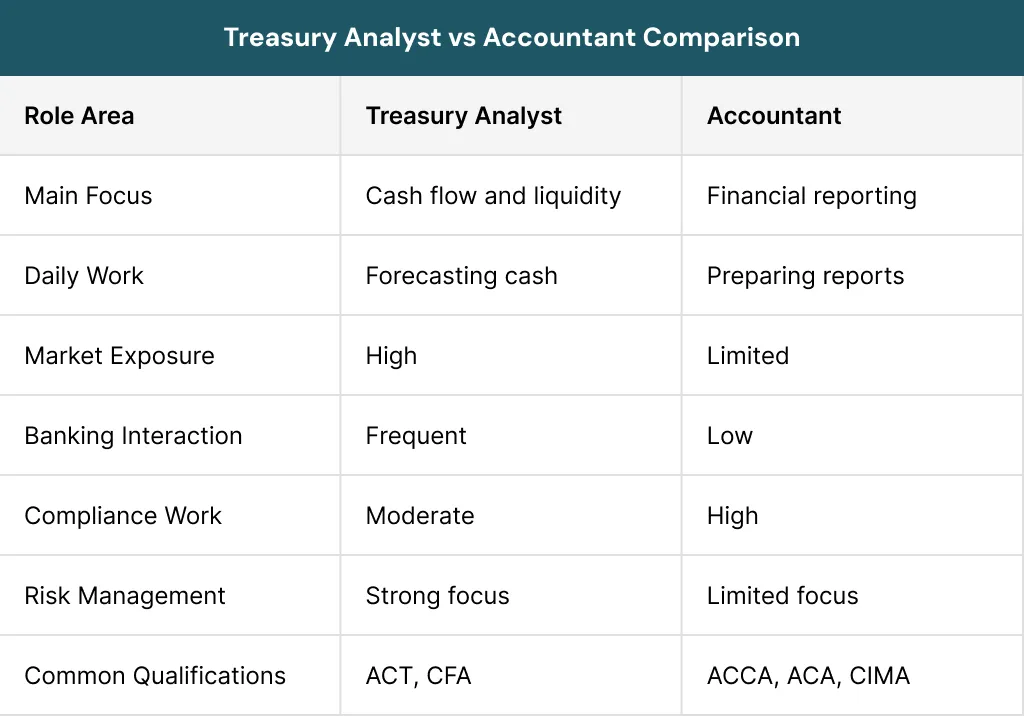
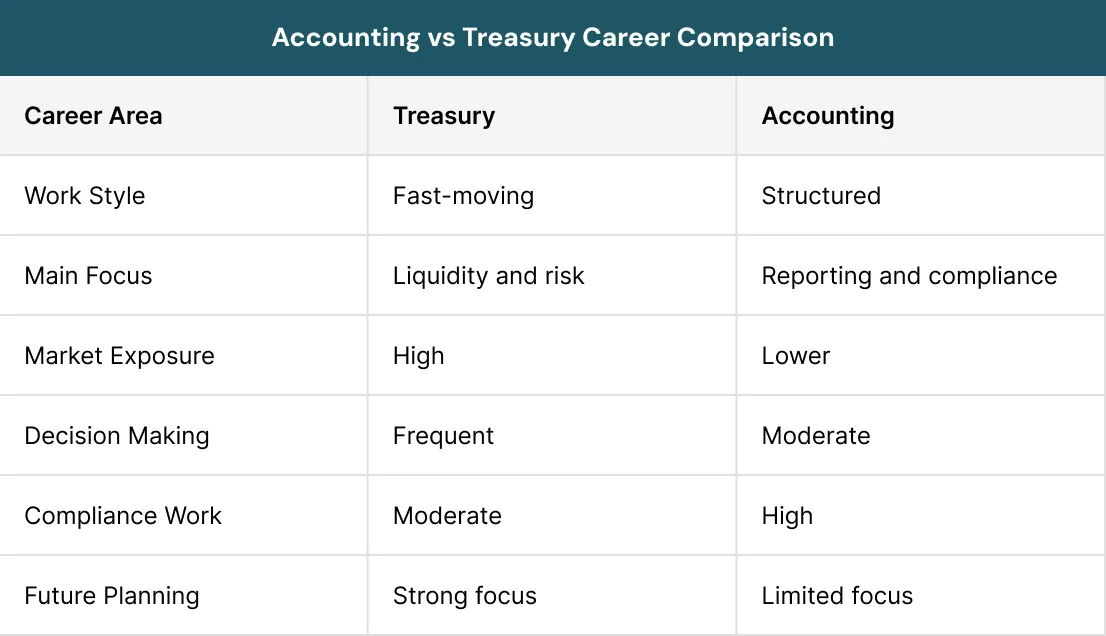
    It depends on your interests. Treasury analysts focus more on forecasting and liquidity, while accountants focus more on reporting and compliance.


    Treasury and accounts payable teams work together to manage supplier payments and maintain healthy cash flow across the business.


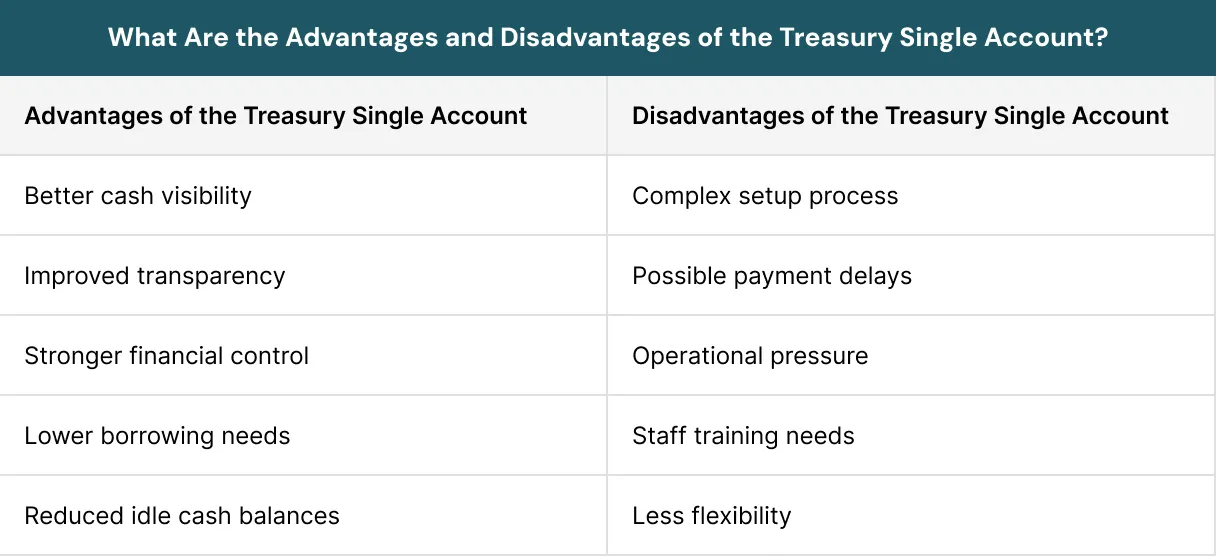
    The advantages and disadvantages of the treasury single account include stronger financial control and better visibility, but also possible operational delays and implementation challenges.


    Treasury helps businesses manage liquidity, improve cash flow, and reduce financial risk during uncertain market conditions.

    Share This Article!

    Recent Posts

  • Essential Insights into Accounting Practices for Sustainable Growth

    Essential Insights into Accounting Practices for Sustainable Growth

    Accounting Practices

    Posted by:

    Admin

    Date:

    May 29, 2026

    Category:

    blogs

    Error: Contact form not found.

    Essential Insights into Accounting Practices for Sustainable Growth

    Introduction

    Ever felt confused when looking at financial reports?

    Accounting can be confusing for you. But once you understand the basics it feels like a helpful tool.

    Understanding accounting practices is important for any business. It helps businesses to keep their financial records organised. 

    Whether you’re managing a small startup or handling multiple clients. Accounting practices help you have better control. When you break things into simple steps you should understand the technical issues in a better way.

    Research shows that in 2025 the global accounting services market is worth over 735 billion dollars.

    This guide is designed to make accounting simple and also easy to follow. In the end you will feel more confident in managing the finances.

    Key Takeaways

    • Accounting practices are essential for business success, they help track income, control expenses, and support better financial decisions.
    • Understanding the basics simplifies complex finance, once you know the core concepts, managing money becomes much easier.
    • Choosing the right accounting method matters, cash accounting suits small businesses, while accrual accounting gives a more accurate financial picture for growing companies.
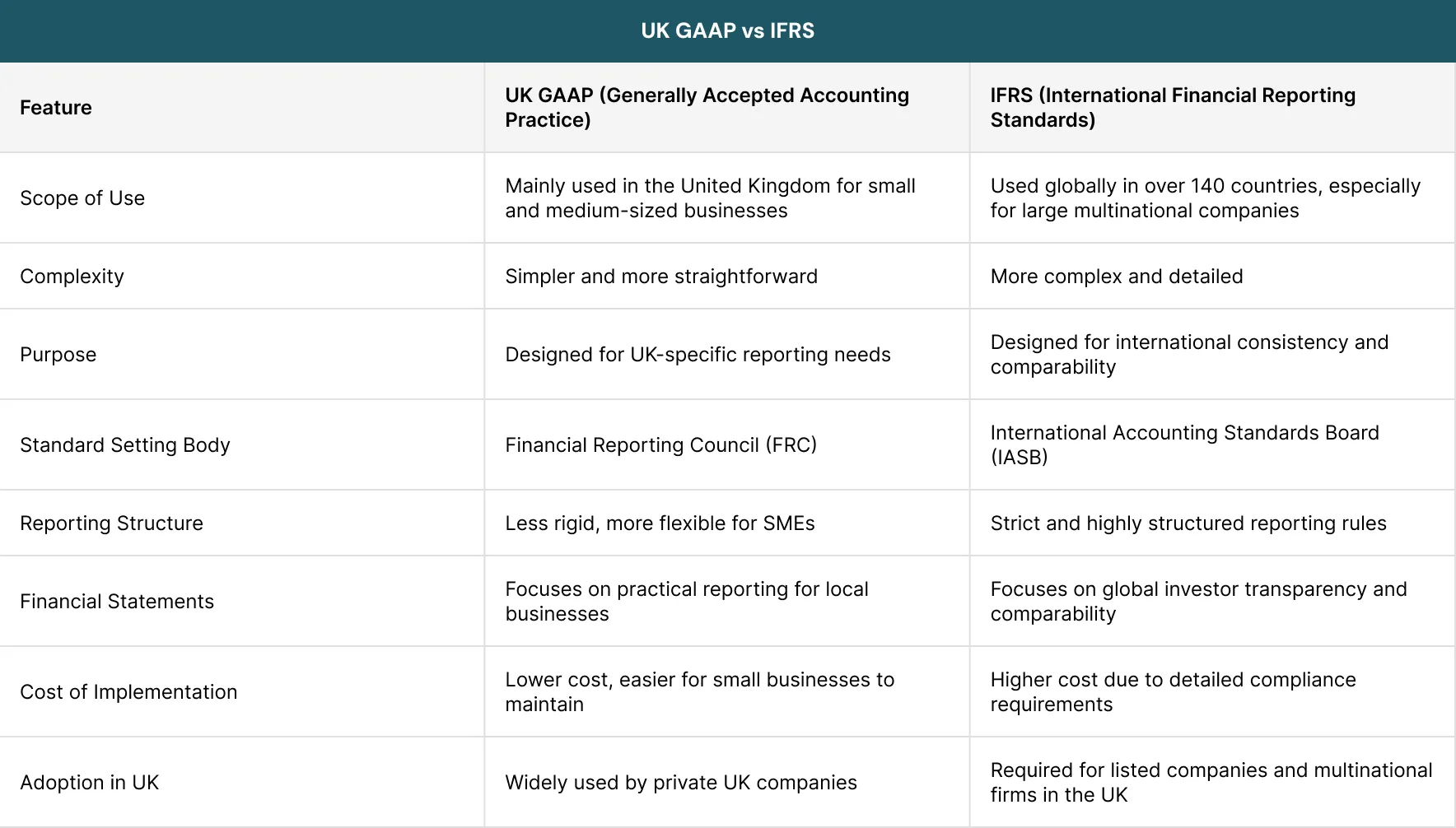
    • UK compliance is crucial, following GAAP, filing with HMRC, and meeting Companies House deadlines helps avoid penalties.
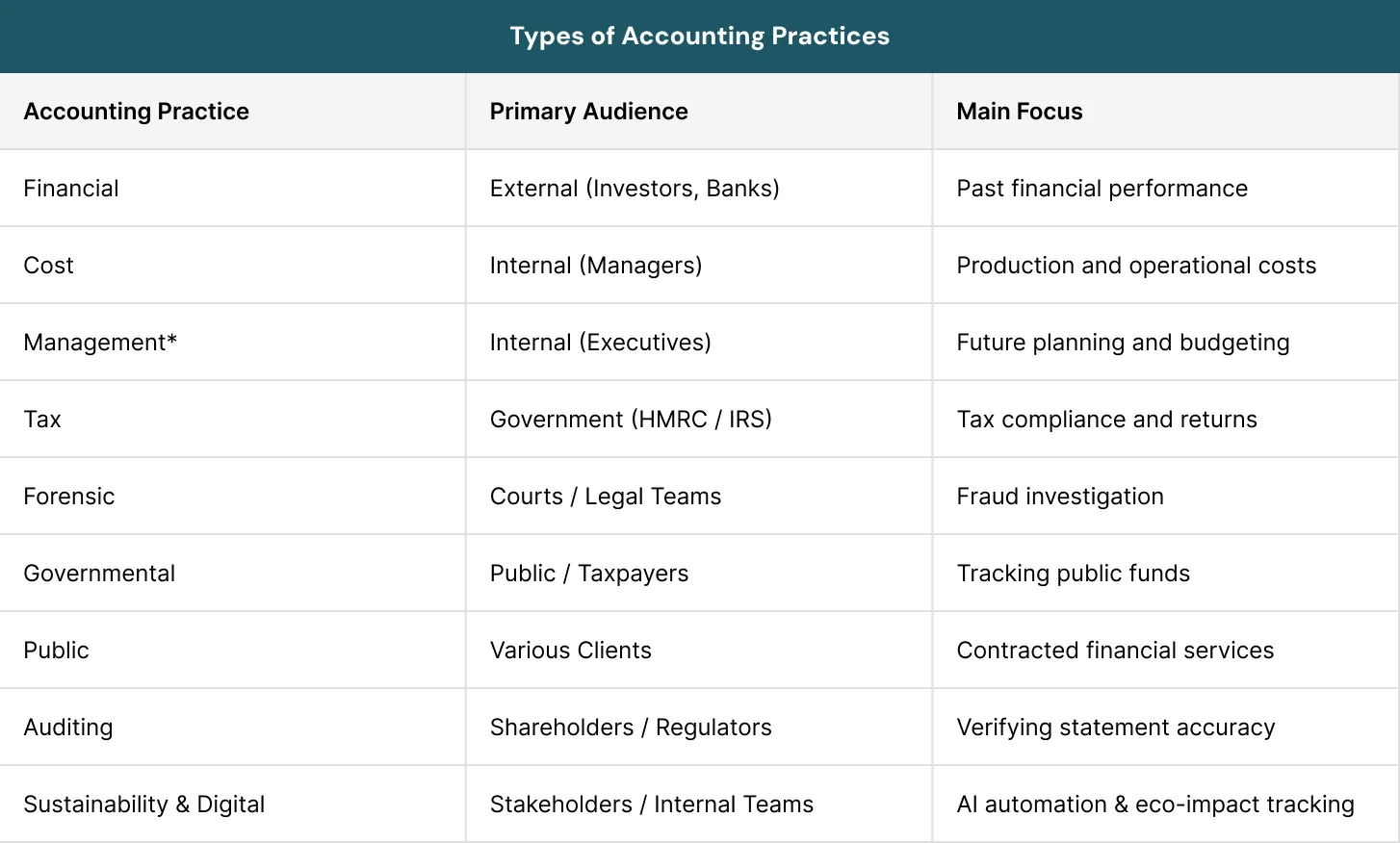
    • Different types of accounting serve different purposes, financial, tax, management, and forensic accounting all play unique roles in business operations.
    • Strong bookkeeping builds a solid foundation, accurate records, proper categorisation, and regular reviews prevent costly mistakes.
    • Efficient systems save time and reduce errors, using automation, clear processes, and structured workflows improves productivity.
    • Technology is transforming accounting, tools like Xero and QuickBooks help automate tasks and improve accuracy.
    • Payroll and tax compliance must not be ignored, managing PAYE, VAT, and CIS correctly is essential for UK businesses.
    • Avoiding common mistakes protects your business, poor record-keeping, missed deadlines, and mixing finances can lead to serious issues.
    • Modern accounting goes beyond numbers, it includes advisory services, data analysis, and strategic planning.
    • Outsourcing vs in-house depends on the business stage, small businesses often outsource, while larger ones may build internal teams.
    • Clear communication improves client relationships, transparency builds trust and long-term partnerships.
    • Data security is a growing priority, protecting financial information is essential in today’s digital world.
    • The future of accounting is digital and AI-driven, automation, cloud systems, and predictive analytics are shaping the industry.
    • Continuous learning keeps you competitive, staying updated with new tools and regulations ensures long-term success.

    What Are Accounting Practices?

    Accounting practices mean the process of organising, recording and reporting the financial records. It is helpful for businesses to track every pound they earn or spend.

    Businesses will face financial loss if they do not focus on the accountancy practice. In simple words it is the system that keeps financial information clear and well structured.

    It also ensures that the reports are accurate and also useful for the decision making process.

    Importance of Accounting Practices

    Good accounting practices can help businesses to understand their real financial position. This includes losses, profits and also cash flow.

    Well structured financial data will reduce the risk of loss. It also improves the stability in business. It is helpful for business owners that they have to plan ahead instead of guessing.

    Proper accounting is also required for tax and legal compliance in the UK.

    Importance of Accounting Practices in Financial Management

    GAAP and Its Role in Accounting

    GAAP stands for Generally Accepted Accounting Principles. The main role of GAAP is to ensure that a company’s financial statements are complete and consistent. It can allow the investors to analyze and extract useful information from financial statements.

    “Accounting is the language of business.”

    — Warren Buffett

    Accounting Practices Matter for Businesses and Accountants

    Accounting practices are the backbone of every successful business. Even profitable businesses can face losses without proper accounting.

    It helps to keep everything well organised and legally compliant. It builds trust and also helps to explain the financial health clearly for the accountants.

    It is also helpful for business owners that they can make better decisions every day.

    Methods of Accounting Practices

    Accounting methods are the rules which business uses to maintain the record of the revenue and expenses.

    1. Cash Accounting

    It helps to record the income and expenses when money is actually received or paid. Small businesses and freelancers use this method in the UK. Because it helps them to track real cash flow.

    2. Accrual Accounting

    Under accrual accounting, revenue is recorded when it is earned, not when it is received. This  method follows the matching principle, which links to the income with related costs.

    Larger businesses in the UK use this method. It helps in long-term financial planning.

    What is the Difference Between Cash and Accrual Accounting?

    The right method depends on your business size and its complexity. Small businesses often prefer cash accounting for simplicity. But on the other hand larger companies usually choose accrual accounting for accuracy. Because it provides better results for performance.

    The right choice can help in the process of reporting and decision-making. It also ensures compliance with UK financial rules.

    Difference Between Cash and Accrual Accounting

    Types of Accounting Practices

    There are 9 types of accounting practices which can help to improve your business.

    • Financial Accounting
    • Cost Accounting
    • Management Accounting
    • Tax Accounting
    • Forensic Accounting
    • Governmental Accounting
    • Public Accounting
    • Auditing
    • Sustainability and Digital Accounting

    Types of Accounting Practices

    Accounting Practices in the UK Context

    Accounting practices in the UK are governed by a robust framework. It is designed to ensure transparency and consistency of financial positions.

    What Does UK GAAP Mean?

    UK GAAP (Generally Accepted Accounting Practices) is a set of accounting rules which are used by the businesses in the UK.

    It helps to ensure that financial reports are consistent. Small businesses use this process to keep accounting simple.

    What are Key Financial Reporting Standards?

    FRS standards help to guide the companies on how they prepare their financial statements in the UK. Each standard applies to different types of business. For example, FRS 102 is mostly used by medium-sized companies.

    UK GAAP vs IFRS

    How to Ensure Compliance with UK GAAP?

    Compliance starts with keeping the record accurate because every transaction must be recorded properly.

    Regular reviews ensure that nothing is missed. This helps to reduce the errors. Many businesses also use software tools for compliance because this makes the process easier.

    Filing Requirements

    UK businesses must file the financial reports with HMRC and Companies House because these filings are legally required.

    To avoid fines you must have to follow the deadlines because late submissions lead to penalties.

    Proper filing helps to keep businesses in good standing. It also supports the accuracy of tax.

    Read more: 5 Ways Cloud Accounting Can Save You Time and Money

    Setting Up an Efficient Accounting Process

    Efficient accounting helps you to save time and reduce stress. It also improves the financial process.

    Efficiency also helps businesses to grow faster because it provides clear insights of finance.

    Key Components of an Efficient System

    A strong accounting system includes several key elements. These can help to maintain the accuracy.

    • Separate the personal and business finances.
    • Use a structured chart of accounts.
    • Perform regular reconciliations.
    • Use automation tools where possible.
    • Track all expenses consistently.

    Good Bookkeeping for Best Accounting Practices

    Good bookkeeping ensures that every financial transaction is recorded properly. It also helps businesses to stay organised and compliant with the rules of tax.

    1. Categorising the Income and Expenses

    This practice improves the overall financial process. Best categorisation makes the financial reports useful. It is also helpful for tax preparation.

    2. Managing Invoices and Receipts

    Invoices and receipts must be stored in a proper way. Because they are proof of every transaction. Proper management helps to avoid the missing documents during audits.

    3. Monitoring Cash Flow

    Cash flow shows how money is used in the business whether its expenses or profit. Regular monitoring helps to avoid the shortage of cash. Good cash flow helps to ensure the stability of business.

    4. Using Accounting Software

    Accounting software helps to reduce your manual work and errors. It also helps you to easily track the income, expenses and reports.

    In the present era software improves the accuracy and efficiency of the business.

    5. Management of Payroll

    Effective payroll management and compliance help to calculate the employee earnings and withholding taxes to prevent the penalties.

    Automated software for tax deductions and maintaining the detailed records are the key components of management of payroll.

    6. Payroll Software

    Payroll software helps to simplify the salary calculations. It reduces the risk of manual mistakes. It also helps to save time and improve the accuracy of your business.

    7. Registering with HMRC

    Businesses must have to register with HM Revenue and Customs (HMRC) to run payroll legally. In this process employers deduct the tax and National Insurance from the employees salaries.

    It is mandatory in the UK because it ensures that the employees pay correct taxes.

    8. National Insurance and Pensions

    National insurance and pensions are the legal requirements in the UK. In simple words it is the process where employers must have to contribute with National Insurance and pensions.

    How to Prepare Year-End Accounts?

    The end of the financial year is a time for any business or startups where they go through their financial performance.

    1. Closing the Books

    Closing the book is an important step for compliance. Because it finalises all the financial records of the year. It also ensures that all transactions must be recorded in the right way.

    2. Financial Statements

    Once the books are closed, now you can prepare the financial statements which show the health of business. It includes the profit, losses and assets.

    3. Filing Accounts with Companies House and HMRC

    Businesses must file their accounts with Companies House. They also file their Corporation Tax Return with HMRC.

    Companies House: Accounts must be filed within nine months after the company’s financial year ends.

    HMRC: The Corporation Tax Return is due for twelve months after the end of the accounting period. But the tax must be paid within nine months.

    What is VAT Registration?

    Value-Added Tax (VAT) is mandatory in the UK. It is a consumption tax which is placed on a product. Whenever value is added at each stage of the supply chain from production to sale.

    It is crucial for startups because it impacts the pricing, cash flow and tax compliance.

    1. How to File VAT Returns?

    Every three months, startups are required to submit their VAT returns to HMRC.

    This process involves reporting the amount of VAT charged to customers, the amount of VAT that has been paid while purchases and the net VAT payable to HMRC.

    Filing the VAT returns has become simple. Now they are filed digitally in the UK and this system is called Making Tax Digital.

    2. CIS Overview

    The Construction Industry Scheme (CIS) is a set of special tax rules for the construction sector of the UK. It involves deductions of tax from payments related to construction work which can affect the contractors and subcontractors.

    Accounting Practices That Damage Businesses

    In the accounting practices, common mistakes include mixing the personal and business finances.

    Another issue is that many businesses fail to keep their records organised. These mistakes can affect the finance of your business.

    How to Avoid Mistakes?

    Regular reviews of the balance sheet help to identify the problems early. This can help to prevent bigger issues.

    Once you identify the problems the next step is to correct those mistakes because it increases the accuracy of your business.

    Read more: Accounting Terms Made Easy: A Simple Guide for Non-Financial People

    Best Accounting Practices Every Small Business Should Follow

    Small businesses should always keep their personal and business finances separate. It helps to avoid confusion during the tax filing.

    Track the income, expenses and cash flow on a daily basis is also important. For this you can use accounting software which can help to save time, reduce errors and also improve the financial accuracy.

    1. Automation and AI

    Automation and AI help businesses to complete their tasks faster.They help to reduce the manual work and improve the overall efficiency of the business.

    These tools also help to track the expenses of the business and also organise financial data. This allows the accountants to focus on the planning and growth of the business.

    2. Data Security

    The modern accounting system helps to store important financial information. You can protect this information from cyber threats with the help of strong data security.

    If you want to reduce the security risks you should use secure passwords.

    3. Cloud-Based and Hybrid Accounting Software

    Cloud-based accounting software allows businesses to access the data from anywhere.

    While the Hybrid accounting software combines the cloud features with local storage for added security.

    Popular Tools

    To simplify the accounting tasks there are some popular tools which include Xero, QuickBooks and Silverfin.

    How to Scale Your Accounting Practices?

    If you want to scale your accounting practice then you have to start with improving efficiency and use the best technology. Regular training helps your practice to stay competitive.

    1. Select the Niche

    Select the niche which helps you stand out in a market because a clear niche builds trust. It also allows you to focus on a specific industry.

    2. Building a Strong Online Branding

    A strong online presence is very important in today’s digital world. It helps clients to find and trust you.

    Your website, social media accounts and content should be well organised. Because it attracts the right audience. 

    3. Build the Networking

    Build your strong network. It helps you to connect with other professionals. Building strong relationships leads to long-term business growth.

    What is the Future of Accounting Practices?

    The future of accounting practices is becoming more digital. AI will handle tasks like data entry and reporting. It makes accounting faster and more efficient.

    Cloud systems will become more common in accounting, making processes easier in the future.

    How Firms Can Stay Agile?

    Firms can stay agile by understanding the customer needs and market trends. Regular training can help the employees to improve their skills.

    Using modern tools also helps businesses to solve the challenges. Strong planning allows firms to stay competitive.

    Conclusion

    In the UK accounting practices are important for any business. From basic to advanced reporting every step plays a key role in your business.

    By following best accounting practices and using the modern tools businesses can improve their performance.

    At Sterling Cooper we know how important is accounting for your business. Our team is here to help you throughout the process.

    Don’t let confusing financial reports hold your business back.

    Contact us today to simplify your accounting, tax filings, and cash flow management so you can scale with confidence.
    +443300102526
    Book an Appointment

    FAQs


    What are the 4 practices of accounting?


    The 4 main practices of accounting are financial accounting, management accounting, cost accounting, and tax accounting. Each practice helps businesses manage finances, track performance, control costs, and stay compliant with tax regulations.


    Accounting plays an important role in sustainability by helping businesses track environmental, social, and financial performance. It supports better decision-making, improves transparency, and helps companies meet sustainability and ESG reporting goals.


    The 3 golden rules of accounting are: debit the receiver and credit the giver, debit what comes in and credit what goes out, and debit all expenses and losses while crediting all incomes and gains. These rules help businesses record financial transactions accurately.


    The five main importances of accounting are tracking business income and expenses, helping with financial decision-making, ensuring legal and tax compliance.


    The 5 main objectives of accounting are recording financial transactions, determining profit or loss, showing the financial position of a business, helping management make informed decisions, and ensuring compliance with legal and tax requirements.

    Share This Article!

    Recent Posts

  • Year End Accounting Checklist for UK Businesses

    Year End Accounting Checklist for UK Businesses

    year end accounting checklist

    Posted by:

    Admin

    Date:

    May 26, 2026

    Category:

    blogs

    Error: Contact form not found.

    Year End Accounting Checklist for UK Businesses

    Is your business ready for the financial year end or will last minute accounting tasks stress you out? A good year end accounting checklist helps UK businesses stay compliant, improve cash flow and prepare for smarter financial decisions.

    The end of the financial year is very busy for businesses in the United Kingdom. Many teams are working hard to meet their targets. They are also working on budgets and planning for the year ahead. Finance teams ensure all the financial records are accurate and up to date. They have to do tasks like reconcile accounts and prepare financial statements. These tasks are important because they help in compliance, tax reporting and planning for the business’s future.

    The process of year end accounting can be challenging for many businesses because they are missing invoices. There may be delayed approvals. They also have incorrect records and tight deadlines for filing. But if you have an organised year end accounting checklist, it can make the whole process a lot easier. It can improve accuracy and reduce the chance of making mistakes that will cost the business.

    The UK has over 5 million registered limited companies as per 2025 data, all of which must file annual accounts.

    When the year end comes around, the accounting process is not just about meeting the rules set by HMRC and Companies House. It also gives you an idea of cash flow, profitability and financial health of a company. If year end accounting is done properly, it helps you make decisions and you can start the new year with confidence.

    Key Takeaways

    • A structured year end accounting checklist helps UK businesses stay organised, avoid last minute stress and ensure full compliance with HMRC and Companies House requirements
    • Completing an accounting year end checklist early, especially reconciliations, accruals and payroll reviews. It reduces errors and improves financial accuracy
    • A complete year end accounts checklist UK includes bank reconciliation, accounts payable/receivable review, inventory checks, fixed asset updates and tax planning
    • An end of financial year accounting checklist ensures all income, expenses and adjustments are correctly recorded before preparing statutory reports
    • Accurate preparation of year end accounts supports better tax efficiency, audit readiness and improved business decision making
    • Regular reconciliation and documentation throughout the year make closing accounting faster, smoother and less error prone
    • Businesses that follow a disciplined year end process gain clearer financial visibility and stronger planning for the next accounting period

    What Is Year End Accounting?

    Year end accounting is the process of reviewing, reconciling, adjusting and finalising the financial records at the end of a company’s accounting year. The goal is to make sure all financial records are correct before preparing year end accounts and sending tax returns.

    The accounting year is a 12 months period for most limited companies in the UK. At the end of the year, companies check income and expenses, assets and liabilities, payroll records, inventory and tax liabilities.

    The process involves:

    • Reconciling bank accounts
    • Reviewing accounts payable and receivable
    • Accruals and prepayments recording
    • Depreciation calculation
    • Financial statements preparation
    • Reviewing tax liabilities
    • HMRC and Companies House reports filing

    Once the process is complete, businesses can prepare accurate year end reports. These include the balance sheet, profit and loss statement and cash flow statement.

    Key Year End Accounting Tasks for UK Businesses

    What Is the Importance of Year End Accounting in UK Businesses?

    Many business owners think of year end accounting as a legal requirement but it is more than that. A good year end close helps businesses know their finances better. It also reduces risks and helps them plan for future growth. Year end accounting helps to give a picture of a business’s financial health.

    1. Legal Compliance

    UK businesses must submit annual accounts and Corporation Tax returns before the set deadlines. There can be penalties, interest charges and other compliance issues if these deadlines are missed.

    Companies House usually asks for annual accounts within nine months after the end of the financial year. HMRC requires Corporation Tax payments within nine months and one day.

    Businesses can stay compliant and avoid unnecessary penalties by doing accurate year end accounting.

    In the 2025, around 297,682 late filing penalties were issued by Companies House for overdue annual accounts.

    2. Financial Accuracy

    The year end close helps make sure all financial records are correct and complete. Checking accounts help businesses identify missing transactions. They also help find duplicate entries, wrong journal records, unrecorded liabilities and unauthorised spending.

    Accurate records help businesses make decisions and improve their financial reporting.

    Good financial reporting is the backbone of sound decision making. – Sir David Tweedie, former Chairman of the International Accounting Standards Board (UK accountant)

    3. Tax Efficiency

    A proper year end review can help businesses find ways to save tax. Businesses may lower their corporation tax through capital allowances, pension payments, bad debt relief, stock write downs and allowed business costs.

    Tax savings can be improved by reviewing these areas before year end closing.

    4. Better Business Planning

    Year end reports provide valuable information about the performance of a business. Management teams can check on growth of sales, profits, cash flow, customers’ payment behaviour and escalation of business expenses.

    This information helps you forecast your budget and make plans for the future.

    Year End Filing Deadlines for Businesses in the UK

    Why Complete Year End Accounting Checklist is Required for UK Businesses?

    A year end accounting checklist helps businesses close their books accurately. It also helps them stay compliant and reduces last minute pressure with accounting. Preparing early with a year end accounting checklist makes the accounting process more efficient. It is also less stressful with an accounting checklist.

    1. Preparing Early for a Smooth Year End Close

    Successful year end accounting with a year end accounting checklist starts well before the closing date.

    Businesses that keep records organised during the year often have a smoother and less stressful year end process.

    Important steps include:

    • Monthly reconciliations
    • Tracking expenses regularly
    • Using cloud accounting software
    • Keeping digital records organised
    • Reviewing unpaid invoices during the year
    • Setting internal deadlines

    Creating a financial close schedule as part of a year end accounting checklist can also help teams manage tasks and avoid last minute problems.

    2. Create a Financial Close Schedule

    A well planned and easy to follow schedule really helps businesses keep track of important dates and avoid last minute stress. This schedule includes:

    • Important reporting deadlines
    • Filing deadlines of HMRC and Companies House
    • Internal review dates
    • Assigned responsibilities
    • Reconciliation timelines

    When it is time to complete the year end accounting, it becomes a lot easier if you break it down into smaller tasks. 

    3. Gather and Organise Financial Documents

    Businesses following a year end accounting checklist should have all of their financial records and supporting documents in one place before starting reconciliation. Important records include:

    • Bank statements
    • Credit card statements
    • Payroll reports
    • Supplier invoices
    • Expense receipts
    • Loan documents
    • Tax records
    • Sales reports
    • Inventory reports

    The digital copies of invoices should be kept safe and provided when needed. This is important for audit readiness and compliance. Businesses are required to keep records for at least six years as per HMRC.

    Key Challenges in Year End Accounting and How to Manage Them

    What Are the Common Challenges During Year End Accounting?

    Even organised businesses can struggle during year end close. Understanding common problems helps companies prepare more effectively.

    1. Manual Processes and Human Error

    Businesses that still use spreadsheets and enter data by hand often have problems with entries, mistakes in calculations, missing transactions and taking a long time to reconcile things.

    Small mistakes can cause problems when you are getting ready to make your financial statements and tax returns.

    2. Missing Documentation

    Finance teams often waste time looking for receipts, invoices from suppliers, expense claims and payroll details. This is usually because they do not have a system for managing documents. This slows down the closing accounting process and increases compliance risks.

    3. Tight Deadlines

    Year end accounting usually happens along with month end reports, tax work and other operational tasks. This can make it tough for finance teams to complete all the reconciliations and reviews on time.

    4. Poor Communication Between Departments

    Year end accounting requires input from HR, payroll teams, operations, procurement and department managers. Delays in receiving information can slow down the entire close process.

    5. High Transaction Volumes

    Businesses may handle thousands of transactions during the year. Checking every invoice, payment and expense can take a lot of time and attention.

    6. Audit and Compliance Pressure

    Businesses are required to keep their records organised and audit ready. They also meet the deadlines set by HMRC and Companies House.

    Quick Tip:

    Keeping digital receipts in real time can eliminate most year end document chasing.

    4. Reconcile Bank Accounts and Credit Cards

    A big part of any year end accounting checklist is bank reconciliation. Businesses should compare:

    • Bank statements
    • Credit card records
    • Accounting software balances
    • General ledger transactions

    The goal is to make sure that every transaction recorded internally matches actual financial activity. Some of the common issues are incorrect amounts, duplicate entries, unauthorised transactions, missing payments and timing differences.

    You Should Know:

    Even small mismatches in bank reconciliation can signal fraud or hidden expenses.

    You need to investigate any mistakes and fix them before finishing up your accounts. If you check your accounts regularly, it will make the year end process a lot easier.

    5. Review Accounts Receivable

    The money that customers have not paid yet is called accounts receivable. You must check the invoices that are still unpaid, the amounts that are overdue, payment history of a customer, aged debtors report and potential bad debts as part of year end accounting checklist.

    If you collect unpaid invoices before the year ends, you will have improved cash flow and financial reports will be more accurate. If you think some payments cannot be received, you need to record them as bad debts. This is all part of managing accounts receivable.

    6. Review Accounts Payable

    Accounts payable is the money that you have not paid yet to vendors and suppliers. Finance teams following a year end accounting checklist must:

    • Verify supplier invoices
    • Review unpaid bills
    • Record accrued expenses
    • Check for duplicate payments
    • Confirm liabilities are complete

    You have to record all the expenses for the accounting period even if you do not have the invoices yet. The accounts payable review is very important for businesses to avoid understating liabilities or overstating profits.

    7. Record Accruals and Prepayments

    Accruals and prepayments are an important part of a year end accounting checklist for making sure that you have recorded income and expenses in the right time frame.

    Understanding Accruals and Prepayments

    8. Conduct Inventory Reviews

    Businesses holding stock should complete a physical inventory count as part of their year end accounting checklist before closing the books. The process should include:

    • Counting physical stock
    • Identifying damaged inventory
    • Reviewing obsolete stock
    • Comparing stock records with accounting records

    The cost of goods sold (COGS), gross profit and tax calculations are directly affected by inventory. You should identify the mistakes in inventory, if any and make the necessary changes.

    The valuation methods of inventory should remain consistent throughout accounting periods.

    9. Review Fixed Assets and Depreciation

    Vehicles, equipment, computers, furniture and machinery that a business owns are called fixed assets. A year end accounting checklist should include reviewing the list of fixed assets and make sure:

    • New purchases are recorded correctly
    • Disposals are removed
    • Depreciation calculations are accurate

    Most companies use the straight line depreciation method. This method spreads the cost of assets evenly over the years that the asset is expected to be useful, which is the useful life of the asset. Depreciation adjustments affect:

    • Profitability
    • Balance sheet values
    • Corporation Tax calculations

    Businesses should also check their eligibility to claim capital allowances and the Annual Investment Allowance (AIA).

    10. Review Payroll and Employee Records

    Payroll is one of the most regulated areas in a year end accounting checklist. Businesses should review:

    • PAYE records
    • National Insurance contributions
    • Pension contributions
    • Bonuses and commissions
    • Holiday accruals
    • Employee benefits

    Payroll reports should match accounting records, HMRC RTI submissions and payroll journals. Any discrepancies should be corrected before finalising year end accounts.

    Important Insight:

    Payroll errors are one of the most common triggers for HMRC investigations in the UK.

    11. Categorise and Review Business Expenses

    A year end accounting checklist should include reviewing business expenses carefully to ensure accurate categorisation, consistent treatment and HMRC compliance. Finance teams should review:

    • Travel costs
    • Office expenses
    • Training costs
    • Professional fees
    • Home office expenses
    • Client entertainment

    Incorrect expense coding can distort profitability and increase tax risks.

    12. Post Adjusting Journal Entries

    A year end accounting checklist should include adjusting journal entries to ensure financial statements accurately reflect the company’s financial position. Common year end adjustments include:

    • Accrued expenses
    • Prepaid expenses
    • Depreciation
    • Inventory adjustments
    • Payroll liabilities
    • Bad debt write offs

    These entries help make sure that your income and expenses are written down in the right time period. You need to make journal entries so that your financial reports are accurate and ready for an audit.

    13. Prepare Financial Statements

    Once reconciliations and adjustments are complete, businesses can prepare year end accounts and financial reports.

    Financial Reports in Year End Accounting

    14. Conduct Financial Analysis

    A year end accounting checklist also provides an opportunity to review business performance in detail. Businesses should compare:

    • Current and previous year performance
    • Revenue trends
    • Profit margins
    • Expense growth
    • Cash flow changes
    • Debt levels

    Financial analysis is important for businesses and helps them identify operational inefficiencies. They can identify rising costs, weak cash flows and late customer payments.

    Financial analysis gives businesses these insights so they can plan effectively for the next financial year.

    15. Carry Out Tax Planning

    A year end accounting checklist should include reviewing the tax position carefully before finalising accounts. There are several ways businesses can reduce tax liabilities. These things include:

    • Bringing forward allowable expenses
    • Increasing pension contributions
    • Claiming capital allowances
    • Writing off obsolete inventory
    • Reviewing bad debts
    • Purchasing qualifying assets

    The eligibility of businesses should also be checked for:

    • Annual Investment Allowance (AIA)
    • Research and Development relief
    • Other available deductions

    Proper tax planning is essential for companies to reduce their Corporation Tax liabilities while following the rules set by HMRC.

    16. Backup and Secure Financial Records

    Once the year end accounting checklist is complete, businesses should securely store all financial records.

    Important records include:

    • Invoices
    • Receipts
    • Payroll reports
    • Tax returns
    • Financial statements
    • Supplier agreements
    • Bank statements

    Cloud backups help:

    • Protect against data loss
    • Improve accessibility
    • Support audit readiness
    • Enhance cybersecurity

    Having recordkeeping practices is a good idea because it makes future audits and financial reviews much easier to do.

    Case Study

    A UK telecom company called Lycamobile had financial troubles. They were unable to get their accounts approved because of tax and VAT problems. This led to an argument with HMRC about £51 million in VAT. Their year end accounts and financial statements were delayed. Auditors were worried about their records being accurate.

    The problem showed how not having clear yearly accounts can cause compliance issues. These issues include tax investigations and damage to a company’s reputation.

    Conclusion

    Year end accounting is crucial for all UK businesses, no matter how big or small they are. It is not just about closing your accounts or meeting HMRC and Companies House deadlines; it is about getting a clear and correct picture of your business finances. 

    If you do year end bookkeeping properly, it can help keep your business compliant, reduce penalties, increase tax efficiency and help you make smarter decisions for the next year. When it comes to tasks such as bank reconciliation, payroll, inventory and accruals, each one is crucial for keeping your records accurate and complete.

    The best businesses do not leave year end accounting until the last minute. They keep records organised during the year, use clear checklists and work with digital accounting tools. This makes the closing accounting process easier and reduces stress during the closing period.

    Finally, a seamless year end close provides you with not only compliant year end accounts, but clarity, confidence and a solid base for future growth.

    Sterling Cooper understands how stressful year end accounting can be for UK businesses, especially when deadlines, reconciliations and compliance requirements all come together at once. Contact us for expert support to ensure accurate, compliant and stress free financial close.

    Struggling to manage year end accounting deadlines and compliance stress?

    Sterling Cooper helps UK businesses streamline bookkeeping, reconciliations and year end reporting with expert accounting support. Contact us today to simplify your year end accounts.
    +443300102526
    Book an Appointment

    FAQs


    How to prepare year end accounts in the UK?

    To prepare year end accounts, businesses must reconcile bank accounts, review income and expenses, adjust accruals and prepayments and finalise payroll and tax records.
    They then prepare financial statements like the P&L, balance sheet and cash flow statement for HMRC and Companies House filing.

    The 7 pillars of accounting refer to key principles: prudence, consistency, accruals, going concern, materiality, relevance and reliability. These ensure financial statements are accurate, consistent and useful for decision making.

    The UK follows accounting standards known as UK GAAP (Generally Accepted Accounting Practice), mainly FRS 102 and FRS 105 for small entities. Some businesses may also use IFRS if they are listed or internationally active.

    UK businesses mainly use accrual accounting, where income and expenses are recorded when earned or incurred, not when cash is received or paid. Smaller businesses may sometimes use cash accounting for simpler tax reporting.

    The four main types are financial accounting, management accounting, cost accounting and tax accounting.
    Each focuses on reporting, internal decision making, cost control and tax compliance respectively.

    Share This Article!

    Recent Posts

  • National Living Wage Explained: How It Differs From The Minimum Wage

    National Living Wage Explained: How It Differs From The Minimum Wage

    national living wage

    Posted by:

    Admin

    Date:

    May 25, 2026

    Category:

    blogs

    Error: Contact form not found.

    National Living Wage Explained: How It Differs From The Minimum Wage

    Living in the UK, you might be one of those who believe that national living wage and minimum wage mean the same. Well most people think so but the reality might differ. On the surface, they do look very similar as both relate to minimum pay and both are set within the UK system. However, the gap between them becomes clearer once we study it in detail.

    Research data from the official sources show that millions of workers in the UK are affected by minimum wage legislation each year. At the same time wage growth has not always matched the rise in living costs. This creates pressure on both employees and employers.

    For many, it is not just a compliance topic. For professionals and business owners, It is more about cost planning, hiring decisions, and long term financial stability. The national living wage is central to this discussion yet the difference between living and minimum wage often remains vague.

    This guide explains the topic in a practical way. It explores how living wage and national living wage systems work. It will also examine where they differ and how those differences may affect real business decisions.

    Key Takeaways

    • The national living wage and minimum wage are not the same, even though they are often confused. One is based on legal requirements, while the other reflects real living costs, which creates a clear difference in purpose and impact.
    • The national living wage is mandatory for workers aged 21 and over, and businesses must follow it to remain compliant. Failure to do so can lead to penalties and reputational risk.
    • The real living wage is voluntary and usually higher, as it is based on actual cost of living. Many businesses adopt it to improve staff retention and support employee wellbeing.
    • Wage decisions are not just about compliance. They directly affect financial planning, staffing costs, and long term business stability, especially for small and growing businesses.
    • Even small increases in wage rates can lead to significant cost changes over time. This makes forward planning and regular budget reviews essential for businesses.
    • Payroll accuracy is critical. Common mistakes such as outdated wage rates or incorrect working hours can result in underpayment and legal consequences.
    • A strong wage strategy should include compliance, cost planning, and regular review. Businesses that plan ahead are better prepared for changes such as future national living wage increases.
    • Understanding the difference between living and minimum wage helps businesses make better decisions, not only to meet legal requirements but also to build a stable and motivated workforce.

    Wage Systems in the UK

    The wage system is built in layers. Apparently it may seem easy to follow but if we go into the details, the answers to ‘why’ and ‘how’ becomes much clearer. Given below is a detailed account of wage systems in the UK:

    Overview of Wage Structure:

    To get an overview of the wage system, we must know that it is divided into legal minimum wages and voluntary wage standards. The national living wage sits within the legal framework. It is set by the government and must be followed by employers. Thus, compliance no longer remains optional. 

    Other than this there is the concept of a living wage. This is not always required by law. Instead, it reflects what workers actually need to cover daily expenses such as housing, food, and transport.

    This is where the difference between living and minimum wage starts to become more visible. One is designed to protect workers from very low pay, while the other aims to reflect real life costs. In reality the businesses often operate somewhere between the two.

    History of Wage Policies:

    Wage regulation in the UK has evolved gradually. National Minimum Wage came up in 1999. The primary aim at that time was to avoid exploitation and make certain that the workers earned a decent income.

    Over time it became apparent that this minimum level could not always be sufficient in order to represent the modern costs of living. This has led to the introduction of the national living wage in 2016. This was a great change. It established a higher wage rate among the older workers. It sought to align wages more towards a fair standard.

    Rates have been reviewed since then on an annual basis. Such updates capture the evolution of the economy such as the inflation and labour market conditions. In the case of businesses, this implies that wage planning cannot be constant. It must be regularly reviewed.

    Role of Different Wage Types:

    Every type serves its own role.The national living wage is adjusted in such a way that employees are given a legally guaranteed wage. It supports fairness. The living wage on the other hand focuses on quality of life. Its purpose is to make sure that employees are not forced to strain their budgets to afford the cost of living.

    This distinction is significant. It reveals that the system is not merely regarding rules but rather real life conditions. Being aware of this difference will assist employers to make better decisions. It puts into perspective the disparity between living and minimum wage in a manner that resonates with compliance and business strategy.

    What Is the National Living Wage?

    To gain an idea of how the system is working in practice it is vital to take a closer look at the national living wage itself:

    1. Definition

    The national living wage is the minimum wage in UK law which is paid to workers aged 21 and above. The government sets it and all employers have to abide by it. This implies that it is not an option. Penalties may be imposed due to the failure to pay the right rate. The rate is re-examined every year and it tends to rise with time. This renders it a critical aspect in payroll planning.

    2. Who Must Be Paid?

    The rule applies to a wide range of workers. This includes full time employees, part time staff, and agency workers. In most cases if a worker meets the age requirement then they must be paid at least the national living wage.

    There are some exceptions, such as apprentices or younger workers who fall under different wage bands. For employers this means careful classification is important. Misclassification can lead to errors in pay.

    3. How the Rate Is Decided?

    The rate is not chosen randomly. It is based on recommendations from the Low Pay Commission.

    This group reviews economic data such as:

    • Average earnings
    • Employment levels
    • Business costs

    Their goal is to balance worker welfare with business sustainability. This is an important point. The national living wage is not only about increasing pay. It is also about maintaining economic balance.

    Read more: A comprehensive guide to payroll management. 

    What Is the National Minimum Wage?

    To complete the picture it is necessary to look at the National Minimum Wage as well. The minimum wage applies to workers below the age threshold for the national living wage, as well as apprentices. Different age groups have different rates. This creates a structured system where pay increases as workers gain more experience.

    This approach supports entry into the workforce. It allows younger workers to gain skills while still receiving fair pay. It also explains part of the difference between living and minimum wage. The minimum wage focuses more on progression, while the national living wage focuses on stability.

    What Is the Real Living Wage?

    Beyond legal requirements, there is another important concept i-e the real living wage. It is based on the actual cost of living. While calculated by independent institutes, it shows the real costs such as food, rent and transport. That is why it is mostly higher than the national living wage.

    Employers are not needed to pay it but many still do. This can improve staff satisfaction and reduce turnover. It also shows the gap between legal minimums and real living standards. This is actually central to the difference between living and minimum wage.

    Difference Between Living Wage and Minimum Wage

    A comparison of both types of wages help to understand them better. It is shown as follows: 

    1. Legal Requirement:

    The national living wage and minimum wage are required by law but the living wage is voluntary.

    2. Calculation Method:

    Government wages are based on economic data while living wage rates are based on real life costs.

    3. Coverage:

    The national living wage applies to workers aged 21 and over but the minimum wage covers younger workers.

    4. Financial Impact:

    Higher wages increase costs but may improve employee retention. Here the living wage and national living wage decisions become strategic.

    Comparison Table

    Why Does the Difference Matters for Businesses?

    Getting the wage differences is not only theoretical. It affects daily operations. The national living wage sets the minimum cost of labour. This directly affects payroll budgets. At the same time, some businesses choose to pay more. This is often done to improve staff retention.

    For example, a retail business with high turnover may benefit from slightly higher wages. Over time, this reduces hiring costs. This shows how the difference between living and minimum wage affects real decisions.

    Impact on Financial Planning

    Wages are one of the largest costs for many businesses. Even small changes in the national living wage can increase total expenses significantly.

    For example, if a business employs 15 workers, a £1 increase per hour can lead to thousands in additional yearly cost. This is why planning is essential.

    Businesses need to consider:

    • Current wage levels
    • Expected increases
    • Staff numbers

    This is where accountants add real value.

    Payroll Compliance and Risk

    Wages are not only about paying staff on time. It is also about making sure everything is correct. Even small mistakes can cause bigger problems. To make this easier to understand, let’s look at the main risk areas.

    1. Payroll Errors
      A common issue is not updating wage rates when the national living wage changes. This often happens when systems are not checked regularly or updates are missed during busy times.

    Another issue is getting working hours wrong. For example, unpaid time like training or travel can still count as working hours in some cases. If this is not included, the hourly pay may fall below the legal minimum. These may seem like small mistakes, but they can still lead to underpayment.

    1. Enforcement
      The national living wage is enforced by HMRC. If a business does not follow the rules, it may face financial penalties. In some cases, employers may need to pay workers back for past underpayments. There is also a risk of being publicly named, which can harm the business’s reputation. So, it is not only a legal issue. It also affects how the business is viewed.
    2. Importance of Regular Audits
      Regular payroll checks can help avoid most of the problems. Even a basic internal check can catch issues early. This can include checking wage rates, reviewing employee categories and confirming working hours.

    For growing businesses, using an external accounting team can help. It adds extra accuracy and lowers the risk of mistakes.

    Simplify payroll and HR management with expert support.

    Employers’ Legal Duties

    Avoiding mistakes is only part of the job. Employers also have clear duties when it comes to wages. These form the basis of fair payroll practices.

    1. Keeping Payroll Accurate

    Payroll systems should always use the correct national living wage. This means updating them regularly mainly after yearly changes. Using old figures can quickly cause problems.

    1. Recording Working Hours

    Accurate time tracking is important. Employers need to make sure all working hours are recorded properly. This includes overtime, training, and extra duties. Without clear records, it becomes harder to show that everything is correct.

    1. Checking Worker Status

    Each worker should be placed in the right category. Age, role, and contract type all affect which wage applies. Even a small mistake here can lead to incorrect pay. This is where understanding the difference between living wage and minimum wage helps.

    1. Maintaining Records

    Employers must keep detailed payroll records. These may be checked during audits. Clear records make it easier to show that the right wages have been paid.

    How Does it Impact Different Sectors?

    Not all industries are affected in the same way. Some feel the impact more than others.

    Retail and Hospitality

    These sectors often rely on many hourly paid workers. Due to this, wage increases can quickly raise costs. Businesses may need to increase prices or adjust working hours.

    Small Businesses

    Smaller businesses usually have tighter budgets. Even a small wage increase can create pressure. This may lead to careful hiring or slower growth.

    Professional Services

    The impact here is usually lower. However, support staff and entry-level roles are still affected. Over time, this can change overall costs incurred.

    Get insights into How will the National Minimum Wage rise impact SMEs?

    How to Build a Strong Wage Strategy?

    A clear wage plan helps businesses stay compliant and manage costs better. It is always better to plan ahead rather than react later.

    1. Ensure Legal Compliance
      Start by meeting all national living wage rules. This is the most important step. If you comply well, you already half way to success.
    2. Review Financial Position
      Look closely at your finances, including cash flow, profit margins, and payroll costs. This helps you prepare for future changes.
    3. Consider Living Wage Adoption
      Some businesses choose to pay more than the minimum. This depends on what they can afford. It can also help improve the staff retention and morale.
    4. Plan for Future Changes
      Wage rates change often. Keeping up with updates helps avoid sudden pressure on finances.
    5. Monitor and Adjust
      A wage plan should be reviewed regularly. This helps keep it useful as the business grows.

    Mistakes to Avoid While Setting Wages

    Even experienced businesses can make mistakes with wages. These are often small but can still cause problems over time.

    • One issue is ignoring updates. If wage rates change and payroll is not updated, underpayment can happen.
    • Another issue is confusion between wage types. Not understanding the difference between living wage and minimum wage can lead to wrong decisions.
    • Poor record-keeping can also create problems during audits. Without clear records, it is hard to show compliance.
    • Not planning ahead can also be risky. Sudden cost increases can affect cash flow if they are not expected.

    To avoid these issues, it is important to stay aware and check things regularly.

    What The Future Holds

    By now we know that wage policy continues to evolve. To keep up with the trends of the future, businesses must be mindful of them:

    • The growing interest is on the increase of wages to the level of living. This implies that the national living wage is bound to increase with time.
    • Fairness and income equality are also becoming a topic of conversation. This can impact future policy.
    • In the case of businesses, this implies that wage planning should be flexible. These changes are necessary to be adapted to in the long term.

    Conclusion

    Deciding wages is not a simple task now. It needs a clear understanding of rules, costs, and long term impact. The minimum wage is the legal minimum wage set on a national scale. Nevertheless, the actual business decisions are even more. Proper planning is needed to make sure that there is adherence to financial stability.

    Sterling Cooper Consultants is an accounting and financial consultancy firm that offers assistance to businesses. They have you covered, whether you need payroll compliance, or cost planning. Contact us to develop a perfect wage strategy in your business and get the most out of it.

    Get in touch with Sterling Cooper Consultants today.

    Build a wage strategy that supports both compliance and growth.
    +443300102526
    Book an Appointment

    FAQs


    What is a national living wage?


    The national living wage is the legal minimum hourly pay set by the UK government for workers aged 21 and over. It is updated each year based on economic conditions. Employers must follow this rate to remain compliant with wage laws.


    The difference between living and minimum wage is that one is legally required while the other is based on real living costs. The living wage is usually higher and voluntary. Both serve different purposes within the wage system.

    The exact figure for what is the national living wage 2025 has not yet been confirmed. However, it is expected to increase due to inflation and rising living costs. Businesses should prepare for this by reviewing their budgets early.


    Paying a living wage is not required by law. Employers must pay at least the national living wage where applicable. Some businesses choose to pay more to improve employee satisfaction and retention.


    Many businesses pay above the national living wage to attract skilled workers and reduce staff turnover. Higher wages can improve morale and productivity. Over time, this may support better business performance

    Share This Article!

    Recent Posts