Category: blogs

  • National Living Wage Explained: How It Differs From The Minimum Wage

    National Living Wage Explained: How It Differs From The Minimum Wage

    national living wage

    Posted by:

    Admin

    Date:

    May 25, 2026

    Category:

    blogs

    Error: Contact form not found.

    National Living Wage Explained: How It Differs From The Minimum Wage

    Living in the UK, you might be one of those who believe that national living wage and minimum wage mean the same. Well most people think so but the reality might differ. On the surface, they do look very similar as both relate to minimum pay and both are set within the UK system. However, the gap between them becomes clearer once we study it in detail.

    Research data from the official sources show that millions of workers in the UK are affected by minimum wage legislation each year. At the same time wage growth has not always matched the rise in living costs. This creates pressure on both employees and employers.

    For many, it is not just a compliance topic. For professionals and business owners, It is more about cost planning, hiring decisions, and long term financial stability. The national living wage is central to this discussion yet the difference between living and minimum wage often remains vague.

    This guide explains the topic in a practical way. It explores how living wage and national living wage systems work. It will also examine where they differ and how those differences may affect real business decisions.

    Key Takeaways

    • The national living wage and minimum wage are not the same, even though they are often confused. One is based on legal requirements, while the other reflects real living costs, which creates a clear difference in purpose and impact.
    • The national living wage is mandatory for workers aged 21 and over, and businesses must follow it to remain compliant. Failure to do so can lead to penalties and reputational risk.
    • The real living wage is voluntary and usually higher, as it is based on actual cost of living. Many businesses adopt it to improve staff retention and support employee wellbeing.
    • Wage decisions are not just about compliance. They directly affect financial planning, staffing costs, and long term business stability, especially for small and growing businesses.
    • Even small increases in wage rates can lead to significant cost changes over time. This makes forward planning and regular budget reviews essential for businesses.
    • Payroll accuracy is critical. Common mistakes such as outdated wage rates or incorrect working hours can result in underpayment and legal consequences.
    • A strong wage strategy should include compliance, cost planning, and regular review. Businesses that plan ahead are better prepared for changes such as future national living wage increases.
    • Understanding the difference between living and minimum wage helps businesses make better decisions, not only to meet legal requirements but also to build a stable and motivated workforce.

    Wage Systems in the UK

    The wage system is built in layers. Apparently it may seem easy to follow but if we go into the details, the answers to ‘why’ and ‘how’ becomes much clearer. Given below is a detailed account of wage systems in the UK:

    Overview of Wage Structure:

    To get an overview of the wage system, we must know that it is divided into legal minimum wages and voluntary wage standards. The national living wage sits within the legal framework. It is set by the government and must be followed by employers. Thus, compliance no longer remains optional. 

    Other than this there is the concept of a living wage. This is not always required by law. Instead, it reflects what workers actually need to cover daily expenses such as housing, food, and transport.

    This is where the difference between living and minimum wage starts to become more visible. One is designed to protect workers from very low pay, while the other aims to reflect real life costs. In reality the businesses often operate somewhere between the two.

    History of Wage Policies:

    Wage regulation in the UK has evolved gradually. National Minimum Wage came up in 1999. The primary aim at that time was to avoid exploitation and make certain that the workers earned a decent income.

    Over time it became apparent that this minimum level could not always be sufficient in order to represent the modern costs of living. This has led to the introduction of the national living wage in 2016. This was a great change. It established a higher wage rate among the older workers. It sought to align wages more towards a fair standard.

    Rates have been reviewed since then on an annual basis. Such updates capture the evolution of the economy such as the inflation and labour market conditions. In the case of businesses, this implies that wage planning cannot be constant. It must be regularly reviewed.

    Role of Different Wage Types:

    Every type serves its own role.The national living wage is adjusted in such a way that employees are given a legally guaranteed wage. It supports fairness. The living wage on the other hand focuses on quality of life. Its purpose is to make sure that employees are not forced to strain their budgets to afford the cost of living.

    This distinction is significant. It reveals that the system is not merely regarding rules but rather real life conditions. Being aware of this difference will assist employers to make better decisions. It puts into perspective the disparity between living and minimum wage in a manner that resonates with compliance and business strategy.

    What Is the National Living Wage?

    To gain an idea of how the system is working in practice it is vital to take a closer look at the national living wage itself:

    1. Definition

    The national living wage is the minimum wage in UK law which is paid to workers aged 21 and above. The government sets it and all employers have to abide by it. This implies that it is not an option. Penalties may be imposed due to the failure to pay the right rate. The rate is re-examined every year and it tends to rise with time. This renders it a critical aspect in payroll planning.

    2. Who Must Be Paid?

    The rule applies to a wide range of workers. This includes full time employees, part time staff, and agency workers. In most cases if a worker meets the age requirement then they must be paid at least the national living wage.

    There are some exceptions, such as apprentices or younger workers who fall under different wage bands. For employers this means careful classification is important. Misclassification can lead to errors in pay.

    3. How the Rate Is Decided?

    The rate is not chosen randomly. It is based on recommendations from the Low Pay Commission.

    This group reviews economic data such as:

    • Average earnings
    • Employment levels
    • Business costs

    Their goal is to balance worker welfare with business sustainability. This is an important point. The national living wage is not only about increasing pay. It is also about maintaining economic balance.

    Read more: A comprehensive guide to payroll management. 

    What Is the National Minimum Wage?

    To complete the picture it is necessary to look at the National Minimum Wage as well. The minimum wage applies to workers below the age threshold for the national living wage, as well as apprentices. Different age groups have different rates. This creates a structured system where pay increases as workers gain more experience.

    This approach supports entry into the workforce. It allows younger workers to gain skills while still receiving fair pay. It also explains part of the difference between living and minimum wage. The minimum wage focuses more on progression, while the national living wage focuses on stability.

    What Is the Real Living Wage?

    Beyond legal requirements, there is another important concept i-e the real living wage. It is based on the actual cost of living. While calculated by independent institutes, it shows the real costs such as food, rent and transport. That is why it is mostly higher than the national living wage.

    Employers are not needed to pay it but many still do. This can improve staff satisfaction and reduce turnover. It also shows the gap between legal minimums and real living standards. This is actually central to the difference between living and minimum wage.

    Difference Between Living Wage and Minimum Wage

    A comparison of both types of wages help to understand them better. It is shown as follows: 

    1. Legal Requirement:

    The national living wage and minimum wage are required by law but the living wage is voluntary.

    2. Calculation Method:

    Government wages are based on economic data while living wage rates are based on real life costs.

    3. Coverage:

    The national living wage applies to workers aged 21 and over but the minimum wage covers younger workers.

    4. Financial Impact:

    Higher wages increase costs but may improve employee retention. Here the living wage and national living wage decisions become strategic.
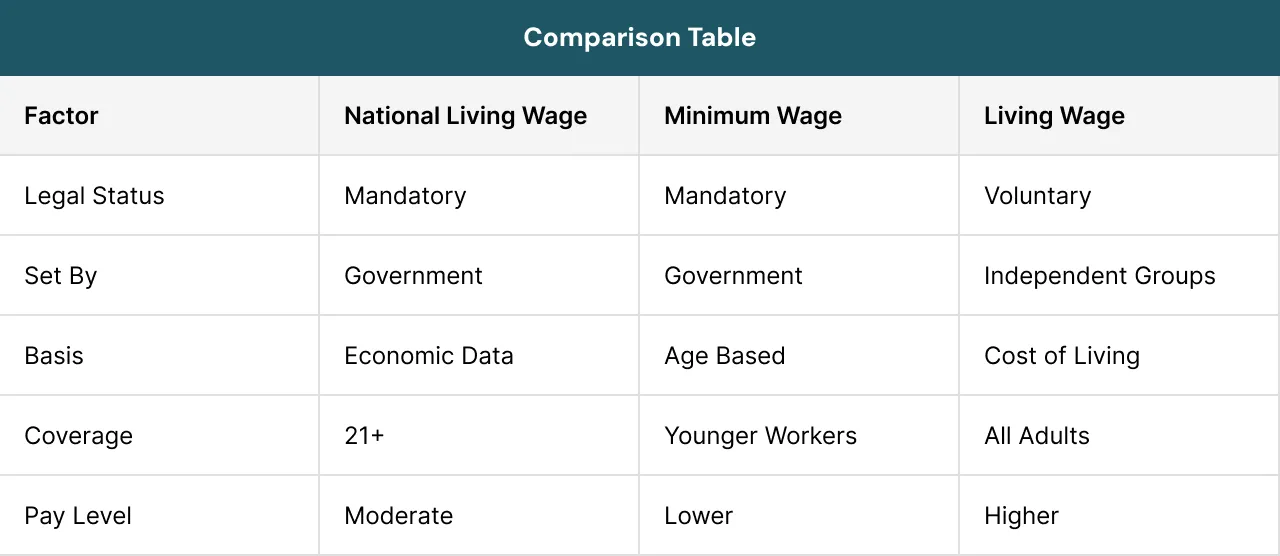
    Comparison Table

    Why Does the Difference Matters for Businesses?

    Getting the wage differences is not only theoretical. It affects daily operations. The national living wage sets the minimum cost of labour. This directly affects payroll budgets. At the same time, some businesses choose to pay more. This is often done to improve staff retention.

    For example, a retail business with high turnover may benefit from slightly higher wages. Over time, this reduces hiring costs. This shows how the difference between living and minimum wage affects real decisions.

    Impact on Financial Planning

    Wages are one of the largest costs for many businesses. Even small changes in the national living wage can increase total expenses significantly.

    For example, if a business employs 15 workers, a £1 increase per hour can lead to thousands in additional yearly cost. This is why planning is essential.

    Businesses need to consider:

    • Current wage levels
    • Expected increases
    • Staff numbers

    This is where accountants add real value.

    Payroll Compliance and Risk

    Wages are not only about paying staff on time. It is also about making sure everything is correct. Even small mistakes can cause bigger problems. To make this easier to understand, let’s look at the main risk areas.

    1. Payroll Errors
      A common issue is not updating wage rates when the national living wage changes. This often happens when systems are not checked regularly or updates are missed during busy times.

    Another issue is getting working hours wrong. For example, unpaid time like training or travel can still count as working hours in some cases. If this is not included, the hourly pay may fall below the legal minimum. These may seem like small mistakes, but they can still lead to underpayment.

    1. Enforcement
      The national living wage is enforced by HMRC. If a business does not follow the rules, it may face financial penalties. In some cases, employers may need to pay workers back for past underpayments. There is also a risk of being publicly named, which can harm the business’s reputation. So, it is not only a legal issue. It also affects how the business is viewed.
    2. Importance of Regular Audits
      Regular payroll checks can help avoid most of the problems. Even a basic internal check can catch issues early. This can include checking wage rates, reviewing employee categories and confirming working hours.

    For growing businesses, using an external accounting team can help. It adds extra accuracy and lowers the risk of mistakes.

    Simplify payroll and HR management with expert support.

    Employers’ Legal Duties

    Avoiding mistakes is only part of the job. Employers also have clear duties when it comes to wages. These form the basis of fair payroll practices.

    1. Keeping Payroll Accurate

    Payroll systems should always use the correct national living wage. This means updating them regularly mainly after yearly changes. Using old figures can quickly cause problems.

    1. Recording Working Hours

    Accurate time tracking is important. Employers need to make sure all working hours are recorded properly. This includes overtime, training, and extra duties. Without clear records, it becomes harder to show that everything is correct.

    1. Checking Worker Status

    Each worker should be placed in the right category. Age, role, and contract type all affect which wage applies. Even a small mistake here can lead to incorrect pay. This is where understanding the difference between living wage and minimum wage helps.

    1. Maintaining Records

    Employers must keep detailed payroll records. These may be checked during audits. Clear records make it easier to show that the right wages have been paid.

    How Does it Impact Different Sectors?

    Not all industries are affected in the same way. Some feel the impact more than others.

    Retail and Hospitality

    These sectors often rely on many hourly paid workers. Due to this, wage increases can quickly raise costs. Businesses may need to increase prices or adjust working hours.

    Small Businesses

    Smaller businesses usually have tighter budgets. Even a small wage increase can create pressure. This may lead to careful hiring or slower growth.

    Professional Services

    The impact here is usually lower. However, support staff and entry-level roles are still affected. Over time, this can change overall costs incurred.

    Get insights into How will the National Minimum Wage rise impact SMEs?

    How to Build a Strong Wage Strategy?

    A clear wage plan helps businesses stay compliant and manage costs better. It is always better to plan ahead rather than react later.

    1. Ensure Legal Compliance
      Start by meeting all national living wage rules. This is the most important step. If you comply well, you already half way to success.
    2. Review Financial Position
      Look closely at your finances, including cash flow, profit margins, and payroll costs. This helps you prepare for future changes.
    3. Consider Living Wage Adoption
      Some businesses choose to pay more than the minimum. This depends on what they can afford. It can also help improve the staff retention and morale.
    4. Plan for Future Changes
      Wage rates change often. Keeping up with updates helps avoid sudden pressure on finances.
    5. Monitor and Adjust
      A wage plan should be reviewed regularly. This helps keep it useful as the business grows.

    Mistakes to Avoid While Setting Wages

    Even experienced businesses can make mistakes with wages. These are often small but can still cause problems over time.

    • One issue is ignoring updates. If wage rates change and payroll is not updated, underpayment can happen.
    • Another issue is confusion between wage types. Not understanding the difference between living wage and minimum wage can lead to wrong decisions.
    • Poor record-keeping can also create problems during audits. Without clear records, it is hard to show compliance.
    • Not planning ahead can also be risky. Sudden cost increases can affect cash flow if they are not expected.

    To avoid these issues, it is important to stay aware and check things regularly.

    What The Future Holds

    By now we know that wage policy continues to evolve. To keep up with the trends of the future, businesses must be mindful of them:

    • The growing interest is on the increase of wages to the level of living. This implies that the national living wage is bound to increase with time.
    • Fairness and income equality are also becoming a topic of conversation. This can impact future policy.
    • In the case of businesses, this implies that wage planning should be flexible. These changes are necessary to be adapted to in the long term.

    Conclusion

    Deciding wages is not a simple task now. It needs a clear understanding of rules, costs, and long term impact. The minimum wage is the legal minimum wage set on a national scale. Nevertheless, the actual business decisions are even more. Proper planning is needed to make sure that there is adherence to financial stability.

    Sterling Cooper Consultants is an accounting and financial consultancy firm that offers assistance to businesses. They have you covered, whether you need payroll compliance, or cost planning. Contact us to develop a perfect wage strategy in your business and get the most out of it.

    Get in touch with Sterling Cooper Consultants today.

    Build a wage strategy that supports both compliance and growth.
    +443300102526
    Book an Appointment

    FAQs


    What is a national living wage?


    The national living wage is the legal minimum hourly pay set by the UK government for workers aged 21 and over. It is updated each year based on economic conditions. Employers must follow this rate to remain compliant with wage laws.


    The difference between living and minimum wage is that one is legally required while the other is based on real living costs. The living wage is usually higher and voluntary. Both serve different purposes within the wage system.

    The exact figure for what is the national living wage 2025 has not yet been confirmed. However, it is expected to increase due to inflation and rising living costs. Businesses should prepare for this by reviewing their budgets early.


    Paying a living wage is not required by law. Employers must pay at least the national living wage where applicable. Some businesses choose to pay more to improve employee satisfaction and retention.


    Many businesses pay above the national living wage to attract skilled workers and reduce staff turnover. Higher wages can improve morale and productivity. Over time, this may support better business performance

    Share This Article!

    Recent Posts

  • What Disabilities Qualify for VAT Exemption?

    What Disabilities Qualify for VAT Exemption?

    VAT exemption for disabled people

    Posted by:

    Admin

    Date:

    May 21, 2026

    Category:

    blogs

    Error: Contact form not found.

    What Disabilities Qualify for VAT Exemption?

    Living with a disability often requires special equipment to maintain a normal quality of life. However, this equipment comes at a cost with VAT, which makes it difficult for most people to buy it. In the UK, the government has allowed VAT exemption for disabled people so that they can buy goods without the need to pay VAT.

    According to a source, in the UK a household with at least one disabled person has to face an additional cost of £975 per month.

    The government has introduced this scheme to help disabled people. It makes buying special equipment like mobility aids, wheelchairs, adapted cutlery, shower chairs, etc. easier.

    Many people might have heard about the value added tax exemption scheme. However, they don’t know who is actually exempt from VAT and how this scheme works. They assume that they just need a disability certificate to qualify for the VAT relief scheme. This is not true. There are certain criteria set by HMRC which makes you eligible for this scheme.

    If you are someone who wants to know if you are eligible for the VAT scheme or not, then this guide is for you. In this guide, we will see in detail what VAT is. We will also explore what makes you eligible for a value added tax exemption.

    Key Takeaways

    • Disabled people with long-term physical, mental, or chronic conditions may qualify for VAT exemption for disabled people under HMRC rules.
    • You do not need PIP (Personal Independence Payment), DLA (Disability Living Allowance), or a Blue Badge to claim VAT relief.
    • VAT exemption for disabled people removes the standard 20% VAT from eligible disability products and services.
    • VAT-free items may include wheelchairs, mobility aids, stairlifts, adjustable beds, bathroom aids, and emergency alarms.
    • Products must usually be designed specifically for disabled people and used personally or domestically.
    • People over 60 may qualify for a reduced 5% VAT rate on certain mobility aids and home adaptations.
    • Claiming VAT relief is simple and usually only requires a short eligibility declaration form.
    • VAT relief may also apply to repairs, installations, home adaptations, and charities supporting disabled people.

    In order to understand VAT exemption for disabled people, first let’s see what VAT is.

    What Is VAT?

    VAT (Value Added Tax) is a tax that is charged on goods or services sold in the country. The standard VAT rate for the UK is 20% as of 2026. It means that whatever product you buy, an additional 20% will be charged on it.

    According to HMRC:
    ‘VAT is a tax added to most products and services sold by VAT registered businesses.’

    VAT is charged on goods ranging from everyday household items to electronics and furniture. In the UK, VAT is collected by HMRC. The money collected through VAT is used to fund public services.

    Read more: VAT on Private School Fees

    What Is VAT Exemption for Disabled People?

    VAT exemption for disabled people means that eligible disabled persons can buy disability equipment without the need to pay VAT. Suppliers will not charge you an additional 20% at the time of sale. For example, if a mobility aid costs £1,000 with VAT, then you will have to pay only the original price, which would be around £833.

    The VAT relief scheme is introduced by the government of the UK so that disabled people do not have to pay an additional 20% to buy specialised equipment. It is important to know that not every single item bought by disabled people will become VAT free. Only certain products and services that meet HMRC conditions come under VAT exemption for disabled people.

    Example of VAT Exemption in Practice

    A person with mobility issues buys a wheelchair priced at £1,000 including VAT. With value added tax exemption for disabled people, they only pay around £833. This shows how the scheme directly reduces financial burden.

    Who Is Eligible for Value Added Tax Exemption in the UK?

    If you are chronically sick or disabled, then you are eligible for VAT exemption for disabled people.

    Under the guidelines of HMRC, a person with any kind of:

    • Physical disability
    • Mental impairments
    • Chronic illness
    • Terminal illness

    Or any condition that has a long term effect on the ability to carry out daily life tasks qualifies for the VAT exemption for disabled people scheme.

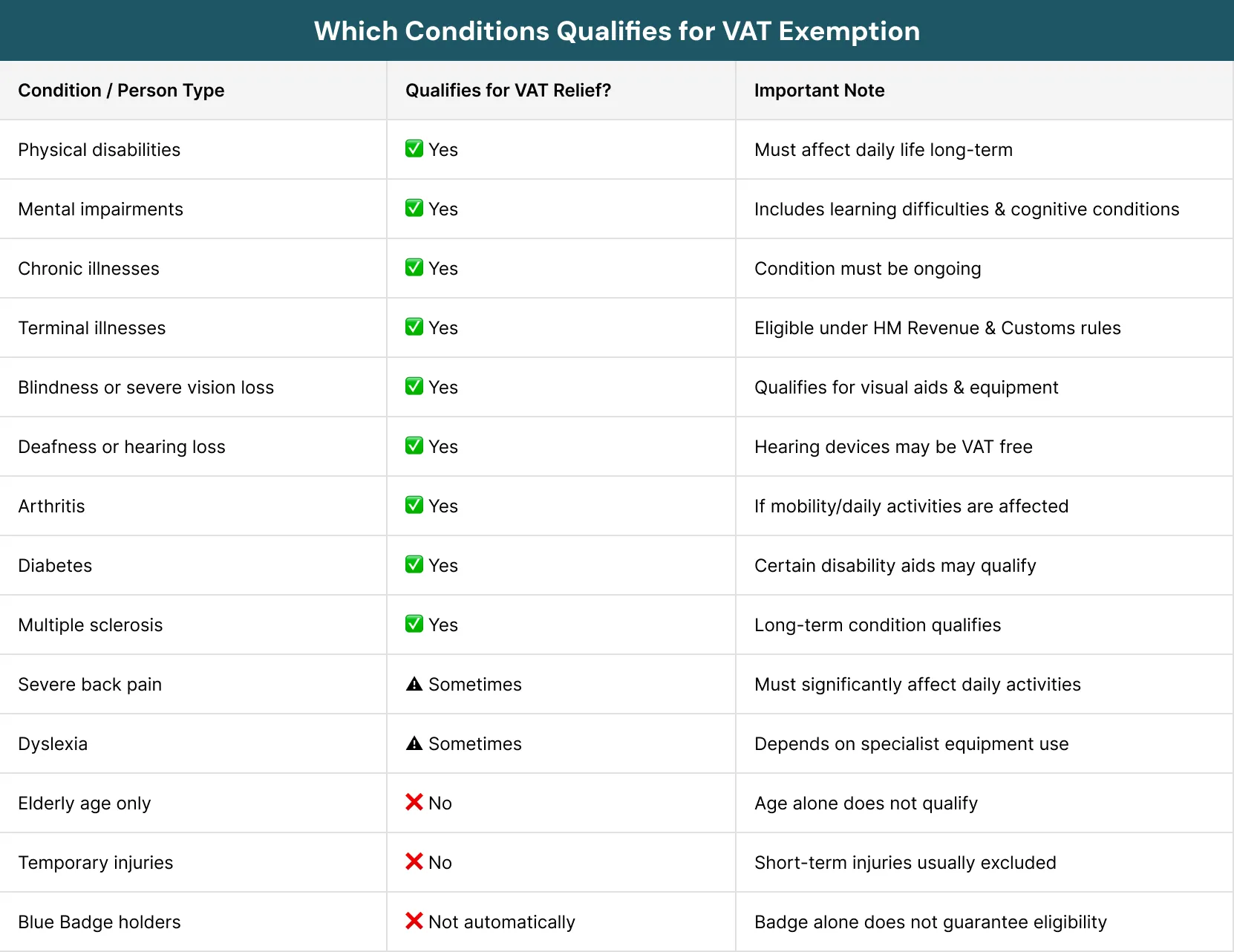
    Many other conditions like asthma, blindness, deafness, diabetes, epilepsy, cancer, heart disease and multiple sclerosis may also be exempted from VAT if they have a significant effect on your daily life.

    Certain common conditions also qualify for VAT if they have a long term effect on daily life. Examples include back pain, dyslexia, psoriasis, etc.

    Once you qualify for the value added tax exemption for disabled people scheme, you can easily buy goods without the need to pay VAT. Common goods and services that are exempted from VAT for disabled people include:

    • Mobility aids like wheelchairs, mobility scooters, etc.
    • Medical equipment like adjustable beds, riser recliner chairs, etc.
    • Emergency alarms
    • Blind aid devices
    • Communication aids

    One misconception you might have heard is that elderly persons are also exempted from VAT but that’s not true. Being elderly does not automatically make you eligible for the exemption scheme. They will only qualify if they have a disability and chronic illness that affects their daily life activities severely.

    Which Conditions Qualifies for VAT Exemption

    Quick Eligibility Checklist

    You may qualify for value added tax exemption for disabled people if:

    • You have a long term illness or disability
    • Your condition affects daily activities
    • The product is designed for your condition
    • You are buying for personal use
    • You can complete a VAT relief form

    Important Detail

    Temporary injuries like a broken leg usually do not qualify for VAT exemption because HMRC only considers long-term conditions.

    VAT Exemption List for Disabled

    Many disability products come under the VAT relief scheme. Here’s a list for disabled people who are exempted from VAT.

    • Wheelchairs, which include manual wheelchairs, powered wheelchairs, walking aids, etc.
    • Adjustable beds specifically designed for disabled persons
    • Stairlifts and chair lifts, which include ceiling hoists and transfer hoists
    • Bathroom and toilet aids, which include commode chairs, shower stools, toilet frames, bath lifts and accessible sanitary devices
    • Low vision aids, which include magnifiers, braille equipment, white canes and specialist reading aids
    • Hearing aids, which include induction loops, text telephones, vibrating pillows and TV hearing devices
    • Hoist and lift equipment, which include transfer equipment, lifting slings and standing aids
    • Home change, which include wheelchair ramps, installing stairlifts, adapting shower rooms and installing alarm systems
    • Emergency alarm systems used to contact carers, family members and emergency support services

    In addition to this, certain assistive technology products may also come under VAT if they are specifically designed to help disabled persons. Examples include voice recognition systems, communication systems and accessibility technology under.

    It is important to note that certain products like ordinary wheelchairs are not exempted from VAT, as they are also used for general purposes.

    VAT relief may also apply to adaptation services, repair and maintenance of the qualifying products. This means that you do not have to pay VAT for repairing, servicing and installing such products.

    What Does Not Qualify for Value Added Tax Exemption

    • General use products not designed for disability
    • Luxury or non essential items
    • Items bought for business use
    • Items used by non disabled individuals

    Which People/Products Are Partially Exempt from VAT?

    Partial exemption VAT refers to a situation where some disability products are sold without VAT, while some products are subject to reduced VAT (5%) or standard VAT (20%).

    People over the age of 60 who are not chronically ill fall under the category of reduced VAT for some products.

    Some products which are not specifically designed for disabled persons but help them, e.g. standard recliners or wheelchairs, are subject to reduced VAT.

    If a disabled person has bought a car, then the car itself will be subject to full VAT. However, wheelchair adaptation for the car will be VAT free under VAT exemption for disabled people.

    HMRC Rules You Should Know

    • The product must be for personal use
    • The item must be designed or adapted for disability
    • The buyer must meet eligibility criteria
    • A VAT relief form must be completed

    Pro Tip

    Always ask the supplier whether the product is VAT exempt before making payment online or in-store.

    How to Claim VAT Exemption

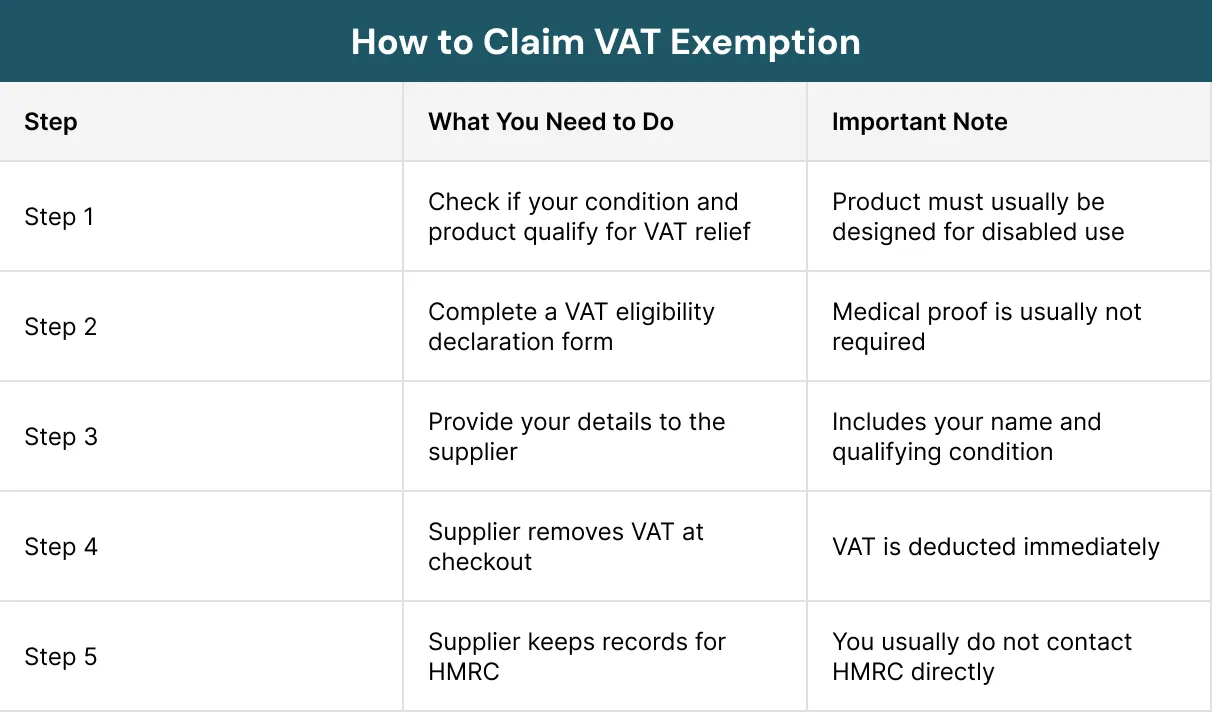
    Many people think that claiming VAT is a difficult thing but it’s actually a simple process. Following is a breakdown:

    1. Confirm Your Eligibility

    To claim a value added tax exemption for disabled people, you have to first confirm your eligibility. You must ensure that your condition qualifies for VAT and that the item you need also qualifies.

    2. Complete VAT Declaration

    You have to complete a VAT relief form to confirm that you have a disability or chronic illness that makes you eligible for VAT relief under VAT exemption for disabled people. You also have to declare that you are using the item for personal or domestic use.

    The form usually contains:

    • Your name
    • Your condition
    • VAT confirmation

    3. Suppliers Remove VAT

    Once your eligibility has been confirmed, suppliers remove VAT from your purchase. They keep records for HMRC, so you do not need to contact HMRC directly.

    VAT claims are handled completely by suppliers and they apply for VAT relief under VAT exemption for disabled people.

    Step by Step Buying Process

    1. Choose a qualifying product
    2. Confirm eligibility
    3. Fill out VAT relief form
    4. Supplier removes VAT
    5. Complete purchase

    How to Claim VAT Exemption

    Do You Need to Fill a VAT Declaration Form to Claim VAT Exemption for Disabled People?

    To claim a value added tax exemption for disabled people, completing the VAT relief form is the most important step. Many people lose the benefit simply because they do not understand how this form works.

    The VAT declaration is a simple statement where you confirm that you are eligible for an exemption and that the product is for personal or domestic use. This form is required by suppliers so they can legally remove VAT from your purchase.

    The form usually asks for basic details such as your name, address and the nature of your condition. You do not need to provide medical proof, but your statement must be honest and accurate.

    It is important to understand that this form is not sent by you to HMRC. Instead, the supplier keeps it as a record in case HMRC asks for proof later. This is why filling it correctly is essential when claiming VAT exemption for disabled people.

    You may be asked to complete this form:

    • At checkout in a physical store
    • Online before making payment
    • Or sometimes after placing an order

    If the form is not completed, the supplier cannot apply exemption and you may be charged full VAT.

    Always double check your details before submitting. Incorrect or false statements can lead to penalties, even if done by mistake.

    Do You Need Medical Proof to Claim VAT?

    No, you usually do not need medical proof to claim VAT. You do not require any medical evidence like a doctor’s letter or certificate.

    You only need to make a statement that confirms you are eligible for a value added tax exemption for disabled people. Avoid making false statements, as this may lead to penalties.

    Good to Know

    You normally do not need to send medical proof to HMRC. Most suppliers only require a simple eligibility declaration form.

    VAT Relief for Charities

    VAT relief may also apply to certain charities that support disabled people. These charities support disabled people through care services, medical support and accessibility services.

    Charities may be exempt from VAT on:

    • Disability aids
    • Accessibility equipment
    • Medical supplies
    • Adapted vehicles

    This may also fall under conditions similar to VAT exemption for disabled people.

    VAT Exemption for International Customers

    International customers who buy disability products from the UK are not usually charged VAT. However, they may have to pay customs charges or import tax depending on their country.

    Some countries allow tax free imports of disability products, while others apply local taxes. These rules are separate from VAT exemption for disabled people.

    VAT Exemption in the UK vs Other Countries

    The UK offers VAT exemption for disabled people at the point of sale, while many other countries require refunds or partial tax relief after purchase.

    Common Misconceptions About VAT Relief

    Here are some common misunderstandings about value added tax exemption for disabled people:

    • Elderly people automatically qualify (not true)
    • Every disabled person qualifies (both person and product must qualify)
    • All disability products are VAT free (only specific products qualify)
    • Benefits like a blue badge are required (not true)
    • HMRC approval is needed (self declaration is enough)

    Read more: Common Errors on VAT Returns

    Importance of VAT for Disabled People

    VAT exemption for disabled people is important because it reduces financial burden. Many disability related products like wheelchairs, adjustable beds and mobility scooters are expensive.

    In addition, home changes and assistive technologies also cost money. Removing VAT can save thousands of pounds.

    It improves the quality of life by making essential products more accessible. It also helps charities reduce their operating costs.

    How Much Can You Save?

    With VAT exemption for disabled people, removing 20% VAT can save hundreds or even thousands of pounds on equipment like mobility aids, home change and medical devices.

    Final Thoughts

    There is no doubt that disability products come as an additional expense. The VAT exemption scheme for disabled people by the UK government is a great step in managing this cost.

    VAT schemes can only be used properly if you have complete knowledge about them. You must know which products and conditions qualify for VAT exemption for disabled people. Always confirm that both the product and your condition qualify before buying.

    Many people miss out on value added tax exemption for disabled people simply because they are unaware of the eligibility criteria. The process is simple. No medical evidence is required. You only need to make a declaration. It can become difficult only when there is a lack of understanding about eligibility, products and the process.

    Understanding VAT exemption for disabled people can sometimes be confusing. Sterling Cooper Consultants can guide you on eligibility, qualifying products and correct declarations to ensure you do not miss out on available relief. Reach out to us today.

    At Sterling Cooper, we help you stay compliant and reduce tax stress.

    Trusted by UK individuals and businesses, we make VAT relief and exemption easier to understand. Contact us today!
    +443300102526
    Book an Appointment

    FAQs


    Can I claim VAT back if I am disabled?

    Yes, disabled people can receive VAT relief on certain eligible products and services designed specifically for disability use. However, VAT relief is usually applied at the time of purchase, meaning you do not pay the VAT upfront rather than claiming it back later.
    You may qualify if you have a long-term physical or mental condition that affects your daily activities.

    Physical disabilities, mental impairments, chronic illnesses, and terminal illnesses may qualify for VAT relief if they have a long-term effect on daily life. Conditions such as blindness, deafness, diabetes, epilepsy, arthritis, multiple sclerosis, cancer, and severe mobility issues can qualify under HMRC rules. Temporary conditions, minor injuries, or simply being elderly do not usually qualify for full VAT exemption.

    No, having a Blue Badge alone does not automatically qualify you for VAT exemption.
    Eligibility depends on whether you have a long-term disability or chronic illness that affects your daily activities under HMRC rules. You can still qualify for VAT relief even if you do not receive benefits or have a Blue Badge.


    Yes, arthritis can qualify for VAT exemption if it has a long-term and substantial impact on your ability to carry out everyday activities. Under HMRC rules, chronic conditions such as arthritis are considered eligible when purchasing qualifying disability-related products or services. The products must also be for personal or domestic use to receive VAT relief.


    To apply for VAT exemption in the UK, you usually need to complete a simple VAT eligibility declaration form provided by the supplier. You must confirm that you have a qualifying long-term disability or chronic illness and that the product is for personal or domestic use. Once approved, the supplier removes the VAT at the time of purchase.

    Share This Article!

    Recent Posts

  • Making Tax Digital for Income Tax: A Practical Guide for UK Taxpayers

    Making Tax Digital for Income Tax: A Practical Guide for UK Taxpayers

    making tax digital

    Posted by:

    Admin

    Date:

    May 20, 2026

    Category:

    blogs

    Error: Contact form not found.

    Making Tax Digital for Income Tax: A Practical Guide for UK Taxpayers

    Making Tax Digital (MTD) is changing how UK businesses, sole traders and landlords keep tax records and report information to HMRC. Those covered by the rules must keep certain records digitally and use compatible software.
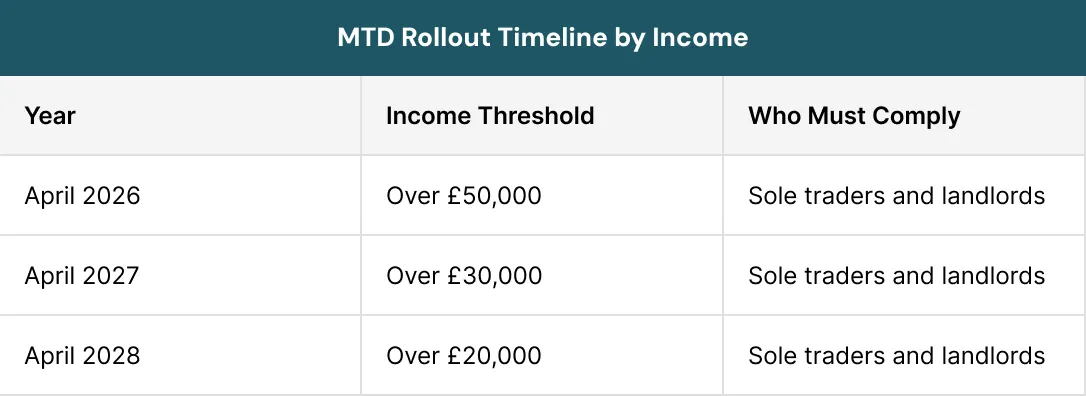
    The rules vary by tax type. VAT-registered businesses generally need to follow MTD for VAT, while MTD for Income Tax is being introduced in stages. From 6 April 2026, it applies to individuals with qualifying income above £50,000, with the threshold falling to above £30,000 in 2027 and above £20,000 in 2028.
    This guide explains who needs to follow MTD, when the rules apply and how to prepare.

    Key Takeaways

    • Growth can come from existing products, new products, existing markets or new markets.
    • Market penetration focuses on selling more existing products to existing customers.
    • Product development means creating new products for an existing market.
    • Market development means taking existing products or services into new markets.
    • Diversification combines a new product with a new market.
    • Businesses should review their results and change their approach when needed.

    What Is Making Tax Digital (MTD)

    Making Tax Digital (MTD) is a UK government initiative designed to modernise how taxpayers keep records and report information to HMRC. Those within the relevant rules must maintain digital records and use compatible software to submit information.
    MTD currently covers VAT and Income Tax. VAT-registered businesses already follow MTD for VAT, while MTD for Income Tax is being introduced in stages for qualifying sole traders and landlords. The initiative is intended to support more accurate record-keeping and reduce errors in tax reporting.

    How Does Making Tax Digital Work

    For MTD for Income Tax, qualifying sole traders and landlords use compatible software to keep digital records of their income and expenses. They then send quarterly updates to HMRC and complete the required year-end process.
    HMRC reported that more than 436,000 sole traders and landlords had submitted their first quarterly update by August 2026. The exact requirements vary depending on whether you are following MTD for VAT or MTD for Income Tax.

    When Do I Need to Comply with MTD Rules?

    The date you need to comply depends on which MTD rules apply to you. All VAT-registered businesses must keep relevant VAT records digitally and submit VAT Returns using MTD-compatible software. This requirement has applied to all VAT-registered businesses since April 2022. For Income Tax, MTD is being introduced in stages based on your qualifying income. The following table shows when the rules apply:
    MTD Rollout Timeline by Income

    Qualifying income means your total gross income from self-employment and property before expenses.

    What Digital Records Do I Need to Keep?

    The records you need depend on the MTD rules that apply to you. For MTD for Income Tax, qualifying sole traders and landlords need digital records of their self-employment or property income and expenses. They must also retain supporting records, such as invoices and bank statements.

    For MTD for VAT, digital records generally include details of sales, purchases, supplies, VAT charged and VAT claimed. Accurate records make it easier to check your figures before submitting information to HMRC

    How to Prepare for Making Tax Digital

    If MTD for Income Tax applies to you, preparing your records and software in advance can make the transition easier.

    Check Your Qualifying Income

    First, calculate your total gross income from self-employment and property before taking away any expenses. If your combined income is more than £50,000, you must follow MTD for income tax starting from 6 April 2026. Future thresholds drop to £30,000 from 6 April 2027 and £20,000 from 6 April 2028.

    Choose Compatible Software

    HMRC does not provide free software for Making Tax Digital, so you need to use compatible commercial software or bridging software that works with spreadsheets. Choose software that supports the digital record-keeping requirements and allows you to record sales and expenses. Setting up and testing the software early can also help you become familiar with recording transactions before you need to submit your first update.

    Sign Up with HMRC

    To sign up for MTD for Income Tax, use the official UK government website and follow the steps provided. You will need to provide information about your income sources and connect your compatible software as part of the process.

    Once you have signed up, make sure you have completed the necessary setup before submitting your first quarterly update. Your compatible software will be used to keep digital records and send the required updates to HMRC.

    Submit Quarterly Updates

    Once you are using MTD for Income Tax, you need to send four quarterly updates each tax year for each relevant self-employment or property income source. These updates summarise your income and expenses and are submitted through your compatible software. They are not tax returns.

    For standard tax-year update periods, the deadlines are 7 August, 7 November, 7 February and 7 May. You will then need to submit your tax return by 31 January following the end of the tax year. Your quarterly updates feed into this tax return, but they do not replace it.

    How Sterling Cooper Helps You with Making Tax Digital

    Making Tax Digital can feel challenging when you are unsure which rules apply to your business. Sterling Cooper can help you understand your MTD responsibilities and prepare for the changes. Our team can review your current records, explain your reporting requirements and help you choose a suitable approach to digital record-keeping.

    We can also support you with organising your tax information and understanding key HMRC deadlines. With the right guidance, you can approach MTD with greater confidence while staying focused on running your business.

    If you are unsure whether Making Tax Digital applies to your business or need support preparing for the changes, contact us today to discuss your requirements with our team.

    FAQs


    What is Making Tax Digital for businesses?

    Making Tax Digital is an HMRC initiative requiring those within the relevant rules to keep digital tax records and use compatible software to submit information to HMRC.

    MTD for Income Tax started on 6 April 2026 for those with qualifying income above £50,000. The threshold falls to above £30,000 from 6 April 2027 and above £20,000 from 6 April 2028.

    Yes. Those within the MTD rules generally need compatible software to keep digital records and submit the required information to HMRC.

    For MTD for Income Tax, you normally need to send four quarterly updates each tax year, followed by the required year-end process and tax return.

    The consequences depend on the obligation missed. HMRC has penalty rules for certain late submissions and payments. However, penalty points will not apply to late quarterly updates during the 2026–27 tax year.

    Share This Article!

    Recent Posts


  • The Impact of AI on Financial Reporting and Auditing

    The Impact of AI on Financial Reporting and Auditing

    AI in financial reporting

    Posted by:

    Admin

    Date:

    May 19, 2026

    Category:

    blogs

    Error: Contact form not found.

    The Impact of AI on Financial Reporting and Auditing

    What if your financial reports could be faster, smarter and more accurate without putting extra pressure on your finance team?

    Financial reporting and auditing are the basis of business growth because money decisions need your trust. Investors can face problems and may lose trust if your reports are late or inaccurate or even when they are hard to understand.

    Today, efficient and smart businesses use AI tools. Their finance teams and audit firms use AI to perform daily tasks. It helps them plan better.

    AI tools help companies to:

    • Make reports faster
    • Check data better
    • Find risks early
    • Understand numbers more clearly

    Research shows that around 15% of UK businesses were planning to adopt AI within the next three months as per data collected in Dec, 2025. This suggests how quickly AI demand continues to grow.

    AI is not just a technology. It has become a helping hand for your business and your financial decisions as well. AI is changing financial reporting and auditing in a way that leads you to a bright future. It is all about faster work, fewer mistakes and smarter decisions.

    Artificial intelligence is not a substitute for human intelligence; it is a tool to amplify human creativity and ingenuity.

    – Fei-Fei Li, Sequoia Capital Professor, Stanford University

    Key Takeaways

    • AI in financial reporting is improving financial reporting by reducing manual work, lowering errors and giving faster real-time insights for better decisions
    • Financial audits are becoming stronger with AI in auditing through fraud detection, anomaly alerts and continuous monitoring of transactions
    • Natural Language Processing supports AI in financial reporting by turning complex financial data into clear summaries, dashboards and investor-friendly reports
    • Businesses using AI in financial reporting for forecasting, budgeting and risk checks can react faster to market changes and protect profits
    • Human judgement still matters in AI and auditing as AI should support finance teams, while people handle ethics, strategy and final decisions
    • Strong data quality, privacy controls and clear governance are essential for successful and trusted AI in auditing and finance adoption
    • The best way to start with AI in financial reporting is one small use case, measure results, then scale gradually across finance operations

    What Is Financial Reporting

    Financial reporting means using reports to show how a business is doing with money. It helps people understand the business clearly, such as:

    • Owners
    • Investors
    • Lenders
    • Tax authorities
    • Managers

    Why Financial Reporting Matters

    Financial reporting matters because it involves producing key reports, such as:

    • The balance sheet
    • Income statement
    • Cash flow statement

    Notes to accounts help explain the numbers in more detail. Some companies also add generative AI in financial reporting like MD&A (Management Discussion and Analysis) to explain results, risks and future plans.

    If reports are not clear, people do guesswork. This leads to making wrong decisions and you may lose clients’ trust.

    What Is Auditing

    Auditing means checking if financial reports are fair, correct and properly prepared. It helps confirm that the numbers shown in the reports are reliable and can be trusted by business owners, investors, lenders and regulators. 

    Why It Matters

    It matters because auditors make sure the numbers can be trusted with the help of auditing. They review:

    • Records
    • Systems
    • Controls
    • Evidence

    Before AI in auditing, audits often needed manual checks, spreadsheets, sample testing

    and long working hours. This took time and could still miss hidden mistakes. Now, AI and auditing work together.

    Why AI Is Becoming Important In Finance

    The following points explain why AI in financial reporting is becoming important:

    Why Boards and Leaders Care About AI in Financial Reporting

    Boards and leaders now see AI in financial reporting not just as an extra option but as an important business tool. Studies suggest that all surveyed boards had already taken the next step with AI.

    AI in financial reporting becomes more successful when company boards support it because they can provide funding, clear rules and long term planning.

    When leaders know how to use AI in financial reporting in the right way, AI projects are more likely to succeed.

    1. Regional Adoption of AI in Financial Reporting

    Each region is moving at its own speed but AI is clearly becoming important in finance everywhere.

    The use of AI in financial reporting is growing around the world, such as:

    • North America is moving the fastest because many businesses there have bigger technology budgets and adopt new tools early
    • Europe is also moving forward, with more focus on rules, governance and data quality
    • Asia Pacific is growing quickly too, as more businesses update their finance systems

    2. Industry Trends in AI in Financial Reporting

    AI in financial reporting is growing in many industries but not all sectors are moving at the same speed, such as:

    Telecom and technology companies

    Telecom and technology companies are leading because they already use a lot of AI data and digital systems.

    Energy and natural resources companies

    Energy and natural resources companies are also using AI to improve forecasts, control costs and check risks.

    Manufacturing businesses

    Manufacturing businesses use AI to connect finance with supply chain planning.

    Retail and consumer businesses

    Retail and consumer businesses are not efficient enough. They have older systems and tighter budgets due to which they are not as smart.

    How AI Is Changing Financial Reporting

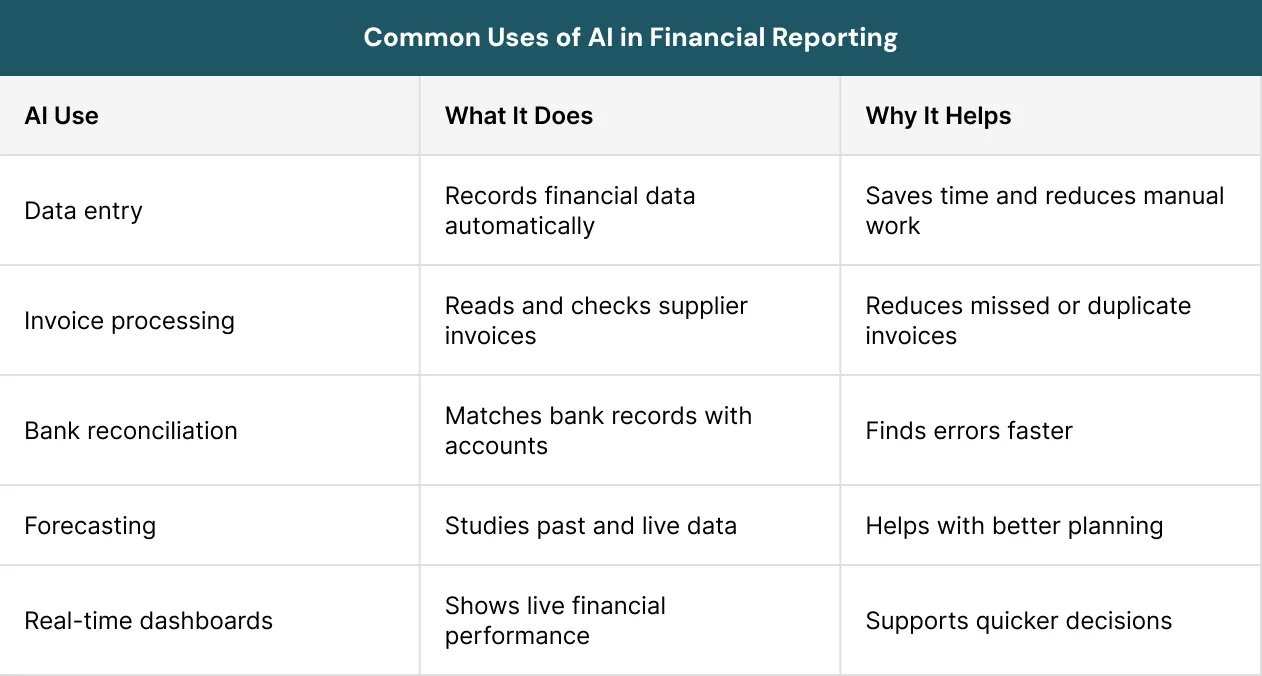
    Finance teams take help from AI in daily tasks. One main use is automation, it can handle repeated work much faster like:

    • Data entry
    • Invoice processing
    • Expense approvals
    • Financial reconciliations

    Workers can save around 45 to 60 minutes each day by using AI in financial reporting. It can process transactions as they happen. This is why finance teams do not need to wait until month end to understand business performance.

    Common Uses of AI in Financial Reporting

    1. Better Accuracy and Fewer Errors

    Manual work can lead to mistakes. These are typing errors, missed invoices, duplicate entries and wrong spreadsheet formulas.

    Key Benefit:

    AI helps businesses find mistakes early and make faster decisions.

    AI tools can help reduce these mistakes. They can quickly check records, confirm data and flag unusual entries.

    2. Real Time Reporting Gives Better Control

    In old reporting numbers were usually checked after the month or period ended. A problem could be noticed too late if it happened early in the month.

    AI helps to track different activities earlier, such as sales and profit trends, cash flow and costs.

    AI in financial reporting changes finance from fixing problems late to managing them early. For example, leaders can control it quickly if spending rises. They can also respond sooner if sales drop.

    3. Continuous Close Is Changing Reporting

    Traditional reporting often finalises numbers at the end of the month or the quarter. This can delay important decisions and affects control over finances.

    AI in financial reporting helps companies move towards a continuous close process. This means transactions are checked and updated during the period, not only at the end. It also helps to find errors earlier.

    4. AI and Forecasting

    Many finance teams find forecasting hard due to quick market change. Old methods may use limited data and take more time to update. AI can study past records, market trends, customer demand, costs and outside economic signals.

    This helps create better forecasts that can support revenue planning, budgeting, staffing and stock decisions.

    Many companies may move from slow forecasting methods to AI supported forecasting in the future.

    5. NLP Is Changing Written Financial Reports

    NLP is one of the most useful AI tools in financial reports. It helps AI read and write human language. In finance, it can write short summaries. It can also read invoices, contracts, receipts, bank statements and notes.

    6. AI Makes Data Easier to Understand in Financial Reporting

    Many readers find financial reports hard to understand because of long tables and difficult terms. AI helps them by changing raw data into dashboards, charts and short explanations.

    AI makes reports easier for managers, investors and staff to read. This also helps them make better decisions.

    AI Improves Investor Communication

    Investors prefer the reports which are clear, quick and easy to understand. This makes the communication clear and easy and gains you customer trust and confidence.

    AI helps by turning complex financial data into simple summaries, dashboards and charts.

    Natural Language Processing (NLP) uses simple words to explain changes in revenue, costs and future risks.

    NLP helps investors understand business performance without reading long technical reports.

    How AI Is Changing Auditing

    The following points explain how AI is changing auditing:

    1. AI and Auditing

    Auditing is changing quickly with the use of AI. In the past, auditors often checked only a sample of transactions. It was difficult to check everything.

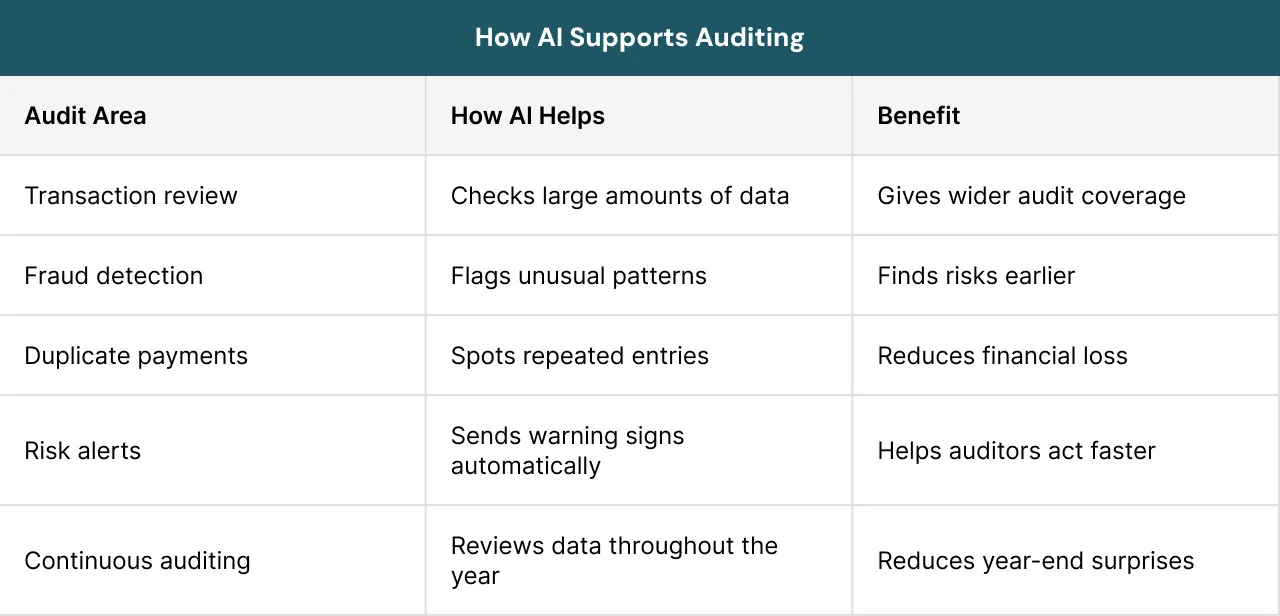
    How AI Supports Auditing

    AI in auditing helps auditors review much larger amounts of data. It can even check almost all transactions. AI can also improve audit quality because it can:

    • Compare patterns
    • Find duplicate entries
    • Flag suspicious payments
    • Spot unusual transaction timings

    2. Fraud Detection and Risk Alerts

    Manual checks may not always find fraud that hides inside normal looking records. AI can study patterns and flag warning signs, such as:

    • Repeated round number payments
    • Unusual supplier activity
    • Late night approvals
    • Sudden changes in trends

    AI in auditing can also watch credit risk, cash flow risk and market risk.

    Some AI systems send automatic alerts that help businesses find problems early before they become bigger.

    3. Continuous Auditing

    Another big change is continuous auditing. Today, audits do not only happen at the end of the year. AI and auditing come forward to check transactions and controls throughout the year. This helps auditors find problems earlier, not after the year is over.

    Continuous auditing helps build more trust with investors and regulators by saving time.

    4. Why Managers Trust AI More in Some Cases

    If both the auditor and the company used AI in auditing, the managers are more likely to accept audit changes. This happens because the audit advice looks more accurate and reliable with the use of AI. It also shows that trust in AI depends on how both sides use it.

    AI Helps Compliance

    AI helps finance teams stay organised and prepared. Financial reporting must follow rules like:

    • GAAP
    • IFRS
    • Tax laws
    • Industry rules

    Compliance with rules and regulations is crucial otherwise businesses face penalties. It can also damage its reputation. AI can check transactions, documents and reports against these rules in real time. It can also flag missing data, unusual entries and possible policy issues.

    1. AI and Stakeholder Trust

    A stakeholder needs reliable numbers and trust only grows when AI is used properly. AI can help by making reports more consistent, reducing delays and finding problems early.

    This shows businesses need clear controls, human review, data protection and honest communication.

    2. Cost Savings and Efficiency

    Costs can go down with faster routine work with the use of AI. This helps teams spend less time fixing mistakes and chasing documents. This also helps prepare reports  sooner and easier audit preparation.

    Now, there is less manual work which allows finance teams to spend more time on analysis. This happens when teams use AI. Some managers also expect AI to make audits more efficient. This may reduce audit costs in some cases.

    3. AI Creates Better Decisions

    The real value of AI is not only faster reports, it also helps with better decisions. Leaders can act with more confidence, when they can quickly see cash flow, risks, customer behaviour, market changes and budget gaps.

    AI can help leaders with recruitment and HR, business Expansion, budgeting and Pricing, cost control and financial decisions.

    Human Skills Still Matter

    AI is powerful but it should not manage finance without human support. Human judgement is still needed for ethics, context, strategy and final approval.

    Sometimes there may be a real reason behind a strange number. A business experience may help to understand forecasts properly. This is why human skills still matter.

    Bias and Explainability

    Bias data gives biased results because AI systems learn from data. That is why AI should be checked and tested often. This can affect lending decisions, fraud alerts, risk scores and financial forecasts.

    People trust AI more when the system is clear and easy to understand. If AI says profit risk is increasing, finance teams need to know the reason why risk is increasing.

    Challenges of Using AI in Finance

    The following are the challenges that come with AI:

    • One challenge is poor data quality. If old records are messy, missing or not consistent, AI may give weak results. Bad data often leads to bad insights
    • Privacy is also a major concern. Businesses must protect their customer records because financial data is sensitive. The payroll details, business plans and pricing information demands confidentiality
    • Security also matters. If AI systems are attacked, the damage can be serious
    • Some staff may also worry that AI will replace their jobs. This concern is real but many roles may change instead of disappear

    How to Start Using AI in Finance

    Following are the ways to start using AI in finance: 

    1. Best Way to Start With AI

    Businesses struggle when they try to use AI without proper research. You should not use AI in too many areas at the same time. The best approach is to test it on one single problem first. This could be invoice processing, expense coding, cash flow forecasting and bank reconciliation statements.

    Note:

    Start small with AI, then grow when it works well.

    Test AI on that one task and check how much time it saves, how many errors it reduces and how the team feels about it. This simple approach reduces risk. If it works well, expand slowly.

    2. A Simple 12 Months Roadmap

    Following is a simple 12 months guide to start using AI in finance:

    Month 1 to 3 should focus on getting ready by:

    • Checking current systems
    • Reviewing data quality
    • Finding slow repeated tasks
    • Getting support from leaders

    Months 3 to 6 can focus on small tests like:

    • Use OCR for invoices
    • AI for simple forecasts
    • Dashboards for live reporting

    Months 6 to 12 can focus on growth by:

    • Using AI tools in ERP and CRM systems
    • Creating clear rules
    • Training the team properly

    3. Important AI Tools in Finance

    There are many tools that can now help finance teams. No single tool works for every business. The right tool depends on the business size, goals, current systems and budget.

    Some AI tools help with payments, supplier bills and bookkeeping. Other AI tools support planning, forecasting, closing accounts, fraud checks and excel work.

    Following are the examples of some AI tools Tipalti, BlackLine, Planful, Workday Adaptive Planning, DataRails, Zeni, Botkeeper, Kensho and OneStream.

    4. AI and Small Businesses

    AI is not only for big companies. Small businesses can also take advantage. Cloud tools have made AI’s access easy and affordable. Smaller firms can now use AI for:

    • Invoices
    • Reporting dashboards
    • Expense checks
    • Budgeting support

    The current data of 2026 suggests that 16% of UK businesses have embraced AI in their operations. This shows AI in financial reporting is growing very fast.

    AI helps growing businesses improve control and report quality. Large companies may still lead AI adoption but smaller firms are catching up.

    Real Life Example

    Retail companies in the UK use AI in financial reporting. It makes monthly financial reporting easier. AI compares spending with the budget after:

    • Collecting sales data from all stores
    • Checking supplier invoices
    • Tracking stock costs

    Annual reports also matter for business growth. Managers do not wait many days for reports at the end of the month. They get:

    • Real time dashboards showing profit
    • Cash flow
    • Store performance

    Auditors also use AI in auditing to check transactions for risks and unusual patterns. This helps the company make reports faster, reduce mistakes and make better decisions.

    What Finance Professionals Should Learn Now

    Finance teams should learn the use of AI in financial reporting. The basics of AI include NLP, data quality, governance and how to give clear prompts.

    In the future, the strongest finance professionals may be those who understand both finance and technology. They should know how to check AI answers and understand the logic. They should also know how to use human judgement with AI insights.

    The Future of AI in Finance

    AI in finance looks stronger with new trends, such as:

    • NLP (Natural Language Processing) will get better at reading contracts, emails, reports and rules
    • AI assistants may answer finance questions in simple words
    • Predictive tools will also improve planning. For example, leaders can see what may happen if costs rise or sales drop
    • Continuous close may become normal
    • Audits may find problems earlier instead of after they happen

    Conclusion

    AI gives you a new direction to financial reporting and auditing. AI in financial reporting helps auditors check data  efficiently and provide better assurance and accuracy. It also helps businesses save their time and control the errors.

    AI is a powerful tool. It helps in forecasting and financial decision making but it cannot replace human judgement. AI in financial reporting still needs human guidance to work and serve businesses. The more skilled the people, the better the results.

    AI in financial reporting helps businesses make wise decisions. It also helps a company grow and it’s helpful to use AI in financial reporting to get real time information efficiently. Yet it has some limitations. AI lacks ethics and real emotions, which are important factors to build trust with your clients.

    Finance and auditing are changing with AI adoption but people still need to guide decisions and check the results carefully.

    Sterling Cooper understands that the best way to use AI in your finance and reporting is to back it with human research and expertise. This is because businesses need faster, clearer and more reliable financial insights. 

    Contact us today to see how expert guidance on the best and most suitable AI tools can improve reporting and growth of your business within days.

    Struggling with slow reports, manual errors or unclear financial data?

    We help businesses use AI in financial reporting and auditing to improve accuracy, speed and decision-making. We have helped companies streamline finance processes and reporting systems.
    Contact us today to discuss the right AI solution for your finance team.
    +443300102526
    Book an Appointment

    FAQs


    What is AI in financial reporting?


    AI in financial reporting means using smart software to help prepare, review and improve financial reports. It can automate tasks like data entry, reconciliations and report creation. AI also helps spot errors, track trends and provide real-time insights. This allows finance teams to work faster and make better decisions while improving reporting accuracy.


    The use of AI in financial reporting includes automating manual work, reducing reporting errors, improving forecasting, detecting unusual transactions and creating faster reports. AI can also turn complex numbers into simple summaries and charts. This helps management, investors and finance teams understand business performance more clearly.


    Generative AI in financial reporting is AI that can create written content, summaries and draft reports from financial data. It can help produce management reports, investor updates, executive summaries and MD&A sections. Finance teams still need to review outputs but it saves time and improves communication.


    Yes, AI can improve auditing by checking large volumes of transactions quickly and identifying unusual patterns. It helps with fraud detection, continuous auditing, risk alerts and data testing. This gives auditors better coverage than only checking small samples and can improve audit quality.


    AI is more likely to change finance jobs than replace them fully. It can handle repetitive tasks such as data entry and reconciliations but human skills are still needed for judgement, ethics, communication, strategy and final approvals. Finance professionals who learn AI tools may become more valuable.


    AI can be safe when used with strong controls. Businesses should focus on data privacy, secure systems, regular testing and human oversight. AI outputs should be reviewed before final use. Good governance helps ensure reports remain accurate, compliant and trustworthy.

    Share This Article!

    Recent Posts

  • What is Auditing in Accounting?

    What is Auditing in Accounting?

    auditing in accounting

    Posted by:

    Admin

    Date:

    May 18, 2026

    Category:

    blogs

    Error: Contact form not found.

    What is Auditing in Accounting?

    Can you trust a business just by looking at its financial reports? That is where auditing in accounting becomes important.

    Auditing helps businesses to check accuracy of their financial records. In simple words auditing is the process of reviewing the financial statement.

    It is also the process of reviewing the overall transactions of the company.
    It also builds the trust between the company and its stakeholders such as investors and banks.

    Research shows that 83% of audit functions are currently using AI to improve their audit in 2026.

    Key Takeaways

    • Auditing in accounting helps businesses verify that their financial records are accurate, transparent, and compliant with laws and accounting standards.
    • Accounting and auditing work together, but they have different roles. Accountants prepare financial records, while auditors examine and verify them for accuracy.
    • Auditing improves financial transparency, increases investor confidence, and helps businesses build trust with stakeholders, lenders, and customers.
    • The main types of auditing include internal auditing, external auditing, government auditing, and forensic auditing, each serving a different business purpose.
    • Auditors play an important role in fraud prevention and risk management by identifying financial errors, suspicious activities, and weaknesses in internal controls.
    • Modern technologies such as Artificial Intelligence (AI), cloud-based software, and data analytics are transforming the auditing industry and improving efficiency.
    • Emerging trends like ESG audits, cryptocurrency audits, and AI governance audits are creating new opportunities for auditors in the future.
    • Essential skills for audit accountants include analytical thinking, communication, attention to detail, project management, and regulatory knowledge.
    • Businesses that perform regular audits are more likely to improve operational efficiency, reduce financial risks, and make smarter financial decisions.
    • As the financial world continues to evolve, auditing remains a critical tool for ensuring business accountability, compliance, and long-term success.

    Purpose of Auditing in Accounting

    Auditing in accounting is the process of checking financial records of the company. It helps businesses to confirm that their reports follow the legal rules.

    The main purpose of an audit is to build trust. It also helps to find the errors and improve the financial records.

    Why Do Businesses Need Auditing?

    Businesses need auditing in accounting because it helps them to maintain their financial records.

    Without it hidden issues will be ignored which create bigger issues in future.

    One of the most common reasons is that it helps to stay compliant with laws and tax rules. It also helps businesses to avoid penalties.

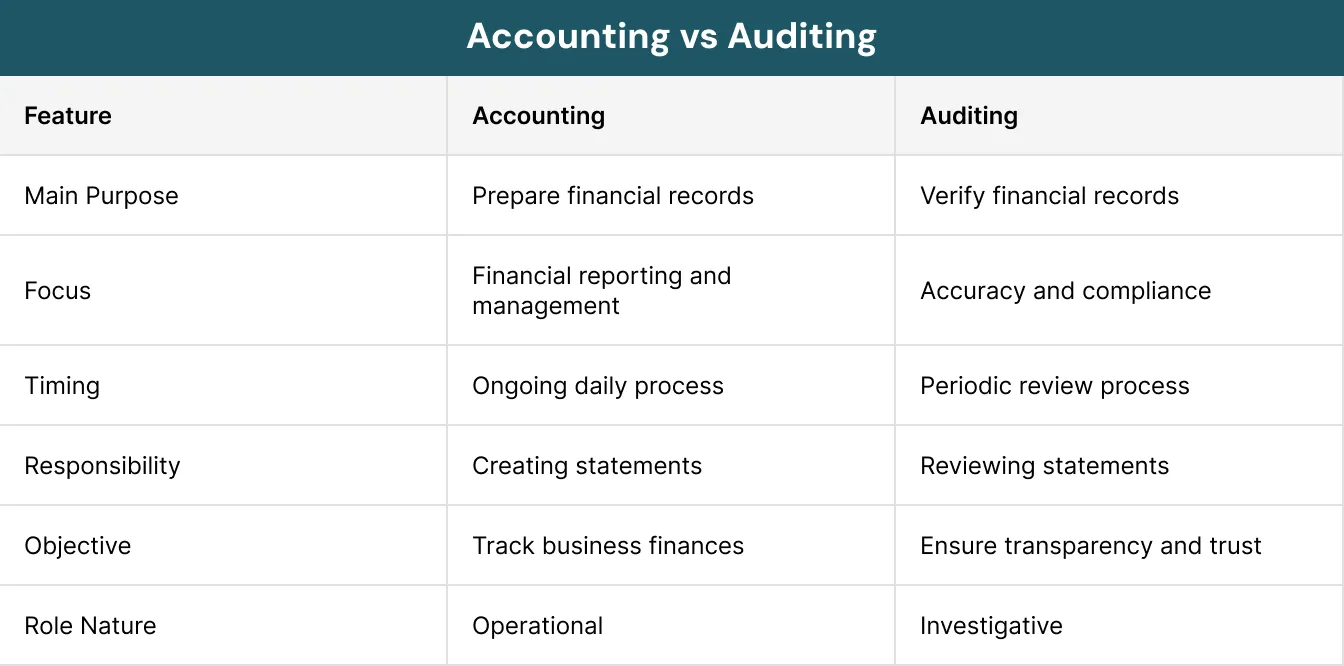
    Accountant vs Auditor

    They both are connected to each other but they have different roles.

    Accounting vs Auditing

    Role of an Accountant

    The role of an accountant is to manage the financial activities of the business. They work on preparing the reports, recording transactions and also handling the taxes.

    They help businesses to understand their financial records. They also make plans for future growth of the business.

    Role of an Auditor

    The role of an auditor is to review the financial records to ensure that they are correct. They also help businesses to improve their internal controls.

    In many cases they can act as financial investigators.

    Why Auditing in Accounting Matters in Modern Business?

    Auditing in accounting helps businesses to remain financially secure. It gives confidence to stakeholders that records of the company are reliable.

    It can help modern businesses to identify the problems and also manage the legal risk.

    It also helps to find the errors. Once the errors are found it helps to improve the financial statements.

    Financial Transparency and Investors Trust

    Financial transparency means being honest about the financial records of the company.

    It also helps to improve the reputation and strength of the company. This can ensure to maintain a good relationship with stakeholders.

    Audits help businesses to provide accurate reports to investors. This can help to gain the trust of the investors.

    Types of Auditing in Accounting

    There are some main types of auditing in accounting which include:

    • Internal
    • External
    • Government
    • Forensic

    Here we have explained these types below which will help you to better understand each type:

    1. Internal Auditing in Accounting

    Internal auditing in accounting is conducted in a company to review the financial systems.

    It also helps businesses to follow the policies of the company. It ensures that all departments are doing their work in a proper way.

    2. External Auditing

    This type of auditing is carried out by the auditors from outside the organisation. Their role is to review the financial records and give an opinion.

    It helps to increase the trust among the investors. It also confirms whether financial reports of the company are accurate or not.

    3. Government Auditing

    It ensures that businesses should comply with tax laws and regulations. These audits are performed by the government.

    In this process auditors of the government review financial records to confirm that taxes are reported in a proper way.

    4. Forensic Auditing

    This type of auditing investigates the financial records to uncover fraud. It is important because it helps to detect financial crimes.

    To stop these crimes, auditors work closely with the legal teams and law agencies.

    What is the Process of Auditing in Accounting?

    The process of audit follows a structured approach to review the financial information.

    With the help of a proper audit process you can improve the efficiency. You can also ensure that financial records are reviewed carefully.

    This process includes:

    • Planning
    • Testing
    • Reporting and Opinions

    1. Audit Planning

    Planning is the first stage of the process of the audit. At this stage you define the objectives and timeline of the audit before starting the review.

    During the planning, auditors identify the high-risk areas. This can help them to focus on the important issues.

    It helps the audit to run smoothly and also helps to avoid missing the information.

    2. Evidence Collection and Testing

    At this stage auditors collect the evidence by reviewing documents. This includes invoices, receipts and also bank statements.

    They also check the transactions to confirm the accuracy. It can help auditors to identify the errors or any fraud.

    In this process audit tools and software make it easy to collect the evidence.

    3. Reporting and Opinions

    After completing the review, now auditors prepare a report which can explain their findings.

    The report highlights the issues related to financial records which are found during the audit.

    In the last step they also give their opinions to improve the financial system. These opinions can help businesses to achieve good results.

    Read more: Understanding the Accounting Cycle: Step-By-Step Breakdown

    Skills Required for Audit Accountants

    An audit accountant must have technical skills and also problem solving skills.

    Strong skills help them to identify rare issues and also help to manage complex tasks. They must be able to solve the problem in a given time.

    As technology grows day by day, they also need digital skills to stay updated with market trends.

    Analytical Skills

    Analytical skills help them to review financial data and to identify the issues and possible fraud.

    They must also understand the information and risks. It allows them to solve problems and make good decisions during the audit.

    These skills help them to detect fraud and ensure good financial reporting.

    Other Skills

    During the audit, they must work with managers on a regular basis. Strong communication skills help you to explain issues in a better way.

    Project management skills are also important because audits depend on deadlines and planning.

    Good teamwork helps them to complete audits in a better way.

    Role of Technology in Auditing in Accounting

    Technology plays a key role in today’s audit. It helps to perform the audit in a better way, which is the need of modern businesses.

    It also helps businesses to secure financial records during the audit. Auditors now use digital tools and software to improve their speed.

    Role of AI

    AI helps auditors to manage large amounts of data quickly. It can also help to identify wrong transaction and fraud risks.

    AI also helps to improve efficiency but human work is still important. Because the final opinions should be given by auditors.

    Cloud-Based Audit

    Cloud-based audit allows you to access the financial information from anywhere. During the audit this can help to improve teamwork.

    Data analytics tools also help you to identify trends. With the help of these tools, you can also review large amounts of data quickly.

    These tools help you to improve audit quality and also help businesses to make better financial decisions.

    Also Read: 5 Ways Cloud Accounting Can Save You Time and Money

    What are the Audit Trends in 2026?

    The auditing industry grows day by day as businesses adopt the new tools.

    Future audit trends focus on digital assets like Cyber security and AI. These areas are more important for businesses.

    Auditors who develop modern skills will have a good chance of growing in the future.

    Role of Cryptocurrency and AI Audits

    Crypto audits work on digital assets and blockchain transactions. As crypto grows, your business needs a proper system to manage the risks.

    AI audits help to inspect how companies use AI to make decisions.

    These types of audits are more important because technology continues to transform the global business.

    What are the Challenges for an Auditor?

    As an auditor, you may face many challenges, such as changes in technology. You must adapt to these changes quickly to stay effective.

    Companies now expect from auditors that they provide deeper insights and faster results. You must be able to handle more complex financial systems.

    You may also face pressure to balance the technology with human judgement.

    AI Risks and Regulatory Concerns

    AI helps you to improve audit structure. But if the system makes wrong decisions then it can also create risks. You must monitor these tools carefully.

    For the perfect use of AI and data protection Regulatory audits are introducing new rules. It is important that audit firms must stay updated with these changes.

    Conclusion

    Auditing in accounting is an important part of any business. It helps businesses to maintain accurate and reliable financial records.

    From detecting fraud to improving the financial issues, it helps to support better business decisions.

    Both internal auditing in accounting and external auditing play an important role in protecting businesses from financial risks.

    As technology continues to change the way of business, auditing in accounting will become more advanced in future.

    Businesses and professionals who adapt to these changes will get success in the future.

    At Sterling Cooper, we know the value of auditing in accounting. Our team is available to help you in this process.

    Struggling to manage financial records, tax rules, and compliance requirements?

    Contact us today and get professional auditing and accounting guidance for your business.
    +443300102526
    Book an Appointment

    FAQs


    What are three types of audits?


    The three main types of audits in accounting are internal audits, external audits, and government audits.


    The main purpose of auditing is to check whether a company’s financial records and statements are accurate, reliable, and compliant with accounting standards and legal regulations.


    The “Five C’s” of Internal Auditors are Criteria, Condition, Cause, Consequence, and Corrective action.


    An audit is an independent examination of an organization’s financial records to ensure they are accurate and comply with established accounting standards.


    Common types include internal, statutory, cost, tax, secretarial, forensic, government, compliance and IT auditors.

    Share This Article!

    Recent Posts

  • Payroll Deductions: A Complete Guide to the UK Deductions From Pay

    Payroll Deductions: A Complete Guide to the UK Deductions From Pay

    payroll deductions

    Posted by:

    Admin

    Date:

    May 15, 2026

    Category:

    blogs

    Error: Contact form not found.

    Payroll Deductions: A Complete Guide to the UK Deductions From Pay

    When you are paid on a monthly basis, it seems very simple. You just have to work and earn your salary, which is then deposited into your bank account. But you need to know that the money that will be paid to you is not your total earnings.

    Before the payment gets transferred, different amounts are deducted from it. Almost everyone working in the UK has payroll deductions.

    HM Revenue & Customs reports that in 2022-2023, the UK government received an income tax of nearly £814 billion, with the majority of this income tax collected through payroll processing systems. This clearly signifies the importance of deductions as part of payroll, as it isn’t only about earning by individuals, but it’s also about the overall economic state of the country.

    The amount that is deducted from the gross income before the net salary amount is paid is known as the payroll deductions. This might include income tax deduction and contributions to the National Insurance Fund and pension funds.

    Thus, when people look for information on UK payroll deductions, they actually want to learn about adjusting their salary amount before it gets transferred into their bank accounts.

    Key Takeaways

    • Payroll deductions are taken from gross pay before employees receive their net salary.
    • They include tax, National Insurance, pensions, student loans, and other approved deductions.
    • UK payroll runs through the PAYE system, where employers handle deductions and send them to HMRC.
    • Deductions are either mandatory (required by law) or voluntary (based on employee agreement).
    • Employers must ensure deductions are correct, legal, and clearly shown on payslips.
    • The basic payroll flow is: gross pay → tax → NI → pension → other deductions → net pay.
    • Employees can challenge incorrect deductions by first speaking to their employer, then raising a formal complaint if needed.
    • Payroll is more complex today due to loans, pensions, benefits, and salary sacrifice schemes.

    Payroll Deduction in the UK

    These are the deductions which are automatically made from your salary before getting the salary paycheck.

    This way, employers can be assured that taxes and other deductions will automatically be made before the employee makes any payments himself.

    How Do Salary Deductions Work Through the UK PAYE System

    Deductions from salary in the UK are made under the Pay As You Earn (PAYE) system.

    Tax, National Insurance, and any other deductions are calculated by your employer before paying you your salary.

    You won’t have to worry about working out your deductions, as all of that will be done for you automatically.

    How Payroll Deductions Work in Real Time

    Payroll deduction is a system applied each time salary deduction takes place. It starts from your gross salary, which is your total salary before any deductions.

    Such deductions from pay in the UK start with income tax and national insurance payments. The other deductions include contributions to pension schemes.

    The amount left after deductions is the net salary. The process of salary deductions is now computerised, thus reducing any manual deductions. Most employees can find these deductions on their pay slips.

    Quick Insight

    Payroll deductions are not random. They are carefully calculated based on the laws of accounting in the UK under PAYE.

    Why Do Payroll Deductions Exist

    They are vital in maintaining the financial systems of individuals and the public sector. They are crucial in making fundamental decisions that fulfil some conditions.

    The reasons for payroll deductions are to:

    • Meet health needs and other public services
    • Finance state pensions schemes
    • Administer employee benefits and contribution schemes.
    • Follow legal rules

    If salary deductions are not made, it will be hard to maintain sectors like health care and pension schemes.

    “Paying tax is part of living in a civilised society”

    by Oliver Wendell Holmes Jr.

    What Are the Types of Payroll Deductions in the UK

    They can be categorised into two different categories.

    1. Mandatory Deductions

    These deductions from pay in the UK are mandatory by law and must be made by all employers.

    The deductions are:

    • Taxes on income
    • National Insurance Contributions (NICs)
    • Student loan repayments
    • Court-ordered deductions (e.g., debt repayment or maintenance payments)

    These are mandatory deductions and are the core of the UK payroll system.

    2. Voluntary Deductions

    These deductions are not mandatory and are based on the employee’s consent.

    These are:

    • Pension contributions
    • Health insurance
    • Union dues
    • Salary sacrifice

    Types of Payroll Deductions in the UK

    What Are Mandatory Payroll Deductions

    Let’s take a look at the most vital payroll deduction.

    1. Income Tax

    Income tax is one of the biggest deductions from the salary in the UK. Salaries below the personal allowance level are not subject to tax. Tax is charged according to their income brackets. This way, the richer people pay more and the poorer people pay less.

    2. NICs

    Services that are vital are financed by National Insurance.

    They include:

    • Pensions from the state
    • Healthcare system
    • Benefits for mothers and sick workers

    Both employees and employers make contributions under the PAYE system.

    3. Student Loan Repayment

    In case the employee has taken a student loan, they will have to pay it back automatically once they cross a certain salary limit. This is why most students usually become aware of such deductions once they start working full-time.

    4. Deductions Ordered by the Court

    The courts may require the employer to deduct money for:

    • Payment of debt
    • Child support
    • Fines

    How Employers Handle Payroll Deductions

    Employers have a vital part to play in ensuring deductions are correct.

    They must:

    • Use the right tax codes
    • Use PAYE
    • Provide data to HMRC
    • Make sure workers aren’t underpaid

    Businesses often use payroll and accounting services to help manage payroll calculations, reporting and compliance requirements. It is equally vital for firms to learn about the process of payroll deductions in the UK.

    Read more: The Complete Guide to Payroll Management

    How to Calculate the Payroll Deductions?

    The process is the same for calculating payroll deductions, which is used throughout the UK payroll system. So, the amount will vary depending on your salary and other personal situations. 

    To understand this process correctly, you have to know your gross salary first.

    Taxable income is calculated based on your earnings and tax rules. Once your income exceeds the threshold, you will make payments for your National Insurance contribution. In case you have any student loans, you will make payments for student loans at a fixed rate based on your income, which exceeds the threshold.

    You also pay for additional amounts like pension contributions, healthcare and trade union membership fees, depending upon your arrangements.

    How Payroll Deductions Are Calculated

    What Are the Common Mistakes to Avoid in Payroll Deductions in the UK

    Even though there is an automatic processing of salary deductions in many firms, there is always a possibility of an error. This can cause financial inaccuracies, legal violations or confusion among workers. So, it is essential to understand typical mistakes in salary deductions in the UK.

    Consider the most frequent errors associated with the process of deduction in the UK.

    1. Incorrect Tax Codes

    Among the most widespread mistakes in salary deductions in the UK, there are cases where incorrect tax codes were used. The tax code refers to the numerical figure that determines the amount of tax that will be deducted from the salary.

    The mistake that will happen in using the tax code is that people will get taxed too much or not enough.

    This implies that it is crucial to always ensure that the codes are updated with the help of information from HMRC. At the same time, employees can check whether the amount of tax deducted from their pay slip seems unusual.

    2. Ignoring National Insurance Thresholds

    However, NICs are subject to particular income levels, which means that a misinterpretation of these figures may lead to deductions being calculated incorrectly.

    This is because if an employee’s income is below the threshold, then no deduction for National Insurance will take place; however, if the system does not update these figures correctly, the deduction will occur. This is the reason why a basic knowledge of how salary deductions work could help both employers and employees make fewer mistakes.

    3. Miscalculation of Student Loan Repayments

    The repayments of the students’ loans are made in accordance with the repayment plan, which sets out thresholds and rates.

    One mistake which may happen when processing students’ loan repayments is selecting the incorrect repayment plan or making repayments sooner than required. Also, the employer might not receive relevant notifications about the need to stop or start the student loans deduction.

    4. Misunderstanding Salary Sacrifice Schemes

    The salary sacrifice scheme is where employees sacrifice some of their salary for the benefits of the workplace, like the pension schemes and child-care support.

    There are ways through which salary sacrifice reduces the amount of income that is taxable; however, care needs to be taken.

    Employees may sometimes presume that all the benefits received will lower their tax bill; this does not always apply, all the time owing to recent legislation.

    The salary sacrifice can have an effect on the overall salary received, depending on whether it is not well managed and can even interfere with one’s eligibility for receiving other perks such as statutory payments and pensions.

    5. Failure to Review Payslips Consistently

    Most employees depend entirely on the payroll system, meaning that they never go through their payslips properly.

    The payslip contains all the deductions from salary in the UK. Such includes the tax paid, pension, national insurance and other deductions. Employers need to ensure that they make it clear to their employees what the deductions are.

    6. Lack of Proper Payroll Systems

    Manually managed payroll systems are vulnerable to errors made by the personnel involved in calculating deductions. Without any systems for controlling these actions, the processes will likely be inconsistent.

    Modern payroll systems automate deduction processes and help comply with the new requirements. They also make it easier to provide reports for HMRC.

    It becomes more important as payroll and the additional deductions become more complex.

    7. Not Staying Informed about Legal Requirements

    The regulations on running payroll are regularly amended in the UK. This requires employers to stay abreast of changes in order not to fall foul of the law.

    Tax band changes or National Insurance rates can affect payroll and the calculation of relevant sums. Such information is crucial to staying compliant.

    This will protect both employees and employers under the legislation.

    What Is a Typical Payslip Breakdown in the UK

    A payslip provides a clear breakdown of salary deductions in the UK.

    A typical payslip will include:

    • Gross pay
    • Tax deductions
    • National Insurance
    • Pension contributions
    • Deductions (if any)
    • Net pay

    In other words, if your gross salary is £2,500, there might be some deductions for tax, National Insurance and pension contributions before you get your final pay. And that is precisely why your final pay will always be less than the contract amount.

    Real Life Example of Payroll Deductions System

    We will look at an example from our practical experience, in which we will be able to see how the system works. 

    Let’s say there is a case of an employee who is earning £3,000 monthly.

    In the above salary,

    • The income tax is charged
    • The national insurance charge is made
    • The student loan charge is added
    • The pension charge is made
    • And even some optional benefits, such as insurance, might be considered

    All these charges will be made from the gross salary and the employee will receive his or her net salary.

    Why Are Payroll Deductions Becoming More Complex

    UK payroll processes have seen great development over time.

    In the olden days, deductions would only be made for taxes and National Insurance purposes. Now, employees may experience:

    • Student loan repayments
    • Auto-enrollment pensions
    • Salary sacrifices
    • Employee benefits
    • Deductions ordered by the court

    All these factors combine to make pay deductions quite complicated in the UK. Thus, most firms now utilise payroll software to avoid mistakes.

    What Is the Disagreement Regarding a Payroll Deduction

    In some cases, employees may realise that deductions from pay in the UK are made, yet they do not know the reason behind these deductions.

    The first thing to do is always communicate. Workers should talk informally with their employer about why the salary deduction occurred.

    In case this does not help, workers may lodge a formal complaint. This will allow the employer to conduct an official investigation.

    In case of unresolved disputes, workers may take the case to an employment tribunal under unlawful deduction or breach of contract.

    Moreover, there are strict deadlines here too. In most cases:

    • A single deduction should be reported within 3 months minus 1 day
    • Deductions made several times should be calculated from the latest occurrence
    • Sometimes, when deductions take place over a period of time, the claim period can be for as long as 2 years.

    These regulations provide justice for all deductions from salary in the UK.

    What Happens When You Leave a Job

    Payroll deductions will not necessarily stop once employment comes to an end.

    In almost all instances, the employee is entitled to get their entire wages up until their last day at work. Nevertheless, the employer is allowed to make:

    • Loans owed
    • Overpayments
    • Repayments contracted

    There might be occasions where several deductions can be made in one final payment because there are outstanding balances.

    That is why it is important to know about salary deductions in the UK even after employment ends.

    How Payroll Deductions Are Reported to HMRC

    However, payroll is not only concerned with making deductions from salaries in the UK but also with the proper reporting of these deductions. In the UK, employers have to make proper reports of their payroll information to HM Revenue and Customs through the Pay As You Earn (PAYE) scheme.

    A Full Payment Submission (FPS) has to be submitted by the employer:

    • Before the payday
    • Containing the details of the salary
    • With all the deductions

    Payroll reporting is usually handled through payroll software or professional payroll support services to help maintain accurate records and submissions.

    Important Detail

    Payroll reporting is equally as important as payroll accounting. Payroll errors in reporting will impact tax reporting, pension contributions and employee benefits.

    What Is the Role of Salary Sacrifice in Payroll Deductions

    The salary sacrifice may lower one’s tax liability, but it needs to be handled carefully. It is not allowed to bring salaries below the National Minimum Wage and it has to be planned ahead.

    Examples of salary sacrifice may include:

    • Pension payments
    • Cycle-to-work programs
    • Childcare assistance

    This makes it an essential aspect of modern salary deduction systems in the UK.

    What Are the Legal Protection for Employees

    The UK law offers comprehensive protection from unfair payroll deductions.

    The employer needs to ensure that:

    • The deductions are legal
    • The employees are notified beforehand
    • The payslip reflects all the deductions
    • Minimum wage standards are followed

    The unlawful deduction may become grounds for legal action and monetary punishment. Thus, the UK deductions from pay are transparent and justifiable.

    Conclusion

    Payroll deductions play a vital role in how salaries are calculated in the UK. Whether it is taxes and NICs or pensions and any other deductions that may be negotiated, payroll deductions help in ensuring that the employee receives their pay without issues and that public services are adequately funded.

    Knowing how payroll deductions are made helps both the employee and the employer to make sure that everything is done within the law.

    At Sterling Cooper Consultants, we specialise in payroll management, accounting and compliance, helping firms navigate all these issues with ease. If you need help with payroll or compliance, you can contact us for expert assistance.

    Tired of dealing with payroll deduction issues and UK compliance requirements?

    Get in touch with Sterling Cooper Consultants today and gain expert advice regarding payroll and business management and we will help you comply with all the required regulations.
    +443300102526
    Book an Appointment

    FAQs


    What are the salary deductions in the UK?


    Deductions from salary in the UK include Income Tax, National Insurance and student loan repayments. Some voluntary deductions like pensions, insurance and union fees may also apply. These are taken before you receive your net pay.


    Income tax depends on your earnings and tax band. Most people pay 20%, 40%, or 45% based on income levels. The exact amount varies according to your tax code and personal situation.


    Payroll deductions work by subtracting required or voluntary amounts, such as tax, National Insurance, pensions, or benefits, from an employee’s gross pay before they receive their final salary.


    You can calculate your payroll deductions by subtracting taxes, National Insurance, pension contributions, and other deductions from your gross salary to find your net pay.


    A £100,000 salary typically results in around £65,000 to £67,000 take-home pay. This includes deductions for tax and National Insurance. The exact amount depends on pensions and other deductions.

    Share This Article!

    Recent Posts

  • eBay Taxes for Beginners: A Step-by-Step Guide

    eBay Taxes for Beginners: A Step-by-Step Guide

    ebay tax rules

    Posted by:

    Admin

    Date:

    May 14, 2026

    Category:

    blogs

    Error: Contact form not found.

    eBay Taxes for Beginners: A Step-by-Step Guide

    eBay selling has become one of the simplest ways in the UK to earn a side income. People use eBay for different purposes, some use it to sell their unwanted and unused items while some people use it to make a strong online presence for their business.

    Some people think that selling on eBay is completely free, but that’s not true.Be it for any purpose, there are some eBay tax rules UK that you need to understand very well especially if you are a beginner.

    Not every sale on eBay is taxable, there are certain rules set by HMRC (His Majesty’s Revenue & Custom) that defines when you need to pay the tax on your selling. HMRC carefully monitors your selling and imposes a certain tax on it. Different rules apply to different kinds of selling. 

    According to a report nearly £55 billion worth of seller income was reported to HMRC by online marketplaces in 2025 which was double in comparison to the report of 2024.

    To understand in more detail about eBay sales tax rules, let’s explore this guide further.

    eBay tax is the tax which you pay when selling online through eBay. It is not an official tax, it is like any other tax which is paid when selling online using platforms like Etsy, Vinted, Facebook Marketplace etc.

    For beginners eBay tax rules on selling can sound intimidating at first, but once they get familiar with it, selling becomes easier for them.

    Key Takeaways

    • Know the difference between casual selling and trading: casual selling is usually not taxable, but profit-driven trading is.
    • The £1,000 Trading Allowance applies across all side hustles combined.
    • Register for Self Assessment if trading income exceeds £1,000.
    • Tax is paid on profit, not total sales revenue.
    • Claim allowable expenses to reduce taxable profit legally.
    • Keep accurate records of sales, expenses, and receipts.
    • VAT registration is required after £90,000 taxable turnover.
    • HMRC actively monitors online selling activity and seller data.

    eBay Tax Rules for Beginners: A Step-by-Step Guide

    Here is a step-by-step guide for you that will help you understand about the eBay tax rules in more detail and will help you manage your selling more confidently.

    Step 1: Understand the Difference Between Casual Selling and Trading

    The first and most important thing to understand in eBay selling is to have a knowledge of when your selling becomes taxable. And for this thing you need to know the difference between casual selling and trading.

    Casual selling is when you are selling your personal, unwanted or second hand items like used clothes, books, old video games or electronics etc. Such items are usually sold out with no profit so hence there is no tax imposed on it by HMRC.

    Trading is when you are selling regularly throughout the year, maintaining stock, or purchasing wholesale goods etc. When you start making a huge profit and when your selling starts looking like a commercial business, that is when HMRC imposes tax on it.

    The Difference between Casual Trading & Selling

    Step 2: Understand the Trading Allowance

    The United Kingdom has made a rule called Trading Allowance. This rule states that people can earn up to £1,000 per tax year from trading without the need to pay tax. It is usually helpful for small or beginners traders or those who are doing trading occasionally.

    There is one important thing about trading allowance that beginners often misunderstand i.e, the £1,000 is not just for eBay, it’s for any other side business. Let’s take an example for make it more clear:

    If you earn £600 for eBay and £600 from Etsy then the total income becomes £1200 then you have to register for Self Assessment.

    Step 3: Register for Self Assessment

    Once your trading income exceeds £1,000 then it’s the time to register for the Self Assessment set by HMRC. Self Assessment is a system that reports online selling income, side hustle profits or any untaxed income.

    For Self Assessment you need to report your sales incomes, allowable expenses and profits.

    The registration deadline for Self Assessment is 5 October after the end of tax year. The UK tax year runs from April 6 to April 5.

    Keep in Mind

    Crossing the £1,000 threshold does not automatically mean huge taxes — it mainly triggers reporting obligations.

    Step 4: Understand About the Tax you Pay

    People usually think that they need to pay tax for every pound they earn. The tax you pay is based on profit and not on revenue. For Example if you sell £5,000 worth of products from which earned a profit of £1800 then you have to pay tax on this amount of profit. The UK tax system works in bands, you only have to pay a higher rate on the portion of income within that band.

    Step 5: Know Which Expenses you can Claim

    Beginners usually have no knowledge about which expenses they are allowed to claim. Claim your expenses clearly as this is an important step in eBay tax rules. These expenses must be exclusively for your business purposes.

    Common claimable eBay expenses include:

    • eBay fees which further includes listing & final value fees and seller charges.
    • Payment processing fee which includes PayPal fee and card processing charges.
    • Postage & Shipping which includes royal mail postage, courier costs, shipping labels etc.
    • Packaging materials which includes tapes, boxes, bubble wrap etc.
    • Product cost which includes wholesale inventory, handmade items, items purchased for resale.

    Software & Services which includes website hosting, accounting software, bookkeeping services and accountant fees.

    Pro Tip

    Save every receipt related to packaging, postage, eBay fees, and stock purchases to maximise allowable expense claims.

    Step 6: Maintain Proper Records

    Keep proper records of your online selling to avoid any inconvenience in the future. HMRC expects that sellers should maintain a proper record of:

    • Sales
    • Income
    • Expenses
    • Cost
    • Invoices
    • Bank statements
    • eBay transaction history
    • PayPal statements
    • Shipping records

    Proper record keeping not only helps you to calculate your profit accurately but also helps to respond to HMRC questions promptly. You can also use spreadsheets or accounting apps to keep the track of your records.

    Step 7: Understand Capital Gains Tax

    Along with the Income Tax it is also important to understand the CGT (Capital Gains Tax) as a part of eBay tax rules. CGT applies when you sell personal assets at a gain. Things like vintage watches, artwork, antiques etc may be subject to CGT.

    If you sell an item worth more than £6,000 then CGT applies on it. For example if you buy an item of £1,000 and then sell it at £8,000 then it becomes taxable. One important thing to keep in mind is that personal cars are not subject to CGT.

    Step 8: Learn About VAT

    As a beginner you don’t have to worry about VAT from the starting point. But it’s important to learn about VAT as once your taxable turnover exceeds the amount of £90,000 in 12 months VAT registration becomes mandatory.

    After the VAT registration you have to follow VAT compliance rules, submit VAT on returns, charge VAT on sales and keep VAT records. VAT registration allows reclaiming VAT on purchases and improves business credibility.

    For selling on eBay internationally you need to understand the international VAT rules. International VAT rules apply when you start selling your products outside the UK or storing the stock overseas. In some cases like international sales eBay may also collect VAT on behalf of the seller.

    Even though eBay collects the VAT it is important that sellers must also themselves maintain the records to report the VAT accurately.

    Step 9: Learn how HMRC Monitors

    During recent times HMRC have become more focused on the digital economy and that’s why it has started monitoring online selling more closely.

    HMRC frequently monitors the following to find out wether it’s causal selling or trading:

    • Records
    • Transaction history
    • Undeclared income
    • Listing
    • Selling activity

    HMRC particularly looks for the sellers who are regularly making profit and operating continuously to spot the signs of trading. Frequent listing, fast resale activity, branded packaging, dedicated inventory storage are some of the common indicators that helps HMRC identify trading.

    Step 10: Know the Consequences of Non-Compliance in Advance

    As a beginner in eBay selling it’s important to understand how serious tax non-compliance is. In fact it would not be wrong to call tax compliance one of the most important eBay tax rules.

    Beginners usually think that small online selling is okay to ignore but they do not know that they can be subject to penalties and HMRC investigation once the trading becomes more frequent. Once you have been identified with undeclared income HMRC may charge you with financial penalties including unpaid tax and additional interest.

    So, it is important to declare your income and comply with rules to avoid any HMRC investigations in the future.

    Step 11: Understand the Difference Between Revenue and Profit

    One of the most important things beginner sellers need to understand is the difference between revenue and profit. Revenue is the total amount earned from sales whereas profit is the amount left after calculating the expanses.

    The tax you pay is one the basis of profit and not on the revenue.

    Profit and Cost Summary Overview

    If your total sales revenue is £15,000 and total expense is £10,000 your profit would be £5,000 so the tax would apply to £5,000 (amount of profit).

    Step 12: Know When to Seek Professional Advice

    In the beginning you might not find the need to consult any professional but as your selling grows, handling eBay tax rules situations might start becoming difficult for you. So in that case seeking professional advice is a must.

    Seeking professional advice helps to ensure compliance and reduces the chances of any penalties. It would be helpful for you to seek an expert advice when:

    • You are selling internationally
    • You reach VAT threshold
    • Start making more profit
    • Store stock overseas
    • You want to turn your casual selling into trading

    These are some of the important steps that you should learn in advance as a beginner eBay seller. Having knowledge about eBay tax rules will make your selling on eBay easier and more smooth.

    Common Mistakes Beginner eBay Seller Make

    Beginners eBay sellers make many mistakes simply because they don’t understand the rules completely due to the lack of proper knowledge.

    Here are some of common mistakes that new sellers on eBay make:

    • Ignoring the small amount of regular profits thinking that side hustle can not generate taxable income.
    • Ignoring the trading allowance threshold.
    • Not keeping the records and receipts which may lead to payment problems.
    • Not creating a separate bank to keep accurate track of all the selling transactions.
    • eBay collects VAT sometimes so some sellers think that eBay handles everything but that’s not true. As a seller you are responsible for accurate recording keeping and reporting.

    How eBay Selling can Convert into a Business?

    Many beginner sellers on eBay don’t realize when their selling starts turning into a business. At first, it may feel like an easy way to earn extra money by selling your unwanted items but with the passage of time you will see your sales start growing. eBay selling can eventually turn into a full time business without even sellers realizing.

    When you see consistent demand for the products you are selling, daily profits, need to buy stock in bulk and frequent listing that is when your selling starts converting into a business. As the selling grows and starts becoming like a commercial business, sellers might invest more in packaging, storage space, photography and other operations.

    Some sellers eventually move from part time to full time and then to a full ecommerce business. But one important thing to keep in mind is that with the growing business the tax responsibilities increase and also demands better record keeping, self assessment registration and VAT monitoring.

    Quick Win

    Keeping accurate records from day one can save you time, stress, and money during tax season.

    Final Thoughts

    Selling on eBay is no doubt a great way to establish a great side hustle and earn extra income. It is also one of the best platforms to start your online business. All you have to do is to follow the eBay tax rules and platforms best practices to avoid any inconvenience and HMRC penalties.

    Once you completely understand the eBay rules for sellers, selling becomes more convenient for you. eBay tax rules at first might seem overwhelming to the beginners but once you start selling frequently you will better understand them.

    The important things to remember as a beginner eBay seller are:

    • Every sale on eBay is not taxable
    • Tax applies to the profit and not on sales
    • Staying compliant with eBay tax rules
    • The £1,000 trading allowance
    • Registering for Self Assessment
    • VAT
    • Accurate record keeping

    Remember every full time eBay seller was once a beginner, so there is nothing that you have to worry much about. In the beginning you might make mistakes, but instead of giving up, learn from those mistakes, eventually you will master the art of selling on eBay. The key is to make a profitable selling while staying compliant with eBay tax rules.

    If you still have some queries regarding eBay tax rules, HMRC rules, or Self Assessment deadlines then our tax experts are here to clear your queries.

    Struggling to understand complex eBay tax rules or worried about HMRC penalties.

    At Sterling Copper we help online sellers stay compliant and reduce tax stress. Trusted by UK freelancers and ecommerce businesses, we make online selling taxes simple. Contact us today!
    +443300102526
    Book an Appointment

    FAQs


    How much tax will eBay take?


    eBay itself does not directly charge income tax on your sales. However, HMRC may require you to pay tax if your eBay selling is considered trading and your income exceeds the £1,000 Trading Allowance. You may also need to pay VAT if your taxable turnover goes above £90,000 in a 12-month period.


    Red flags for eBay sellers include frequent listings, buying items specifically for resale, maintaining stock, and making regular profits. HMRC may also view branded packaging, fast resale activity, and business-style operations as signs of trading rather than casual selling. Failing to keep records or report taxable income can also attract HMRC attention.


    Selling more than 30 items on eBay does not automatically mean you owe tax, but your seller information may be reported to HMRC under digital platform reporting rules. HMRC will then assess whether your activity qualifies as casual selling or trading. If you are selling regularly for profit, you may need to register for Self Assessment and pay tax on your profits.


    The amount eBay takes from a $100 sale depends on the product category and seller account type, but eBay typically charges around 10%–15% in selling fees, including final value fees and payment processing charges. This means you may pay roughly $10–$15 in total fees from a $100 sale. Additional costs may apply for promoted listings or optional upgrades.


    In the UK, you can generally earn up to £1,000 per tax year from online trading before needing to report it to HMRC under the Trading Allowance. However, if you are regularly selling for profit or operating like a business, HMRC may still consider your activity taxable even below this threshold. Casual sales of personal belongings are usually not taxed unless valuable items trigger Capital Gains Tax rules.

    Share This Article!

    Recent Posts